Dr. Hashem Ahmed
Remember 
NO FOOD OR DRINK ALLOWED IN THE LABORATORY 
NO MOUTH PIPETTING 
INDIVIDUALS NOT ALLOWED TO WORK IN THE LABORATORY 
ALONE 
WEAR REQUIRED PERSONAL PROTECTIVE EQUIPMENT 
NO SMOKING IN LABORATORY 
MAINTAIN GOOD HOUSEKEEPING HABITS
Microbial culture 
Culture media 
Culture conditions 
Measurement of growth
Media 
In order to recover or isolate bacteria for study, you 
need to provide all of the growth demands and growth 
conditions. 
Combination of all of the ingredients that supports 
the growth of microorganisms is called media
Types of media 
Different approaches for classifications of types of 
media used in microbiology are available.
Culture Conditions 
6
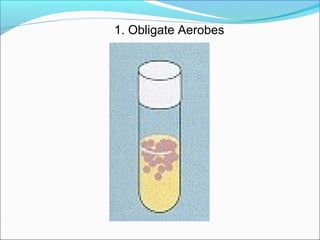
1. Obligate Aerobes
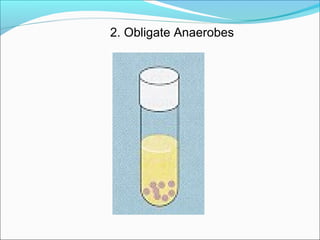
2. Obligate Anaerobes
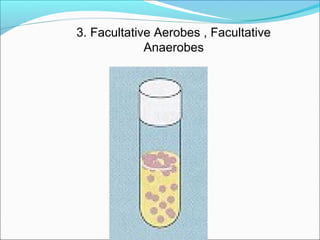
3. Facultative Aerobes , Facultative 
Anaerobes
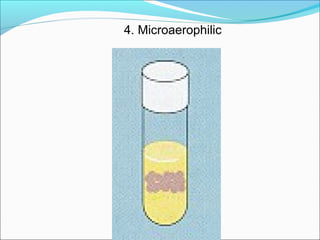
4. Microaerophilic
Culture Media 
11
Culture Media 
A. compositions 
1. Chemically defined 
The exact chemical composition is known 
Used to grow fastidious organisms 
2. Complex media 
Exact chemical composition is not known 
Most bacteria and fungi are grown with this
Culture Media 
B. consistency 
1. Broth 
Media provided in liquid phase 
used to measure motility, aeration and counting of 
bacteria 
2. solid Media 
Media with solidifying agents like agar 
Used for recovery of bacterial colonies
Agar : 
Solid medium is made by adding Agar 
 Agar is obtained from Sea weeds 
Agar contains long chain polysaccharides. 
Inorganic salts and protein like substances 
It melts at 980c and sets at 420c 
It is not degraded or metabolized by bacteria
Liquid media can be converted to solid media by 
adding 1-2% of agar 
If you add 0.6% agar, the media is called semisolid
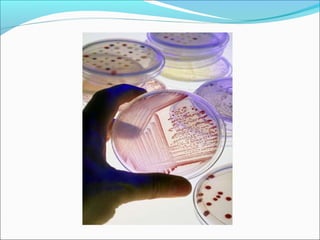
Petri Dish With Media : 
Petri dish with Media Plate: provide large surface for 
isolation and observation of colonies 
 Using a sterile loop or a sterile swab streak your 
sample on the petri plate 
Important let your sterilized loop cool before you pick 
up your sample
Culture media 
C. Purpose and use 
1. General purpose media 
Media provided in liquid phase or agar to provide the 
minimal and basic growth requirements 
Not all microbes can grow on such media 
It is a complex, general purpose medium 
Examples: 
• Nutrient agar, 
• Trypticase soy broth ((TSB, or tryptone soya agar (TSA)): 
is frequently the base media of other agar plate type, i.e. blood agar plates (BAP) are made 
by enriching TSA plates with blood 
• Mueller Hinton agar: commonly used for antibiotic susceptibility testing, it 
contains starch (Starch is known to absorb toxins released from bacteria, to prevent 
interfere with the antibiotics. Second, it is a loose agar. This allows for better diffusion of 
the antibiotics. BETTER DIFFUSION = TRUER ZONE OF INHIBITION.
2. Enriched media 
Is a medium with specific and known qualities that favors the 
growth of a particular microorganism. Media provided with 
additional growth requirements to enable the growth of 
fastidious microorganisms(by adding blood, serum or egg). 
Best obtained by additions of 5% sheep or horse blood 
 Examples: 
• Blood agar 
•Selenite broth is used to selectively isolate Salmonella species. 
• Alkaline peptone water is used for the cultivation of vibrio.
3. Selective Media 
Inhibits the growth of some bacteria while selecting 
for the growth of others 
Example: 
 Brilliant Green Agar, MacConky or CLED (Cystine Lactose 
Electrolyte Deficient Media)) 
 Dyes Inhibit The Growth Of Gram (+) Bacteria 
 Selects For Gram (-) Bacteria 
Most G.I. Tract infections are caused by Gram (-) bacteria
Selective Media 
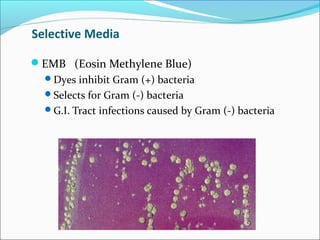
EMB (Eosin Methylene Blue) 
Dyes inhibit Gram (+) bacteria 
Selects for Gram (-) bacteria 
G.I. Tract infections caused by Gram (-) bacteria
Selective Media 
MacConky agar 
Dyes inhibit Gram (+) bacteria 
Delects for Gram (-) bacteria by bile salts 
G.I. Tract infections caused by Gram (-) bacteria
4. differential media 
Differentiates between different organisms 
growing on the same plate 
Example: 
Blood Agar Plates (TSA with 5% sheep blood) 
 Used to differentiate different types of Streptococci 
MacConky agar 
 Used to differentiate between lactose and non lactose 
fermenting bacteria
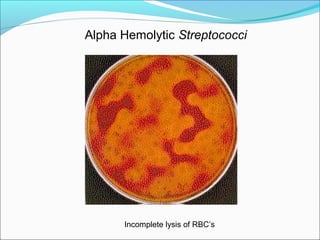
Alpha Hemolytic Streptococci 
Incomplete lysis of RBC’s
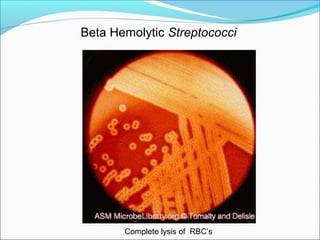
Beta Hemolytic Streptococci 
Complete lysis of RBC’s
Selective and Differential 
Media 
Mannitol Salt Agar 
Used to identify Staphylococcus aureus 
Mannitol Salt Agar 
High salt conc. (7.5%) inhibits most bacteria 
Sugar Mannitol 
pH Indicator (Turns Yellow when acid)
Selective and Differential 
Media 
MacConkey’s Agar 
Used to identify G-ve 
MacConkey’s Agar 
Bile salts and crystal violet (inhibits Gram (+) 
bacteria) 
lactose 
pH Indicator 
Many Gram (-) enteric non-pathogenic bacteria can ferment 
lactose, Salmonella can not
Special Culture Techniques 
1. Anaerobic Bacteria 
a. Reducing Media 
b. Anaerobic Container 
c. Agar Stab: stab culture one in which the medium is 
inoculated by thrusting a needle deep into its 
substance. 
d. Agar Shake: shake culture a culture made by 
inoculating warm liquid agar culture medium in a tube 
and shaking to distribute contents evenly. Incubation of 
the resolidified culture allows the development of 
separated colonies; especially adaptable to obligate 
anaerobes.
Special Culture Techniques 
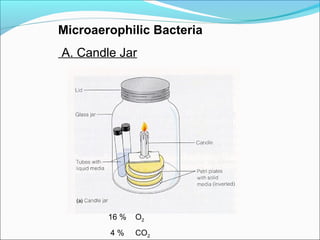
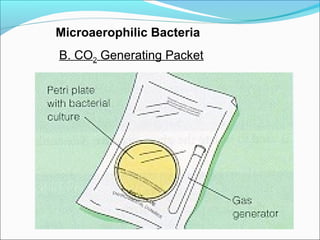
2. Microaerophilic Bacteria 
Grow best under reduced O2 levels and increased CO2 
levels 
Normal Atmosphere 21 % O2 
 3 to .03 % CO2
Microaerophilic Bacteria 
A. Candle Jar 
16 % O2 
4 % CO2
Microaerophilic Bacteria 
B. CO2 Generating Packet
33 
The End

media microbial culture

  • 1.
  • 2.
    Remember NO FOODOR DRINK ALLOWED IN THE LABORATORY NO MOUTH PIPETTING INDIVIDUALS NOT ALLOWED TO WORK IN THE LABORATORY ALONE WEAR REQUIRED PERSONAL PROTECTIVE EQUIPMENT NO SMOKING IN LABORATORY MAINTAIN GOOD HOUSEKEEPING HABITS
  • 3.
    Microbial culture Culturemedia Culture conditions Measurement of growth
  • 4.
    Media In orderto recover or isolate bacteria for study, you need to provide all of the growth demands and growth conditions. Combination of all of the ingredients that supports the growth of microorganisms is called media
  • 5.
    Types of media Different approaches for classifications of types of media used in microbiology are available.
  • 6.
  • 7.
  • 8.
  • 9.
    3. Facultative Aerobes, Facultative Anaerobes
  • 10.
  • 11.
  • 12.
    Culture Media A.compositions 1. Chemically defined The exact chemical composition is known Used to grow fastidious organisms 2. Complex media Exact chemical composition is not known Most bacteria and fungi are grown with this
  • 13.
    Culture Media B.consistency 1. Broth Media provided in liquid phase used to measure motility, aeration and counting of bacteria 2. solid Media Media with solidifying agents like agar Used for recovery of bacterial colonies
  • 14.
    Agar : Solidmedium is made by adding Agar  Agar is obtained from Sea weeds Agar contains long chain polysaccharides. Inorganic salts and protein like substances It melts at 980c and sets at 420c It is not degraded or metabolized by bacteria
  • 15.
    Liquid media canbe converted to solid media by adding 1-2% of agar If you add 0.6% agar, the media is called semisolid
  • 17.
    Petri Dish WithMedia : Petri dish with Media Plate: provide large surface for isolation and observation of colonies  Using a sterile loop or a sterile swab streak your sample on the petri plate Important let your sterilized loop cool before you pick up your sample
  • 19.
    Culture media C.Purpose and use 1. General purpose media Media provided in liquid phase or agar to provide the minimal and basic growth requirements Not all microbes can grow on such media It is a complex, general purpose medium Examples: • Nutrient agar, • Trypticase soy broth ((TSB, or tryptone soya agar (TSA)): is frequently the base media of other agar plate type, i.e. blood agar plates (BAP) are made by enriching TSA plates with blood • Mueller Hinton agar: commonly used for antibiotic susceptibility testing, it contains starch (Starch is known to absorb toxins released from bacteria, to prevent interfere with the antibiotics. Second, it is a loose agar. This allows for better diffusion of the antibiotics. BETTER DIFFUSION = TRUER ZONE OF INHIBITION.
  • 20.
    2. Enriched media Is a medium with specific and known qualities that favors the growth of a particular microorganism. Media provided with additional growth requirements to enable the growth of fastidious microorganisms(by adding blood, serum or egg). Best obtained by additions of 5% sheep or horse blood  Examples: • Blood agar •Selenite broth is used to selectively isolate Salmonella species. • Alkaline peptone water is used for the cultivation of vibrio.
  • 21.
    3. Selective Media Inhibits the growth of some bacteria while selecting for the growth of others Example:  Brilliant Green Agar, MacConky or CLED (Cystine Lactose Electrolyte Deficient Media))  Dyes Inhibit The Growth Of Gram (+) Bacteria  Selects For Gram (-) Bacteria Most G.I. Tract infections are caused by Gram (-) bacteria
  • 22.
    Selective Media EMB(Eosin Methylene Blue) Dyes inhibit Gram (+) bacteria Selects for Gram (-) bacteria G.I. Tract infections caused by Gram (-) bacteria
  • 23.
    Selective Media MacConkyagar Dyes inhibit Gram (+) bacteria Delects for Gram (-) bacteria by bile salts G.I. Tract infections caused by Gram (-) bacteria
  • 24.
    4. differential media Differentiates between different organisms growing on the same plate Example: Blood Agar Plates (TSA with 5% sheep blood)  Used to differentiate different types of Streptococci MacConky agar  Used to differentiate between lactose and non lactose fermenting bacteria
  • 25.
    Alpha Hemolytic Streptococci Incomplete lysis of RBC’s
  • 26.
    Beta Hemolytic Streptococci Complete lysis of RBC’s
  • 27.
    Selective and Differential Media Mannitol Salt Agar Used to identify Staphylococcus aureus Mannitol Salt Agar High salt conc. (7.5%) inhibits most bacteria Sugar Mannitol pH Indicator (Turns Yellow when acid)
  • 28.
    Selective and Differential Media MacConkey’s Agar Used to identify G-ve MacConkey’s Agar Bile salts and crystal violet (inhibits Gram (+) bacteria) lactose pH Indicator Many Gram (-) enteric non-pathogenic bacteria can ferment lactose, Salmonella can not
  • 29.
    Special Culture Techniques 1. Anaerobic Bacteria a. Reducing Media b. Anaerobic Container c. Agar Stab: stab culture one in which the medium is inoculated by thrusting a needle deep into its substance. d. Agar Shake: shake culture a culture made by inoculating warm liquid agar culture medium in a tube and shaking to distribute contents evenly. Incubation of the resolidified culture allows the development of separated colonies; especially adaptable to obligate anaerobes.
  • 30.
    Special Culture Techniques 2. Microaerophilic Bacteria Grow best under reduced O2 levels and increased CO2 levels Normal Atmosphere 21 % O2  3 to .03 % CO2
  • 31.
    Microaerophilic Bacteria A.Candle Jar 16 % O2 4 % CO2
  • 32.
    Microaerophilic Bacteria B.CO2 Generating Packet
  • 33.