AIR SAMPLING AND ANALYSIS METHODOLOGY

Background
Concerns were raised in early January 2003 with the possible high lead levels in air at
the Forrestdale Primary School. These results were published in July 2002 in a
consultant’s report to the Department of Environmental Protection (DEP) ‘Brookdale
Liquid Waste Treatment Facility: Air Quality Monitoring Program Results’. The
DEP immediately arranged for sampling in the Forrestdale area of air, groundwater,
soil, gutter sludge and dusts from various surfaces (swabs) and arranged for their
subsequent analysis. Consultants were contracted to undertake the groundwater, soil,
gutter sludge and swab sampling. The methodology used by the consultant is outlined
in their report.

Air Sampling
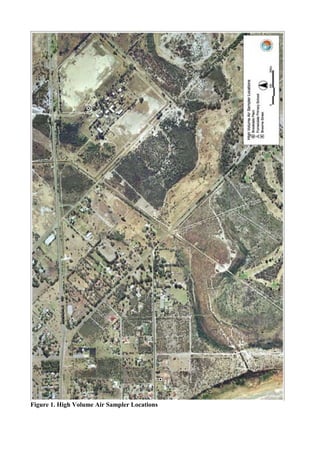
DEP staff is undertaking the air sampling. Three High Volume Air Samplers (HVAS)
are in use to collect particulate matter in the air for analysis. The locations of these
samplers are identified in Figure 1. The installation and operation of the air sampling
network at Brookdale are governed by two Australian Standards, AS 2724.3 -1984
Determination of Total suspended particulates (TSP) - High Volume Sampler
Gravimetric Method and AS 2922 - 1987 Ambient Air - Guide for the Siting of
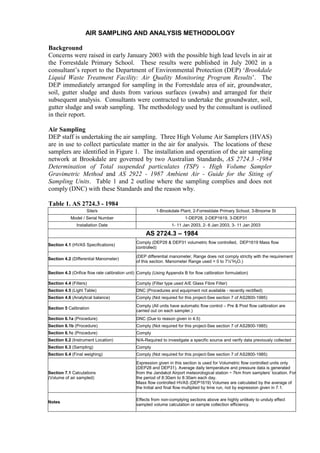
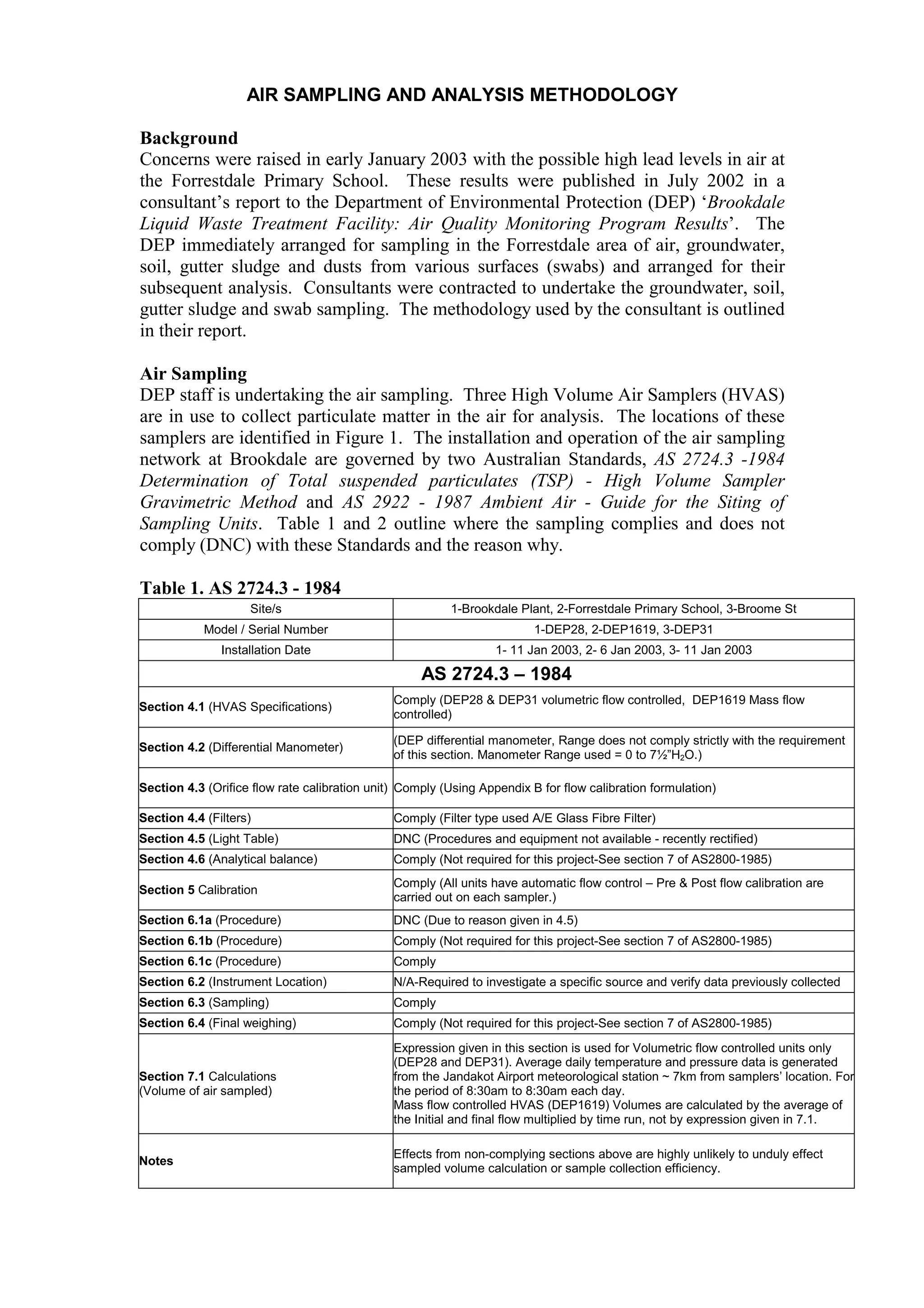
Sampling Units. Table 1 and 2 outline where the sampling complies and does not
comply (DNC) with these Standards and the reason why.

Table 1. AS 2724.3 - 1984
                    Site/s                               1-Brookdale Plant, 2-Forrestdale Primary School, 3-Broome St
            Model / Serial Number                                        1-DEP28, 2-DEP1619, 3-DEP31
               Installation Date                                  1- 11 Jan 2003, 2- 6 Jan 2003, 3- 11 Jan 2003

                                                    AS 2724.3 – 1984
                                               Comply (DEP28 & DEP31 volumetric flow controlled, DEP1619 Mass flow
Section 4.1 (HVAS Specifications)
                                               controlled)

                                               (DEP differential manometer, Range does not comply strictly with the requirement
Section 4.2 (Differential Manometer)
                                               of this section. Manometer Range used = 0 to 7½”H2O.)

Section 4.3 (Orifice flow rate calibration unit) Comply (Using Appendix B for flow calibration formulation)

Section 4.4 (Filters)                          Comply (Filter type used A/E Glass Fibre Filter)
Section 4.5 (Light Table)                      DNC (Procedures and equipment not available - recently rectified)
Section 4.6 (Analytical balance)               Comply (Not required for this project-See section 7 of AS2800-1985)
                                               Comply (All units have automatic flow control – Pre & Post flow calibration are
Section 5 Calibration
                                               carried out on each sampler.)
Section 6.1a (Procedure)                       DNC (Due to reason given in 4.5)
Section 6.1b (Procedure)                       Comply (Not required for this project-See section 7 of AS2800-1985)
Section 6.1c (Procedure)                       Comply
Section 6.2 (Instrument Location)              N/A-Required to investigate a specific source and verify data previously collected
Section 6.3 (Sampling)                         Comply
Section 6.4 (Final weighing)                   Comply (Not required for this project-See section 7 of AS2800-1985)
                                               Expression given in this section is used for Volumetric flow controlled units only
                                               (DEP28 and DEP31). Average daily temperature and pressure data is generated
Section 7.1 Calculations                       from the Jandakot Airport meteorological station ~ 7km from samplers’ location. For
(Volume of air sampled)                        the period of 8:30am to 8:30am each day.
                                               Mass flow controlled HVAS (DEP1619) Volumes are calculated by the average of
                                               the Initial and final flow multiplied by time run, not by expression given in 7.1.

                                               Effects from non-complying sections above are highly unlikely to unduly effect
Notes
                                               sampled volume calculation or sample collection efficiency.
Table 2. AS 2922 - 1987
                    Site/s                            1-Brookdale Plant, 2-Forrestdale Primary School, 3-Broome St
            Model / Serial Number                                    1-DEP28, 2-DEP1619, 3-DEP31
               Installation Date                              1- 11 Jan 2003, 2- 6 Jan 2003, 3- 11 Jan 2003

                                                  AS 2922 - 1987
The following recommendation are made under Table 2

Pollutant                                                                           Lead
Type of Monitoring station                                                   Neighbourhood/Peak
Height above ground (m)                                                       1 to 1.5 (Comply)
                                                   Other locating criteria
1) Clear sky angle of 120°above sampling
                                                                      1-Comply, 2-Comply, 3-Comply
Inlet

2) Unrestricted airflow of 270°around
                                           1-Comply, 2-Comply, 3-DNC(Fence restricting air flow from the West of sampler)
sampling inlet

                                           1-DNC(Trees within 20m to North / NW of sampler), 2-Comply, 3-DNC (A tree is
3) 20m from trees
                                           located to WNW of sampler ~10m away)

                                           Not applicable - required to investigate a specific source. (An incinerator is located
4) No Boiler or incinerator flues nearby   at Forrestdale primary school. The school principle indicated that it has not been
                                           used for many years)


                                           1-Comply, 2-Comply, 3-DNC (Unsealed driveway passing North/South in-front of
5) 50m from roads                          sampler. Unsealed storage/loading area for metals to the SE of sampler, small
                                           business + Workshop to South, Local traffic road ~35m from sampler to North)


                                           This is a special project where the DEP is seeking to validate results generated by
                                           a third party. Therefore adhering strictly to the siting recommendations in this
                                           standard (used as a guide) is secondary to replicating the sites used by the
                                           contractor. This is true for Sites 1 & 2. Site 3 was chosen to monitor lead levels
                    Notes
                                           down wind of the school due to the exceptional high results obtain at the school by
                                           the contractor. While immediate surroundings and local activity are influencing
                                           current results the purpose of this site is to investigate other possible sources in the
                                           immediate area.


Analysis of the High Volume Air Sampler Filter Papers
The Chemistry Centre (WA) analysed the samples collected by the DEP. The
Chemistry Centre (WA) advised that the filters for the High Volume Air Samplers
were analysed for lead according to the Australian Standard AS 2800 –1985 Ambient
Air - Determination of Particulate Lead - High Volume Sampler Gravimetric
Collection - Flame Atomic Absorption Spectrometric Method. More sensitive
analytical instrumentation was also used to confirm the lead results. These multi-
element techniques (Inductively Coupled Plasma Atomic Emission Spectrometry and
Inductively Coupled Plasma Mass Spectrometry) simultaneously measure a range of
elements. As a consequence heavy metal results were also provided for evaluation.
The analytical data includes arsenic (As), cadmium (Cd), chromium (Cr), copper
(Cu), nickel (Ni) and zinc (Zn). The analytical methods for these elements are
validated procedures. However, because there is limited data and it acknowledged
that particulate matter collected on the filters would not include vapours, these results
are only indicative values.

The lead reporting limit, which is ten time the standard deviation of the blanks is
0.05ug.m-3 at STP.

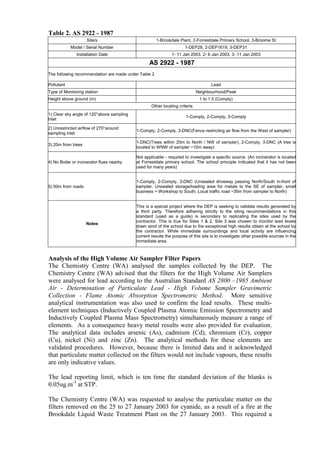
The Chemistry Centre (WA) was requested to analyse the particulate matter on the
filters removed on the 25 to 27 January 2003 for cyanide, as a result of a fire at the
Brookdale Liquid Waste Treatment Plant on the 27 January 2003. This required a
separate analysis using a validated procedure. However, as only particulate matter is
collected on the filter, only cyanide in a particulate form would report in the analysis.
A quarter of the filter paper was extracted for cyanide according to NIOSH method
7904 “CYANIDES, aerosols and gases”. The resulting extract was analysed for
cyanide by Skalar segmented flow autoanalyser.
Figure 1. High Volume Air Sampler Locations

AIR SAMPLING ANALYSIS AND METHODOLOGY

  • 1.
    AIR SAMPLING ANDANALYSIS METHODOLOGY Background Concerns were raised in early January 2003 with the possible high lead levels in air at the Forrestdale Primary School. These results were published in July 2002 in a consultant’s report to the Department of Environmental Protection (DEP) ‘Brookdale Liquid Waste Treatment Facility: Air Quality Monitoring Program Results’. The DEP immediately arranged for sampling in the Forrestdale area of air, groundwater, soil, gutter sludge and dusts from various surfaces (swabs) and arranged for their subsequent analysis. Consultants were contracted to undertake the groundwater, soil, gutter sludge and swab sampling. The methodology used by the consultant is outlined in their report. Air Sampling DEP staff is undertaking the air sampling. Three High Volume Air Samplers (HVAS) are in use to collect particulate matter in the air for analysis. The locations of these samplers are identified in Figure 1. The installation and operation of the air sampling network at Brookdale are governed by two Australian Standards, AS 2724.3 -1984 Determination of Total suspended particulates (TSP) - High Volume Sampler Gravimetric Method and AS 2922 - 1987 Ambient Air - Guide for the Siting of Sampling Units. Table 1 and 2 outline where the sampling complies and does not comply (DNC) with these Standards and the reason why. Table 1. AS 2724.3 - 1984 Site/s 1-Brookdale Plant, 2-Forrestdale Primary School, 3-Broome St Model / Serial Number 1-DEP28, 2-DEP1619, 3-DEP31 Installation Date 1- 11 Jan 2003, 2- 6 Jan 2003, 3- 11 Jan 2003 AS 2724.3 – 1984 Comply (DEP28 & DEP31 volumetric flow controlled, DEP1619 Mass flow Section 4.1 (HVAS Specifications) controlled) (DEP differential manometer, Range does not comply strictly with the requirement Section 4.2 (Differential Manometer) of this section. Manometer Range used = 0 to 7½”H2O.) Section 4.3 (Orifice flow rate calibration unit) Comply (Using Appendix B for flow calibration formulation) Section 4.4 (Filters) Comply (Filter type used A/E Glass Fibre Filter) Section 4.5 (Light Table) DNC (Procedures and equipment not available - recently rectified) Section 4.6 (Analytical balance) Comply (Not required for this project-See section 7 of AS2800-1985) Comply (All units have automatic flow control – Pre & Post flow calibration are Section 5 Calibration carried out on each sampler.) Section 6.1a (Procedure) DNC (Due to reason given in 4.5) Section 6.1b (Procedure) Comply (Not required for this project-See section 7 of AS2800-1985) Section 6.1c (Procedure) Comply Section 6.2 (Instrument Location) N/A-Required to investigate a specific source and verify data previously collected Section 6.3 (Sampling) Comply Section 6.4 (Final weighing) Comply (Not required for this project-See section 7 of AS2800-1985) Expression given in this section is used for Volumetric flow controlled units only (DEP28 and DEP31). Average daily temperature and pressure data is generated Section 7.1 Calculations from the Jandakot Airport meteorological station ~ 7km from samplers’ location. For (Volume of air sampled) the period of 8:30am to 8:30am each day. Mass flow controlled HVAS (DEP1619) Volumes are calculated by the average of the Initial and final flow multiplied by time run, not by expression given in 7.1. Effects from non-complying sections above are highly unlikely to unduly effect Notes sampled volume calculation or sample collection efficiency.
  • 2.
    Table 2. AS2922 - 1987 Site/s 1-Brookdale Plant, 2-Forrestdale Primary School, 3-Broome St Model / Serial Number 1-DEP28, 2-DEP1619, 3-DEP31 Installation Date 1- 11 Jan 2003, 2- 6 Jan 2003, 3- 11 Jan 2003 AS 2922 - 1987 The following recommendation are made under Table 2 Pollutant Lead Type of Monitoring station Neighbourhood/Peak Height above ground (m) 1 to 1.5 (Comply) Other locating criteria 1) Clear sky angle of 120°above sampling 1-Comply, 2-Comply, 3-Comply Inlet 2) Unrestricted airflow of 270°around 1-Comply, 2-Comply, 3-DNC(Fence restricting air flow from the West of sampler) sampling inlet 1-DNC(Trees within 20m to North / NW of sampler), 2-Comply, 3-DNC (A tree is 3) 20m from trees located to WNW of sampler ~10m away) Not applicable - required to investigate a specific source. (An incinerator is located 4) No Boiler or incinerator flues nearby at Forrestdale primary school. The school principle indicated that it has not been used for many years) 1-Comply, 2-Comply, 3-DNC (Unsealed driveway passing North/South in-front of 5) 50m from roads sampler. Unsealed storage/loading area for metals to the SE of sampler, small business + Workshop to South, Local traffic road ~35m from sampler to North) This is a special project where the DEP is seeking to validate results generated by a third party. Therefore adhering strictly to the siting recommendations in this standard (used as a guide) is secondary to replicating the sites used by the contractor. This is true for Sites 1 & 2. Site 3 was chosen to monitor lead levels Notes down wind of the school due to the exceptional high results obtain at the school by the contractor. While immediate surroundings and local activity are influencing current results the purpose of this site is to investigate other possible sources in the immediate area. Analysis of the High Volume Air Sampler Filter Papers The Chemistry Centre (WA) analysed the samples collected by the DEP. The Chemistry Centre (WA) advised that the filters for the High Volume Air Samplers were analysed for lead according to the Australian Standard AS 2800 –1985 Ambient Air - Determination of Particulate Lead - High Volume Sampler Gravimetric Collection - Flame Atomic Absorption Spectrometric Method. More sensitive analytical instrumentation was also used to confirm the lead results. These multi- element techniques (Inductively Coupled Plasma Atomic Emission Spectrometry and Inductively Coupled Plasma Mass Spectrometry) simultaneously measure a range of elements. As a consequence heavy metal results were also provided for evaluation. The analytical data includes arsenic (As), cadmium (Cd), chromium (Cr), copper (Cu), nickel (Ni) and zinc (Zn). The analytical methods for these elements are validated procedures. However, because there is limited data and it acknowledged that particulate matter collected on the filters would not include vapours, these results are only indicative values. The lead reporting limit, which is ten time the standard deviation of the blanks is 0.05ug.m-3 at STP. The Chemistry Centre (WA) was requested to analyse the particulate matter on the filters removed on the 25 to 27 January 2003 for cyanide, as a result of a fire at the Brookdale Liquid Waste Treatment Plant on the 27 January 2003. This required a
  • 3.
    separate analysis usinga validated procedure. However, as only particulate matter is collected on the filter, only cyanide in a particulate form would report in the analysis. A quarter of the filter paper was extracted for cyanide according to NIOSH method 7904 “CYANIDES, aerosols and gases”. The resulting extract was analysed for cyanide by Skalar segmented flow autoanalyser.
  • 4.
    Figure 1. HighVolume Air Sampler Locations