R3 Talk 
Benjamin P. Geisler, MD MPH 
11/10/2014 
* 
* I borrowed this term from Dr. Ben Goldacre’s 2004 BMJ 2014 opinion piece
A long time ago in a galaxy far, 
far away....
Vignette 1 
• 66yo non-diabetic M w/ HTN (BP 125/75 on 
amlodipine) and w/o known ASCVD visits you 
in the primary care clinic for a well visit. He is 
a never smoker and has no acute complaints. 
• Lipids: TC 140; HDL 45; TG 100; LDL 79 (calc) 
• You calculate his 10y ASCVD risk as 12.8% 
• Should he be on a statin?
A Tale Of Two Types of Endpoints 
• The term “surrogate marker” dates from the late 
1980s, but it had been preceded by the term 
“biomarker” and was succeeded and replaced by 
yet another term, “surrogate endpoint”. 
• A surrogate endpoint has been defined as “a 
biomarker intended to substitute for a clinical 
endpoint” 
• A clinical [hard] endpoint is “a characteristic or 
variable that reflects how a patient feels, 
functions, or survives” 
Brotman&Prince Vox Sang 1988; Paone et al. J Surg Oncol 1980; Boone&Kelloff J Cell Biochem Suppl 1993; NIH Definitions 
Working Group. Biomarkers and Surrogate Endpoints. 2000. Cited after Aronson Br J Pharmacol 2005
Lipoproteins (i) 
Genest & Libby. In: Bonow et al. Braunwald’s Heart Disease. Cited After Ridker Lancet 2014
Lipoproteins (i) 
non-HDL 
Genest & Libby. In: Bonow et al. Braunwald’s Heart Disease. Cited After Ridker Lancet 2014
Lipoproteins (ii) 
Mora et al. Circ 2009. Cited After Ridker Lancet 2014
ATP III Lipid Goals 
Detection, Evaluation, and Treatment of High Blood Cholesterol in Adults (Adult Treatment Panel III) Executive Summary 2001
ATP III Algorithms 
Detection, Evaluation, and Treatment of High Blood Cholesterol in Adults (Adult Treatment Panel III) Executive Summary 2001
Vignette 1 
• 66yo non-diabetic M w/ HTN (BP 125/75 on 
amlodipine) and w/o known ASCVD visits you 
in the primary care clinic for a well visit. He is 
a never smoker and has no acute complaints. 
• Lipids: TC 140; HDL 45; TG 100; LDL 79 (calc) 
• You calculate his 10y ASCVD risk as 12.8% 
• Should he be on a statin?
Prevention of MACEs 
• Paradigm shifted from treating the one “risk factor” 
(among others) HLD to preventing Major Adverse 
Cardiovascular Events (MACEs as hard endpoints): 
– All-cause Mortality 
– CV mortality 
– MI (non-fatal, fatal, or both) 
– Revascularization (CABG, PCI, lysis, all – physician-driven) 
– Stroke (ischemic or total; non-fatal, fatal, or both) 
• Lowering cholesterol (LDL or non-HDL or HDL/TC ratio) 
vs outcomes that actually matter 
• Triglycerides and other endpoints (eg, pancreatitis) not 
addressed in some guidelines
Hayward, Hofer & Vijan Ann Int Med 2006
Hayward & Krumholz Circ Cardiovasc Qual Outcomes 2012
Stone Circ 2014
Proposed Statin Indications 
(and changes from ATP-III) 
• Secondary prevention (any prior 
atherosclerotic disease including stroke that is 
not believed to be embolic or hemorrhagic) 
• Diabetes (unchanged, previously termed CHD 
equivalent) 
• LDL≥190 (unchanged) 
• And … primary prevention (previously optional 
drug therapy for LDL 160-189)
Relative Risk Does Not Depend On 
ASCVD Status, T2DM, Sex, Age, or HTN 
Cholesterol Treatment Trialists’ Collaboration Lancet 2010
Relative Risk Does Not Depend On BP, 
BMI, HDL, Smoking Status, or EGFR 
Cholesterol Treatment Trialists’ Collaboration Lancet 2010
RR Depends on ASCVD Status and Risk 
Cholesterol Treatment Trialists’ Collaboration Lancet 2012
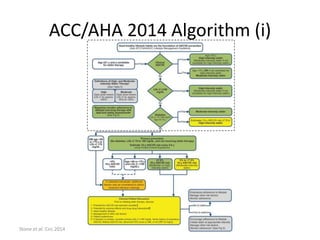
ACC/AHA 2014 Algorithm (i) 
Stone et al. Circ 2014
ACC/AHA 2014 Algorithm (i) 
Stone et al. Circ 2014
ACC/AHA 2014 Algorithm (ii) 
Stone et al. Circ 2014 
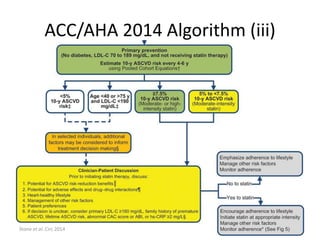
Primary Prevention
ACC/AHA 2014 Algorithm (iii) 
Stone et al. Circ 2014
Vignette 1 
• 66yo non-diabetic M w/ HTN (BP 125/75 on 
amlodipine) and w/o known ASCVD visits you 
in the primary care clinic for a well visit. He is 
a never smoker and has no acute complaints. 
• Lipids: TC 140; HDL 45; TG 100; LDL 79 (calc) 
• You calculate his 10y ASCVD risk as 12.8% 
• Should he be on a statin?
Vignette 1 
• 66yo non-diabetic M w/ HTN (BP 125/75 on 
amlodipine) and w/o known ASCVD visits you 
in the primary care clinic for a well visit. He is 
a never smoker and has no acute complaints. 
• Lipids: TC 140; HDL 45; TG 100; LDL 79 (calc) 
• You calculate his 10y ASCVD risk as 12.8% 
• Should he be on a statin? 
• What if his TC is 130 and his LDL is 69
Vignette 2 
• 60yo normotensive, non-diabetic, non-smoking 
F w/ HLD 
• Lipids: TC 257; HDL 50; TG 166; LDL 180 
• You calculate her 10y ASCVD risk as 4.9% 
• Should she be on a statin?
Statins for Primary Prevention 
• Age 40-75 
• LDL 70-190 
• 10y MACE Risk >7.5% (or even >5%) 
• And … patient preference 
• 33mio add’ pts w/ 10y MACE risk>7.5 
• 12mio add’ pts w/ 10y MACE risk 5-7.5%
Factors To Weigh in the Discussion 
• 10-year risk (stay tuned) 
• Lifetime risk (stay tuned) 
• What impact can life style changes have? 
• Other risk factors (…) 
– … and how well controlled they are 
• Risk vs benefit 
– DM 
– Myalgia 
– Transaminitis 
– Cognitive impairment 
– ICH 
– Cancer?
Where is the 7.5% from? (i) 
Benefit vs Risk 
14% ↓ mortality 
27% ↓ CHD (fatal and non fatal) events 
22% ↓ in stroke (fatal and non fatal) 
33% ↓ in nonfatal MI 
38% ↓ in revascularization 
18% ↑in diabetes (2.8% on statin vs. 2.4% controls) 
No significant increase in short-term risk of 
- Muscle adverse events 
- Liver adverse events 
- Cancer, memory loss 
- Hemorrhagic stroke 
Taylor et al. Cochrane 2013
Where is the 7.5% from? (ii) 
Benefit vs Risk for High-intensity Statins for PP 
HIGH INTENSITY STATIN TREATMENT 
Assumes a 45% relative risk reduction in ASCVD from high intensity statin treatment 
NNT to prevent 1 ASCVD event varies by baseline estimated 10-year ASCVD risk 
NNH based on 3 excess cases of incident diabetes* per 100 individuals treated with statins for 10 years. 
Stone Circ 2014 Suppl 
For T2DM
What Exactly is a “High-Intensity Statin”? 
High-Intensity Statin 
Moderate-Intensity 
Statin Low-Intensity Statin 
Daily dose lowers LDL-C on average, by 
approximately ≥50% 
Daily dose lowers 
LDL-C on average, by 
approximately 30% to <50% 
Daily dose lowers LDL-C on 
average, by <30% 
Atorvastatin (40†)-80 mg 
Rosuvasatin 20 (40) mg 
Atorvastatin 10 (20) mg 
Rosuvastatin (5) 10 mg 
Simvastatin 20-40 mg‡ 
Pravstatin 40 (80) mg 
Lovastatin 40 mg 
Fluvastatin XL 80 mg 
Fluvastatin 40 mg bid 
Pitavastatin 2-4 mg 
Simvastatin 10 mg 
Pravastatin 10-20 mg 
Lovastatin 20 mg 
Fluvastatin 20-40 mg 
Pitavastatin 1 mg 
*Individual responses to statin therapy varied in the RCTs and should be expected to vary in clinical practice. There might be a biologic basis for a 
less-than-average response. 
†Evidence from 1 RCT only: down-titration if unable to tolerate atorvastatin 80 mg in IDEAL (Pedersen et al). 
‡Although simvastatin 80 mg was evaluated in RCTs, initiation of simvastatin 80 mg or titration to 80 mg is not recommended by the FDA due to 
the increased risk of myopathy, including rhabdomyolysis. 
Stone Circ 2014 Suppl
What Exactly is a “High-Intensity Statin”? 
High-Intensity Statin 
Moderate-Intensity 
Statin Low-Intensity Statin 
Daily dose lowers LDL-C on average, by 
approximately ≥50% 
Daily dose lowers 
LDL-C on average, by 
approximately 30% to <50% 
Daily dose lowers LDL-C on 
average, by <30% 
Atorvastatin (40†)-80 mg 
Rosuvasatin 20 (40) mg 
Atorvastatin 10 (20) mg 
Rosuvastatin (5) 10 mg 
Simvastatin 20-40 mg‡ 
Pravstatin 40 (80) mg 
Lovastatin 40 mg 
Fluvastatin XL 80 mg 
Fluvastatin 40 mg bid 
Pitavastatin 2-4 mg 
Simvastatin 10 mg 
Pravastatin 10-20 mg 
Lovastatin 20 mg 
Fluvastatin 20-40 mg 
Pitavastatin 1 mg 
*Individual responses to statin therapy varied in the RCTs and should be expected to vary in clinical practice. There might be a biologic basis for a 
less-than-average response. 
†Evidence from 1 RCT only: down-titration if unable to tolerate atorvastatin 80 mg in IDEAL (Pedersen et al). 
‡Although simvastatin 80 mg was evaluated in RCTs, initiation of simvastatin 80 mg or titration to 80 mg is not recommended by the FDA due to 
the increased risk of myopathy, including rhabdomyolysis. 
Stone Circ 2014 Suppl
5% for Moderate-intensity Statins – 
Did You Know? 
MODERATE INTENSITY STATIN TREATMENT 
Assumes a 35% relative risk reduction in ASCVD from moderate intensity statin treatment 
NNT to prevent 1 ASCVD event varies by baseline estimated 10-year ASCVD risk. 
NNH based on 1 excess case of incident diabetes per 100 individuals* treated with statins for 10 years. 
Stone Circ 2014 Suppl 
For T2DM
MACE 10-year Risk (i) 
Google “ASCVD Risk Calculator”
MACE Risk (ii) 
Ridker & Cook Lancet 2014
MACE Risk (iii) 
Ridker & Cook Lancet 2014
MACE Lifetime Risk Calculation 
• Can be used in the 
shared decision making 
process 
• Only available for ages 
20-59
So does this mean we never have to 
measure lipids again? 
Follow-up lipid panel – see if anticipated response 
Reinforce continued adherence 
Follow-up 3-12 mo 
Anticipated 
therapeutic 
response? 
Follow-up 4-12 wk & 
thereafter as indicated 
Management of 
statin intolerance 
(Table 8, Rec 8) 
Less-than-anticipated 
therapeutic response 
Intolerance 
to recommended 
dose of statin 
Follow-up 4-12 wk 
Yes 
Yes 
No 
No 
Reinforce improved adherence 
Increase statin intensityǂ 
OR 
Consider addition of nonstatin drug therapy 
Reinforce medical adherence 
Reinforce adherence to intensive lifestyle changes 
Exclude secondary causes of hypercholesterolemia (Table 
6) 
therapy 
Treat 
Initial lipid panel 
to risk-stratify 
Stone Circ 2014 Suppl
Other Problems with the New 
Guidelines 
• Study selection 
– Important (older) RCTs seem to have been left out 
– No update of the systematic review(s) for the critical 
questions has been conducted since 2011; individual 
studies have only been added selectively 
– No observational studies, no post-hoc analyses, and expert 
opinion are consider as input for the deliberations 
– However, many recommendations extrapolate either from 
RCTs or from observational studies (that are discussed in 
much detail) 
• Just because there is no evidence does not mean that 
something is wrong (stay tuned) 
– No trial has used ASCVD risk as an entry criterion
Inclusion Criteria Age and Baseline LDL 
Of Studies Included In the Guidelines 
Age (y) 
80+ 
70–79 JUPITER 
Stone Circ 2014 Suppl 
AFCAPS 
60–69 
MEGA 
50–59 
40–49 
CARDS 
<40 
70–99 100–129 130–159 160–189 190–229 
LDL–C (mg/dL)
Inclusion Criteria Age and Baseline LDL 
Of PP Studies In the Guidelines 
Age (y) 
80+ 
70–79 JUPITER 
Stone Circ 2014 Suppl 
AFCAPS 
60–69 
MEGA 
50–59 
40–49 
CARDS (100% DM) 
<40 
70–99 100–129 130–159 160–189 190–229 
LDL–C (mg/dL)
Inclusion Criteria Age and Baseline LDL 
Of PP Studies In the Guidelines 
Age (y) 
80+ 
70–79 JUPITER 
Stone Circ 2014 Suppl 
AFCAPS 
60–69 
MEGA 
50–59 
40–49 
<40 
70–99 100–129 130–159 160–189 190–229 
LDL–C (mg/dL)
Baseline LDL Mediates MACE Risk 
– To Different Degrees 
Robinson & Stone Am J Card 2006
4S Posthoc: Logarithmic Relationship 
between LDL Reduction and MACE 
Pedersen et al. Circ 1998
Meta-regression Confirms Correlation 
1.2 1.4 1.6 1.8 
2 
1 
.1 .2 .3 .4 
Proportion of LDL reduction 
1.2 1.4 1.6 1.8 
2 
1 
0 20 40 60 80 
New analysis, based on Cholesterol Treatment Trialists’ Collaboration Lancet 2010 
LDL reduction
CARE (Prava40 for PP) Post-Hoc 
New analysis, based on Cholesterol Treatment Trialists’ Collaboration Lancet 2010
TNT Posthoc 
Q LDL Mean ± SD At 10 At 80 Total 
1 <64 54 ± 8 114 1,722 1,836 
2 64-76 70 ± 4 529 1,403 1,932 
3 77-89 83 ± 4 1,019 968 1,987 
4 90-105 97 ± 5 1,515 515 2,030 
5 ≥106 122 ± 16 1,718 266 1,984 
LaRosa et al. Am J Card 2007
UK NICE - QRISK
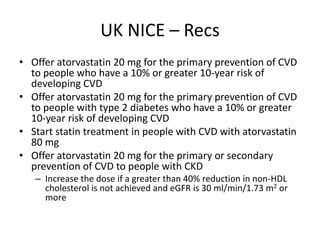
UK NICE – Recs 
• Offer atorvastatin 20 mg for the primary prevention of CVD 
to people who have a 10% or greater 10-year risk of 
developing CVD 
• Offer atorvastatin 20 mg for the primary prevention of CVD 
to people with type 2 diabetes who have a 10% or greater 
10-year risk of developing CVD 
• Start statin treatment in people with CVD with atorvastatin 
80 mg 
• Offer atorvastatin 20 mg for the primary or secondary 
prevention of CVD to people with CKD 
– Increase the dose if a greater than 40% reduction in non-HDL 
cholesterol is not achieved and eGFR is 30 ml/min/1.73 m2 or 
more
Misunderstandings 
• Isn’t a, say >50% risk reduction a goal in itself? 
– Substitute “goal” with “target level” – just semantics 
• Just because there is no evidence does not mean that 
something is wrong 
– That is why the ACC/AHA guidelines actually do not give a 
recommendation on target levels (N for no recommendation for 
or against) 
• The (unabridged) guidelines actually do not recommend 
automatic prescriptions but rather a discussion with the 
patient first 
• Confusion about dosing 
– Except for atorva-, rosuva-, and fluvastatin, all 10-20mg 
preparations are low-intensity and almost never indicated 
– For high-intensity statin, there is more evidence for atorvastatin 
80 – so unless there are reasons against, do not pre
Future Therapies 
• Ezetimibe: PROVE IT 
• PCSK9 Ab: ODYSSEE, Fourier, SPIRE 
• CEPT Inhibition (also raises HDL): REVAL-HPS3/ 
TIMI, ACCELERATE
Conclusions 
• Statins – via decreasing LDL +/- unknown mechanisms (that 
might differ between members of this class) – prevent or 
probably just delay MACEs. 
• Moving from surrogate to hard endpoints is interesting. 
However, it is unclear if abandoning LDL/non-HDL target levels 
is justified as they might be supported by post-hoc evidence. 
• The guidelines greatly simplify the process for PCPs and will 
help to improve patient care. 
• Although the change to including more primary prevention 
seems reasonable, as physicians we need to individualize our 
treatment recommendations and be mindful about the 
context and our patients’ preferences. Discussions will 
strengthen understanding and adherence.
Acknowledgements 
• Arnab Ghosh, MD MA 
• Arthur Schwartzbard, MD FACC 
• James Underberg, MD MS FACPM FACP FNLA

Statin Wars

  • 1.
    R3 Talk BenjaminP. Geisler, MD MPH 11/10/2014 * * I borrowed this term from Dr. Ben Goldacre’s 2004 BMJ 2014 opinion piece
  • 2.
    A long timeago in a galaxy far, far away....
  • 3.
    Vignette 1 •66yo non-diabetic M w/ HTN (BP 125/75 on amlodipine) and w/o known ASCVD visits you in the primary care clinic for a well visit. He is a never smoker and has no acute complaints. • Lipids: TC 140; HDL 45; TG 100; LDL 79 (calc) • You calculate his 10y ASCVD risk as 12.8% • Should he be on a statin?
  • 4.
    A Tale OfTwo Types of Endpoints • The term “surrogate marker” dates from the late 1980s, but it had been preceded by the term “biomarker” and was succeeded and replaced by yet another term, “surrogate endpoint”. • A surrogate endpoint has been defined as “a biomarker intended to substitute for a clinical endpoint” • A clinical [hard] endpoint is “a characteristic or variable that reflects how a patient feels, functions, or survives” Brotman&Prince Vox Sang 1988; Paone et al. J Surg Oncol 1980; Boone&Kelloff J Cell Biochem Suppl 1993; NIH Definitions Working Group. Biomarkers and Surrogate Endpoints. 2000. Cited after Aronson Br J Pharmacol 2005
  • 5.
    Lipoproteins (i) Genest& Libby. In: Bonow et al. Braunwald’s Heart Disease. Cited After Ridker Lancet 2014
  • 6.
    Lipoproteins (i) non-HDL Genest & Libby. In: Bonow et al. Braunwald’s Heart Disease. Cited After Ridker Lancet 2014
  • 7.
    Lipoproteins (ii) Moraet al. Circ 2009. Cited After Ridker Lancet 2014
  • 8.
    ATP III LipidGoals Detection, Evaluation, and Treatment of High Blood Cholesterol in Adults (Adult Treatment Panel III) Executive Summary 2001
  • 9.
    ATP III Algorithms Detection, Evaluation, and Treatment of High Blood Cholesterol in Adults (Adult Treatment Panel III) Executive Summary 2001
  • 10.
    Vignette 1 •66yo non-diabetic M w/ HTN (BP 125/75 on amlodipine) and w/o known ASCVD visits you in the primary care clinic for a well visit. He is a never smoker and has no acute complaints. • Lipids: TC 140; HDL 45; TG 100; LDL 79 (calc) • You calculate his 10y ASCVD risk as 12.8% • Should he be on a statin?
  • 12.
    Prevention of MACEs • Paradigm shifted from treating the one “risk factor” (among others) HLD to preventing Major Adverse Cardiovascular Events (MACEs as hard endpoints): – All-cause Mortality – CV mortality – MI (non-fatal, fatal, or both) – Revascularization (CABG, PCI, lysis, all – physician-driven) – Stroke (ischemic or total; non-fatal, fatal, or both) • Lowering cholesterol (LDL or non-HDL or HDL/TC ratio) vs outcomes that actually matter • Triglycerides and other endpoints (eg, pancreatitis) not addressed in some guidelines
  • 13.
    Hayward, Hofer &Vijan Ann Int Med 2006
  • 14.
    Hayward & KrumholzCirc Cardiovasc Qual Outcomes 2012
  • 15.
  • 16.
    Proposed Statin Indications (and changes from ATP-III) • Secondary prevention (any prior atherosclerotic disease including stroke that is not believed to be embolic or hemorrhagic) • Diabetes (unchanged, previously termed CHD equivalent) • LDL≥190 (unchanged) • And … primary prevention (previously optional drug therapy for LDL 160-189)
  • 17.
    Relative Risk DoesNot Depend On ASCVD Status, T2DM, Sex, Age, or HTN Cholesterol Treatment Trialists’ Collaboration Lancet 2010
  • 18.
    Relative Risk DoesNot Depend On BP, BMI, HDL, Smoking Status, or EGFR Cholesterol Treatment Trialists’ Collaboration Lancet 2010
  • 19.
    RR Depends onASCVD Status and Risk Cholesterol Treatment Trialists’ Collaboration Lancet 2012
  • 20.
    ACC/AHA 2014 Algorithm(i) Stone et al. Circ 2014
  • 21.
    ACC/AHA 2014 Algorithm(i) Stone et al. Circ 2014
  • 22.
    ACC/AHA 2014 Algorithm(ii) Stone et al. Circ 2014 Primary Prevention
  • 23.
    ACC/AHA 2014 Algorithm(iii) Stone et al. Circ 2014
  • 24.
    Vignette 1 •66yo non-diabetic M w/ HTN (BP 125/75 on amlodipine) and w/o known ASCVD visits you in the primary care clinic for a well visit. He is a never smoker and has no acute complaints. • Lipids: TC 140; HDL 45; TG 100; LDL 79 (calc) • You calculate his 10y ASCVD risk as 12.8% • Should he be on a statin?
  • 25.
    Vignette 1 •66yo non-diabetic M w/ HTN (BP 125/75 on amlodipine) and w/o known ASCVD visits you in the primary care clinic for a well visit. He is a never smoker and has no acute complaints. • Lipids: TC 140; HDL 45; TG 100; LDL 79 (calc) • You calculate his 10y ASCVD risk as 12.8% • Should he be on a statin? • What if his TC is 130 and his LDL is 69
  • 26.
    Vignette 2 •60yo normotensive, non-diabetic, non-smoking F w/ HLD • Lipids: TC 257; HDL 50; TG 166; LDL 180 • You calculate her 10y ASCVD risk as 4.9% • Should she be on a statin?
  • 27.
    Statins for PrimaryPrevention • Age 40-75 • LDL 70-190 • 10y MACE Risk >7.5% (or even >5%) • And … patient preference • 33mio add’ pts w/ 10y MACE risk>7.5 • 12mio add’ pts w/ 10y MACE risk 5-7.5%
  • 28.
    Factors To Weighin the Discussion • 10-year risk (stay tuned) • Lifetime risk (stay tuned) • What impact can life style changes have? • Other risk factors (…) – … and how well controlled they are • Risk vs benefit – DM – Myalgia – Transaminitis – Cognitive impairment – ICH – Cancer?
  • 29.
    Where is the7.5% from? (i) Benefit vs Risk 14% ↓ mortality 27% ↓ CHD (fatal and non fatal) events 22% ↓ in stroke (fatal and non fatal) 33% ↓ in nonfatal MI 38% ↓ in revascularization 18% ↑in diabetes (2.8% on statin vs. 2.4% controls) No significant increase in short-term risk of - Muscle adverse events - Liver adverse events - Cancer, memory loss - Hemorrhagic stroke Taylor et al. Cochrane 2013
  • 30.
    Where is the7.5% from? (ii) Benefit vs Risk for High-intensity Statins for PP HIGH INTENSITY STATIN TREATMENT Assumes a 45% relative risk reduction in ASCVD from high intensity statin treatment NNT to prevent 1 ASCVD event varies by baseline estimated 10-year ASCVD risk NNH based on 3 excess cases of incident diabetes* per 100 individuals treated with statins for 10 years. Stone Circ 2014 Suppl For T2DM
  • 31.
    What Exactly isa “High-Intensity Statin”? High-Intensity Statin Moderate-Intensity Statin Low-Intensity Statin Daily dose lowers LDL-C on average, by approximately ≥50% Daily dose lowers LDL-C on average, by approximately 30% to <50% Daily dose lowers LDL-C on average, by <30% Atorvastatin (40†)-80 mg Rosuvasatin 20 (40) mg Atorvastatin 10 (20) mg Rosuvastatin (5) 10 mg Simvastatin 20-40 mg‡ Pravstatin 40 (80) mg Lovastatin 40 mg Fluvastatin XL 80 mg Fluvastatin 40 mg bid Pitavastatin 2-4 mg Simvastatin 10 mg Pravastatin 10-20 mg Lovastatin 20 mg Fluvastatin 20-40 mg Pitavastatin 1 mg *Individual responses to statin therapy varied in the RCTs and should be expected to vary in clinical practice. There might be a biologic basis for a less-than-average response. †Evidence from 1 RCT only: down-titration if unable to tolerate atorvastatin 80 mg in IDEAL (Pedersen et al). ‡Although simvastatin 80 mg was evaluated in RCTs, initiation of simvastatin 80 mg or titration to 80 mg is not recommended by the FDA due to the increased risk of myopathy, including rhabdomyolysis. Stone Circ 2014 Suppl
  • 32.
    What Exactly isa “High-Intensity Statin”? High-Intensity Statin Moderate-Intensity Statin Low-Intensity Statin Daily dose lowers LDL-C on average, by approximately ≥50% Daily dose lowers LDL-C on average, by approximately 30% to <50% Daily dose lowers LDL-C on average, by <30% Atorvastatin (40†)-80 mg Rosuvasatin 20 (40) mg Atorvastatin 10 (20) mg Rosuvastatin (5) 10 mg Simvastatin 20-40 mg‡ Pravstatin 40 (80) mg Lovastatin 40 mg Fluvastatin XL 80 mg Fluvastatin 40 mg bid Pitavastatin 2-4 mg Simvastatin 10 mg Pravastatin 10-20 mg Lovastatin 20 mg Fluvastatin 20-40 mg Pitavastatin 1 mg *Individual responses to statin therapy varied in the RCTs and should be expected to vary in clinical practice. There might be a biologic basis for a less-than-average response. †Evidence from 1 RCT only: down-titration if unable to tolerate atorvastatin 80 mg in IDEAL (Pedersen et al). ‡Although simvastatin 80 mg was evaluated in RCTs, initiation of simvastatin 80 mg or titration to 80 mg is not recommended by the FDA due to the increased risk of myopathy, including rhabdomyolysis. Stone Circ 2014 Suppl
  • 33.
    5% for Moderate-intensityStatins – Did You Know? MODERATE INTENSITY STATIN TREATMENT Assumes a 35% relative risk reduction in ASCVD from moderate intensity statin treatment NNT to prevent 1 ASCVD event varies by baseline estimated 10-year ASCVD risk. NNH based on 1 excess case of incident diabetes per 100 individuals* treated with statins for 10 years. Stone Circ 2014 Suppl For T2DM
  • 34.
    MACE 10-year Risk(i) Google “ASCVD Risk Calculator”
  • 35.
    MACE Risk (ii) Ridker & Cook Lancet 2014
  • 36.
    MACE Risk (iii) Ridker & Cook Lancet 2014
  • 37.
    MACE Lifetime RiskCalculation • Can be used in the shared decision making process • Only available for ages 20-59
  • 38.
    So does thismean we never have to measure lipids again? Follow-up lipid panel – see if anticipated response Reinforce continued adherence Follow-up 3-12 mo Anticipated therapeutic response? Follow-up 4-12 wk & thereafter as indicated Management of statin intolerance (Table 8, Rec 8) Less-than-anticipated therapeutic response Intolerance to recommended dose of statin Follow-up 4-12 wk Yes Yes No No Reinforce improved adherence Increase statin intensityǂ OR Consider addition of nonstatin drug therapy Reinforce medical adherence Reinforce adherence to intensive lifestyle changes Exclude secondary causes of hypercholesterolemia (Table 6) therapy Treat Initial lipid panel to risk-stratify Stone Circ 2014 Suppl
  • 39.
    Other Problems withthe New Guidelines • Study selection – Important (older) RCTs seem to have been left out – No update of the systematic review(s) for the critical questions has been conducted since 2011; individual studies have only been added selectively – No observational studies, no post-hoc analyses, and expert opinion are consider as input for the deliberations – However, many recommendations extrapolate either from RCTs or from observational studies (that are discussed in much detail) • Just because there is no evidence does not mean that something is wrong (stay tuned) – No trial has used ASCVD risk as an entry criterion
  • 40.
    Inclusion Criteria Ageand Baseline LDL Of Studies Included In the Guidelines Age (y) 80+ 70–79 JUPITER Stone Circ 2014 Suppl AFCAPS 60–69 MEGA 50–59 40–49 CARDS <40 70–99 100–129 130–159 160–189 190–229 LDL–C (mg/dL)
  • 41.
    Inclusion Criteria Ageand Baseline LDL Of PP Studies In the Guidelines Age (y) 80+ 70–79 JUPITER Stone Circ 2014 Suppl AFCAPS 60–69 MEGA 50–59 40–49 CARDS (100% DM) <40 70–99 100–129 130–159 160–189 190–229 LDL–C (mg/dL)
  • 42.
    Inclusion Criteria Ageand Baseline LDL Of PP Studies In the Guidelines Age (y) 80+ 70–79 JUPITER Stone Circ 2014 Suppl AFCAPS 60–69 MEGA 50–59 40–49 <40 70–99 100–129 130–159 160–189 190–229 LDL–C (mg/dL)
  • 43.
    Baseline LDL MediatesMACE Risk – To Different Degrees Robinson & Stone Am J Card 2006
  • 44.
    4S Posthoc: LogarithmicRelationship between LDL Reduction and MACE Pedersen et al. Circ 1998
  • 45.
    Meta-regression Confirms Correlation 1.2 1.4 1.6 1.8 2 1 .1 .2 .3 .4 Proportion of LDL reduction 1.2 1.4 1.6 1.8 2 1 0 20 40 60 80 New analysis, based on Cholesterol Treatment Trialists’ Collaboration Lancet 2010 LDL reduction
  • 46.
    CARE (Prava40 forPP) Post-Hoc New analysis, based on Cholesterol Treatment Trialists’ Collaboration Lancet 2010
  • 47.
    TNT Posthoc QLDL Mean ± SD At 10 At 80 Total 1 <64 54 ± 8 114 1,722 1,836 2 64-76 70 ± 4 529 1,403 1,932 3 77-89 83 ± 4 1,019 968 1,987 4 90-105 97 ± 5 1,515 515 2,030 5 ≥106 122 ± 16 1,718 266 1,984 LaRosa et al. Am J Card 2007
  • 50.
    UK NICE -QRISK
  • 51.
    UK NICE –Recs • Offer atorvastatin 20 mg for the primary prevention of CVD to people who have a 10% or greater 10-year risk of developing CVD • Offer atorvastatin 20 mg for the primary prevention of CVD to people with type 2 diabetes who have a 10% or greater 10-year risk of developing CVD • Start statin treatment in people with CVD with atorvastatin 80 mg • Offer atorvastatin 20 mg for the primary or secondary prevention of CVD to people with CKD – Increase the dose if a greater than 40% reduction in non-HDL cholesterol is not achieved and eGFR is 30 ml/min/1.73 m2 or more
  • 52.
    Misunderstandings • Isn’ta, say >50% risk reduction a goal in itself? – Substitute “goal” with “target level” – just semantics • Just because there is no evidence does not mean that something is wrong – That is why the ACC/AHA guidelines actually do not give a recommendation on target levels (N for no recommendation for or against) • The (unabridged) guidelines actually do not recommend automatic prescriptions but rather a discussion with the patient first • Confusion about dosing – Except for atorva-, rosuva-, and fluvastatin, all 10-20mg preparations are low-intensity and almost never indicated – For high-intensity statin, there is more evidence for atorvastatin 80 – so unless there are reasons against, do not pre
  • 53.
    Future Therapies •Ezetimibe: PROVE IT • PCSK9 Ab: ODYSSEE, Fourier, SPIRE • CEPT Inhibition (also raises HDL): REVAL-HPS3/ TIMI, ACCELERATE
  • 54.
    Conclusions • Statins– via decreasing LDL +/- unknown mechanisms (that might differ between members of this class) – prevent or probably just delay MACEs. • Moving from surrogate to hard endpoints is interesting. However, it is unclear if abandoning LDL/non-HDL target levels is justified as they might be supported by post-hoc evidence. • The guidelines greatly simplify the process for PCPs and will help to improve patient care. • Although the change to including more primary prevention seems reasonable, as physicians we need to individualize our treatment recommendations and be mindful about the context and our patients’ preferences. Discussions will strengthen understanding and adherence.
  • 55.
    Acknowledgements • ArnabGhosh, MD MA • Arthur Schwartzbard, MD FACC • James Underberg, MD MS FACPM FACP FNLA