PREPARED BY: Ahmad Ikmal ‘Akif bin Abdul Khalil 4 UTM CHAPTER 2 Cell Structure and Cell Organisation 2.1 CELL STRUCTURE AND FUNCTION
2.1 CELL STRUCTURE AND FUNCTION Living organisms are made of basic units called  cells . Living component of a cell is called  protoplasm  which is consists of  cytoplasm  and  nucleus . The protoplasm is surrounded by a thin layer of  plasma membrane . Both animal and plant cells have these components.
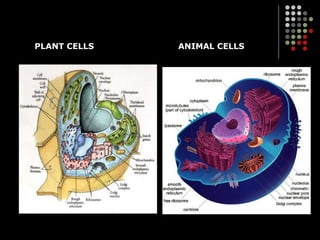
PLANT CELLS ANIMAL CELLS
CELL MEMBRANE CELL WALL The membrane at the surface which encloses the content of a cell-plasma membrane. It regulates the movement of substances into and out of the cytoplasm. Rigid outer layer that surrounds the plasma membrane of plant cells. Functions : gives shape to a plant cell provides mechanical support for plant cell Protects the plant cell from rupturing due to the excessive intake of water.
CYTOPLASM NUCLEUS The region between the nucleus and the plasma membrane. Contains organic and inorganic substances and acts as a medium for biochemical reactions in cell. Function : provides substances obtained from the external environment to the organelles. Appears as large,dense,spherical organelle enclosed by a nuclear membrane. Contains nucleoplasm and dark spherical structure called nucleolus. Function : controls all the activities which take place in the cell.
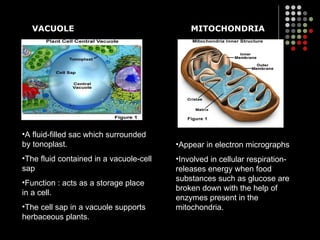
VACUOLE MITOCHONDRIA A fluid-filled sac which surrounded by tonoplast. The fluid contained in a vacuole-cell sap Function : acts as a storage place in a cell. The cell sap in a vacuole supports herbaceous plants. Appear in electron micrographs Involved in cellular respiration- releases energy when food substances such as glucose are broken down with the help of enzymes present in the mitochondria.
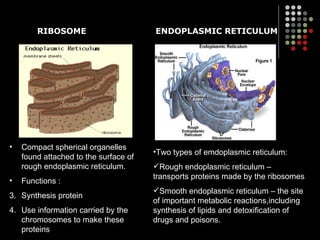
RIBOSOME ENDOPLASMIC RETICULUM Compact spherical organelles found attached to the surface of rough endoplasmic reticulum. Functions : Synthesis protein Use information carried by the chromosomes to make these proteins Two types of emdoplasmic reticulum: Rough endoplasmic reticulum –transports proteins made by the ribosomes Smooth endoplasmic reticulum – the site of important metabolic reactions,including synthesis of lipids and detoxification of drugs and poisons.
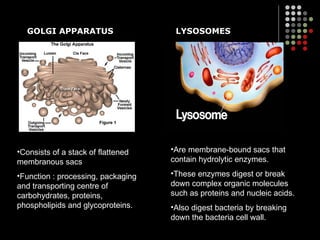
GOLGI APPARATUS LYSOSOMES Consists of a stack of flattened membranous sacs Function : processing, packaging and transporting centre of carbohydrates, proteins, phospholipids and glycoproteins. Are membrane-bound sacs that contain hydrolytic enzymes. These enzymes digest or break down complex organic molecules such as proteins and nucleic acids. Also digest bacteria by breaking down the bacteria cell wall.
CENTRIOLES CHLOROPLAST Are a pair of small cylindrical structures located just outside the nucleus. Are composed of a complex arrangement of microtubules. Typically lens-shaped Chloroplasts contain the green pigment which is called chlorophyll. Chlorophyll traps sunlight and converts light energy into chemical energy during photosynthesis.
COMPARISON BETWEEN THE STRUCTURE OF ANIMAL AND PLANT CELLS SIMILARITIES Present Present Ribosomes Present Present Cytoplasmic streaming Present Present Nucleus PLANT CELLS ANIMAL CELLS
DIFFERENCES Yes None Cell wall  Rectangular  Round  Shape  One, large central vacuole taking up 90% of cell volume.  One or more small vacuoles (much smaller than plant cells). Vacuole  Lysosomes usually not evident. Lysosomes occur in cytoplasm  Lysosomes  Only present in lower plant forms Always present  Centrioles  Yes; cell wall and a cell membrane  Yes; only cell membrane  Plasma Membrane  Plant cells have chloroplasts Animal cells don't have chloroplasts Chloroplast  PLANT CELLS ANIMAL CELLS
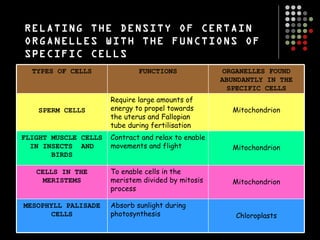
RELATING THE DENSITY OF CERTAIN ORGANELLES WITH THE FUNCTIONS OF SPECIFIC CELLS Mitochondrion To enable cells in the meristem divided by mitosis process CELLS IN THE MERISTEMS Chloroplasts Absorb sunlight during photosynthesis MESOPHYLL PALISADE CELLS Mitochondrion Contract and relax to enable movements and flight FLIGHT MUSCLE CELLS IN INSECTS  AND BIRDS Mitochondrion Require large amounts of energy to propel towards the uterus and Fallopian tube during fertilisation SPERM CELLS ORGANELLES FOUND ABUNDANTLY IN THE SPECIFIC CELLS FUNCTIONS TYPES OF CELLS
THANK YOU

2.1 cell structure and function

  • 1.
    PREPARED BY: AhmadIkmal ‘Akif bin Abdul Khalil 4 UTM CHAPTER 2 Cell Structure and Cell Organisation 2.1 CELL STRUCTURE AND FUNCTION
  • 2.
    2.1 CELL STRUCTUREAND FUNCTION Living organisms are made of basic units called cells . Living component of a cell is called protoplasm which is consists of cytoplasm and nucleus . The protoplasm is surrounded by a thin layer of plasma membrane . Both animal and plant cells have these components.
  • 3.
  • 4.
    CELL MEMBRANE CELLWALL The membrane at the surface which encloses the content of a cell-plasma membrane. It regulates the movement of substances into and out of the cytoplasm. Rigid outer layer that surrounds the plasma membrane of plant cells. Functions : gives shape to a plant cell provides mechanical support for plant cell Protects the plant cell from rupturing due to the excessive intake of water.
  • 5.
    CYTOPLASM NUCLEUS Theregion between the nucleus and the plasma membrane. Contains organic and inorganic substances and acts as a medium for biochemical reactions in cell. Function : provides substances obtained from the external environment to the organelles. Appears as large,dense,spherical organelle enclosed by a nuclear membrane. Contains nucleoplasm and dark spherical structure called nucleolus. Function : controls all the activities which take place in the cell.
  • 6.
    VACUOLE MITOCHONDRIA Afluid-filled sac which surrounded by tonoplast. The fluid contained in a vacuole-cell sap Function : acts as a storage place in a cell. The cell sap in a vacuole supports herbaceous plants. Appear in electron micrographs Involved in cellular respiration- releases energy when food substances such as glucose are broken down with the help of enzymes present in the mitochondria.
  • 7.
    RIBOSOME ENDOPLASMIC RETICULUMCompact spherical organelles found attached to the surface of rough endoplasmic reticulum. Functions : Synthesis protein Use information carried by the chromosomes to make these proteins Two types of emdoplasmic reticulum: Rough endoplasmic reticulum –transports proteins made by the ribosomes Smooth endoplasmic reticulum – the site of important metabolic reactions,including synthesis of lipids and detoxification of drugs and poisons.
  • 8.
    GOLGI APPARATUS LYSOSOMESConsists of a stack of flattened membranous sacs Function : processing, packaging and transporting centre of carbohydrates, proteins, phospholipids and glycoproteins. Are membrane-bound sacs that contain hydrolytic enzymes. These enzymes digest or break down complex organic molecules such as proteins and nucleic acids. Also digest bacteria by breaking down the bacteria cell wall.
  • 9.
    CENTRIOLES CHLOROPLAST Area pair of small cylindrical structures located just outside the nucleus. Are composed of a complex arrangement of microtubules. Typically lens-shaped Chloroplasts contain the green pigment which is called chlorophyll. Chlorophyll traps sunlight and converts light energy into chemical energy during photosynthesis.
  • 10.
    COMPARISON BETWEEN THESTRUCTURE OF ANIMAL AND PLANT CELLS SIMILARITIES Present Present Ribosomes Present Present Cytoplasmic streaming Present Present Nucleus PLANT CELLS ANIMAL CELLS
  • 11.
    DIFFERENCES Yes NoneCell wall Rectangular Round Shape One, large central vacuole taking up 90% of cell volume. One or more small vacuoles (much smaller than plant cells). Vacuole Lysosomes usually not evident. Lysosomes occur in cytoplasm Lysosomes Only present in lower plant forms Always present Centrioles Yes; cell wall and a cell membrane Yes; only cell membrane Plasma Membrane Plant cells have chloroplasts Animal cells don't have chloroplasts Chloroplast PLANT CELLS ANIMAL CELLS
  • 12.
    RELATING THE DENSITYOF CERTAIN ORGANELLES WITH THE FUNCTIONS OF SPECIFIC CELLS Mitochondrion To enable cells in the meristem divided by mitosis process CELLS IN THE MERISTEMS Chloroplasts Absorb sunlight during photosynthesis MESOPHYLL PALISADE CELLS Mitochondrion Contract and relax to enable movements and flight FLIGHT MUSCLE CELLS IN INSECTS AND BIRDS Mitochondrion Require large amounts of energy to propel towards the uterus and Fallopian tube during fertilisation SPERM CELLS ORGANELLES FOUND ABUNDANTLY IN THE SPECIFIC CELLS FUNCTIONS TYPES OF CELLS
  • 13.