The Nature of Experiential
Learning
Often dysfunctional, always incomplete
Need to use present experience to test our
beliefs, correcting the misinterpretations we’ve
made
We often manipulate experience to fit our beliefs
We usually see and hear selectively
Stop and Think
Can you recall a personally
significant learning experience?
In formal education or in the school of life?
What was it? What were the
circumstances surrounding the experience?
Why was it significant to you?
What Makes Learning Significant?
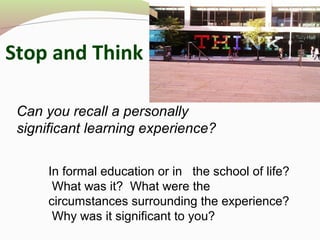
(experience attended to
and reflected on)
(experience not
attended to)
Learning Non-Learning
Experience
Non-Significant Significant
(can involve expansion but is
not subjectively valued)
• Subjectively valued
AND
• Has personal impact
involving expansion or
transformation
Informal and Incidental Learning
from Experience
Informal Learning: Can be planned or unplanned,
but usually conscious awareness that learning is
taking place
Incidental Learning: A by-product of some other
activity; usually unintentional, unexamined, and
embedded in closely held belief systems
Marsick and Watkins’ definitions, 1990, 1992
Informal Learning
Requires becoming aware of conscious learning
in a non-routine situation as people reflect on
experience
Incidental Learning
When incidental learning occurs, people often
act with little or no reflection, and the learning is
thus embedded in their action
To bring awareness of learning to surface
requires making tacit assumptions explicit;
Langer calls this concept “mindfulness”
What proportion of our learning
do you think is informal and
incidental as compared to
formal learning?
What are the implications of this
for the learners you teach?
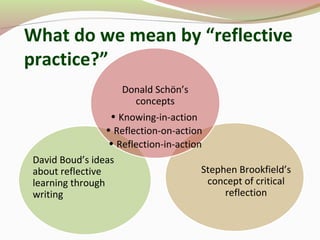
What do we mean by “reflective
practice?”
Stephen Brookfield’s
concept of critical
reflection
David Boud’s ideas
about reflective
learning through
writing
Donald Schön’s
concepts
• Knowing-in-action
• Reflection-on-action
• Reflection-in-action
What strategies do you use to
engage learners in reflective
practice?
Journal writing
End-of-course reflective essays
Blogs as reflective learning journals
Digital storytelling
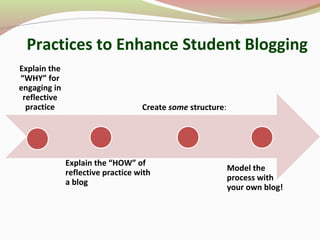
Practices to Enhance Student Blogging
Explain the
“WHY” for
engaging in
reflective
practice
Explain the “HOW” of
reflective practice with
a blog
Create some structure:
Model the
process with
your own blog!
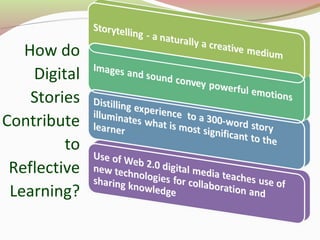
How do
Digital
Stories
Contribute
to
Reflective
Learning?
Steps in the Digital Storytelling
Process
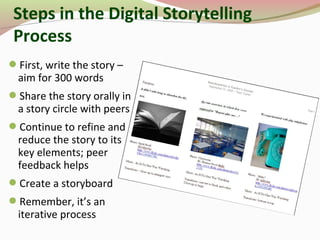
First, write the story –
aim for 300 words
Share the story orally in
a story circle with peers
Continue to refine and
reduce the story to its
key elements; peer
feedback helps
Create a storyboard
Remember, it’s an
iterative process
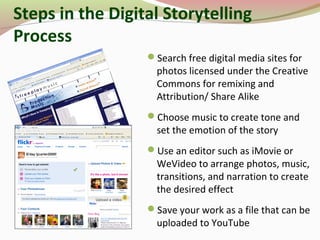
Search free digital media sites for
photos licensed under the Creative
Commons for remixing and
Attribution/ Share Alike
Choose music to create tone and
set the emotion of the story
Use an editor such as iMovie or
WeVideo to arrange photos, music,
transitions, and narration to create
the desired effect
Save your work as a file that can be
uploaded to YouTube
Steps in the Digital Storytelling
Process
What is the Creative Commons?
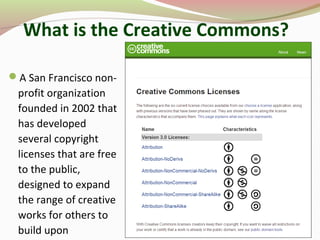
A San Francisco non-
profit organization
founded in 2002 that
has developed
several copyright
licenses that are free
to the public,
designed to expand
the range of creative
works for others to
build upon
In Conclusion, Reflective Practice …
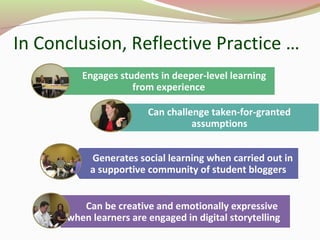
Engages students in deeper-level learning
from experience
Can challenge taken-for-granted
assumptions
Generates social learning when carried out in
a supportive community of student bloggers
Can be creative and emotionally expressive
when learners are engaged in digital storytelling
References for this presentation
Boud, D. (2001, Summer). Using journal writing to enhance reflective practice. New Directions for Adult
and Continuing Education, 90, 9-17.
Boud, D., Keogh, R., & Walker, D. (1985). (Eds.). Reflection: Turning experience into learning. New York:
Kogan Page.
Brookfield, S. D. (1987). Developing critical thinkers: Challenging adults to explore alternative ways of
thinking and acting. San Francisco: Jossey-Bass.
Brookfield, S. D. (1995). Becoming a critically reflective teacher. San Francisco: Jossey-Bass.
Brookfield, S. D. (1997, Fall). Accessing critical thinking. New Directions for Adult and Continuing
Education, 74, 17-29.
Carter, T. J. (2010, in press). Blogging as reflective practice in the graduate classroom. In K. King & T. Cox
(Eds.), Teaching with digital media: Best practices and innovations in higher education. Charlotte,
NC: Information Age Publications.
Hull, G. A., & Katz, M. (2006, August). Crafting an agentive self: Case studies of digital storytelling.
Research in the Teaching of English, 41(1), 43-81.
McLellan, H. (2008, October). Digital storytelling: Expanding media possibilities for learning.
Educational Technology, 18-21.
Robin, B. R. (2008). Digital storytelling: A powerful technology tool for the 21st
century classroom.
Theory into Practice, 47, 220-228. doi: 10.1080/00405840802153916
Schön, D. A. (1983). The reflective practitioner: How professionals think in action. New York: Basic Books.
Schön, D. A. (1987). Educating the reflective practitioner. San Francisco: Jossey-Bass.
Wilson, A. L. (2009, Fall). Reflecting on reflecting on practice. New Directions for Adult and Continuing
Education, 123, 75-85.

Class 5 experiential learning and reflective practice for july 7, 2015 class

  • 1.
    The Nature ofExperiential Learning Often dysfunctional, always incomplete Need to use present experience to test our beliefs, correcting the misinterpretations we’ve made We often manipulate experience to fit our beliefs We usually see and hear selectively
  • 2.
    Stop and Think Canyou recall a personally significant learning experience? In formal education or in the school of life? What was it? What were the circumstances surrounding the experience? Why was it significant to you?
  • 3.
    What Makes LearningSignificant? (experience attended to and reflected on) (experience not attended to) Learning Non-Learning Experience Non-Significant Significant (can involve expansion but is not subjectively valued) • Subjectively valued AND • Has personal impact involving expansion or transformation
  • 4.
    Informal and IncidentalLearning from Experience Informal Learning: Can be planned or unplanned, but usually conscious awareness that learning is taking place Incidental Learning: A by-product of some other activity; usually unintentional, unexamined, and embedded in closely held belief systems Marsick and Watkins’ definitions, 1990, 1992
  • 5.
    Informal Learning Requires becomingaware of conscious learning in a non-routine situation as people reflect on experience
  • 6.
    Incidental Learning When incidentallearning occurs, people often act with little or no reflection, and the learning is thus embedded in their action To bring awareness of learning to surface requires making tacit assumptions explicit; Langer calls this concept “mindfulness”
  • 7.
    What proportion ofour learning do you think is informal and incidental as compared to formal learning? What are the implications of this for the learners you teach?
  • 8.
    What do wemean by “reflective practice?” Stephen Brookfield’s concept of critical reflection David Boud’s ideas about reflective learning through writing Donald Schön’s concepts • Knowing-in-action • Reflection-on-action • Reflection-in-action
  • 9.
    What strategies doyou use to engage learners in reflective practice? Journal writing End-of-course reflective essays Blogs as reflective learning journals Digital storytelling
  • 10.
    Practices to EnhanceStudent Blogging Explain the “WHY” for engaging in reflective practice Explain the “HOW” of reflective practice with a blog Create some structure: Model the process with your own blog!
  • 11.
  • 12.
    Steps in theDigital Storytelling Process First, write the story – aim for 300 words Share the story orally in a story circle with peers Continue to refine and reduce the story to its key elements; peer feedback helps Create a storyboard Remember, it’s an iterative process
  • 13.
    Search free digitalmedia sites for photos licensed under the Creative Commons for remixing and Attribution/ Share Alike Choose music to create tone and set the emotion of the story Use an editor such as iMovie or WeVideo to arrange photos, music, transitions, and narration to create the desired effect Save your work as a file that can be uploaded to YouTube Steps in the Digital Storytelling Process
  • 14.
    What is theCreative Commons? A San Francisco non- profit organization founded in 2002 that has developed several copyright licenses that are free to the public, designed to expand the range of creative works for others to build upon
  • 15.
    In Conclusion, ReflectivePractice … Engages students in deeper-level learning from experience Can challenge taken-for-granted assumptions Generates social learning when carried out in a supportive community of student bloggers Can be creative and emotionally expressive when learners are engaged in digital storytelling
  • 16.
    References for thispresentation Boud, D. (2001, Summer). Using journal writing to enhance reflective practice. New Directions for Adult and Continuing Education, 90, 9-17. Boud, D., Keogh, R., & Walker, D. (1985). (Eds.). Reflection: Turning experience into learning. New York: Kogan Page. Brookfield, S. D. (1987). Developing critical thinkers: Challenging adults to explore alternative ways of thinking and acting. San Francisco: Jossey-Bass. Brookfield, S. D. (1995). Becoming a critically reflective teacher. San Francisco: Jossey-Bass. Brookfield, S. D. (1997, Fall). Accessing critical thinking. New Directions for Adult and Continuing Education, 74, 17-29. Carter, T. J. (2010, in press). Blogging as reflective practice in the graduate classroom. In K. King & T. Cox (Eds.), Teaching with digital media: Best practices and innovations in higher education. Charlotte, NC: Information Age Publications. Hull, G. A., & Katz, M. (2006, August). Crafting an agentive self: Case studies of digital storytelling. Research in the Teaching of English, 41(1), 43-81. McLellan, H. (2008, October). Digital storytelling: Expanding media possibilities for learning. Educational Technology, 18-21. Robin, B. R. (2008). Digital storytelling: A powerful technology tool for the 21st century classroom. Theory into Practice, 47, 220-228. doi: 10.1080/00405840802153916 Schön, D. A. (1983). The reflective practitioner: How professionals think in action. New York: Basic Books. Schön, D. A. (1987). Educating the reflective practitioner. San Francisco: Jossey-Bass. Wilson, A. L. (2009, Fall). Reflecting on reflecting on practice. New Directions for Adult and Continuing Education, 123, 75-85.