Consciousness, Cognition, Learning,
and Reflective Practice:
Roanoke Community Ecosystems
Consciousness, Cognition, Learning, and Reflective Practice:
Roanoke Community Ecosystems
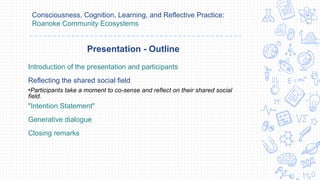
Introduction of the presentation and participants
Reflecting the shared social field
"Intention Statement"
Generative dialogue
Closing remarks
Presentation - Outline
Consciousness, Cognition, Learning,
and Reflective Practice:
Introduction of the presentation, presenter, and
respective participants
Paul van Schaik (at Linkedin)
Paul van Schaik
Introduction of participants . . .
SourceWatch lists Paul as one of the
founding members of the Integral Politics
branch for the Integral Institute.
•Paul is also cofounder with Gail Hochachka
of Integral Without Borders.
•the Founding Director of IntegralMENTORS.
•and currently an Independent Trustee (Chief
Knowledge Officer) of the
ThriveAbility Foundation.
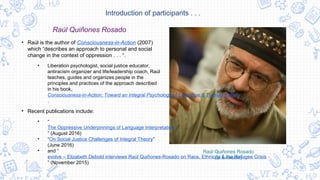
Raúl Quiñones Rosado
(at Linkedin)
Raúl Quiñones Rosado
Introduction of participants . . .
• Raúl is the author of Consciousness-in-Action (2007)
which “describes an approach to personal and social
change in the context of oppression . . . “.
• Liberation psychologist, social justice educator,
antiracism organizer and life/leadership coach, Raúl
teaches, guides and organizes people in the
principles and practices of the approach described
in his book,
Consciousness-in-Action: Toward an Integral Psychology of Liberation & Transformation
.
• Recent publications include:
• “
The Oppressive Underpinnings of Language Interpretation
” (August 2016)
• “On Social Justice Challenges of Integral Theory”
(June 2016)
• and “
evolve – Elizabeth Debold interviews Raúl Quiñones-Rosado on Race, Ethnicity & the Refugee Crisis
” (November 2015)
Consciousness, Cognition, Learning, and Reflective Practice:
Roanoke Community Ecosystems
Introduction of the presentation and participants
• Participants take a minute to “check-in” and are invited to share their
primary interest or reason for participating.
Reflecting the shared social field
"Intention Statement"
Generative dialogue
Closing remarks
Presentation - Outline
Consciousness, Cognition, Learning,
and Reflective Practice:
Reflecting the shared social field
Consciousness, Cognition, Learning, and Reflective Practice:
Roanoke Community Ecosystems
Introduction of the presentation and participants
Reflecting the shared social field
•Participants take a moment to co-sense and reflect on their shared social
field.
"Intention Statement"
Generative dialogue
Closing remarks
Presentation - Outline
Consciousness, Cognition, Learning,
and Reflective Practice:
"Intention Statement" by presenter
Consciousness, Cognition, Learning, and Reflective Practice:
Roanoke Community Ecosystems
Introduction of the presentation and participants
Reflecting the shared social field
"Intention Statement“
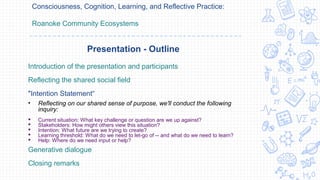
• Reflecting on our shared sense of purpose, we'll conduct the following
inquiry:
 Current situation: What key challenge or question are we up against?
 Stakeholders: How might others view this situation?
 Intention: What future are we trying to create?
 Learning threshold: What do we need to let-go of -- and what do we need to learn?
 Help: Where do we need input or help?
Generative dialogue
Closing remarks
Presentation - Outline
Consciousness, Cognition, Learning,
and Reflective Practice:
"Intention Statement" by presenter . . .
Current situation: What key challenge or question are we up against?
How do we initiate and shape community-based ecosystems
that will help generate social and economic equities?
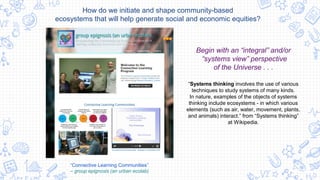
“Connective Learning Communities”
– group epignosis (an urban ecolab)
Begin with an “integral” and/or
“systems view” perspective
of the Universe . . .
How do we initiate and shape community-based
ecosystems that will help generate social and economic equities?
“Systems thinking involves the use of various
techniques to study systems of many kinds.
In nature, examples of the objects of systems
thinking include ecosystems - in which various
elements (such as air, water, movement, plants,
and animals) interact.” from “Systems thinking”
at Wikipedia.
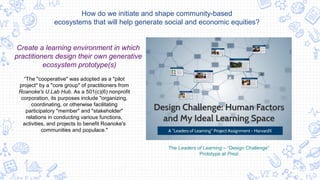
The Leaders of Learning – “Design Challenge”
Prototype at Prezi
Create a learning environment in which
practitioners design their own generative
ecosystem prototype(s)
How do we initiate and shape community-based
ecosystems that will help generate social and economic equities?
“The "cooperative" was adopted as a "pilot
project" by a "core group" of practitioners from
Roanoke's U.Lab Hub. As a 501(c)(6) nonprofit
corporation, its purposes include "organizing,
coordinating, or otherwise facilitating
participatory "member" and "stakeholder"
relations in conducting various functions,
activities, and projects to benefit Roanoke's
communities and populace."
Consciousness, Cognition,
Learning, and Reflective Practice:
"Intention Statement" by presenter . . .
Stakeholders: How might others view this situation?
How do we go about (in)forming the most robust learning
environment we possibly can?
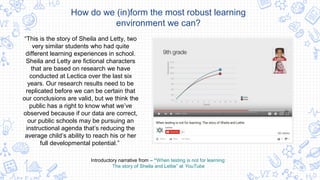
How do we (in)form the most robust learning
environment we can?
“This is the story of Sheila and Letty, two
very similar students who had quite
different learning experiences in school.
Sheila and Letty are fictional characters
that are based on research we have
conducted at Lectica over the last six
years. Our research results need to be
replicated before we can be certain that
our conclusions are valid, but we think the
public has a right to know what we’ve
observed because if our data are correct,
our public schools may be pursuing an
instructional agenda that’s reducing the
average child’s ability to reach his or her
full developmental potential.”
Introductory narrative from – “When testing is not for learning:
The story of Sheila and Lettie” at YouTube
Consciousness, Cognition,
Learning, and Reflective Practice:
"Intention Statement" by presenter . . .
Intention: What future are we trying to create?
How do we create a future in which community members (practitioners) are
empowered to better actualize their own health, happiness, and well-being.
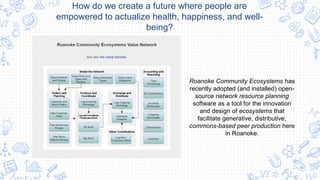
Roanoke Community Ecosystems has
recently adopted (and installed) open-
source network resource planning
software as a tool for the innovation
and design of ecosystems that
facilitate generative, distributive,
commons-based peer production here
in Roanoke.
How do we create a future where people are
empowered to actualize health, happiness, and well-
being?
Consciousness, Cognition,
Learning, and Reflective Practice:
"Intention Statement" by presenter . . .
Learning Threshold: What do we need to let-go of – and what do we
need to learn?
We’ll need to let-go of our “collective habits of thought” and “action” which
reinforce the “grip of the past” and learn to create ‘living networks’.
from – Energies 2010
. . . and we’ll also need to adopt
qualitative indicators!
Letting go of a ‘mechanistic’ approach, we’ll instead
learn to create ‘living networks’.
“These considerations imply that, to
properly assess the health of an
economy, we need qualitative indicators
of poverty, health, equity, education,
social inclusion, and the state of the
natural environment – none of which can
be reduced to money coefficients or
aggregated into a simple number”
[emphasis added] (Capra, p. 369).
from Chapter 17 – Connecting the dots of – The Systems
View of Life: A Unifying Vision
Consciousness, Cognition,
Learning, and Reflective Practice:
"Intention Statement" by presenter . . .
Help: Where do we need input or help?
We’ll need help and input in mobilizing community engagement.
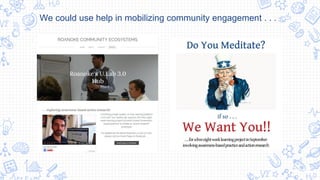
We could use help in mobilizing community engagement . . .
Consciousness, Cognition, Learning,
and Reflective Practice:
Generative dialogue
Consciousness, Cognition, Learning, and Reflective Practice:
Roanoke Community Ecosystems
Introduction of the presentation and participants
Reflecting the shared social field
"Intention Statement"
Generative dialogue
• All reflect on remarks by presenter and move into a generative dialogue on
how these observations can offer new perspectives on the group’s situation
and journey.
• Go with the flow of the dialogue. Build on each other’s ideas.
Closing remarks
Presentation - Outline
Consciousness, Cognition, Learning,
and Reflective Practice:
Closing remarks
Consciousness, Cognition, Learning, and Reflective Practice:
Roanoke Community Ecosystems
Introduction of the presentation and participants
Reflecting the shared social field
"Intention Statement"
Generative dialogue
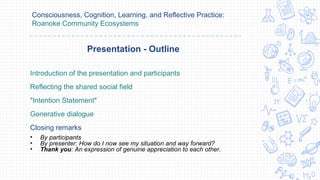
Closing remarks
• By participants
• By presenter: How do I now see my situation and way forward?
• Thank you: An expression of genuine appreciation to each other.
Presentation - Outline
Consciousness, Cognition, Learning,
and Reflective Practice:
Roanoke Community Ecosystems
SlidesCarnival icons are editable
shapes.
This means that you can:
● Resize them without losing quality.
● Change fill color and opacity.
Isn’t that nice? :)
Examples:

Overview Presentation - "Consciousness, Cognition, Learning, and Reflective Practice

  • 1.
    Consciousness, Cognition, Learning, andReflective Practice: Roanoke Community Ecosystems
  • 2.
    Consciousness, Cognition, Learning,and Reflective Practice: Roanoke Community Ecosystems Introduction of the presentation and participants Reflecting the shared social field "Intention Statement" Generative dialogue Closing remarks Presentation - Outline
  • 3.
    Consciousness, Cognition, Learning, andReflective Practice: Introduction of the presentation, presenter, and respective participants
  • 4.
    Paul van Schaik(at Linkedin) Paul van Schaik Introduction of participants . . . SourceWatch lists Paul as one of the founding members of the Integral Politics branch for the Integral Institute. •Paul is also cofounder with Gail Hochachka of Integral Without Borders. •the Founding Director of IntegralMENTORS. •and currently an Independent Trustee (Chief Knowledge Officer) of the ThriveAbility Foundation.
  • 5.
    Raúl Quiñones Rosado (atLinkedin) Raúl Quiñones Rosado Introduction of participants . . . • Raúl is the author of Consciousness-in-Action (2007) which “describes an approach to personal and social change in the context of oppression . . . “. • Liberation psychologist, social justice educator, antiracism organizer and life/leadership coach, Raúl teaches, guides and organizes people in the principles and practices of the approach described in his book, Consciousness-in-Action: Toward an Integral Psychology of Liberation & Transformation . • Recent publications include: • “ The Oppressive Underpinnings of Language Interpretation ” (August 2016) • “On Social Justice Challenges of Integral Theory” (June 2016) • and “ evolve – Elizabeth Debold interviews Raúl Quiñones-Rosado on Race, Ethnicity & the Refugee Crisis ” (November 2015)
  • 6.
    Consciousness, Cognition, Learning,and Reflective Practice: Roanoke Community Ecosystems Introduction of the presentation and participants • Participants take a minute to “check-in” and are invited to share their primary interest or reason for participating. Reflecting the shared social field "Intention Statement" Generative dialogue Closing remarks Presentation - Outline
  • 7.
    Consciousness, Cognition, Learning, andReflective Practice: Reflecting the shared social field
  • 8.
    Consciousness, Cognition, Learning,and Reflective Practice: Roanoke Community Ecosystems Introduction of the presentation and participants Reflecting the shared social field •Participants take a moment to co-sense and reflect on their shared social field. "Intention Statement" Generative dialogue Closing remarks Presentation - Outline
  • 9.
    Consciousness, Cognition, Learning, andReflective Practice: "Intention Statement" by presenter
  • 10.
    Consciousness, Cognition, Learning,and Reflective Practice: Roanoke Community Ecosystems Introduction of the presentation and participants Reflecting the shared social field "Intention Statement“ • Reflecting on our shared sense of purpose, we'll conduct the following inquiry:  Current situation: What key challenge or question are we up against?  Stakeholders: How might others view this situation?  Intention: What future are we trying to create?  Learning threshold: What do we need to let-go of -- and what do we need to learn?  Help: Where do we need input or help? Generative dialogue Closing remarks Presentation - Outline
  • 11.
    Consciousness, Cognition, Learning, andReflective Practice: "Intention Statement" by presenter . . . Current situation: What key challenge or question are we up against? How do we initiate and shape community-based ecosystems that will help generate social and economic equities?
  • 12.
    “Connective Learning Communities” –group epignosis (an urban ecolab) Begin with an “integral” and/or “systems view” perspective of the Universe . . . How do we initiate and shape community-based ecosystems that will help generate social and economic equities? “Systems thinking involves the use of various techniques to study systems of many kinds. In nature, examples of the objects of systems thinking include ecosystems - in which various elements (such as air, water, movement, plants, and animals) interact.” from “Systems thinking” at Wikipedia.
  • 13.
    The Leaders ofLearning – “Design Challenge” Prototype at Prezi Create a learning environment in which practitioners design their own generative ecosystem prototype(s) How do we initiate and shape community-based ecosystems that will help generate social and economic equities? “The "cooperative" was adopted as a "pilot project" by a "core group" of practitioners from Roanoke's U.Lab Hub. As a 501(c)(6) nonprofit corporation, its purposes include "organizing, coordinating, or otherwise facilitating participatory "member" and "stakeholder" relations in conducting various functions, activities, and projects to benefit Roanoke's communities and populace."
  • 14.
    Consciousness, Cognition, Learning, andReflective Practice: "Intention Statement" by presenter . . . Stakeholders: How might others view this situation? How do we go about (in)forming the most robust learning environment we possibly can?
  • 15.
    How do we(in)form the most robust learning environment we can? “This is the story of Sheila and Letty, two very similar students who had quite different learning experiences in school. Sheila and Letty are fictional characters that are based on research we have conducted at Lectica over the last six years. Our research results need to be replicated before we can be certain that our conclusions are valid, but we think the public has a right to know what we’ve observed because if our data are correct, our public schools may be pursuing an instructional agenda that’s reducing the average child’s ability to reach his or her full developmental potential.” Introductory narrative from – “When testing is not for learning: The story of Sheila and Lettie” at YouTube
  • 16.
    Consciousness, Cognition, Learning, andReflective Practice: "Intention Statement" by presenter . . . Intention: What future are we trying to create? How do we create a future in which community members (practitioners) are empowered to better actualize their own health, happiness, and well-being.
  • 17.
    Roanoke Community Ecosystemshas recently adopted (and installed) open- source network resource planning software as a tool for the innovation and design of ecosystems that facilitate generative, distributive, commons-based peer production here in Roanoke. How do we create a future where people are empowered to actualize health, happiness, and well- being?
  • 18.
    Consciousness, Cognition, Learning, andReflective Practice: "Intention Statement" by presenter . . . Learning Threshold: What do we need to let-go of – and what do we need to learn? We’ll need to let-go of our “collective habits of thought” and “action” which reinforce the “grip of the past” and learn to create ‘living networks’.
  • 19.
    from – Energies2010 . . . and we’ll also need to adopt qualitative indicators! Letting go of a ‘mechanistic’ approach, we’ll instead learn to create ‘living networks’. “These considerations imply that, to properly assess the health of an economy, we need qualitative indicators of poverty, health, equity, education, social inclusion, and the state of the natural environment – none of which can be reduced to money coefficients or aggregated into a simple number” [emphasis added] (Capra, p. 369). from Chapter 17 – Connecting the dots of – The Systems View of Life: A Unifying Vision
  • 20.
    Consciousness, Cognition, Learning, andReflective Practice: "Intention Statement" by presenter . . . Help: Where do we need input or help? We’ll need help and input in mobilizing community engagement.
  • 21.
    We could usehelp in mobilizing community engagement . . .
  • 22.
    Consciousness, Cognition, Learning, andReflective Practice: Generative dialogue
  • 23.
    Consciousness, Cognition, Learning,and Reflective Practice: Roanoke Community Ecosystems Introduction of the presentation and participants Reflecting the shared social field "Intention Statement" Generative dialogue • All reflect on remarks by presenter and move into a generative dialogue on how these observations can offer new perspectives on the group’s situation and journey. • Go with the flow of the dialogue. Build on each other’s ideas. Closing remarks Presentation - Outline
  • 24.
    Consciousness, Cognition, Learning, andReflective Practice: Closing remarks
  • 25.
    Consciousness, Cognition, Learning,and Reflective Practice: Roanoke Community Ecosystems Introduction of the presentation and participants Reflecting the shared social field "Intention Statement" Generative dialogue Closing remarks • By participants • By presenter: How do I now see my situation and way forward? • Thank you: An expression of genuine appreciation to each other. Presentation - Outline
  • 26.
    Consciousness, Cognition, Learning, andReflective Practice: Roanoke Community Ecosystems
  • 27.
    SlidesCarnival icons areeditable shapes. This means that you can: ● Resize them without losing quality. ● Change fill color and opacity. Isn’t that nice? :) Examples: