Phase
Relations
For this chapter, we need to know the
following
 Mass (M) is a measure of a body's inertia, or its "quantity of
matter". Mass does not changed at different places.
 Weight (W) is the force of gravity acting on a body.
 The unit weight is frequently used in geotechnical engineering
than the density (e.g. in calculating the overburden pressure).
Volume
Mass
Density 

,
Volume
g
Mass
Volume
Weight
weight
Unit




,
2
sec
81
.
9
:
where m
gravity
to
due
on
accelerati
g
g
M
W 


g
So 
 

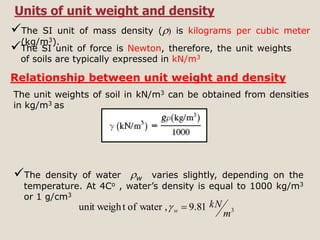
Units of unit weight and density
The SI unit of force is Newton, therefore, the unit weights
of soils are typically expressed in kN/m3
The SI unit of mass density () is kilograms per cubic meter
(kg/m3).
The density of water w varies slightly, depending on the
temperature. At 4Co , water’s density is equal to 1000 kg/m3
or 1 g/cm3
Relationship between unit weight and density
The unit weights of soil in kN/m3 can be obtained from densities
in kg/m3 as
3
81
.
9
,
water
of
t
unit weigh
m
kN
w 

 Soil deposits comprise the accumulated solid
particles plus the void space between the
particles
 The void spaces are partially or completely filled
with water or other liquid.
 Voids space not occupied by fluid are filled with
air or other gas.
 Hence soil deposits are referred to as three-
phase system, i.e. Solid + Liquid (water) + Gas
(air)
Soil Phases
For purpose of study and analysis, it is convenient to
represent the soil by a PHASE DIAGRAM, with part of
the diagram representing the solid particles, part
representing water or liquid, and another part air or
other gas.
PHASE DIAGRAM
Volumetric Ratios
(1) Void ratio e
(2) Porosity n%
(3) Degree of Saturation S% (0 – 100%)
s
v
V
V
solids
of
Volume
voids
of
Volume
e 

100



t
v
V
V
sample
soil
of
volume
Total
voids
of
Volume
n
%
100



v
w
V
V
voids
of
volume
Total
water
contains
voids
of
volume
Total
S
Dry
Saturated
Weight Ratios
(1) Water Content w%
%
100



s
w
W
W
solids
soil
of
Weight
water
of
Weight
w
Soil unit weights
(1) Dry unit weight
(2) Total, Wet, Bulk, or Moist unit weight
Saturated unit weight (considering
S=100%, Va =0)
t
s
d
V
W
soil
of
volume
Total
solids
soil
of
Weight



t
w
s
V
W
W
soil
of
volume
Total
soil
of
Total 


weight

t
w
s
sat
V
W
W
soil
of
volume
Total
water
solids
soil
of
Weight 




Note: The density/or unit weight are ratios which connects the
volumetric side of the PHASE DIAGRAM with the mass/or weight side.
Specific gravity, Gs
The ratio of the mass of a solid particles to the
mass of an equal volume of distilled water at 4°C
The specific gravity of soil solids is often needed for
various calculations in soil mechanics.
i.e., the specific gravity of a certain material is ratio of
the unit weight of that material to the unit weight of
water at 4o C.
w
s
s
s
V
w
G


•Gw = 1
•Gmercury = 13.6
w
s
s
G



Typical Values of Specific Gravity
(Lambe and Whitman, 1979)
(Goodman, 1989)
Example 1:
In its natural state, a moist soil has a total volume of 9344.56 cm3
and a mass 18.11 kg. The oven-dry mass of soil is 15.67 kg. If Gs =
2.67, calculate the moisture content, moist unit weight, void ratio and
degree of saturation.
15.67
kg
18.11
kg
2.44
kg
5868.9
cm3
2440cm
3
9344.56
cm3
3475.66
cm3
Relationships Between Various Physical Properties
All the weight- volume relationships needed in soil
mechanics can be derived from appropriate
combinations of six fundamental definitions. They
are:
1.Void ratio
2.Porosity
3.Degree of saturation
4.Water content
5.Unit weight
6.Specific gravity
Use of Phase diagrams in finding
relationships physical properties
Remember the following simple rules:
1.Remember the basic definitions of w, e, Gs, S,
etc.
2.Draw a phase diagram.
3.Assume either Vs=1 or Vt=1 or ws = 1
depending on given values.
4.Solve the phase diagram for required values.
Solids
Water
Air
If given e, assume
Vs =1
1
e
1+
e
Solids
Water
Air
If given w, assume
Ws =1
1
w
1+
w
1. Relationship between e and n
1
e
1+
e
Using phase
diagram
Given : e
required: n
e
e
V
V
n
t
v



1
2. Relationship among e, S, w, and Gs
s
s
w
s
s
w
w
w
s
s
w
w
s
w
V
G
V
V
G
V
V
V
w
w
w 







•Dividing the denominator and numerator of the R.H.S. by Vv
yields:
s
wG
Se 
•This is a very useful relation for solving THREE-PHASE
RELATIONSHIPS.
•Textbook derivation
2. Relationship among e, S, w, and Gs
Using phase
diagram
Given : e, S,
Gs
required: w
S
e
w
S
e
S
e
W
W
w w
s
w
G
G
G
s
s
w
s







2. Relationship among e, S, w, and Gs
Solids
Water
Air
1+
e
e
1
e
S
Gs w
e S
w
Gs w + e S
w
3. Relationship among , e, S and Gs
v
s
s
s
w
w
w
v
s
s
s
w
w
v
s
s
w
V
V
V
G
V
V
V
V
V
V
V
W
W
V
W















w
s
e
G
Se





1
)
(
•Notes:
• Unit weights for dry, fully saturated and submerged
cases can be derived from the upper equation
• Water content can be used instead of degree of
saturation.
Using phase
diagram
Given : e, S,
Gs
required: 
1
)
(
e
eS
G
V
W w
s
t
t






Solids
Water
Air
1+
e
e
1
e
S
Gs w
e S
w
Gs w + e S
w
3. Relationship among , e, S and Gs
1 e
G
V
W w
s
t
s
d





1
)
(
r)
with wate
filled
water
(
e
e
G
V
W w
s
t
t
d






•Various Unit Weight Relationships
Solution of Phase Problems
Method 1: Memorize relationships
Method 2: Return to Basics
Remember the following simple rules:
1.Remember the basic definitions of w, e, Gs, S,
etc.
2.Draw a phase diagram.
3.Assume either Vs=1 or Vt=1 or ws = 1
depending on given values.
4.Solve the phase diagram.
s
wG
Se  w
s
e
G
Se





1
)
(
e
e
n


1 w
d


1


Solids
Water
Air
Method 2: Problem assumptions
If given e, assume
Vs =1
1
e
1+
e
Solids
Water
Air
If given w, assume
Ws =1
1
w
1+
w
Example 2
Method 1a
Method 1b
Given : w = 9.8% ,   19.2 kN/m3, Gs =
2.69
required: d , e, n, S
3
kN/m
48
.
17
0572
.
0
1



t
s
d
V
W

Method 2:
Solids
Water
Air
1.098/
19.2
=
0.0572
0.0193
1
1/(2.69 x
9.81) =
0.03789
0.098/
9.81=
0.0099
8
1
9.8/10
0 =
0.098
1.098
assume Ws =1 kN
3
kN/m
51
.
0
03789
.
0
01931
.
0



S
V
V
V
e
%
76
.
33
100
0572
.
0
01931
.
0




t
v
V
V
n
%
68
.
51
100
01931
.
0
00998
.
0




v
w
V
V
S
Example 3
Field density testing (e.g., sand replacement method)
has shown bulk density of a compacted road base to be
2.06 t/m3 with a water content of 11.6%. Specific gravity of
the soil grains is 2.69. Calculate the dry density, porosity,
void ratio and degree of saturation.
•Relative Density
•The relative density Dr, also called density index is
commonly used to indicate the IN SITU denseness or
looseness of granular soil.
•The relative density is the parameter that compare the volume
reduction achieved from compaction to the maximum possible
volume reduction
Volume reduction from compaction of granular soil
•34
•Dr can be expressed either in terms of void ratios
or dry densities.
•Remarks
•The relative density of a natural soil very strongly
affect its engineering behavior.
•The range of values of Dr may vary from a
minimum of zero for very LOOSE soil to a
maximum of 100% for a very DENSE soil.
•Because of the irregular size and shape of granular
particles, it is not possible to obtain a ZERO
volume of voids. (Do you remember well-graded vs.
poorly-graded!!)
•ASTM test designations D-4253 and D-4254 (2007)
provide procedure for determining maximum and
minimum dry unit weights of granular soils.
•Granular soils are qualitatively described
according to their relative densities as shown
below
•The use of relative density has been restricted to
granular soils because of the difficulty of
determining emax in clayey soils. Liquidity Index in
fine-grained soils is of similar use as Dr in
granular soils.

MEKTAN Phase Relations -TE Properties.ppt

  • 1.
  • 2.
    For this chapter,we need to know the following  Mass (M) is a measure of a body's inertia, or its "quantity of matter". Mass does not changed at different places.  Weight (W) is the force of gravity acting on a body.  The unit weight is frequently used in geotechnical engineering than the density (e.g. in calculating the overburden pressure). Volume Mass Density   , Volume g Mass Volume Weight weight Unit     , 2 sec 81 . 9 : where m gravity to due on accelerati g g M W    g So    
  • 3.
    Units of unitweight and density The SI unit of force is Newton, therefore, the unit weights of soils are typically expressed in kN/m3 The SI unit of mass density () is kilograms per cubic meter (kg/m3). The density of water w varies slightly, depending on the temperature. At 4Co , water’s density is equal to 1000 kg/m3 or 1 g/cm3 Relationship between unit weight and density The unit weights of soil in kN/m3 can be obtained from densities in kg/m3 as 3 81 . 9 , water of t unit weigh m kN w  
  • 4.
     Soil depositscomprise the accumulated solid particles plus the void space between the particles  The void spaces are partially or completely filled with water or other liquid.  Voids space not occupied by fluid are filled with air or other gas.  Hence soil deposits are referred to as three- phase system, i.e. Solid + Liquid (water) + Gas (air) Soil Phases
  • 9.
    For purpose ofstudy and analysis, it is convenient to represent the soil by a PHASE DIAGRAM, with part of the diagram representing the solid particles, part representing water or liquid, and another part air or other gas. PHASE DIAGRAM
  • 10.
    Volumetric Ratios (1) Voidratio e (2) Porosity n% (3) Degree of Saturation S% (0 – 100%) s v V V solids of Volume voids of Volume e   100    t v V V sample soil of volume Total voids of Volume n % 100    v w V V voids of volume Total water contains voids of volume Total S Dry Saturated
  • 11.
    Weight Ratios (1) WaterContent w% % 100    s w W W solids soil of Weight water of Weight w
  • 12.
    Soil unit weights (1)Dry unit weight (2) Total, Wet, Bulk, or Moist unit weight Saturated unit weight (considering S=100%, Va =0) t s d V W soil of volume Total solids soil of Weight    t w s V W W soil of volume Total soil of Total    weight  t w s sat V W W soil of volume Total water solids soil of Weight      Note: The density/or unit weight are ratios which connects the volumetric side of the PHASE DIAGRAM with the mass/or weight side.
  • 13.
    Specific gravity, Gs Theratio of the mass of a solid particles to the mass of an equal volume of distilled water at 4°C The specific gravity of soil solids is often needed for various calculations in soil mechanics. i.e., the specific gravity of a certain material is ratio of the unit weight of that material to the unit weight of water at 4o C. w s s s V w G   •Gw = 1 •Gmercury = 13.6 w s s G   
  • 14.
    Typical Values ofSpecific Gravity (Lambe and Whitman, 1979) (Goodman, 1989)
  • 16.
    Example 1: In itsnatural state, a moist soil has a total volume of 9344.56 cm3 and a mass 18.11 kg. The oven-dry mass of soil is 15.67 kg. If Gs = 2.67, calculate the moisture content, moist unit weight, void ratio and degree of saturation. 15.67 kg 18.11 kg 2.44 kg 5868.9 cm3 2440cm 3 9344.56 cm3 3475.66 cm3
  • 17.
    Relationships Between VariousPhysical Properties All the weight- volume relationships needed in soil mechanics can be derived from appropriate combinations of six fundamental definitions. They are: 1.Void ratio 2.Porosity 3.Degree of saturation 4.Water content 5.Unit weight 6.Specific gravity
  • 18.
    Use of Phasediagrams in finding relationships physical properties Remember the following simple rules: 1.Remember the basic definitions of w, e, Gs, S, etc. 2.Draw a phase diagram. 3.Assume either Vs=1 or Vt=1 or ws = 1 depending on given values. 4.Solve the phase diagram for required values.
  • 19.
    Solids Water Air If given e,assume Vs =1 1 e 1+ e Solids Water Air If given w, assume Ws =1 1 w 1+ w
  • 20.
    1. Relationship betweene and n 1 e 1+ e Using phase diagram Given : e required: n e e V V n t v    1
  • 21.
    2. Relationship amonge, S, w, and Gs s s w s s w w w s s w w s w V G V V G V V V w w w         •Dividing the denominator and numerator of the R.H.S. by Vv yields: s wG Se  •This is a very useful relation for solving THREE-PHASE RELATIONSHIPS.
  • 22.
  • 23.
    Using phase diagram Given :e, S, Gs required: w S e w S e S e W W w w s w G G G s s w s        2. Relationship among e, S, w, and Gs Solids Water Air 1+ e e 1 e S Gs w e S w Gs w + e S w
  • 24.
    3. Relationship among, e, S and Gs v s s s w w w v s s s w w v s s w V V V G V V V V V V V W W V W                w s e G Se      1 ) ( •Notes: • Unit weights for dry, fully saturated and submerged cases can be derived from the upper equation • Water content can be used instead of degree of saturation.
  • 25.
    Using phase diagram Given :e, S, Gs required:  1 ) ( e eS G V W w s t t       Solids Water Air 1+ e e 1 e S Gs w e S w Gs w + e S w 3. Relationship among , e, S and Gs 1 e G V W w s t s d      1 ) ( r) with wate filled water ( e e G V W w s t t d      
  • 26.
  • 27.
    Solution of PhaseProblems Method 1: Memorize relationships Method 2: Return to Basics Remember the following simple rules: 1.Remember the basic definitions of w, e, Gs, S, etc. 2.Draw a phase diagram. 3.Assume either Vs=1 or Vt=1 or ws = 1 depending on given values. 4.Solve the phase diagram. s wG Se  w s e G Se      1 ) ( e e n   1 w d   1  
  • 28.
    Solids Water Air Method 2: Problemassumptions If given e, assume Vs =1 1 e 1+ e Solids Water Air If given w, assume Ws =1 1 w 1+ w
  • 29.
  • 30.
  • 31.
    Given : w= 9.8% ,   19.2 kN/m3, Gs = 2.69 required: d , e, n, S 3 kN/m 48 . 17 0572 . 0 1    t s d V W  Method 2: Solids Water Air 1.098/ 19.2 = 0.0572 0.0193 1 1/(2.69 x 9.81) = 0.03789 0.098/ 9.81= 0.0099 8 1 9.8/10 0 = 0.098 1.098 assume Ws =1 kN 3 kN/m 51 . 0 03789 . 0 01931 . 0    S V V V e % 76 . 33 100 0572 . 0 01931 . 0     t v V V n % 68 . 51 100 01931 . 0 00998 . 0     v w V V S
  • 32.
    Example 3 Field densitytesting (e.g., sand replacement method) has shown bulk density of a compacted road base to be 2.06 t/m3 with a water content of 11.6%. Specific gravity of the soil grains is 2.69. Calculate the dry density, porosity, void ratio and degree of saturation.
  • 33.
    •Relative Density •The relativedensity Dr, also called density index is commonly used to indicate the IN SITU denseness or looseness of granular soil. •The relative density is the parameter that compare the volume reduction achieved from compaction to the maximum possible volume reduction Volume reduction from compaction of granular soil
  • 34.
    •34 •Dr can beexpressed either in terms of void ratios or dry densities.
  • 35.
    •Remarks •The relative densityof a natural soil very strongly affect its engineering behavior. •The range of values of Dr may vary from a minimum of zero for very LOOSE soil to a maximum of 100% for a very DENSE soil. •Because of the irregular size and shape of granular particles, it is not possible to obtain a ZERO volume of voids. (Do you remember well-graded vs. poorly-graded!!) •ASTM test designations D-4253 and D-4254 (2007) provide procedure for determining maximum and minimum dry unit weights of granular soils.
  • 36.
    •Granular soils arequalitatively described according to their relative densities as shown below •The use of relative density has been restricted to granular soils because of the difficulty of determining emax in clayey soils. Liquidity Index in fine-grained soils is of similar use as Dr in granular soils.