Topic 3

MASS HAUL
 DIAGRAM
Objective:
• Explain the basic concepts of the Mass
  Haul Diagram.

• Define the use of Mass Haul Diagram.

• Explain the methods used in the haulage of
  large volumes of earthwork calculation .

• Explain the method used in calculating the
  haulage of large volumes of earthwork for
  construction
INTRODUCTION
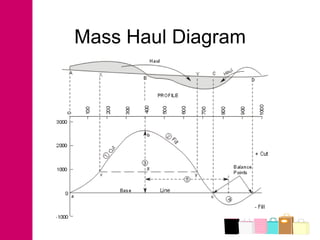
     Mass-haul diagrams (MHD) are used to compare the economics
of the various methods of earthwork distribution on road or railway
construction schemes. With the combined use of the MHD plotted
directly below the longitudinal section of the survey centre-line, one
can find :

    The distances over which ‘cut and fill’ will balance.
    Quantities of materials to be moved and the direction of movement.
    Areas where earth may have to be borrowed or wasted and the
    amounts involved.
    The best policy to adopt to obtain the most economic use of plan.
Mass Haul Diagrams
• Diagrammatic representation of
  earthwork volumes along a linear
  profile
• Horizontal stationing is plotted along
  the X-axis
• Net earthwork values are plotted
  along the Y-axis
Mass Haul Diagrams
• An Earthwork Profile is a plot of the net
  earthwork along a roadway or airstrip
• Net cut values are plotted above the X-
  axis (positive Y value)
• Net fill values are plotted below the X-
  axis (negative Y value)
• Presents a picture of the earthwork
  requirements
Mass Haul Diagrams
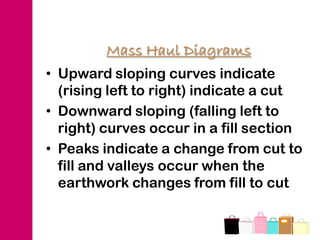
• Upward sloping curves indicate
  (rising left to right) indicate a cut
• Downward sloping (falling left to
  right) curves occur in a fill section
• Peaks indicate a change from cut to
  fill and valleys occur when the
  earthwork changes from fill to cut
Mass Haul Diagrams
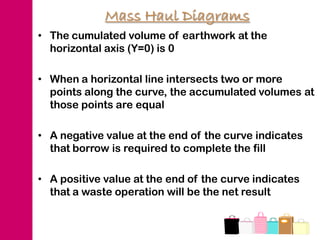
• The cumulated volume of earthwork at the
  horizontal axis (Y=0) is 0

• When a horizontal line intersects two or more
  points along the curve, the accumulated volumes at
  those points are equal

• A negative value at the end of the curve indicates
  that borrow is required to complete the fill

• A positive value at the end of the curve indicates
  that a waste operation will be the net result
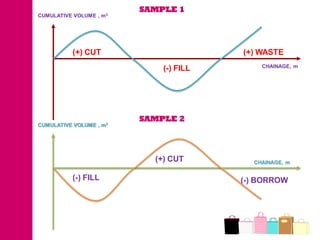
SAMPLE 1
CUMULATIVE VOLUME , m3


          (+) CUT                       (+) WASTE
                                            CHAINAGE, m
                             (-) FILL


                         SAMPLE 2
CUMULATIVE VOLUME , m3


                           (+) CUT        CHAINAGE, m


          (-) FILL                      (-) BORROW
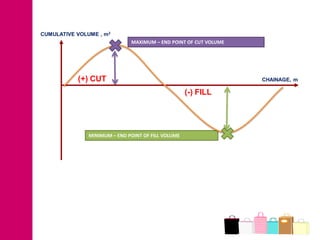
CUMULATIVE VOLUME , m3
                              MAXIMUM – END POINT OF CUT VOLUME


           (+) CUT                                                CHAINAGE, m

                                                    (-) FILL


               MINIMUM – END POINT OF FILL VOLUME
Mass Haul Diagrams
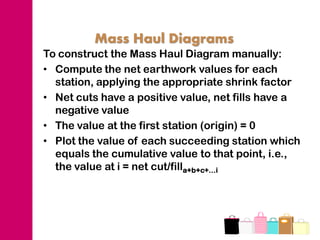
To construct the Mass Haul Diagram manually:
• Compute the net earthwork values for each
  station, applying the appropriate shrink factor
• Net cuts have a positive value, net fills have a
  negative value
• The value at the first station (origin) = 0
• Plot the value of each succeeding station which
  equals the cumulative value to that point, i.e.,
  the value at i = net cut/filla+b+c+…i
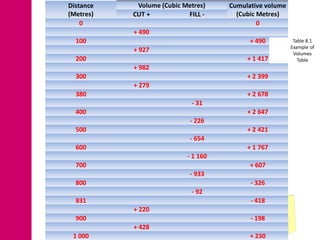
Distance    Volume (Cubic Metres)    Cumulative volume
(Metres)   CUT +           FILL -      (Cubic Metres)
    0                                         0
           + 490
  100                                      + 490          Table 8.1
                                                         Example of
           + 927                                          Volumes
  200                                     + 1 417           Table
           + 982
  300                                     + 2 399
           + 279
  380                                     + 2 678
                            - 31
  400                                     + 2 647
                            - 226
  500                                     + 2 421
                            - 654
  600                                     + 1 767
                           - 1 160
  700                                      + 607
                            - 933
  800                                      - 326
                            - 92
  831                                      - 418
           + 220
  900                                      - 198
           + 428
 1 000                                     + 230
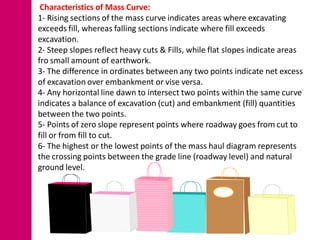
Characteristics of Mass Curve:
1- Rising sections of the mass curve indicates areas where excavating
exceeds fill, whereas falling sections indicate where fill exceeds
excavation.
2- Steep slopes reflect heavy cuts & Fills, while flat slopes indicate areas
fro small amount of earthwork.
3- The difference in ordinates between any two points indicate net excess
of excavation over embankment or vise versa.
4- Any horizontal line dawn to intersect two points within the same curve
indicates a balance of excavation (cut) and embankment (fill) quantities
between the two points.
5- Points of zero slope represent points where roadway goes from cut to
fill or from fill to cut.
6- The highest or the lowest points of the mass haul diagram represents
the crossing points between the grade line (roadway level) and natural
ground level.
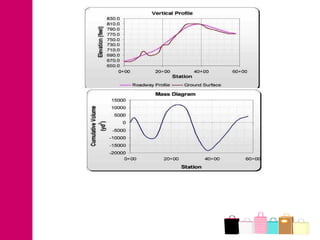
Mass Haul Diagram
Mass Haul Diagrams
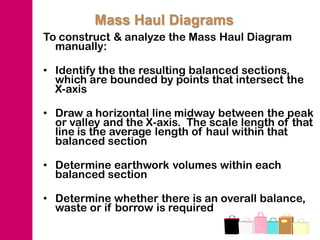
To construct & analyze the Mass Haul Diagram
  manually:

• Identify the the resulting balanced sections,
  which are bounded by points that intersect the
  X-axis

• Draw a horizontal line midway between the peak
  or valley and the X-axis. The scale length of that
  line is the average length of haul within that
  balanced section

• Determine earthwork volumes within each
  balanced section

• Determine whether there is an overall balance,
  waste or if borrow is required
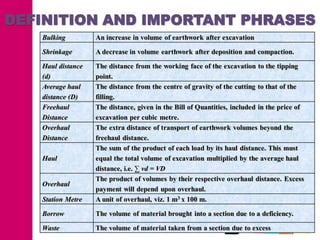
DEFINITION AND IMPORTANT PHRASES
   Bulking         An increase in volume of earthwork after excavation

   Shrinkage       A decrease in volume earthwork after deposition and compaction.

   Haul distance   The distance from the working face of the excavation to the tipping
   (d)             point.
   Average haul    The distance from the centre of gravity of the cutting to that of the
   distance (D)    filling.
   Freehaul        The distance, given in the Bill of Quantities, included in the price of
   Distance        excavation per cubic metre.
   Overhaul        The extra distance of transport of earthwork volumes beyond the
   Distance        freehaul distance.
                   The sum of the product of each load by its haul distance. This must
   Haul            equal the total volume of excavation multiplied by the average haul
                   distance, i.e. ∑ vd = VD
                   The product of volumes by their respective overhaul distance. Excess
   Overhaul
                   payment will depend upon overhaul.
   Station Metre   A unit of overhaul, viz. 1 m3 x 100 m.

   Borrow          The volume of material brought into a section due to a deficiency.

   Waste           The volume of material taken from a section due to excess
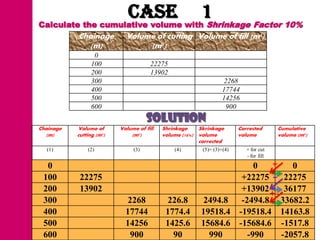
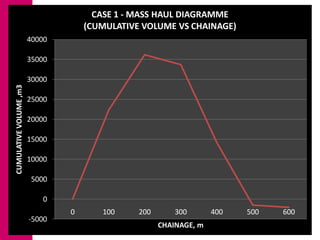
CASE with1
Calculate the cumulative volume Shrinkage Factor 10%
           Chainage         Volume of cutting Volume of fill (m3)
              (m)                (m3)
                  0
                 100                  22275
                 200                  13902
                 300                                             2268
                 400                                             17744
                 500                                             14256
                 600                                              900
                                     Solution
Chainage   Volume of      Volume of fill   Shrinkage    Skrinkage       Corrected       Cumulative
  (m)      cutting (m3)       (m3)         volume (10%) volume          volume          volume (m3)
                                                        corrected
  (1)          (2)             (3)             (4)       (5)= (3)+(4)      + for cut
                                                                           - for fill

  0                                                                          0    +         0
 100        22275                                                        +22275 +         22275
 200        13902                                                        +13902           36177
                                                                                 +
 300                         2268           226.8       2494.8           -2494.8         33682.2
 400                        17744           1774.4      19518.4         -19518.4         14163.8
 500                        14256           1425.6      15684.6         -15684.6         -1517.8
 600                         900              90          990              -990          -2057.8
CASE 1 - MASS HAUL DIAGRAMME
                                    (CUMULATIVE VOLUME VS CHAINAGE)
                        40000

                        35000

                        30000
CUMULATIVE VOLUME ,m3


                        25000

                        20000

                        15000

                        10000

                         5000

                            0
                                0      100     200       300       400   500   600
                        -5000
                                                     CHAINAGE, m
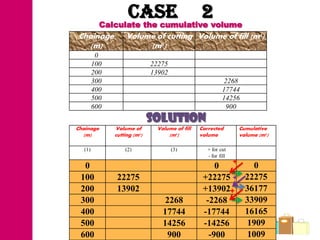
CASE 2volume
           Calculate the cumulative
Chainage           Volume of cutting Volume of fill (m3)
   (m)                  (m3)
         0
        100                  22275
        200                  13902
        300                                              2268
        400                                              17744
        500                                              14256
        600                                               900
                             Solution
Chainage      Volume of       Volume of fill   Corrected       Cumulative
  (m)         cutting (m3)        (m3)         volume          volume (m3)

  (1)             (2)                (3)          + for cut
                                                  - for fill
                                                       +           0
  0                                                 0
 100           22275                            +22275 +         22275
 200           13902                            +13902+          36177
 300                            2268             -2268           33909
 400                            17744           -17744           16165
 500                            14256           -14256           1909
 600                             900              -900           1009
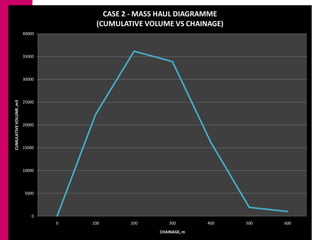
CASE 2 - MASS HAUL DIAGRAMME
                                     (CUMULATIVE VOLUME VS CHAINAGE)
                        40000


                        35000


                        30000
CUMULATIVE VOLUME ,m3


                        25000


                        20000


                        15000


                        10000


                         5000


                            0
                                0   100      200        300       400   500   600
                                                    CHAINAGE, m
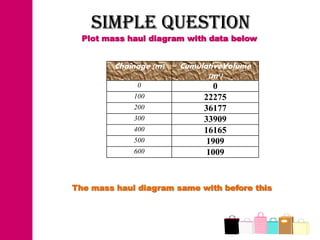
SIMPLE QUESTION
  Plot mass haul diagram with data below


         Chainage (m)   CumulativeVolume
                              (m3)
              0                0
             100             22275
             200             36177
             300             33909
             400             16165
             500             1909
             600             1009


The mass haul diagram same with before this
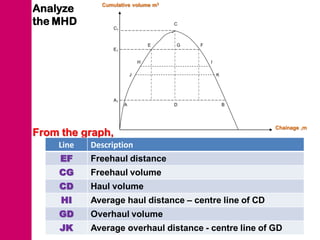
Analyze        Cumulative volume m3
               Isipadu Kumulatif (m 3)


the MHD            C1
                                         C


                                    E     G       F
                   E1

                                H                     I

                            J                             K


                   A1
                        A                D                    B


                                                                   Chainage
                                                                  Rantaian (m)   ,m
From the graph,
    Line   Description 7.2 : Lengkung Gambarajah Urungan Padu
                  Gambarajah


     EF    Freehaul distance
    CG     Freehaul volume
    CD     Haul volume
     HI    Average haul distance – centre line of CD
    GD     Overhaul volume
     JK    Average overhaul distance - centre line of GD
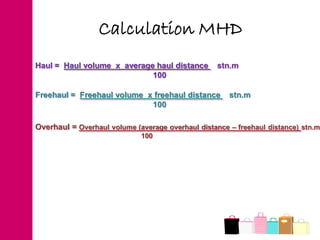
Calculation MHD
Haul = Haul volume x average haul distance         stn.m
                            100

Freehaul = Freehaul volume x freehaul distance        stn.m
                            100

Overhaul = Overhaul volume (average overhaul distance – freehaul distance) stn.m
                             100
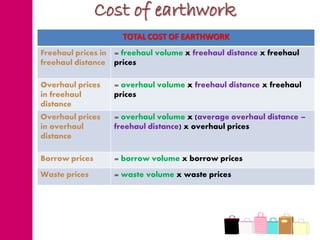
Cost of earthwork
                     TOTAL COST OF EARTHWORK
Freehaul prices in = freehaul volume x freehaul distance x freehaul
freehaul distance prices

Overhaul prices    = overhaul volume x freehaul distance x freehaul
in freehaul        prices
distance
Overhaul prices    = overhaul volume x (average overhaul distance –
in overhaul        freehaul distance) x overhaul prices
distance

Borrow prices      = borrow volume x borrow prices
Waste prices       = waste volume x waste prices
End of topic
  • Exercise

Topic 3 mass haul diagram

  • 1.
  • 2.
    Objective: • Explain thebasic concepts of the Mass Haul Diagram. • Define the use of Mass Haul Diagram. • Explain the methods used in the haulage of large volumes of earthwork calculation . • Explain the method used in calculating the haulage of large volumes of earthwork for construction
  • 3.
    INTRODUCTION Mass-haul diagrams (MHD) are used to compare the economics of the various methods of earthwork distribution on road or railway construction schemes. With the combined use of the MHD plotted directly below the longitudinal section of the survey centre-line, one can find : The distances over which ‘cut and fill’ will balance. Quantities of materials to be moved and the direction of movement. Areas where earth may have to be borrowed or wasted and the amounts involved. The best policy to adopt to obtain the most economic use of plan.
  • 4.
    Mass Haul Diagrams •Diagrammatic representation of earthwork volumes along a linear profile • Horizontal stationing is plotted along the X-axis • Net earthwork values are plotted along the Y-axis
  • 5.
    Mass Haul Diagrams •An Earthwork Profile is a plot of the net earthwork along a roadway or airstrip • Net cut values are plotted above the X- axis (positive Y value) • Net fill values are plotted below the X- axis (negative Y value) • Presents a picture of the earthwork requirements
  • 6.
    Mass Haul Diagrams •Upward sloping curves indicate (rising left to right) indicate a cut • Downward sloping (falling left to right) curves occur in a fill section • Peaks indicate a change from cut to fill and valleys occur when the earthwork changes from fill to cut
  • 7.
    Mass Haul Diagrams •The cumulated volume of earthwork at the horizontal axis (Y=0) is 0 • When a horizontal line intersects two or more points along the curve, the accumulated volumes at those points are equal • A negative value at the end of the curve indicates that borrow is required to complete the fill • A positive value at the end of the curve indicates that a waste operation will be the net result
  • 8.
    SAMPLE 1 CUMULATIVE VOLUME, m3 (+) CUT (+) WASTE CHAINAGE, m (-) FILL SAMPLE 2 CUMULATIVE VOLUME , m3 (+) CUT CHAINAGE, m (-) FILL (-) BORROW
  • 9.
    CUMULATIVE VOLUME ,m3 MAXIMUM – END POINT OF CUT VOLUME (+) CUT CHAINAGE, m (-) FILL MINIMUM – END POINT OF FILL VOLUME
  • 10.
    Mass Haul Diagrams Toconstruct the Mass Haul Diagram manually: • Compute the net earthwork values for each station, applying the appropriate shrink factor • Net cuts have a positive value, net fills have a negative value • The value at the first station (origin) = 0 • Plot the value of each succeeding station which equals the cumulative value to that point, i.e., the value at i = net cut/filla+b+c+…i
  • 11.
    Distance Volume (Cubic Metres) Cumulative volume (Metres) CUT + FILL - (Cubic Metres) 0 0 + 490 100 + 490 Table 8.1 Example of + 927 Volumes 200 + 1 417 Table + 982 300 + 2 399 + 279 380 + 2 678 - 31 400 + 2 647 - 226 500 + 2 421 - 654 600 + 1 767 - 1 160 700 + 607 - 933 800 - 326 - 92 831 - 418 + 220 900 - 198 + 428 1 000 + 230
  • 12.
    Characteristics of MassCurve: 1- Rising sections of the mass curve indicates areas where excavating exceeds fill, whereas falling sections indicate where fill exceeds excavation. 2- Steep slopes reflect heavy cuts & Fills, while flat slopes indicate areas fro small amount of earthwork. 3- The difference in ordinates between any two points indicate net excess of excavation over embankment or vise versa. 4- Any horizontal line dawn to intersect two points within the same curve indicates a balance of excavation (cut) and embankment (fill) quantities between the two points. 5- Points of zero slope represent points where roadway goes from cut to fill or from fill to cut. 6- The highest or the lowest points of the mass haul diagram represents the crossing points between the grade line (roadway level) and natural ground level.
  • 14.
  • 15.
    Mass Haul Diagrams Toconstruct & analyze the Mass Haul Diagram manually: • Identify the the resulting balanced sections, which are bounded by points that intersect the X-axis • Draw a horizontal line midway between the peak or valley and the X-axis. The scale length of that line is the average length of haul within that balanced section • Determine earthwork volumes within each balanced section • Determine whether there is an overall balance, waste or if borrow is required
  • 16.
    DEFINITION AND IMPORTANTPHRASES Bulking An increase in volume of earthwork after excavation Shrinkage A decrease in volume earthwork after deposition and compaction. Haul distance The distance from the working face of the excavation to the tipping (d) point. Average haul The distance from the centre of gravity of the cutting to that of the distance (D) filling. Freehaul The distance, given in the Bill of Quantities, included in the price of Distance excavation per cubic metre. Overhaul The extra distance of transport of earthwork volumes beyond the Distance freehaul distance. The sum of the product of each load by its haul distance. This must Haul equal the total volume of excavation multiplied by the average haul distance, i.e. ∑ vd = VD The product of volumes by their respective overhaul distance. Excess Overhaul payment will depend upon overhaul. Station Metre A unit of overhaul, viz. 1 m3 x 100 m. Borrow The volume of material brought into a section due to a deficiency. Waste The volume of material taken from a section due to excess
  • 17.
    CASE with1 Calculate thecumulative volume Shrinkage Factor 10% Chainage Volume of cutting Volume of fill (m3) (m) (m3) 0 100 22275 200 13902 300 2268 400 17744 500 14256 600 900 Solution Chainage Volume of Volume of fill Shrinkage Skrinkage Corrected Cumulative (m) cutting (m3) (m3) volume (10%) volume volume volume (m3) corrected (1) (2) (3) (4) (5)= (3)+(4) + for cut - for fill 0 0 + 0 100 22275 +22275 + 22275 200 13902 +13902 36177 + 300 2268 226.8 2494.8 -2494.8 33682.2 400 17744 1774.4 19518.4 -19518.4 14163.8 500 14256 1425.6 15684.6 -15684.6 -1517.8 600 900 90 990 -990 -2057.8
  • 18.
    CASE 1 -MASS HAUL DIAGRAMME (CUMULATIVE VOLUME VS CHAINAGE) 40000 35000 30000 CUMULATIVE VOLUME ,m3 25000 20000 15000 10000 5000 0 0 100 200 300 400 500 600 -5000 CHAINAGE, m
  • 19.
    CASE 2volume Calculate the cumulative Chainage Volume of cutting Volume of fill (m3) (m) (m3) 0 100 22275 200 13902 300 2268 400 17744 500 14256 600 900 Solution Chainage Volume of Volume of fill Corrected Cumulative (m) cutting (m3) (m3) volume volume (m3) (1) (2) (3) + for cut - for fill + 0 0 0 100 22275 +22275 + 22275 200 13902 +13902+ 36177 300 2268 -2268 33909 400 17744 -17744 16165 500 14256 -14256 1909 600 900 -900 1009
  • 20.
    CASE 2 -MASS HAUL DIAGRAMME (CUMULATIVE VOLUME VS CHAINAGE) 40000 35000 30000 CUMULATIVE VOLUME ,m3 25000 20000 15000 10000 5000 0 0 100 200 300 400 500 600 CHAINAGE, m
  • 21.
    SIMPLE QUESTION Plot mass haul diagram with data below Chainage (m) CumulativeVolume (m3) 0 0 100 22275 200 36177 300 33909 400 16165 500 1909 600 1009 The mass haul diagram same with before this
  • 22.
    Analyze Cumulative volume m3 Isipadu Kumulatif (m 3) the MHD C1 C E G F E1 H I J K A1 A D B Chainage Rantaian (m) ,m From the graph, Line Description 7.2 : Lengkung Gambarajah Urungan Padu Gambarajah EF Freehaul distance CG Freehaul volume CD Haul volume HI Average haul distance – centre line of CD GD Overhaul volume JK Average overhaul distance - centre line of GD
  • 23.
    Calculation MHD Haul =Haul volume x average haul distance stn.m 100 Freehaul = Freehaul volume x freehaul distance stn.m 100 Overhaul = Overhaul volume (average overhaul distance – freehaul distance) stn.m 100
  • 24.
    Cost of earthwork TOTAL COST OF EARTHWORK Freehaul prices in = freehaul volume x freehaul distance x freehaul freehaul distance prices Overhaul prices = overhaul volume x freehaul distance x freehaul in freehaul prices distance Overhaul prices = overhaul volume x (average overhaul distance – in overhaul freehaul distance) x overhaul prices distance Borrow prices = borrow volume x borrow prices Waste prices = waste volume x waste prices
  • 25.
    End of topic • Exercise