
Implications of Digital Generations for a
Learning Society:
New Technologies, Pedagogies &
Assessments
CITERS 2015
Emerging pedagogies and technologies
Gerald Knezek, University of North Texas, USA
Regents Professor of Learning Technologies
Hong Kong University
May 29, 2015
Higher Ed Symposium Brazil Aug
2014
International Handbook of IT in
Education
Section Editors – UNESCO, Paris,
2006
Brief Vita
1974: Bachelors Degree Dartmouth College (NH)
Mathematics & the Social Sciences
1976: Masters Univ. of Hawaii
Experimental Psychology, Learning Theories
1978: Ph.D. Educational Psychology Univ. of Hawaii
Educational Psychology, Pedagogy, Computational Psychometrics
Technology-infused pedagogical methods (Learning Sciences)
1993, 2006, 2011: Fulbright Appointments to Japan, Ecuador, the Netherlands
2000-2014: Regents Professor of Learning Technologies
Director, Institute for the Integration of Technology into Teaching & Learning
http://iittl.unt.edu
2005-14: International Handbook of Information Technology (Co-Editor), Co-
Chair, EduSummIT 2009, 11, 13
(Computer Science > CECS > Technology & Cognition > Learning
Technologies)
Recurring Theme: Teacher Preparation for Past 39 Years
Topics
Digital Generations
as a context for
Old and New Pedagogies
delivered through
New Technologies
with implications for
Assessments
Topics
Digital Generations
as a context for
Old and New Pedagogies
delivered through
New Technologies
with implications for
Assessments
to tell us if these initiatives are contributing to a
Learning Society
Basic Question
Why do we have teachers?
Basic Question
Why do we have teachers?
Answer:
To educate our children
To help them become productive future
citizens in our society
Sakamoto Sensei (Fulbright Scholar 1993-94, Tokyo Inst.
Technlogy)
Mission of Educators
The purpose of education in every society is
two-fold:
a) Transmit skills
b) Transmit culture to the next generation
(Sakamoto, 1993)
Big Question?
Do the technologies we are choosing
and our children are using
hinder or help in achieving the goals
of:
- Transmitting skills
and
- Transmitting culture?
Digital Generations:
A context for pedagody, technologies
and assessment
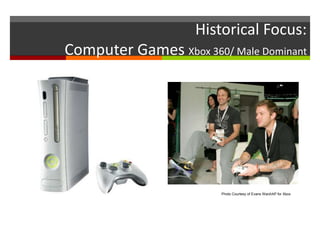
Historical Focus:
Computer Games Xbox 360/ Male Dominant
Photo Courtesy of Evans WardAP for Xbox
Is Expanding Toward: Programmable
Clothes & Jewelry Female Preference
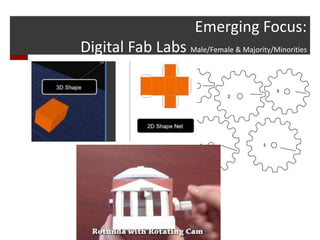
Emerging Focus:
Digital Fab Labs Male/Female & Majority/Minorities
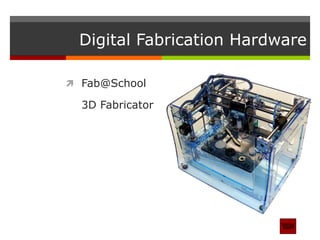
Digital Fabrication Hardware
 Fab@School
3D Fabricator
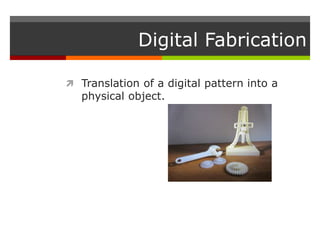
Digital Fabrication
 Translation of a digital pattern into a
physical object.
Biological Fabrication
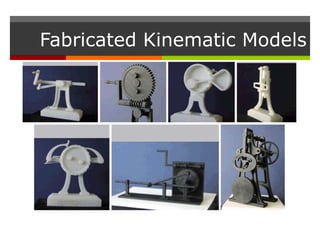
Cornell Kinematics Models
Fabricated Kinematic Models
Exponential Growth Curve
RP Machine Sales
Curriculum
Digital fabrication can facilitate
 student engagement
 developmental skills
 STEM learning
Curriculum
 Students will have the motivating and
satisfying experience of taking their
concepts from mind’s eye to physical
form.
Pedagogical Practices:
Project-Based Learning
Digital Fabrication
MIT Fablab (Gershenfeld)
As of 2013, there were 125 fablabs in 34 countries
http://www.fabfoundation.org/fab-labs/
https://www.ted.com/talks/
neil_gershenfeld_on_fab_labs
http://fab.cba.mit.edu

Classroom-Based Practices since 2009
Fab@School Preservice & Inservice Teacher Training
Univ. of Virginia
Curriculum,
Cornell Univ. (USA)
Physics & Engineering
Univ. of North Texas (USA)
Teacher Preparation
http://iittl.unt.edu/content/about-fablab-classroom
Now Univ –Wide Group (Library, Art, LTEC)
New NSF Award Final Negotiation May 2015
Digital Age Learners:
Two Generations (Plus Us)
 Gen1 Millennials (Gen Y)
 80 million born between 1980 and 1995
 Now in their twenties & thirties
 Gen2 Millennials (Gen Z) born 1996 – 2015 ?
 Students of Millennials becoming teachers
 These are the next generation learners
 Primarily The Rest of Us (Gen X ’65 - ’79)
 Baby Boomers (’45 - ‘64, Teachers of Teachers)
Howe, N. (2007). Millennials Shaping the Future
Digital Age Learners Still Dislike School
(Not All is Perfect)
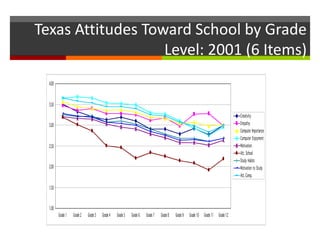
Texas Attitudes Toward School by Grade
Level: 2001 (6 Items)
Just As Their Predecessors
Did 30 Years Before
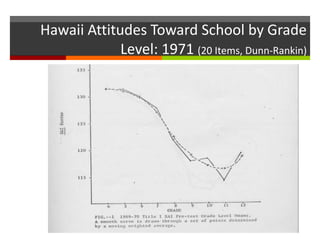
Hawaii Attitudes Toward School by Grade
Level: 1971 (20 Items, Dunn-Rankin)
That may be changing worldwide
(UNESCO’s Jonghwi Park: Happiness Quotient)
The Case of Nan Chiau Primary School
Nan Chiau Primary
School in Singapore, is
part of the Qualcomm
Wireless Reach WE
Learn project.
Soloway (Univ. Michigan)
& Norris (UNT) Pis:
2009-2014
Smartphone use for teaching and learning.
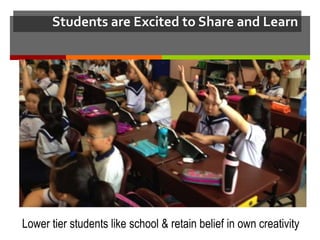
Students are Excited to Share and Learn
Lower tier students like school & retain belief in own creativity
Digital Age Learners G1 (Gen Y)
 As the newest adults (Millennials)
 Tend toward pre-diabetic & attention deficit
 Obese (250% increase vs. Boomers)
 ADHD (2-3 per class, 8x since 1990)
 Are focused on self-gratification
 Ironic given save the world beliefs
 Do not have loyalty to job or career
 Are a bit pampered
 Economic prosperity, parents with strong work ethics
Digital Age Learners G1 (Gen Y)
 Have never been without technology surrounding them
 Are said to be good at it multi-tasking
 But still cannot drive and text:
 May 5, 2009 -- Driving while text messaging or fiddling
 with an MP3 player is dangerous -- even more
 hazardous than talking on a cell phone, a new study shows.
 21 teens ages 16-18
 http://www.webmd.com/parenting/news/20090505/teens-all-thumbs-
when-texting-and-driving
For Digital Age Learners G1 (Gen Y)
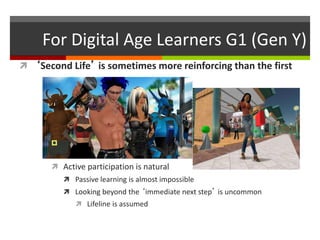
 ‘Second Life’ is sometimes more reinforcing than the first
 Active participation is natural
 Passive learning is almost impossible
 Looking beyond the ‘immediate next step’ is uncommon
 Lifeline is assumed
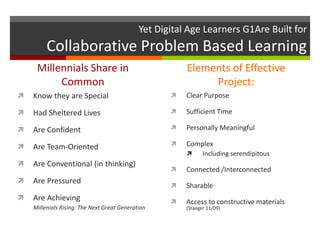
Yet Digital Age Learners G1Are Built for
Collaborative Problem Based Learning
Millennials Share in
Common
 Know they are Special
 Had Sheltered Lives
 Are Confident
 Are Team-Oriented
 Are Conventional (in thinking)
 Are Pressured
 Are Achieving
Millenials Rising: The Next Great Generation
Elements of Effective
Project:
 Clear Purpose
 Sufficient Time
 Personally Meaningful
 Complex
 Including serendipitous
 Connected /Interconnected
 Sharable
 Access to constructive materials
(Staeger 11/09)
 Funded 2008 – 2013 $1.5M; 2013 - 2017 Scaleup $2M US
 New Funding 2013 to Scale Up to more environments and
with increased focus on STEM Careers
 Year One (Grades 6 – 8)
 7 veteran classroom teachers in 3 states for treatment
 Texas
 Vermont
 Louisiana
 13 classrooms for comparison
 Hawaii
 Virginia
 North Carolina
 Louisiana
 Texas
 Year Two
 Adding Maine, Florida, ???
Overview: Going Green! Middle Schoolers Out to
Save theWorld
Project Locations
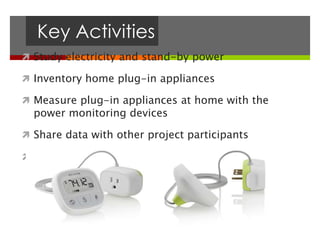
 Study electricity and stand-by power
 Inventory home plug-in appliances
 Measure plug-in appliances at home with the
power monitoring devices
 Share data with other project participants
 Use data for ‘what if’ projections
Key Activities
ITEST Goal: Interest in STEM Careers
 Awareness of and Reduction of CO2 impact
 Increase student interest of STEM career
options
 Out of School activity coordinated in
School
Project Goals
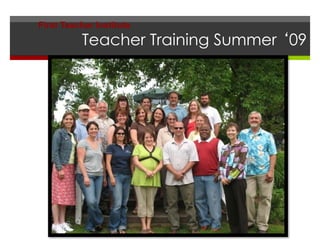
Teacher Training Summer ‘09
First Teacher Institute
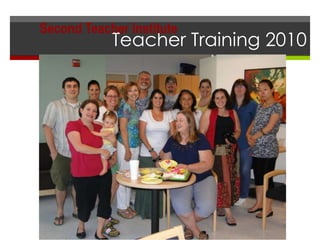
Teacher Training 2010
Second Teacher Institute
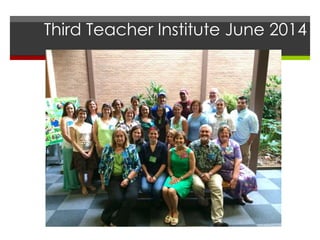
Third Teacher Institute June 2014
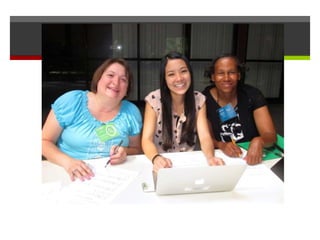
24 Teachers from 7 States
Practice in Monitoring
Spreadsheet Projections
Discussions Outside
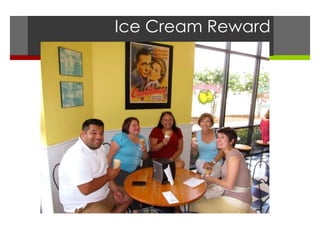
Ice Cream Reward
Teacher Training 2015
Fourth Teacher Institute
June 24-26, NASA’s Goddard Space Center, Maryland
Target Audience: Middle School Girls and Boys
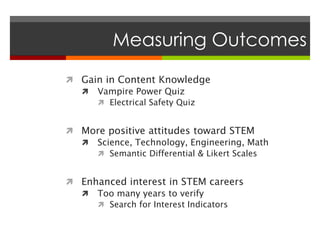
 Gain in Content Knowledge
 More positive attitudes toward STEM
 Enhanced interest in STEM careers
 Productive Citizens
 Working in a real world context
Outcomes
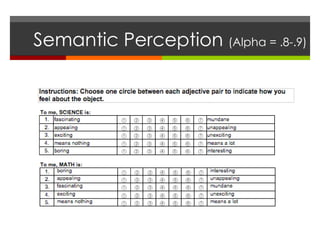
 STEM Semantic Survey
 Semantic Differential
 7-point scale pairs (interesting – boring) 5
areas:
 Science
 Math
 Engineering
 Technology
 STEM Career
 Career Interest Inventory
 13 item Likert (SD to SA), 3 subscales
 Math items from TIMSS
 Attitudes toward School, Creative Tendencies
Instrumentation for STEM Projects
Semantic Perception (Alpha = .8-.9)
College / Career Success Subscale from CIQ
(Alpha = .7-.9)
(Alpha = .8-.9)
 Gain in Content Knowledge
 Vampire Power Quiz
 Electrical Safety Quiz
 More positive attitudes toward STEM
 Science, Technology, Engineering, Math
 Semantic Differential & Likert Scales
 Enhanced interest in STEM careers
 Too many years to verify
 Search for Interest Indicators
Measuring Outcomes
Content Measure: Standby Power Quiz (Meier,
Lawrence Berkeley Labs)
http://ngm.nationalgeographic.com/2008/04/climate/st
andby-quiz-interactive.html
Content Items (NELS)
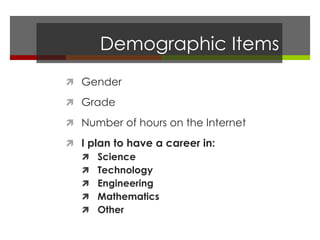
Demographic Items
 Gender
 Grade
 Number of hours on the Internet
 I plan to have a career in:
 Science
 Technology
 Engineering
 Mathematics
 Other
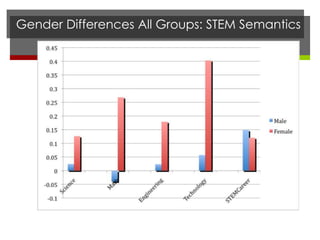
Gender Differences All Groups: STEM Semantics
Gender Differences: All Measures
 Gain in Content Knowledge?
 Absolutely!
 More positive attitudes toward STEM
 Yes, especially for MS FEMALES
 Enhanced interest in STEM careers
 Finally in 2013-14
For MSOSW
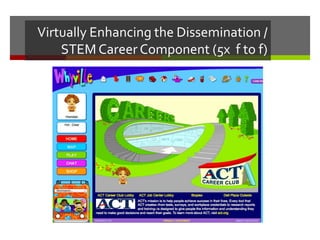
Virtually Enhancing the Dissemination /
STEM Career Component (5x f to f)
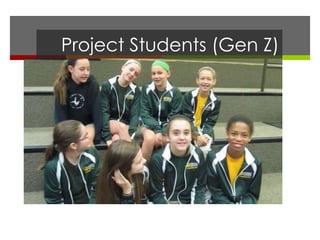
Project Students (Gen Z)
What about Digital Age Learners G1
(Gen Y) as Teachers?
 As soon-to-be new teachers:
 Expect respect from their students in the classroom
 Even though they do not expect to give the same to
their own teachers
 As teachers will not be too different in maturity from
their students
 Tyler-Wood, 12/09
Aggregate “U” is Clear
0
5
10
15
20
25
30
35
G4_5 G_6_7_8 HS G_12 Univ.Preserv. Eng.Majors STEM Prof.
Career
Technology
Engineering
Math
Science
Now a “W” Shape
0
1
2
3
4
5
6
7
G4_5 G_6_7_8 HS G_12 TAMS
G11_12
Univ.Preserv. Eng.Majors STEM Prof.
Science
Mathematics
Engineering
Technology
Career
AndYet Millenials May Be the Greatest
Generation Ever
Digital Generation Families
Traditional:
Parents are the first teachers of children
Millennial:
For the first time in history, children have
more knowledge than their parents (via the
Internet) and skill in how to get it.
Congressional Record, V. 146, Pt. 15, October 6, 2000 to October
12 2000
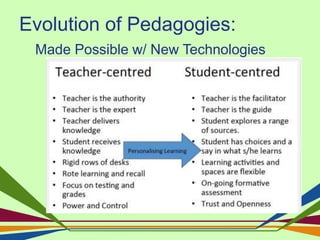
Evolution of Pedagogies:
Made Possible w/ New Technologies
My Family is an Example
May 15, 2015
Digital Literacy
May 14, 2015
Thesis Topics
Gabe: Computer Engineering
Parallel Processing in Cloud Computing
Sarah: Biomedical Engineering
Math Models of Chemotherapy
Treatments
Nick: Astrophysics
Magnetosphere of Earth & Planetary
Objects
Outcome Assessments: STEM Careers
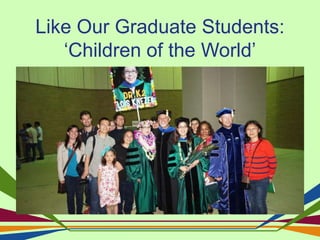
Like Our Graduate Students:
‘Children of the World’
Emerging New Pedagogies
Paul Kim (Stanford)
Causing a Paradigm Shift in the
Global Education Ecosystem
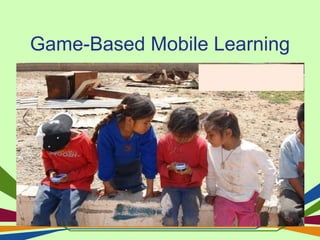
Alien Pedagogy: Modern Day
Discovery Learning
Game-Based Mobile Learning
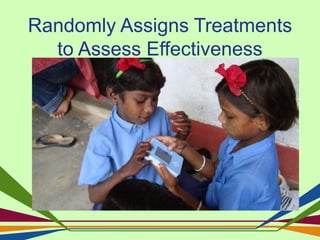
Randomly Assigns Treatments
to Assess Effectiveness
Technologies are Constantly Changing (CFB
HS weekly use 2009)
Digital Age Learners G2
 Were first Netbook Generation
 2007: 1 M
 2008: 14 M
 2012: 12-14% of total Market
 Are Now the Smartphone / Notepad Generation
 Phone, Camera & GPS
 Calculator & Web Browser
 Voice and Text Messaging (+flashlight ;-)
Soloway & Norris; Staeger 2009
Digital Age Learners (G2) are:
Going to be a mini-baby boom?
Are often brilliant
PI = 3.14159265 … (six year old 11/09)
Come in extremes
 Children of Gen X Yuppies
 Children of broken homes
parents = one or none
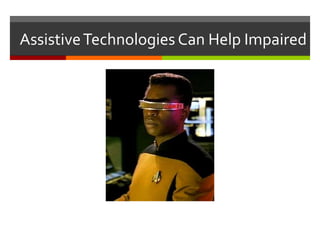
AssistiveTechnologies Can Help Impaired
Attention Deficit Remediation is Reality
Today: Neurofeedback
Tomorrow: EmbeddedAssessment & Self-
Correction will be Reality
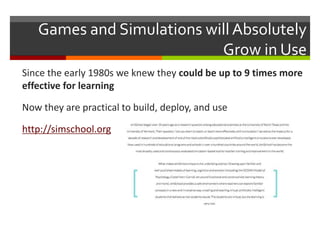
Games and Simulations will Absolutely
Grow in Use
Since the early 1980s we knew they could be up to 9 times more
effective for learning
Now they are practical to build, deploy, and use
http://simschool.org
Big Data has Great Prospects for Good
and Some Prospects for Pearl
 Big brother may be watching
 Publishers
 Companies
 Governments
I am Watching you ?
Some Unresolved Questions
 How are G2 Millennials different from G1?
 More broken homes?
 Suffered more hardships?
 Focused on job, not self?
 Will G1 Millennials be better G2 teachers?
 Digital Natives
 Color Blind (to race)?
 Tech Saavy
 Able to relate?
Contact: gknezek@gmail.com
Thank you !
1. In what ways does teacher education need to
change to better meet the needs and learning style
of digital-age learners?
Discussion Question

Prof. Gerald KNEZEK: Implications of Digital Generations for a Learning Society

  • 1.
    Implications of DigitalGenerations for a Learning Society: New Technologies, Pedagogies & Assessments CITERS 2015 Emerging pedagogies and technologies Gerald Knezek, University of North Texas, USA Regents Professor of Learning Technologies Hong Kong University May 29, 2015
  • 2.
    Higher Ed SymposiumBrazil Aug 2014
  • 3.
    International Handbook ofIT in Education Section Editors – UNESCO, Paris, 2006
  • 5.
    Brief Vita 1974: BachelorsDegree Dartmouth College (NH) Mathematics & the Social Sciences 1976: Masters Univ. of Hawaii Experimental Psychology, Learning Theories 1978: Ph.D. Educational Psychology Univ. of Hawaii Educational Psychology, Pedagogy, Computational Psychometrics Technology-infused pedagogical methods (Learning Sciences) 1993, 2006, 2011: Fulbright Appointments to Japan, Ecuador, the Netherlands 2000-2014: Regents Professor of Learning Technologies Director, Institute for the Integration of Technology into Teaching & Learning http://iittl.unt.edu 2005-14: International Handbook of Information Technology (Co-Editor), Co- Chair, EduSummIT 2009, 11, 13 (Computer Science > CECS > Technology & Cognition > Learning Technologies) Recurring Theme: Teacher Preparation for Past 39 Years
  • 6.
    Topics Digital Generations as acontext for Old and New Pedagogies delivered through New Technologies with implications for Assessments
  • 7.
    Topics Digital Generations as acontext for Old and New Pedagogies delivered through New Technologies with implications for Assessments to tell us if these initiatives are contributing to a Learning Society
  • 8.
    Basic Question Why dowe have teachers?
  • 9.
    Basic Question Why dowe have teachers? Answer: To educate our children To help them become productive future citizens in our society
  • 10.
    Sakamoto Sensei (FulbrightScholar 1993-94, Tokyo Inst. Technlogy)
  • 11.
    Mission of Educators Thepurpose of education in every society is two-fold: a) Transmit skills b) Transmit culture to the next generation (Sakamoto, 1993)
  • 12.
    Big Question? Do thetechnologies we are choosing and our children are using hinder or help in achieving the goals of: - Transmitting skills and - Transmitting culture?
  • 13.
    Digital Generations: A contextfor pedagody, technologies and assessment
  • 14.
    Historical Focus: Computer GamesXbox 360/ Male Dominant Photo Courtesy of Evans WardAP for Xbox
  • 15.
    Is Expanding Toward:Programmable Clothes & Jewelry Female Preference
  • 16.
    Emerging Focus: Digital FabLabs Male/Female & Majority/Minorities
  • 18.
    Digital Fabrication Hardware Fab@School 3D Fabricator
  • 19.
    Digital Fabrication  Translationof a digital pattern into a physical object.
  • 20.
  • 21.
  • 22.
  • 23.
  • 24.
    Curriculum Digital fabrication canfacilitate  student engagement  developmental skills  STEM learning
  • 25.
    Curriculum  Students willhave the motivating and satisfying experience of taking their concepts from mind’s eye to physical form.
  • 26.
    Pedagogical Practices: Project-Based Learning DigitalFabrication MIT Fablab (Gershenfeld) As of 2013, there were 125 fablabs in 34 countries http://www.fabfoundation.org/fab-labs/ https://www.ted.com/talks/ neil_gershenfeld_on_fab_labs http://fab.cba.mit.edu
  • 27.
     Classroom-Based Practices since2009 Fab@School Preservice & Inservice Teacher Training Univ. of Virginia Curriculum, Cornell Univ. (USA) Physics & Engineering Univ. of North Texas (USA) Teacher Preparation http://iittl.unt.edu/content/about-fablab-classroom
  • 28.
    Now Univ –WideGroup (Library, Art, LTEC) New NSF Award Final Negotiation May 2015
  • 29.
    Digital Age Learners: TwoGenerations (Plus Us)  Gen1 Millennials (Gen Y)  80 million born between 1980 and 1995  Now in their twenties & thirties  Gen2 Millennials (Gen Z) born 1996 – 2015 ?  Students of Millennials becoming teachers  These are the next generation learners  Primarily The Rest of Us (Gen X ’65 - ’79)  Baby Boomers (’45 - ‘64, Teachers of Teachers) Howe, N. (2007). Millennials Shaping the Future
  • 30.
    Digital Age LearnersStill Dislike School (Not All is Perfect)
  • 31.
    Texas Attitudes TowardSchool by Grade Level: 2001 (6 Items)
  • 32.
    Just As TheirPredecessors Did 30 Years Before
  • 33.
    Hawaii Attitudes TowardSchool by Grade Level: 1971 (20 Items, Dunn-Rankin)
  • 34.
    That may bechanging worldwide (UNESCO’s Jonghwi Park: Happiness Quotient)
  • 35.
    The Case ofNan Chiau Primary School Nan Chiau Primary School in Singapore, is part of the Qualcomm Wireless Reach WE Learn project. Soloway (Univ. Michigan) & Norris (UNT) Pis: 2009-2014
  • 36.
    Smartphone use forteaching and learning.
  • 37.
    Students are Excitedto Share and Learn Lower tier students like school & retain belief in own creativity
  • 38.
    Digital Age LearnersG1 (Gen Y)  As the newest adults (Millennials)  Tend toward pre-diabetic & attention deficit  Obese (250% increase vs. Boomers)  ADHD (2-3 per class, 8x since 1990)  Are focused on self-gratification  Ironic given save the world beliefs  Do not have loyalty to job or career  Are a bit pampered  Economic prosperity, parents with strong work ethics
  • 39.
    Digital Age LearnersG1 (Gen Y)  Have never been without technology surrounding them  Are said to be good at it multi-tasking  But still cannot drive and text:  May 5, 2009 -- Driving while text messaging or fiddling  with an MP3 player is dangerous -- even more  hazardous than talking on a cell phone, a new study shows.  21 teens ages 16-18  http://www.webmd.com/parenting/news/20090505/teens-all-thumbs- when-texting-and-driving
  • 40.
    For Digital AgeLearners G1 (Gen Y)  ‘Second Life’ is sometimes more reinforcing than the first  Active participation is natural  Passive learning is almost impossible  Looking beyond the ‘immediate next step’ is uncommon  Lifeline is assumed
  • 41.
    Yet Digital AgeLearners G1Are Built for Collaborative Problem Based Learning Millennials Share in Common  Know they are Special  Had Sheltered Lives  Are Confident  Are Team-Oriented  Are Conventional (in thinking)  Are Pressured  Are Achieving Millenials Rising: The Next Great Generation Elements of Effective Project:  Clear Purpose  Sufficient Time  Personally Meaningful  Complex  Including serendipitous  Connected /Interconnected  Sharable  Access to constructive materials (Staeger 11/09)
  • 42.
     Funded 2008– 2013 $1.5M; 2013 - 2017 Scaleup $2M US  New Funding 2013 to Scale Up to more environments and with increased focus on STEM Careers  Year One (Grades 6 – 8)  7 veteran classroom teachers in 3 states for treatment  Texas  Vermont  Louisiana  13 classrooms for comparison  Hawaii  Virginia  North Carolina  Louisiana  Texas  Year Two  Adding Maine, Florida, ??? Overview: Going Green! Middle Schoolers Out to Save theWorld
  • 43.
  • 44.
     Study electricityand stand-by power  Inventory home plug-in appliances  Measure plug-in appliances at home with the power monitoring devices  Share data with other project participants  Use data for ‘what if’ projections Key Activities
  • 45.
    ITEST Goal: Interestin STEM Careers
  • 46.
     Awareness ofand Reduction of CO2 impact  Increase student interest of STEM career options  Out of School activity coordinated in School Project Goals
  • 47.
    Teacher Training Summer‘09 First Teacher Institute
  • 48.
  • 49.
  • 50.
  • 52.
  • 53.
  • 55.
  • 57.
  • 58.
    Teacher Training 2015 FourthTeacher Institute June 24-26, NASA’s Goddard Space Center, Maryland
  • 59.
    Target Audience: MiddleSchool Girls and Boys
  • 60.
     Gain inContent Knowledge  More positive attitudes toward STEM  Enhanced interest in STEM careers  Productive Citizens  Working in a real world context Outcomes
  • 61.
     STEM SemanticSurvey  Semantic Differential  7-point scale pairs (interesting – boring) 5 areas:  Science  Math  Engineering  Technology  STEM Career  Career Interest Inventory  13 item Likert (SD to SA), 3 subscales  Math items from TIMSS  Attitudes toward School, Creative Tendencies Instrumentation for STEM Projects
  • 62.
  • 63.
    College / CareerSuccess Subscale from CIQ (Alpha = .7-.9)
  • 64.
  • 65.
     Gain inContent Knowledge  Vampire Power Quiz  Electrical Safety Quiz  More positive attitudes toward STEM  Science, Technology, Engineering, Math  Semantic Differential & Likert Scales  Enhanced interest in STEM careers  Too many years to verify  Search for Interest Indicators Measuring Outcomes
  • 66.
    Content Measure: StandbyPower Quiz (Meier, Lawrence Berkeley Labs) http://ngm.nationalgeographic.com/2008/04/climate/st andby-quiz-interactive.html
  • 67.
  • 69.
    Demographic Items  Gender Grade  Number of hours on the Internet  I plan to have a career in:  Science  Technology  Engineering  Mathematics  Other
  • 70.
    Gender Differences AllGroups: STEM Semantics
  • 71.
  • 72.
     Gain inContent Knowledge?  Absolutely!  More positive attitudes toward STEM  Yes, especially for MS FEMALES  Enhanced interest in STEM careers  Finally in 2013-14 For MSOSW
  • 73.
    Virtually Enhancing theDissemination / STEM Career Component (5x f to f)
  • 78.
  • 81.
    What about DigitalAge Learners G1 (Gen Y) as Teachers?  As soon-to-be new teachers:  Expect respect from their students in the classroom  Even though they do not expect to give the same to their own teachers  As teachers will not be too different in maturity from their students  Tyler-Wood, 12/09
  • 82.
    Aggregate “U” isClear 0 5 10 15 20 25 30 35 G4_5 G_6_7_8 HS G_12 Univ.Preserv. Eng.Majors STEM Prof. Career Technology Engineering Math Science
  • 83.
    Now a “W”Shape 0 1 2 3 4 5 6 7 G4_5 G_6_7_8 HS G_12 TAMS G11_12 Univ.Preserv. Eng.Majors STEM Prof. Science Mathematics Engineering Technology Career
  • 84.
    AndYet Millenials MayBe the Greatest Generation Ever
  • 85.
    Digital Generation Families Traditional: Parentsare the first teachers of children Millennial: For the first time in history, children have more knowledge than their parents (via the Internet) and skill in how to get it. Congressional Record, V. 146, Pt. 15, October 6, 2000 to October 12 2000
  • 86.
    Evolution of Pedagogies: MadePossible w/ New Technologies
  • 87.
    My Family isan Example
  • 88.
  • 89.
  • 90.
  • 92.
    Thesis Topics Gabe: ComputerEngineering Parallel Processing in Cloud Computing Sarah: Biomedical Engineering Math Models of Chemotherapy Treatments Nick: Astrophysics Magnetosphere of Earth & Planetary Objects Outcome Assessments: STEM Careers
  • 93.
    Like Our GraduateStudents: ‘Children of the World’
  • 94.
    Emerging New Pedagogies PaulKim (Stanford) Causing a Paradigm Shift in the Global Education Ecosystem
  • 95.
    Alien Pedagogy: ModernDay Discovery Learning
  • 96.
  • 97.
    Randomly Assigns Treatments toAssess Effectiveness
  • 98.
    Technologies are ConstantlyChanging (CFB HS weekly use 2009)
  • 99.
    Digital Age LearnersG2  Were first Netbook Generation  2007: 1 M  2008: 14 M  2012: 12-14% of total Market  Are Now the Smartphone / Notepad Generation  Phone, Camera & GPS  Calculator & Web Browser  Voice and Text Messaging (+flashlight ;-) Soloway & Norris; Staeger 2009
  • 100.
    Digital Age Learners(G2) are: Going to be a mini-baby boom? Are often brilliant PI = 3.14159265 … (six year old 11/09) Come in extremes  Children of Gen X Yuppies  Children of broken homes parents = one or none
  • 101.
  • 102.
    Attention Deficit Remediationis Reality Today: Neurofeedback
  • 103.
    Tomorrow: EmbeddedAssessment &Self- Correction will be Reality
  • 104.
    Games and Simulationswill Absolutely Grow in Use Since the early 1980s we knew they could be up to 9 times more effective for learning Now they are practical to build, deploy, and use http://simschool.org
  • 105.
    Big Data hasGreat Prospects for Good and Some Prospects for Pearl  Big brother may be watching  Publishers  Companies  Governments
  • 106.
  • 107.
    Some Unresolved Questions How are G2 Millennials different from G1?  More broken homes?  Suffered more hardships?  Focused on job, not self?  Will G1 Millennials be better G2 teachers?  Digital Natives  Color Blind (to race)?  Tech Saavy  Able to relate?
  • 108.
  • 109.
    1. In whatways does teacher education need to change to better meet the needs and learning style of digital-age learners? Discussion Question