
Promises & Reality
Peter Sidorko, Fred Chan
University of Hong Kong Libraries
29 May 2015
Outline
• Open Access (OA)
– Concept & Elements
– History & Development
• Open Education Resources (OER)
• Open Data & Reproducible Research
• Reality of OA
• OA @ HKU
2
Definition
• Open Access is the free, immediate, online availability
of research articles, coupled with the rights to use these
articles fully in the digital environment. (SPARC, n.d.)
3
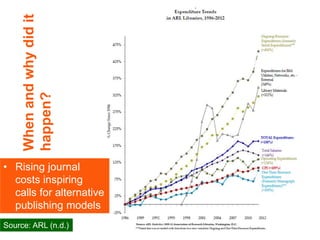
Whenandwhydidit
happen?
4
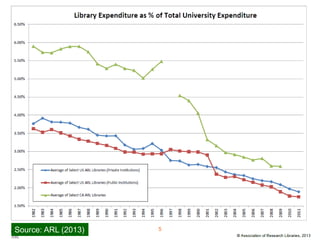
• Rising journal
costs inspiring
calls for alternative
publishing models
Source: ARL (n.d.)
5Source: ARL (2013)
Collection size rapidly losing importance…
• Even the wealthiest academic libraries are abandoning
the “collection arms race” as the value of physical
resources declines. Increasingly, libraries must adapt to
a world in which providing access to—rather than
ownership of—scholarly resources is their primary
role. (Education Advisory Board, 2011)
6
Other Early Influences
• Currently, access to research is restricted and the
means to gain access are determined by a market in
which a small number of publishers have a dominant
position. (The Wellcome Trust, 2003)
• It is not for either publishers or academics to decide who
should, and who should not, be allowed to read scientific
journal articles. It is in society’s interest that public
understanding of science should increase. Increased
public access to research findings should be encouraged
by publishers, academics and Government alike. (House
of Commons Science and Technology Committee, 2004)
7
8
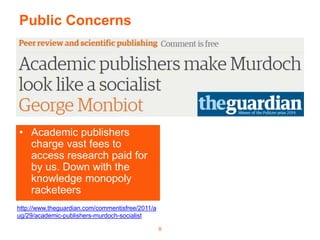
• Academic publishers
charge vast fees to
access research paid for
by us. Down with the
knowledge monopoly
racketeers
Public Concerns
http://www.theguardian.com/commentisfree/2011/a
ug/29/academic-publishers-murdoch-socialist
9
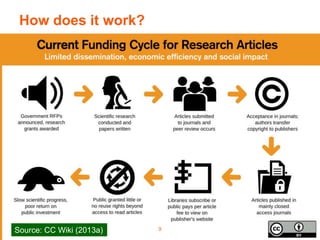
How does it work?
Source: CC Wiki (2013a)
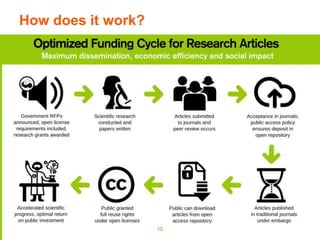
How does it work?
10
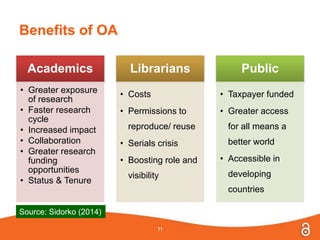
Benefits of OA
11
Academics
• Greater exposure
of research
• Faster research
cycle
• Increased impact
• Collaboration
• Greater research
funding
opportunities
• Status & Tenure
Librarians
• Costs
• Permissions to
reproduce/ reuse
• Serials crisis
• Boosting role and
visibility
Public
• Taxpayer funded
• Greater access
for all means a
better world
• Accessible in
developing
countries
Source: Sidorko (2014)
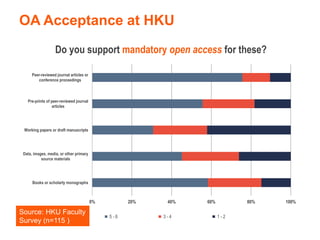
OA Acceptance at HKU
0% 20% 40% 60% 80% 100%
Peer-reviewed journal articles or
conference proceedings
Pre-prints of peer-reviewed journal
articles
Working papers or draft manuscripts
Data, images, media, or other primary
source materials
Books or scholarly monographs
Do you support mandatory open access for these?
5 - 6 3 - 4 1 - 2
Source: HKU Faculty
Survey (n=115 )
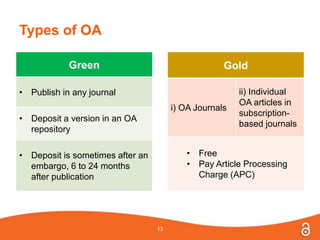
Types of OA
Green
• Publish in any journal
• Deposit a version in an OA
repository
• Deposit is sometimes after an
embargo, 6 to 24 months
after publication
13
Gold
i) OA Journals
ii) Individual
OA articles in
subscription-
based journals
• Free
• Pay Article Processing
Charge (APC)
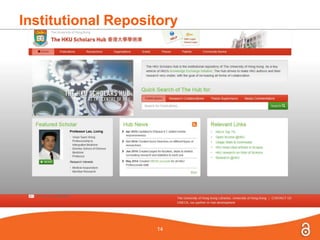
Institutional Repository
14
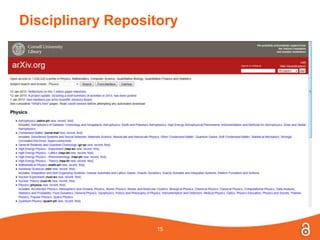
Disciplinary Repository
15
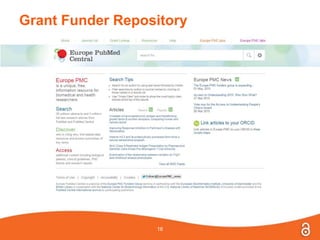
Grant Funder Repository
16
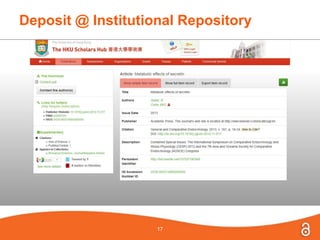
Deposit @ Institutional Repository
17
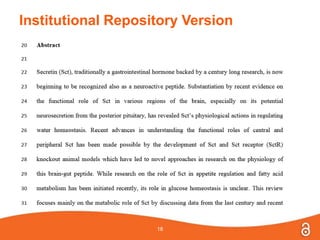
Institutional Repository Version
18
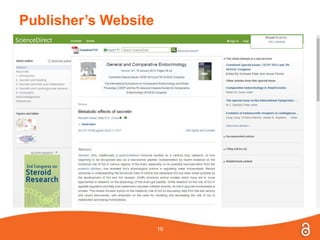
Publisher’s Website
19
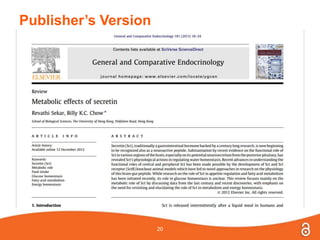
Publisher’s Version
20
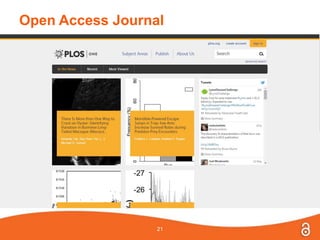
Open Access Journal
21
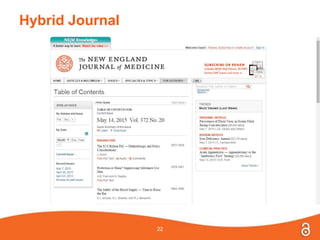
Hybrid Journal
22
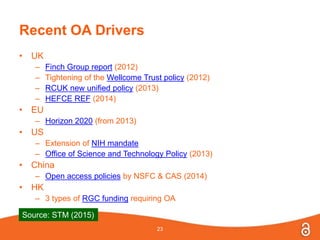
Recent OA Drivers
• UK
– Finch Group report (2012)
– Tightening of the Wellcome Trust policy (2012)
– RCUK new unified policy (2013)
– HEFCE REF (2014)
• EU
– Horizon 2020 (from 2013)
• US
– Extension of NIH mandate
– Office of Science and Technology Policy (2013)
• China
– Open access policies by NSFC & CAS (2014)
• HK
– 3 types of RGC funding requiring OA
23
Source: STM (2015)
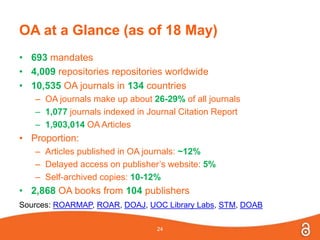
OA at a Glance (as of 18 May)
• 693 mandates
• 4,009 repositories repositories worldwide
• 10,535 OA journals in 134 countries
– OA journals make up about 26-29% of all journals
– 1,077 journals indexed in Journal Citation Report
– 1,903,014 OA Articles
• Proportion:
– Articles published in OA journals: ~12%
– Delayed access on publisher’s website: 5%
– Self-archived copies: 10-12%
• 2,868 OA books from 104 publishers
24
Sources: ROARMAP, ROAR, DOAJ, UOC Library Labs, STM, DOAB
OPEN EDUCATION RESOURCES
Open Educational Resources (OER)
• Open Educational Resources (OERs) are any type of
educational materials that are in the public domain or
introduced with an open license. The nature of these
open materials means that anyone can legally and
freely copy, use, adapt and re-share them.
• OERs range from textbooks to curricula, syllabi, lecture
notes, assignments, tests, projects, audio, video and
animation.
26
Source: UNESCO (n.d.)
Why OER?
• More pickup of assigned class materials
• Greater savings
• More students
• No more updates
• Personalize examples
• Integrate disciplines
But…OER means more work!
27
Source: Schaffhauser (2014)
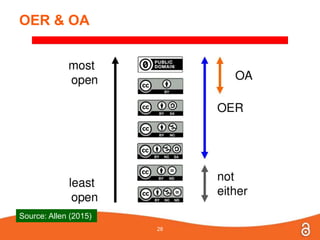
OER & OA
28
Source: Allen (2015)
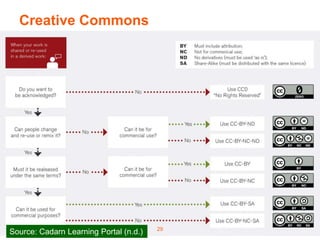
Creative Commons
29
Source: Cadarn Learning Portal (n.d.)
Re-examining OER & OA
• OA, Open Data and OER movements all emphasize the
need to enable unobstructed digital reuse of these
materials, to fully exploit the power - and the value - of
the information they contain.
• Understanding the implications that a larger vision of
“open” as the default mode for research, teaching and
learning materials can have is crucial.
30
Source: Joseph (2015)
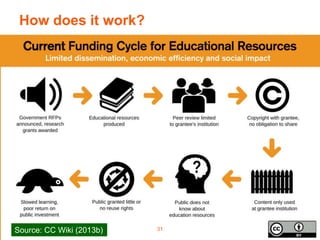
How does it work?
31Source: CC Wiki (2013b)
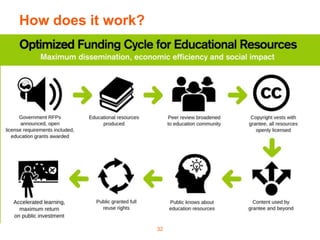
How does it work?
32
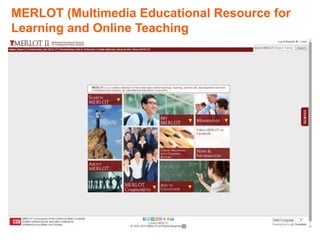
MERLOT (Multimedia Educational Resource for
Learning and Online Teaching
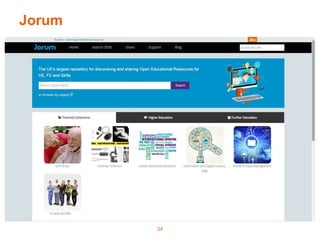
Jorum
34
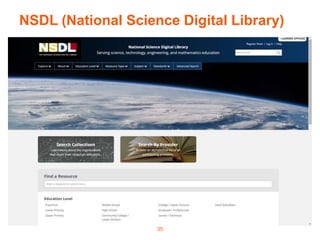
NSDL (National Science Digital Library)
35
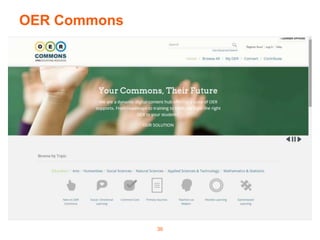
OER Commons
36
OPEN DATA
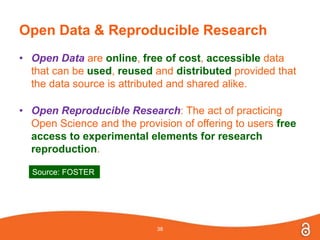
Open Data & Reproducible Research
• Open Data are online, free of cost, accessible data
that can be used, reused and distributed provided that
the data source is attributed and shared alike.
• Open Reproducible Research: The act of practicing
Open Science and the provision of offering to users free
access to experimental elements for research
reproduction.
38
Source: FOSTER
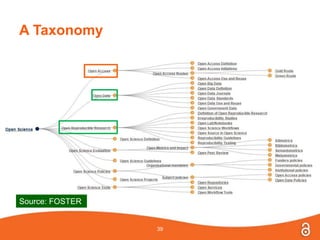
A Taxonomy
39
Source: FOSTER
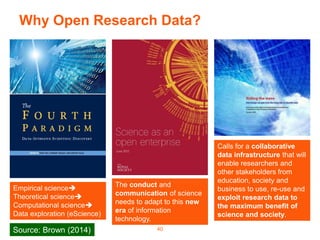
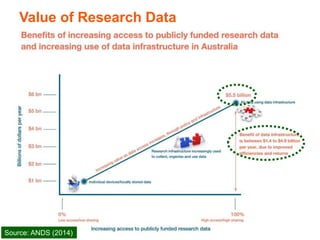
Why Open Research Data?
40
Calls for a collaborative
data infrastructure that will
enable researchers and
other stakeholders from
education, society and
business to use, re-use and
exploit research data to
the maximum benefit of
science and society.
The conduct and
communication of science
needs to adapt to this new
era of information
technology.
Empirical science
Theoretical science
Computational science
Data exploration (eScience)
Source: Brown (2014)
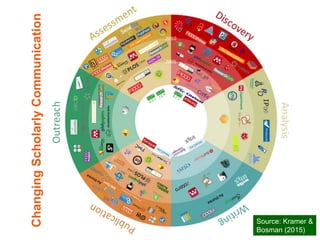
ChangingScholarlyCommunication
41
Source: Kramer &
Bosman (2015)
Value of Research Data
Source: ANDS (2014)
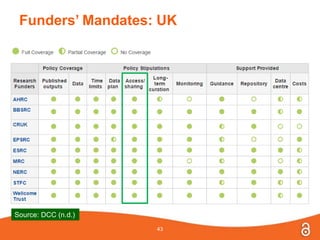
Funders’ Mandates: UK
43
Source: DCC (n.d.)
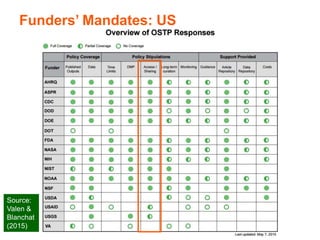
Funders’ Mandates: US
44
Source:
Valen &
Blanchat
(2015)
OA REALITY
Objections to Open Access
• Misconception that OA journals are not subject to the
same rigorous peer-review process as traditional
journals.
• Promotion and tenure are inexplicably intertwined with
the notion of publishing in established, “brand name”
journal titles (Nosek & Bar-Anan, 2012).
• Fees (APC – article processing charges) for Gold OA are
significant and subsidies not always clear.
• Suitability for all disciplines?
• Shifting support ($s) from “creation of knowledge to the
dissemination of knowledge”.
46
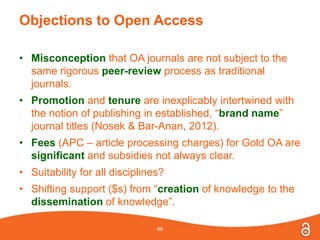
Concerns on Quality...
http://www.nature.com/news/open-access-website-gets-tough-1.15674
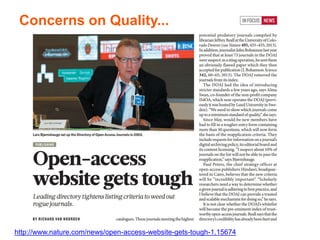
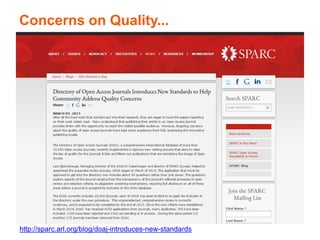
Concerns on Quality...
http://sparc.arl.org/blog/doaj-introduces-new-standards
49
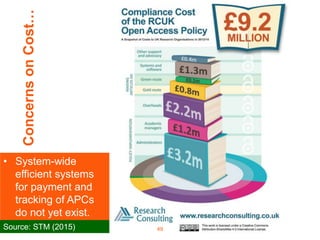
ConcernsonCost…
• System-wide
efficient systems
for payment and
tracking of APCs
do not yet exist.
Source: STM (2015)
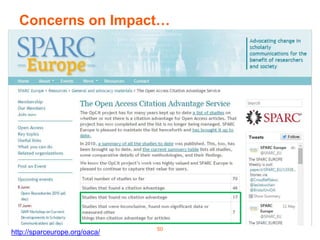
Concerns on Impact…
50
http://sparceurope.org/oaca/
Predatory OA Publishers…
• Beall’s List: Evaluate potential, possible, or probable
predatory scholarly OA publishers based on
– Editor and Staff
– Business management
– Integrity
– Poor journal standards / practice
– Other
• 797 publishers! (18 May 2015)
• 658 stand-alone journals! (14 May 2015)
51
OA @ HKU
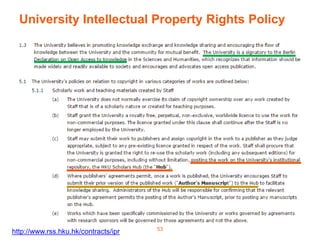
University Intellectual Property Rights Policy
53
http://www.rss.hku.hk/contracts/ipr
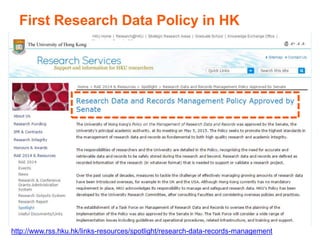
First Research Data Policy in HK
http://www.rss.hku.hk/links-resources/spotlight/research-data-records-management
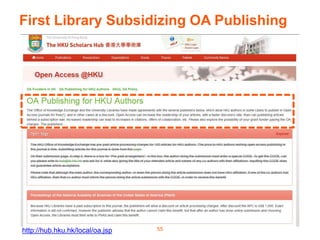
First Library Subsidizing OA Publishing
55http://hub.hku.hk/local/oa.jsp
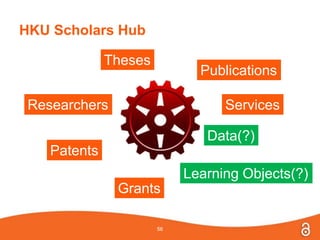
HKU Scholars Hub
56
Theses
Publications
Researchers
Patents
Grants
Data(?)
Services
Learning Objects(?)
Q & A
29 May 2015
References
• Allen, N. (2015). Open Educational Resources Overview (UT Austin, 4/6/15). Retrieved from
http://www.slideshare.net/txtbks/open-educational-resources-overview-at-ut-system-advisory-committee-on-library-
affairs
• ANDS. (2014). Open Research Data Report. Retrieved from http://ands.org.au//resource/open-research-data.html
• ARL. (2013). Library Expenditure as % of Total University Expenditure 1982-2011. Retrieved from
http://www.libqual.org/documents/admin/EG_4.pdf
• ARL. (n.d.). Expenditure Trends in ARL Libraries 1986-2012. Retrieved from
http://www.arl.org/storage/documents/expenditure-trends.pdf
• Brown, C. (2014). Open Research Data –A Jisc Perspective. Retrieved from
http://library2.epfl.ch/files/content/sites/library2/files/vie-culturelle/conference/OpenData/Presentations/JISC.pdf
• Cadarn Learning Portal. (n.d.). Brief Guide to Choosing Creative Commons Licenses. Retrieved from
http://www.cadarn.ac.uk/production/resource/brief-guide-choosing-creative-commons-licenses
• CC Wiki. (2013a). Research articles cycles. Retrieved from
https://wiki.creativecommons.org/File:Research_articles_cycles.jpg
• CC Wiki. (2013b). Educational resources cycles. Retrieved from
https://wiki.creativecommons.org/File:Educational_resources_cycles.jpg
• DCC. (n.d.). Overview of funders' data policies. Retrieved from http://www.dcc.ac.uk/resources/policy-and-
legal/overview-funders-data-policies
• Education Advisory Board. (2011). Redefining the Academic Library: Managing the Migration to Digital Information
Services. Retrieved from
http://www.fullerton.edu/senate/meetings/retreat/Redefining%20the%20Academic%20Library%20-
%20Matthew%20Pellish%20CSU%20Fullerton%208-16-11,%2051%20pgs.pdf
• FOSTER. (n.d.). Facilitate Open Science Training for European Research (FOSTER). Retrieved from
https://www.fosteropenscience.eu/
58
References
• House of Commons Science and Technology Committee. (2004). Scientific Publications: Free for all?. Retrieved
from http://www.publications.parliament.uk/pa/cm200304/cmselect/cmsctech/399/399.pdf
• Joseph, H. (2015, March). Open Expansion: The Intersection of Open Access, Open Data and OER. Paper
presented at 2015 ACRL Annual Conference, Portland, OR. Retrieved from
http://www.sparc.arl.org/resource/open-expansion-%0B-intersection-open-access-open-data-and-oer
• Kramer, B. & Bosman, J. (2015). 101 Innovations in Scholarly Communication - the Changing Research Workflow.
figshare. http://dx.doi.org/10.6084/m9.figshare.1286826
• Nosek, B. A., & Bar-Anan, Y. (2012). Scientific Utopia: I. Opening Scientific Communication. Psychological Inquiry,
23(3), 217-243. doi: 10.1080/1047840X.2012.692215
• Schaffhauser, D. (2014). 6 Arguments for OER (and 1 Against). Retrieved from
http://campustechnology.com/articles/2014/08/27/6-arguments-for-oer-and-1-against.aspx
• Sidorko, P. (2014). Current Issues in Library Collections. Retrieved from http://hdl.handle.net/10722/198286
• SPARC. (n.d.). Open Access. Retrieved from http://www.sparc.arl.org/issues/open-access
• STM. (2015). The STM Report, Fourth Edition. Retrieved from http://www.stm-
assoc.org/2015_02_20_STM_Report_2015.pdf
• The Wellcome Trust. (2003). Economic analysis of scientific research publishing. Retrieved from
http://www.wellcome.ac.uk/stellent/groups/corporatesite/@policy_communications/documents/web_document/wtd
003182.pdf
• UNESCO. (n.d.). What are Open Educational Resources (OERs)?. Retrieved from
http://www.unesco.org/new/en/communication-and-information/access-to-knowledge/open-educational-
resources/what-are-open-educational-resources-oers/
• Valen, D. & Blanchat, K. (2015). Overview of OSTP Responses. figshare.
http://dx.doi.org/10.6084/m9.figshare.1367165
59

G:\CITERS2015\29May2015\2 Invited-Talk-2-Sidorko-Fred

  • 1.
    Promises & Reality PeterSidorko, Fred Chan University of Hong Kong Libraries 29 May 2015
  • 2.
    Outline • Open Access(OA) – Concept & Elements – History & Development • Open Education Resources (OER) • Open Data & Reproducible Research • Reality of OA • OA @ HKU 2
  • 3.
    Definition • Open Accessis the free, immediate, online availability of research articles, coupled with the rights to use these articles fully in the digital environment. (SPARC, n.d.) 3
  • 4.
    Whenandwhydidit happen? 4 • Rising journal costsinspiring calls for alternative publishing models Source: ARL (n.d.)
  • 5.
  • 6.
    Collection size rapidlylosing importance… • Even the wealthiest academic libraries are abandoning the “collection arms race” as the value of physical resources declines. Increasingly, libraries must adapt to a world in which providing access to—rather than ownership of—scholarly resources is their primary role. (Education Advisory Board, 2011) 6
  • 7.
    Other Early Influences •Currently, access to research is restricted and the means to gain access are determined by a market in which a small number of publishers have a dominant position. (The Wellcome Trust, 2003) • It is not for either publishers or academics to decide who should, and who should not, be allowed to read scientific journal articles. It is in society’s interest that public understanding of science should increase. Increased public access to research findings should be encouraged by publishers, academics and Government alike. (House of Commons Science and Technology Committee, 2004) 7
  • 8.
    8 • Academic publishers chargevast fees to access research paid for by us. Down with the knowledge monopoly racketeers Public Concerns http://www.theguardian.com/commentisfree/2011/a ug/29/academic-publishers-murdoch-socialist
  • 9.
    9 How does itwork? Source: CC Wiki (2013a)
  • 10.
    How does itwork? 10
  • 11.
    Benefits of OA 11 Academics •Greater exposure of research • Faster research cycle • Increased impact • Collaboration • Greater research funding opportunities • Status & Tenure Librarians • Costs • Permissions to reproduce/ reuse • Serials crisis • Boosting role and visibility Public • Taxpayer funded • Greater access for all means a better world • Accessible in developing countries Source: Sidorko (2014)
  • 12.
    OA Acceptance atHKU 0% 20% 40% 60% 80% 100% Peer-reviewed journal articles or conference proceedings Pre-prints of peer-reviewed journal articles Working papers or draft manuscripts Data, images, media, or other primary source materials Books or scholarly monographs Do you support mandatory open access for these? 5 - 6 3 - 4 1 - 2 Source: HKU Faculty Survey (n=115 )
  • 13.
    Types of OA Green •Publish in any journal • Deposit a version in an OA repository • Deposit is sometimes after an embargo, 6 to 24 months after publication 13 Gold i) OA Journals ii) Individual OA articles in subscription- based journals • Free • Pay Article Processing Charge (APC)
  • 14.
  • 15.
  • 16.
  • 17.
  • 18.
  • 19.
  • 20.
  • 21.
  • 22.
  • 23.
    Recent OA Drivers •UK – Finch Group report (2012) – Tightening of the Wellcome Trust policy (2012) – RCUK new unified policy (2013) – HEFCE REF (2014) • EU – Horizon 2020 (from 2013) • US – Extension of NIH mandate – Office of Science and Technology Policy (2013) • China – Open access policies by NSFC & CAS (2014) • HK – 3 types of RGC funding requiring OA 23 Source: STM (2015)
  • 24.
    OA at aGlance (as of 18 May) • 693 mandates • 4,009 repositories repositories worldwide • 10,535 OA journals in 134 countries – OA journals make up about 26-29% of all journals – 1,077 journals indexed in Journal Citation Report – 1,903,014 OA Articles • Proportion: – Articles published in OA journals: ~12% – Delayed access on publisher’s website: 5% – Self-archived copies: 10-12% • 2,868 OA books from 104 publishers 24 Sources: ROARMAP, ROAR, DOAJ, UOC Library Labs, STM, DOAB
  • 25.
  • 26.
    Open Educational Resources(OER) • Open Educational Resources (OERs) are any type of educational materials that are in the public domain or introduced with an open license. The nature of these open materials means that anyone can legally and freely copy, use, adapt and re-share them. • OERs range from textbooks to curricula, syllabi, lecture notes, assignments, tests, projects, audio, video and animation. 26 Source: UNESCO (n.d.)
  • 27.
    Why OER? • Morepickup of assigned class materials • Greater savings • More students • No more updates • Personalize examples • Integrate disciplines But…OER means more work! 27 Source: Schaffhauser (2014)
  • 28.
    OER & OA 28 Source:Allen (2015)
  • 29.
    Creative Commons 29 Source: CadarnLearning Portal (n.d.)
  • 30.
    Re-examining OER &OA • OA, Open Data and OER movements all emphasize the need to enable unobstructed digital reuse of these materials, to fully exploit the power - and the value - of the information they contain. • Understanding the implications that a larger vision of “open” as the default mode for research, teaching and learning materials can have is crucial. 30 Source: Joseph (2015)
  • 31.
    How does itwork? 31Source: CC Wiki (2013b)
  • 32.
    How does itwork? 32
  • 33.
    MERLOT (Multimedia EducationalResource for Learning and Online Teaching
  • 34.
  • 35.
    NSDL (National ScienceDigital Library) 35
  • 36.
  • 37.
  • 38.
    Open Data &Reproducible Research • Open Data are online, free of cost, accessible data that can be used, reused and distributed provided that the data source is attributed and shared alike. • Open Reproducible Research: The act of practicing Open Science and the provision of offering to users free access to experimental elements for research reproduction. 38 Source: FOSTER
  • 39.
  • 40.
    Why Open ResearchData? 40 Calls for a collaborative data infrastructure that will enable researchers and other stakeholders from education, society and business to use, re-use and exploit research data to the maximum benefit of science and society. The conduct and communication of science needs to adapt to this new era of information technology. Empirical science Theoretical science Computational science Data exploration (eScience) Source: Brown (2014)
  • 41.
  • 42.
    Value of ResearchData Source: ANDS (2014)
  • 43.
  • 44.
  • 45.
  • 46.
    Objections to OpenAccess • Misconception that OA journals are not subject to the same rigorous peer-review process as traditional journals. • Promotion and tenure are inexplicably intertwined with the notion of publishing in established, “brand name” journal titles (Nosek & Bar-Anan, 2012). • Fees (APC – article processing charges) for Gold OA are significant and subsidies not always clear. • Suitability for all disciplines? • Shifting support ($s) from “creation of knowledge to the dissemination of knowledge”. 46
  • 47.
  • 48.
  • 49.
    49 ConcernsonCost… • System-wide efficient systems forpayment and tracking of APCs do not yet exist. Source: STM (2015)
  • 50.
  • 51.
    Predatory OA Publishers… •Beall’s List: Evaluate potential, possible, or probable predatory scholarly OA publishers based on – Editor and Staff – Business management – Integrity – Poor journal standards / practice – Other • 797 publishers! (18 May 2015) • 658 stand-alone journals! (14 May 2015) 51
  • 52.
  • 53.
    University Intellectual PropertyRights Policy 53 http://www.rss.hku.hk/contracts/ipr
  • 54.
    First Research DataPolicy in HK http://www.rss.hku.hk/links-resources/spotlight/research-data-records-management
  • 55.
    First Library SubsidizingOA Publishing 55http://hub.hku.hk/local/oa.jsp
  • 56.
  • 57.
    Q & A 29May 2015
  • 58.
    References • Allen, N.(2015). Open Educational Resources Overview (UT Austin, 4/6/15). Retrieved from http://www.slideshare.net/txtbks/open-educational-resources-overview-at-ut-system-advisory-committee-on-library- affairs • ANDS. (2014). Open Research Data Report. Retrieved from http://ands.org.au//resource/open-research-data.html • ARL. (2013). Library Expenditure as % of Total University Expenditure 1982-2011. Retrieved from http://www.libqual.org/documents/admin/EG_4.pdf • ARL. (n.d.). Expenditure Trends in ARL Libraries 1986-2012. Retrieved from http://www.arl.org/storage/documents/expenditure-trends.pdf • Brown, C. (2014). Open Research Data –A Jisc Perspective. Retrieved from http://library2.epfl.ch/files/content/sites/library2/files/vie-culturelle/conference/OpenData/Presentations/JISC.pdf • Cadarn Learning Portal. (n.d.). Brief Guide to Choosing Creative Commons Licenses. Retrieved from http://www.cadarn.ac.uk/production/resource/brief-guide-choosing-creative-commons-licenses • CC Wiki. (2013a). Research articles cycles. Retrieved from https://wiki.creativecommons.org/File:Research_articles_cycles.jpg • CC Wiki. (2013b). Educational resources cycles. Retrieved from https://wiki.creativecommons.org/File:Educational_resources_cycles.jpg • DCC. (n.d.). Overview of funders' data policies. Retrieved from http://www.dcc.ac.uk/resources/policy-and- legal/overview-funders-data-policies • Education Advisory Board. (2011). Redefining the Academic Library: Managing the Migration to Digital Information Services. Retrieved from http://www.fullerton.edu/senate/meetings/retreat/Redefining%20the%20Academic%20Library%20- %20Matthew%20Pellish%20CSU%20Fullerton%208-16-11,%2051%20pgs.pdf • FOSTER. (n.d.). Facilitate Open Science Training for European Research (FOSTER). Retrieved from https://www.fosteropenscience.eu/ 58
  • 59.
    References • House ofCommons Science and Technology Committee. (2004). Scientific Publications: Free for all?. Retrieved from http://www.publications.parliament.uk/pa/cm200304/cmselect/cmsctech/399/399.pdf • Joseph, H. (2015, March). Open Expansion: The Intersection of Open Access, Open Data and OER. Paper presented at 2015 ACRL Annual Conference, Portland, OR. Retrieved from http://www.sparc.arl.org/resource/open-expansion-%0B-intersection-open-access-open-data-and-oer • Kramer, B. & Bosman, J. (2015). 101 Innovations in Scholarly Communication - the Changing Research Workflow. figshare. http://dx.doi.org/10.6084/m9.figshare.1286826 • Nosek, B. A., & Bar-Anan, Y. (2012). Scientific Utopia: I. Opening Scientific Communication. Psychological Inquiry, 23(3), 217-243. doi: 10.1080/1047840X.2012.692215 • Schaffhauser, D. (2014). 6 Arguments for OER (and 1 Against). Retrieved from http://campustechnology.com/articles/2014/08/27/6-arguments-for-oer-and-1-against.aspx • Sidorko, P. (2014). Current Issues in Library Collections. Retrieved from http://hdl.handle.net/10722/198286 • SPARC. (n.d.). Open Access. Retrieved from http://www.sparc.arl.org/issues/open-access • STM. (2015). The STM Report, Fourth Edition. Retrieved from http://www.stm- assoc.org/2015_02_20_STM_Report_2015.pdf • The Wellcome Trust. (2003). Economic analysis of scientific research publishing. Retrieved from http://www.wellcome.ac.uk/stellent/groups/corporatesite/@policy_communications/documents/web_document/wtd 003182.pdf • UNESCO. (n.d.). What are Open Educational Resources (OERs)?. Retrieved from http://www.unesco.org/new/en/communication-and-information/access-to-knowledge/open-educational- resources/what-are-open-educational-resources-oers/ • Valen, D. & Blanchat, K. (2015). Overview of OSTP Responses. figshare. http://dx.doi.org/10.6084/m9.figshare.1367165 59

Editor's Notes

  • #4 http://www.sparc.arl.org/issues/open-access
  • #5 http://www.arl.org/storage/documents/expenditure-trends.pdf
  • #6 http://www.libqual.org/documents/admin/EG_4.pdf
  • #7 http://www.fullerton.edu/senate/meetings/retreat/Redefining%20the%20Academic%20Library%20-%20Matthew%20Pellish%20CSU%20Fullerton%208-16-11,%2051%20pgs.pdf
  • #8 http://www.wellcome.ac.uk/stellent/groups/corporatesite/@policy_communications/documents/web_document/wtd003182.pdf http://www.publications.parliament.uk/pa/cm200304/cmselect/cmsctech/399/399.pdf
  • #9 http://www.theguardian.com/commentisfree/2011/aug/29/academic-publishers-murdoch-socialist
  • #10 https://wiki.creativecommons.org/File:Research_articles_cycles.jpg
  • #11 https://wiki.creativecommons.org/File:Research_articles_cycles.jpg
  • #15 http://hub.hku.hk/
  • #16 arXiv RePEc MEDLINE PubMed Central  AgEcon: Agriculture and Applied Economics (http://ageconsearch.umn.edu/)  Astrophysics Data System - Astrophysics (http://adswww.harvard.edu/)  CiteSeer - Computer and Information Science (http://citeseerx.ist.psu.edu/index)  Dryad - Biosciences (http://datadryad.org/)  PhilPapers - Philosophy (http://philpapers.org/)  Social Science Research Network - Social Sciences (http://www.ssrn.com/en/)
  • #17 http://europepmc.org/
  • #22 http://www.plosone.org/
  • #23 http://www.nejm.org/
  • #24 From STM Report http://www.stm-assoc.org/2015_02_20_STM_Report_2015.pdf
  • #25 http://roarmap.eprints.org/ http://roar.eprints.org/ https://doaj.org/ http://labs.biblioteca.uoc.edu/test/doaj/index.html STEM Report http://www.doabooks.org/
  • #27 http://www.unesco.org/new/en/communication-and-information/access-to-knowledge/open-educational-resources/what-are-open-educational-resources-oers/
  • #28 http://campustechnology.com/articles/2014/08/27/6-arguments-for-oer-and-1-against.aspx
  • #29 http://www.slideshare.net/txtbks/open-educational-resources-overview-at-ut-system-advisory-committee-on-library-affairs
  • #30 http://www.cadarn.ac.uk/production/resource/brief-guide-choosing-creative-commons-licenses
  • #31 http://www.sparc.arl.org/resource/open-expansion-%0B-intersection-open-access-open-data-and-oer
  • #32 https://wiki.creativecommons.org/File:Educational_resources_cycles.jpg
  • #33 https://wiki.creativecommons.org/File:Educational_resources_cycles.jpg
  • #34 http://www.merlot.org/merlot/index.htm
  • #35 http://www.jorum.ac.uk/
  • #36 https://nsdl.oercommons.org/
  • #37 https://www.oercommons.org/
  • #39 https://www.fosteropenscience.eu/taxonomy/term/6 https://www.fosteropenscience.eu/foster-taxonomy/open-science
  • #41 http://research.microsoft.com/en-us/collaboration/fourthparadigm/4th_paradigm_book_complete_lr.pdf http://royalsociety.org/policy/projects/science-public-enterprise/report/ http://cordis.europa.eu/fp7/ict/e-infrastructure/docs/hlg-sdi-report.pdf http://library2.epfl.ch/files/content/sites/library2/files/vie-culturelle/conference/OpenData/Presentations/JISC.pdf
  • #42 https://innoscholcomm.silk.co/
  • #43 http://ands.org.au//resource/open-research-data.html
  • #44 http://www.dcc.ac.uk/resources/policy-and-legal/overview-funders-data-policies
  • #45 http://figshare.com/articles/Overview_of_OSTP_Responses/1367165
  • #47 Nosek, B. A., & Bar-Anan, Y. (2012). Scientific Utopia: I. Opening Scientific Communication. Psychological Inquiry, 23(3), 217-243. doi: 10.1080/1047840X.2012.692215
  • #48 http://www.nature.com/news/open-access-website-gets-tough-1.15674
  • #49 http://sparc.arl.org/blog/doaj-introduces-new-standards
  • #50 http://www.researchconsulting.co.uk/wp-content/uploads/2014/11/compliance-costs-OA-CC-license.jpg STM Report
  • #51 http://sparceurope.org/oaca/
  • #52 http://scholarlyoa.com/publishers/
  • #54 http://www.rss.hku.hk/contracts/ipr
  • #55 http://www.rss.hku.hk/links-resources/spotlight/research-data-records-management
  • #56 http://hub.hku.hk/local/oa.jsp