Modernizing Education
The State of Teaching and Learning in the 21st Century
Lucy Gray
Interlochen Arts Academy
April 2, 2012
http://www.lucygray.org
All materials are located at:
http://www.lucygray.org
Specific to this keynote:
http://sg.sg/modernizingedu
Additional resources:
http://groups.diigo.com/group/high-school-stuff
Join the backchannel at:
http://todaysmeet.com/interlochentech
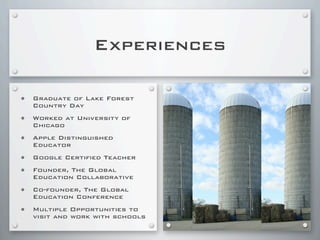
Experiences
• Graduate of Lake Forest
Country Day
• Worked at University of
Chicago
• Apple Distinguished
Educator
• Google Certified Teacher
• Founder, The Global
Education Collaborative
• Co-founder, The Global
Education Conference
• Multiple Opportunities to
visit and work with schools
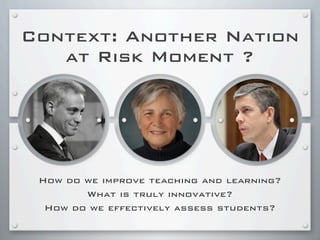
Context: Another Nation
at Risk Moment ?
How do we improve teaching and learning?
What is truly innovative?
How do we effectively assess students?
The Power of Social
Media
Flickr
YouTubeTwitter Facebook
LinkedIn Google+
Diigo
SlideShare
SOCIAL MEDIA WORKSHOP
AT BOARD RETREAT
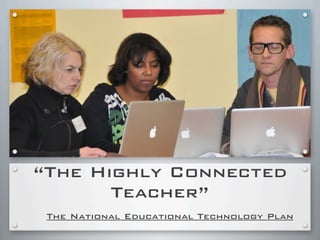
“The Highly Connected
Teacher”
The National Educational Technology Plan
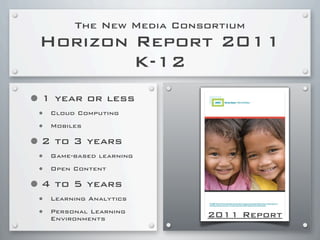
The K12 Horizon Report
The New Media Consortium
Horizon Report 2011
K-12
•1 year or less
• Cloud Computing
• Mobiles
•2 to 3 years
• Game-based learning
• Open Content
•4 to 5 years
• Learning Analytics
• Personal Learning
Environments 2011 Report
Megatrends
People expect to work, learn, socialize,
and play whenever and wherever they
want to.
Megatrends
The Internet is becoming a global
mobile network - and already is at its
edges.
Megatrends
The technologies we use are
increasingly cloud-based and delivered
over utility networks, facilitating the
rapid growth of online videos and rich
media.
Megatrends
Openness — concepts like open
content, open data, and open
resources — is moving from a trend to
a value for much of the world.
Megatrends
Legal notions of ownership and privacy
lag behind the practices common in
society. The very concept of ownership
is blurry.
Megatrends
Real challenges of access, efficiency, and
scale are redefining what we mean by
quality and success. Access to learning in
any form is a challenge in too many parts
of the world, and efficiency in learning
systems and institutions is increasingly an
expectation of governments.
Megatrends
The Internet is constantly challenging
us to rethink learning and education,
while refining our notion of literacy.
Megatrends
There is a rise in informal learning as
individual needs are redefining schools,
universities, and training. Traditional
authority is increasingly being
challenged in many arenas.
Megatrends
Business models across the education
ecosystem are changing. Look to
libraries, colleges, and the publishing
industry.
Why Change?
Why Evolve?
Shift Happens: Iowa, Did You Know?
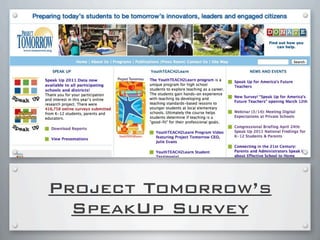
Project Tomorrow’s
SpeakUp Survey
Project Tomorrow
Recommendations
• Un-tether learning and leverage mobile devices to extend
learning beyond the school day and meet all learners in their
own world
• Create new interactive, participatory learning spaces using
tools such as online classes, gaming and simulations, online
tutors, and virtual reality environments
• Incorporate Web 2.0 tools into daily instruction especially
those that develop collaborative or social-based learning and
provide unique opportunities for students to be content
developers
• Expand digital resources in the classroom to add context and
relevancy to learning experiences through new media tools
• Get beyond the classroom walls and make learning truly
experiential such as using high tech science instrumentation
and creating podcasts with content experts
Via John Pfluger
The Reality
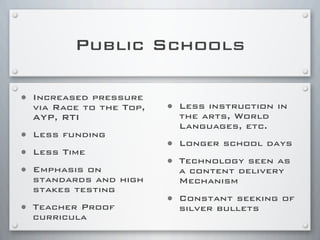
Public Schools
• Increased pressure
via Race to the Top,
AYP, RTI
• Less funding
• Less Time
• Emphasis on
standards and high
stakes testing
• Teacher Proof
curricula
• Less instruction in
the arts, World
Languages, etc.
• Longer school days
• Technology seen as
a content delivery
Mechanism
• Constant seeking of
silver bullets
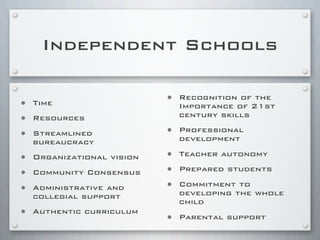
Independent Schools
• Time
• Resources
• Streamlined
bureaucracy
• Organizational vision
• Community Consensus
• Administrative and
collegial support
• Authentic curriculum
• Recognition of the
Importance of 21st
century skills
• Professional
development
• Teacher autonomy
• Prepared students
• Commitment to
developing the whole
child
• Parental support
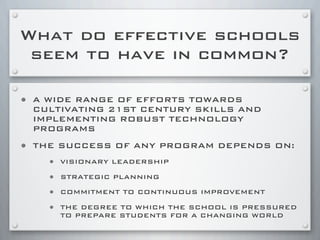
What do effective schools
seem to have in common?
• A WIDE RANGE OF EFFORTS TOWARDS
CULTIVATING 21ST CENTURY SKILLS AND
IMPLEMENTING ROBUST TECHNOLOGY
PROGRAMS
• THE SUCCESS OF ANY PROGRAM DEPENDS ON:
• VISIONARY LEADERSHIP
• STRATEGIC PLANNING
• COMMITMENT TO CONTINUOUS IMPROVEMENT
• THE DEGREE TO WHICH THE SCHOOL IS PRESSURED
TO PREPARE STUDENTS FOR A CHANGING WORLD
Greene County Schools
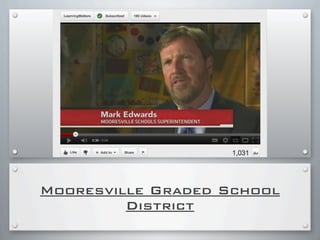
Mooresville Graded School
District
My Experience as a
Parent
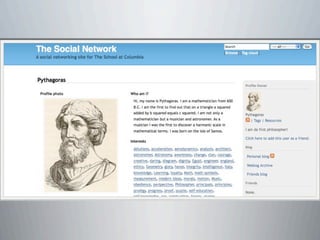
The School at Columbia
• K-8
• Columbia University faculty and local kids
• Innovation driven
• 1 to 1 laptop program
• 3 technologists plus tech staff
• Extensive Google Apps for Education and new
media use
• Other: field trip guides, computer programming,
robotics, conference
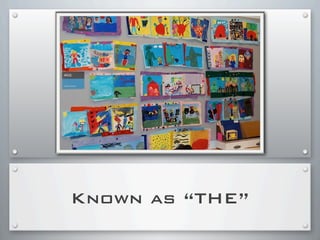
Known as “THE”
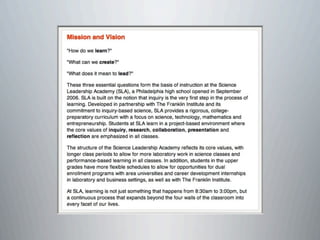
Science Leadership
Academy
Educon 2.4
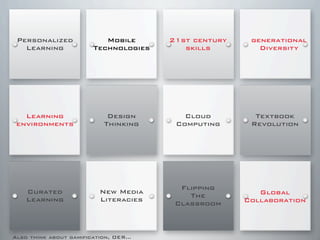
Personalized
Learning
Mobile
Technologies
21st century
skills
generational
Diversity
Learning
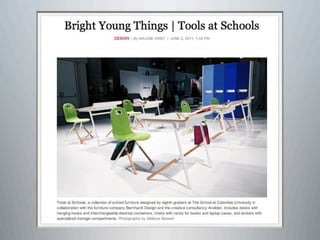
environments
Design
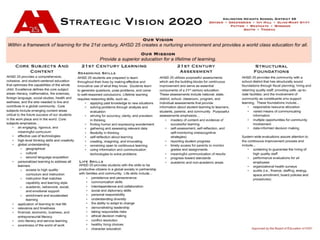
Thinking
Cloud
Computing
Textbook
Revolution
Curated
Learning
New Media
Literacies
Flipping
The
Classroom
Global
Collaboration
Also think about gamification, OER...
21st Century Skills
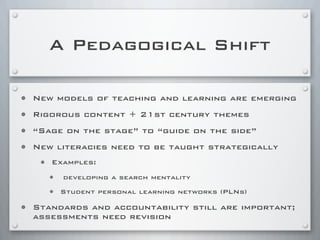
A Pedagogical Shift
• New models of teaching and learning are emerging
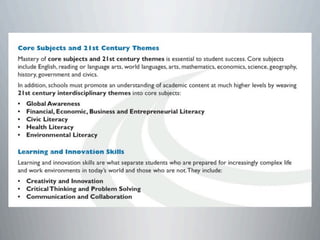
• Rigorous content + 21st century themes
• “Sage on the stage” to “guide on the side”
• New literacies need to be taught strategically
• Examples:
• developing a search mentality
• Student personal learning networks (PLNs)
• Standards and accountability still are important;
assessments need revision
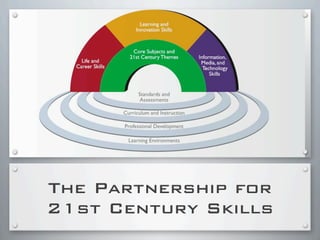
The Partnership for
21st Century Skills
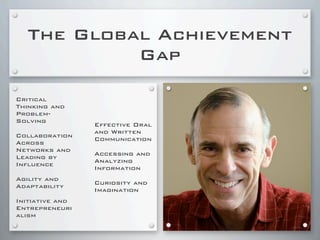
The Global Achievement
Gap
Critical
Thinking and
Problem-
Solving
Collaboration
Across
Networks and
Leading by
Influence
Agility and
Adaptability
Initiative and
Entrepreneuri
alism
Effective Oral
and Written
Communication
Accessing and
Analyzing
Information
Curiosity and
Imagination
Managing
Generational Diversity
Teachers and Students
• Adults have different learning styles. How
are we taking this into account in terms of
professional development and human capital?
• Baby Boomers
• Gen Xers
• Gen Yers
• Kids have had different levels of exposure to
technology. The period of time at which our
schools have been wired is fairly short.
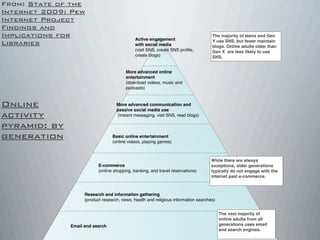
Basic online entertainment
(online videos, playing games)
E-commerce
(online shopping, banking, and travel reservations)
Research and information gathering
(product research, news, health and religious information searches)
Email and search
Active engagement
with social media
(visit SNS, create SNS profile,
create blogs)
More advanced online
entertainment
(download videos, music and
podcasts)
More advanced communication and
passive social media use
(instant messaging, visit SNS, read blogs)
From: State of the
Internet 2009: Pew
Internet Project
Findings and
Implications for
Libraries
The vast majority of
online adults from all
generations uses email
and search engines.
While there are always
exceptions, older generations
typically do not engage with the
internet past e-commerce.
The majority of teens and Gen
Y use SNS, but fewer maintain
blogs. Online adults older than
Gen X are less likely to use
SNS.
Online
activity
pyramid: by
generation
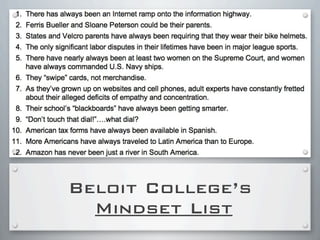
Beloit College’s
Mindset List
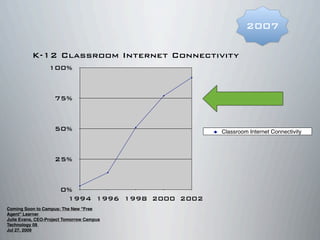
0%
25%
50%
75%
100%
1994 1996 1998 2000 2002
K-12 Classroom Internet Connectivity
Classroom Internet Connectivity
2007
Coming Soon to Campus: The New "Free
Agent" Learner
Julie Evans, CEO-Project Tomorrow Campus
Technology 09
Jul 27, 2009
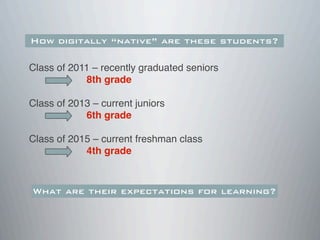
Class of 2011 – recently graduated seniors
! ! ! ! 8th grade
Class of 2013 – current juniors
! ! ! ! 6th grade
Class of 2015 – current freshman class
! ! ! ! 4th grade
How digitally “native” are these students?
What are their expectations for learning?
Implications for Schools
• Need for strategic human capital planning
• Need for increased targeted, sustained,
personalized and thoughtful professional
development
• Need for long range planning for students’
use of technology. Requires schools to think
of skills sets needed by students at various
points in their academic careers while gauging
the future of technology
Learning Environments
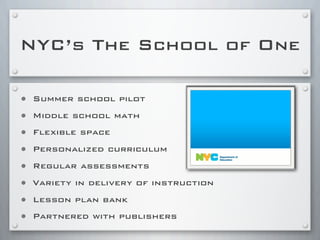
NYC’s The School of One
• Summer school pilot
• Middle school math
• Flexible space
• Personalized curriculum
• Regular assessments
• Variety in delivery of instruction
• Lesson plan bank
• Partnered with publishers
NYC’s The School of One
• Summer school pilot
• Middle school math
• Flexible space
• Personalized curriculum
• Regular assessments
• Variety in delivery of instruction
• Lesson plan bank
• Partnered with publishers
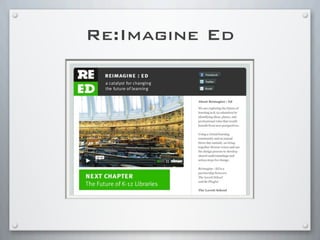
Re:Imagine Ed
The Third Teacher
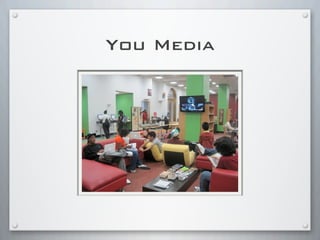
You Media
So what?
• Networked learning: You must be open to at least letting your kids drive the
technology use in your classrooms. Be willing to engage them in the ways
that they learn best.
• Generational diversity: Change is not going to happen without schools
working as teams to examine at longitudinal goals.
• 21st century skills: The art of teaching comes through via the weaving of
21st century themes into core content. You need to provide guidance and
be thoughtful when designing classroom activities.
• Learning environments: Just as we’ve looked at the whole child, we need to
start emphasizing the whole learning environment. Personalized learning for
both students and teachers is important.
Getting Started
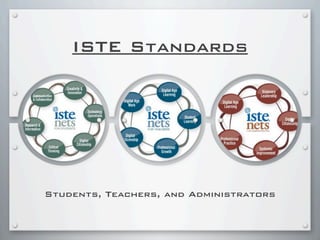
ISTE Standards
Students, Teachers, and Administrators
Technology Integration Framework
Woodstock (IL) CUSD 200
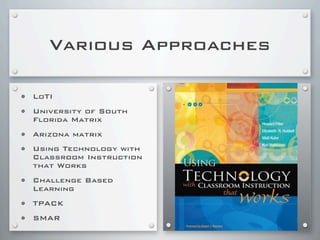
Various Approaches
• LoTI
• University of South
Florida Matrix
• Arizona matrix
• Using Technology with
Classroom Instruction
that Works
• Challenge Based
Learning
• TPACK
• SMAR
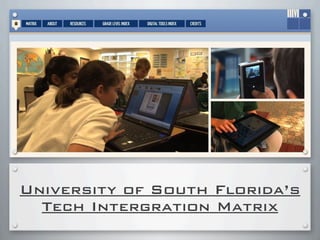
University of South Florida’s
Tech Intergration Matrix
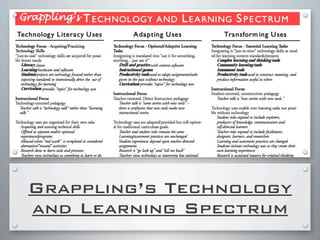
Grappling’s Technology
and Learning Spectrum
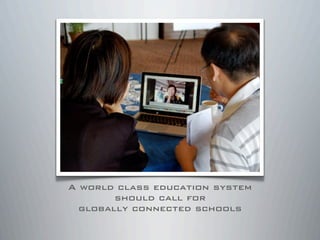
A world class education system
should call for
globally connected schools
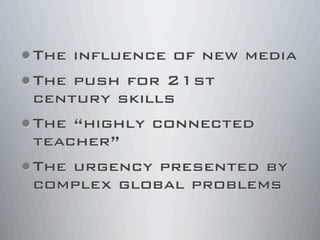
•The influence of new media
•The push for 21st
century skills
•The “highly connected
teacher”
•The urgency presented by
complex global problems
CCSSO and
Asia Society’s PGL
• New resource on
global competence!
• Download a copy
here.
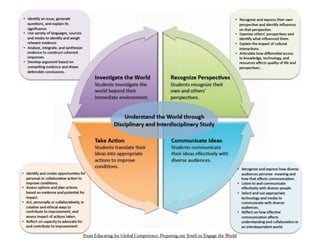
From Educating for Global Competence: Preparing our Youth to Engage the World
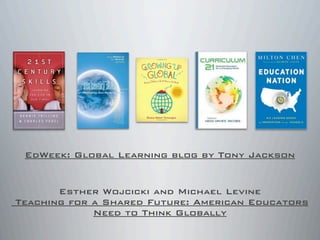
Esther Wojcicki and Michael Levine
Teaching for a Shared Future: American Educators
Need to Think Globally
EdWeek: Global Learning blog by Tony Jackson
THINK GlobalSchool
12 countries in 12 trimesters
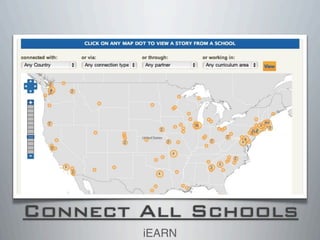
Connect All Schools
iEARN
My Story
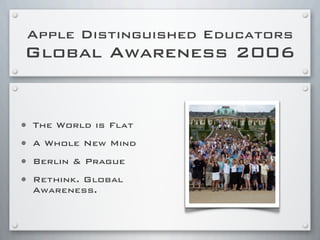
Apple Distinguished Educators
Global Awareness 2006
• The World is Flat
• A Whole New Mind
• Berlin & Prague
• Rethink. Global
Awareness.
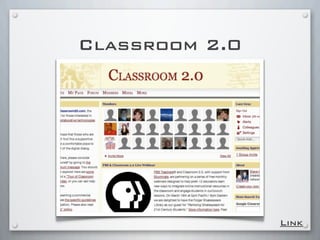
Classroom 2.0
Link
Global Education
Conference
http://globaleducationconference.com
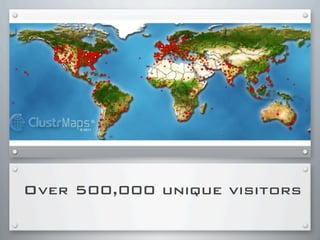
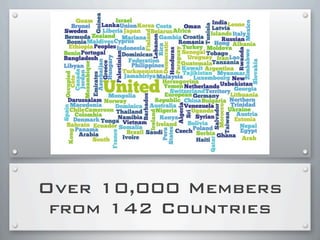
Over 500,000 unique visitors
Over 10,000 Members
from 142 Countries
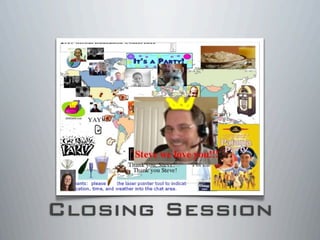
Steve Hargadon
Closing Session
2010 - Brian Mannix
2010 - Polar Bears
International
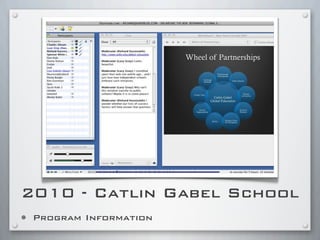
2010 - Catlin Gabel School
• Program Information
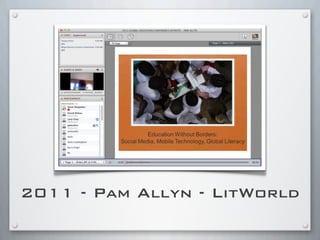
2011 - Pam Allyn - LitWorld
2011 - Greg Jacobs - Louder
Than a Bomb
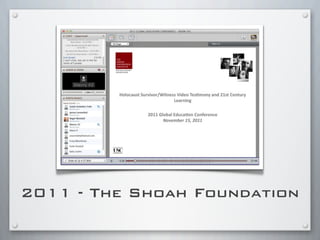
2011 - The Shoah Foundation
Project Examples
Dan Meyer
http://vimeo.com/19507645
ADE Application
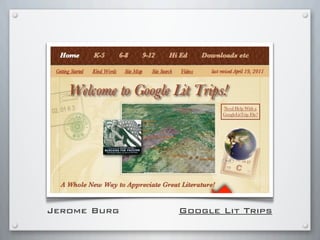
Google Lit TripsJerome Burg
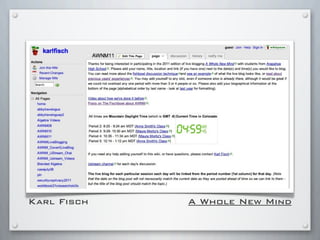
A Whole New MindKarl Fisch
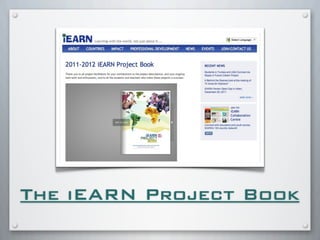
The iEARN Project Book
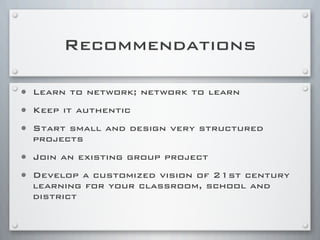
Recommendations
• Learn to network; network to learn
• Keep it authentic
• Start small and design very structured
projects
• Join an existing group project
• Develop a customized vision of 21st century
learning for your classroom, school and
district
WHY NOW?
@oline73: Can you distill why globally connected classrooms are vital in 2010?
Photo source
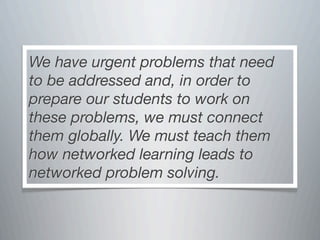
We have urgent problems that need
to be addressed and, in order to
prepare our students to work on
these problems, we must connect
them globally. We must teach them
how networked learning leads to
networked problem solving.
http://sg.sg/modernizingedu
lucy@lucygrayconsulting.com
Twitter: elemenous

Modernizing Education

  • 1.
    Modernizing Education The Stateof Teaching and Learning in the 21st Century Lucy Gray Interlochen Arts Academy April 2, 2012 http://www.lucygray.org
  • 2.
    All materials arelocated at: http://www.lucygray.org Specific to this keynote: http://sg.sg/modernizingedu Additional resources: http://groups.diigo.com/group/high-school-stuff Join the backchannel at: http://todaysmeet.com/interlochentech
  • 3.
    Experiences • Graduate ofLake Forest Country Day • Worked at University of Chicago • Apple Distinguished Educator • Google Certified Teacher • Founder, The Global Education Collaborative • Co-founder, The Global Education Conference • Multiple Opportunities to visit and work with schools
  • 4.
    Context: Another Nation atRisk Moment ? How do we improve teaching and learning? What is truly innovative? How do we effectively assess students?
  • 5.
    The Power ofSocial Media Flickr YouTubeTwitter Facebook LinkedIn Google+ Diigo SlideShare
  • 6.
  • 7.
    “The Highly Connected Teacher” TheNational Educational Technology Plan
  • 8.
  • 9.
    The New MediaConsortium Horizon Report 2011 K-12 •1 year or less • Cloud Computing • Mobiles •2 to 3 years • Game-based learning • Open Content •4 to 5 years • Learning Analytics • Personal Learning Environments 2011 Report
  • 10.
    Megatrends People expect towork, learn, socialize, and play whenever and wherever they want to.
  • 11.
    Megatrends The Internet isbecoming a global mobile network - and already is at its edges.
  • 12.
    Megatrends The technologies weuse are increasingly cloud-based and delivered over utility networks, facilitating the rapid growth of online videos and rich media.
  • 13.
    Megatrends Openness — conceptslike open content, open data, and open resources — is moving from a trend to a value for much of the world.
  • 14.
    Megatrends Legal notions ofownership and privacy lag behind the practices common in society. The very concept of ownership is blurry.
  • 15.
    Megatrends Real challenges ofaccess, efficiency, and scale are redefining what we mean by quality and success. Access to learning in any form is a challenge in too many parts of the world, and efficiency in learning systems and institutions is increasingly an expectation of governments.
  • 16.
    Megatrends The Internet isconstantly challenging us to rethink learning and education, while refining our notion of literacy.
  • 17.
    Megatrends There is arise in informal learning as individual needs are redefining schools, universities, and training. Traditional authority is increasingly being challenged in many arenas.
  • 18.
    Megatrends Business models acrossthe education ecosystem are changing. Look to libraries, colleges, and the publishing industry.
  • 19.
  • 20.
  • 21.
    Shift Happens: Iowa,Did You Know?
  • 22.
  • 23.
    Project Tomorrow Recommendations • Un-tetherlearning and leverage mobile devices to extend learning beyond the school day and meet all learners in their own world • Create new interactive, participatory learning spaces using tools such as online classes, gaming and simulations, online tutors, and virtual reality environments • Incorporate Web 2.0 tools into daily instruction especially those that develop collaborative or social-based learning and provide unique opportunities for students to be content developers • Expand digital resources in the classroom to add context and relevancy to learning experiences through new media tools • Get beyond the classroom walls and make learning truly experiential such as using high tech science instrumentation and creating podcasts with content experts
  • 24.
  • 25.
  • 26.
    Public Schools • Increasedpressure via Race to the Top, AYP, RTI • Less funding • Less Time • Emphasis on standards and high stakes testing • Teacher Proof curricula • Less instruction in the arts, World Languages, etc. • Longer school days • Technology seen as a content delivery Mechanism • Constant seeking of silver bullets
  • 27.
    Independent Schools • Time •Resources • Streamlined bureaucracy • Organizational vision • Community Consensus • Administrative and collegial support • Authentic curriculum • Recognition of the Importance of 21st century skills • Professional development • Teacher autonomy • Prepared students • Commitment to developing the whole child • Parental support
  • 28.
    What do effectiveschools seem to have in common? • A WIDE RANGE OF EFFORTS TOWARDS CULTIVATING 21ST CENTURY SKILLS AND IMPLEMENTING ROBUST TECHNOLOGY PROGRAMS • THE SUCCESS OF ANY PROGRAM DEPENDS ON: • VISIONARY LEADERSHIP • STRATEGIC PLANNING • COMMITMENT TO CONTINUOUS IMPROVEMENT • THE DEGREE TO WHICH THE SCHOOL IS PRESSURED TO PREPARE STUDENTS FOR A CHANGING WORLD
  • 29.
  • 30.
  • 31.
  • 32.
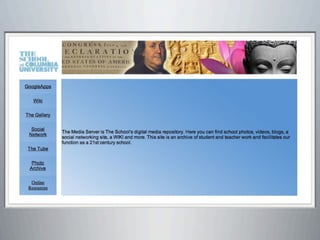
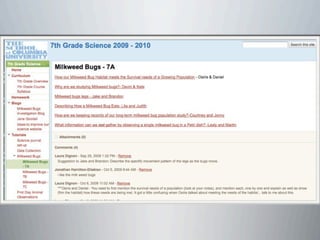
    The School atColumbia • K-8 • Columbia University faculty and local kids • Innovation driven • 1 to 1 laptop program • 3 technologists plus tech staff • Extensive Google Apps for Education and new media use • Other: field trip guides, computer programming, robotics, conference
  • 33.
  • 43.
  • 45.
  • 46.
  • 47.
  • 48.
    A Pedagogical Shift •New models of teaching and learning are emerging • Rigorous content + 21st century themes • “Sage on the stage” to “guide on the side” • New literacies need to be taught strategically • Examples: • developing a search mentality • Student personal learning networks (PLNs) • Standards and accountability still are important; assessments need revision
  • 49.
  • 52.
    The Global Achievement Gap Critical Thinkingand Problem- Solving Collaboration Across Networks and Leading by Influence Agility and Adaptability Initiative and Entrepreneuri alism Effective Oral and Written Communication Accessing and Analyzing Information Curiosity and Imagination
  • 54.
  • 55.
    Teachers and Students •Adults have different learning styles. How are we taking this into account in terms of professional development and human capital? • Baby Boomers • Gen Xers • Gen Yers • Kids have had different levels of exposure to technology. The period of time at which our schools have been wired is fairly short.
  • 56.
    Basic online entertainment (onlinevideos, playing games) E-commerce (online shopping, banking, and travel reservations) Research and information gathering (product research, news, health and religious information searches) Email and search Active engagement with social media (visit SNS, create SNS profile, create blogs) More advanced online entertainment (download videos, music and podcasts) More advanced communication and passive social media use (instant messaging, visit SNS, read blogs) From: State of the Internet 2009: Pew Internet Project Findings and Implications for Libraries The vast majority of online adults from all generations uses email and search engines. While there are always exceptions, older generations typically do not engage with the internet past e-commerce. The majority of teens and Gen Y use SNS, but fewer maintain blogs. Online adults older than Gen X are less likely to use SNS. Online activity pyramid: by generation

  • 57.
  • 58.
    0% 25% 50% 75% 100% 1994 1996 19982000 2002 K-12 Classroom Internet Connectivity Classroom Internet Connectivity 2007 Coming Soon to Campus: The New "Free Agent" Learner Julie Evans, CEO-Project Tomorrow Campus Technology 09 Jul 27, 2009
  • 59.
    Class of 2011– recently graduated seniors ! ! ! ! 8th grade Class of 2013 – current juniors ! ! ! ! 6th grade Class of 2015 – current freshman class ! ! ! ! 4th grade How digitally “native” are these students? What are their expectations for learning?
  • 60.
    Implications for Schools •Need for strategic human capital planning • Need for increased targeted, sustained, personalized and thoughtful professional development • Need for long range planning for students’ use of technology. Requires schools to think of skills sets needed by students at various points in their academic careers while gauging the future of technology
  • 61.
  • 62.
    NYC’s The Schoolof One • Summer school pilot • Middle school math • Flexible space • Personalized curriculum • Regular assessments • Variety in delivery of instruction • Lesson plan bank • Partnered with publishers
  • 63.
    NYC’s The Schoolof One • Summer school pilot • Middle school math • Flexible space • Personalized curriculum • Regular assessments • Variety in delivery of instruction • Lesson plan bank • Partnered with publishers
  • 64.
  • 65.
  • 66.
  • 67.
    So what? • Networkedlearning: You must be open to at least letting your kids drive the technology use in your classrooms. Be willing to engage them in the ways that they learn best. • Generational diversity: Change is not going to happen without schools working as teams to examine at longitudinal goals. • 21st century skills: The art of teaching comes through via the weaving of 21st century themes into core content. You need to provide guidance and be thoughtful when designing classroom activities. • Learning environments: Just as we’ve looked at the whole child, we need to start emphasizing the whole learning environment. Personalized learning for both students and teachers is important.
  • 68.
  • 69.
  • 70.
  • 71.
    Various Approaches • LoTI •University of South Florida Matrix • Arizona matrix • Using Technology with Classroom Instruction that Works • Challenge Based Learning • TPACK • SMAR
  • 72.
    University of SouthFlorida’s Tech Intergration Matrix
  • 73.
  • 74.
    A world classeducation system should call for globally connected schools
  • 76.
    •The influence ofnew media •The push for 21st century skills •The “highly connected teacher” •The urgency presented by complex global problems
  • 77.
    CCSSO and Asia Society’sPGL • New resource on global competence! • Download a copy here.
  • 78.
    From Educating forGlobal Competence: Preparing our Youth to Engage the World
  • 79.
    Esther Wojcicki andMichael Levine Teaching for a Shared Future: American Educators Need to Think Globally EdWeek: Global Learning blog by Tony Jackson
  • 80.
  • 81.
  • 83.
  • 84.
    Apple Distinguished Educators GlobalAwareness 2006 • The World is Flat • A Whole New Mind • Berlin & Prague • Rethink. Global Awareness.
  • 85.
  • 86.
  • 87.
  • 88.
  • 89.
  • 90.
  • 91.
  • 92.
    2010 - PolarBears International
  • 93.
    2010 - CatlinGabel School • Program Information
  • 94.
    2011 - PamAllyn - LitWorld
  • 95.
    2011 - GregJacobs - Louder Than a Bomb
  • 96.
    2011 - TheShoah Foundation
  • 98.
  • 99.
  • 100.
  • 101.
    A Whole NewMindKarl Fisch
  • 102.
  • 103.
    Recommendations • Learn tonetwork; network to learn • Keep it authentic • Start small and design very structured projects • Join an existing group project • Develop a customized vision of 21st century learning for your classroom, school and district
  • 104.
    WHY NOW? @oline73: Canyou distill why globally connected classrooms are vital in 2010? Photo source
  • 105.
    We have urgentproblems that need to be addressed and, in order to prepare our students to work on these problems, we must connect them globally. We must teach them how networked learning leads to networked problem solving.
  • 106.