Eight years of ubiquitous technology access and digital curricula: business and marketing high school teachers’ perspectiveM.T. Eckert
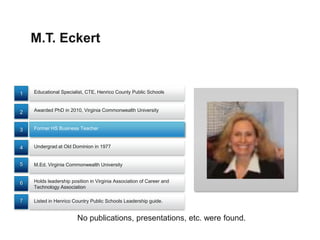
M.T. EckertEducational Specialist, CTE, Henrico County Public Schools1Awarded PhD in 2010, Virginia Commonwealth University2Former HS Business Teacher34Undergrad at Old Dominion in 19775M.Ed. Virginia Commonwealth UniversityHolds leadership position in Virginia Association of Career and Technology Association67Listed in Henrico Country Public Schools Leadership guide.No publications, presentations, etc. were found.
Case study of ubiquitous computing2001 one-to-one laptop initiativeEvery high school and middle school student
Laptop cart in every elementary classroom
Research questionWhat effect has a comprehensive one-to-one wireless laptop deployment and technology initiative had on business and marketing high school teachers’ technology skills and technology integrationHow has technology (hardware, software) in business and marketing classrooms changed over eight years?
How has the initiative enhanced business and marketing teachers’ comfort in using technology?Your own footer
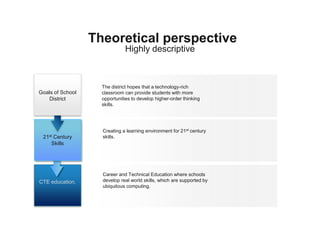
Theoretical perspectiveHighly descriptiveThe district hopes that a technology-rich classroom can provide students with more opportunities to develop higher-order thinking skills.Goals of School DistrictCreating a learning environment for 21st century skills. 21st Century SkillsCareer and Technical Education where schools develop real world skills, which are supported by ubiquitous computing.CTE education.
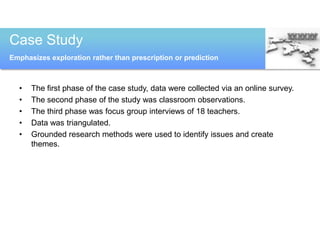
The first phase of the case study, data were collected via an online survey.The second phase of the study was classroom observations. The third phase was focus group interviews of 18 teachers. Data was triangulated.Grounded research methods were used to identify issues and create themes.Case StudyEmphasizes exploration rather than prescription or prediction
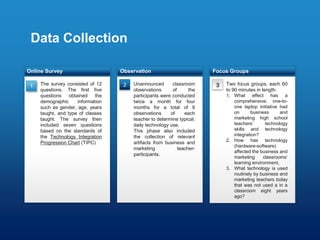
Data CollectionObservationOnline SurveyFocus GroupsUnannounced classroom observations of the participants were conducted twice a month for four months for a total of 8 observations of each teacher to determine typical, daily technology use. This phase also included the collection of relevant artifacts from business and marketing teacher-participants. Two focus groups, each 60 to 90 minutes in length.What effect has a comprehensive, one-to-one laptop initiative had on business and marketing high school teachers‘ technology skills and technology integration? How has technology (hardware-software) affected the business and marketing classrooms‘ learning environment, What technology is used routinely by business and marketing teachers today that was not used a in a classroom eight years ago?The survey consisted of 12 questions. The first five questions obtained the demographic information such as gender, age, years taught, and type of classes taught. The survey then included seven questions based on the standards of the Technology Integration Progression Chart (TIPC)312
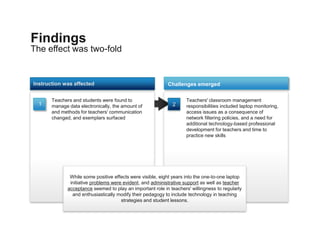
FindingsThe effect was two-foldChallenges emergedInstruction was affectedTeachers' classroom management responsibilities included laptop monitoring, access issues as a consequence of network filtering policies, and a need for additional technology-based professional development for teachers and time to practice new skillsTeachers and students were found to manage data electronically, the amount of and methods for teachers' communication changed, and exemplars surfaced12While some positive effects were visible, eight years into the one-to-one laptop initiative problems were evident, and administrative support as well as teacher acceptance seemed to play an important role in teachers' willingness to regularly and enthusiastically modify their pedagogy to include technology in teaching strategies and student lessons.
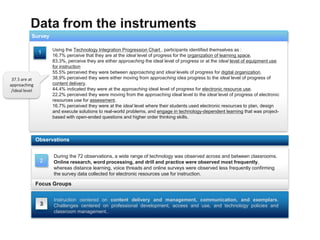
Data from the instrumentsSurveyUsing the Technology Integration Progression Chart , participants identified themselves as : 16.7% perceive that they are at the ideal level of progress for the organization of learning space.83.3%, perceive they are either approaching the ideal level of progress or at the ideal level of equipment use for instruction55.5% perceived they were between approaching and ideal levels of progress for digital organization.38.9% perceived they were either moving from approaching idea progress to the ideal level of progress of content delivery.44.4% indicated they were at the approaching ideal level of progress for electronic resource use.22.2% perceived they were moving from the approaching ideal level to the ideal level of progress of electronic resources use for assessment.16.7% perceived they were at the ideal level where their students used electronic resources to plan, design and execute solutions to real-world problems, and engage in technology-dependent learning that was project-based with open-ended questions and higher order thinking skills.137.5 are at approaching /ideal levelObservationsDuring the 72 observations, a wide range of technology was observed across and between classrooms. Online research, word processing, and drill and practice were observed most frequently, whereas distance learning, voice threads and online surveys were observed less frequently confirming the survey data collected for electronic resources use for instruction.2Focus GroupsInstruction centered on content delivery and management, communication, and exemplars. Challenges centered on professional development, access and use, and technology policies and classroom management.. 3
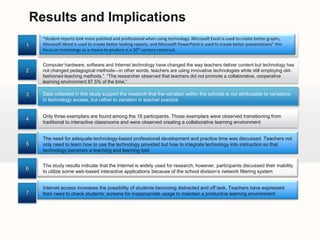
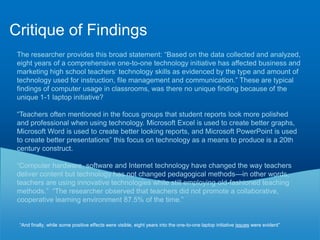
Results and Implications“Student reports look more polished and professional when using technology. Microsoft Excel is used to create better graphs, Microsoft Word is used to create better looking reports, and Microsoft PowerPoint is used to create better presentations” this focus on technology as a means to produce is a 20th century construct.Computer hardware, software and Internet technology have changed the way teachers deliver content but technology has not changed pedagogical methods—in other words, teachers are using innovative technologies while still employing old-fashioned teaching methods.”  “The researcher observed that teachers did not promote a collaborative, cooperative learning environment 87.5% of the time.”1Data collected in this study support the research that the variation within the schools is not attributable to variations in technology access, but rather to variation in teacher practice2Only three exemplars are found among the 18 participants. Those exemplars were observed transitioning from traditional to interactive classrooms and were observed creating a collaborative learning environment3The need for adequate technology-based professional development and practice time was discussed. Teachers not only need to learn how to use the technology provided but how to integrate technology into instruction so that technology becomes a teaching and learning tool45The study results indicate that the Internet is widely used for research; however, participants discussed their inability to utilize some web-based interactive applications because of the school division‘s network filtering system6Internet access increases the possibility of students becoming distracted and off task. Teachers have expressed their need to check students‘ screens for inappropriate usage to maintain a productive learning environment7
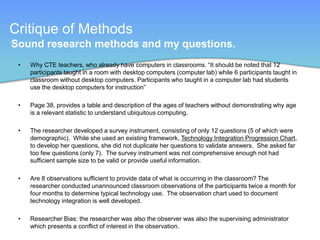
Critique of MethodsSound research methods and my questions.Why CTE teachers, who already have computers in classrooms. “It should be noted that 12 participants taught in a room with desktop computers (computer lab) while 6 participants taught in classroom without desktop computers. Participants who taught in a computer lab had students use the desktop computers for instruction” Page 38, provides a table and description of the ages of teachers without demonstrating why age is a relevant statistic to understand ubiquitous computing. The researcher developed a survey instrument, consisting of only 12 questions (5 of which were demographic).  While she used an existing framework, Technology Integration Progression Chart, to develop her questions, she did not duplicate her questions to validate answers.  She asked far too few questions (only 7).  The survey instrument was not comprehensive enough not had sufficient sample size to be valid or provide useful information.  Are 8 observations sufficient to provide data of what is occurring in the classroom? The researcher conducted unannounced classroom observations of the participants twice a month for four months to determine typical technology use.  The observation chart used to document technology integration is well developed.     Researcher Bias: the researcher was also the observer was also the supervising administrator which presents a conflict of interest in the observation.
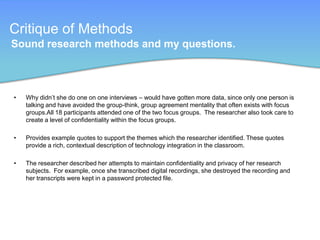
Critique of MethodsSound research methods and my questions. Why didn’t she do one on one interviews – would have gotten more data, since only one person is talking and have avoided the group-think, group agreement mentality that often exists with focus groups.All 18 participants attended one of the two focus groups.  The researcher also took care to create a level of confidentiality within the focus groups.  Provides example quotes to support the themes which the researcher identified. These quotes provide a rich, contextual description of technology integration in the classroom.The researcher described her attempts to maintain confidentiality and privacy of her research subjects.  For example, once she transcribed digital recordings, she destroyed the recording and her transcripts were kept in a password protected file.
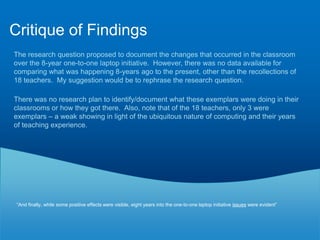
Critique of FindingsThe research question proposed to document the changes that occurred in the classroom over the 8-year one-to-one laptop initiative.  However, there was no data available for comparing what was happening 8-years ago to the present, other than the recollections of 18 teachers.  My suggestion would be to rephrase the research question.There was no research plan to identify/document what these exemplars were doing in their classrooms or how they got there.  Also, note that of the 18 teachers, only 3 were exemplars – a weak showing in light of the ubiquitous nature of computing and their years of teaching experience.“And finally, while some positive effects were visible, eight years into the one-to-one laptop initiative issues were evident”

Dissertation review

  • 1.
    Eight years ofubiquitous technology access and digital curricula: business and marketing high school teachers’ perspectiveM.T. Eckert
  • 2.
    M.T. EckertEducational Specialist,CTE, Henrico County Public Schools1Awarded PhD in 2010, Virginia Commonwealth University2Former HS Business Teacher34Undergrad at Old Dominion in 19775M.Ed. Virginia Commonwealth UniversityHolds leadership position in Virginia Association of Career and Technology Association67Listed in Henrico Country Public Schools Leadership guide.No publications, presentations, etc. were found.
  • 3.
    Case study ofubiquitous computing2001 one-to-one laptop initiativeEvery high school and middle school student
  • 4.
    Laptop cart inevery elementary classroom
  • 5.
    Research questionWhat effecthas a comprehensive one-to-one wireless laptop deployment and technology initiative had on business and marketing high school teachers’ technology skills and technology integrationHow has technology (hardware, software) in business and marketing classrooms changed over eight years?
  • 6.
    How has theinitiative enhanced business and marketing teachers’ comfort in using technology?Your own footer
  • 7.
    Theoretical perspectiveHighly descriptiveThedistrict hopes that a technology-rich classroom can provide students with more opportunities to develop higher-order thinking skills.Goals of School DistrictCreating a learning environment for 21st century skills. 21st Century SkillsCareer and Technical Education where schools develop real world skills, which are supported by ubiquitous computing.CTE education.
  • 8.
    The first phaseof the case study, data were collected via an online survey.The second phase of the study was classroom observations. The third phase was focus group interviews of 18 teachers. Data was triangulated.Grounded research methods were used to identify issues and create themes.Case StudyEmphasizes exploration rather than prescription or prediction
  • 9.
    Data CollectionObservationOnline SurveyFocusGroupsUnannounced classroom observations of the participants were conducted twice a month for four months for a total of 8 observations of each teacher to determine typical, daily technology use. This phase also included the collection of relevant artifacts from business and marketing teacher-participants. Two focus groups, each 60 to 90 minutes in length.What effect has a comprehensive, one-to-one laptop initiative had on business and marketing high school teachers‘ technology skills and technology integration? How has technology (hardware-software) affected the business and marketing classrooms‘ learning environment, What technology is used routinely by business and marketing teachers today that was not used a in a classroom eight years ago?The survey consisted of 12 questions. The first five questions obtained the demographic information such as gender, age, years taught, and type of classes taught. The survey then included seven questions based on the standards of the Technology Integration Progression Chart (TIPC)312
  • 10.
    FindingsThe effect wastwo-foldChallenges emergedInstruction was affectedTeachers' classroom management responsibilities included laptop monitoring, access issues as a consequence of network filtering policies, and a need for additional technology-based professional development for teachers and time to practice new skillsTeachers and students were found to manage data electronically, the amount of and methods for teachers' communication changed, and exemplars surfaced12While some positive effects were visible, eight years into the one-to-one laptop initiative problems were evident, and administrative support as well as teacher acceptance seemed to play an important role in teachers' willingness to regularly and enthusiastically modify their pedagogy to include technology in teaching strategies and student lessons.
  • 11.
    Data from theinstrumentsSurveyUsing the Technology Integration Progression Chart , participants identified themselves as : 16.7% perceive that they are at the ideal level of progress for the organization of learning space.83.3%, perceive they are either approaching the ideal level of progress or at the ideal level of equipment use for instruction55.5% perceived they were between approaching and ideal levels of progress for digital organization.38.9% perceived they were either moving from approaching idea progress to the ideal level of progress of content delivery.44.4% indicated they were at the approaching ideal level of progress for electronic resource use.22.2% perceived they were moving from the approaching ideal level to the ideal level of progress of electronic resources use for assessment.16.7% perceived they were at the ideal level where their students used electronic resources to plan, design and execute solutions to real-world problems, and engage in technology-dependent learning that was project-based with open-ended questions and higher order thinking skills.137.5 are at approaching /ideal levelObservationsDuring the 72 observations, a wide range of technology was observed across and between classrooms. Online research, word processing, and drill and practice were observed most frequently, whereas distance learning, voice threads and online surveys were observed less frequently confirming the survey data collected for electronic resources use for instruction.2Focus GroupsInstruction centered on content delivery and management, communication, and exemplars. Challenges centered on professional development, access and use, and technology policies and classroom management.. 3
  • 12.
    Results and Implications“Studentreports look more polished and professional when using technology. Microsoft Excel is used to create better graphs, Microsoft Word is used to create better looking reports, and Microsoft PowerPoint is used to create better presentations” this focus on technology as a means to produce is a 20th century construct.Computer hardware, software and Internet technology have changed the way teachers deliver content but technology has not changed pedagogical methods—in other words, teachers are using innovative technologies while still employing old-fashioned teaching methods.” “The researcher observed that teachers did not promote a collaborative, cooperative learning environment 87.5% of the time.”1Data collected in this study support the research that the variation within the schools is not attributable to variations in technology access, but rather to variation in teacher practice2Only three exemplars are found among the 18 participants. Those exemplars were observed transitioning from traditional to interactive classrooms and were observed creating a collaborative learning environment3The need for adequate technology-based professional development and practice time was discussed. Teachers not only need to learn how to use the technology provided but how to integrate technology into instruction so that technology becomes a teaching and learning tool45The study results indicate that the Internet is widely used for research; however, participants discussed their inability to utilize some web-based interactive applications because of the school division‘s network filtering system6Internet access increases the possibility of students becoming distracted and off task. Teachers have expressed their need to check students‘ screens for inappropriate usage to maintain a productive learning environment7
  • 13.
    Critique of MethodsSoundresearch methods and my questions.Why CTE teachers, who already have computers in classrooms. “It should be noted that 12 participants taught in a room with desktop computers (computer lab) while 6 participants taught in classroom without desktop computers. Participants who taught in a computer lab had students use the desktop computers for instruction” Page 38, provides a table and description of the ages of teachers without demonstrating why age is a relevant statistic to understand ubiquitous computing. The researcher developed a survey instrument, consisting of only 12 questions (5 of which were demographic). While she used an existing framework, Technology Integration Progression Chart, to develop her questions, she did not duplicate her questions to validate answers. She asked far too few questions (only 7). The survey instrument was not comprehensive enough not had sufficient sample size to be valid or provide useful information.  Are 8 observations sufficient to provide data of what is occurring in the classroom? The researcher conducted unannounced classroom observations of the participants twice a month for four months to determine typical technology use. The observation chart used to document technology integration is well developed.  Researcher Bias: the researcher was also the observer was also the supervising administrator which presents a conflict of interest in the observation.
  • 14.
    Critique of MethodsSoundresearch methods and my questions. Why didn’t she do one on one interviews – would have gotten more data, since only one person is talking and have avoided the group-think, group agreement mentality that often exists with focus groups.All 18 participants attended one of the two focus groups. The researcher also took care to create a level of confidentiality within the focus groups. Provides example quotes to support the themes which the researcher identified. These quotes provide a rich, contextual description of technology integration in the classroom.The researcher described her attempts to maintain confidentiality and privacy of her research subjects. For example, once she transcribed digital recordings, she destroyed the recording and her transcripts were kept in a password protected file.
  • 15.
    Critique of FindingsTheresearch question proposed to document the changes that occurred in the classroom over the 8-year one-to-one laptop initiative. However, there was no data available for comparing what was happening 8-years ago to the present, other than the recollections of 18 teachers. My suggestion would be to rephrase the research question.There was no research plan to identify/document what these exemplars were doing in their classrooms or how they got there. Also, note that of the 18 teachers, only 3 were exemplars – a weak showing in light of the ubiquitous nature of computing and their years of teaching experience.“And finally, while some positive effects were visible, eight years into the one-to-one laptop initiative issues were evident”