
Future Focused 
Education: 
What does it look 
like in your school? 
CORE Breakfast presentation, Thursday 11 September, Hamilton
THE DIGITAL LEARNER 
• 1989 – Concept floated for 
WWW 
• 1989 – Tomorrow’s Schools 
• 1993 - First browser 
released 
• 1995 – WWW comes to NZ 
BORN 1997 
• 2001 – iPod released 
• 2002 – NCEA introduced 
• 2010 – iPad released 
• 2013 – NCEA level 1 
(includes programming)
CHALLENGE 
Have we grasped how 
significantly student access to 
technology is changing their 
expectations as learners?
PROJECTED SECONDARY SCHOOL POPULATION 
390,000 
380,000 
370,000 
360,000 
350,000 
340,000 
330,000 
320,000 
2011 
2016 
2021 
2026 
2031 
2036 
2041 
2046 
2051 
2056 
2061 
Number 
13-18 years 
Need to be 
vigilant 
about this 
space 
Statistics New Zealand National Population Projections by Age and Sex, 2011(base)-2061
NZ: 28,000 FEWER SCHOOL LEAVERS OVER 
30,000 
20,000 
10,000 
0 
-10,000 
-20,000 
2011-2016 
2016-2021 
THE NEXT 10 YEARS 
2021-2026 
2026-2031 
2031-2036 
2036-2041 
1041-2046 
2046-2051 
2051-2056 
2056-2061 
Projected change in numbers at 15-19 years 
(Total NZ) 
Source: Statistics NZ 2012 Projected population of New Zealand by age and sex, 2011(base)-2061
IT IS HAPPENING – CENSUS 2013 
325,119 
369,090 
353,091 
380,000 
370,000 
360,000 
350,000 
340,000 
330,000 
320,000 
310,000 
300,000 
2001 2006 2013 
Number 
Actual Numbers 13-18 Years 2001, 2006, 2013 
(Total NZ) 
Source: Statistics NZ 2012 Projected population of New Zealand by age and sex, 2011(base)-2061
.. HAPPENING IN THE WAIKATO 
32,901 
36,369 
34,899 
37,000 
36,000 
35,000 
34,000 
33,000 
32,000 
31,000 
2001 2006 2013 
Number 
Actual Numbers 13-18 Years 2001, 2006, 2013 
(Waikato)
BUT - HAMILTON CITY ONE OF FEW TO BUCK 
THE TREND 
11,307 
12,588 
12,753 
13,000 
12,500 
12,000 
11,500 
11,000 
10,500 
2001 2006 2013 
Number 
Actual N 13-18 Years 2001, 2006, 2013 (Hamilton 
City)
SUMMARY 
• Every year for the next 19 years a successively larger 
cohort will reach the retirement zone 
• Every year for the next 15 years they will be replaced 
by a successively smaller cohort 
• 2021-26 will see a brief respite, as the recently-born 
baby blip arrives at labour market age 
• A zero unemployment opportunity is here
The surprising jobs you’ll 
be doing by the 2030s 
http://io9.com/these-are-the-surprising-jobs-youll-be-doing-by-the-203-1577363367
• Robot counsellor 
• Rewilder 
• Garbage designer 
• Neighbourhood watch specialist 
• Simplicity expert 
• Healthcare navigator 
• Nostalgist 
• Telesurgeon 
• Solar technology specialist 
• Aquaponic fish farmer 
http://io9.com/these-are-the-surprising-jobs-youll-be-doing-by-the-203-1577363367
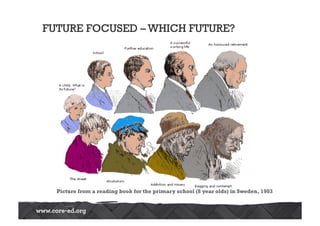
FUTURE FOCUSED – WHICH FUTURE? 
Picture from a reading book for the primary school (8 year olds) in Sweden, 1903
WHAT IS FUTURE-FOCUSED EDUCATION? 
How can schooling change to meet meet 
the opportunities and challenges of the 
21st century?
WHAT IS FUTURE-FOCUSED EDUCATION? 
How can we prepare students to address 
"future-focused" issues such as 
sustainability, globalisation, citizenship, 
and enterprise?
WHAT IS FUTURE-FOCUSED EDUCATION? 
How can education prepare students for 
living in the 21st century?
TWO PERSPECTIVES OF EDUCATION… 
In the future For the future 
• How will learning 
occur? 
• What about the role 
of teachers? 
• What sorts of 
environments? 
• What will we learn 
about? 
• What will we learn 
with? 
• What skills/ 
knowledge/ 
competencies do we 
need to be 
developing now in 
order to cope with 
what the future 
might hold?
EDUCATION IN THE FUTURE… 
• How will learning occur? 
• What about the role of teachers? 
• What sorts of environments? 
• What will we learn about? 
• What will we learn with?
http://ingvihrannar.com/14-things-that-are-obsolete-in-21st-century-schools/
1. Computer rooms 
2. Isolated classrooms 
3. Schools that don’t have WiFi 
4. Banning phones and tablets 
5. Tech director with an admin access 
6. Teachers that don’t share what they do 
7. Schools that don’t have Facebook or Twitter 
8. Unhealthy cafeteria food 
9. Starting school at 8am for teenagers 
10. Buying poster, website and pamphlet design for school 
11. Traditional libraries 
12. All students get the same 
13. One-PD-workshop-fits-all 
14. Standardized tests to measure the quality of education
REPLIES
WHERE WILL THEY LEARN?
Students in 
physical school, 
instruction and 
assessment 
predominantly on-site 
Students access 
formal learning via 
the network, 
instruction and 
assessment 
provided online 
Students learning 
through their 
online personal 
learning network, 
incl. social 
networking 
environments 
Students at home, 
library or other 
space, pursuing 
own interests 
individually or 
collaboratively 
FORMAL 
INFORMAL 
PHYSICAL 
VIRTUAL 
e.g. Classrooms, 
field trips, music 
exams, sports 
awards etc. 
e.g. Virtual 
Learning Network, 
online classrooms, 
Coursera, virtual 
field trips etc. 
e.g. PLN 
comprising 
Facebook, Twitter, 
Khan Academy, 
YouTube etc. 
e.g. Community 
library, sports 
organisations, after 
school clubs etc.
ASB BUILDING
ASB BUILDING
ASB BUILDING
ASB BUILDING
ASB BUILDING
UNPACK 
If this is the kind of work 
environment our young people will be 
functioning in when they leave school, 
how well effectively we preparing them 
for this in the environments we have 
in our schools?
WHAT WILL THEY LEARN?
FUTURE FOCUS THEMES 
• Sustainability 
• Enterprise 
• Globalization 
• Citizenship
THINKING 3D
• kjb
http://bit.ly/1tKP5Lm
HOW WILL THEY LEARN?
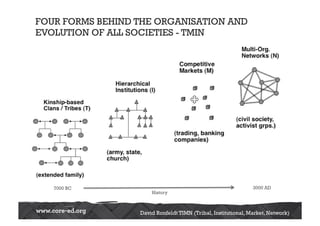
FOUR FORMS BEHIND THE ORGANISATION AND 
EVOLUTION OF ALL SOCIETIES - TMIN 
7000 BC 3000 AD 
History 
David Ronfeldt TIMN (Tribal, Institutional, Market, Network)
An education system that fails to emulate the characteristics of 
information in an era of knowledge is doomed to fail. 
Information today is… 
• Open 
• Distributed 
• Scalable 
• Social 
• Generative 
• Networked 
• Self-organised 
• Adaptive 
• Global 
George Siemens: Connectivism – 
a theory of learning for the networked age 
http://www.connectivism.ca/
TWO FORMS OF NETWORK 
The way networks learn is the way individuals learn 
School A 
Network Groups 
PLN 
Federally organised 
Collections of entities 
Collaborative 
Heterarchical 
Networked knowledge 
Externally organised 
Single entity 
Competitive 
Hierarchical 
Knowledge transfer 
Personally organised 
Association of entities 
Connected 
Heutagogy 
Personal knowledge
EDUCATION FOR THE FUTURE… 
What skills/knowledge/ competencies do we 
need to be developing now in order to cope 
with what the future might hold?
THE FUTURE… 
• Food supply 
• Water 
• Cryogenics 
• Nano-technology 
• Cultural assimilation 
• Human rights 
• Poverty 
• Religious intolerance
FUTURE FOCUSED CONSIDERATIONS 
• Personalising learning – how 
can you build the school 
curriculum around the learner 
and more flexibly to meet 
learners’ needs?
http://www.bbc.co.uk/news/technology-29063614
FUTURE FOCUSED CONSIDERATIONS 
• Are you building an inclusive 
learning environment - how do 
you: 
• enage learners, family/whānau, and 
communities in co-shaping education to 
address students’ needs, strengths, 
interests and aspirations? 
• provide access to anywhere, anytime 
learning? 
• support assessment and evaluation 
processes so that these are dynamic and 
responsive to information about 
students?
FUTURE FOCUSED CONSIDERATIONS 
• Are you developing a school 
curriculum that uses knowledge 
to develop learning capacity – 
how can you enable students 
to create and use new 
knowledge to solve problems 
and find solutions to challenges 
as they arise on a “just-in-time” 
basis?
FUTURE FOCUSED CONSIDERATIONS 
• Rethinking learners’ and create 
a “knowledge-building” learning 
environment where learners and 
teachers work together?
FUTURE FOCUSED CONSIDERATIONS 
• Building a culture of 
continuous learning for teachers 
and school leaders – what 
opportunities to participate in 
and build professional learning 
are afforded by technologies?
FUTURE FOCUSED CONSIDERATIONS 
• How can technologies be used to 
facilitate all of this?
Modern technologies 
provide students with 
the potential for 
experiences of 
unprecedented 
breadth, depth 
and relevance. 
 
.
We now have the 
conditions for 
modern learners to 
tackle projects of 
a complexity 
previously 
unimaginable.
..as a result we must 
rethink what we expect 
of our students. 
We must stop 
underestimating what 
they are now capable of; 
and above all…set much 
higher expectations 
.
The evolving learning environment… 
14TH- 19TH CENTURY 
PRINT ERA 
Authors/Publishers 
Books, Documents 
21ST CENTURY 
COLLABORATIVE AGE 
Community 
Generated 
Experiences 
Mixed Media, Social 
Networks, Virtual 
Environments 
20TH CENTURY 
BROADCAST ERA 
Vendor Produced 
Content 
Film, Radio, TV, 
Video, Web Pages
Forget blogs – 
think open 
dialogues
Forget wikis – think collaboration
Forget podcasts 
– think 
democratisation 
of voice
Forget RSS/aggregation 
- think personal learning networks
Derek Wenmoth 
Email: derek@core-ed.org 
Blog: http://blog.core-ed.org/derek 
Skype: dwenmoth

Future focused education - what does it look like?

  • 1.
    Future Focused Education: What does it look like in your school? CORE Breakfast presentation, Thursday 11 September, Hamilton
  • 4.
    THE DIGITAL LEARNER • 1989 – Concept floated for WWW • 1989 – Tomorrow’s Schools • 1993 - First browser released • 1995 – WWW comes to NZ BORN 1997 • 2001 – iPod released • 2002 – NCEA introduced • 2010 – iPad released • 2013 – NCEA level 1 (includes programming)
  • 5.
    CHALLENGE Have wegrasped how significantly student access to technology is changing their expectations as learners?
  • 6.
    PROJECTED SECONDARY SCHOOLPOPULATION 390,000 380,000 370,000 360,000 350,000 340,000 330,000 320,000 2011 2016 2021 2026 2031 2036 2041 2046 2051 2056 2061 Number 13-18 years Need to be vigilant about this space Statistics New Zealand National Population Projections by Age and Sex, 2011(base)-2061
  • 7.
    NZ: 28,000 FEWERSCHOOL LEAVERS OVER 30,000 20,000 10,000 0 -10,000 -20,000 2011-2016 2016-2021 THE NEXT 10 YEARS 2021-2026 2026-2031 2031-2036 2036-2041 1041-2046 2046-2051 2051-2056 2056-2061 Projected change in numbers at 15-19 years (Total NZ) Source: Statistics NZ 2012 Projected population of New Zealand by age and sex, 2011(base)-2061
  • 8.
    IT IS HAPPENING– CENSUS 2013 325,119 369,090 353,091 380,000 370,000 360,000 350,000 340,000 330,000 320,000 310,000 300,000 2001 2006 2013 Number Actual Numbers 13-18 Years 2001, 2006, 2013 (Total NZ) Source: Statistics NZ 2012 Projected population of New Zealand by age and sex, 2011(base)-2061
  • 9.
    .. HAPPENING INTHE WAIKATO 32,901 36,369 34,899 37,000 36,000 35,000 34,000 33,000 32,000 31,000 2001 2006 2013 Number Actual Numbers 13-18 Years 2001, 2006, 2013 (Waikato)
  • 10.
    BUT - HAMILTONCITY ONE OF FEW TO BUCK THE TREND 11,307 12,588 12,753 13,000 12,500 12,000 11,500 11,000 10,500 2001 2006 2013 Number Actual N 13-18 Years 2001, 2006, 2013 (Hamilton City)
  • 11.
    SUMMARY • Everyyear for the next 19 years a successively larger cohort will reach the retirement zone • Every year for the next 15 years they will be replaced by a successively smaller cohort • 2021-26 will see a brief respite, as the recently-born baby blip arrives at labour market age • A zero unemployment opportunity is here
  • 13.
    The surprising jobsyou’ll be doing by the 2030s http://io9.com/these-are-the-surprising-jobs-youll-be-doing-by-the-203-1577363367
  • 14.
    • Robot counsellor • Rewilder • Garbage designer • Neighbourhood watch specialist • Simplicity expert • Healthcare navigator • Nostalgist • Telesurgeon • Solar technology specialist • Aquaponic fish farmer http://io9.com/these-are-the-surprising-jobs-youll-be-doing-by-the-203-1577363367
  • 15.
    FUTURE FOCUSED –WHICH FUTURE? Picture from a reading book for the primary school (8 year olds) in Sweden, 1903
  • 18.
    WHAT IS FUTURE-FOCUSEDEDUCATION? How can schooling change to meet meet the opportunities and challenges of the 21st century?
  • 19.
    WHAT IS FUTURE-FOCUSEDEDUCATION? How can we prepare students to address "future-focused" issues such as sustainability, globalisation, citizenship, and enterprise?
  • 20.
    WHAT IS FUTURE-FOCUSEDEDUCATION? How can education prepare students for living in the 21st century?
  • 21.
    TWO PERSPECTIVES OFEDUCATION… In the future For the future • How will learning occur? • What about the role of teachers? • What sorts of environments? • What will we learn about? • What will we learn with? • What skills/ knowledge/ competencies do we need to be developing now in order to cope with what the future might hold?
  • 22.
    EDUCATION IN THEFUTURE… • How will learning occur? • What about the role of teachers? • What sorts of environments? • What will we learn about? • What will we learn with?
  • 23.
  • 24.
    1. Computer rooms 2. Isolated classrooms 3. Schools that don’t have WiFi 4. Banning phones and tablets 5. Tech director with an admin access 6. Teachers that don’t share what they do 7. Schools that don’t have Facebook or Twitter 8. Unhealthy cafeteria food 9. Starting school at 8am for teenagers 10. Buying poster, website and pamphlet design for school 11. Traditional libraries 12. All students get the same 13. One-PD-workshop-fits-all 14. Standardized tests to measure the quality of education
  • 25.
  • 26.
  • 27.
    Students in physicalschool, instruction and assessment predominantly on-site Students access formal learning via the network, instruction and assessment provided online Students learning through their online personal learning network, incl. social networking environments Students at home, library or other space, pursuing own interests individually or collaboratively FORMAL INFORMAL PHYSICAL VIRTUAL e.g. Classrooms, field trips, music exams, sports awards etc. e.g. Virtual Learning Network, online classrooms, Coursera, virtual field trips etc. e.g. PLN comprising Facebook, Twitter, Khan Academy, YouTube etc. e.g. Community library, sports organisations, after school clubs etc.
  • 28.
  • 29.
  • 30.
  • 31.
  • 32.
  • 33.
    UNPACK If thisis the kind of work environment our young people will be functioning in when they leave school, how well effectively we preparing them for this in the environments we have in our schools?
  • 34.
  • 35.
    FUTURE FOCUS THEMES • Sustainability • Enterprise • Globalization • Citizenship
  • 36.
  • 38.
  • 40.
  • 41.
  • 42.
    FOUR FORMS BEHINDTHE ORGANISATION AND EVOLUTION OF ALL SOCIETIES - TMIN 7000 BC 3000 AD History David Ronfeldt TIMN (Tribal, Institutional, Market, Network)
  • 43.
    An education systemthat fails to emulate the characteristics of information in an era of knowledge is doomed to fail. Information today is… • Open • Distributed • Scalable • Social • Generative • Networked • Self-organised • Adaptive • Global George Siemens: Connectivism – a theory of learning for the networked age http://www.connectivism.ca/
  • 44.
    TWO FORMS OFNETWORK The way networks learn is the way individuals learn School A Network Groups PLN Federally organised Collections of entities Collaborative Heterarchical Networked knowledge Externally organised Single entity Competitive Hierarchical Knowledge transfer Personally organised Association of entities Connected Heutagogy Personal knowledge
  • 45.
    EDUCATION FOR THEFUTURE… What skills/knowledge/ competencies do we need to be developing now in order to cope with what the future might hold?
  • 46.
    THE FUTURE… •Food supply • Water • Cryogenics • Nano-technology • Cultural assimilation • Human rights • Poverty • Religious intolerance
  • 47.
    FUTURE FOCUSED CONSIDERATIONS • Personalising learning – how can you build the school curriculum around the learner and more flexibly to meet learners’ needs?
  • 48.
  • 49.
    FUTURE FOCUSED CONSIDERATIONS • Are you building an inclusive learning environment - how do you: • enage learners, family/whānau, and communities in co-shaping education to address students’ needs, strengths, interests and aspirations? • provide access to anywhere, anytime learning? • support assessment and evaluation processes so that these are dynamic and responsive to information about students?
  • 51.
    FUTURE FOCUSED CONSIDERATIONS • Are you developing a school curriculum that uses knowledge to develop learning capacity – how can you enable students to create and use new knowledge to solve problems and find solutions to challenges as they arise on a “just-in-time” basis?
  • 53.
    FUTURE FOCUSED CONSIDERATIONS • Rethinking learners’ and create a “knowledge-building” learning environment where learners and teachers work together?
  • 54.
    FUTURE FOCUSED CONSIDERATIONS • Building a culture of continuous learning for teachers and school leaders – what opportunities to participate in and build professional learning are afforded by technologies?
  • 55.
    FUTURE FOCUSED CONSIDERATIONS • How can technologies be used to facilitate all of this?
  • 56.
    Modern technologies providestudents with the potential for experiences of unprecedented breadth, depth and relevance. .
  • 57.
    We now havethe conditions for modern learners to tackle projects of a complexity previously unimaginable.
  • 58.
    ..as a resultwe must rethink what we expect of our students. We must stop underestimating what they are now capable of; and above all…set much higher expectations .
  • 60.
    The evolving learningenvironment… 14TH- 19TH CENTURY PRINT ERA Authors/Publishers Books, Documents 21ST CENTURY COLLABORATIVE AGE Community Generated Experiences Mixed Media, Social Networks, Virtual Environments 20TH CENTURY BROADCAST ERA Vendor Produced Content Film, Radio, TV, Video, Web Pages
  • 61.
    Forget blogs – think open dialogues
  • 62.
    Forget wikis –think collaboration
  • 63.
    Forget podcasts –think democratisation of voice
  • 64.
    Forget RSS/aggregation -think personal learning networks
  • 66.
    Derek Wenmoth Email:derek@core-ed.org Blog: http://blog.core-ed.org/derek Skype: dwenmoth