Cisco Router as a
   VPN Server
Agenda
• VPN
• Categories of VPN
    – Secure VPNs
    – Trusted VPN
•   Hardware / Software Requirement
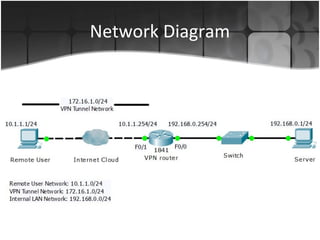
•   Network Diagram
•   Basic Router Configuration
•   Configuring AAA Server
•   Virtual Template
•   VPDN
•   IPSec
What is VPN     ?
 A virtual private network (VPN) is a
 computer network that is
 implemented in an additional logical
 layer (overlay) on top of an existing
 network. It has the purpose of
 creating a private scope of computer
 communications or providing a
 secure extension of a private
 network into an insecure network
 such as the Internet.
                    http://en.wikipedia.org/wiki/Virtual_private_network
Categories of VPN
 VPN technologies may be classified
 by many standards.

 Two broad categories of VPN are:
 – Secure VPNs
 – Trusted VPNs
Secure VPNs

• Provide mechanisms for authentication of the
  tunnel endpoints and encryption of the traffic.
• Provide remote access facilities to employees.
• Connects multiple networks together securely
  using the Internet to carry the traffic.
• Secure VPN protocols include IPSec, SSL or
  PPTP (with MPPE).
• Doesn't provide Qos or routing.
Trusted VPNs

• Created by carriers and large organizations on
  large core networks.
• Provides Quality of Service.
• Trusted VPN protocols include MPLS, ATM or
  Frame Relay.
• Do not provide security features such as data
  confidentiality through encryption.
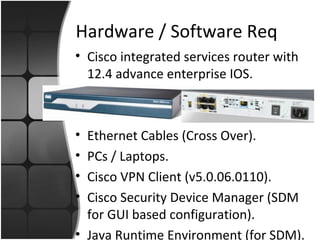
Hardware / Software Req
• Cisco integrated services router with
  12.4 advance enterprise IOS.


• Ethernet Cables (Cross Over).
• PCs / Laptops.
• Cisco VPN Client (v5.0.06.0110).
• Cisco Security Device Manager (SDM
  for GUI based configuration).
• Java Runtime Environment (for SDM).
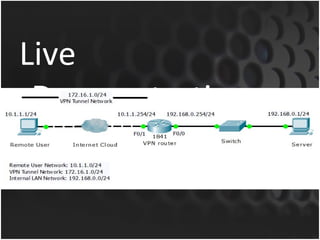
Network Diagram
Basic Router Configuration

• Creating Local Login Users for VPN.
Router(config)# username [loginID] privilege [1-15] password 0 [password]

• Configure Fast Ethernet Interfaces
Router#config t
Router(config)#int f0/0
Router(config-if)# description Internal LAN (192.168.0.0/24)
Router(config-if)#ip address 192.168.0.254 255.255.255.0
Router(config-if)#no shut
Router(config)#int f0/1
Router(config-if)# description VPN INT (10.1.1.0/24)
Router(config-if)#ip address 10.1.1.254 255.255.255.0
Router(config-if)#no shut
Basic Router Configuration (contd)

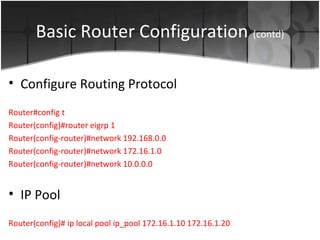
• Configure Routing Protocol
Router#config t
Router(config)#router eigrp 1
Router(config-router)#network 192.168.0.0
Router(config-router)#network 172.16.1.0
Router(config-router)#network 10.0.0.0


• IP Pool
Router(config)# ip local pool ip_pool 172.16.1.10 172.16.1.20
Configuring AAA

• aaa-model
Enables the authentication, authorization, and accounting (AAA) access control
   model.

Router(config)#aaa new-model

• aaa session-id [common | unique]
Ensures that all session identification (ID) information that is sent out for a given
   call will be made identical. The default behavior is common.

Router(config)#aaa session-id common
Configuring AAA (contd)

• aaa authentication login [list-name] local
Sets (AAA) authentication at login. ‘Local’ keyword tells the AAA to use local
   username database for authentication.

Router(config)# aaa authentication login vpn_xauth local


• aaa authorization network [list-name] local
Creates a list for authorization of all network-related service requests . ‘Local’
   keyword tells the AAA to use local username database for authentication

Router(config)# aaa authorization network vpn_group local
Virtual Template

• A virtual template interface is a logical entity that
  are created, configured dynamically, used, and
  then freed when no longer needed.
• Requires the same amount of memory as a serial
  interface.
• Cisco routers support a maximum of 300 virtual
  interfaces.
Benifts of Virtual Template

• For easier maintenance, allows customized
  configurations to be predefined.
• For scalability, allows interface configuration to
  be separated from physical interfaces.
• For consistency and configuration ease, allows the
  same predefined template to be used for all
  users.
• For efficient router operation, frees the virtual
  access interface memory for another dial-in use
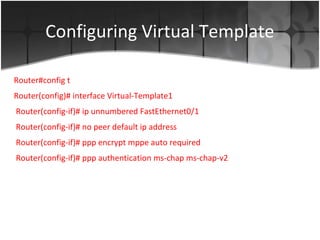
Configuring Virtual Template

Router#config t
Router(config)# interface Virtual-Template1
Router(config-if)# ip unnumbered FastEthernet0/1
Router(config-if)# no peer default ip address
Router(config-if)# ppp encrypt mppe auto required
Router(config-if)# ppp authentication ms-chap ms-chap-v2
VPDN

• A virtual private dial−up network (VPDN) allows a
  private network dial in service to span across to
  remote access servers (defined as the L2TP Access
  Concentrator [LAC]).
• LAC forwards the PPP session on to an L2TP
  Network Server (LNS). The LNS then authenticates
  the user and starts the PPP negotiation.
• VPDN uses the Layer 2 Forwarding protocol (L2F)
  which permits the tunneling of link level frames
Configuring VPDN

• enable vpdn
Enables virtual private networking.

Router(config)#enable vpdn


• vpdn-group [group name]
Ceates a vpdn group which specifies the protocol, dialup mode and interface

Router(config)# vpdn-group VPN_Server
Router(config)# accept-dialin
Router(config)# protocol pptp
Router(config)# virtual-template 1
IPSec

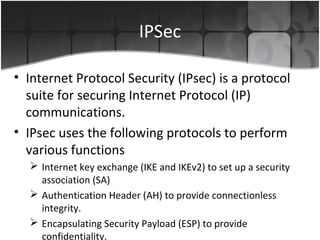
• Internet Protocol Security (IPsec) is a protocol
  suite for securing Internet Protocol (IP)
  communications.
• IPsec uses the following protocols to perform
  various functions
   Internet key exchange (IKE and IKEv2) to set up a security
    association (SA)
   Authentication Header (AH) to provide connectionless
    integrity.
   Encapsulating Security Payload (ESP) to provide
    confidentiality.
Configuring IPSec based VPN

• crypto isakmp policy [priority]
Defines an Internet Key Exchange (IKE) policy. IKE policies define a set of
   parameters to be used during the IKE negotiation

Router(config)#crypto isakmp policy 1
Router(config-crypto-isakmp)# encr 3des
Router(config-crypto-isakmp)# authentication pre-share
Router(config-crypto-isakmp)# group 2
Configuring IPSec based VPN (contd)

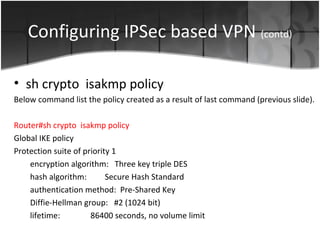
• sh crypto isakmp policy
Below command list the policy created as a result of last command (previous slide).

Router#sh crypto isakmp policy
Global IKE policy
Protection suite of priority 1
    encryption algorithm: Three key triple DES
    hash algorithm:        Secure Hash Standard
    authentication method: Pre-Shared Key
    Diffie-Hellman group: #2 (1024 bit)
    lifetime:         86400 seconds, no volume limit
Configuring IPSec based VPN (contd)

• crypto isakmp client configuration group [name]
Specify which group’s policy profile will be defined by defining key and ip address
   pool.

Router(config)#crypto isakmp client configuration group ipsec_group
Router(config-crypto-isakmp )# key ipsec
Router(config-crypto-isakmp )# pool ip_pool
Router(config-crypto-isakmp )# netmask 255.255.255.255
Configuring IPSec based VPN (contd)

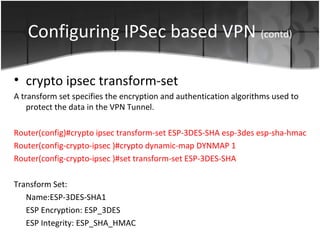
• crypto ipsec transform-set
A transform set specifies the encryption and authentication algorithms used to
    protect the data in the VPN Tunnel.

Router(config)#crypto ipsec transform-set ESP-3DES-SHA esp-3des esp-sha-hmac
Router(config-crypto-ipsec )#crypto dynamic-map DYNMAP 1
Router(config-crypto-ipsec )#set transform-set ESP-3DES-SHA

Transform Set:
   Name:ESP-3DES-SHA1
   ESP Encryption: ESP_3DES
   ESP Integrity: ESP_SHA_HMAC
Configuring IPSec based VPN (contd)

• crypto map
Creates a crypto profile that provides a template for configuration.

Router(config)#crypto map CMAP client authentication list vpn_auth
Router(config)#crypto map CMAP isakmp authorization list vpn_group
Router(config)#int f0/1
Router(config-if)#crypto map CMAP
Live
 Demonstration

Ciscorouterasavpnserver 100218045815-phpapp01

  • 1.
    Cisco Router asa VPN Server
  • 2.
    Agenda • VPN • Categoriesof VPN – Secure VPNs – Trusted VPN • Hardware / Software Requirement • Network Diagram • Basic Router Configuration • Configuring AAA Server • Virtual Template • VPDN • IPSec
  • 3.
    What is VPN ? A virtual private network (VPN) is a computer network that is implemented in an additional logical layer (overlay) on top of an existing network. It has the purpose of creating a private scope of computer communications or providing a secure extension of a private network into an insecure network such as the Internet. http://en.wikipedia.org/wiki/Virtual_private_network
  • 4.
    Categories of VPN VPN technologies may be classified by many standards. Two broad categories of VPN are: – Secure VPNs – Trusted VPNs
  • 5.
    Secure VPNs • Providemechanisms for authentication of the tunnel endpoints and encryption of the traffic. • Provide remote access facilities to employees. • Connects multiple networks together securely using the Internet to carry the traffic. • Secure VPN protocols include IPSec, SSL or PPTP (with MPPE). • Doesn't provide Qos or routing.
  • 6.
    Trusted VPNs • Createdby carriers and large organizations on large core networks. • Provides Quality of Service. • Trusted VPN protocols include MPLS, ATM or Frame Relay. • Do not provide security features such as data confidentiality through encryption.
  • 7.
    Hardware / SoftwareReq • Cisco integrated services router with 12.4 advance enterprise IOS. • Ethernet Cables (Cross Over). • PCs / Laptops. • Cisco VPN Client (v5.0.06.0110). • Cisco Security Device Manager (SDM for GUI based configuration). • Java Runtime Environment (for SDM).
  • 8.
  • 9.
    Basic Router Configuration •Creating Local Login Users for VPN. Router(config)# username [loginID] privilege [1-15] password 0 [password] • Configure Fast Ethernet Interfaces Router#config t Router(config)#int f0/0 Router(config-if)# description Internal LAN (192.168.0.0/24) Router(config-if)#ip address 192.168.0.254 255.255.255.0 Router(config-if)#no shut Router(config)#int f0/1 Router(config-if)# description VPN INT (10.1.1.0/24) Router(config-if)#ip address 10.1.1.254 255.255.255.0 Router(config-if)#no shut
  • 10.
    Basic Router Configuration(contd) • Configure Routing Protocol Router#config t Router(config)#router eigrp 1 Router(config-router)#network 192.168.0.0 Router(config-router)#network 172.16.1.0 Router(config-router)#network 10.0.0.0 • IP Pool Router(config)# ip local pool ip_pool 172.16.1.10 172.16.1.20
  • 11.
    Configuring AAA • aaa-model Enablesthe authentication, authorization, and accounting (AAA) access control model. Router(config)#aaa new-model • aaa session-id [common | unique] Ensures that all session identification (ID) information that is sent out for a given call will be made identical. The default behavior is common. Router(config)#aaa session-id common
  • 12.
    Configuring AAA (contd) •aaa authentication login [list-name] local Sets (AAA) authentication at login. ‘Local’ keyword tells the AAA to use local username database for authentication. Router(config)# aaa authentication login vpn_xauth local • aaa authorization network [list-name] local Creates a list for authorization of all network-related service requests . ‘Local’ keyword tells the AAA to use local username database for authentication Router(config)# aaa authorization network vpn_group local
  • 13.
    Virtual Template • Avirtual template interface is a logical entity that are created, configured dynamically, used, and then freed when no longer needed. • Requires the same amount of memory as a serial interface. • Cisco routers support a maximum of 300 virtual interfaces.
  • 14.
    Benifts of VirtualTemplate • For easier maintenance, allows customized configurations to be predefined. • For scalability, allows interface configuration to be separated from physical interfaces. • For consistency and configuration ease, allows the same predefined template to be used for all users. • For efficient router operation, frees the virtual access interface memory for another dial-in use
  • 15.
    Configuring Virtual Template Router#configt Router(config)# interface Virtual-Template1 Router(config-if)# ip unnumbered FastEthernet0/1 Router(config-if)# no peer default ip address Router(config-if)# ppp encrypt mppe auto required Router(config-if)# ppp authentication ms-chap ms-chap-v2
  • 16.
    VPDN • A virtualprivate dial−up network (VPDN) allows a private network dial in service to span across to remote access servers (defined as the L2TP Access Concentrator [LAC]). • LAC forwards the PPP session on to an L2TP Network Server (LNS). The LNS then authenticates the user and starts the PPP negotiation. • VPDN uses the Layer 2 Forwarding protocol (L2F) which permits the tunneling of link level frames
  • 17.
    Configuring VPDN • enablevpdn Enables virtual private networking. Router(config)#enable vpdn • vpdn-group [group name] Ceates a vpdn group which specifies the protocol, dialup mode and interface Router(config)# vpdn-group VPN_Server Router(config)# accept-dialin Router(config)# protocol pptp Router(config)# virtual-template 1
  • 18.
    IPSec • Internet ProtocolSecurity (IPsec) is a protocol suite for securing Internet Protocol (IP) communications. • IPsec uses the following protocols to perform various functions  Internet key exchange (IKE and IKEv2) to set up a security association (SA)  Authentication Header (AH) to provide connectionless integrity.  Encapsulating Security Payload (ESP) to provide confidentiality.
  • 19.
    Configuring IPSec basedVPN • crypto isakmp policy [priority] Defines an Internet Key Exchange (IKE) policy. IKE policies define a set of parameters to be used during the IKE negotiation Router(config)#crypto isakmp policy 1 Router(config-crypto-isakmp)# encr 3des Router(config-crypto-isakmp)# authentication pre-share Router(config-crypto-isakmp)# group 2
  • 20.
    Configuring IPSec basedVPN (contd) • sh crypto isakmp policy Below command list the policy created as a result of last command (previous slide). Router#sh crypto isakmp policy Global IKE policy Protection suite of priority 1 encryption algorithm: Three key triple DES hash algorithm: Secure Hash Standard authentication method: Pre-Shared Key Diffie-Hellman group: #2 (1024 bit) lifetime: 86400 seconds, no volume limit
  • 21.
    Configuring IPSec basedVPN (contd) • crypto isakmp client configuration group [name] Specify which group’s policy profile will be defined by defining key and ip address pool. Router(config)#crypto isakmp client configuration group ipsec_group Router(config-crypto-isakmp )# key ipsec Router(config-crypto-isakmp )# pool ip_pool Router(config-crypto-isakmp )# netmask 255.255.255.255
  • 22.
    Configuring IPSec basedVPN (contd) • crypto ipsec transform-set A transform set specifies the encryption and authentication algorithms used to protect the data in the VPN Tunnel. Router(config)#crypto ipsec transform-set ESP-3DES-SHA esp-3des esp-sha-hmac Router(config-crypto-ipsec )#crypto dynamic-map DYNMAP 1 Router(config-crypto-ipsec )#set transform-set ESP-3DES-SHA Transform Set: Name:ESP-3DES-SHA1 ESP Encryption: ESP_3DES ESP Integrity: ESP_SHA_HMAC
  • 23.
    Configuring IPSec basedVPN (contd) • crypto map Creates a crypto profile that provides a template for configuration. Router(config)#crypto map CMAP client authentication list vpn_auth Router(config)#crypto map CMAP isakmp authorization list vpn_group Router(config)#int f0/1 Router(config-if)#crypto map CMAP
  • 24.

Editor's Notes

  • #23 The IPSec Encapsulating Security Payload (ESP) provides data privacy. The ESP protocol also defines an authenticated format that provides data authentication and integrity, with data privacy. AH with the SHA (Secure Hash Algorithm) (an HMAC variant) authentication algorithm