COUNTING SORT
INTRODUCTION
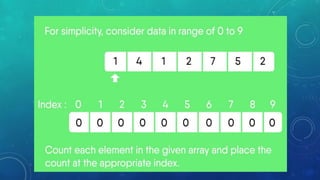
• It is an integer sorting algorithm. It operates by counting the
number of objects that have each distinct key value, and using
arithmetic on those counts to determine the positions of each key
value in the output sequence
• Counting sort uses key values as indexes into an array, it is not a
comparison sort.
INPUT AND OUTPUT ASSUMPTIONS
• The input to counting sort consists of a collection of n items, each of which
has a non-negative integer key whose maximum value is at most k
• The input to be sorted is assumed to be more simply a sequence of integers
itself,but this simplification does not accommodate many applications of
counting sort. For instance, when used as a subroutine in radix sort, the keys
for each call to counting sort are individual digits of larger item keys; it would
not suffice to return only a sorted list of the key digits, separated from the
items.
• The output is an array of the items, in order by their keys. Because
of the application to radix sorting, it is important for counting sort
to be a stable sort: if two items have the same key as each other,
they should have the same relative position in the output as they
did in the input
TIME COMPLEXITY
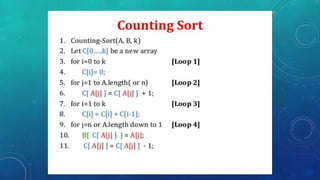
• The algorithm uses only simple for loops, without recursion or
subroutine calls, it is straightforward to analyze. The initialization
of the count array, and the second for loop which performs a prefix
sum on the count array, each iterate at most k + 1 times and
therefore take O(k) time. The other two for loops, and the
initialization of the output array, each take O(n) time. Therefore,
the time for the whole algorithm is the sum of the times for these
steps, O(n + k).
SPACE COMPLEXITY
• It uses arrays of length k + 1 and n, the total space usage of the
algorithm is also O(n + k). For problem instances in which the
maximum key value is significantly smaller than the number of
items, counting sort can be highly space-efficient, as the only
storage it uses other than its input and output arrays is the Count
array which uses space O(k).
THANK YOU !!!

Counting sort

  • 1.
  • 2.
    INTRODUCTION • It isan integer sorting algorithm. It operates by counting the number of objects that have each distinct key value, and using arithmetic on those counts to determine the positions of each key value in the output sequence • Counting sort uses key values as indexes into an array, it is not a comparison sort.
  • 3.
    INPUT AND OUTPUTASSUMPTIONS • The input to counting sort consists of a collection of n items, each of which has a non-negative integer key whose maximum value is at most k • The input to be sorted is assumed to be more simply a sequence of integers itself,but this simplification does not accommodate many applications of counting sort. For instance, when used as a subroutine in radix sort, the keys for each call to counting sort are individual digits of larger item keys; it would not suffice to return only a sorted list of the key digits, separated from the items.
  • 4.
    • The outputis an array of the items, in order by their keys. Because of the application to radix sorting, it is important for counting sort to be a stable sort: if two items have the same key as each other, they should have the same relative position in the output as they did in the input
  • 7.
    TIME COMPLEXITY • Thealgorithm uses only simple for loops, without recursion or subroutine calls, it is straightforward to analyze. The initialization of the count array, and the second for loop which performs a prefix sum on the count array, each iterate at most k + 1 times and therefore take O(k) time. The other two for loops, and the initialization of the output array, each take O(n) time. Therefore, the time for the whole algorithm is the sum of the times for these steps, O(n + k).
  • 8.
    SPACE COMPLEXITY • Ituses arrays of length k + 1 and n, the total space usage of the algorithm is also O(n + k). For problem instances in which the maximum key value is significantly smaller than the number of items, counting sort can be highly space-efficient, as the only storage it uses other than its input and output arrays is the Count array which uses space O(k).
  • 9.