
Sorting Algorithm
History
 Herman Hollerith’s card-sorting
 Hollerith’s original (bad) idea: sort on most-
significant digit first.
 Good idea: Sort on least-significant digit
first with auxiliary stable sort.
 Digit-by-digit sort.
Definition
 Radix sort is an integer sorting
algorithm that sorts data with integer keys
by grouping the keys by individual digits
that share the same significant position and
value (place value). Radix sort
uses counting sort as a subroutine to sort
an array of numbers. Because integers can
be used to
represent strings (by hashing the strings to
integers), radix sort works on data types
other than just integers.
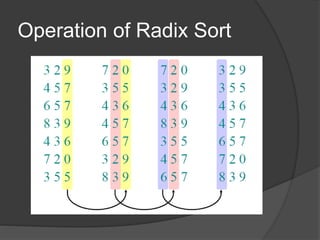
Operation of Radix Sort
Sample Program
#include <iostream>
using namespace std;
int size(int arr[], int a)
{
int high= arr[0];
for (int b = 1; b < a; b++)
if (arr[b] > high)
high = arr[b];
return high;
}
void countSort(int arr[], int a, int place)
{
int output[a], b, count[10] = {0};
for (b = 0; b < a; b++)
count[(arr[b] / place) % 10]++;
for (b = 1; b < 10; b++)
count[b] += count[b-1];
for (b = a - 1; b >= 0; b--)
{
output[count[(arr[b] / place) % 10] - 1] = arr[b];
count[(arr[b] / place) % 10]--;
}
for (b = 0; b < a; b++)
arr[b] = output[b];
}
void radixsort(int arr[], int a)
{
int place, m;
m = size(arr, a);
for (place = 1; m/place > 0; place *= 10)
countSort(arr, a, place);
}
int main()
{
int a, b;
cout<<"nEnter the number of records: ";
cin>>a;
int arr[a];
for(b = 0; b < a; b++)
{
cout<<"Enter number: "<<b+1<<": ";
cin>>arr[b];
}
radixsort(arr, a);
cout<<"nData are Sorted ";
for (b = 0; b < a; b++)
cout<<" "<<arr[b];
return 0;
}
Sample Output
Sorting Algorithm
History
 Named after its inventor D. L. Shell.
 This algorithm was improperly called the
Shell-Metzner sort by John P. Grillo
 Crediting "one of the fastest" programs
for sorting by Fredrick Stuart
Definition
 Shell sort is a generalization of insertion
sort that allows the exchange of items
that are far apart. The idea is to arrange
the list of elements so that, starting
anywhere, considering every hth
element gives a sorted list.
Operation of Shell Sort
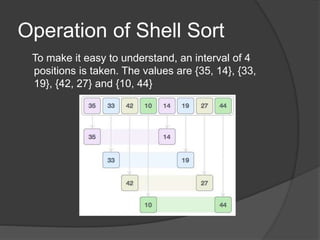
To make it easy to understand, an interval of 4
positions is taken. The values are {35, 14}, {33,
19}, {42, 27} and {10, 44}
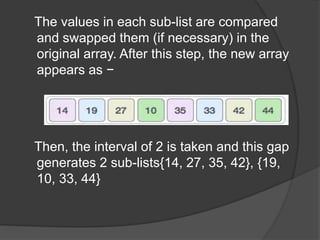
The values in each sub-list are compared
and swapped them (if necessary) in the
original array. After this step, the new array
appears as −
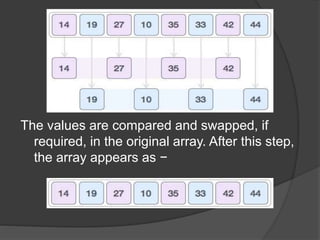
Then, the interval of 2 is taken and this gap
generates 2 sub-lists{14, 27, 35, 42}, {19,
10, 33, 44}
The values are compared and swapped, if
required, in the original array. After this step,
the array appears as −
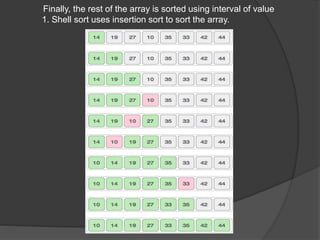
Finally, the rest of the array is sorted using interval of value
1. Shell sort uses insertion sort to sort the array.
Sample Program
#include<iostream>
using namespace std;
void sort(int a[],int n)
{
int gap,i,j,temp;
for(gap=n/2;gap>0;gap/=2)
{
for(i=gap;i<n;i+=1)
{
temp=a[i];
for(j=i;j>=gap&&a[j-gap]>temp;j-=gap)
a[j]=a[j-gap];
a[j]=temp;
}
}
}
int main()
{
int a[20],i,n;
cout<<"Enter number of elements:";
cin>>n;
cout<<"Enter array elements:n";
for(i=0;i<n;++i)
cin>>a[i];
sort(a,n);
cout<<"nArray after shell sort:n";
for(i=0;i<n;++i)
cout<<a[i]<<" "
return 0;
}
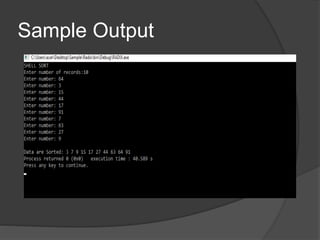
Sample Output

Radix and shell sort

  • 1.
  • 2.
    History  Herman Hollerith’scard-sorting  Hollerith’s original (bad) idea: sort on most- significant digit first.  Good idea: Sort on least-significant digit first with auxiliary stable sort.  Digit-by-digit sort.
  • 3.
    Definition  Radix sortis an integer sorting algorithm that sorts data with integer keys by grouping the keys by individual digits that share the same significant position and value (place value). Radix sort uses counting sort as a subroutine to sort an array of numbers. Because integers can be used to represent strings (by hashing the strings to integers), radix sort works on data types other than just integers.
  • 4.
  • 5.
    Sample Program #include <iostream> usingnamespace std; int size(int arr[], int a) { int high= arr[0]; for (int b = 1; b < a; b++) if (arr[b] > high) high = arr[b]; return high; }
  • 6.
    void countSort(int arr[],int a, int place) { int output[a], b, count[10] = {0}; for (b = 0; b < a; b++) count[(arr[b] / place) % 10]++; for (b = 1; b < 10; b++) count[b] += count[b-1]; for (b = a - 1; b >= 0; b--) { output[count[(arr[b] / place) % 10] - 1] = arr[b]; count[(arr[b] / place) % 10]--; } for (b = 0; b < a; b++) arr[b] = output[b]; }
  • 7.
    void radixsort(int arr[],int a) { int place, m; m = size(arr, a); for (place = 1; m/place > 0; place *= 10) countSort(arr, a, place); }
  • 8.
    int main() { int a,b; cout<<"nEnter the number of records: "; cin>>a; int arr[a]; for(b = 0; b < a; b++) { cout<<"Enter number: "<<b+1<<": "; cin>>arr[b]; } radixsort(arr, a); cout<<"nData are Sorted "; for (b = 0; b < a; b++) cout<<" "<<arr[b]; return 0; }
  • 9.
  • 10.
  • 11.
    History  Named afterits inventor D. L. Shell.  This algorithm was improperly called the Shell-Metzner sort by John P. Grillo  Crediting "one of the fastest" programs for sorting by Fredrick Stuart
  • 12.
    Definition  Shell sortis a generalization of insertion sort that allows the exchange of items that are far apart. The idea is to arrange the list of elements so that, starting anywhere, considering every hth element gives a sorted list.
  • 13.
    Operation of ShellSort To make it easy to understand, an interval of 4 positions is taken. The values are {35, 14}, {33, 19}, {42, 27} and {10, 44}
  • 14.
    The values ineach sub-list are compared and swapped them (if necessary) in the original array. After this step, the new array appears as − Then, the interval of 2 is taken and this gap generates 2 sub-lists{14, 27, 35, 42}, {19, 10, 33, 44}
  • 15.
    The values arecompared and swapped, if required, in the original array. After this step, the array appears as −
  • 16.
    Finally, the restof the array is sorted using interval of value 1. Shell sort uses insertion sort to sort the array.
  • 17.
    Sample Program #include<iostream> using namespacestd; void sort(int a[],int n) { int gap,i,j,temp; for(gap=n/2;gap>0;gap/=2) { for(i=gap;i<n;i+=1) { temp=a[i]; for(j=i;j>=gap&&a[j-gap]>temp;j-=gap) a[j]=a[j-gap]; a[j]=temp; } } }
  • 18.
    int main() { int a[20],i,n; cout<<"Enternumber of elements:"; cin>>n; cout<<"Enter array elements:n"; for(i=0;i<n;++i) cin>>a[i]; sort(a,n); cout<<"nArray after shell sort:n"; for(i=0;i<n;++i) cout<<a[i]<<" " return 0; }
  • 19.