Sorting Algorithms
Sorting Algorithms
• There are many sorting algorithms, such as:
– Selection Sort
– Insertion Sort
– Bubble Sort
– Merge Sort
– Quick Sort
• The first three are the foundations for faster
and more efficient algorithms.
Selection Sort
• The list is divided into two sublists, sorted and unsorted,
which are divided by an imaginary wall.
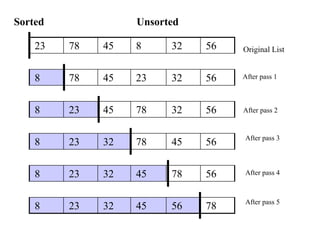
• We find the smallest element from the unsorted sublist and
swap it with the element at the beginning of the unsorted
data.
• After each selection and swapping, the imaginary wall
between the two sublists move one element ahead,
increasing the number of sorted elements and decreasing
the number of unsorted ones.
• Each time we move one element from the unsorted sublist
to the sorted sublist, we say that we have completed a sort
pass.
• A list of n elements requires n-1 passes to completely
rearrange the data.
23 78 45 8 32 56
8 78 45 23 32 56
8 23 45 78 32 56
8 23 32 78 45 56
8 23 32 45 78 56
8 23 32 45 56 78
Original List
After pass 1
After pass 2
After pass 3
After pass 4
After pass 5
Sorted Unsorted
Selection Sort (cont.)
template <class Item>
void selectionSort( Item a[], int n) {
for (int i = 0; i < n-1; i++) {
int min = i;
for (int j = i+1; j < n; j++)
if (a[j] < a[min]) min = j;
swap(a[i], a[min]);
}
}
template < class Object>
void swap( Object &lhs, Object &rhs )
{
Object tmp = lhs;
lhs = rhs;
rhs = tmp;
}
Selection Sort -- Analysis
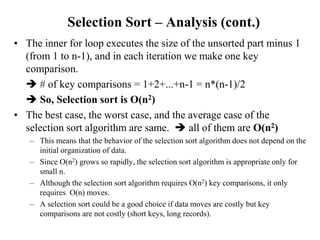
• In general, we compare keys and move items (or exchange items)
in a sorting algorithm (which uses key comparisons).
 So, to analyze a sorting algorithm we should count the
number of key comparisons and the number of moves.
• Ignoring other operations does not affect our final result.
• In selectionSort function, the outer for loop executes n-1 times.
• We invoke swap function once at each iteration.
 Total Swaps: n-1
 Total Moves: 3*(n-1) (Each swap has three moves)
Selection Sort – Analysis (cont.)
• The inner for loop executes the size of the unsorted part minus 1
(from 1 to n-1), and in each iteration we make one key
comparison.
 # of key comparisons = 1+2+...+n-1 = n*(n-1)/2
 So, Selection sort is O(n2)
• The best case, the worst case, and the average case of the
selection sort algorithm are same.  all of them are O(n2)
– This means that the behavior of the selection sort algorithm does not depend on the
initial organization of data.
– Since O(n2) grows so rapidly, the selection sort algorithm is appropriate only for
small n.
– Although the selection sort algorithm requires O(n2) key comparisons, it only
requires O(n) moves.
– A selection sort could be a good choice if data moves are costly but key
comparisons are not costly (short keys, long records).
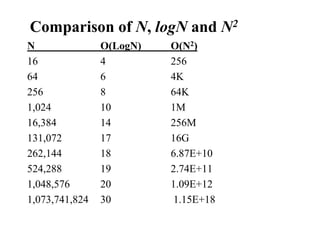
Comparison of N, logN and N2
N O(LogN) O(N2)
16 4 256
64 6 4K
256 8 64K
1,024 10 1M
16,384 14 256M
131,072 17 16G
262,144 18 6.87E+10
524,288 19 2.74E+11
1,048,576 20 1.09E+12
1,073,741,824 30 1.15E+18
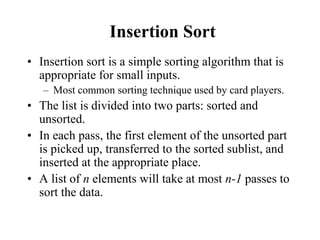
Insertion Sort
• Insertion sort is a simple sorting algorithm that is
appropriate for small inputs.
– Most common sorting technique used by card players.
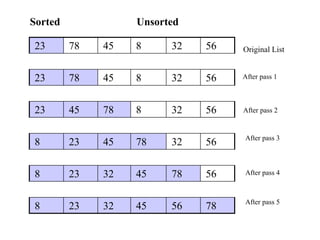
• The list is divided into two parts: sorted and
unsorted.
• In each pass, the first element of the unsorted part
is picked up, transferred to the sorted sublist, and
inserted at the appropriate place.
• A list of n elements will take at most n-1 passes to
sort the data.
Original List
After pass 1
After pass 2
After pass 3
After pass 4
After pass 5
23 78 45 8 32 56
23 78 45 8 32 56
23 45 78 8 32 56
8 23 45 78 32 56
8 23 32 45 78 56
8 23 32 45 56 78
Sorted Unsorted
Insertion Sort Algorithm
template <class Item>
void insertionSort(Item a[], int n)
{
for (int i = 1; i < n; i++)
{
Item tmp = a[i];
for (int j=i; j>0 && tmp < a[j-1]; j--)
a[j] = a[j-1];
a[j] = tmp;
}
}
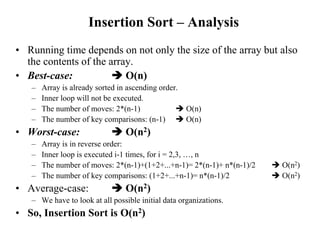
Insertion Sort – Analysis
• Running time depends on not only the size of the array but also
the contents of the array.
• Best-case:  O(n)
– Array is already sorted in ascending order.
– Inner loop will not be executed.
– The number of moves: 2*(n-1)  O(n)
– The number of key comparisons: (n-1)  O(n)
• Worst-case:  O(n2)
– Array is in reverse order:
– Inner loop is executed i-1 times, for i = 2,3, …, n
– The number of moves: 2*(n-1)+(1+2+...+n-1)= 2*(n-1)+ n*(n-1)/2  O(n2)
– The number of key comparisons: (1+2+...+n-1)= n*(n-1)/2  O(n2)
• Average-case:  O(n2)
– We have to look at all possible initial data organizations.
• So, Insertion Sort is O(n2)
Analysis of insertion sort
• Which running time will be used to characterize this
algorithm?
– Best, worst or average?
• Worst:
– Longest running time (this is the upper limit for the algorithm)
– It is guaranteed that the algorithm will not be worse than this.
• Sometimes we are interested in average case. But there are
some problems with the average case.
– It is difficult to figure out the average case. i.e. what is average
input?
– Are we going to assume all possible inputs are equally likely?
– In fact for most algorithms average case is same as the worst case.
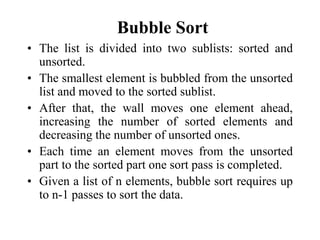
Bubble Sort
• The list is divided into two sublists: sorted and
unsorted.
• The smallest element is bubbled from the unsorted
list and moved to the sorted sublist.
• After that, the wall moves one element ahead,
increasing the number of sorted elements and
decreasing the number of unsorted ones.
• Each time an element moves from the unsorted
part to the sorted part one sort pass is completed.
• Given a list of n elements, bubble sort requires up
to n-1 passes to sort the data.
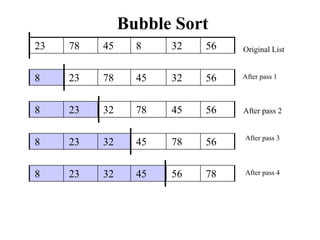
Bubble Sort
23 78 45 8 32 56
8 23 78 45 32 56
8 23 32 78 45 56
8 23 32 45 78 56
8 23 32 45 56 78
Original List
After pass 1
After pass 2
After pass 3
After pass 4
Bubble Sort Algorithm
template <class Item>
void bubleSort(Item a[], int n)
{
bool sorted = false;
int last = n-1;
for (int i = 0; (i < last) && !sorted; i++){
sorted = true;
for (int j=last; j > i; j--)
if (a[j-1] > a[j]{
swap(a[j],a[j-1]);
sorted = false; // signal exchange
}
}
}
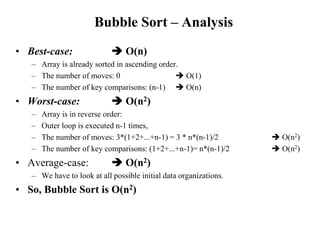
Bubble Sort – Analysis
• Best-case:  O(n)
– Array is already sorted in ascending order.
– The number of moves: 0  O(1)
– The number of key comparisons: (n-1)  O(n)
• Worst-case:  O(n2)
– Array is in reverse order:
– Outer loop is executed n-1 times,
– The number of moves: 3*(1+2+...+n-1) = 3 * n*(n-1)/2  O(n2)
– The number of key comparisons: (1+2+...+n-1)= n*(n-1)/2  O(n2)
• Average-case:  O(n2)
– We have to look at all possible initial data organizations.
• So, Bubble Sort is O(n2)
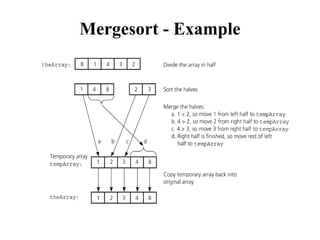
Mergesort - Example
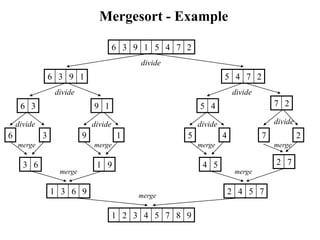
Mergesort - Example
6 3 9 1 5 4 7 2
5 4 7 26 3 9 1
6 3 9 1 7 25 4
6 3 19 5 4 27
3 6 1 9 2 74 5
2 4 5 71 3 6 9
1 2 3 4 5 7 8 9
divide
dividedividedivide
dividedivide
divide
merge merge
merge
merge
merge merge
merge
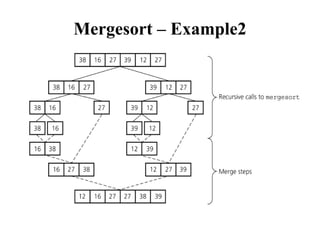
Mergesort – Example2
Mergesort – Analysis of Merge
A worst-case instance of the merge step in mergesort
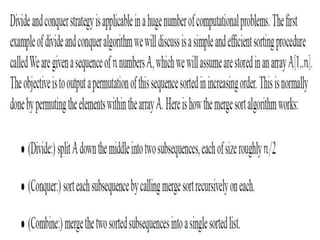
Merge Sort Algo
Analysis of Merge Sort

Sorting algorithms

  • 1.
  • 2.
    Sorting Algorithms • Thereare many sorting algorithms, such as: – Selection Sort – Insertion Sort – Bubble Sort – Merge Sort – Quick Sort • The first three are the foundations for faster and more efficient algorithms.
  • 3.
    Selection Sort • Thelist is divided into two sublists, sorted and unsorted, which are divided by an imaginary wall. • We find the smallest element from the unsorted sublist and swap it with the element at the beginning of the unsorted data. • After each selection and swapping, the imaginary wall between the two sublists move one element ahead, increasing the number of sorted elements and decreasing the number of unsorted ones. • Each time we move one element from the unsorted sublist to the sorted sublist, we say that we have completed a sort pass. • A list of n elements requires n-1 passes to completely rearrange the data.
  • 4.
    23 78 458 32 56 8 78 45 23 32 56 8 23 45 78 32 56 8 23 32 78 45 56 8 23 32 45 78 56 8 23 32 45 56 78 Original List After pass 1 After pass 2 After pass 3 After pass 4 After pass 5 Sorted Unsorted
  • 5.
    Selection Sort (cont.) template<class Item> void selectionSort( Item a[], int n) { for (int i = 0; i < n-1; i++) { int min = i; for (int j = i+1; j < n; j++) if (a[j] < a[min]) min = j; swap(a[i], a[min]); } } template < class Object> void swap( Object &lhs, Object &rhs ) { Object tmp = lhs; lhs = rhs; rhs = tmp; }
  • 6.
    Selection Sort --Analysis • In general, we compare keys and move items (or exchange items) in a sorting algorithm (which uses key comparisons).  So, to analyze a sorting algorithm we should count the number of key comparisons and the number of moves. • Ignoring other operations does not affect our final result. • In selectionSort function, the outer for loop executes n-1 times. • We invoke swap function once at each iteration.  Total Swaps: n-1  Total Moves: 3*(n-1) (Each swap has three moves)
  • 7.
    Selection Sort –Analysis (cont.) • The inner for loop executes the size of the unsorted part minus 1 (from 1 to n-1), and in each iteration we make one key comparison.  # of key comparisons = 1+2+...+n-1 = n*(n-1)/2  So, Selection sort is O(n2) • The best case, the worst case, and the average case of the selection sort algorithm are same.  all of them are O(n2) – This means that the behavior of the selection sort algorithm does not depend on the initial organization of data. – Since O(n2) grows so rapidly, the selection sort algorithm is appropriate only for small n. – Although the selection sort algorithm requires O(n2) key comparisons, it only requires O(n) moves. – A selection sort could be a good choice if data moves are costly but key comparisons are not costly (short keys, long records).
  • 8.
    Comparison of N,logN and N2 N O(LogN) O(N2) 16 4 256 64 6 4K 256 8 64K 1,024 10 1M 16,384 14 256M 131,072 17 16G 262,144 18 6.87E+10 524,288 19 2.74E+11 1,048,576 20 1.09E+12 1,073,741,824 30 1.15E+18
  • 9.
    Insertion Sort • Insertionsort is a simple sorting algorithm that is appropriate for small inputs. – Most common sorting technique used by card players. • The list is divided into two parts: sorted and unsorted. • In each pass, the first element of the unsorted part is picked up, transferred to the sorted sublist, and inserted at the appropriate place. • A list of n elements will take at most n-1 passes to sort the data.
  • 10.
    Original List After pass1 After pass 2 After pass 3 After pass 4 After pass 5 23 78 45 8 32 56 23 78 45 8 32 56 23 45 78 8 32 56 8 23 45 78 32 56 8 23 32 45 78 56 8 23 32 45 56 78 Sorted Unsorted
  • 11.
    Insertion Sort Algorithm template<class Item> void insertionSort(Item a[], int n) { for (int i = 1; i < n; i++) { Item tmp = a[i]; for (int j=i; j>0 && tmp < a[j-1]; j--) a[j] = a[j-1]; a[j] = tmp; } }
  • 12.
    Insertion Sort –Analysis • Running time depends on not only the size of the array but also the contents of the array. • Best-case:  O(n) – Array is already sorted in ascending order. – Inner loop will not be executed. – The number of moves: 2*(n-1)  O(n) – The number of key comparisons: (n-1)  O(n) • Worst-case:  O(n2) – Array is in reverse order: – Inner loop is executed i-1 times, for i = 2,3, …, n – The number of moves: 2*(n-1)+(1+2+...+n-1)= 2*(n-1)+ n*(n-1)/2  O(n2) – The number of key comparisons: (1+2+...+n-1)= n*(n-1)/2  O(n2) • Average-case:  O(n2) – We have to look at all possible initial data organizations. • So, Insertion Sort is O(n2)
  • 13.
    Analysis of insertionsort • Which running time will be used to characterize this algorithm? – Best, worst or average? • Worst: – Longest running time (this is the upper limit for the algorithm) – It is guaranteed that the algorithm will not be worse than this. • Sometimes we are interested in average case. But there are some problems with the average case. – It is difficult to figure out the average case. i.e. what is average input? – Are we going to assume all possible inputs are equally likely? – In fact for most algorithms average case is same as the worst case.
  • 14.
    Bubble Sort • Thelist is divided into two sublists: sorted and unsorted. • The smallest element is bubbled from the unsorted list and moved to the sorted sublist. • After that, the wall moves one element ahead, increasing the number of sorted elements and decreasing the number of unsorted ones. • Each time an element moves from the unsorted part to the sorted part one sort pass is completed. • Given a list of n elements, bubble sort requires up to n-1 passes to sort the data.
  • 15.
    Bubble Sort 23 7845 8 32 56 8 23 78 45 32 56 8 23 32 78 45 56 8 23 32 45 78 56 8 23 32 45 56 78 Original List After pass 1 After pass 2 After pass 3 After pass 4
  • 16.
    Bubble Sort Algorithm template<class Item> void bubleSort(Item a[], int n) { bool sorted = false; int last = n-1; for (int i = 0; (i < last) && !sorted; i++){ sorted = true; for (int j=last; j > i; j--) if (a[j-1] > a[j]{ swap(a[j],a[j-1]); sorted = false; // signal exchange } } }
  • 17.
    Bubble Sort –Analysis • Best-case:  O(n) – Array is already sorted in ascending order. – The number of moves: 0  O(1) – The number of key comparisons: (n-1)  O(n) • Worst-case:  O(n2) – Array is in reverse order: – Outer loop is executed n-1 times, – The number of moves: 3*(1+2+...+n-1) = 3 * n*(n-1)/2  O(n2) – The number of key comparisons: (1+2+...+n-1)= n*(n-1)/2  O(n2) • Average-case:  O(n2) – We have to look at all possible initial data organizations. • So, Bubble Sort is O(n2)
  • 18.
  • 19.
    Mergesort - Example 63 9 1 5 4 7 2 5 4 7 26 3 9 1 6 3 9 1 7 25 4 6 3 19 5 4 27 3 6 1 9 2 74 5 2 4 5 71 3 6 9 1 2 3 4 5 7 8 9 divide dividedividedivide dividedivide divide merge merge merge merge merge merge merge
  • 20.
  • 21.
    Mergesort – Analysisof Merge A worst-case instance of the merge step in mergesort
  • 23.
  • 24.