RADIX SORT
RADIX SORT
• Radix sort is a non-comparative integer sorting algorithm that sorts
data with integer keys by grouping keys by the individual digits which
share the same significant position and value.
• A positional notation is required, but because integers can represent
strings of characters (e.g., names or dates), radix sort is not limited to
integers
PSEUDOCODE
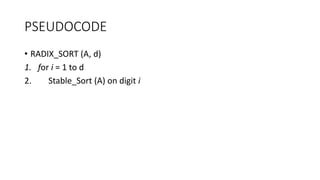
• RADIX_SORT (A, d)
1. for i = 1 to d
2. Stable_Sort (A) on digit i
EXAMPLE
• Let’s sort the following array using radix sort:
A[10] =
64 8 216 512 27 729 0 1 343 125
PASS 1
A[10] =
8 216 512 27 729 0 1 343 12564
PASS 1
Sorted Array after pass 1 (LSD)
A[10] =
1 512 343 64 125 216 27 8 7290
PASS 2
A[10] =
01 512 343 64 125 216 27 08 72900
PASS 2
Sorted Array after pass 2 :
A[10] =
01 08 512 216 125 27 729 343 6400
PASS 3
A[10] =
001 008 512 216 125 027 729 343 064000
PASS 3
Sorted Array after pass 3 :
A[10] =
001 008 027 064 125 216 343 512 729000
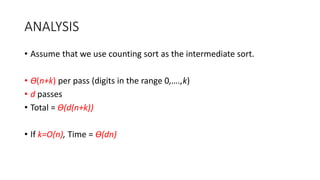
ANALYSIS
• Assume that we use counting sort as the intermediate sort.
• Ө(n+k) per pass (digits in the range 0,….,k)
• d passes
• Total = Ө(d(n+k))
• If k=O(n), Time = Ө(dn)
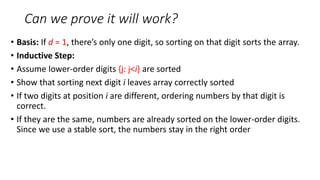
Can we prove it will work?
• Basis: If d = 1, there’s only one digit, so sorting on that digit sorts the array.
• Inductive Step:
• Assume lower-order digits {j: j<i} are sorted
• Show that sorting next digit i leaves array correctly sorted
• If two digits at position i are different, ordering numbers by that digit is
correct.
• If they are the same, numbers are already sorted on the lower-order digits.
Since we use a stable sort, the numbers stay in the right order
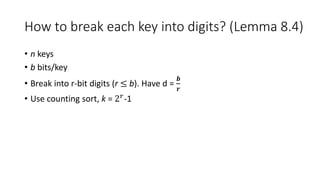
How to break each key into digits? (Lemma 8.4)
• n keys
• b bits/key
• Break into r-bit digits (r ≤ b). Have d =
𝒃
𝒓
• Use counting sort, k = 2 𝑟
-1
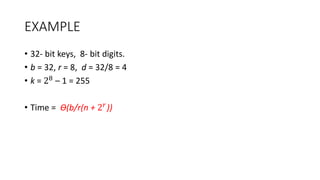
EXAMPLE
• 32- bit keys, 8- bit digits.
• b = 32, r = 8, d = 32/8 = 4
• k = 28 – 1 = 255
• Time = Ө(b/r(n + 2 𝑟
))
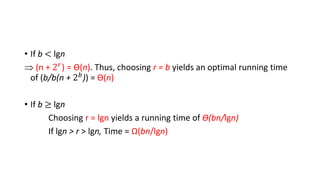
• If b < lgn
 (n + 2 𝑟) = Ө(n). Thus, choosing r = b yields an optimal running time
of (b/b(n + 2 𝑏)) = Ө(n)
• If b ≥ lgn
Choosing r = lgn yields a running time of Ө(bn/lgn)
If lgn > r > lgn, Time = Ω(bn/lgn)

SORTTING IN LINEAR TIME - Radix Sort

  • 1.
  • 2.
    RADIX SORT • Radixsort is a non-comparative integer sorting algorithm that sorts data with integer keys by grouping keys by the individual digits which share the same significant position and value. • A positional notation is required, but because integers can represent strings of characters (e.g., names or dates), radix sort is not limited to integers
  • 3.
    PSEUDOCODE • RADIX_SORT (A,d) 1. for i = 1 to d 2. Stable_Sort (A) on digit i
  • 4.
    EXAMPLE • Let’s sortthe following array using radix sort: A[10] = 64 8 216 512 27 729 0 1 343 125
  • 5.
    PASS 1 A[10] = 8216 512 27 729 0 1 343 12564
  • 6.
    PASS 1 Sorted Arrayafter pass 1 (LSD) A[10] = 1 512 343 64 125 216 27 8 7290
  • 7.
    PASS 2 A[10] = 01512 343 64 125 216 27 08 72900
  • 8.
    PASS 2 Sorted Arrayafter pass 2 : A[10] = 01 08 512 216 125 27 729 343 6400
  • 9.
    PASS 3 A[10] = 001008 512 216 125 027 729 343 064000
  • 10.
    PASS 3 Sorted Arrayafter pass 3 : A[10] = 001 008 027 064 125 216 343 512 729000
  • 11.
    ANALYSIS • Assume thatwe use counting sort as the intermediate sort. • Ө(n+k) per pass (digits in the range 0,….,k) • d passes • Total = Ө(d(n+k)) • If k=O(n), Time = Ө(dn)
  • 12.
    Can we proveit will work? • Basis: If d = 1, there’s only one digit, so sorting on that digit sorts the array. • Inductive Step: • Assume lower-order digits {j: j<i} are sorted • Show that sorting next digit i leaves array correctly sorted • If two digits at position i are different, ordering numbers by that digit is correct. • If they are the same, numbers are already sorted on the lower-order digits. Since we use a stable sort, the numbers stay in the right order
  • 13.
    How to breakeach key into digits? (Lemma 8.4) • n keys • b bits/key • Break into r-bit digits (r ≤ b). Have d = 𝒃 𝒓 • Use counting sort, k = 2 𝑟 -1
  • 14.
    EXAMPLE • 32- bitkeys, 8- bit digits. • b = 32, r = 8, d = 32/8 = 4 • k = 28 – 1 = 255 • Time = Ө(b/r(n + 2 𝑟 ))
  • 15.
    • If b< lgn  (n + 2 𝑟) = Ө(n). Thus, choosing r = b yields an optimal running time of (b/b(n + 2 𝑏)) = Ө(n) • If b ≥ lgn Choosing r = lgn yields a running time of Ө(bn/lgn) If lgn > r > lgn, Time = Ω(bn/lgn)