Designing Procedural Information for
User Manuals: A Case Study with
Circuit Graphics


Debopriyo Roy
Associate Professor, University of Aizu
Complexity in Instructions Design

In traditional instructional design, information designers create
instructions with the whole assembly context in mind, while the readers
have a smaller context; only being able to follow the instructions in the
designer’s chosen order and content presentation (text + graphics).

Problem with Complex Machine Instructions:
1. Multiple components involved (additions and change across
subassembly).
2. Multiple Subassembly shown.
3. Different camera angles shown (body-centered, object-centered).

A problem arises due to inconsistency between the information
designer’s and the reader’s mental models (Norman, 1983).

                                Technical Communication Laboratory
Pictorial Circuit Design
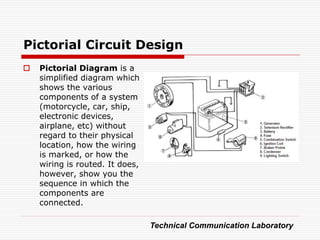
   Pictorial Diagram is a
    simplified diagram which
    shows the various
    components of a system
    (motorcycle, car, ship,
    electronic devices,
    airplane, etc) without
    regard to their physical
    location, how the wiring
    is marked, or how the
    wiring is routed. It does,
    however, show you the
    sequence in which the
    components are
    connected.

                                 Technical Communication Laboratory
Pictorial and Schematic Styles of
Circuit Diagrams


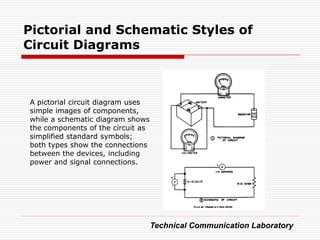
A pictorial circuit diagram uses
simple images of components,
while a schematic diagram shows
the components of the circuit as
simplified standard symbols;
both types show the connections
between the devices, including
power and signal connections.


                                   Technical Communication Laboratory
Focus

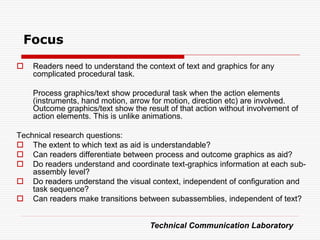
   Readers need to understand the context of text and graphics for any
    complicated procedural task.

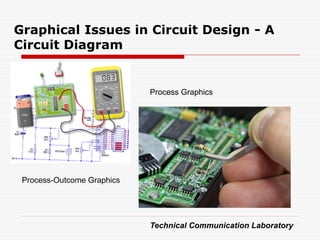
    Process graphics/text show procedural task when the action elements
    (instruments, hand motion, arrow for motion, direction etc) are involved.
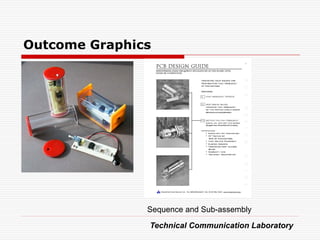
    Outcome graphics/text show the result of that action without involvement of
    action elements. This is unlike animations.

Technical research questions:
 The extent to which text as aid is understandable?
 Can readers differentiate between process and outcome graphics as aid?
 Do readers understand and coordinate text-graphics information at each sub-
    assembly level?
 Do readers understand the visual context, independent of configuration and
    task sequence?
 Can readers make transitions between subassemblies, independent of text?


                                     Technical Communication Laboratory
Graphical Issues in Circuit Design - A
Circuit Diagram


                            Process Graphics


 Process-Outcome Graphics


                            Technical Communication Laboratory
Outcome Graphics


               Sequence and Sub-assembly

               Technical Communication Laboratory
Implications in ESP Context
 In a hardware engineering-based course, would readers
  be able to understand complex designs and circuits
  graphically?

 To what extent would they be able to understand
  complex graphics in a minimalist design set-up?

 Would they be able to understand the supporting
  general text instructions written in English? (procedures)

 Would they understand complex geometrical functions
  and logical design explained in English?


                            Technical Communication Laboratory
Advanced Technical Writing Course
 Focus on the Graphical Design Elements

 Assignments should focus on providing supporting text to
  complex procedural graphics

 Comprehending and matching tasks for text-graphics
  coordination.

 Understanding the placement of text and graphics in a local and
  global context.


                              Technical Communication Laboratory
A Typical Assignment in Technical Writing
   Read the technical article on circuit design.

   Identify the sentences/phrases in the text which explains a
    procedure.

   Identify the sentences/phrases in the text which explains an
    outcome of a procedure.

   Identify the sentence/paragraph which is shown in the process
    and outcome graphics.

   Write a sentence on your own to explain each graphic you see
    in the article.

   Identify the process, process-outcome and outcome graphics.

                                Technical Communication Laboratory
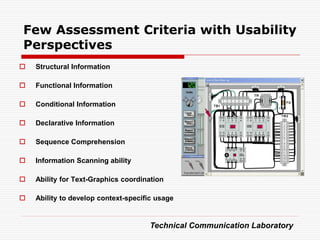
Few Assessment Criteria with Usability
Perspectives
   Structural Information

   Functional Information

   Conditional Information

   Declarative Information

   Sequence Comprehension

   Information Scanning ability

   Ability for Text-Graphics coordination

   Ability to develop context-specific usage


                                     Technical Communication Laboratory
Research Question and Hypotheses
 Is it possible for users to understand text which explain
  process versus outcome orientation?

 Is it possible for users to understand graphics which
  explain process versus outcome orientation?

 Hypothesis: Based on research (Sharp, 2001), readers
  perform better with process graphics than with outcome
  graphics. However (based on previous findings on a
  similar context [Roy, 2006]), when text and graphics are
  presented in coordination, readers perform equally well
  with both process and outcome graphics.


                            Technical Communication Laboratory
Methods
   25 students in an undergraduate (junior-level) technical writing course were
    tested as part of a pilot study.

   A survey was handed out after an initial screening of the students’ ability to
    identify procedural information.

   Each participant was tested with 8 text-visual matching tasks each on the
    category of process, process-outcome and outcome graphics.

   Readers spent time reading basic circuit graphics articles before starting with the
    experiment.

   Readers were given the chance to read about the experimental case study and
    check the process as part of an animation.


                                        Technical Communication Laboratory
Test Instruments
   Each category had 8 matching tasks. Each task had a text and graphic. The three
    categories are identified as Type#1 (process), Type#2 (process-outcome) and
    Type#3 (outcome). Readers did not know how the material was organized.

   For each text support (one sentence each) (inside a type), readers had to match the
    text with a suitable graphics. For each matching task, readers also had to identify
    whether it is a process, process-outcome or outcome graphics.

   Each text and graphics were chosen as a coordination from articles/text on circuit
    design literature (from Google Scholar). Text for each graphic, was written to
    demonstrate the process/outcome orientation (ignoring other details).

   Each matching task had 1 point assigned to it as score. For each type users could
    have maximum of 8 points.

   All introductory level articles/materials were used for the survey. Readers were
    given a chance to familiarize themselves with the material that had the text-graphics
    choices published.

                                        Technical Communication Laboratory
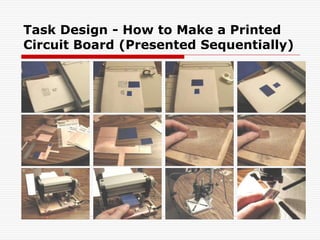
Task Design - How to Make a Printed
Circuit Board (Presented Sequentially)
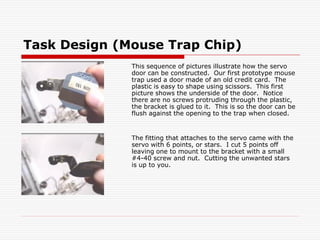
Task Design (Mouse Trap Chip)
              This sequence of pictures illustrate how the servo
              door can be constructed. Our first prototype mouse
              trap used a door made of an old credit card. The
              plastic is easy to shape using scissors. This first
              picture shows the underside of the door. Notice
              there are no screws protruding through the plastic,
              the bracket is glued to it. This is so the door can be
              flush against the opening to the trap when closed.


              The fitting that attaches to the servo came with the
              servo with 6 points, or stars. I cut 5 points off
              leaving one to mount to the bracket with a small
              #4-40 screw and nut. Cutting the unwanted stars
              is up to you.
Task Design
   Each graphic presented in the sequence.
   A description (major statement) for each sequence was provided.
   Two task sequences were used [1. Printed Circuit Board (24-step);
    Mouse Trap Chip (18-step)]
   Each graphic had one line of text support in 1st sequence.
   Each graphic had a paragraph of text support (30 words or less) in
    2nd sequence.
   First sequence has 8 slot process/process-outcome/outcome
    graphic each.
   Second sequence has 6 slot process/process-outcome/outcome
    graphic each.
   1st and 2nd sequence are similar in terms of difficulty levels (as
    suggested in inter-coder reliability analysis with graphics only/text
    only).
   Repeated measures conducted over three weeks to learn about
    distributed practice effect.
Variables
    Dependent:
A.   Score for each type / Total score (individual)
B.   Dependent: Score for each sequence
C.   Dependent: Score for each subassembly

    Independent:
A.   Text content
B.   Graphics content
C.   Sentence structures
D.   Choice of words
E.   Graphical attributes
F.   Information presentation structures
G.   Configuration
H.   Sequence
I.   Complexity of sub-assembly


                                           Technical Communication Laboratory
Intercoder Reliability Analysis
   The graphics and text were chosen on the basis of the inter-coder
    reliability analysis:

   1. Ease with which the text could be translated.
   2. The ease with which the main idea for the graphics could be identified.
   3. How many steps were shown in a sub-assembly?
   4. How many components were shown in the graphics?
   5. Whether action verbs were used in the sentences for matching task?


   Individually, a score was put on for each of the above categories   .
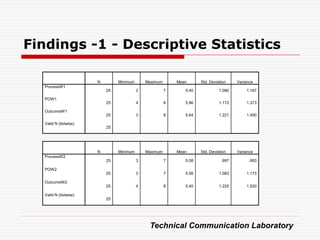
Findings -1 - Descriptive Statistics

                       N        Minimum       Maximum       Mean      Std. Deviation    Variance
  ProcessW1
                           25             3             7      5.40             1.080       1.167

  POW1
                           25             4             8      5.96             1.172       1.373

  OutcomeW1
                           25             3             8      5.64             1.221       1.490

  Valid N (listwise)
                           25


                       N        Minimum       Maximum       Mean      Std. Deviation    Variance
  ProcessW2
                           25             3             7      5.08              .997        .993

  POW2
                           25             3             7      5.56             1.083       1.173

  OutcomeW2
                           25             4             8      5.40             1.225       1.500

  Valid N (listwise)
                           25


                                               Technical Communication Laboratory
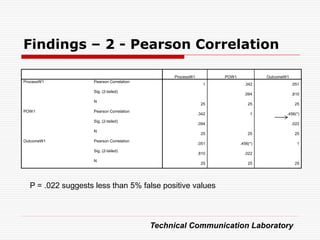
Findings – 2 - Pearson Correlation

                                              ProcessW1          POW1             OutcomeW1
ProcessW1          Pearson Correlation
                                                            1             .342                .051
                   Sig. (2-tailed)
                                                                          .094                .810
                   N
                                                           25               25                 25
POW1               Pearson Correlation
                                                          .342               1            .456(*)
                   Sig. (2-tailed)
                                                          .094                                .022
                   N
                                                           25               25                 25
OutcomeW1          Pearson Correlation
                                                          .051          .456(*)                 1
                   Sig. (2-tailed)
                                                          .810            .022
                   N
                                                           25               25                 25


  P = .022 suggests less than 5% false positive values


                                         Technical Communication Laboratory
More Results on the way

    Friedman Test to analyze any overall difference in the mean scores for
     repeated measures in process, process-outcome and outcome groups. Practice
     effects studied with chi-square values.
    Perform a Bonferroni correction.
    Wilcoxin signed rank test to test if there is any significant difference between
     bivariate groups.
    Multiple regression analysis to test how a group of predictor variables might
     impact the overall total score for an individual on any specific type OR all the
     three types combined.

    The predictor variable GROUPS are as follows:
A.   Subassemblies
B.   Sequences
C.   Configuration identification.
D.   Verb identification


                                        Technical Communication Laboratory
Questions for Predictor Variable Groups

   Accuracy scores for 5 trials for each and every task below:

   Choose a graphic that represents the first task in the sequence.
   Choose a sentence that represents the first task in the sequence.
   Choose a graphic that might be part of a different subassembly.
   Choose a sentence that might be part of a different subassembly.
   Identify the different subassemblies in graphics.
   Identify the different subassemblies in text.
   In the following sentences (steps), identify the verb that represents a
    process.
   In the following sentences (steps), identify the verb that represents an
    outcome.
Future Analysis
   Due to complications relating to the multiple-information scenario (e.g.,
    both process and outcome context within a single graphic or inside a
    subassembly scenario), within a subassembly, a multiple-regression
    /factor analysis should be conducted to test separate loadings of
    predictor variables.

   Test instruments should be systematized so that we get a good reliability
    and Chronback’s alpha value of more that .70.

   Each subassembly should be independently analyzed for its predictor
    variables and measured independently.

   Due to the relative nature of the answer possible, an ordinal scale might
    be used (use Likert scale and rank order responses).


                                    Technical Communication Laboratory
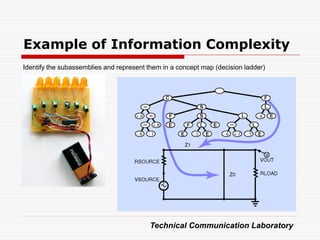
Example of Information Complexity
Identify the subassemblies and represent them in a concept map (decision ladder)


                                         Technical Communication Laboratory
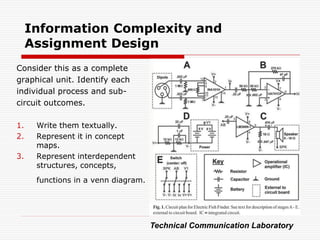
Information Complexity and
     Assignment Design
Consider this as a complete
graphical unit. Identify each
individual process and sub-
circuit outcomes.

1.    Write them textually.
2.    Represent it in concept
      maps.
3.    Represent interdependent
      structures, concepts,
      functions in a venn diagram.


                                     Technical Communication Laboratory
THANK YOU !

Circuit design presentation

  • 1.
    Designing Procedural Informationfor User Manuals: A Case Study with Circuit Graphics Debopriyo Roy Associate Professor, University of Aizu
  • 2.
    Complexity in InstructionsDesign In traditional instructional design, information designers create instructions with the whole assembly context in mind, while the readers have a smaller context; only being able to follow the instructions in the designer’s chosen order and content presentation (text + graphics). Problem with Complex Machine Instructions: 1. Multiple components involved (additions and change across subassembly). 2. Multiple Subassembly shown. 3. Different camera angles shown (body-centered, object-centered). A problem arises due to inconsistency between the information designer’s and the reader’s mental models (Norman, 1983). Technical Communication Laboratory
  • 3.
    Pictorial Circuit Design  Pictorial Diagram is a simplified diagram which shows the various components of a system (motorcycle, car, ship, electronic devices, airplane, etc) without regard to their physical location, how the wiring is marked, or how the wiring is routed. It does, however, show you the sequence in which the components are connected. Technical Communication Laboratory
  • 4.
    Pictorial and SchematicStyles of Circuit Diagrams A pictorial circuit diagram uses simple images of components, while a schematic diagram shows the components of the circuit as simplified standard symbols; both types show the connections between the devices, including power and signal connections. Technical Communication Laboratory
  • 5.
    Focus  Readers need to understand the context of text and graphics for any complicated procedural task. Process graphics/text show procedural task when the action elements (instruments, hand motion, arrow for motion, direction etc) are involved. Outcome graphics/text show the result of that action without involvement of action elements. This is unlike animations. Technical research questions:  The extent to which text as aid is understandable?  Can readers differentiate between process and outcome graphics as aid?  Do readers understand and coordinate text-graphics information at each sub- assembly level?  Do readers understand the visual context, independent of configuration and task sequence?  Can readers make transitions between subassemblies, independent of text? Technical Communication Laboratory
  • 6.
    Graphical Issues inCircuit Design - A Circuit Diagram Process Graphics Process-Outcome Graphics Technical Communication Laboratory
  • 7.
    Outcome Graphics Sequence and Sub-assembly Technical Communication Laboratory
  • 8.
    Implications in ESPContext  In a hardware engineering-based course, would readers be able to understand complex designs and circuits graphically?  To what extent would they be able to understand complex graphics in a minimalist design set-up?  Would they be able to understand the supporting general text instructions written in English? (procedures)  Would they understand complex geometrical functions and logical design explained in English? Technical Communication Laboratory
  • 9.
    Advanced Technical WritingCourse  Focus on the Graphical Design Elements  Assignments should focus on providing supporting text to complex procedural graphics  Comprehending and matching tasks for text-graphics coordination.  Understanding the placement of text and graphics in a local and global context. Technical Communication Laboratory
  • 10.
    A Typical Assignmentin Technical Writing  Read the technical article on circuit design.  Identify the sentences/phrases in the text which explains a procedure.  Identify the sentences/phrases in the text which explains an outcome of a procedure.  Identify the sentence/paragraph which is shown in the process and outcome graphics.  Write a sentence on your own to explain each graphic you see in the article.  Identify the process, process-outcome and outcome graphics. Technical Communication Laboratory
  • 11.
    Few Assessment Criteriawith Usability Perspectives  Structural Information  Functional Information  Conditional Information  Declarative Information  Sequence Comprehension  Information Scanning ability  Ability for Text-Graphics coordination  Ability to develop context-specific usage Technical Communication Laboratory
  • 12.
    Research Question andHypotheses  Is it possible for users to understand text which explain process versus outcome orientation?  Is it possible for users to understand graphics which explain process versus outcome orientation?  Hypothesis: Based on research (Sharp, 2001), readers perform better with process graphics than with outcome graphics. However (based on previous findings on a similar context [Roy, 2006]), when text and graphics are presented in coordination, readers perform equally well with both process and outcome graphics. Technical Communication Laboratory
  • 13.
    Methods  25 students in an undergraduate (junior-level) technical writing course were tested as part of a pilot study.  A survey was handed out after an initial screening of the students’ ability to identify procedural information.  Each participant was tested with 8 text-visual matching tasks each on the category of process, process-outcome and outcome graphics.  Readers spent time reading basic circuit graphics articles before starting with the experiment.  Readers were given the chance to read about the experimental case study and check the process as part of an animation. Technical Communication Laboratory
  • 14.
    Test Instruments  Each category had 8 matching tasks. Each task had a text and graphic. The three categories are identified as Type#1 (process), Type#2 (process-outcome) and Type#3 (outcome). Readers did not know how the material was organized.  For each text support (one sentence each) (inside a type), readers had to match the text with a suitable graphics. For each matching task, readers also had to identify whether it is a process, process-outcome or outcome graphics.  Each text and graphics were chosen as a coordination from articles/text on circuit design literature (from Google Scholar). Text for each graphic, was written to demonstrate the process/outcome orientation (ignoring other details).  Each matching task had 1 point assigned to it as score. For each type users could have maximum of 8 points.  All introductory level articles/materials were used for the survey. Readers were given a chance to familiarize themselves with the material that had the text-graphics choices published. Technical Communication Laboratory
  • 15.
    Task Design -How to Make a Printed Circuit Board (Presented Sequentially)
  • 16.
    Task Design (MouseTrap Chip) This sequence of pictures illustrate how the servo door can be constructed. Our first prototype mouse trap used a door made of an old credit card. The plastic is easy to shape using scissors. This first picture shows the underside of the door. Notice there are no screws protruding through the plastic, the bracket is glued to it. This is so the door can be flush against the opening to the trap when closed. The fitting that attaches to the servo came with the servo with 6 points, or stars. I cut 5 points off leaving one to mount to the bracket with a small #4-40 screw and nut. Cutting the unwanted stars is up to you.
  • 17.
    Task Design  Each graphic presented in the sequence.  A description (major statement) for each sequence was provided.  Two task sequences were used [1. Printed Circuit Board (24-step); Mouse Trap Chip (18-step)]  Each graphic had one line of text support in 1st sequence.  Each graphic had a paragraph of text support (30 words or less) in 2nd sequence.  First sequence has 8 slot process/process-outcome/outcome graphic each.  Second sequence has 6 slot process/process-outcome/outcome graphic each.  1st and 2nd sequence are similar in terms of difficulty levels (as suggested in inter-coder reliability analysis with graphics only/text only).  Repeated measures conducted over three weeks to learn about distributed practice effect.
  • 18.
    Variables  Dependent: A. Score for each type / Total score (individual) B. Dependent: Score for each sequence C. Dependent: Score for each subassembly  Independent: A. Text content B. Graphics content C. Sentence structures D. Choice of words E. Graphical attributes F. Information presentation structures G. Configuration H. Sequence I. Complexity of sub-assembly Technical Communication Laboratory
  • 19.
    Intercoder Reliability Analysis  The graphics and text were chosen on the basis of the inter-coder reliability analysis:  1. Ease with which the text could be translated.  2. The ease with which the main idea for the graphics could be identified.  3. How many steps were shown in a sub-assembly?  4. How many components were shown in the graphics?  5. Whether action verbs were used in the sentences for matching task?  Individually, a score was put on for each of the above categories .
  • 20.
    Findings -1 -Descriptive Statistics N Minimum Maximum Mean Std. Deviation Variance ProcessW1 25 3 7 5.40 1.080 1.167 POW1 25 4 8 5.96 1.172 1.373 OutcomeW1 25 3 8 5.64 1.221 1.490 Valid N (listwise) 25 N Minimum Maximum Mean Std. Deviation Variance ProcessW2 25 3 7 5.08 .997 .993 POW2 25 3 7 5.56 1.083 1.173 OutcomeW2 25 4 8 5.40 1.225 1.500 Valid N (listwise) 25 Technical Communication Laboratory
  • 21.
    Findings – 2- Pearson Correlation ProcessW1 POW1 OutcomeW1 ProcessW1 Pearson Correlation 1 .342 .051 Sig. (2-tailed) .094 .810 N 25 25 25 POW1 Pearson Correlation .342 1 .456(*) Sig. (2-tailed) .094 .022 N 25 25 25 OutcomeW1 Pearson Correlation .051 .456(*) 1 Sig. (2-tailed) .810 .022 N 25 25 25 P = .022 suggests less than 5% false positive values Technical Communication Laboratory
  • 22.
    More Results onthe way  Friedman Test to analyze any overall difference in the mean scores for repeated measures in process, process-outcome and outcome groups. Practice effects studied with chi-square values.  Perform a Bonferroni correction.  Wilcoxin signed rank test to test if there is any significant difference between bivariate groups.  Multiple regression analysis to test how a group of predictor variables might impact the overall total score for an individual on any specific type OR all the three types combined.  The predictor variable GROUPS are as follows: A. Subassemblies B. Sequences C. Configuration identification. D. Verb identification Technical Communication Laboratory
  • 23.
    Questions for PredictorVariable Groups  Accuracy scores for 5 trials for each and every task below:  Choose a graphic that represents the first task in the sequence.  Choose a sentence that represents the first task in the sequence.  Choose a graphic that might be part of a different subassembly.  Choose a sentence that might be part of a different subassembly.  Identify the different subassemblies in graphics.  Identify the different subassemblies in text.  In the following sentences (steps), identify the verb that represents a process.  In the following sentences (steps), identify the verb that represents an outcome.
  • 24.
    Future Analysis  Due to complications relating to the multiple-information scenario (e.g., both process and outcome context within a single graphic or inside a subassembly scenario), within a subassembly, a multiple-regression /factor analysis should be conducted to test separate loadings of predictor variables.  Test instruments should be systematized so that we get a good reliability and Chronback’s alpha value of more that .70.  Each subassembly should be independently analyzed for its predictor variables and measured independently.  Due to the relative nature of the answer possible, an ordinal scale might be used (use Likert scale and rank order responses). Technical Communication Laboratory
  • 25.
    Example of InformationComplexity Identify the subassemblies and represent them in a concept map (decision ladder) Technical Communication Laboratory
  • 26.
    Information Complexity and Assignment Design Consider this as a complete graphical unit. Identify each individual process and sub- circuit outcomes. 1. Write them textually. 2. Represent it in concept maps. 3. Represent interdependent structures, concepts, functions in a venn diagram. Technical Communication Laboratory
  • 27.