Perception of Objects in Technical
Illustrations - A Challenge in Technical
                         Communication


 Debopriyo Roy
 Associate Professor
 University of Aizu

 December 12, 2010

 Presentation at IEEE PCS-J, Nagano City, Japan
Depth Perception
   Depth perception is the visual ability to perceive the world
    in three dimensions (3D)and the distance of an object.

   Monocular cues provide depth information when viewing a
    scene with one eye.

   We perceive depth with 2 main sources of information:
    A. Binocular disparity        B. Monocular cues
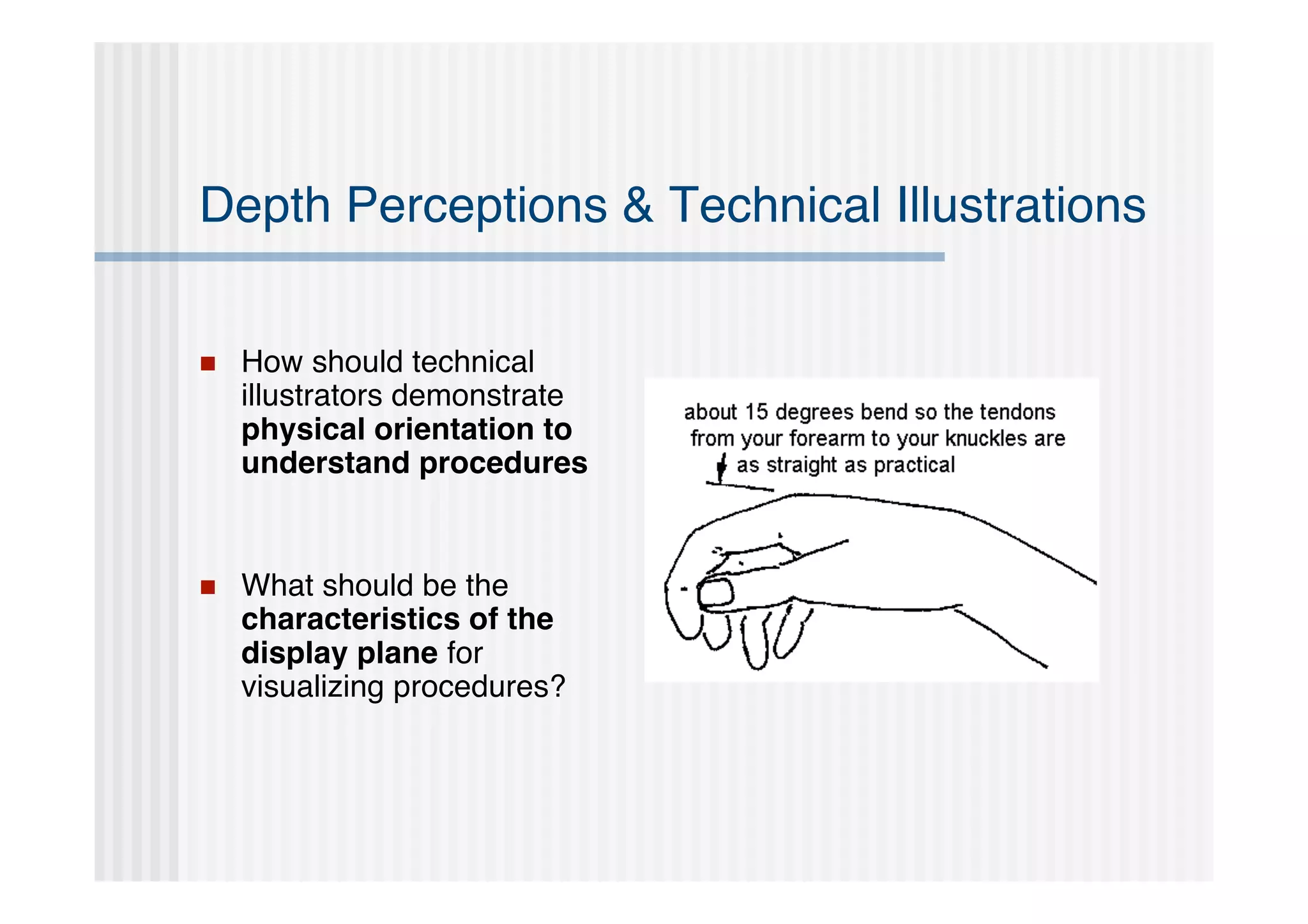
Depth Perceptions & Technical Illustrations


   How should technical
    illustrators demonstrate
    physical orientation to
    understand procedures


   What should be the
    characteristics of the
    display plane for
    visualizing procedures?
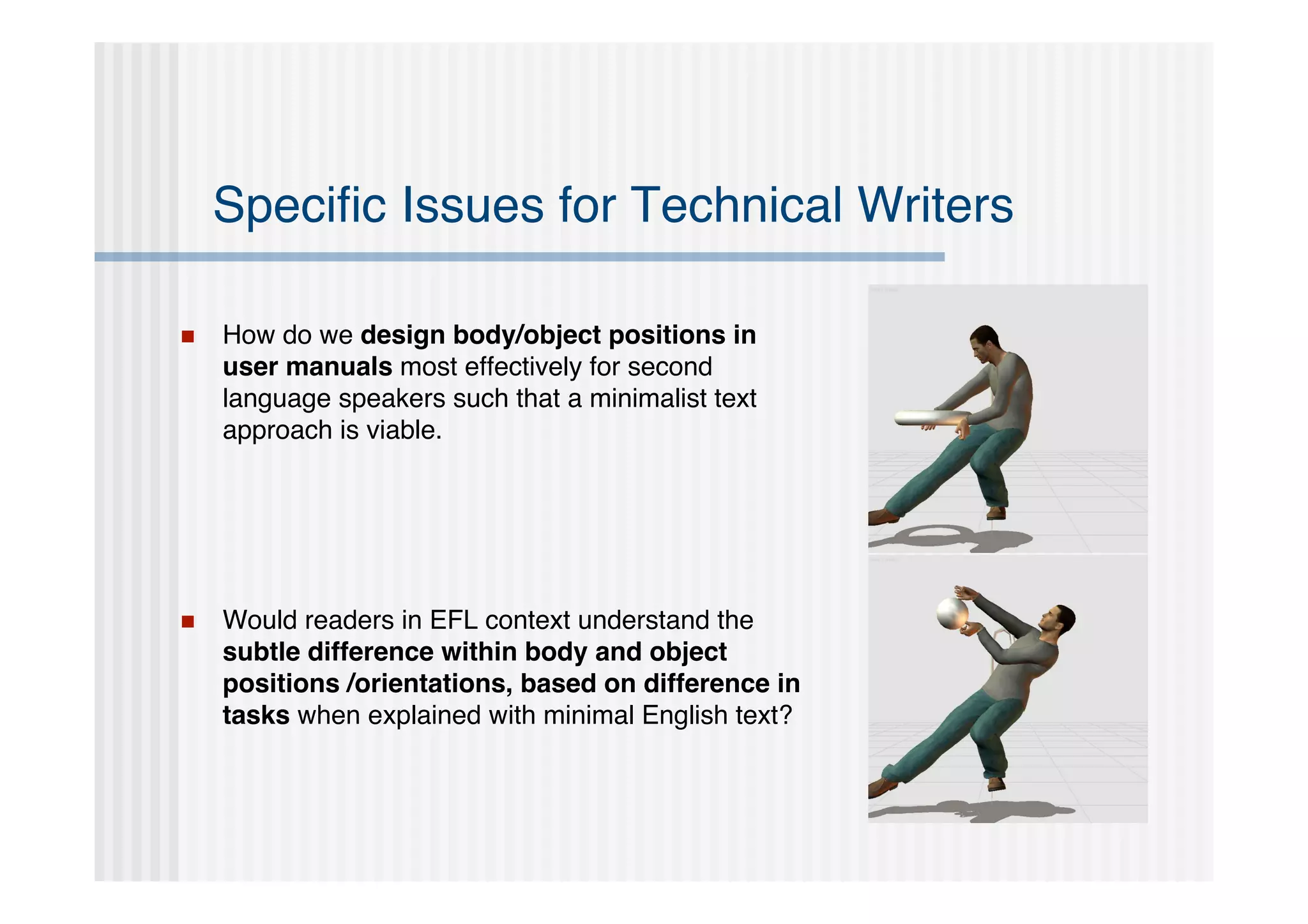
Specific Issues for Technical Writers

   How do we design body/object positions in
    user manuals most effectively for second
    language speakers such that a minimalist text
    approach is viable.


   Would readers in EFL context understand the
    subtle difference within body and object
    positions /orientations, based on difference in
    tasks when explained with minimal English text?
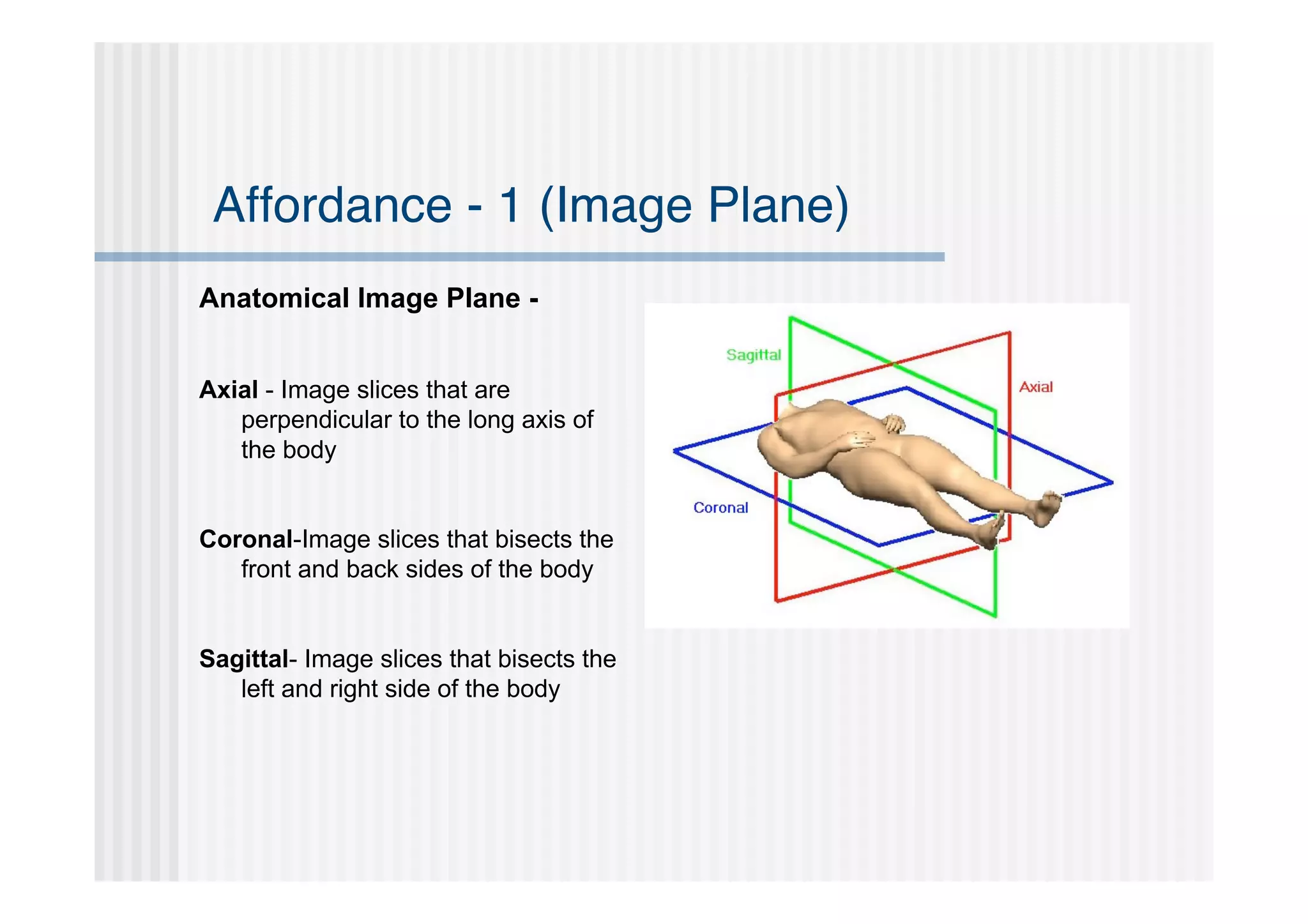
Affordance - 1 (Image Plane)
Anatomical Image Plane -


Axial - Image slices that are
   perpendicular to the long axis of
   the body


Coronal-Image slices that bisects the
   front and back sides of the body


Sagittal- Image slices that bisects the
   left and right side of the body
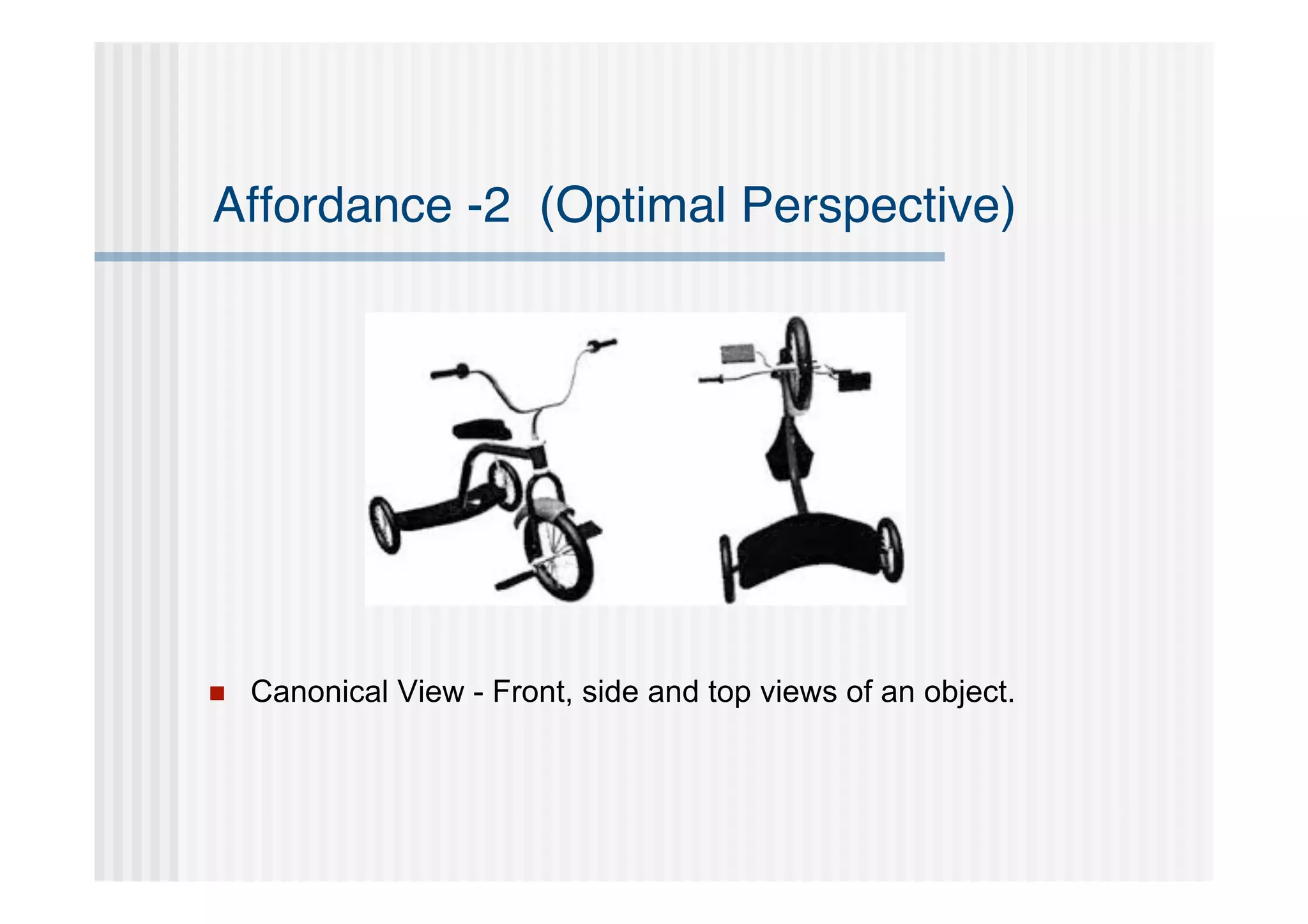
Affordance -2 (Optimal Perspective)


   Canonical View - Front, side and top views of an object.
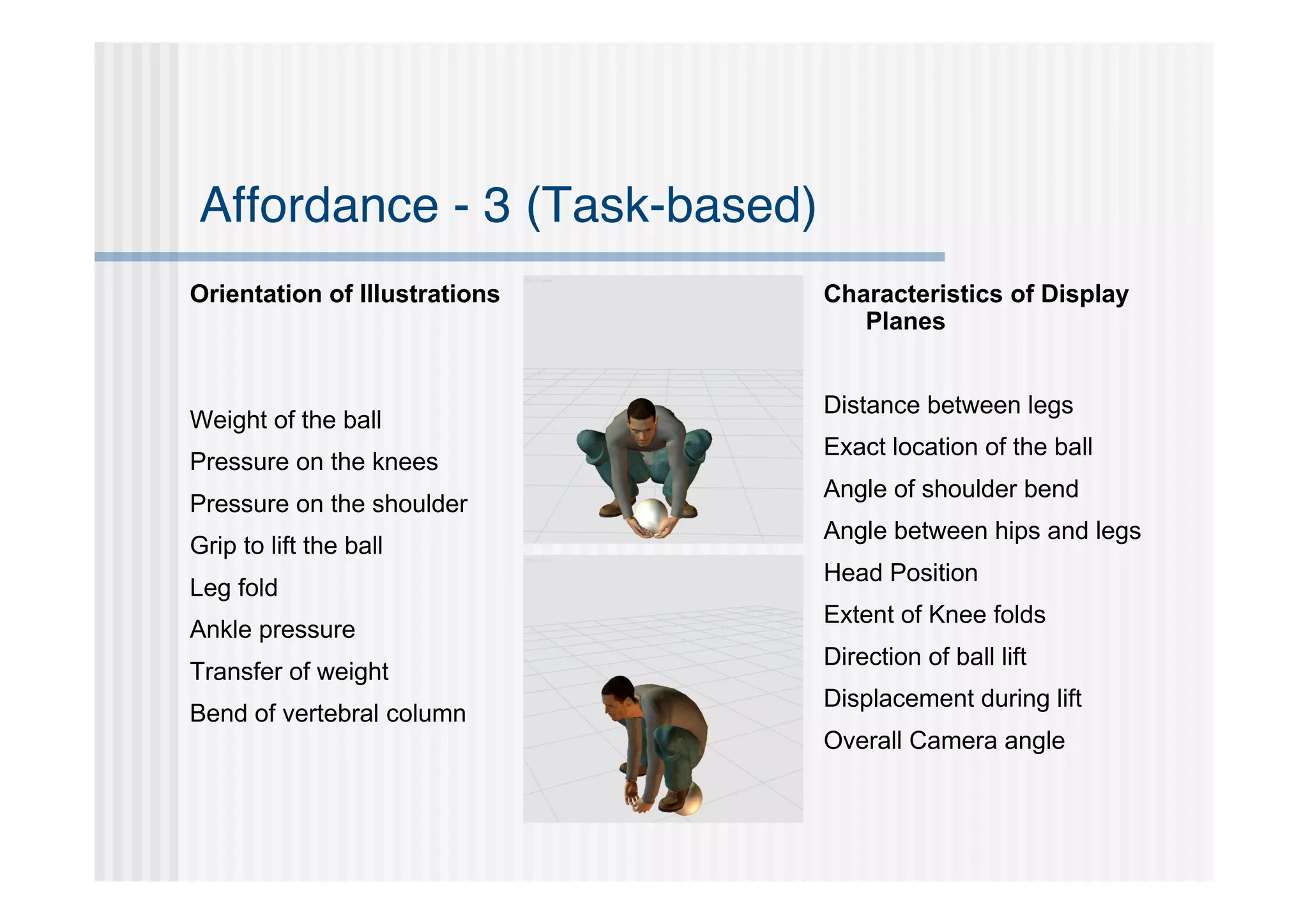
Affordance - 3 (Task-based)
Orientation of Illustrations   Characteristics of Display
                                  Planes


                               Distance between legs
Weight of the ball
                               Exact location of the ball
Pressure on the knees
                               Angle of shoulder bend
Pressure on the shoulder
                               Angle between hips and legs
Grip to lift the ball
                               Head Position
Leg fold
                               Extent of Knee folds
Ankle pressure
                               Direction of ball lift
Transfer of weight
                               Displacement during lift
Bend of vertebral column
                               Overall Camera angle
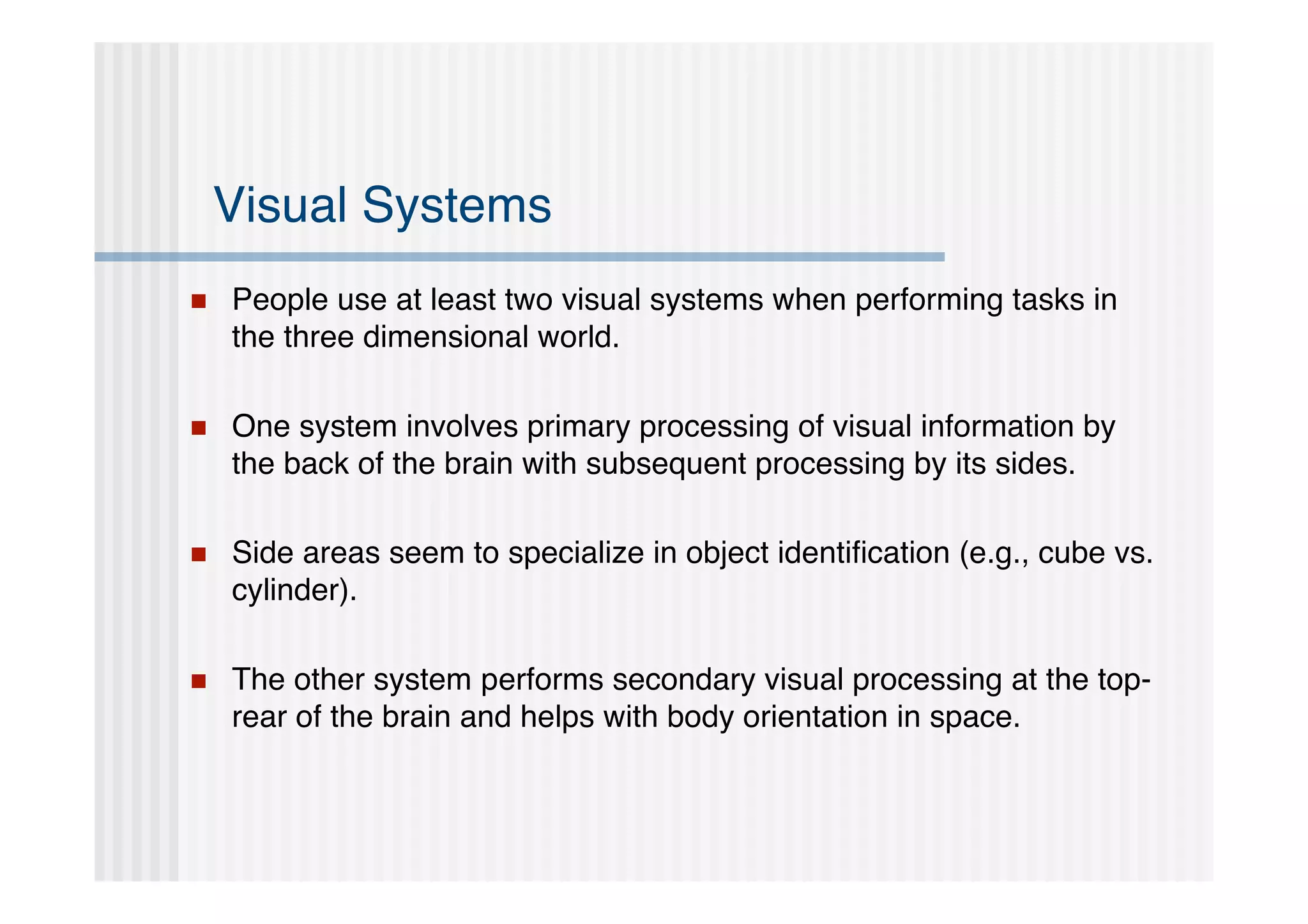
Visual Systems
   People use at least two visual systems when performing tasks in
    the three dimensional world.

   One system involves primary processing of visual information by
    the back of the brain with subsequent processing by its sides.

   Side areas seem to specialize in object identification (e.g., cube vs.
    cylinder).

   The other system performs secondary visual processing at the top-
    rear of the brain and helps with body orientation in space.
Object Manipulation vs. Physical Orientation
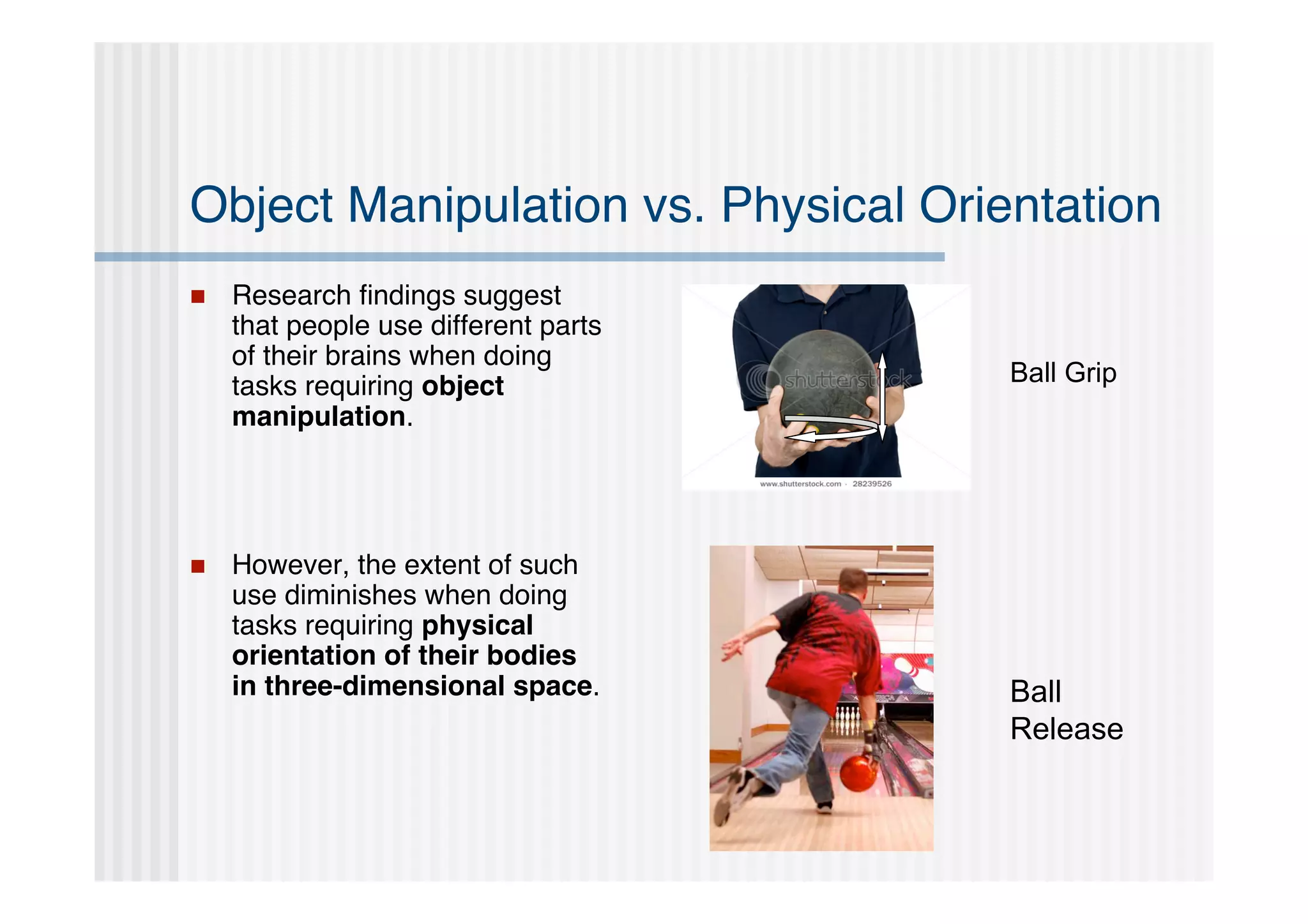
   Research findings suggest
    that people use different parts
    of their brains when doing
    tasks requiring object            Ball Grip
    manipulation.


   However, the extent of such
    use diminishes when doing
    tasks requiring physical
    orientation of their bodies
    in three-dimensional space.       Ball
                                      Release
Two Dimensional Views of Three
Dimensional Plane
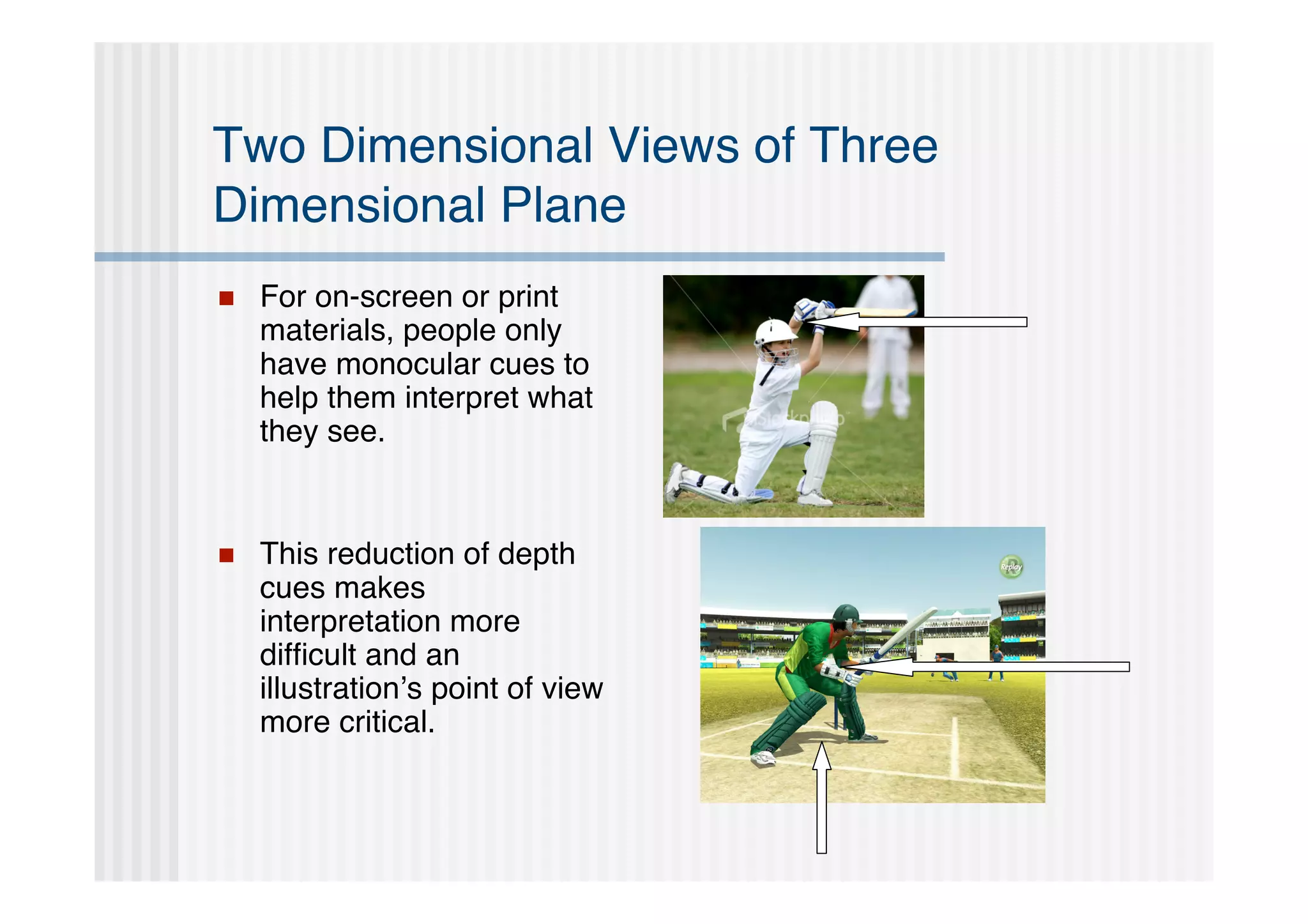
   For on-screen or print
    materials, people only
    have monocular cues to
    help them interpret what
    they see.


   This reduction of depth
    cues makes
    interpretation more
    difficult and an
    illustration’s point of view
    more critical.
Object vs. Body-Centered View
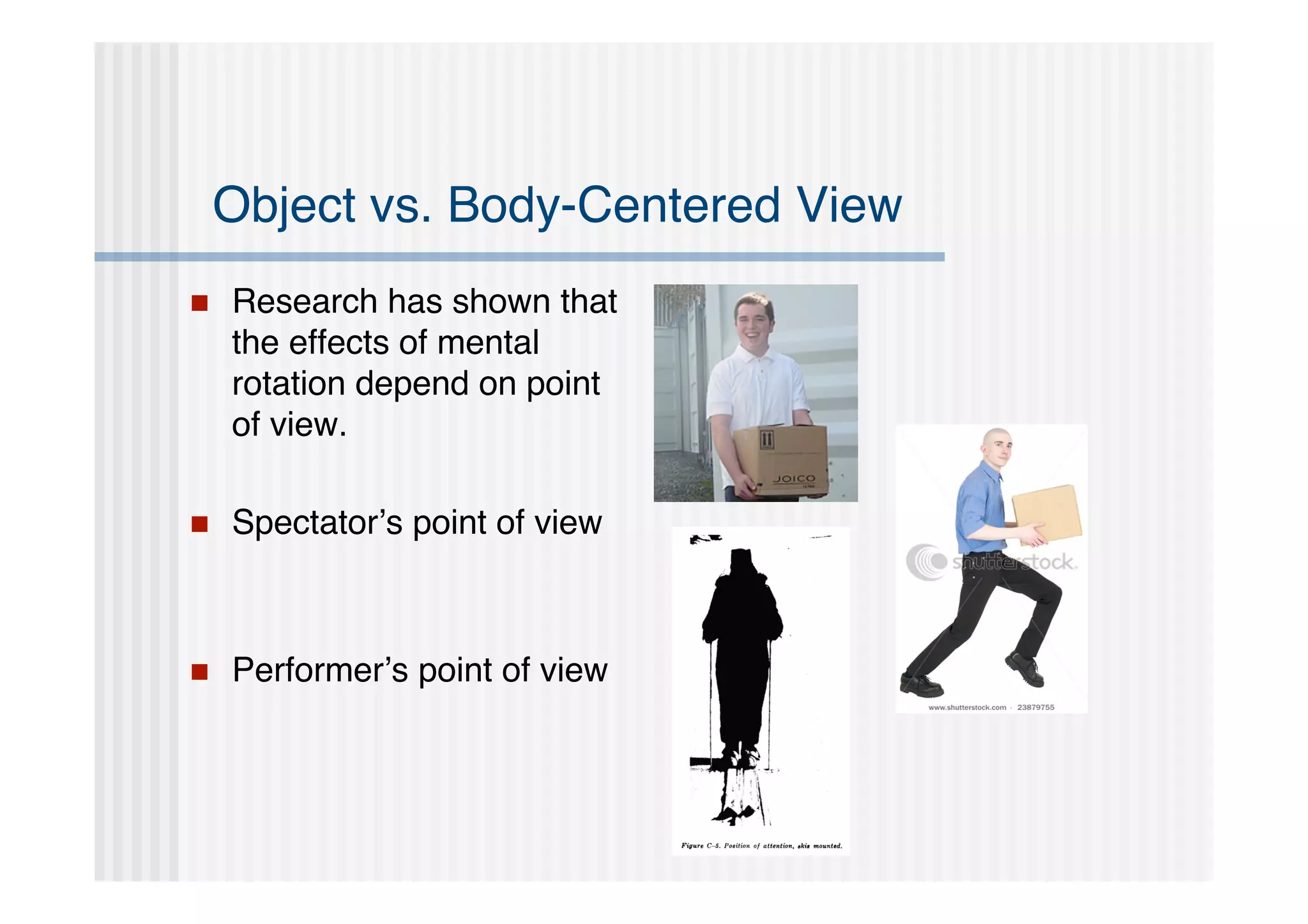
   Research has shown that
    the effects of mental
    rotation depend on point
    of view.

   Spectator’s point of view


   Performer’s point of view
Perception of Distances
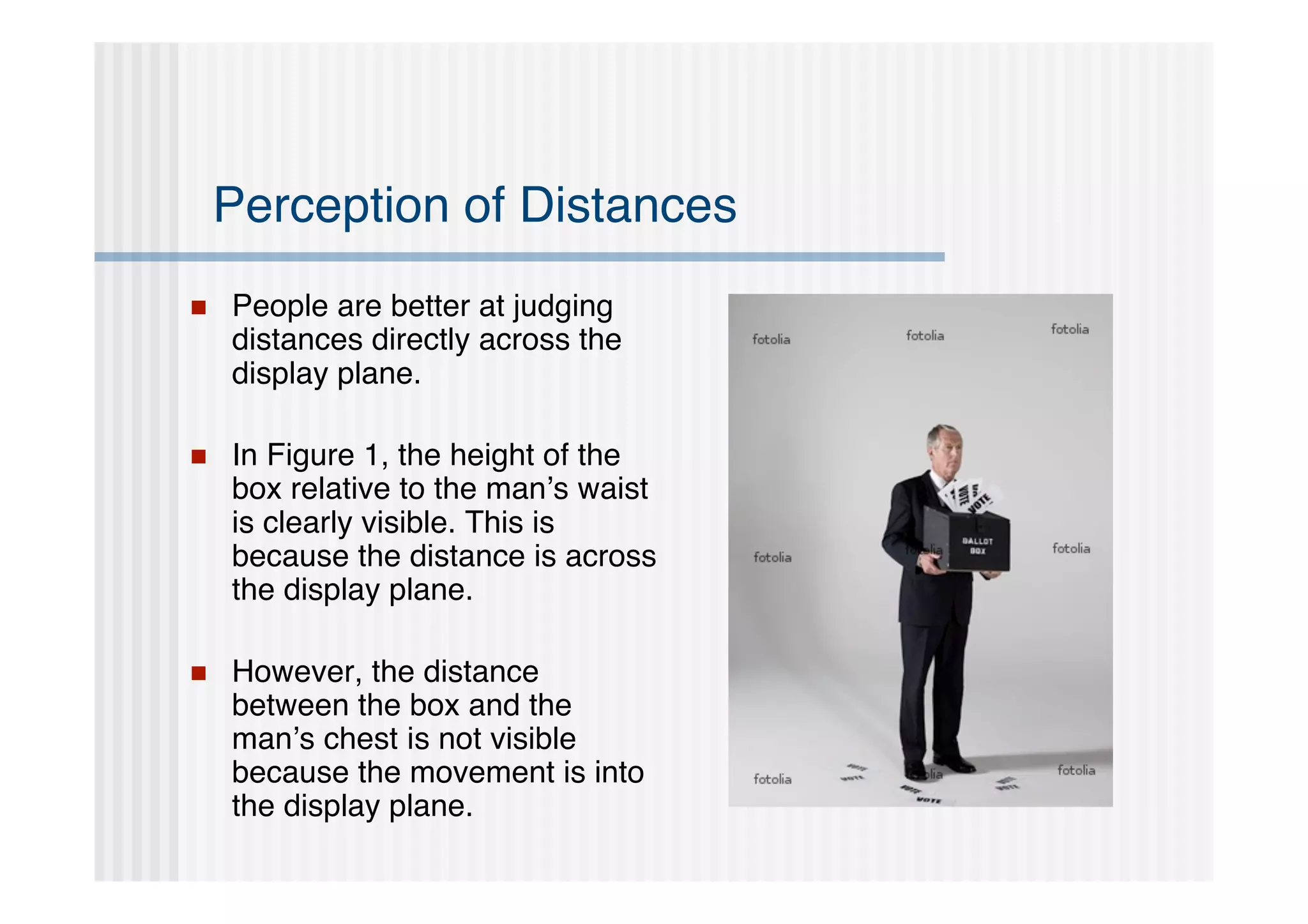
   People are better at judging
    distances directly across the
    display plane.

   In Figure 1, the height of the
    box relative to the man’s waist
    is clearly visible. This is
    because the distance is across
    the display plane.

   However, the distance
    between the box and the
    man’s chest is not visible
    because the movement is into
    the display plane.
Perception of More Complex Physical
    Postures

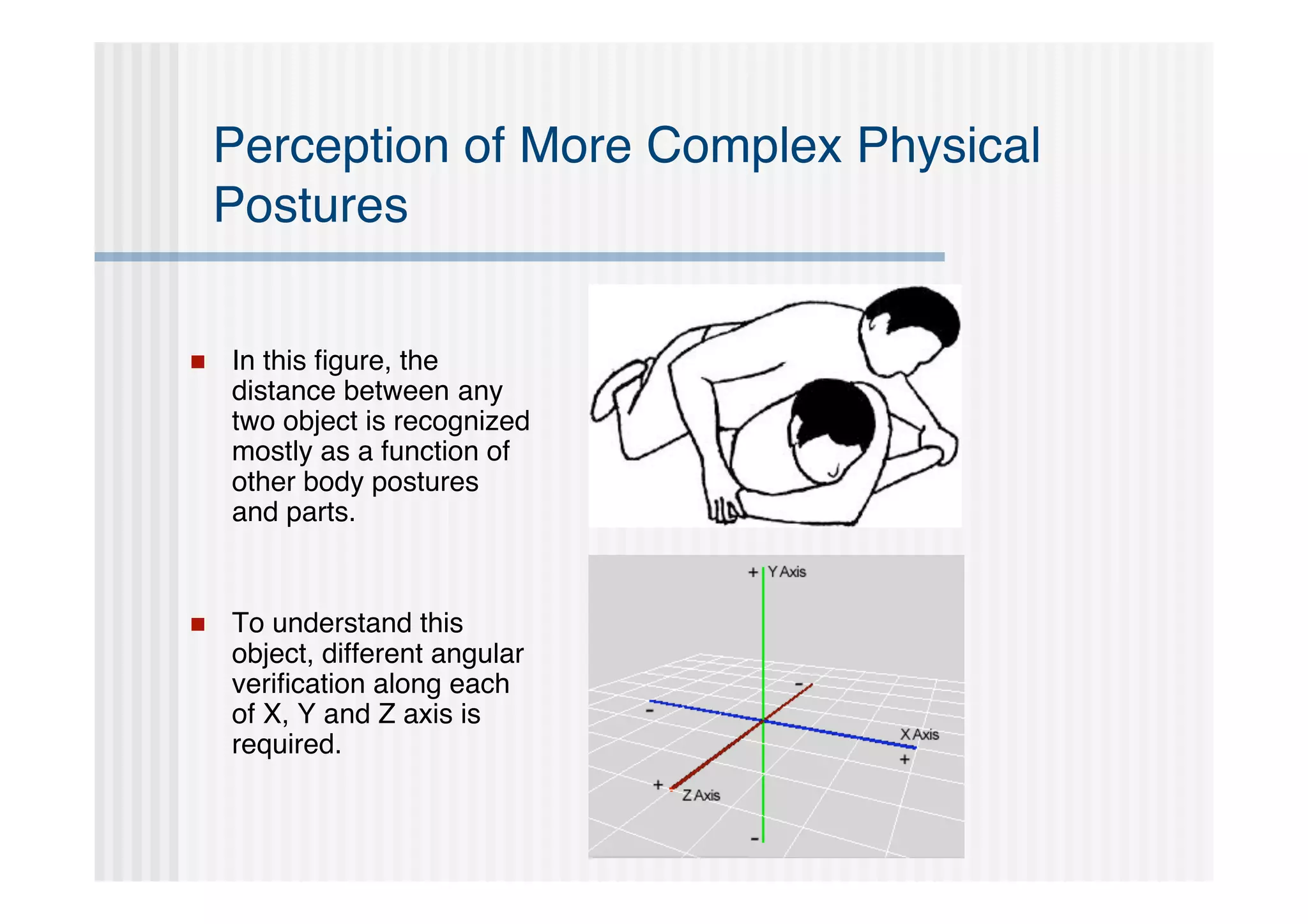
   In this figure, the
    distance between any
    two object is recognized
    mostly as a function of
    other body postures
    and parts.


   To understand this
    object, different angular
    verification along each
    of X, Y and Z axis is
    required.
Illustrations and Instructions
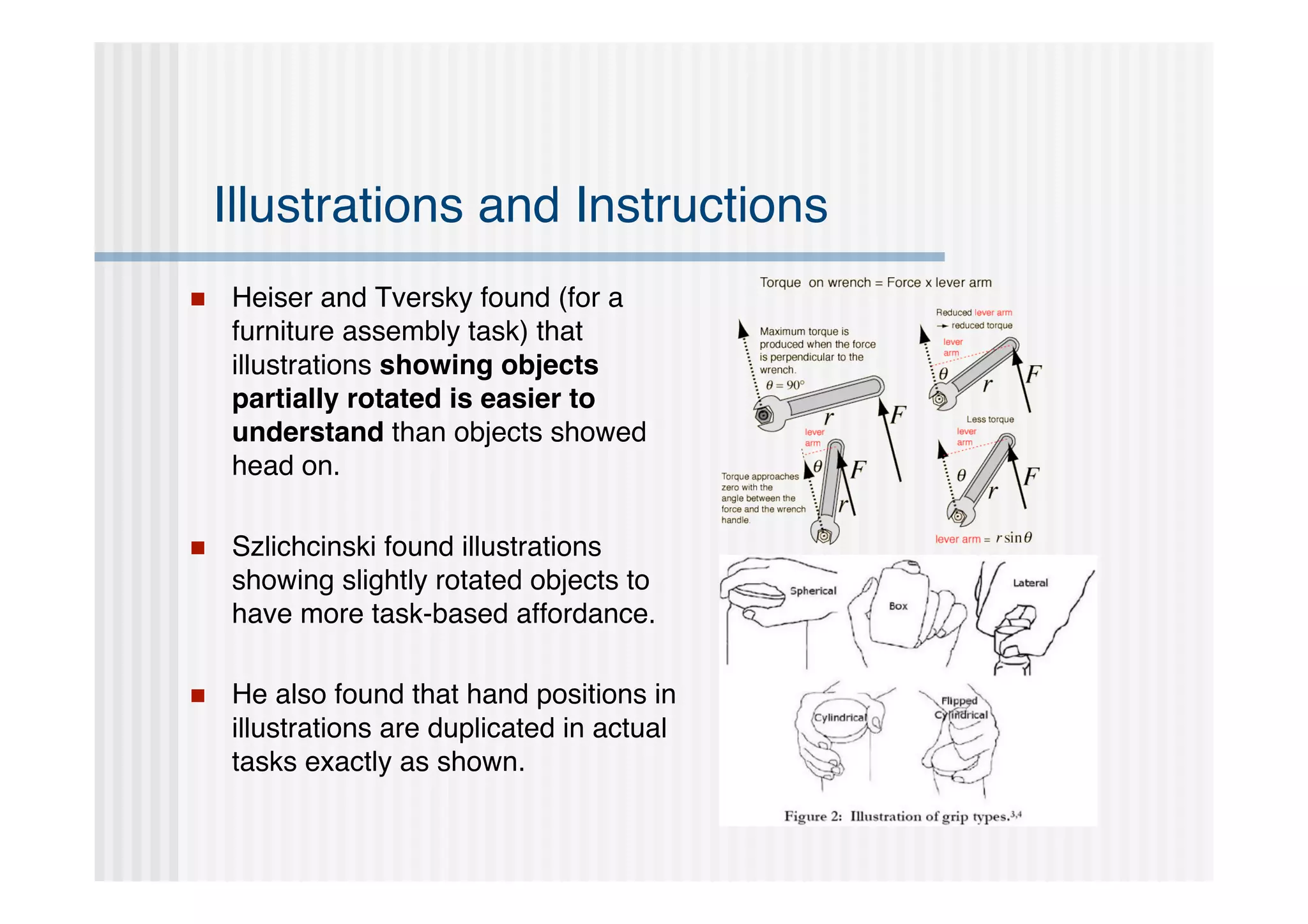
   Heiser and Tversky found (for a
    furniture assembly task) that
    illustrations showing objects
    partially rotated is easier to
    understand than objects showed
    head on.

   Szlichcinski found illustrations
    showing slightly rotated objects to
    have more task-based affordance.

   He also found that hand positions in
    illustrations are duplicated in actual
    tasks exactly as shown.
Image Perceptions

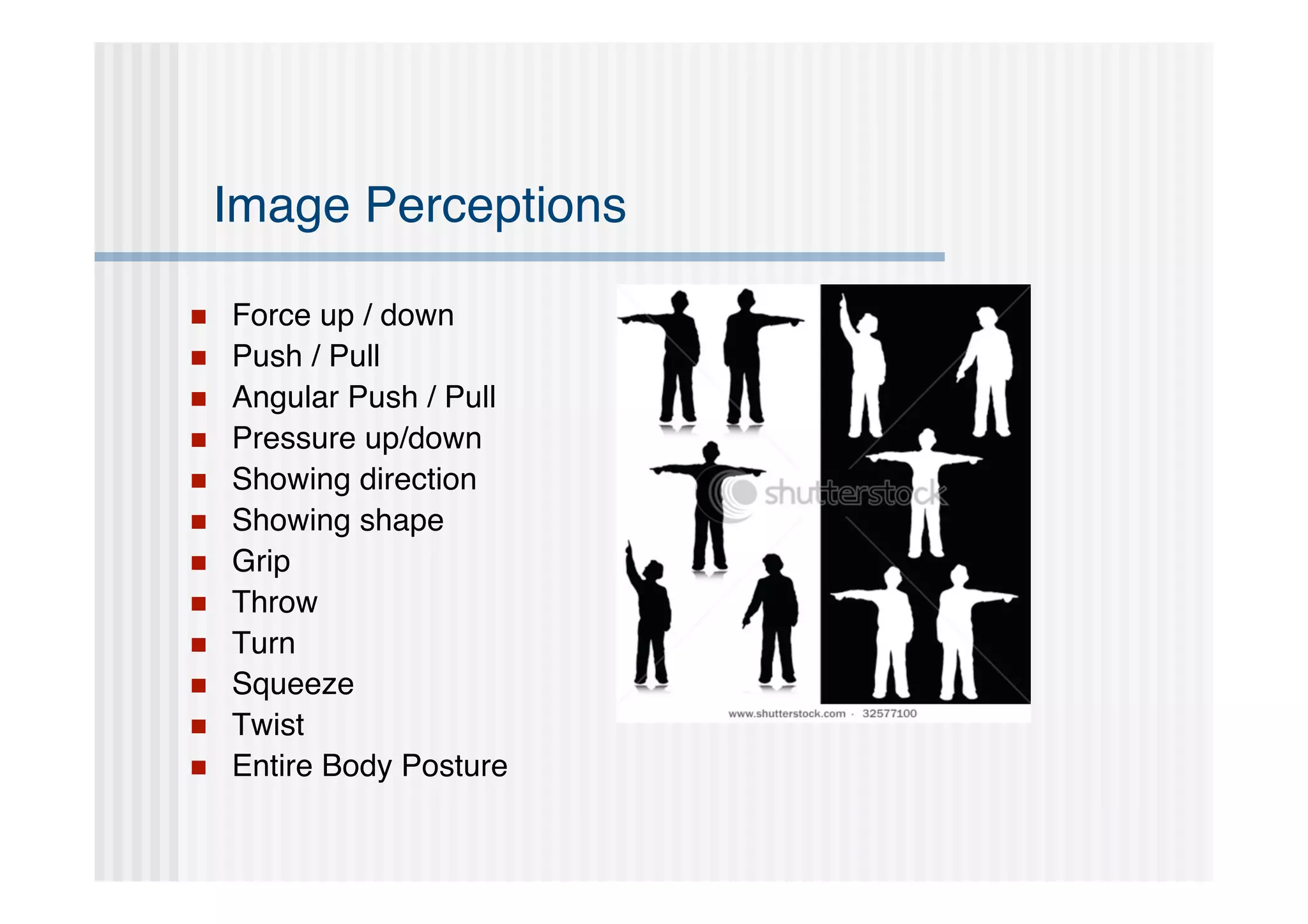
   Force up / down
   Push / Pull
   Angular Push / Pull
   Pressure up/down
   Showing direction
   Showing shape
   Grip
   Throw
   Turn
   Squeeze
   Twist
   Entire Body Posture
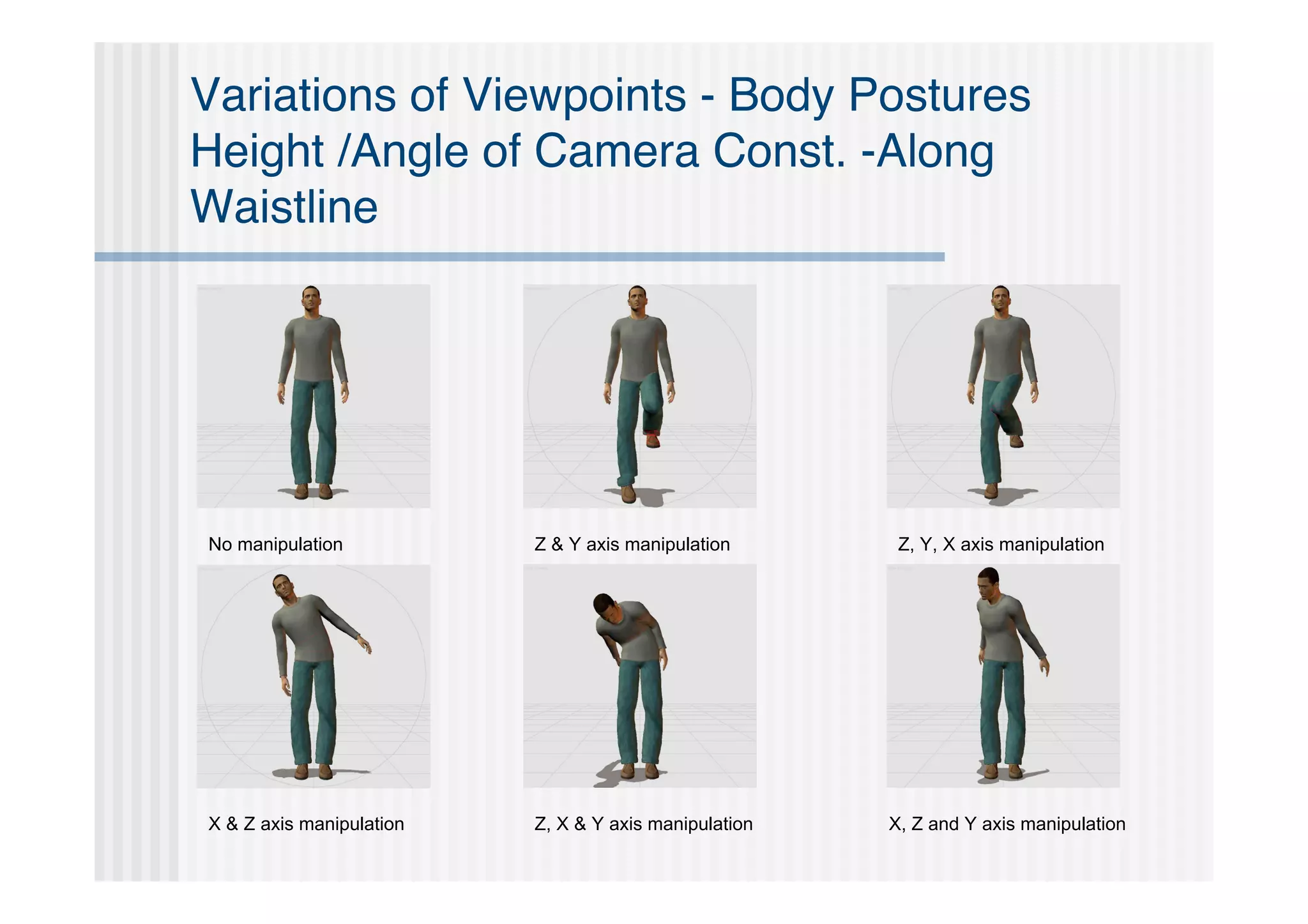
Variations of Viewpoints - Body Postures
Height /Angle of Camera Const. -Along
Waistline


No manipulation           Z & Y axis manipulation       Z, Y, X axis manipulation


X & Z axis manipulation   Z, X & Y axis manipulation   X, Z and Y axis manipulation
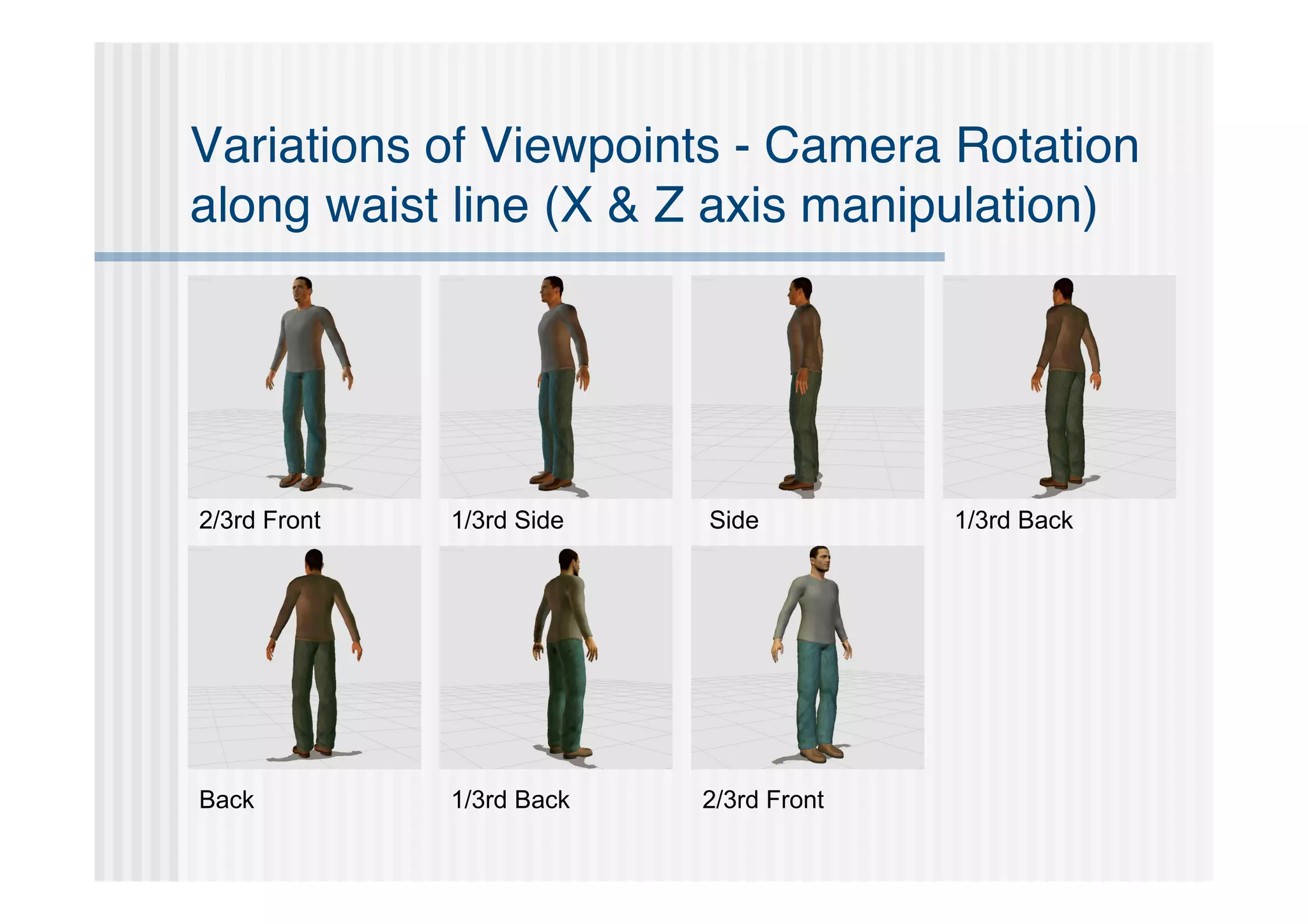
Variations of Viewpoints - Camera Rotation
along waist line (X & Z axis manipulation)


2/3rd Front   1/3rd Side   Side          1/3rd Back


Back          1/3rd Back   2/3rd Front
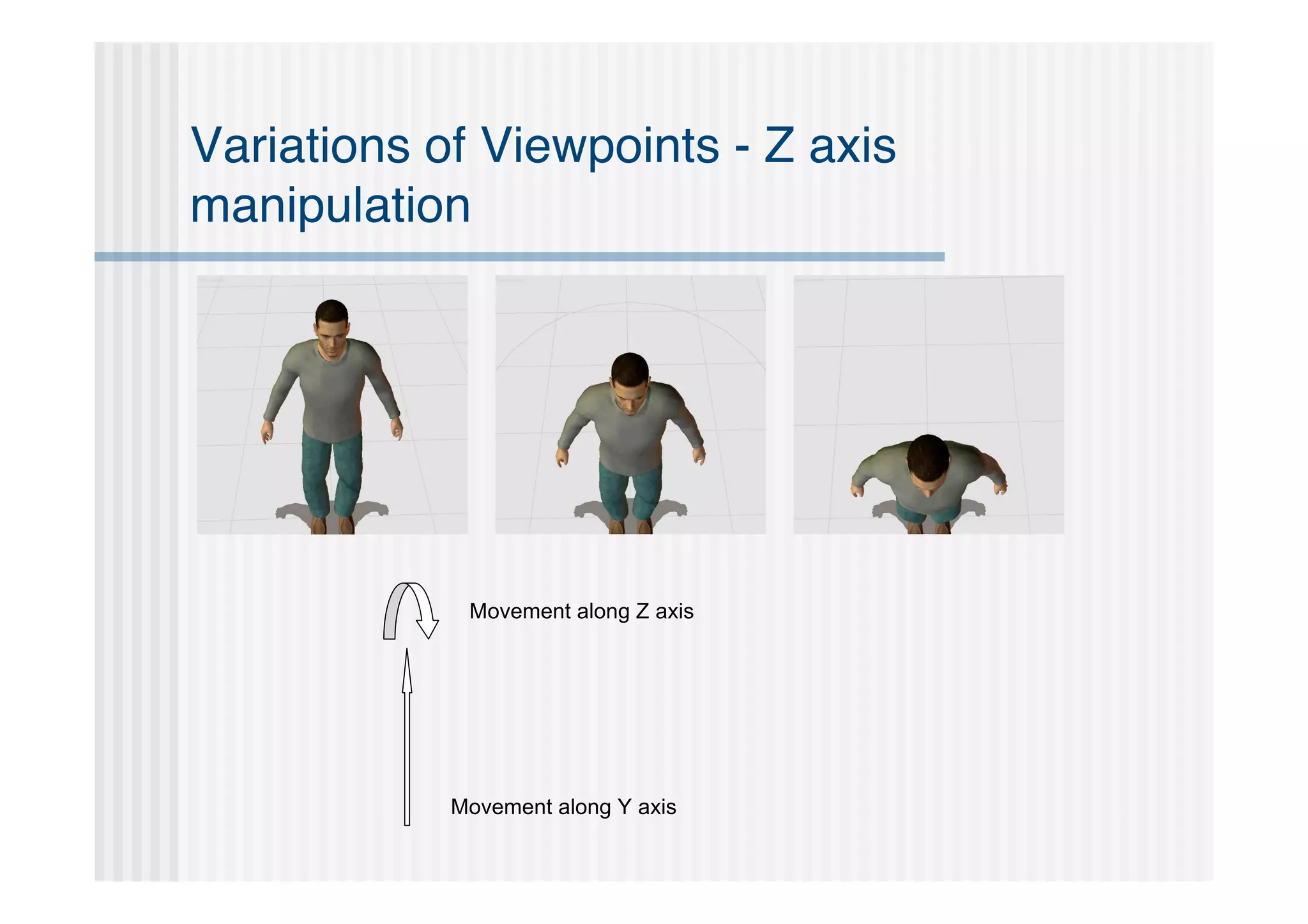
Variations of Viewpoints - Z axis
manipulation


             Movement along Z axis


            Movement along Y axis
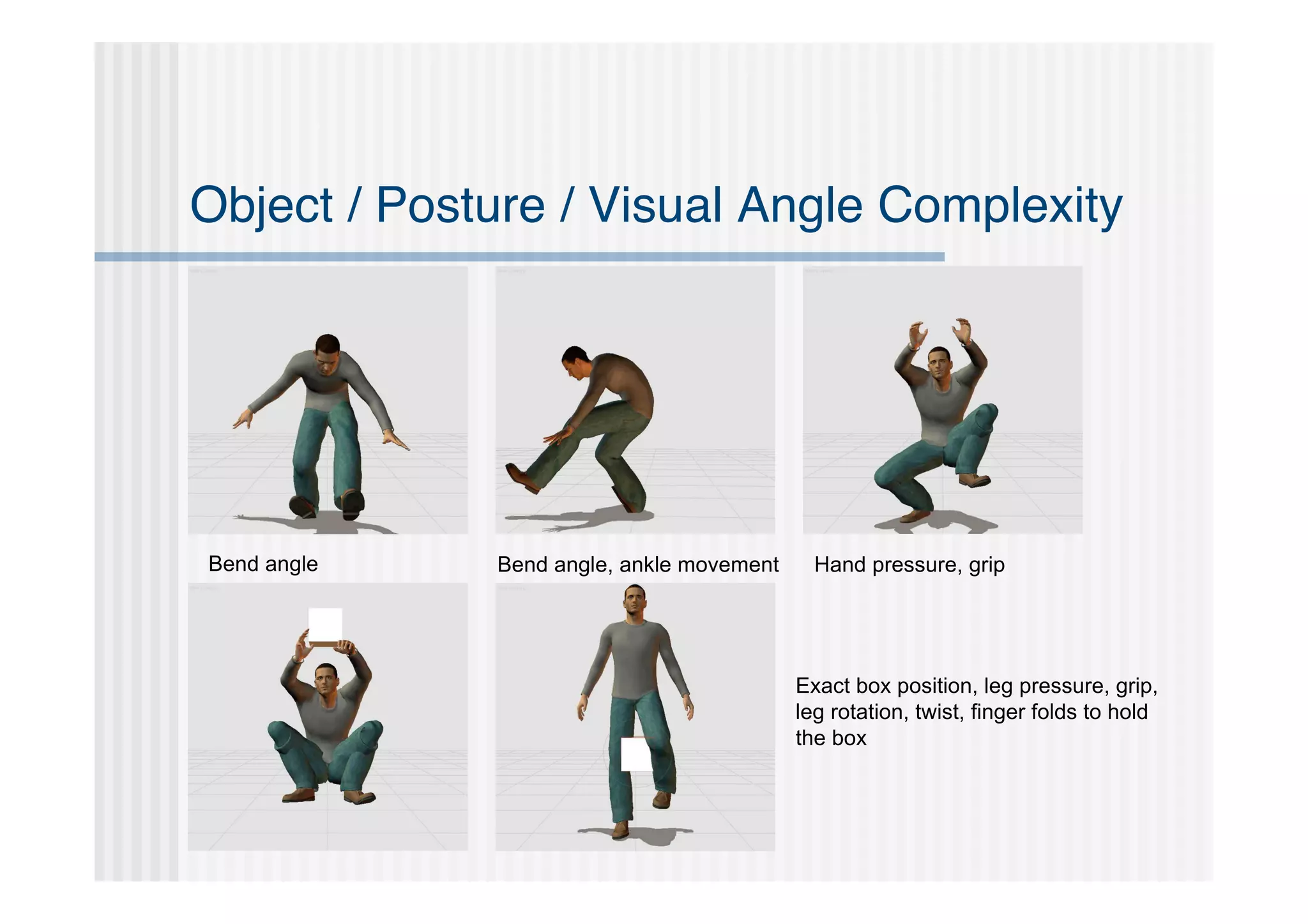
Object / Posture / Visual Angle Complexity


Bend angle   Bend angle, ankle movement     Hand pressure, grip


                                          Exact box position, leg pressure, grip,
                                          leg rotation, twist, finger folds to hold
                                          the box
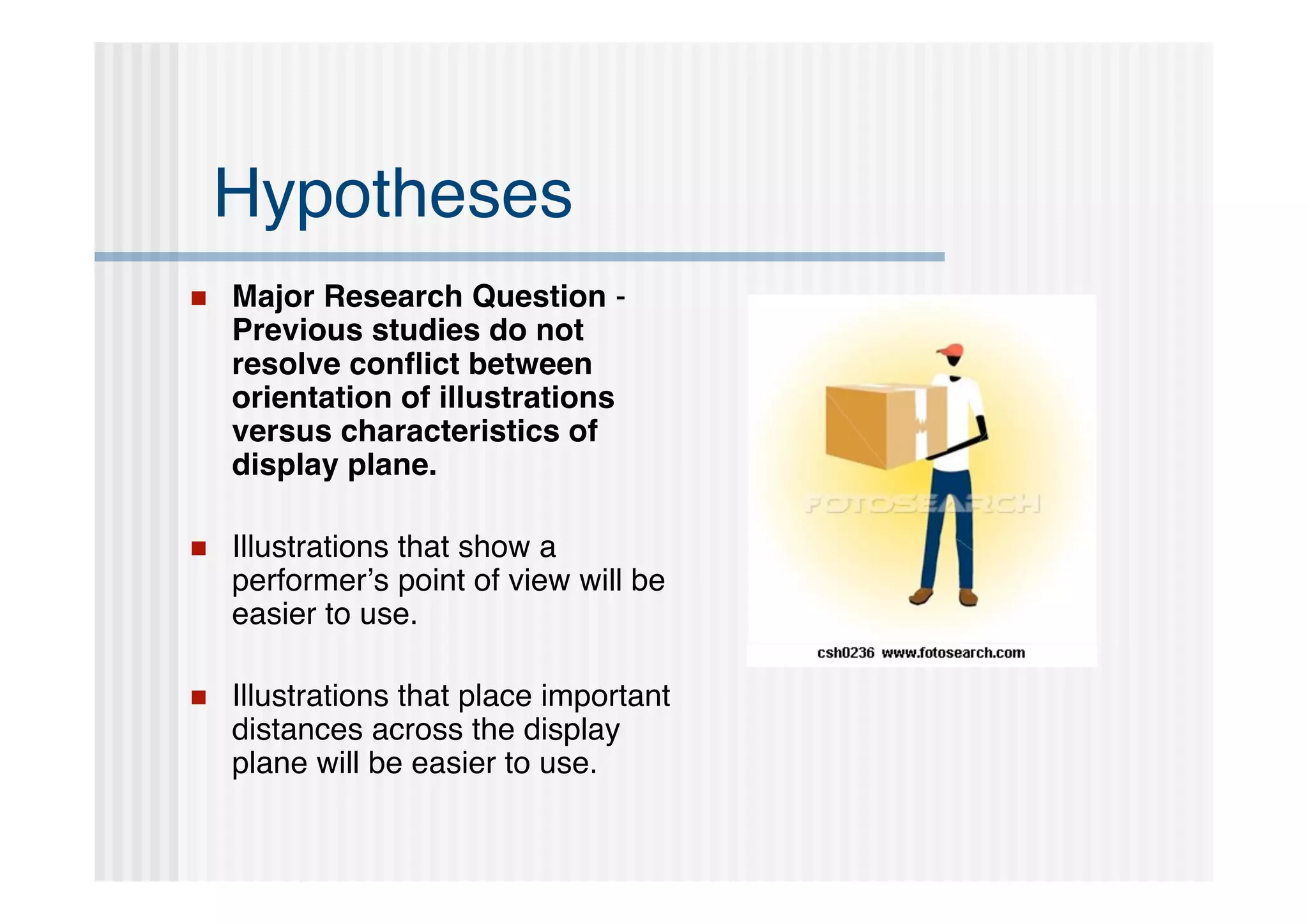
Hypotheses
   Major Research Question -
    Previous studies do not
    resolve conflict between
    orientation of illustrations
    versus characteristics of
    display plane.

   Illustrations that show a
    performer’s point of view will be
    easier to use.

   Illustrations that place important
    distances across the display
    plane will be easier to use.
Methods - 1
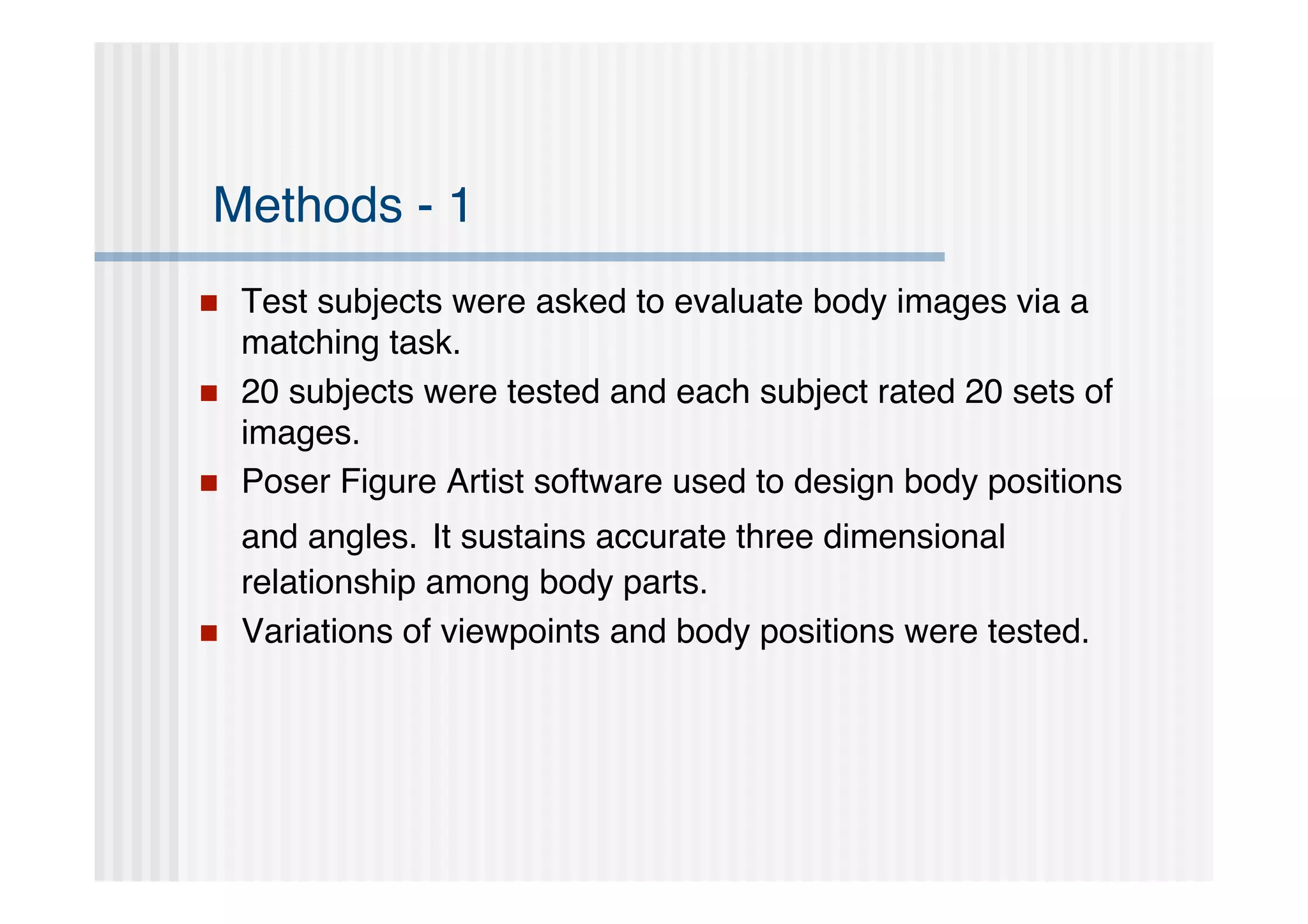
   Test subjects were asked to evaluate body images via a
    matching task.
   20 subjects were tested and each subject rated 20 sets of
    images.
   Poser Figure Artist software used to design body positions
    and angles. It sustains accurate three dimensional
    relationship among body parts.
   Variations of viewpoints and body positions were tested.
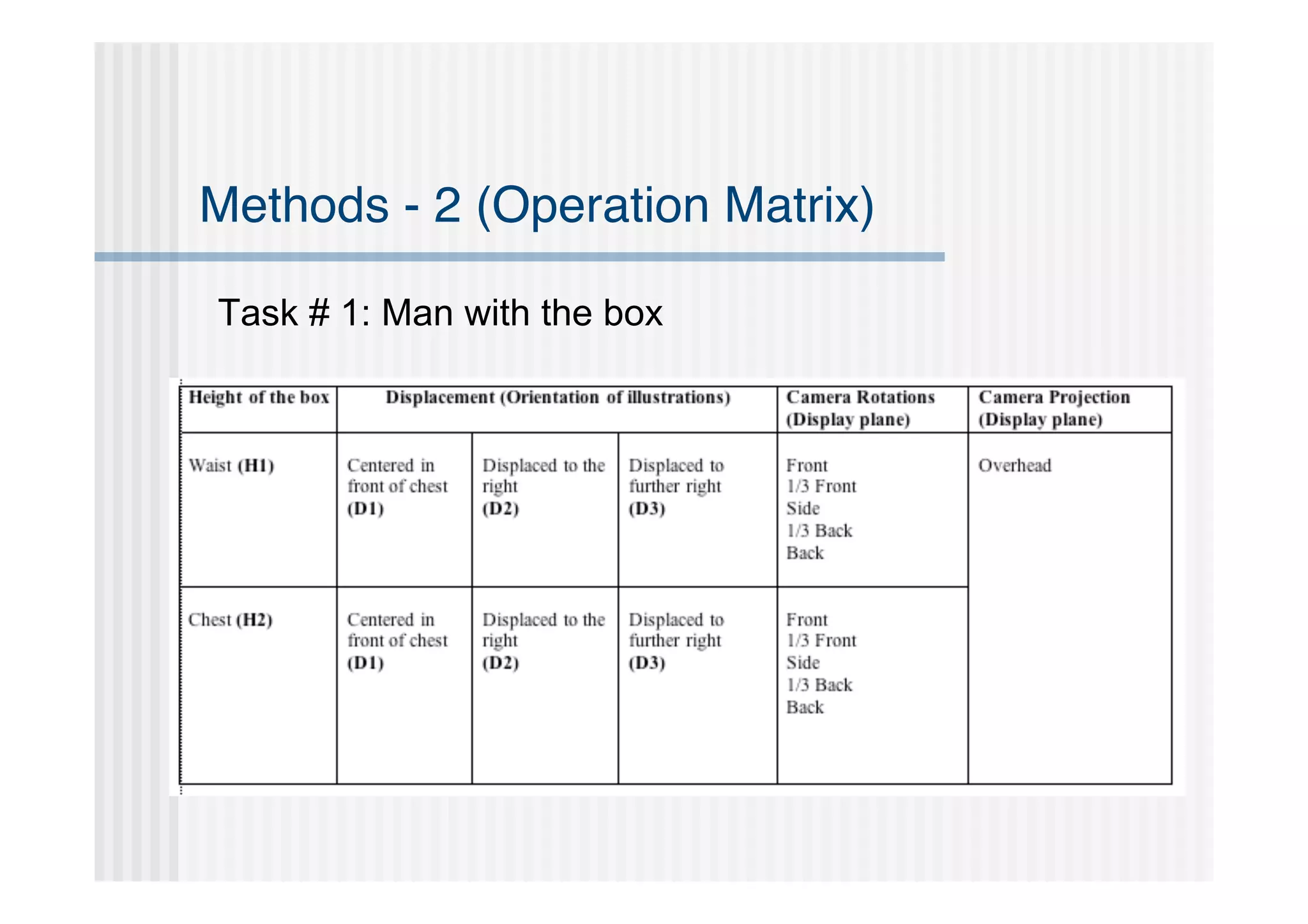
Methods - 2 (Operation Matrix)

Task # 1: Man with the box
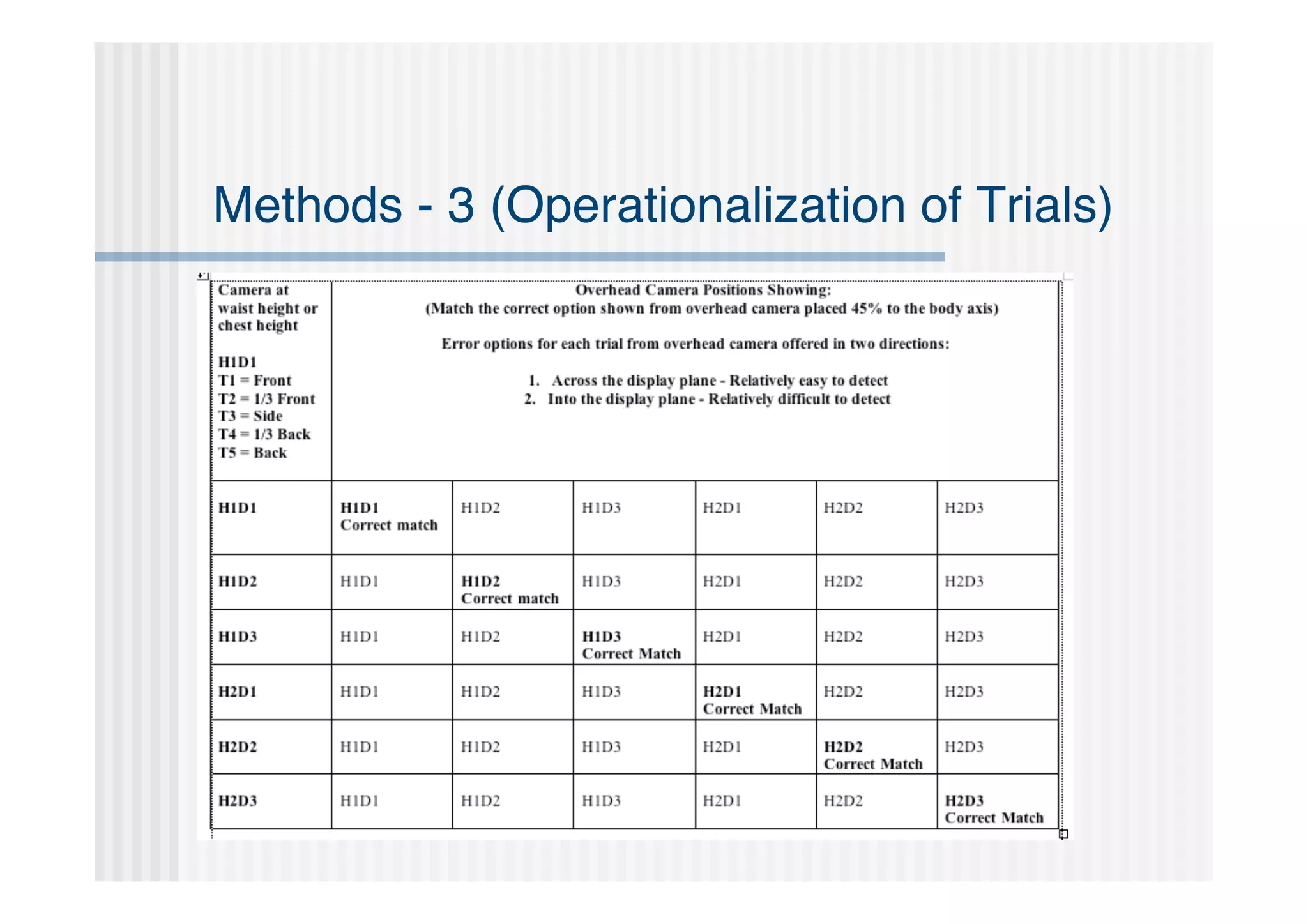
Methods - 3 (Operationalization of Trials)
Summary of Findings
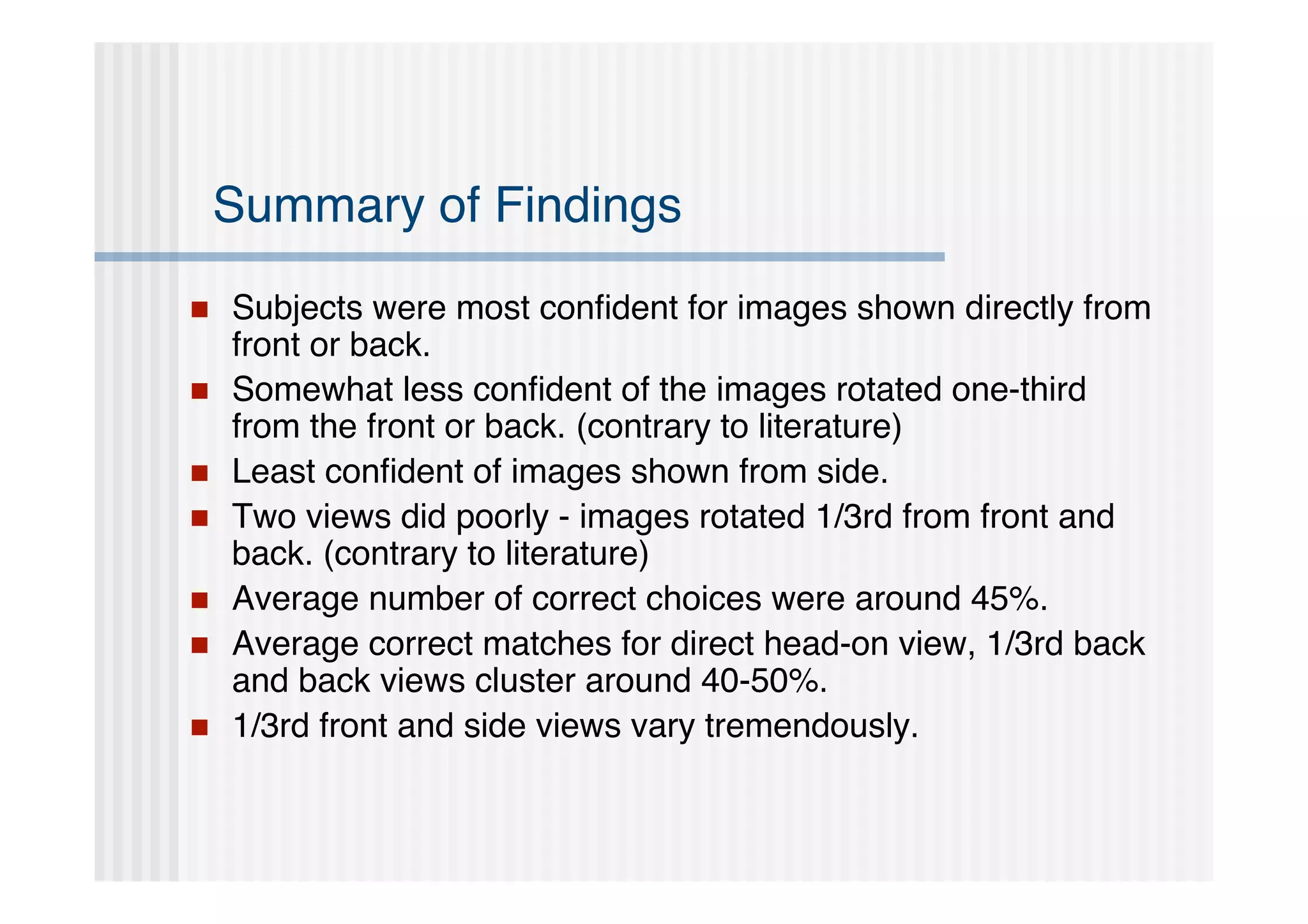
   Subjects were most confident for images shown directly from
    front or back.
   Somewhat less confident of the images rotated one-third
    from the front or back. (contrary to literature)
   Least confident of images shown from side.
   Two views did poorly - images rotated 1/3rd from front and
    back. (contrary to literature)
   Average number of correct choices were around 45%.
   Average correct matches for direct head-on view, 1/3rd back
    and back views cluster around 40-50%.
   1/3rd front and side views vary tremendously.
Ongoing Analysis on Performance:
    Accuracy Scores
   Correlation between accuracy rates for different heights
    of the box along the Y axis.

   Correlation between accuracy rates for the
    displacement types. (Extensive further analysis required
    for Z-axis manipulations into the display plane).

   5 different coordinates were chosen for trial:
    (2, 6, 0); (3 ,6, 2); (4, 6, 4); (4, 6, 6); (3, 6, 5)

   Correlation between camera angle rotations along the
    waist / chest.
Future Analysis
     Variation in displacement types on the basis of action:
1.    Carrying 2. Lifting 3. Pulling 4. Pushing

      Differentiate between postures on the basis of props.
1.     Chair 2. Ball 3. Box 4. Handle 5. Sphere/Triangle.
     - Purpose is to determine whether object shape is a function of
       performance and accuracy with physical tasks.
       OS = f[A f1(D, CA)]

     Variation in displacement types based on movement:
      E.g., left, center and right oriented displacement variations.
      E.g., variation along the Y axis.
      E.g., variation into display plane (z axis).
Free Viewpoint - Looking into Future
   Free viewpoint television (FTV) is a system for viewing natural
    video, allowing the user to interactively control the viewpoint and
    generate new views of a dynamic scene from any 3D position.

   With FTV, the focus of attention can be controlled by the viewers
    rather than a director, meaning that each viewer may be
    observing a unique viewpoint.

   This technology might revolutionize the way we look at
    interactive procedural user manuals. Readers will be able to
    switch views as and when they need to, based on task.

   However, this might not necessarily improve procedural
    accuracy, because of uncontrolled access to viewpoints,
    enabling spatial misconception.
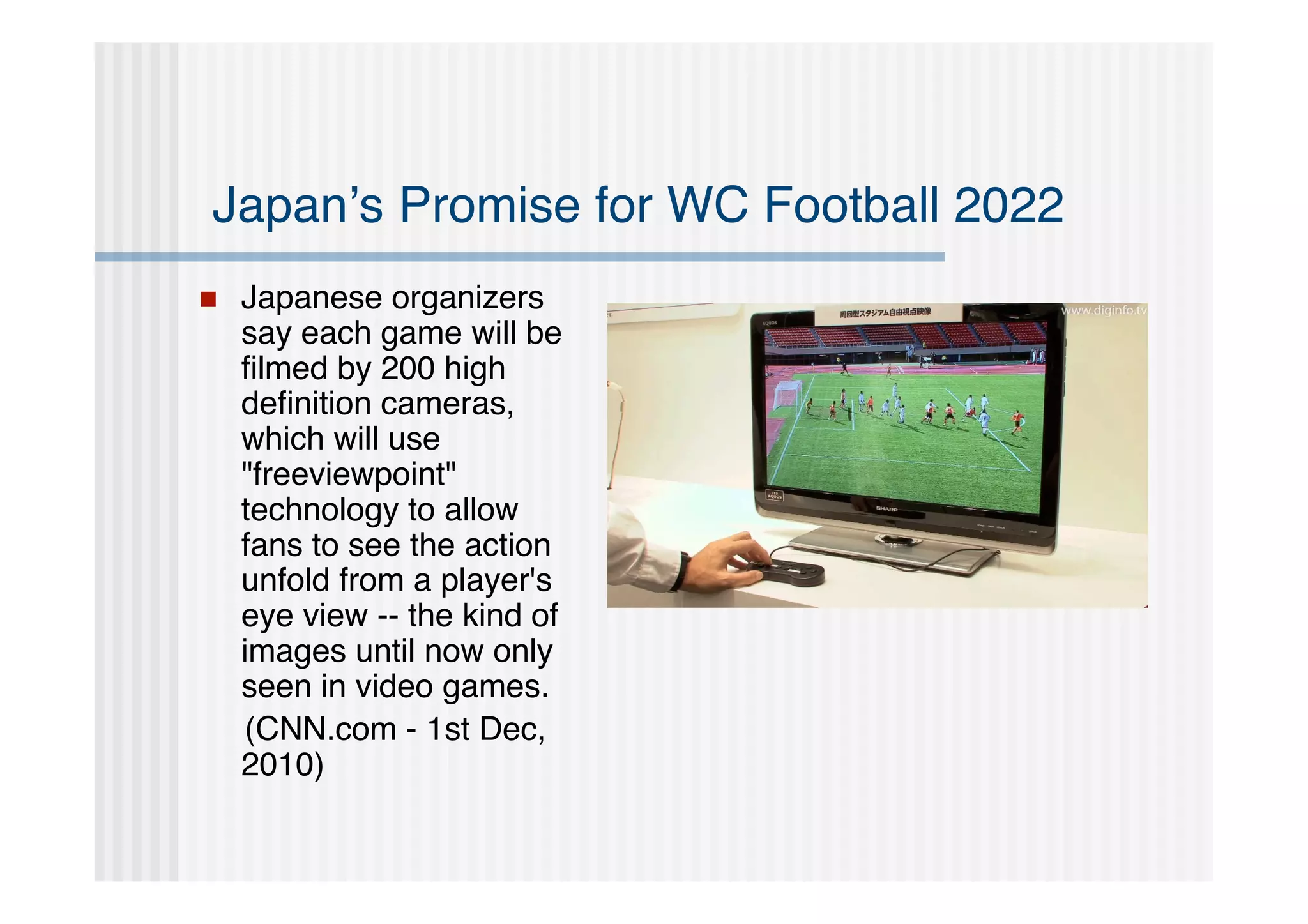
Japan’s Promise for WC Football 2022
   Japanese organizers
    say each game will be
    filmed by 200 high
    definition cameras,
    which will use
    "freeviewpoint"
    technology to allow
    fans to see the action
    unfold from a player's
    eye view -- the kind of
    images until now only
    seen in video games.
    (CNN.com - 1st Dec,
    2010)
THANK YOU !

Ieeej 2010

  • 1.
    Perception of Objectsin Technical Illustrations - A Challenge in Technical Communication Debopriyo Roy Associate Professor University of Aizu December 12, 2010 Presentation at IEEE PCS-J, Nagano City, Japan
  • 2.
    Depth Perception  Depth perception is the visual ability to perceive the world in three dimensions (3D)and the distance of an object.  Monocular cues provide depth information when viewing a scene with one eye.  We perceive depth with 2 main sources of information: A. Binocular disparity B. Monocular cues
  • 3.
    Depth Perceptions &Technical Illustrations  How should technical illustrators demonstrate physical orientation to understand procedures  What should be the characteristics of the display plane for visualizing procedures?
  • 4.
    Specific Issues forTechnical Writers  How do we design body/object positions in user manuals most effectively for second language speakers such that a minimalist text approach is viable.  Would readers in EFL context understand the subtle difference within body and object positions /orientations, based on difference in tasks when explained with minimal English text?
  • 5.
    Affordance - 1(Image Plane) Anatomical Image Plane - Axial - Image slices that are perpendicular to the long axis of the body Coronal-Image slices that bisects the front and back sides of the body Sagittal- Image slices that bisects the left and right side of the body
  • 6.
    Affordance -2 (OptimalPerspective)  Canonical View - Front, side and top views of an object.
  • 7.
    Affordance - 3(Task-based) Orientation of Illustrations Characteristics of Display Planes Distance between legs Weight of the ball Exact location of the ball Pressure on the knees Angle of shoulder bend Pressure on the shoulder Angle between hips and legs Grip to lift the ball Head Position Leg fold Extent of Knee folds Ankle pressure Direction of ball lift Transfer of weight Displacement during lift Bend of vertebral column Overall Camera angle
  • 8.
    Visual Systems  People use at least two visual systems when performing tasks in the three dimensional world.  One system involves primary processing of visual information by the back of the brain with subsequent processing by its sides.  Side areas seem to specialize in object identification (e.g., cube vs. cylinder).  The other system performs secondary visual processing at the top- rear of the brain and helps with body orientation in space.
  • 9.
    Object Manipulation vs.Physical Orientation  Research findings suggest that people use different parts of their brains when doing tasks requiring object Ball Grip manipulation.  However, the extent of such use diminishes when doing tasks requiring physical orientation of their bodies in three-dimensional space. Ball Release
  • 10.
    Two Dimensional Viewsof Three Dimensional Plane  For on-screen or print materials, people only have monocular cues to help them interpret what they see.  This reduction of depth cues makes interpretation more difficult and an illustration’s point of view more critical.
  • 11.
    Object vs. Body-CenteredView  Research has shown that the effects of mental rotation depend on point of view.  Spectator’s point of view  Performer’s point of view
  • 12.
    Perception of Distances  People are better at judging distances directly across the display plane.  In Figure 1, the height of the box relative to the man’s waist is clearly visible. This is because the distance is across the display plane.  However, the distance between the box and the man’s chest is not visible because the movement is into the display plane.
  • 13.
    Perception of MoreComplex Physical Postures  In this figure, the distance between any two object is recognized mostly as a function of other body postures and parts.  To understand this object, different angular verification along each of X, Y and Z axis is required.
  • 14.
    Illustrations and Instructions  Heiser and Tversky found (for a furniture assembly task) that illustrations showing objects partially rotated is easier to understand than objects showed head on.  Szlichcinski found illustrations showing slightly rotated objects to have more task-based affordance.  He also found that hand positions in illustrations are duplicated in actual tasks exactly as shown.
  • 15.
    Image Perceptions  Force up / down  Push / Pull  Angular Push / Pull  Pressure up/down  Showing direction  Showing shape  Grip  Throw  Turn  Squeeze  Twist  Entire Body Posture
  • 16.
    Variations of Viewpoints- Body Postures Height /Angle of Camera Const. -Along Waistline No manipulation Z & Y axis manipulation Z, Y, X axis manipulation X & Z axis manipulation Z, X & Y axis manipulation X, Z and Y axis manipulation
  • 17.
    Variations of Viewpoints- Camera Rotation along waist line (X & Z axis manipulation) 2/3rd Front 1/3rd Side Side 1/3rd Back Back 1/3rd Back 2/3rd Front
  • 18.
    Variations of Viewpoints- Z axis manipulation Movement along Z axis Movement along Y axis
  • 19.
    Object / Posture/ Visual Angle Complexity Bend angle Bend angle, ankle movement Hand pressure, grip Exact box position, leg pressure, grip, leg rotation, twist, finger folds to hold the box
  • 20.
    Hypotheses  Major Research Question - Previous studies do not resolve conflict between orientation of illustrations versus characteristics of display plane.  Illustrations that show a performer’s point of view will be easier to use.  Illustrations that place important distances across the display plane will be easier to use.
  • 21.
    Methods - 1  Test subjects were asked to evaluate body images via a matching task.  20 subjects were tested and each subject rated 20 sets of images.  Poser Figure Artist software used to design body positions and angles. It sustains accurate three dimensional relationship among body parts.  Variations of viewpoints and body positions were tested.
  • 22.
    Methods - 2(Operation Matrix) Task # 1: Man with the box
  • 23.
    Methods - 3(Operationalization of Trials)
  • 24.
    Summary of Findings  Subjects were most confident for images shown directly from front or back.  Somewhat less confident of the images rotated one-third from the front or back. (contrary to literature)  Least confident of images shown from side.  Two views did poorly - images rotated 1/3rd from front and back. (contrary to literature)  Average number of correct choices were around 45%.  Average correct matches for direct head-on view, 1/3rd back and back views cluster around 40-50%.  1/3rd front and side views vary tremendously.
  • 25.
    Ongoing Analysis onPerformance: Accuracy Scores  Correlation between accuracy rates for different heights of the box along the Y axis.  Correlation between accuracy rates for the displacement types. (Extensive further analysis required for Z-axis manipulations into the display plane).  5 different coordinates were chosen for trial: (2, 6, 0); (3 ,6, 2); (4, 6, 4); (4, 6, 6); (3, 6, 5)  Correlation between camera angle rotations along the waist / chest.
  • 26.
    Future Analysis  Variation in displacement types on the basis of action: 1. Carrying 2. Lifting 3. Pulling 4. Pushing  Differentiate between postures on the basis of props. 1. Chair 2. Ball 3. Box 4. Handle 5. Sphere/Triangle. - Purpose is to determine whether object shape is a function of performance and accuracy with physical tasks. OS = f[A f1(D, CA)]  Variation in displacement types based on movement: E.g., left, center and right oriented displacement variations. E.g., variation along the Y axis. E.g., variation into display plane (z axis).
  • 27.
    Free Viewpoint -Looking into Future  Free viewpoint television (FTV) is a system for viewing natural video, allowing the user to interactively control the viewpoint and generate new views of a dynamic scene from any 3D position.  With FTV, the focus of attention can be controlled by the viewers rather than a director, meaning that each viewer may be observing a unique viewpoint.  This technology might revolutionize the way we look at interactive procedural user manuals. Readers will be able to switch views as and when they need to, based on task.  However, this might not necessarily improve procedural accuracy, because of uncontrolled access to viewpoints, enabling spatial misconception.
  • 28.
    Japan’s Promise forWC Football 2022  Japanese organizers say each game will be filmed by 200 high definition cameras, which will use "freeviewpoint" technology to allow fans to see the action unfold from a player's eye view -- the kind of images until now only seen in video games. (CNN.com - 1st Dec, 2010)
  • 29.