Masaya Watanabe (s1170044)
Technical Communication Laboratory
University of Aizu
February 2013Senior Thesis Presentation 1
}  Introduction
}  Problem
}  Method
◦  Participants
◦  Data Collection
◦  Research Tool
}  Results
}  Discussion
}  Conclusion and Future Work
February 2013Senior Thesis Presentation 2
}  What is the meaning of Metacognition?
Metacognition is defined as "cognition about
cognition", or "knowing about knowing.“
For my research, I looked into the different
strategies readers used for comprehension of the
English text.
}  Further, the purpose was to see the extent to which
readers used global reading strategies, problem-
solving strategies and support reading strategies.
February 2013Senior Thesis Presentation 3
}  How do people use cognition and
metacognition in an EFL learning context?
}  Research Purpose: Whether and to what
extent are EFL readers aware of their
metacognitive reading strategies on the web,
while analyzing a website in the target
language?
February 2013Senior Thesis Presentation 4
}  59 EFL readers of the University of Aizu
(age group: 18 – 20 years) took part in the
study.
The participants initially took part in an
extensive web analysis exercise followed by
self-reporting of multiple reading strategies
used for website analysis (Belize tourism
website) in English.
February 2013Senior Thesis Presentation 5
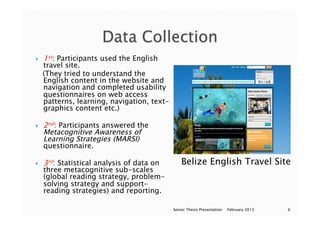
Belize English Travel Site
}  1st: Participants used the English
travel site.
(They tried to understand the
English content in the website and
navigation and completed usability
questionnaires on web access
patterns, learning, navigation, text-
graphics content etc.)
}  2nd: Participants answered the
Metacognitive Awareness of
Learning Strategies (MARSI)
questionnaire.
}  3rd: Statistical analysis of data on
three metacognitive sub-scales
(global reading strategy, problem-
solving strategy and support-
reading strategies) and reporting.
February 2013Senior Thesis Presentation 6
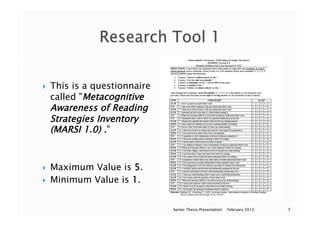
}  This is a questionnaire
called "Metacognitive
Awareness of Reading
Strategies Inventory
(MARSI 1.0) ."
}  Maximum Value is 5.
}  Minimum Value is 1.
February 2013Senior Thesis Presentation 7
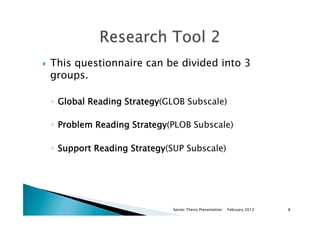
}  This questionnaire can be divided into 3
groups.
◦  Global Reading Strategy(GLOB Subscale)
◦  Problem Reading Strategy(PLOB Subscale)
◦  Support Reading Strategy(SUP Subscale)
February 2013Senior Thesis Presentation 8
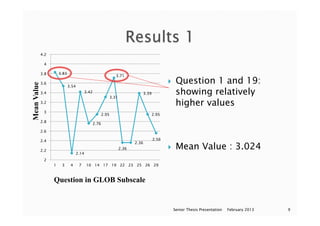
}  Question 1 and 19:
showing relatively
higher values
}  Mean Value : 3.024
February 2013Senior Thesis Presentation 9
3.83
3.54
2.14
3.42
2.76
2.95
3.31
3.71
2.36
2.36
3.39
2.95
2.56
2
2.2
2.4
2.6
2.8
3
3.2
3.4
3.6
3.8
4
4.2
1 3 4 7 10 14 17 19 22 23 25 26 29
MeanValue
Question in GLOB Subscale
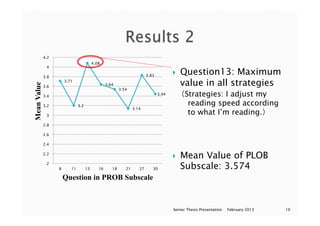
}  Question13: Maximum
value in all strategies
(Strategies: I adjust my
reading speed according
to what I’m reading.)
}  Mean Value of PLOB
Subscale: 3.574
February 2013Senior Thesis Presentation 10
3.71
3.2
4.08
3.64
3.54
3.14
3.83
3.44
2
2.2
2.4
2.6
2.8
3
3.2
3.4
3.6
3.8
4
4.2
8 11 13 16 18 21 27 30
MeanValue
Question in PROB Subscale
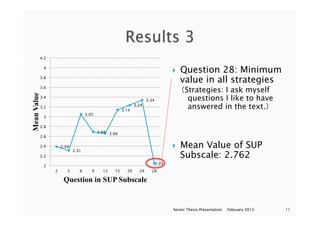
}  Question 28: Minimum
value in all strategies
(Strategies: I ask myself
questions I like to have
answered in the text.)
}  Mean Value of SUP
Subscale: 2.762
February 2013Senior Thesis Presentation 11
2.39
2.31
3.05
2.69 2.66
3.14
3.24
3.34
2.05
2
2.2
2.4
2.6
2.8
3
3.2
3.4
3.6
3.8
4
4.2
2 5 6 9 12 15 20 24 28
MeanValue
Question in SUP Subscale
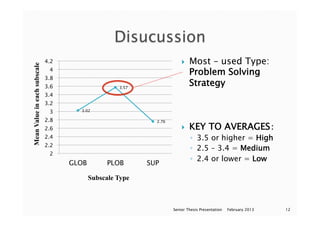
}  Most – used Type:
Problem Solving
Strategy
}  KEY TO AVERAGES:
◦  3.5 or higher = High
◦  2.5 – 3.4 = Medium
◦  2.4 or lower = Low
February 2013Senior Thesis Presentation 12
3.02
3.57
2.76
2
2.2
2.4
2.6
2.8
3
3.2
3.4
3.6
3.8
4
4.2
GLOB PLOB SUP
MeanValueineachsubscale
Subscale Type
}  This research helped in forwarding direct
evidence of how far readers are aware of their
use of metacognitive reading strategies.
}  Future Work
◦  Use of screen capture software to support MARSI
data.
◦  Use of eye-tracking data to verify thought
processes and action sequences.
◦  Use of other formal usability testing methods.
February 2013Senior Thesis Presentation 13
February 2013Senior Thesis Presentation 14

Watanabe presentation

  • 1.
    Masaya Watanabe (s1170044) TechnicalCommunication Laboratory University of Aizu February 2013Senior Thesis Presentation 1
  • 2.
    }  Introduction }  Problem } Method ◦  Participants ◦  Data Collection ◦  Research Tool }  Results }  Discussion }  Conclusion and Future Work February 2013Senior Thesis Presentation 2
  • 3.
    }  What isthe meaning of Metacognition? Metacognition is defined as "cognition about cognition", or "knowing about knowing.“ For my research, I looked into the different strategies readers used for comprehension of the English text. }  Further, the purpose was to see the extent to which readers used global reading strategies, problem- solving strategies and support reading strategies. February 2013Senior Thesis Presentation 3
  • 4.
    }  How dopeople use cognition and metacognition in an EFL learning context? }  Research Purpose: Whether and to what extent are EFL readers aware of their metacognitive reading strategies on the web, while analyzing a website in the target language? February 2013Senior Thesis Presentation 4
  • 5.
    }  59 EFLreaders of the University of Aizu (age group: 18 – 20 years) took part in the study. The participants initially took part in an extensive web analysis exercise followed by self-reporting of multiple reading strategies used for website analysis (Belize tourism website) in English. February 2013Senior Thesis Presentation 5
  • 6.
    Belize English TravelSite }  1st: Participants used the English travel site. (They tried to understand the English content in the website and navigation and completed usability questionnaires on web access patterns, learning, navigation, text- graphics content etc.) }  2nd: Participants answered the Metacognitive Awareness of Learning Strategies (MARSI) questionnaire. }  3rd: Statistical analysis of data on three metacognitive sub-scales (global reading strategy, problem- solving strategy and support- reading strategies) and reporting. February 2013Senior Thesis Presentation 6
  • 7.
    }  This isa questionnaire called "Metacognitive Awareness of Reading Strategies Inventory (MARSI 1.0) ." }  Maximum Value is 5. }  Minimum Value is 1. February 2013Senior Thesis Presentation 7
  • 8.
    }  This questionnairecan be divided into 3 groups. ◦  Global Reading Strategy(GLOB Subscale) ◦  Problem Reading Strategy(PLOB Subscale) ◦  Support Reading Strategy(SUP Subscale) February 2013Senior Thesis Presentation 8
  • 9.
    }  Question 1and 19: showing relatively higher values }  Mean Value : 3.024 February 2013Senior Thesis Presentation 9 3.83 3.54 2.14 3.42 2.76 2.95 3.31 3.71 2.36 2.36 3.39 2.95 2.56 2 2.2 2.4 2.6 2.8 3 3.2 3.4 3.6 3.8 4 4.2 1 3 4 7 10 14 17 19 22 23 25 26 29 MeanValue Question in GLOB Subscale
  • 10.
    }  Question13: Maximum valuein all strategies (Strategies: I adjust my reading speed according to what I’m reading.) }  Mean Value of PLOB Subscale: 3.574 February 2013Senior Thesis Presentation 10 3.71 3.2 4.08 3.64 3.54 3.14 3.83 3.44 2 2.2 2.4 2.6 2.8 3 3.2 3.4 3.6 3.8 4 4.2 8 11 13 16 18 21 27 30 MeanValue Question in PROB Subscale
  • 11.
    }  Question 28:Minimum value in all strategies (Strategies: I ask myself questions I like to have answered in the text.) }  Mean Value of SUP Subscale: 2.762 February 2013Senior Thesis Presentation 11 2.39 2.31 3.05 2.69 2.66 3.14 3.24 3.34 2.05 2 2.2 2.4 2.6 2.8 3 3.2 3.4 3.6 3.8 4 4.2 2 5 6 9 12 15 20 24 28 MeanValue Question in SUP Subscale
  • 12.
    }  Most –used Type: Problem Solving Strategy }  KEY TO AVERAGES: ◦  3.5 or higher = High ◦  2.5 – 3.4 = Medium ◦  2.4 or lower = Low February 2013Senior Thesis Presentation 12 3.02 3.57 2.76 2 2.2 2.4 2.6 2.8 3 3.2 3.4 3.6 3.8 4 4.2 GLOB PLOB SUP MeanValueineachsubscale Subscale Type
  • 13.
    }  This researchhelped in forwarding direct evidence of how far readers are aware of their use of metacognitive reading strategies. }  Future Work ◦  Use of screen capture software to support MARSI data. ◦  Use of eye-tracking data to verify thought processes and action sequences. ◦  Use of other formal usability testing methods. February 2013Senior Thesis Presentation 13
  • 14.