Computer Integrated Manufacturing (CIM)
Introduction to CIM
Syllabus: Need of CIM, Introduction, Evolution of CIM, CIM Hardware and
software, Role of CIM System, Definition of CIM, automation and types of
automation, Reasons for automation, Types of Production, Functions in
Manufacturing, CIM wheel, Computerized element of CIM, Advantages of
CIM
jeetendracoe@gmail.com
Mob. No: 8951834155
UNIT I CIM 1
Computer Integrated Manufacturing (CIM)
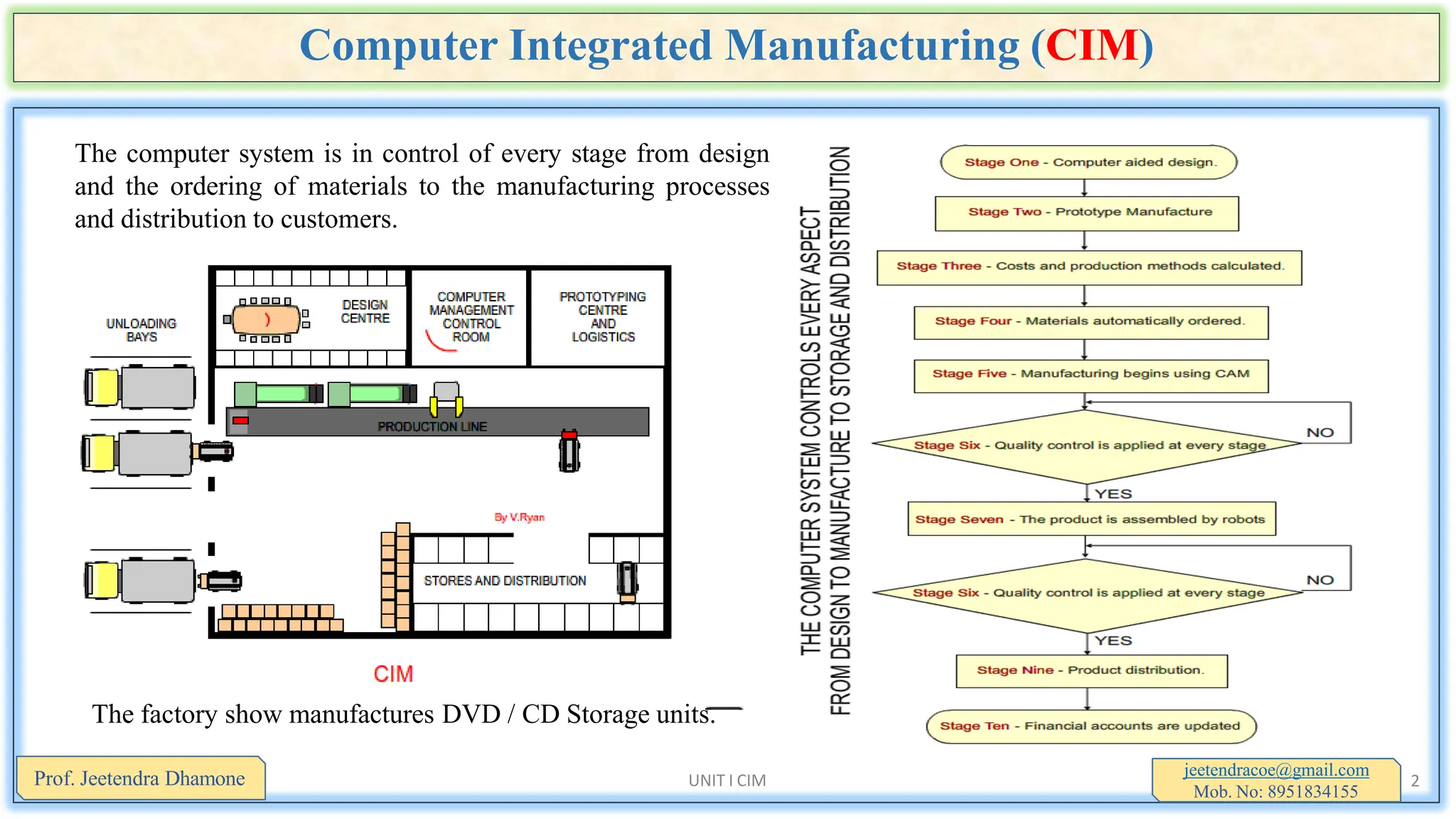
The computer system is in control of every stage from design
and the ordering of materials to the manufacturing processes
and distribution to customers.
The factory show manufactures DVD / CD Storage units.
jeetendracoe@gmail.com
Mob. No: 8951834155
Prof. Jeetendra Dhamone UNIT I CIM 2
Need of CIM
There are several reasons why CIM is becoming increasingly necessary for modern manufacturing
operations:
1.Increased efficiency: By automating repetitive tasks, CIM can help increase production speeds and
reduce the time required for each manufacturing step.
2.Improved accuracy: CIM reduces the chances of human error and improves the overall accuracy of
the manufacturing process.
3.Better data management: CIM allows manufacturers to collect and store data in real-time, making it
easier to track production progress and identify areas that need improvement.
4.Better decision-making: With access to real-time data, manufacturers can make informed decisions
about production processes and improve the overall quality of their products.
5.Increased flexibility: CIM allows manufacturers to quickly adapt to changing market conditions and
customer demands, making it easier to respond to new opportunities and challenges.
6.Increased competitiveness: CIM helps manufacturing organizations to stay ahead of their competitors
by enabling them to respond faster to market demands and to introduce new products more quickly.
7.Better resource utilization: CIM systems allow organizations to optimize their use of resources, such
as materials and labor, leading to reduced costs and increased profitability.
jeetendracoe@gmail.com
Mob. No: 8951834155
Prof. Jeetendra Dhamone UNIT I CIM 3
Introduction
Computer Integrated Manufacturing (CIM) is a
manufacturing process by uses computer-controlled
machinery, automated tool, various computer program, and
software.
Dr. Joseph Harrington
published a book in 1974
titled Computer
Integrated Manufacturing
jeetendracoe@gmail.com
Mob. No: 8951834155
Prof. Jeetendra Dhamone UNIT I CIM 4
Computer Integrated Manufacturing
• Massachusetts Institute of Technology (MIT, USA) is
credited with pioneering the development in both CAD and
CAM.
• Design and manufacturing requirements of aerospace
industries after the Second World.
• Late 40‟sand early 50‟s could not meet the design and
manufacturing challenges
• Develop sophisticated aircraft and satellite launch vehicles
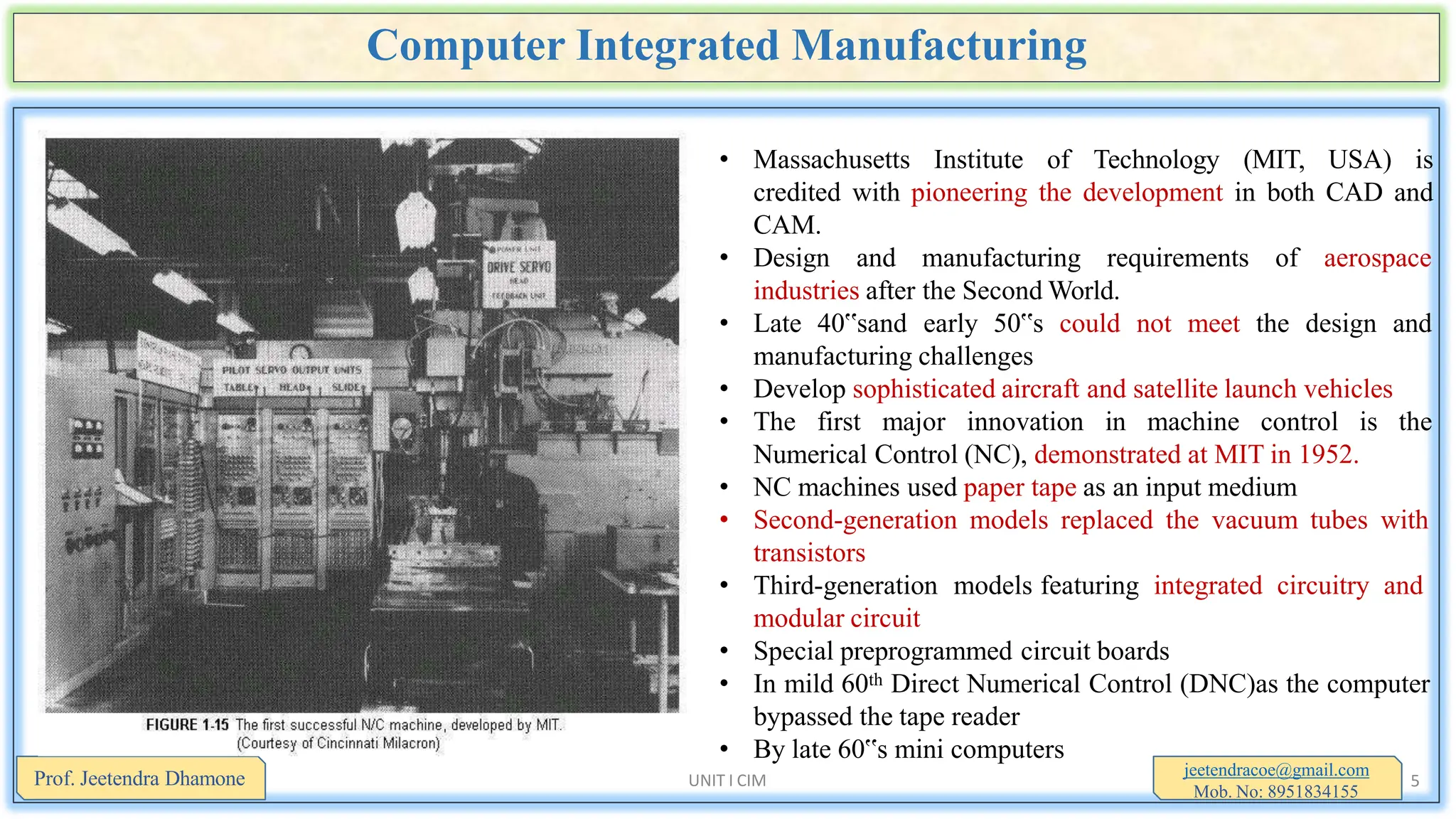
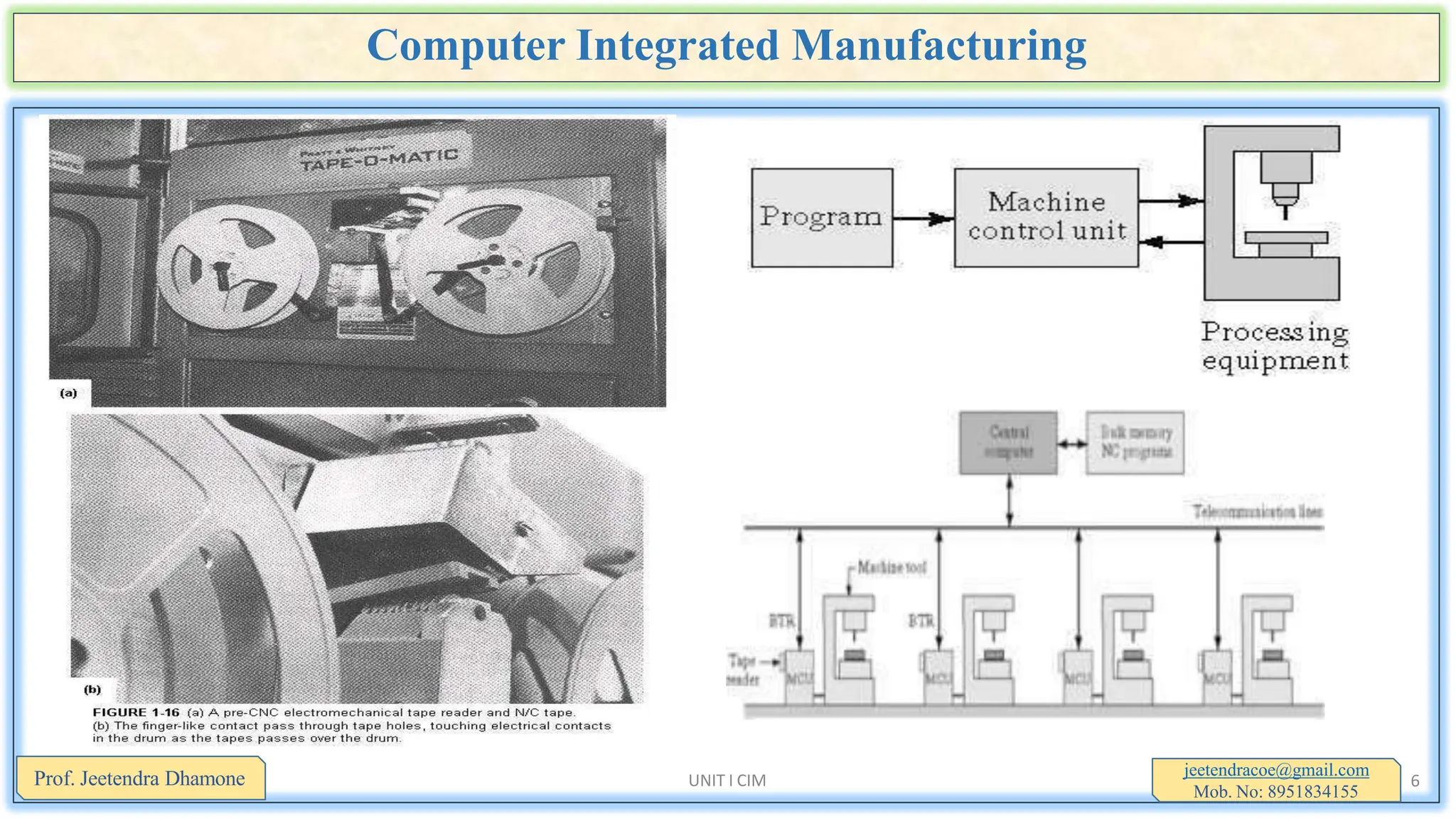
• The first major innovation in machine control is the
Numerical Control (NC), demonstrated at MIT in 1952.
• NC machines used paper tape as an input medium
• Second-generation models replaced the vacuum tubes with
transistors
• Third-generation models featuring integrated circuitry and
modular circuit
• Special preprogrammed circuit boards
• In mild 60th Direct Numerical Control (DNC)as the computer
bypassed the tape reader
• By late 60‟s mini computers
jeetendracoe@gmail.com
Mob. No: 8951834155
Prof. Jeetendra Dhamone UNIT I CIM 5
Computer Integrated Manufacturing
jeetendracoe@gmail.com
Mob. No: 8951834155
Prof. Jeetendra Dhamone UNIT I CIM 6
Computer Integrated Manufacturing
• Flexible manufacturing cells and flexible
manufacturing systems in late 70‟s.
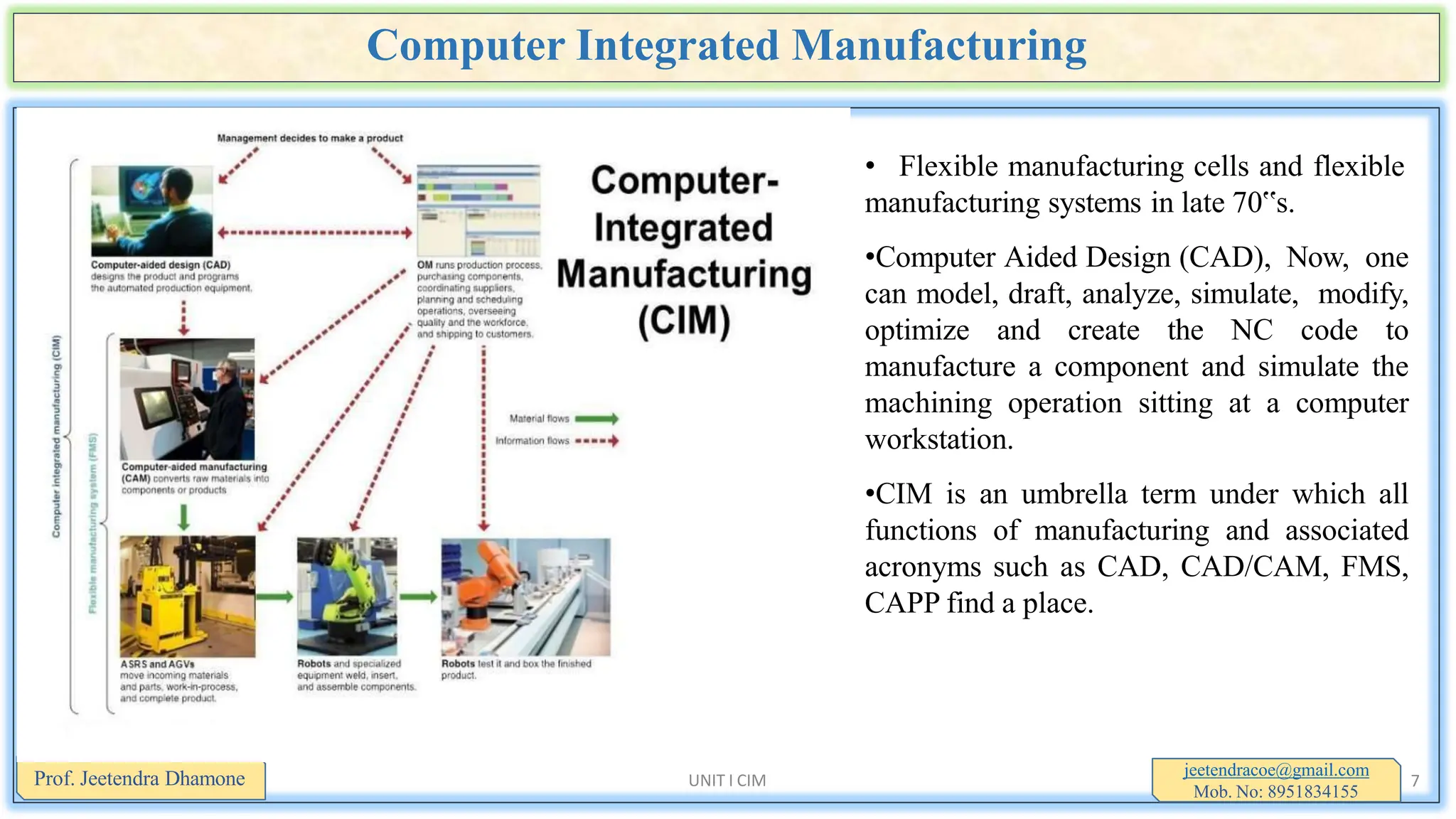
•Computer Aided Design (CAD), Now, one
can model, draft, analyze, simulate, modify,
optimize and create the NC code to
manufacture a component and simulate the
machining operation sitting at a computer
workstation.
•CIM is an umbrella term under which all
functions of manufacturing and associated
acronyms such as CAD, CAD/CAM, FMS,
CAPP find a place.
jeetendracoe@gmail.com
Mob. No: 8951834155
Prof. Jeetendra Dhamone UNIT I CIM 7
Definition of Computer Integrated Manufacturing
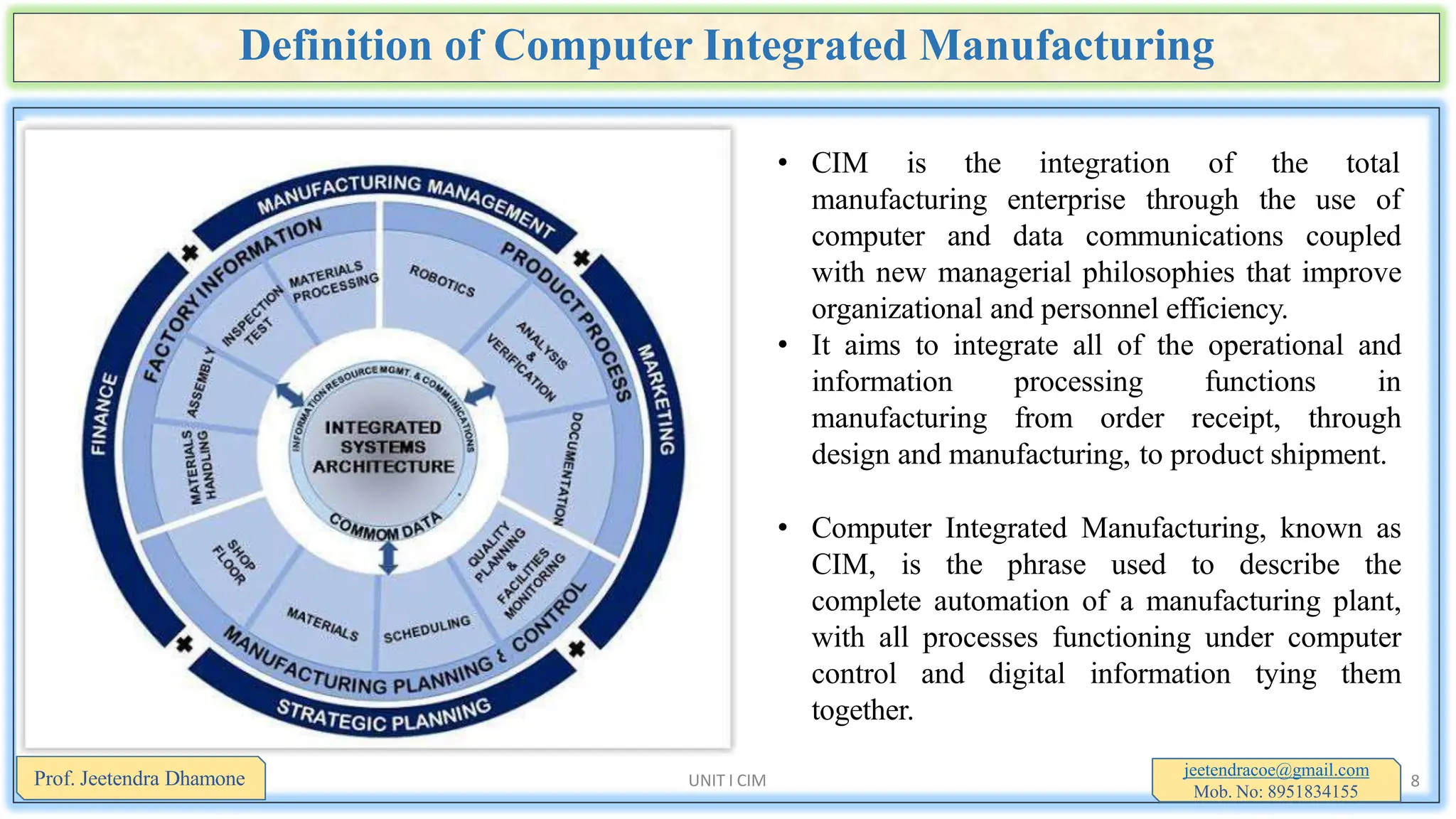
• CIM is the integration of the total
manufacturing enterprise through the use of
computer and data communications coupled
with new managerial philosophies that improve
organizational and personnel efficiency.
• It aims to integrate all of the operational and
information processing functions in
manufacturing from order receipt, through
design and manufacturing, to product shipment.
• Computer Integrated Manufacturing, known as
CIM, is the phrase used to describe the
complete automation of a manufacturing plant,
with all processes functioning under computer
control and digital information tying them
together.
jeetendracoe@gmail.com
Mob. No: 8951834155
Prof. Jeetendra Dhamone UNIT I CIM 8
Role Computer Integrated Manufacturing
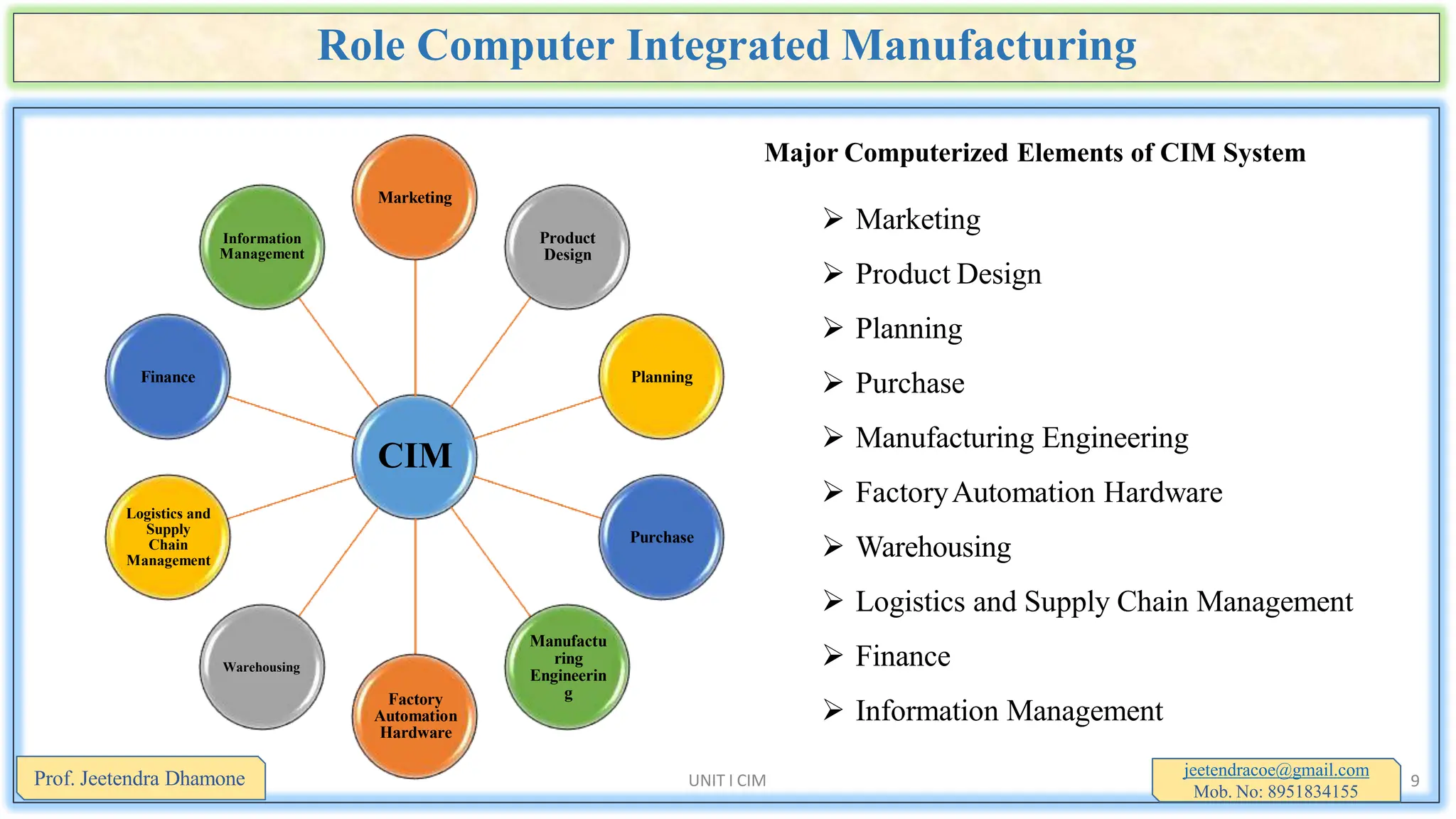
Major Computerized Elements of CIM System
 Marketing
 Product Design
 Planning
 Purchase
 Manufacturing Engineering
 FactoryAutomation Hardware
 Warehousing
 Logistics and Supply Chain Management
 Finance
 Information Management
CIM
Marketing
Product
Design
Planning
Purchase
Manufactu
ring
Engineerin
g
Factory
Automation
Hardware
Warehousing
Logistics and
Supply
Chain
Management
Finance
Information
Management
jeetendracoe@gmail.com
Mob. No: 8951834155
Prof. Jeetendra Dhamone UNIT I CIM 9
CIM Hardware and software
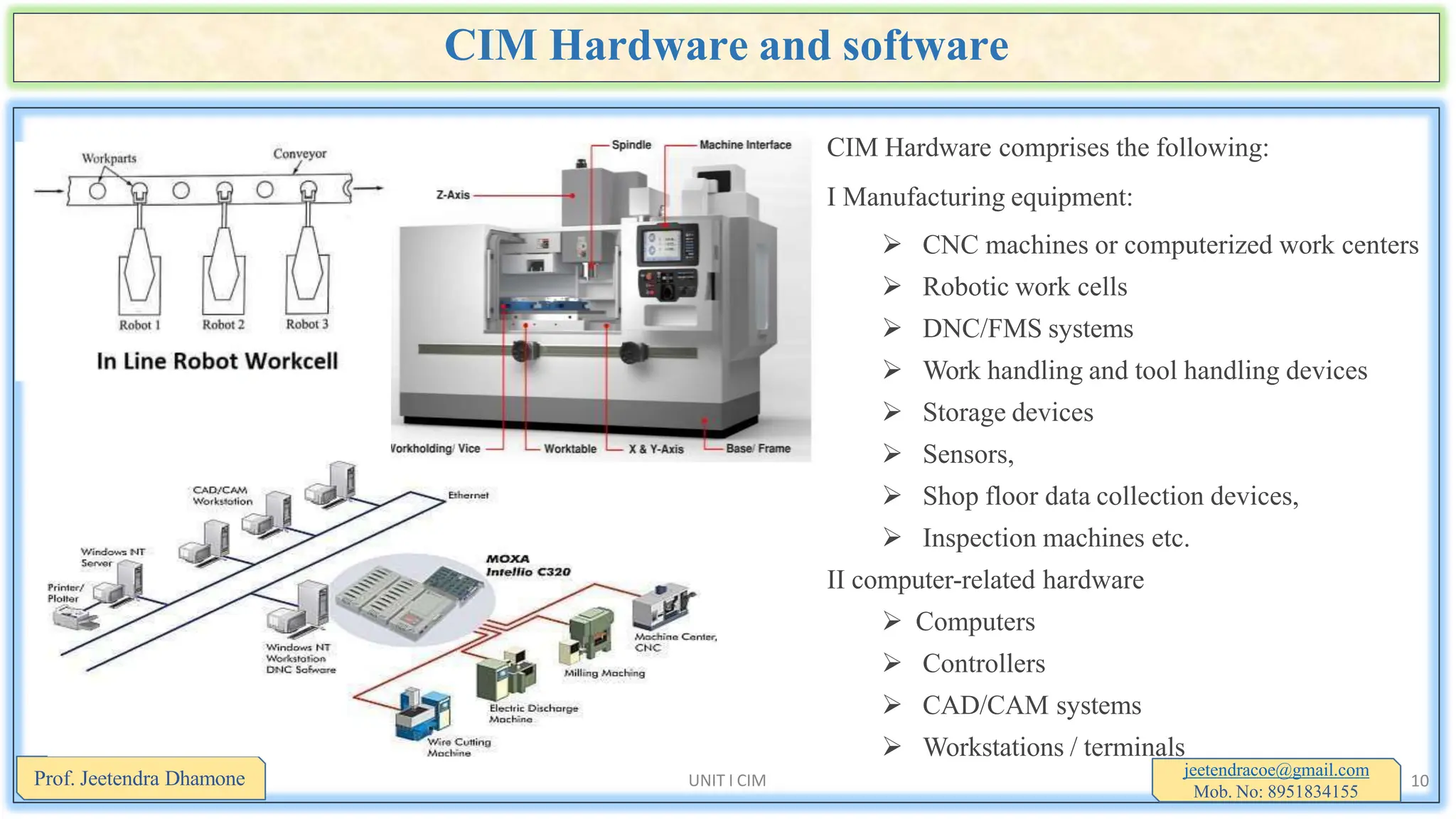
CIM Hardware comprises the following:
I Manufacturing equipment:
 CNC machines or computerized work centers
 Robotic work cells
 DNC/FMS systems
 Work handling and tool handling devices
 Storage devices
 Sensors,
 Shop floor data collection devices,
 Inspection machines etc.
II computer-related hardware
 Computers
 Controllers
 CAD/CAM systems
 Workstations / terminals
jeetendracoe@gmail.com
Mob. No: 8951834155
Prof. Jeetendra Dhamone UNIT I CIM 10
CIM Hardware and software
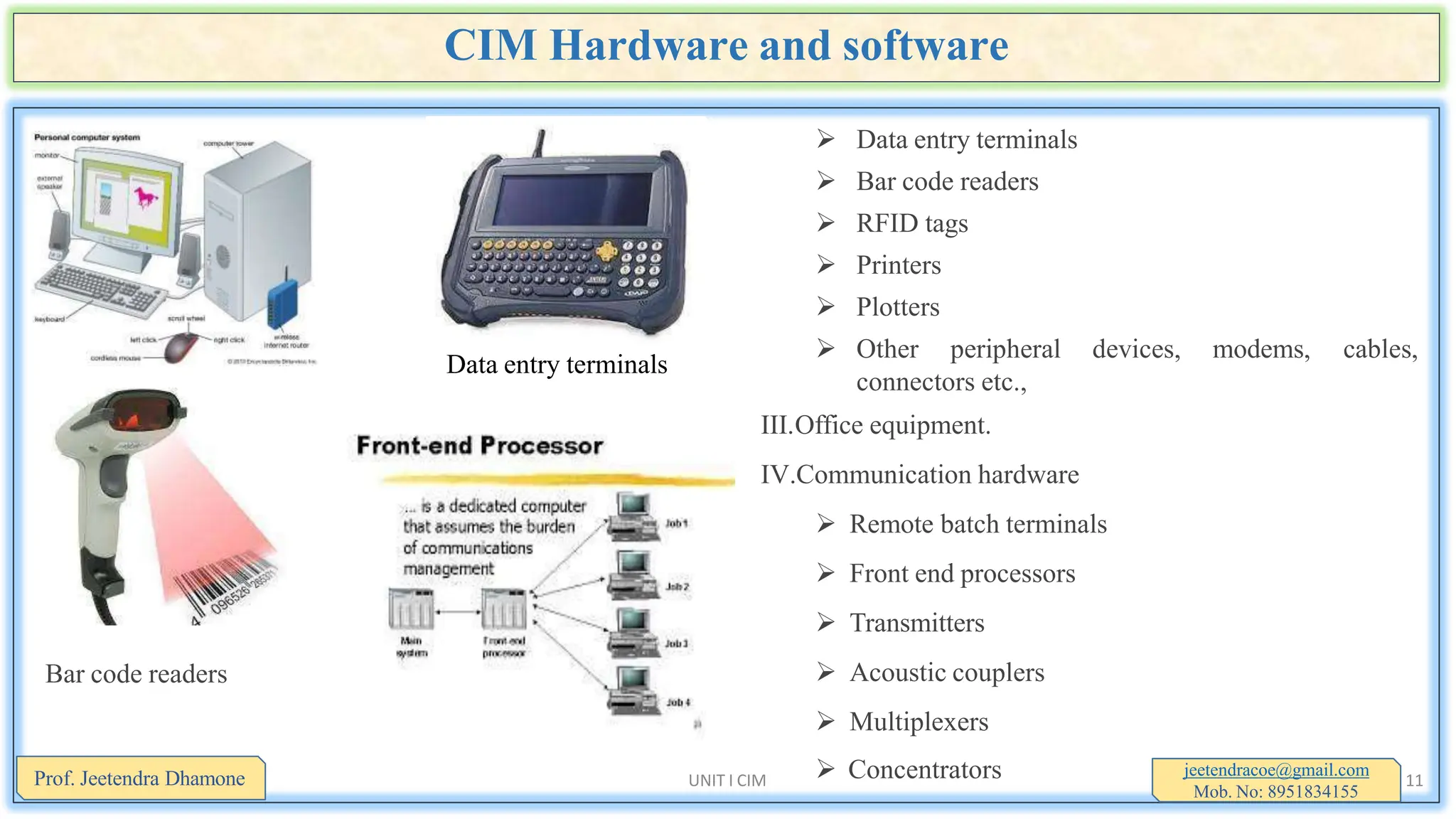
 Data entry terminals
 Bar code readers
 RFID tags
 Printers
 Plotters
modems, cables,
 Other peripheral devices,
connectors etc.,
III.Office equipment.
IV.Communication hardware
 Remote batch terminals
 Front end processors
 Transmitters
 Acoustic couplers
 Multiplexers
Data entry terminals
Bar code readers
 Concentrators jeetendracoe@gmail.com
Mob. No: 8951834155
Prof. Jeetendra Dhamone UNIT I CIM 11
Computer Integrated Manufacturing
:
Management Information System
Sales
Marketing
Finance
Database Management
Modeling and Design
Analysis
Simulation
Communications
Monitoring
Production Control
 Job Tracking
 Inventory Control
 Shop Floor Data Collection
 Order Entry
 Materials Handling
 Device Drivers
 Process Planning
 Manufacturing Facilities Planning
 Work FlowAutomation
 Business Process Engineering
 Network Management
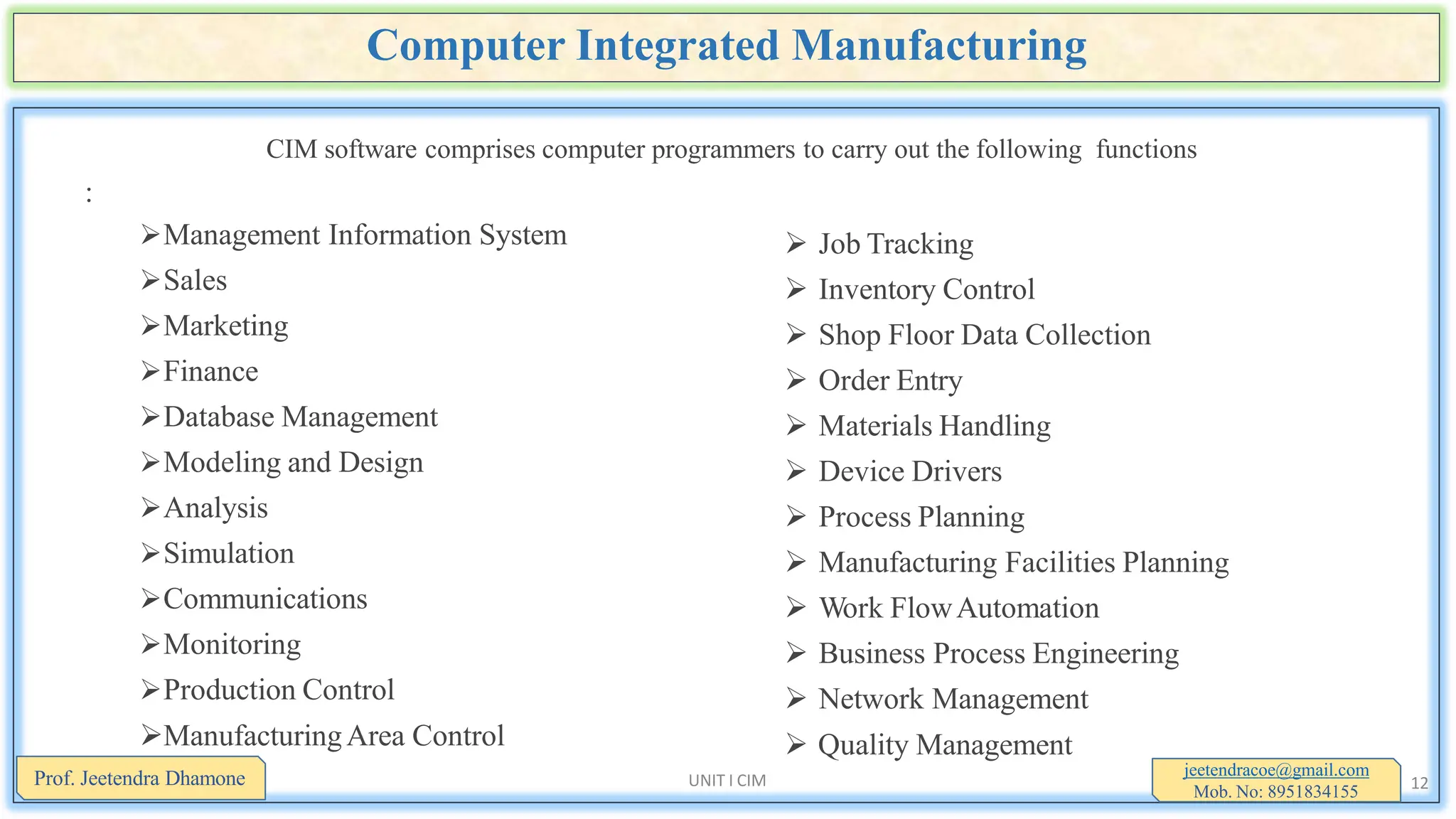
CIM software comprises computer programmers to carry out the following functions
ManufacturingArea Control
Prof. Jeetendra Dhamone
 Quality Management
jeetendracoe@gmail.com
Mob. No: 8951834155
UNIT I CIM 12
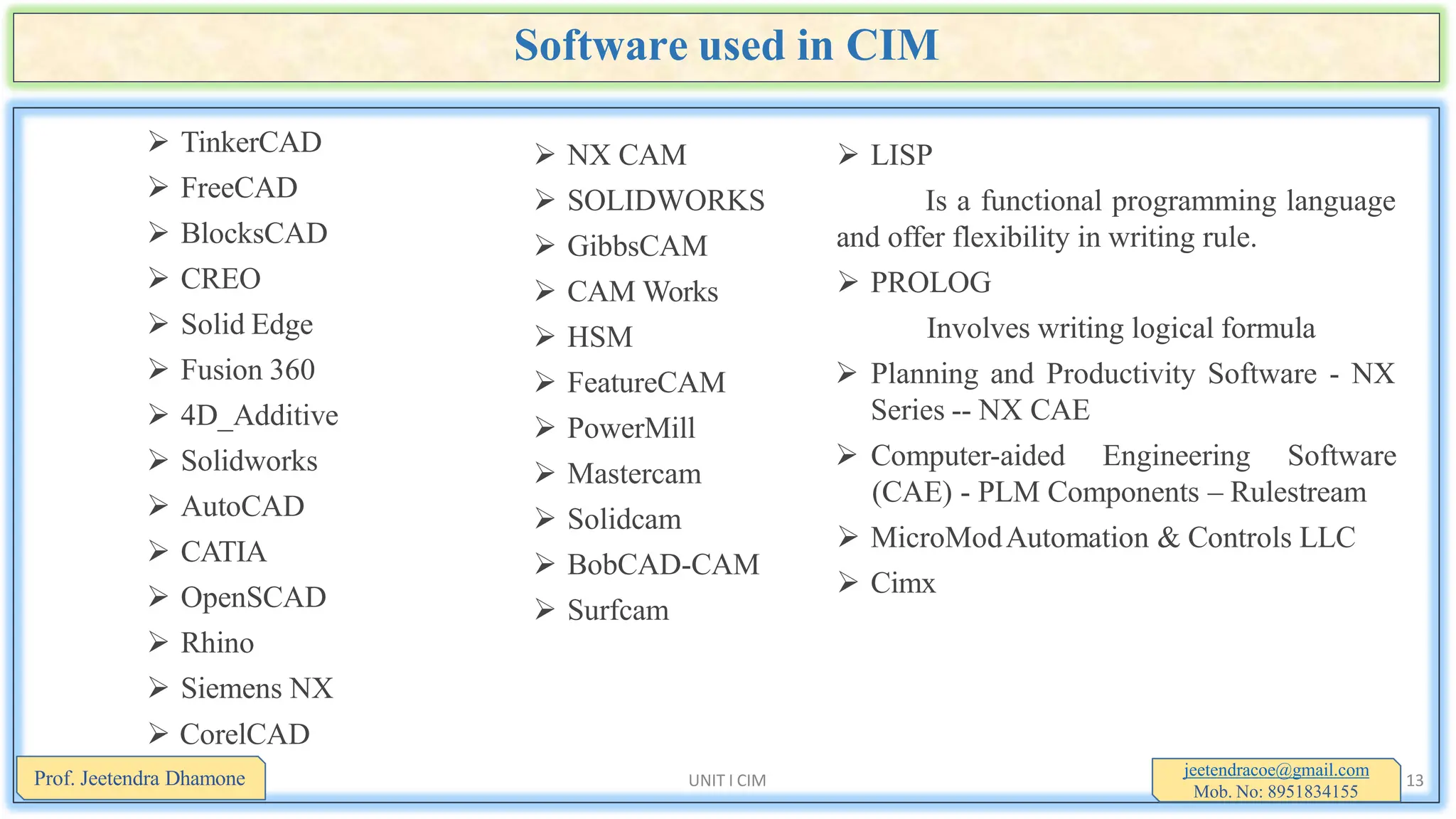
Software used in CIM
 TinkerCAD
 FreeCAD
 BlocksCAD
 CREO
 Solid Edge
 Fusion 360
 4D_Additive
 Solidworks
 AutoCAD
 CATIA
 OpenSCAD
 Rhino
 Siemens NX
 NX CAM
 SOLIDWORKS
 GibbsCAM
 CAM Works
 HSM
 FeatureCAM
 PowerMill
 Mastercam
 Solidcam
 BobCAD-CAM
 Surfcam
 LISP
Is a functional programming language
and offer flexibility in writing rule.
 PROLOG
Involves writing logical formula
 Planning and Productivity Software - NX
Series -- NX CAE
 Computer-aided Engineering Software
(CAE) - PLM Components – Rulestream
 MicroModAutomation & Controls LLC
 Cimx
 CorelCAD
Prof. Jeetendra Dhamone jeetendracoe@gmail.com
Mob. No: 8951834155
UNIT I CIM 13
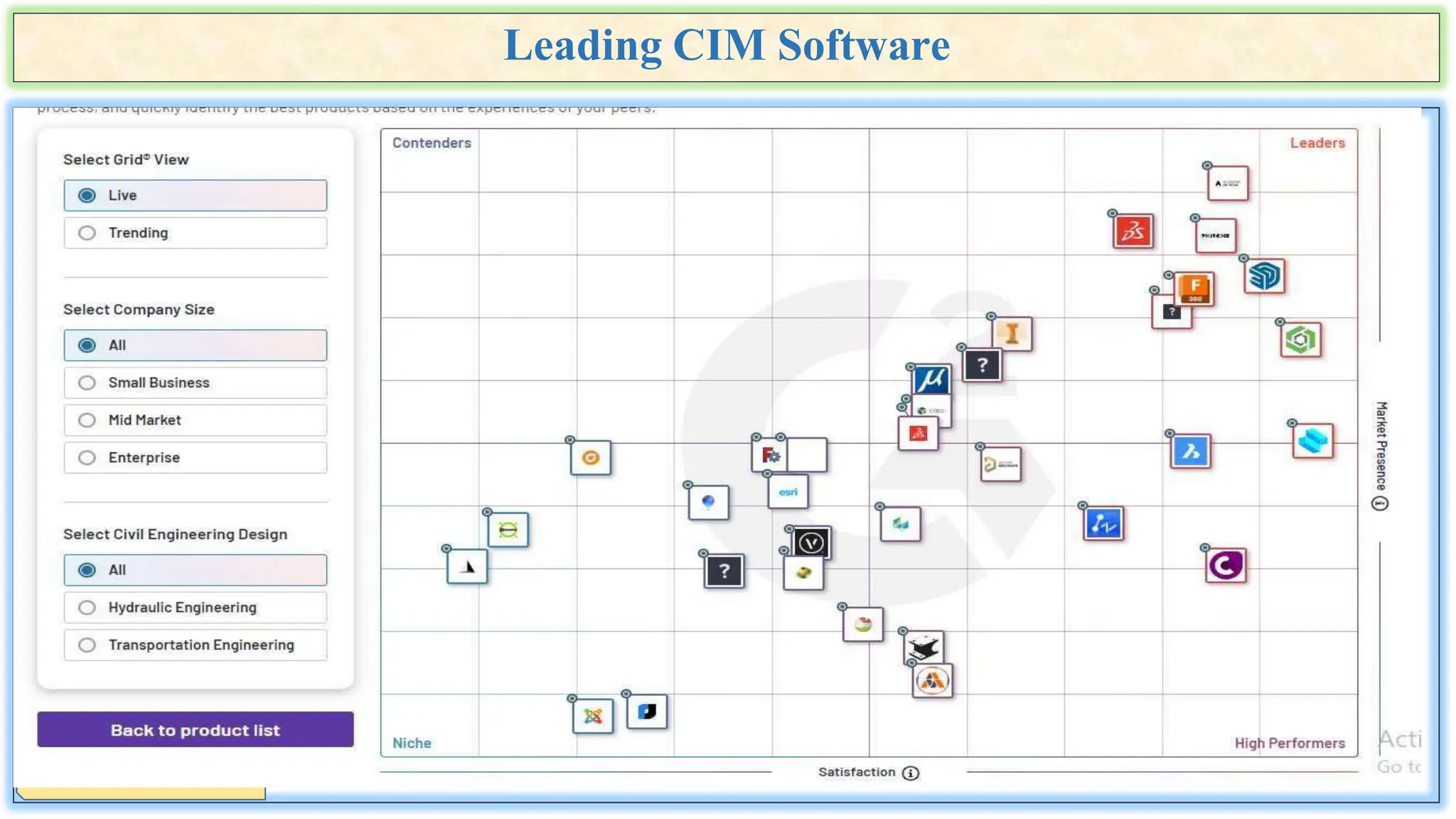
Leading CIM Software
Prof. Jeetendra Dhamone UNIT I CIM 14
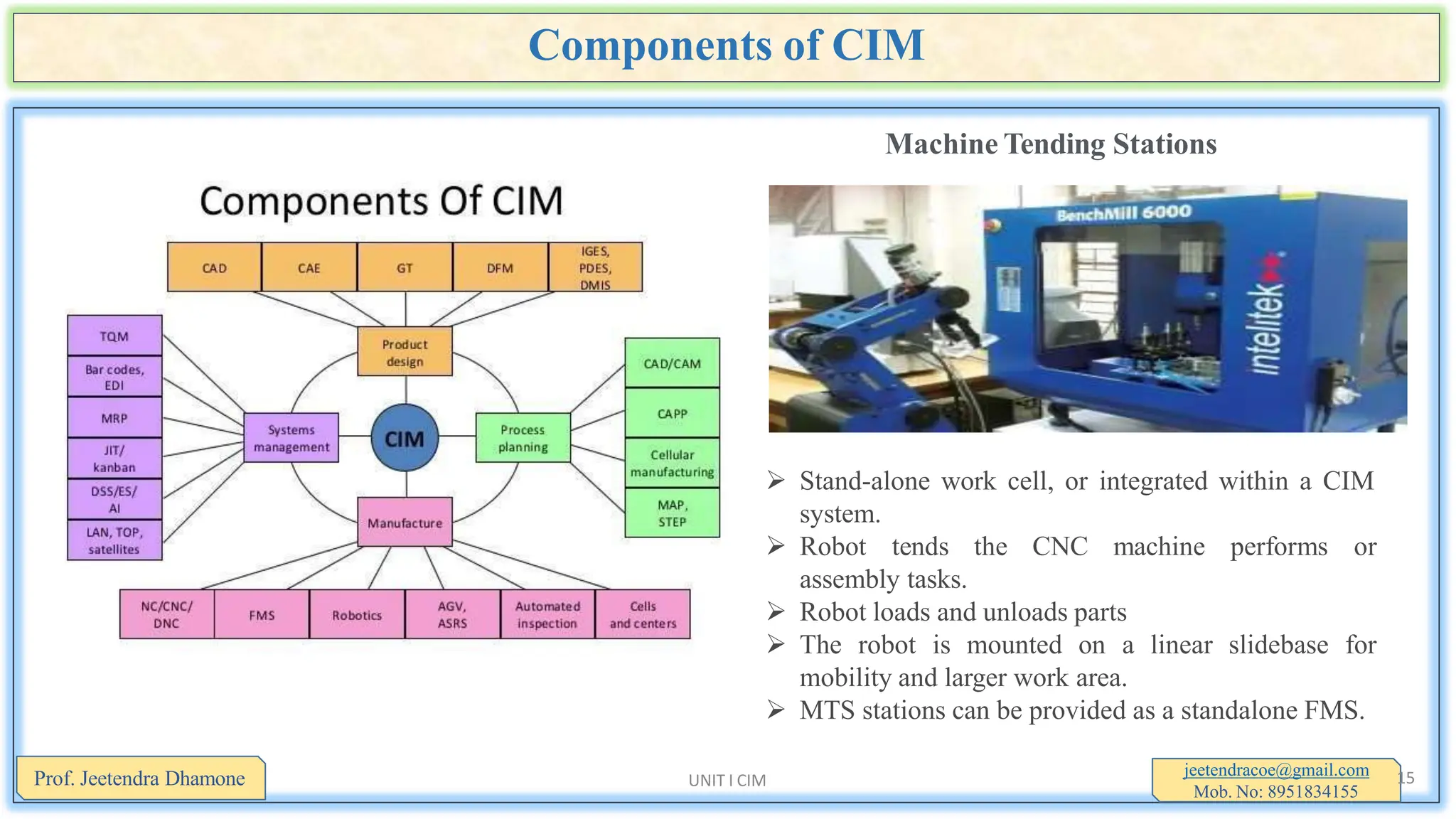
Components of CIM
 Stand-alone work cell, or integrated within a CIM
system.
 Robot tends the CNC machine performs or
assembly tasks.
 Robot loads and unloads parts
 The robot is mounted on a linear slidebase for
mobility and larger work area.
 MTS stations can be provided as a standalone FMS.
Machine Tending Stations
jeetendracoe@gmail.com
Mob. No: 8951834155
Prof. Jeetendra Dhamone 15
UNIT I CIM
Components of CIM
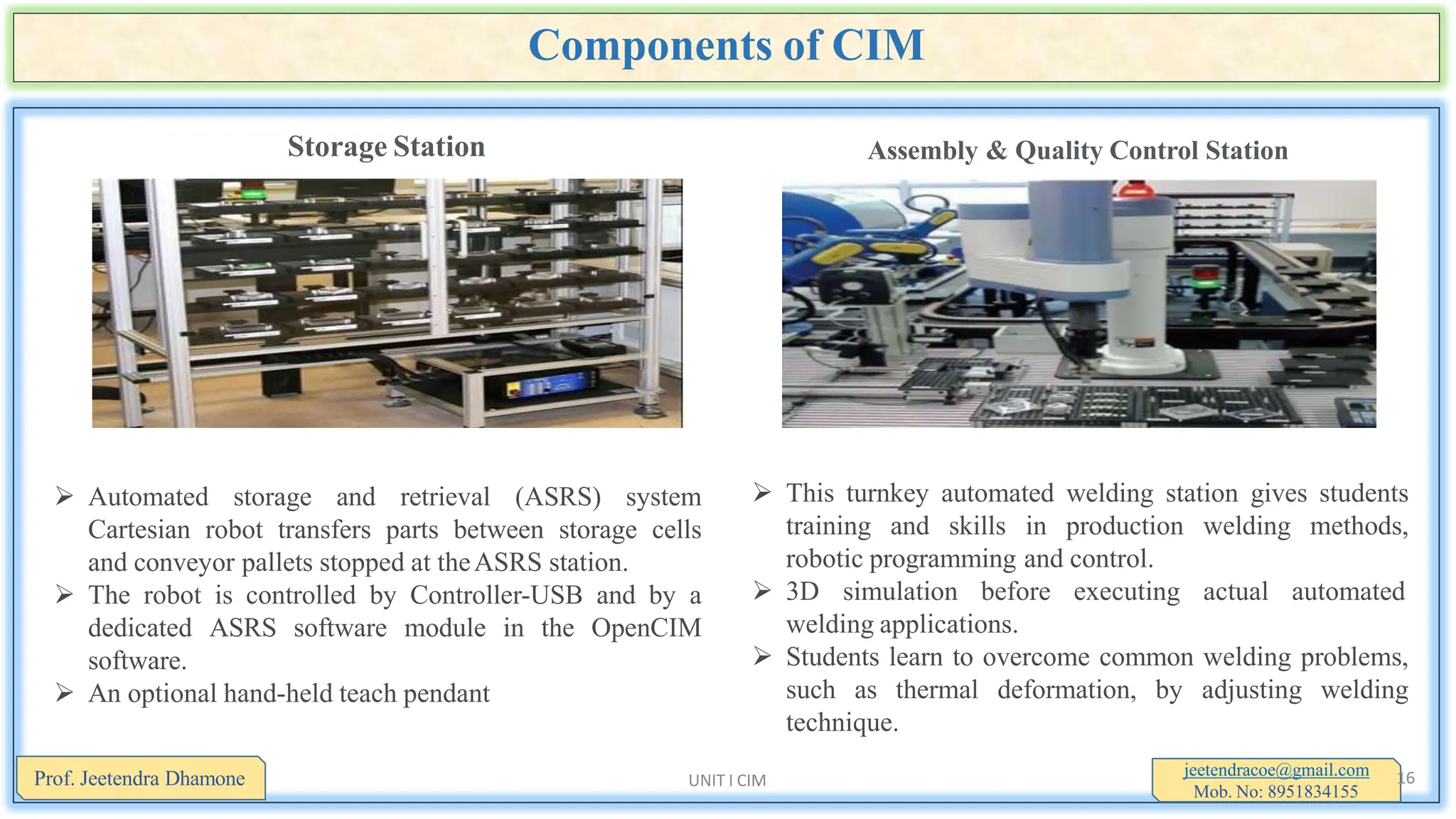
Storage Station
 Automated storage and retrieval (ASRS) system
Cartesian robot transfers parts between storage cells
and conveyor pallets stopped at theASRS station.
 The robot is controlled by Controller-USB and by a
dedicated ASRS software module in the OpenCIM
software.
 An optional hand-held teach pendant
jeetendracoe@gmail.com
Mob. No: 8951834155
Prof. Jeetendra Dhamone 16
UNIT I CIM
Assembly & Quality Control Station
 This turnkey automated welding station gives students
training and skills in production welding methods,
robotic programming and control.
 3D simulation before executing actual automated
welding applications.
 Students learn to overcome common welding problems,
such as thermal deformation, by adjusting welding
technique.
Additional CIM Components
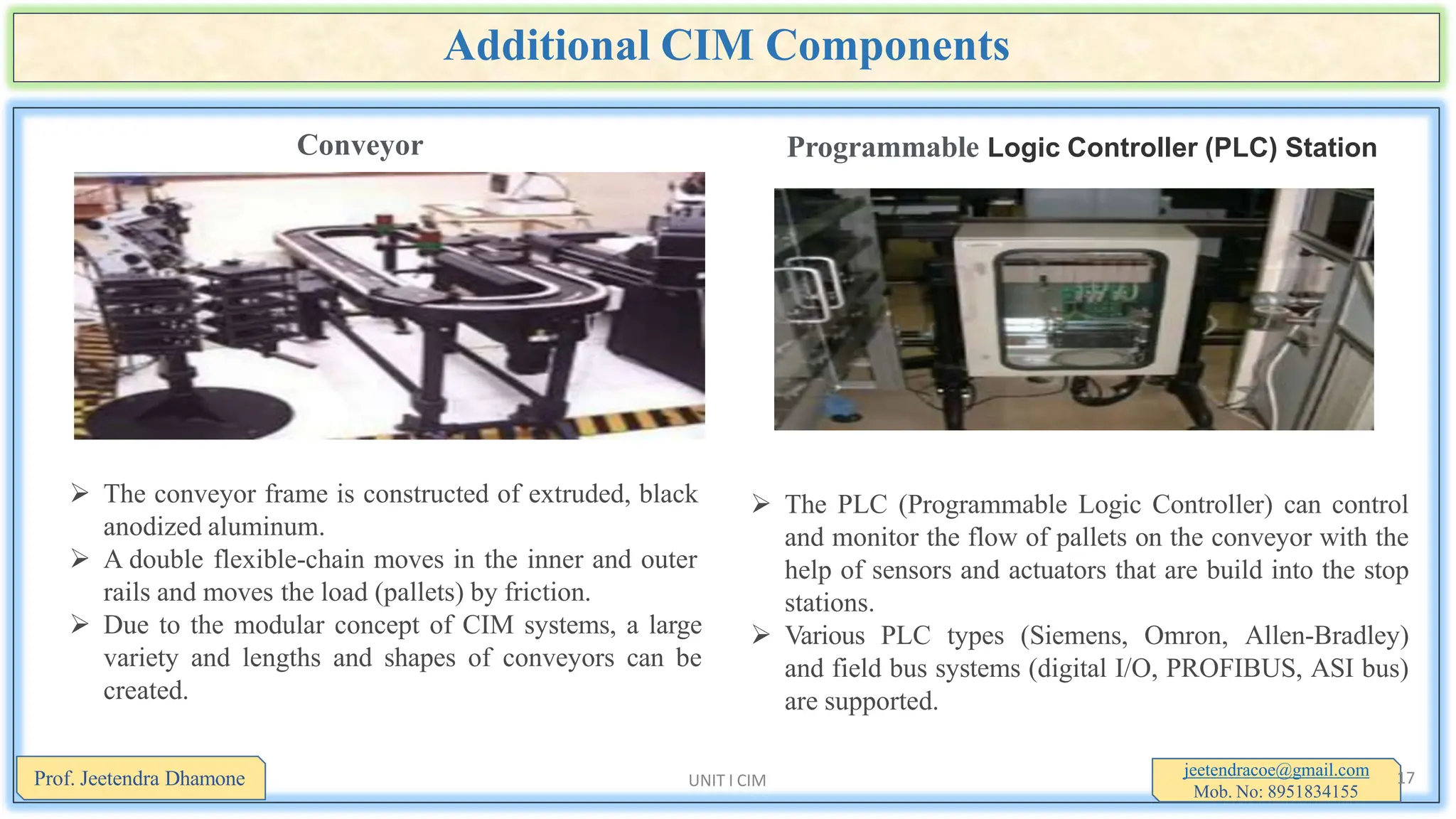
Conveyor
 The conveyor frame is constructed of extruded, black
anodized aluminum.
 A double flexible-chain moves in the inner and outer
rails and moves the load (pallets) by friction.
 Due to the modular concept of CIM systems, a large
variety and lengths and shapes of conveyors can be
created.
Programmable Logic Controller (PLC) Station
 The PLC (Programmable Logic Controller) can control
and monitor the flow of pallets on the conveyor with the
help of sensors and actuators that are build into the stop
stations.
 Various PLC types (Siemens, Omron, Allen-Bradley)
and field bus systems (digital I/O, PROFIBUS, ASI bus)
are supported.
jeetendracoe@gmail.com
Mob. No: 8951834155
Prof. Jeetendra Dhamone 17
UNIT I CIM
Additional CIM Components
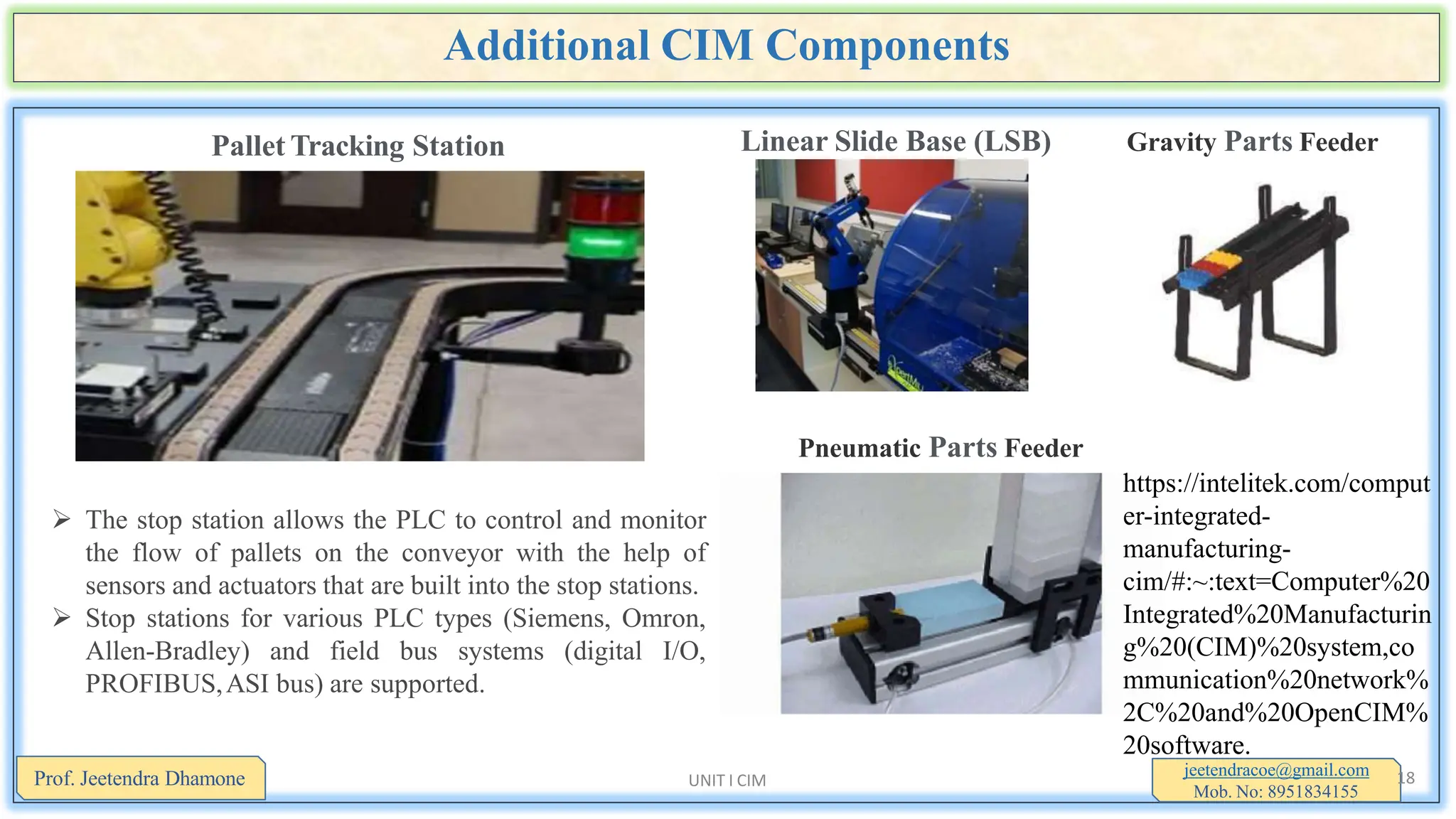
Pallet Tracking Station
 The stop station allows the PLC to control and monitor
the flow of pallets on the conveyor with the help of
sensors and actuators that are built into the stop stations.
 Stop stations for various PLC types (Siemens, Omron,
Allen-Bradley) and field bus systems (digital I/O,
PROFIBUS,ASI bus) are supported.
Linear Slide Base (LSB) Gravity Parts Feeder
Pneumatic Parts Feeder
https://intelitek.com/comput
er-integrated-
manufacturing-
cim/#:~:text=Computer%20
Integrated%20Manufacturin
g%20(CIM)%20system,co
mmunication%20network%
2C%20and%20OpenCIM%
20software.
jeetendracoe@gmail.com
Mob. No: 8951834155
Prof. Jeetendra Dhamone 18
UNIT I CIM
SOFTWARE in CIM
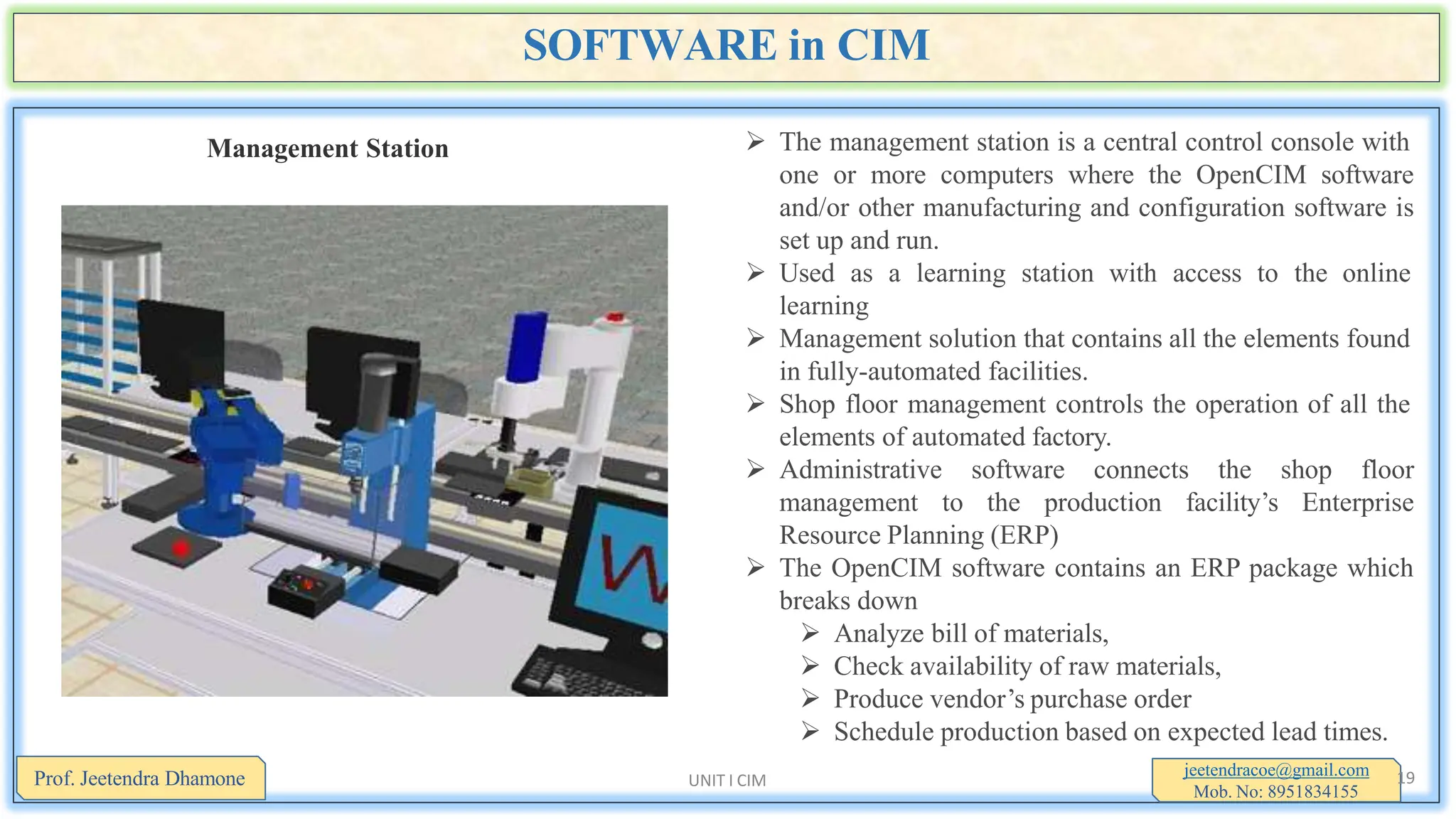
Management Station  The management station is a central control console with
jeetendracoe@gmail.com
Mob. No: 8951834155
Prof. Jeetendra Dhamone 19
UNIT I CIM
one or more computers where the OpenCIM software
and/or other manufacturing and configuration software is
set up and run.
 Used as a learning station with access to the online
learning
 Management solution that contains all the elements found
in fully-automated facilities.
 Shop floor management controls the operation of all the
elements of automated factory.
 Administrative software connects the shop floor
management to the production facility’s Enterprise
Resource Planning (ERP)
 The OpenCIM software contains an ERP package which
breaks down
 Analyze bill of materials,
 Check availability of raw materials,
 Produce vendor’s purchase order
 Schedule production based on expected lead times.
SOFTWARE in CIM
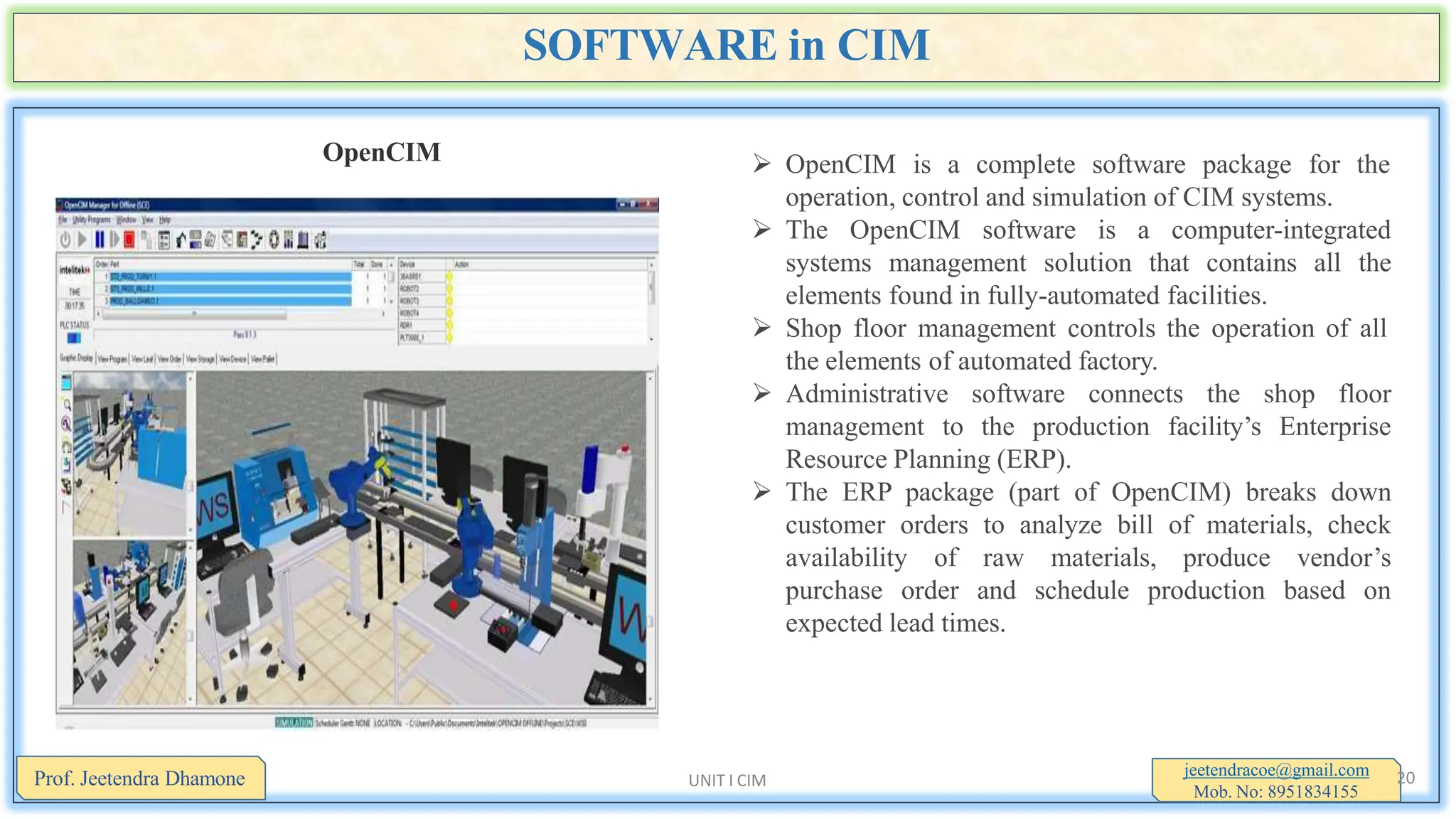
OpenCIM  OpenCIM is a complete software package for the
operation, control and simulation of CIM systems.
 The OpenCIM software is a computer-integrated
systems management solution that contains all the
elements found in fully-automated facilities.
 Shop floor management controls the operation of all
the elements of automated factory.
 Administrative software connects the shop floor
management to the production facility’s Enterprise
Resource Planning (ERP).
 The ERP package (part of OpenCIM) breaks down
customer orders to analyze bill of materials, check
availability of raw materials, produce vendor’s
purchase order and schedule production based on
expected lead times.
jeetendracoe@gmail.com
Mob. No: 8951834155
Prof. Jeetendra Dhamone 20
UNIT I CIM
Terms
Prof. Jeetendra Dhamone UNIT I CIM 21
• IGES: Integrated Graphics Exchange Specification
• PDES: Product Data Exchange Standard
• DMIS: Dimensional Measuring Interface Standard
• MAP: Manufacturing Automation Protocol
• STEP: Standard for The Exchange of Product model data (ISO 10303)
• CASA: Computer andAutomated SystemsAssociation
• SME: Society of Manufacturing Engineers
jeetendracoe@gmail.com
Mob. No: 8951834155
CIM Wheel
Prof. Jeetendra Dhamone UNIT I CIM 22
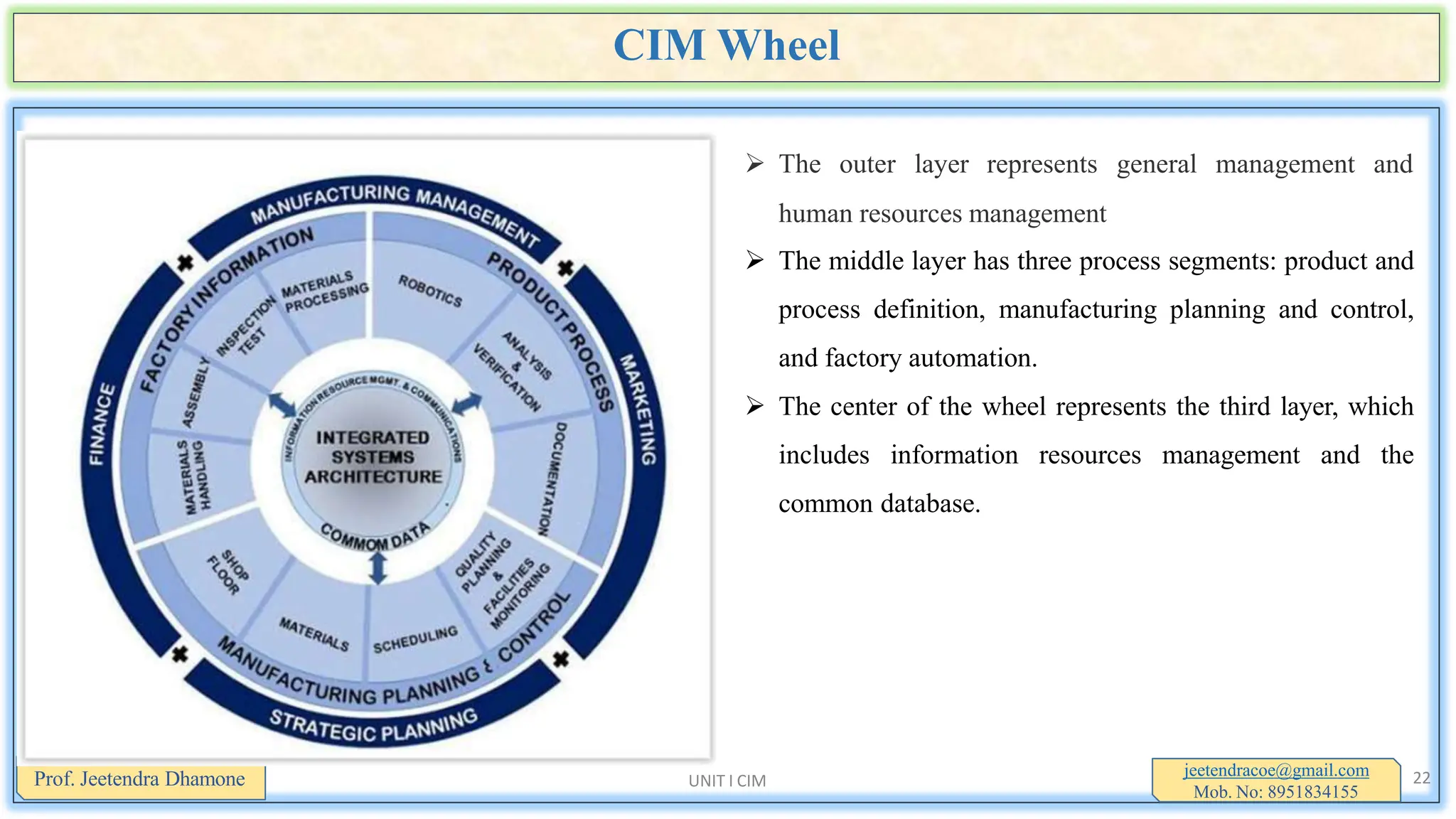
 The outer layer represents general management and
human resources management
 The middle layer has three process segments: product and
process definition, manufacturing planning and control,
and factory automation.
 The center of the wheel represents the third layer, which
includes information resources management and the
common database.
jeetendracoe@gmail.com
Mob. No: 8951834155
Computerized elements of a CIM system
Prof. Jeetendra Dhamone 23
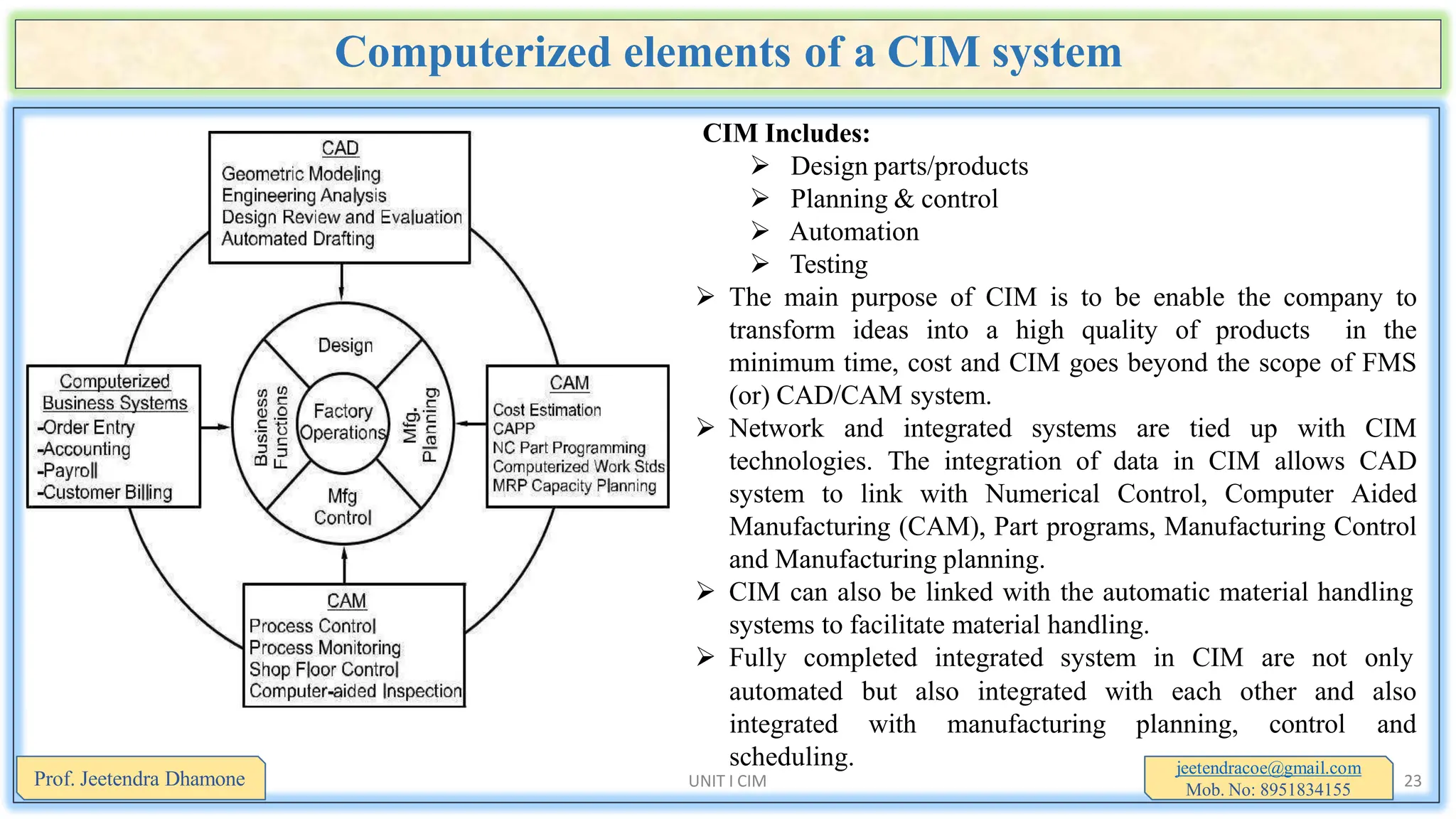
CIM Includes:
 Design parts/products
 Planning & control
 Automation
 Testing
 The main purpose of CIM is to be enable the company to
transform ideas into a high quality of products in the
minimum time, cost and CIM goes beyond the scope of FMS
(or) CAD/CAM system.
 Network and integrated systems are tied up with CIM
technologies. The integration of data in CIM allows CAD
system to link with Numerical Control, Computer Aided
Manufacturing (CAM), Part programs, Manufacturing Control
and Manufacturing planning.
 CIM can also be linked with the automatic material handling
systems to facilitate material handling.
 Fully completed integrated system in CIM are not only
with manufacturing planning, control
but also integrated with each other and also
and
automated
integrated
scheduling.
UNIT I CIM
jeetendracoe@gmail.com
Mob. No: 8951834155
CIM Benefits
Prof. Jeetendra Dhamone UNIT I CIM 24
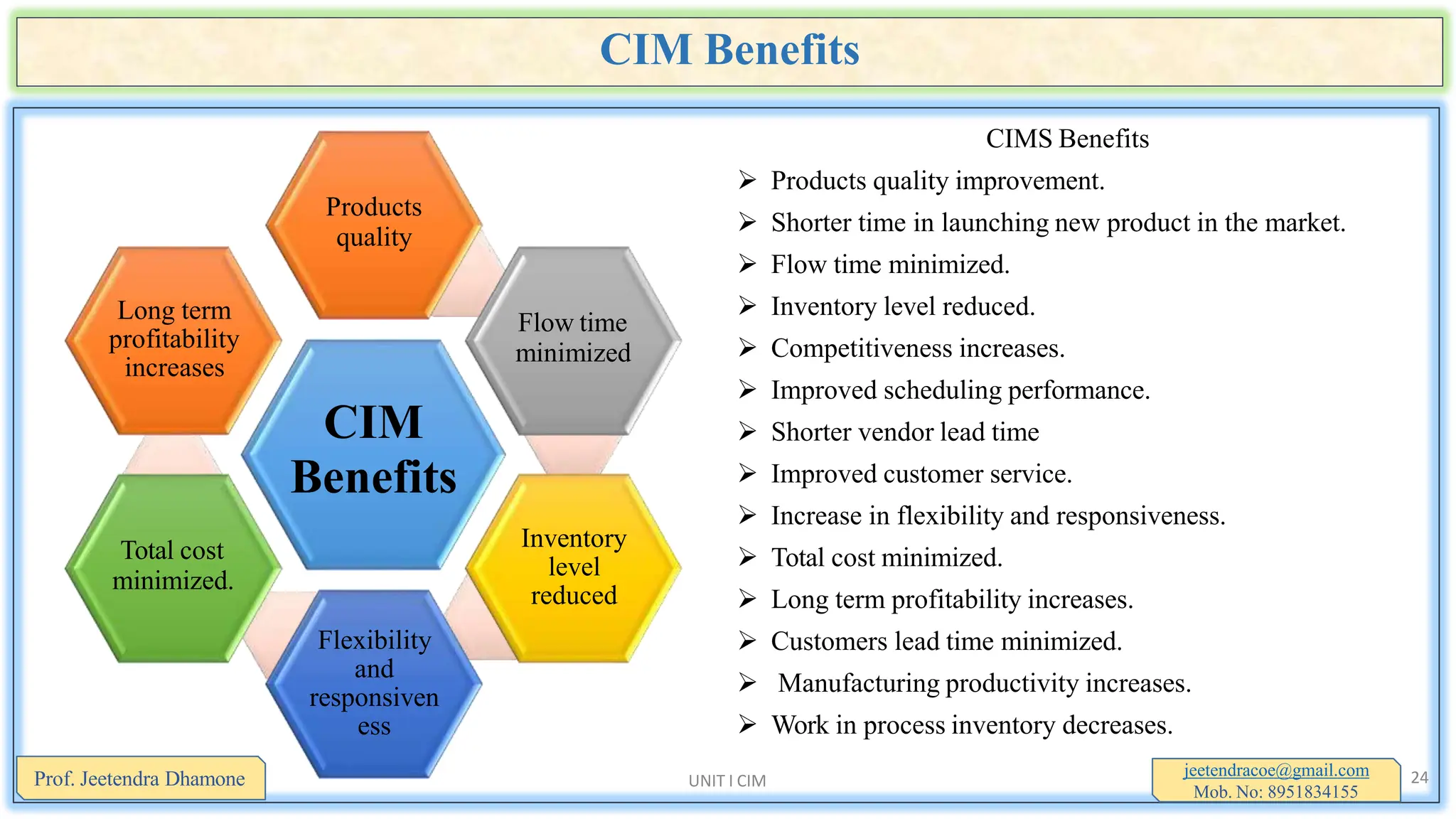
CIMS Benefits
 Products quality improvement.
 Shorter time in launching new product in the market.
 Flow time minimized.
 Inventory level reduced.
 Competitiveness increases.
 Improved scheduling performance.
 Shorter vendor lead time
 Improved customer service.
 Increase in flexibility and responsiveness.
 Total cost minimized.
 Long term profitability increases.
 Customers lead time minimized.
 Manufacturing productivity increases.
 Work in process inventory decreases.
CIM
Benefits
Products
quality
Flow time
minimized
Inventory
level
reduced
Flexibility
and
responsiven
ess
Total cost
minimized.
Long term
profitability
increases
jeetendracoe@gmail.com
Mob. No: 8951834155
Automation
UNIT I CIM 25
The technique of making an apparatus, a process, or a system
operate automatically.
The creation and application of technology to monitor and
control the production and delivery of products and services.
Automation is the creation and application of technologies to
produce and deliver goods and services with minimal human
intervention. The implementation of automation technologies,
techniques and processes improve the efficiency, reliability,
and/or speed of many tasks that were previously performed by
humans.
Automation used in
 Manufacturing
 Transport
 Utilities
 Defense
 Facilities
 Operations and lately
 Information technology.
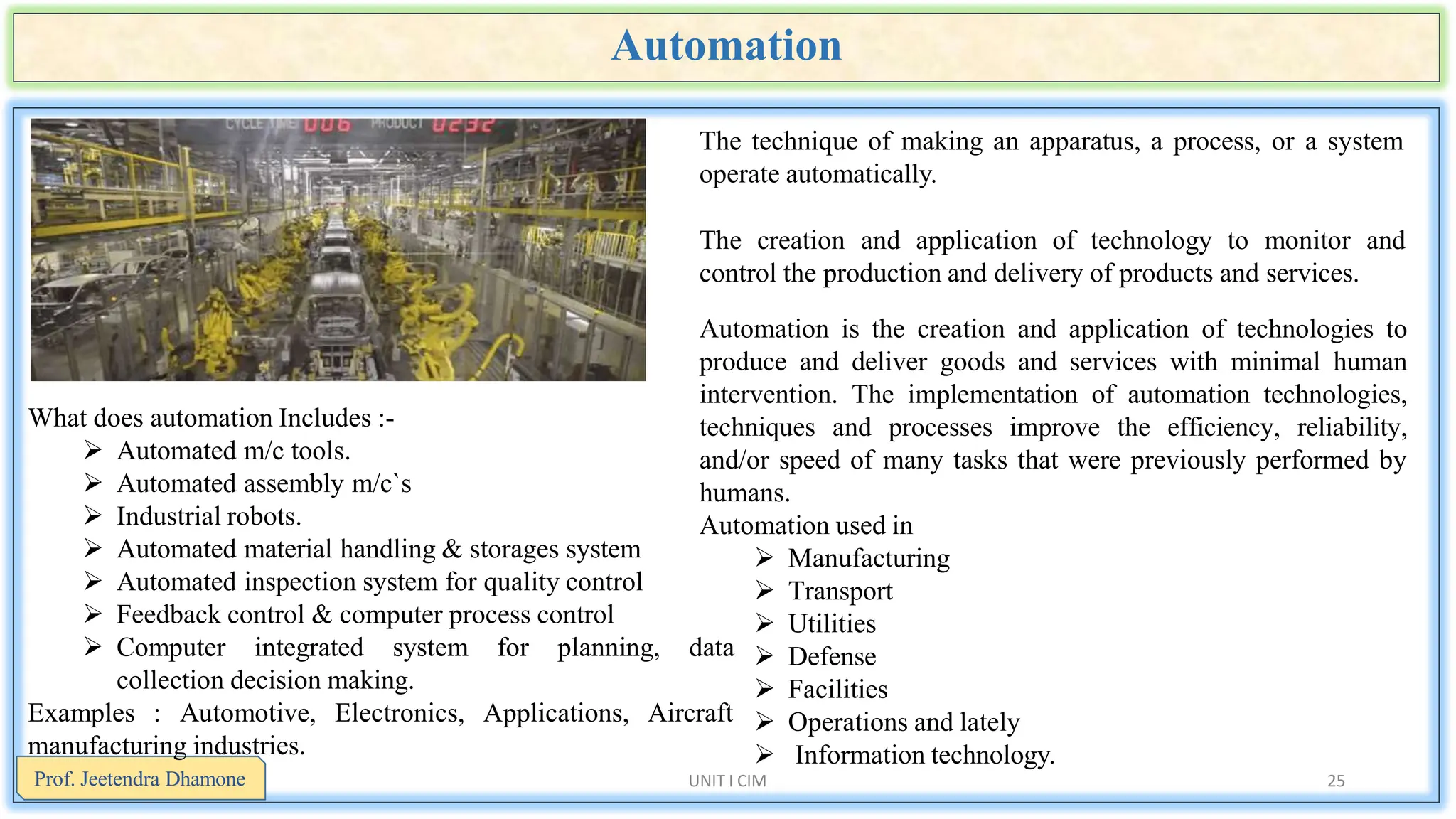
What does automation Includes :-
 Automated m/c tools.
 Automated assembly m/c`s
 Industrial robots.
 Automated material handling & storages system
 Automated inspection system for quality control
 Feedback control & computer process control
 Computer integrated system for planning, data
collection decision making.
Electronics, Applications, Aircraft
Examples : Automotive,
manufacturing industries.
Prof. Jeetendra Dhamone
Reasons for Automation
 Increased productivity due competition
 High cost of labour
 Labour shortage
 Trend of labour toward the sector
 Safety
 High cost of raw materials
 Improved product quality
 Reduced manufacturing lead time
 Reduction of in process inventory
 High cost of not automation
jeetendracoe@gmail.com
Mob. No: 8951834155
Prof. Jeetendra Dhamone UNIT I CIM 26
 Due to Industrialization and globalization the global competition
escalates which causes increase the demand the stoner of productivity
& quality.
 Automation system required less Labour hence increasing cost of
Labour don`t of heat on it
 ManyAdvanced nations, there has been a shortage of Labour
 There are some social & institutional forces Labour toward the service
sector.
 Automation delaminates the human role, work is made safer.
 The high cost of raw materials in manufacturing results in the need for
greater efficiency in using there materials
 Automated operation not only produces parts of faster rates but they
produce parts with greater consistency and conformity to quality.
 For automation allows the manufacturer to reduce the time between
custom order and product delivery.
 Holiday large inventories of work in process represent a significant
cost to the manufacturer because it ties up capital.
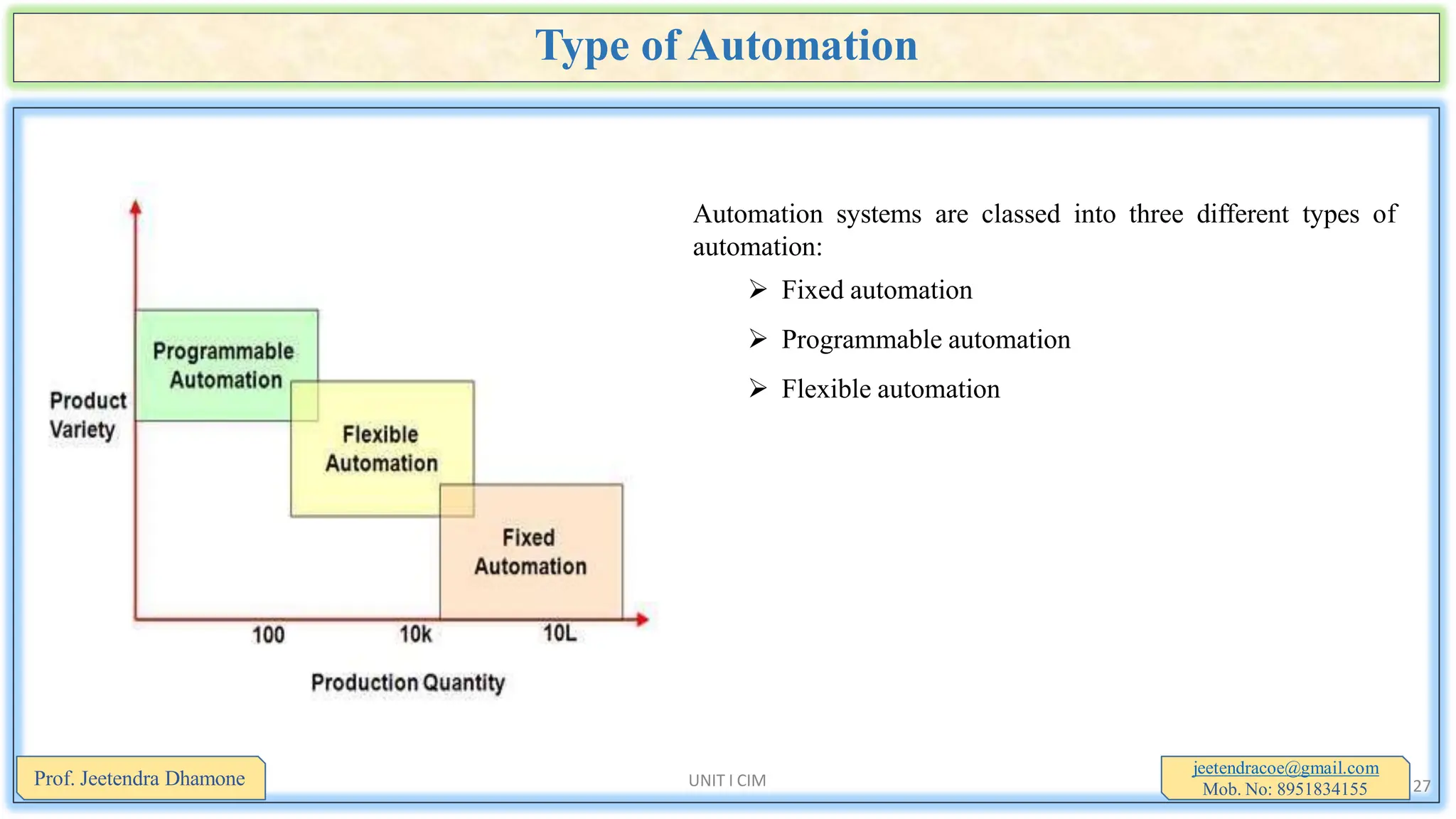
Type of Automation
Automation systems are classed into three different types of
automation:
 Fixed automation
 Programmable automation
 Flexible automation
jeetendracoe@gmail.com
Mob. No: 8951834155
Prof. Jeetendra Dhamone UNIT I CIM 27
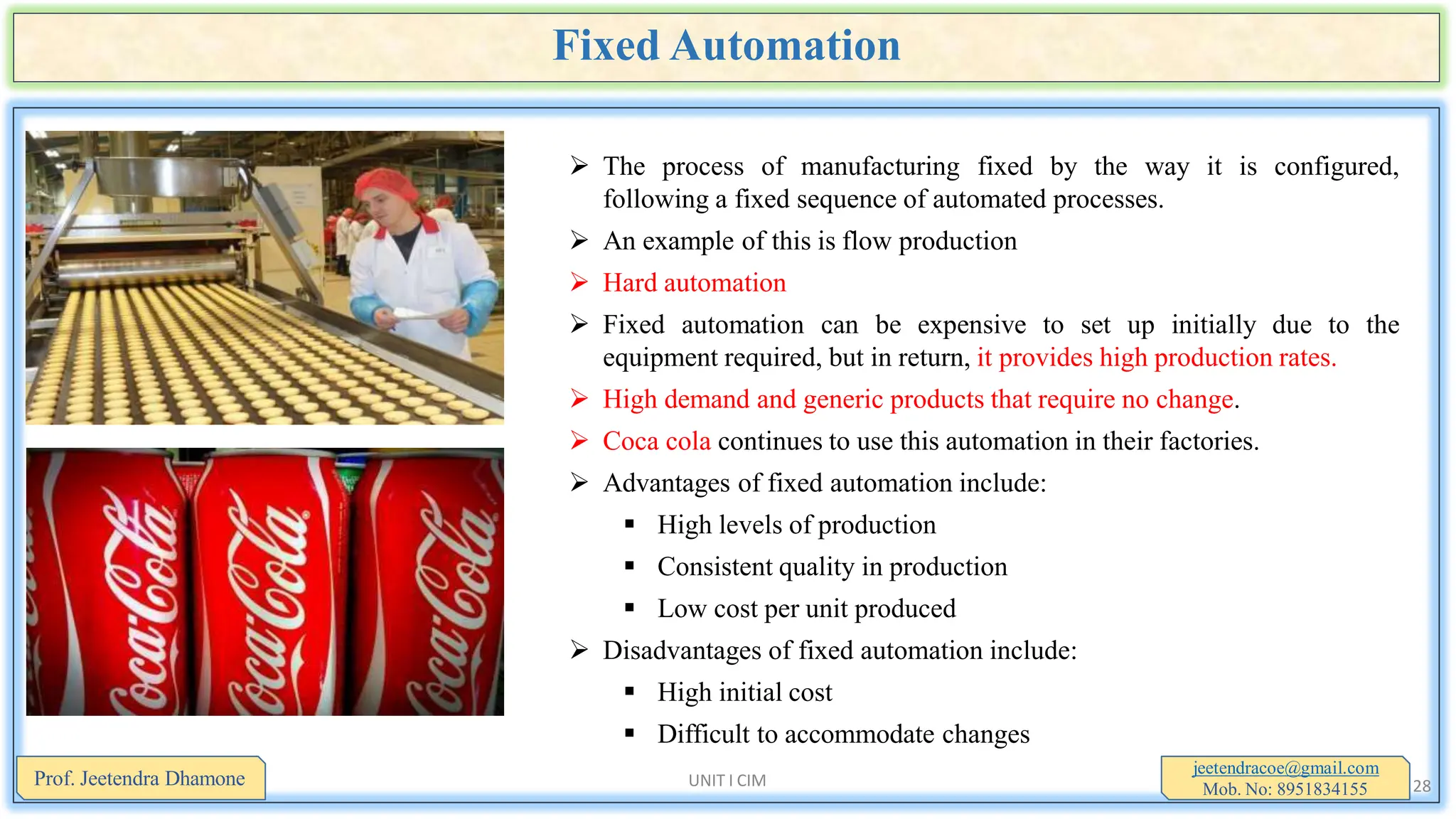
Fixed Automation
 The process of manufacturing fixed by the way it is configured,
following a fixed sequence of automated processes.
 An example of this is flow production
 Hard automation
 Fixed automation can be expensive to set up initially due to the
equipment required, but in return, it provides high production rates.
 High demand and generic products that require no change.
 Coca cola continues to use this automation in their factories.
 Advantages of fixed automation include:
 High levels of production
 Consistent quality in production
 Low cost per unit produced
 Disadvantages of fixed automation include:
 High initial cost
 Difficult to accommodate changes
jeetendracoe@gmail.com
Mob. No: 8951834155
Prof. Jeetendra Dhamone UNIT I CIM 28
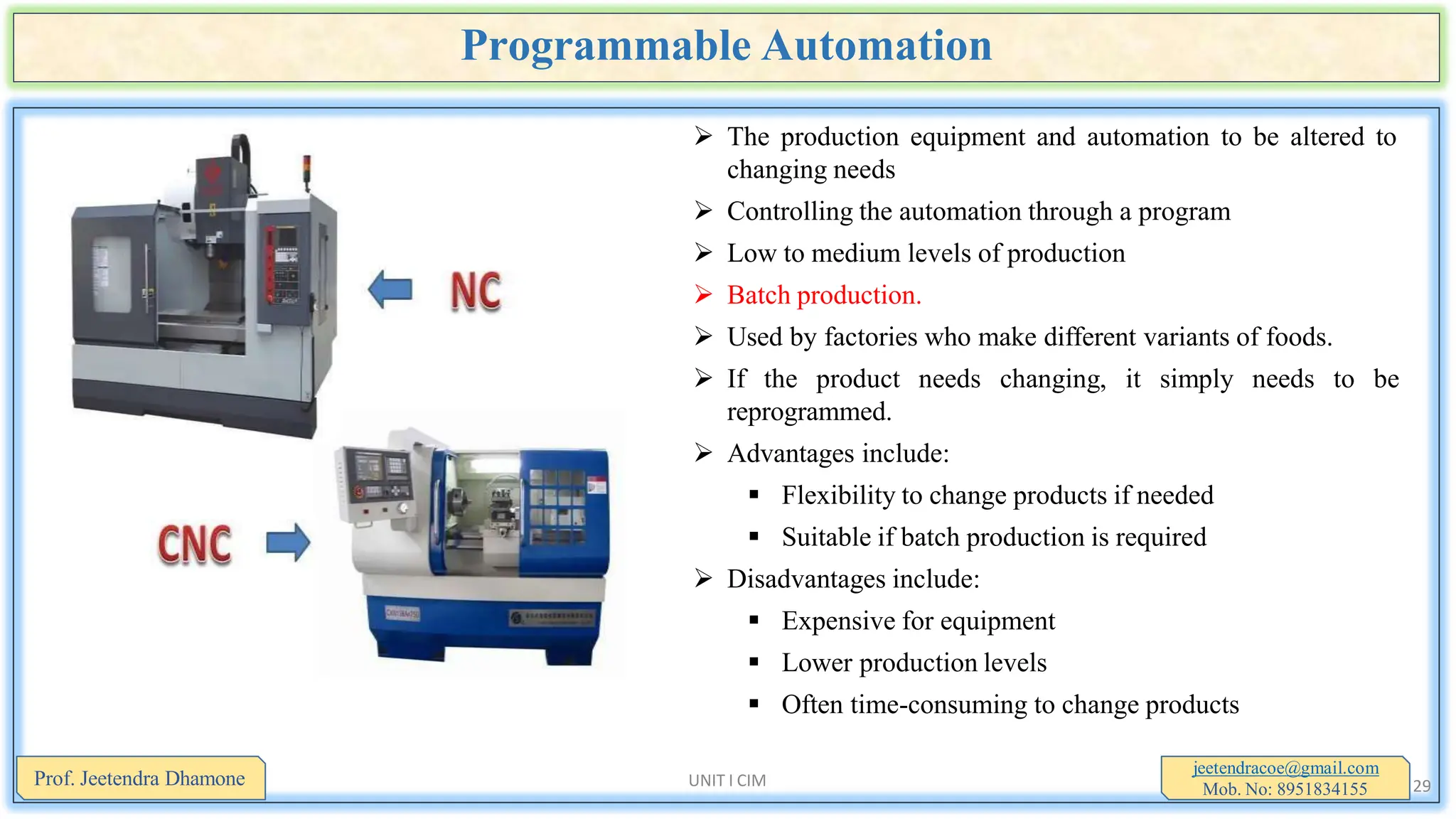
Programmable Automation
 The production equipment and automation to be altered to
changing needs
 Controlling the automation through a program
 Low to medium levels of production
 Batch production.
 Used by factories who make different variants of foods.
 If the product needs changing, it simply needs to be
reprogrammed.
 Advantages include:
 Flexibility to change products if needed
 Suitable if batch production is required
 Disadvantages include:
 Expensive for equipment
 Lower production levels
 Often time-consuming to change products
jeetendracoe@gmail.com
Mob. No: 8951834155
Prof. Jeetendra Dhamone UNIT I CIM 29
Flexible Automation
 Flexible automation, also known as “soft automation”, is
similar to programmable automation, although a little more
complicated. Essentially, flexible automation enables the
production of different types of products without losing time
when reprogramming.
 A flexible automation system can produce various
combinations of products efficiently without having to
separate them into different batches, as required in batch
production. This type of automation tends to have medium
levels of production.
 Advantages include:
 Flexibility of products
 No time lost with new changes to production
 Disadvantages include:
 High custom machinery/automation cost
 Higher cost per unit
jeetendracoe@gmail.com
Mob. No: 8951834155
Prof. Jeetendra Dhamone UNIT I CIM 30
Flexible automation systems consist of the following:
 Part processing machines: CNC machining equipment
carries out a portion of these processes, with inspection
and other automated work stations used in combination.
 Material-handling system: Conveyancing and other
systems move parts from one area along the production
line to another, with robots generally used for the
loading and unloading of product.
 Central computer control system: Communications that
come from this central controller provide component
routing information and adjust timing within the
material-handling system while also coordinating the
operational processes of these machines.
 Human labor: While these systems are based around
automation, engineering this flexibility still requires
humans to manage, repair, maintain and alter procedures
when necessary.
Functions of Automation in manufacturing
The certain basic functions as –
 Processing
 Assembly
 Material handling & storage
 Inspection & Testing
 Control
Processing: It is the operations which transforms the
product from one state of completion into a more
advanced state of completion.
Into one of the following four categories.
 Basic processes
 Secondary processes
 Finishing operations
 Operations to enhance physical properties
jeetendracoe@gmail.com
Mob. No: 8951834155
Prof. Jeetendra Dhamone UNIT I CIM 31
Assembly operation :-
 In it the distinguishing feature is that two or more separate
components are joined together.
 It included mechanical fostering operations, which make use
of screws nuts, rivets and so on, and going processes such as
welding, brazing & soldering.
Material handling and storage :-
 A means of moving and storing materials between the
processing and assembly operations must be provided.
 Material spend move time being moved and stored than
being processed.
 Mostly the cost would be required for handling, moving &
storing of materials.
Inspection & Testing :-
 It is purpose of inspection is to determine the product meets
the established design standards & specifications.

CIM UNIT I PPT.pptx COMPUTER INTEGRATED Manufacturing

  • 1.
    Computer Integrated Manufacturing(CIM) Introduction to CIM Syllabus: Need of CIM, Introduction, Evolution of CIM, CIM Hardware and software, Role of CIM System, Definition of CIM, automation and types of automation, Reasons for automation, Types of Production, Functions in Manufacturing, CIM wheel, Computerized element of CIM, Advantages of CIM jeetendracoe@gmail.com Mob. No: 8951834155 UNIT I CIM 1
  • 2.
    Computer Integrated Manufacturing(CIM) The computer system is in control of every stage from design and the ordering of materials to the manufacturing processes and distribution to customers. The factory show manufactures DVD / CD Storage units. jeetendracoe@gmail.com Mob. No: 8951834155 Prof. Jeetendra Dhamone UNIT I CIM 2
  • 3.
    Need of CIM Thereare several reasons why CIM is becoming increasingly necessary for modern manufacturing operations: 1.Increased efficiency: By automating repetitive tasks, CIM can help increase production speeds and reduce the time required for each manufacturing step. 2.Improved accuracy: CIM reduces the chances of human error and improves the overall accuracy of the manufacturing process. 3.Better data management: CIM allows manufacturers to collect and store data in real-time, making it easier to track production progress and identify areas that need improvement. 4.Better decision-making: With access to real-time data, manufacturers can make informed decisions about production processes and improve the overall quality of their products. 5.Increased flexibility: CIM allows manufacturers to quickly adapt to changing market conditions and customer demands, making it easier to respond to new opportunities and challenges. 6.Increased competitiveness: CIM helps manufacturing organizations to stay ahead of their competitors by enabling them to respond faster to market demands and to introduce new products more quickly. 7.Better resource utilization: CIM systems allow organizations to optimize their use of resources, such as materials and labor, leading to reduced costs and increased profitability. jeetendracoe@gmail.com Mob. No: 8951834155 Prof. Jeetendra Dhamone UNIT I CIM 3
  • 4.
    Introduction Computer Integrated Manufacturing(CIM) is a manufacturing process by uses computer-controlled machinery, automated tool, various computer program, and software. Dr. Joseph Harrington published a book in 1974 titled Computer Integrated Manufacturing jeetendracoe@gmail.com Mob. No: 8951834155 Prof. Jeetendra Dhamone UNIT I CIM 4
  • 5.
    Computer Integrated Manufacturing •Massachusetts Institute of Technology (MIT, USA) is credited with pioneering the development in both CAD and CAM. • Design and manufacturing requirements of aerospace industries after the Second World. • Late 40‟sand early 50‟s could not meet the design and manufacturing challenges • Develop sophisticated aircraft and satellite launch vehicles • The first major innovation in machine control is the Numerical Control (NC), demonstrated at MIT in 1952. • NC machines used paper tape as an input medium • Second-generation models replaced the vacuum tubes with transistors • Third-generation models featuring integrated circuitry and modular circuit • Special preprogrammed circuit boards • In mild 60th Direct Numerical Control (DNC)as the computer bypassed the tape reader • By late 60‟s mini computers jeetendracoe@gmail.com Mob. No: 8951834155 Prof. Jeetendra Dhamone UNIT I CIM 5
  • 6.
    Computer Integrated Manufacturing jeetendracoe@gmail.com Mob.No: 8951834155 Prof. Jeetendra Dhamone UNIT I CIM 6
  • 7.
    Computer Integrated Manufacturing •Flexible manufacturing cells and flexible manufacturing systems in late 70‟s. •Computer Aided Design (CAD), Now, one can model, draft, analyze, simulate, modify, optimize and create the NC code to manufacture a component and simulate the machining operation sitting at a computer workstation. •CIM is an umbrella term under which all functions of manufacturing and associated acronyms such as CAD, CAD/CAM, FMS, CAPP find a place. jeetendracoe@gmail.com Mob. No: 8951834155 Prof. Jeetendra Dhamone UNIT I CIM 7
  • 8.
    Definition of ComputerIntegrated Manufacturing • CIM is the integration of the total manufacturing enterprise through the use of computer and data communications coupled with new managerial philosophies that improve organizational and personnel efficiency. • It aims to integrate all of the operational and information processing functions in manufacturing from order receipt, through design and manufacturing, to product shipment. • Computer Integrated Manufacturing, known as CIM, is the phrase used to describe the complete automation of a manufacturing plant, with all processes functioning under computer control and digital information tying them together. jeetendracoe@gmail.com Mob. No: 8951834155 Prof. Jeetendra Dhamone UNIT I CIM 8
  • 9.
    Role Computer IntegratedManufacturing Major Computerized Elements of CIM System  Marketing  Product Design  Planning  Purchase  Manufacturing Engineering  FactoryAutomation Hardware  Warehousing  Logistics and Supply Chain Management  Finance  Information Management CIM Marketing Product Design Planning Purchase Manufactu ring Engineerin g Factory Automation Hardware Warehousing Logistics and Supply Chain Management Finance Information Management jeetendracoe@gmail.com Mob. No: 8951834155 Prof. Jeetendra Dhamone UNIT I CIM 9
  • 10.
    CIM Hardware andsoftware CIM Hardware comprises the following: I Manufacturing equipment:  CNC machines or computerized work centers  Robotic work cells  DNC/FMS systems  Work handling and tool handling devices  Storage devices  Sensors,  Shop floor data collection devices,  Inspection machines etc. II computer-related hardware  Computers  Controllers  CAD/CAM systems  Workstations / terminals jeetendracoe@gmail.com Mob. No: 8951834155 Prof. Jeetendra Dhamone UNIT I CIM 10
  • 11.
    CIM Hardware andsoftware  Data entry terminals  Bar code readers  RFID tags  Printers  Plotters modems, cables,  Other peripheral devices, connectors etc., III.Office equipment. IV.Communication hardware  Remote batch terminals  Front end processors  Transmitters  Acoustic couplers  Multiplexers Data entry terminals Bar code readers  Concentrators jeetendracoe@gmail.com Mob. No: 8951834155 Prof. Jeetendra Dhamone UNIT I CIM 11
  • 12.
    Computer Integrated Manufacturing : ManagementInformation System Sales Marketing Finance Database Management Modeling and Design Analysis Simulation Communications Monitoring Production Control  Job Tracking  Inventory Control  Shop Floor Data Collection  Order Entry  Materials Handling  Device Drivers  Process Planning  Manufacturing Facilities Planning  Work FlowAutomation  Business Process Engineering  Network Management CIM software comprises computer programmers to carry out the following functions ManufacturingArea Control Prof. Jeetendra Dhamone  Quality Management jeetendracoe@gmail.com Mob. No: 8951834155 UNIT I CIM 12
  • 13.
    Software used inCIM  TinkerCAD  FreeCAD  BlocksCAD  CREO  Solid Edge  Fusion 360  4D_Additive  Solidworks  AutoCAD  CATIA  OpenSCAD  Rhino  Siemens NX  NX CAM  SOLIDWORKS  GibbsCAM  CAM Works  HSM  FeatureCAM  PowerMill  Mastercam  Solidcam  BobCAD-CAM  Surfcam  LISP Is a functional programming language and offer flexibility in writing rule.  PROLOG Involves writing logical formula  Planning and Productivity Software - NX Series -- NX CAE  Computer-aided Engineering Software (CAE) - PLM Components – Rulestream  MicroModAutomation & Controls LLC  Cimx  CorelCAD Prof. Jeetendra Dhamone jeetendracoe@gmail.com Mob. No: 8951834155 UNIT I CIM 13
  • 14.
    Leading CIM Software Prof.Jeetendra Dhamone UNIT I CIM 14
  • 15.
    Components of CIM Stand-alone work cell, or integrated within a CIM system.  Robot tends the CNC machine performs or assembly tasks.  Robot loads and unloads parts  The robot is mounted on a linear slidebase for mobility and larger work area.  MTS stations can be provided as a standalone FMS. Machine Tending Stations jeetendracoe@gmail.com Mob. No: 8951834155 Prof. Jeetendra Dhamone 15 UNIT I CIM
  • 16.
    Components of CIM StorageStation  Automated storage and retrieval (ASRS) system Cartesian robot transfers parts between storage cells and conveyor pallets stopped at theASRS station.  The robot is controlled by Controller-USB and by a dedicated ASRS software module in the OpenCIM software.  An optional hand-held teach pendant jeetendracoe@gmail.com Mob. No: 8951834155 Prof. Jeetendra Dhamone 16 UNIT I CIM Assembly & Quality Control Station  This turnkey automated welding station gives students training and skills in production welding methods, robotic programming and control.  3D simulation before executing actual automated welding applications.  Students learn to overcome common welding problems, such as thermal deformation, by adjusting welding technique.
  • 17.
    Additional CIM Components Conveyor The conveyor frame is constructed of extruded, black anodized aluminum.  A double flexible-chain moves in the inner and outer rails and moves the load (pallets) by friction.  Due to the modular concept of CIM systems, a large variety and lengths and shapes of conveyors can be created. Programmable Logic Controller (PLC) Station  The PLC (Programmable Logic Controller) can control and monitor the flow of pallets on the conveyor with the help of sensors and actuators that are build into the stop stations.  Various PLC types (Siemens, Omron, Allen-Bradley) and field bus systems (digital I/O, PROFIBUS, ASI bus) are supported. jeetendracoe@gmail.com Mob. No: 8951834155 Prof. Jeetendra Dhamone 17 UNIT I CIM
  • 18.
    Additional CIM Components PalletTracking Station  The stop station allows the PLC to control and monitor the flow of pallets on the conveyor with the help of sensors and actuators that are built into the stop stations.  Stop stations for various PLC types (Siemens, Omron, Allen-Bradley) and field bus systems (digital I/O, PROFIBUS,ASI bus) are supported. Linear Slide Base (LSB) Gravity Parts Feeder Pneumatic Parts Feeder https://intelitek.com/comput er-integrated- manufacturing- cim/#:~:text=Computer%20 Integrated%20Manufacturin g%20(CIM)%20system,co mmunication%20network% 2C%20and%20OpenCIM% 20software. jeetendracoe@gmail.com Mob. No: 8951834155 Prof. Jeetendra Dhamone 18 UNIT I CIM
  • 19.
    SOFTWARE in CIM ManagementStation  The management station is a central control console with jeetendracoe@gmail.com Mob. No: 8951834155 Prof. Jeetendra Dhamone 19 UNIT I CIM one or more computers where the OpenCIM software and/or other manufacturing and configuration software is set up and run.  Used as a learning station with access to the online learning  Management solution that contains all the elements found in fully-automated facilities.  Shop floor management controls the operation of all the elements of automated factory.  Administrative software connects the shop floor management to the production facility’s Enterprise Resource Planning (ERP)  The OpenCIM software contains an ERP package which breaks down  Analyze bill of materials,  Check availability of raw materials,  Produce vendor’s purchase order  Schedule production based on expected lead times.
  • 20.
    SOFTWARE in CIM OpenCIM OpenCIM is a complete software package for the operation, control and simulation of CIM systems.  The OpenCIM software is a computer-integrated systems management solution that contains all the elements found in fully-automated facilities.  Shop floor management controls the operation of all the elements of automated factory.  Administrative software connects the shop floor management to the production facility’s Enterprise Resource Planning (ERP).  The ERP package (part of OpenCIM) breaks down customer orders to analyze bill of materials, check availability of raw materials, produce vendor’s purchase order and schedule production based on expected lead times. jeetendracoe@gmail.com Mob. No: 8951834155 Prof. Jeetendra Dhamone 20 UNIT I CIM
  • 21.
    Terms Prof. Jeetendra DhamoneUNIT I CIM 21 • IGES: Integrated Graphics Exchange Specification • PDES: Product Data Exchange Standard • DMIS: Dimensional Measuring Interface Standard • MAP: Manufacturing Automation Protocol • STEP: Standard for The Exchange of Product model data (ISO 10303) • CASA: Computer andAutomated SystemsAssociation • SME: Society of Manufacturing Engineers jeetendracoe@gmail.com Mob. No: 8951834155
  • 22.
    CIM Wheel Prof. JeetendraDhamone UNIT I CIM 22  The outer layer represents general management and human resources management  The middle layer has three process segments: product and process definition, manufacturing planning and control, and factory automation.  The center of the wheel represents the third layer, which includes information resources management and the common database. jeetendracoe@gmail.com Mob. No: 8951834155
  • 23.
    Computerized elements ofa CIM system Prof. Jeetendra Dhamone 23 CIM Includes:  Design parts/products  Planning & control  Automation  Testing  The main purpose of CIM is to be enable the company to transform ideas into a high quality of products in the minimum time, cost and CIM goes beyond the scope of FMS (or) CAD/CAM system.  Network and integrated systems are tied up with CIM technologies. The integration of data in CIM allows CAD system to link with Numerical Control, Computer Aided Manufacturing (CAM), Part programs, Manufacturing Control and Manufacturing planning.  CIM can also be linked with the automatic material handling systems to facilitate material handling.  Fully completed integrated system in CIM are not only with manufacturing planning, control but also integrated with each other and also and automated integrated scheduling. UNIT I CIM jeetendracoe@gmail.com Mob. No: 8951834155
  • 24.
    CIM Benefits Prof. JeetendraDhamone UNIT I CIM 24 CIMS Benefits  Products quality improvement.  Shorter time in launching new product in the market.  Flow time minimized.  Inventory level reduced.  Competitiveness increases.  Improved scheduling performance.  Shorter vendor lead time  Improved customer service.  Increase in flexibility and responsiveness.  Total cost minimized.  Long term profitability increases.  Customers lead time minimized.  Manufacturing productivity increases.  Work in process inventory decreases. CIM Benefits Products quality Flow time minimized Inventory level reduced Flexibility and responsiven ess Total cost minimized. Long term profitability increases jeetendracoe@gmail.com Mob. No: 8951834155
  • 25.
    Automation UNIT I CIM25 The technique of making an apparatus, a process, or a system operate automatically. The creation and application of technology to monitor and control the production and delivery of products and services. Automation is the creation and application of technologies to produce and deliver goods and services with minimal human intervention. The implementation of automation technologies, techniques and processes improve the efficiency, reliability, and/or speed of many tasks that were previously performed by humans. Automation used in  Manufacturing  Transport  Utilities  Defense  Facilities  Operations and lately  Information technology. What does automation Includes :-  Automated m/c tools.  Automated assembly m/c`s  Industrial robots.  Automated material handling & storages system  Automated inspection system for quality control  Feedback control & computer process control  Computer integrated system for planning, data collection decision making. Electronics, Applications, Aircraft Examples : Automotive, manufacturing industries. Prof. Jeetendra Dhamone
  • 26.
    Reasons for Automation Reasonsfor Automation  Increased productivity due competition  High cost of labour  Labour shortage  Trend of labour toward the sector  Safety  High cost of raw materials  Improved product quality  Reduced manufacturing lead time  Reduction of in process inventory  High cost of not automation jeetendracoe@gmail.com Mob. No: 8951834155 Prof. Jeetendra Dhamone UNIT I CIM 26  Due to Industrialization and globalization the global competition escalates which causes increase the demand the stoner of productivity & quality.  Automation system required less Labour hence increasing cost of Labour don`t of heat on it  ManyAdvanced nations, there has been a shortage of Labour  There are some social & institutional forces Labour toward the service sector.  Automation delaminates the human role, work is made safer.  The high cost of raw materials in manufacturing results in the need for greater efficiency in using there materials  Automated operation not only produces parts of faster rates but they produce parts with greater consistency and conformity to quality.  For automation allows the manufacturer to reduce the time between custom order and product delivery.  Holiday large inventories of work in process represent a significant cost to the manufacturer because it ties up capital.
  • 27.
    Type of Automation Automationsystems are classed into three different types of automation:  Fixed automation  Programmable automation  Flexible automation jeetendracoe@gmail.com Mob. No: 8951834155 Prof. Jeetendra Dhamone UNIT I CIM 27
  • 28.
    Fixed Automation  Theprocess of manufacturing fixed by the way it is configured, following a fixed sequence of automated processes.  An example of this is flow production  Hard automation  Fixed automation can be expensive to set up initially due to the equipment required, but in return, it provides high production rates.  High demand and generic products that require no change.  Coca cola continues to use this automation in their factories.  Advantages of fixed automation include:  High levels of production  Consistent quality in production  Low cost per unit produced  Disadvantages of fixed automation include:  High initial cost  Difficult to accommodate changes jeetendracoe@gmail.com Mob. No: 8951834155 Prof. Jeetendra Dhamone UNIT I CIM 28
  • 29.
    Programmable Automation  Theproduction equipment and automation to be altered to changing needs  Controlling the automation through a program  Low to medium levels of production  Batch production.  Used by factories who make different variants of foods.  If the product needs changing, it simply needs to be reprogrammed.  Advantages include:  Flexibility to change products if needed  Suitable if batch production is required  Disadvantages include:  Expensive for equipment  Lower production levels  Often time-consuming to change products jeetendracoe@gmail.com Mob. No: 8951834155 Prof. Jeetendra Dhamone UNIT I CIM 29
  • 30.
    Flexible Automation  Flexibleautomation, also known as “soft automation”, is similar to programmable automation, although a little more complicated. Essentially, flexible automation enables the production of different types of products without losing time when reprogramming.  A flexible automation system can produce various combinations of products efficiently without having to separate them into different batches, as required in batch production. This type of automation tends to have medium levels of production.  Advantages include:  Flexibility of products  No time lost with new changes to production  Disadvantages include:  High custom machinery/automation cost  Higher cost per unit jeetendracoe@gmail.com Mob. No: 8951834155 Prof. Jeetendra Dhamone UNIT I CIM 30 Flexible automation systems consist of the following:  Part processing machines: CNC machining equipment carries out a portion of these processes, with inspection and other automated work stations used in combination.  Material-handling system: Conveyancing and other systems move parts from one area along the production line to another, with robots generally used for the loading and unloading of product.  Central computer control system: Communications that come from this central controller provide component routing information and adjust timing within the material-handling system while also coordinating the operational processes of these machines.  Human labor: While these systems are based around automation, engineering this flexibility still requires humans to manage, repair, maintain and alter procedures when necessary.
  • 31.
    Functions of Automationin manufacturing The certain basic functions as –  Processing  Assembly  Material handling & storage  Inspection & Testing  Control Processing: It is the operations which transforms the product from one state of completion into a more advanced state of completion. Into one of the following four categories.  Basic processes  Secondary processes  Finishing operations  Operations to enhance physical properties jeetendracoe@gmail.com Mob. No: 8951834155 Prof. Jeetendra Dhamone UNIT I CIM 31 Assembly operation :-  In it the distinguishing feature is that two or more separate components are joined together.  It included mechanical fostering operations, which make use of screws nuts, rivets and so on, and going processes such as welding, brazing & soldering. Material handling and storage :-  A means of moving and storing materials between the processing and assembly operations must be provided.  Material spend move time being moved and stored than being processed.  Mostly the cost would be required for handling, moving & storing of materials. Inspection & Testing :-  It is purpose of inspection is to determine the product meets the established design standards & specifications.