Jean-Baptiste Ricco
Vascular service
Hospital Jean Bernard
University of Poitiers, France
CHRONIC CRITICAL LIMB
ISCHEMIA
DIFFICULT PATIENTS TO TAKE CARE
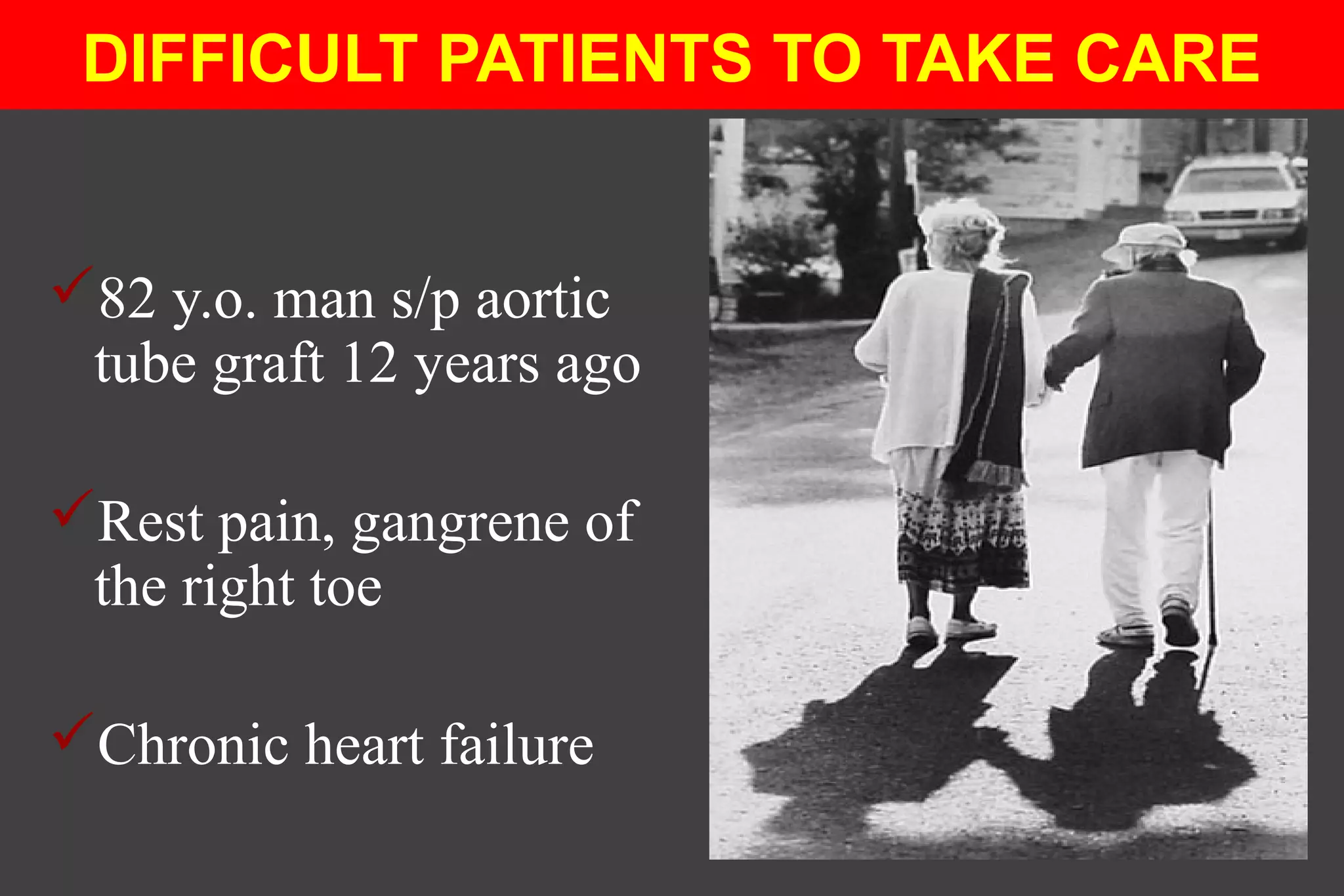
82 y.o. man s/p aortic
tube graft 12 years ago
Rest pain, gangrene of
the right toe
Chronic heart failure
THIS MAN IS LIKE AN OLD BRIDGE
WHY WE SHOULD REVASCULARIZE
THESE PATIENTS WITH CLI
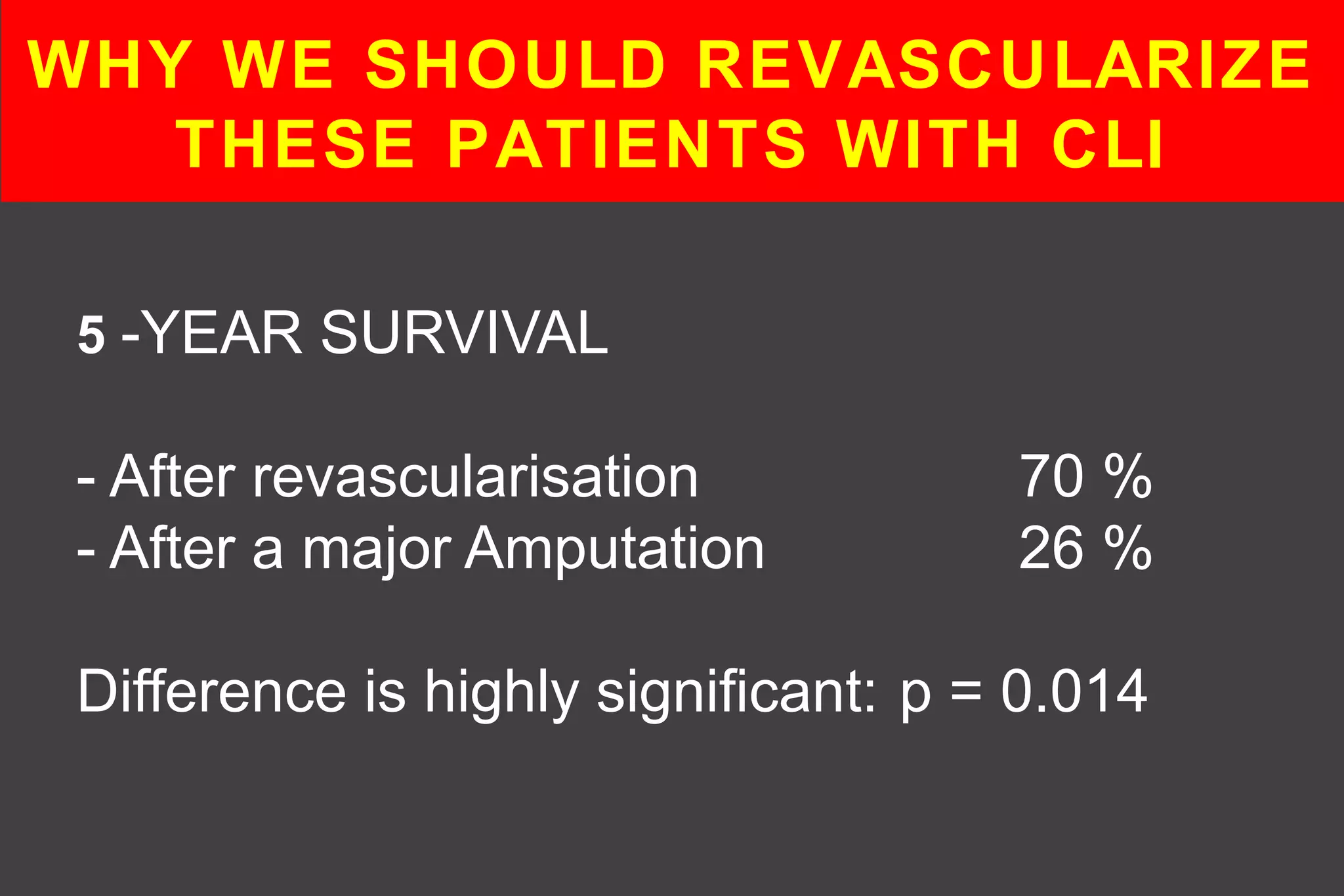
5 -YEAR SURVIVAL
- After revascularisation 70 %
- After a major Amputation 26 %
Difference is highly significant: p = 0.014
TASC 2000
NEED FOR GUIDELINES
TASC 2000
The original TransAtlantic InterSociety
Consensus (TASC) published in 2000 was the
first international consensus on the diagnosis
and treatment of PAD
 TASC II primarily designed to provide
guidance for primary care physicians
 Easy-to-read document (67 vs. 296 pages)
 Not intended for vascular specialists !
TASC II - 2007
 A number of aspects are not updated
 It is not exhaustively referenced
 Recommendations are deliberately simplified
 Fails to recognize that more can be done with
endovascular and open techniques
2007 TASC LITE…
TASC II CLASSIFICATION
INTEROBSERVER
DISAGREEMENT
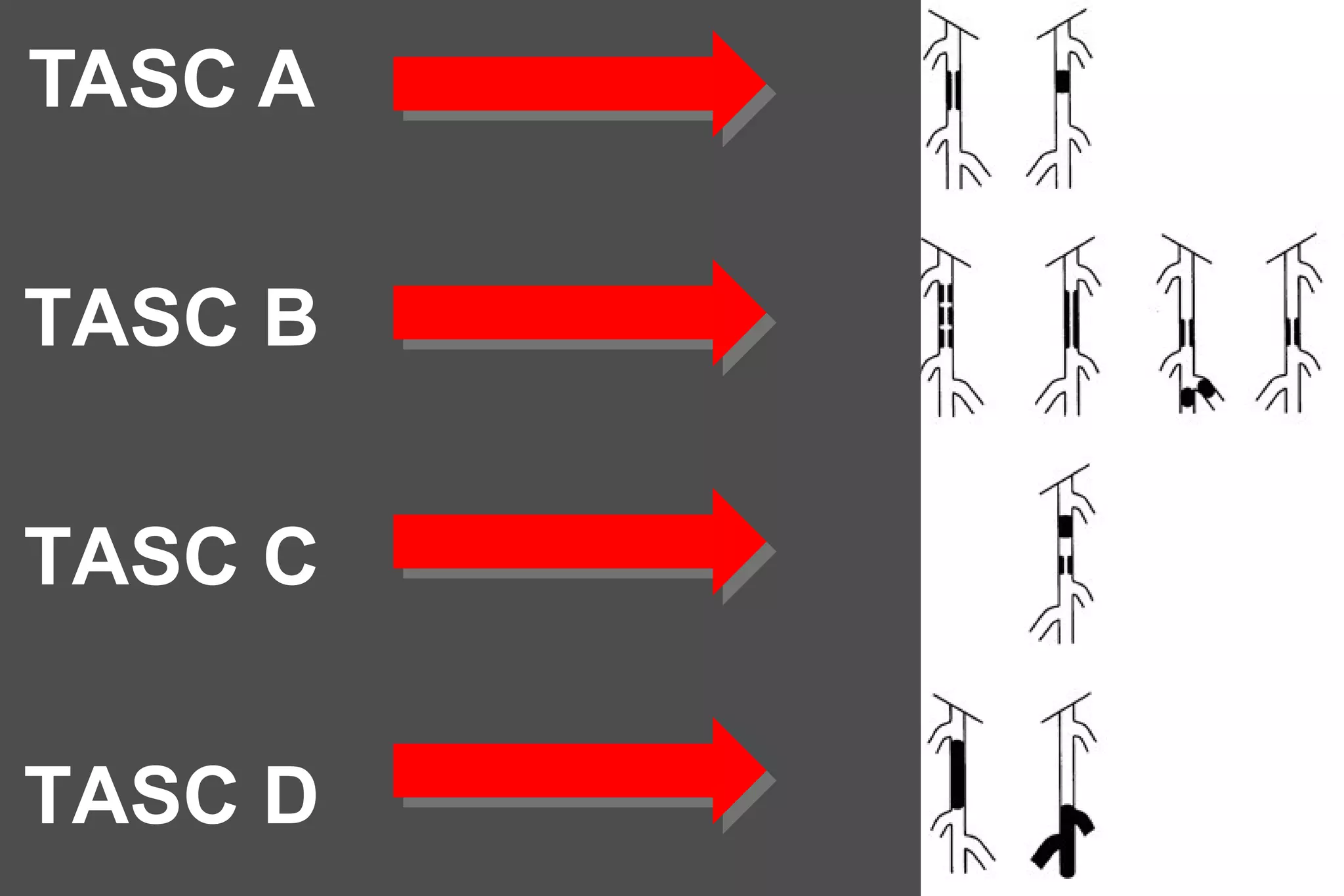
TASC A
TASC B
TASC C
TASC D
TASC A
TASC B
TASC C
TASC D
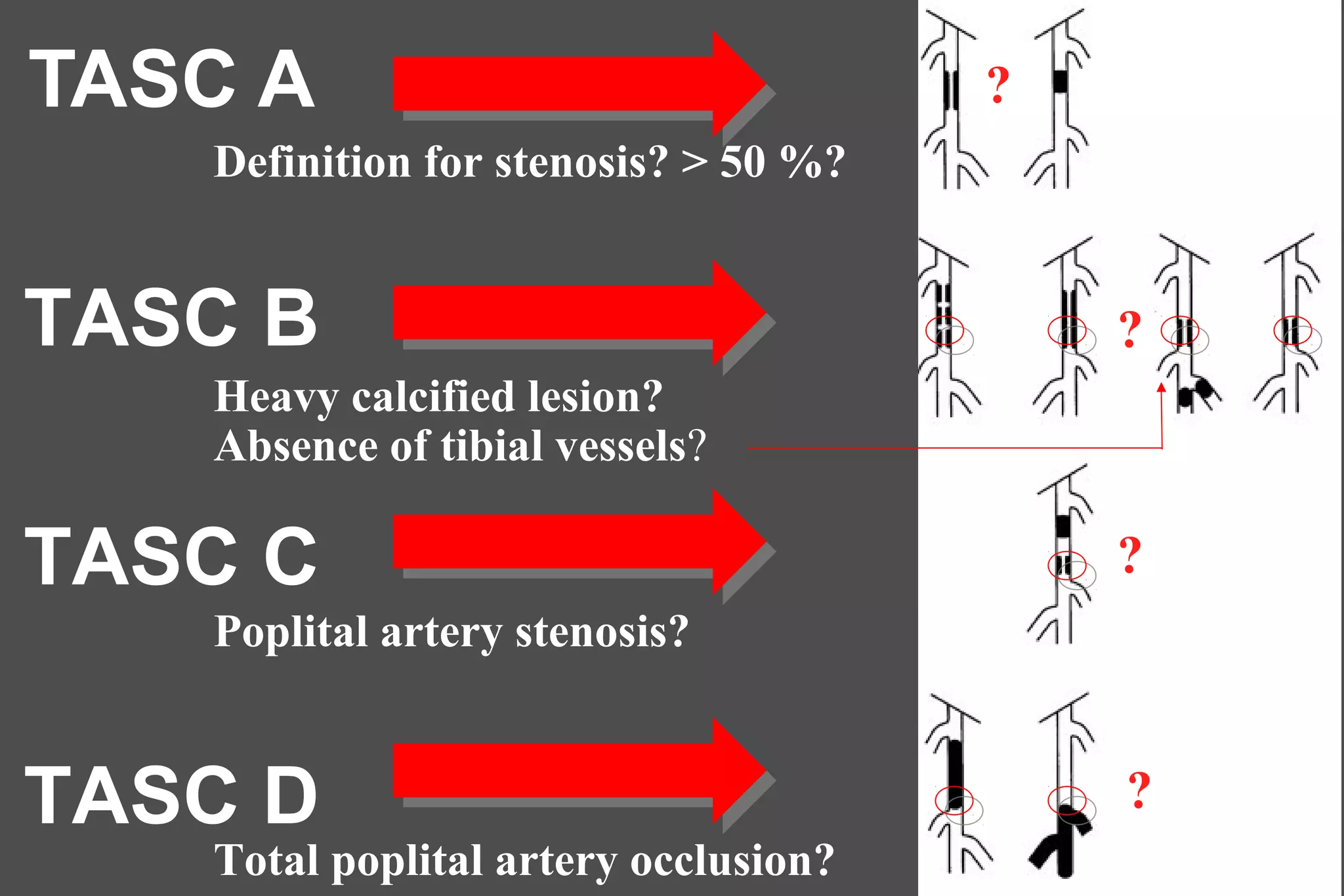
Definition for stenosis? > 50 %?
Heavy calcified lesion?
Absence of tibial vessels?
Total poplital artery occlusion?
Poplital artery stenosis?
?
?
?
?
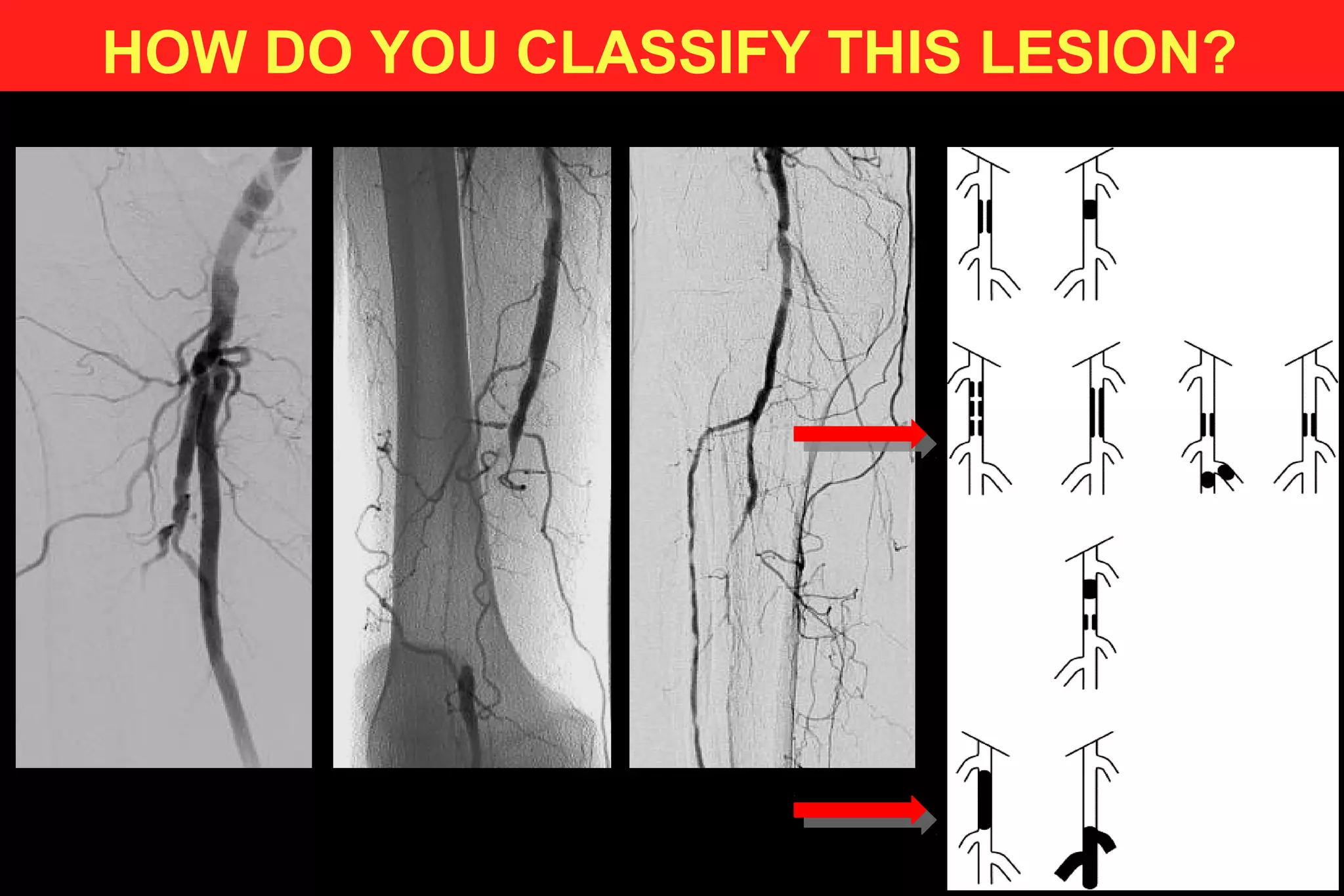
HOW DO YOU CLASSIFY THIS LESION?
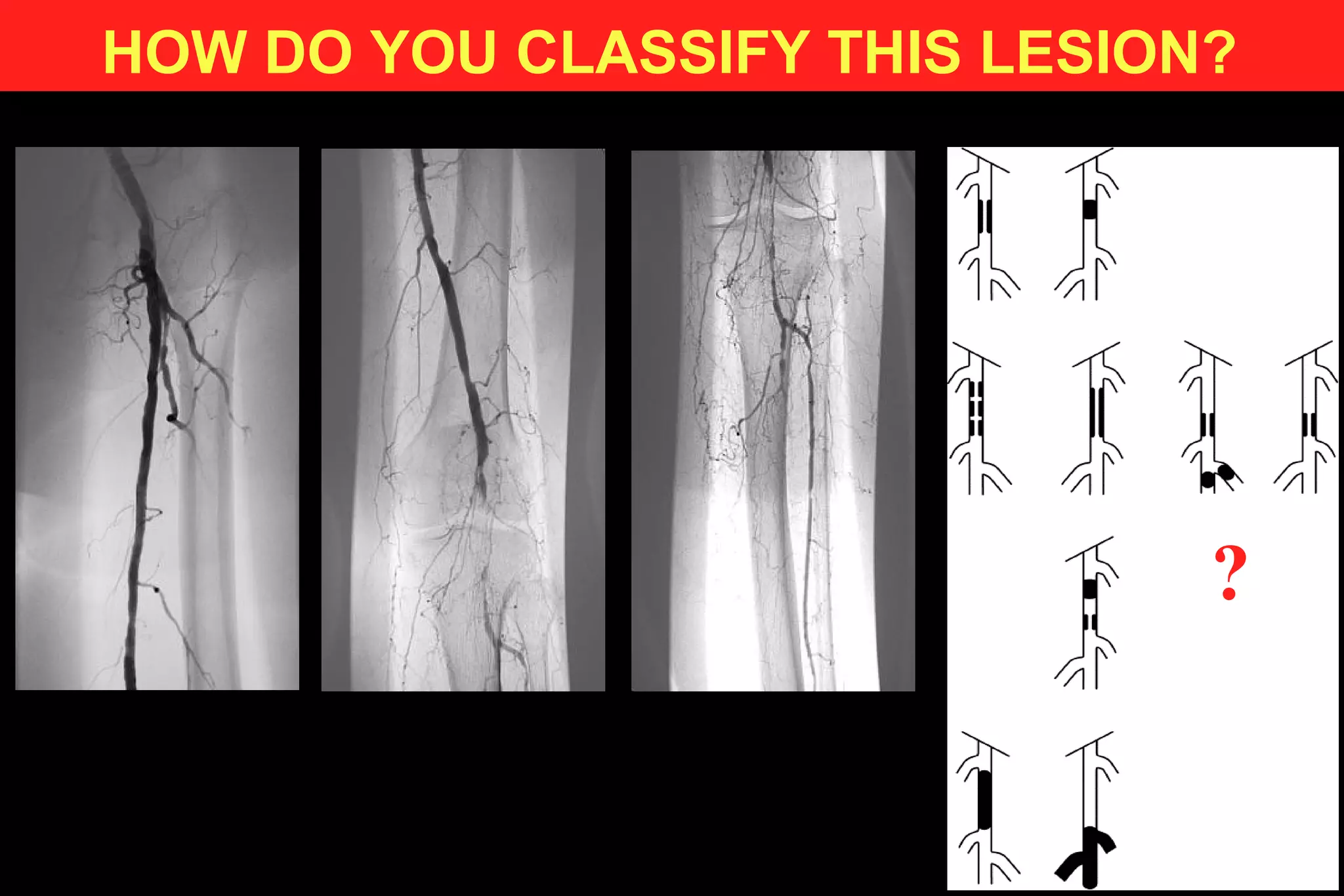
?
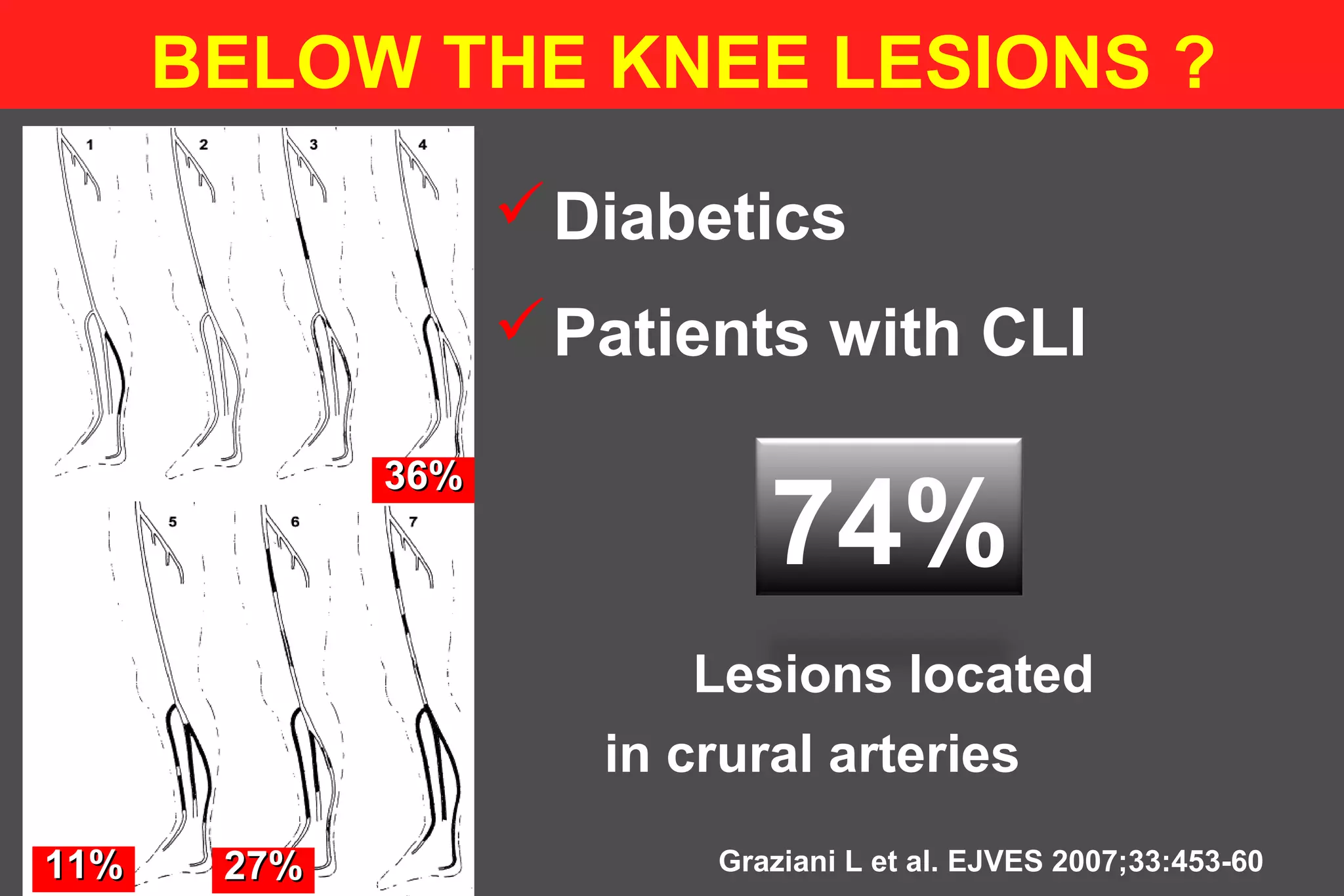
Diabetics
Patients with CLI
Graziani L et al. EJVES 2007;33:453-60
BELOW THE KNEE LESIONS ?
36%36%
11%11% 27%27%
74%
Lesions located
in crural arteries
TASC II Classification for femoropopliteal lesions
allows wide individual interpretations and therefore,
the common use of this classification as a basis of
decision making and reporting outcome can be
questioned.
FEMOROPOPLITEAL LESIONS
TASC II B
TASC II B [2011]TASC II B [2011]
• Not endorsed by the SVS and by the ESVS
• Recommendations were not the product of rigorous
scientific scrutinity
• TASC II B advocates an endovascular first option even
in patients with claudication secondary to an isolated
tibial artery disease while there is no Grade A/B
supporting this conclusion
TASC II B [2011]TASC II B [2011]
TASC II B guidelines adopt a primarily
anatomical approach, which pays
insufficient attention to the clinical
symptoms and risk factors
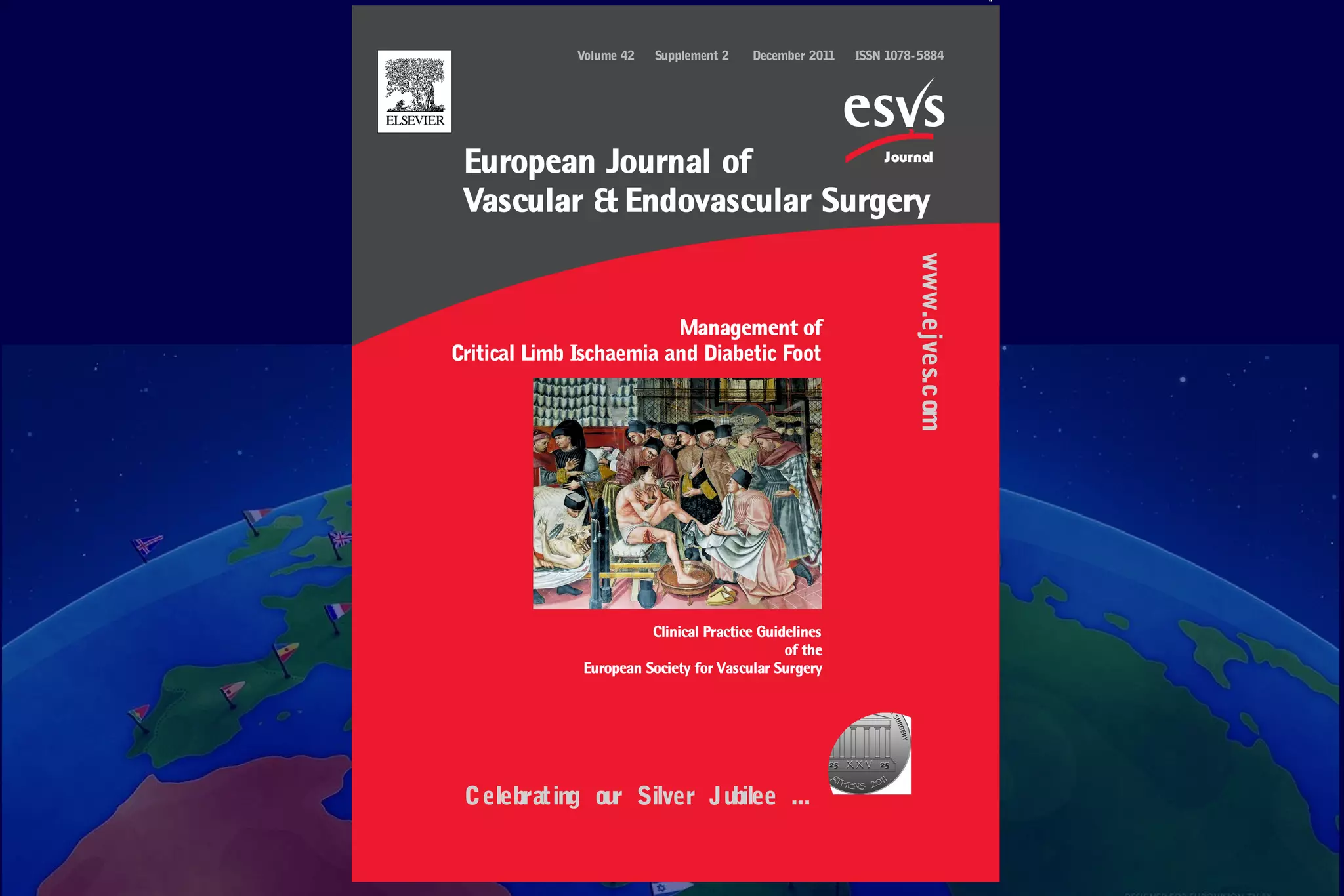
EuropeanJournalofVascular&EndovascularSurgeryELSEVIER
Journal
European Journal of
Vascular & Endovascular Surgery
Celebrating our Silver Jubilee ...
www.ejves.com
pp.S1-S90Volume42Supplement2December2011
Volume 42 Supplement 2 December 2011 ISSN 1078-5884
Management of
Clinical Practice Guidelines
of the
European Society for Vascular Surgery
Critical Limb Ischaemia and Diabetic Foot
OPEN SURGICAL
TECHNIQUES
FOR CLI PATIENTS
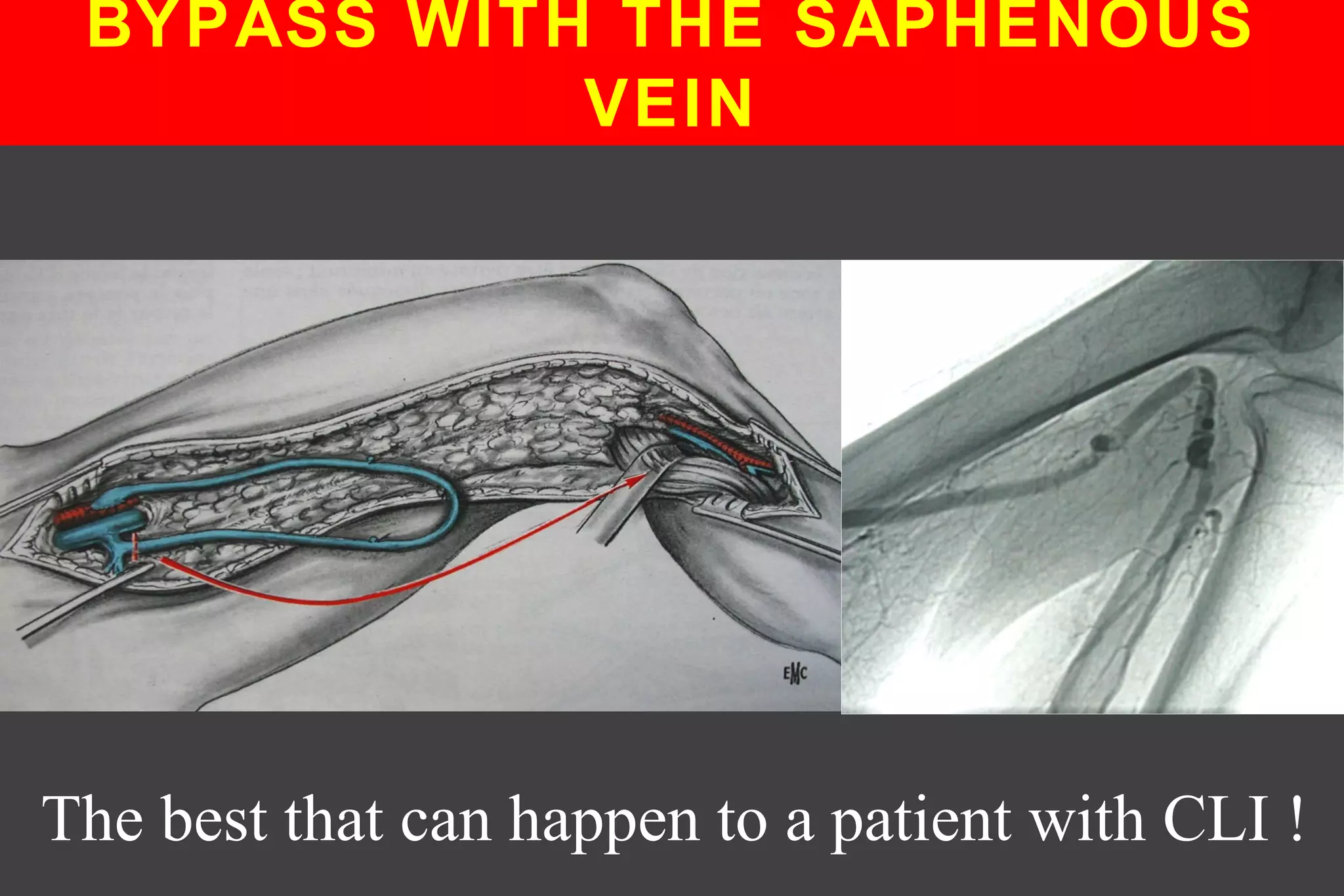
BYPASS WITH THE SAPHENOUS
VEIN
The best that can happen to a patient with CLI !
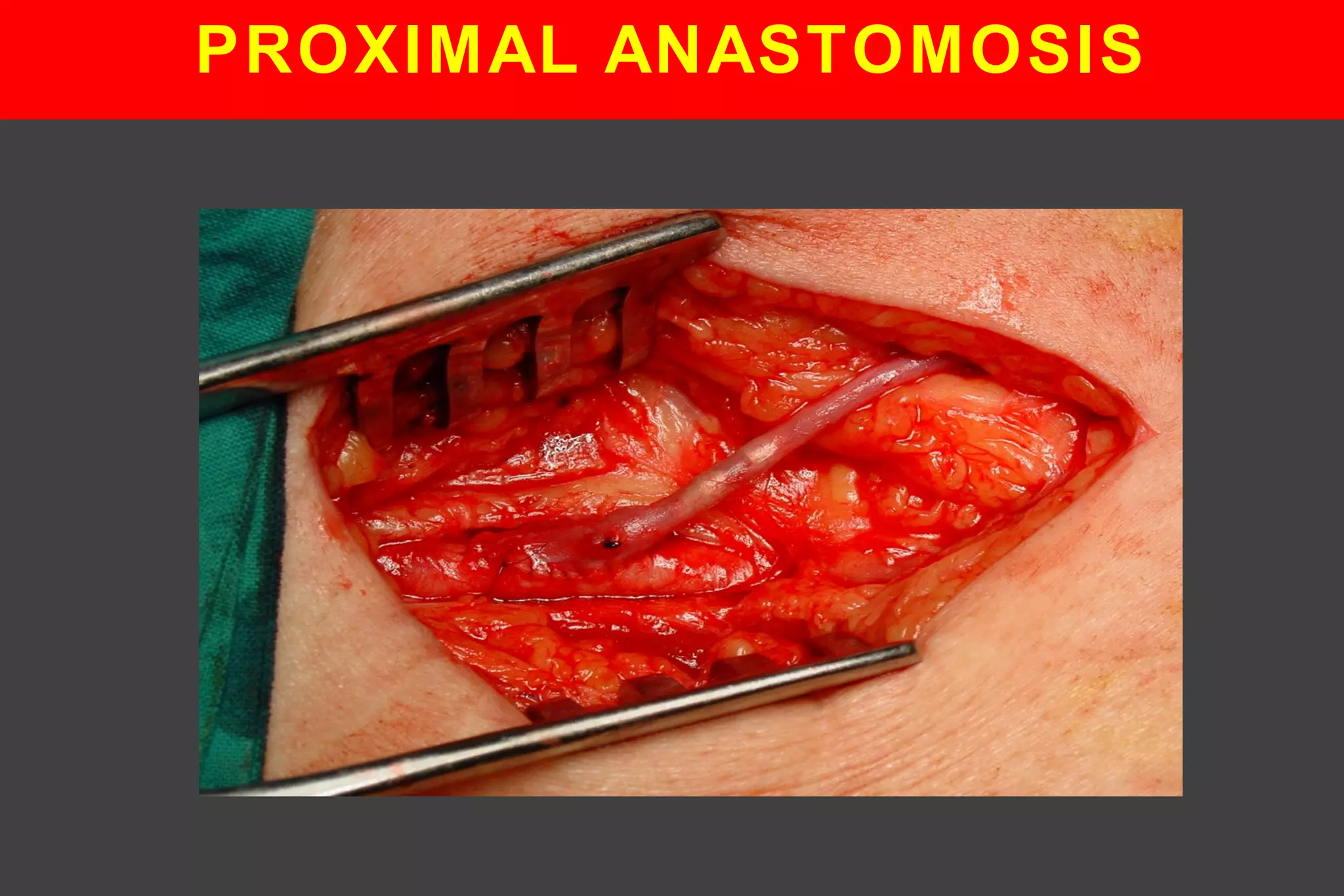
PROXIMAL ANASTOMOSIS
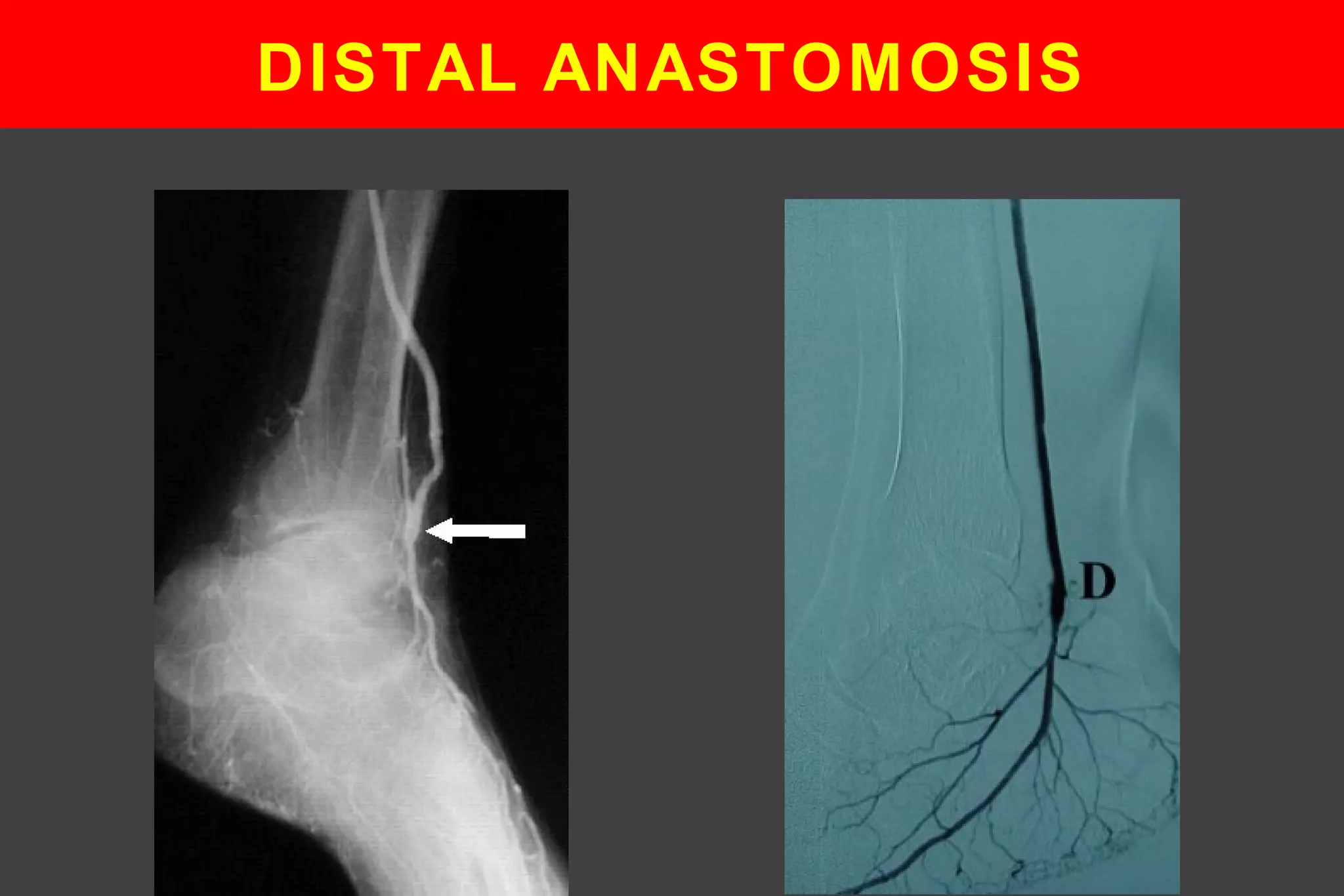
DISTAL ANASTOMOSIS
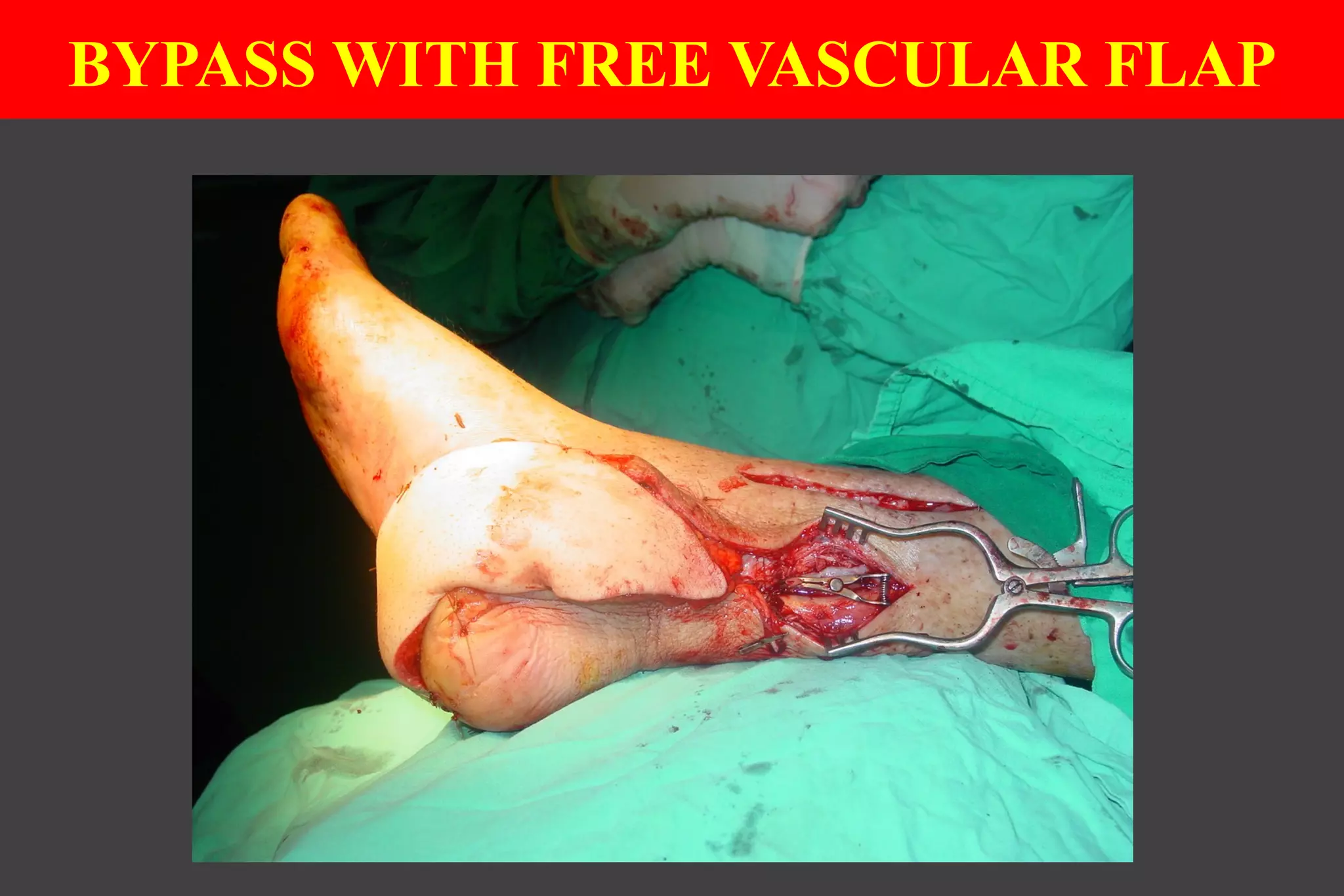
BYPASS WITH FREE VASCULAR FLAP
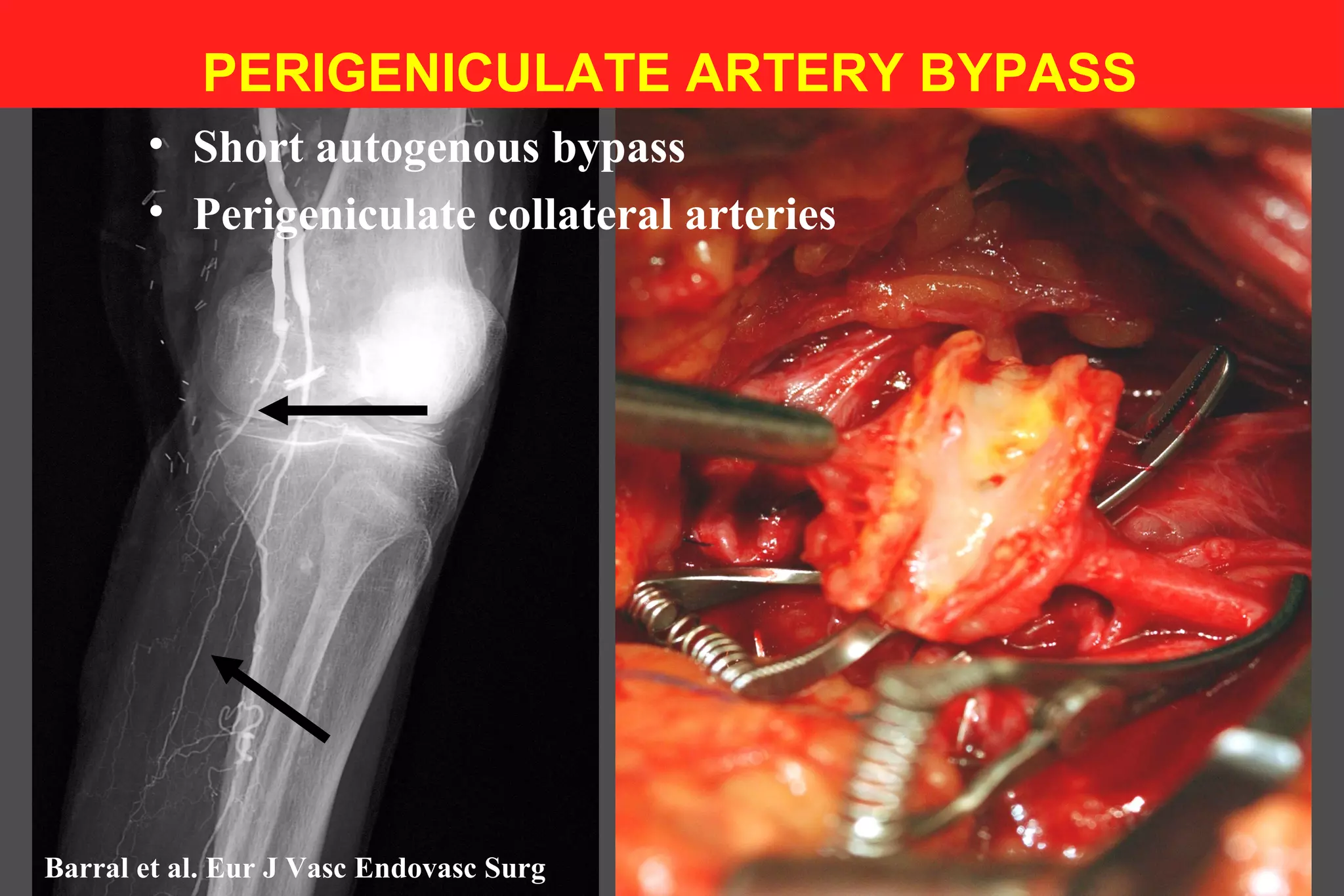
• Short autogenous bypass
• Perigeniculate collateral arteries
PERIGENICULATE ARTERY BYPASS
Barral et al. Eur J Vasc Endovasc Surg
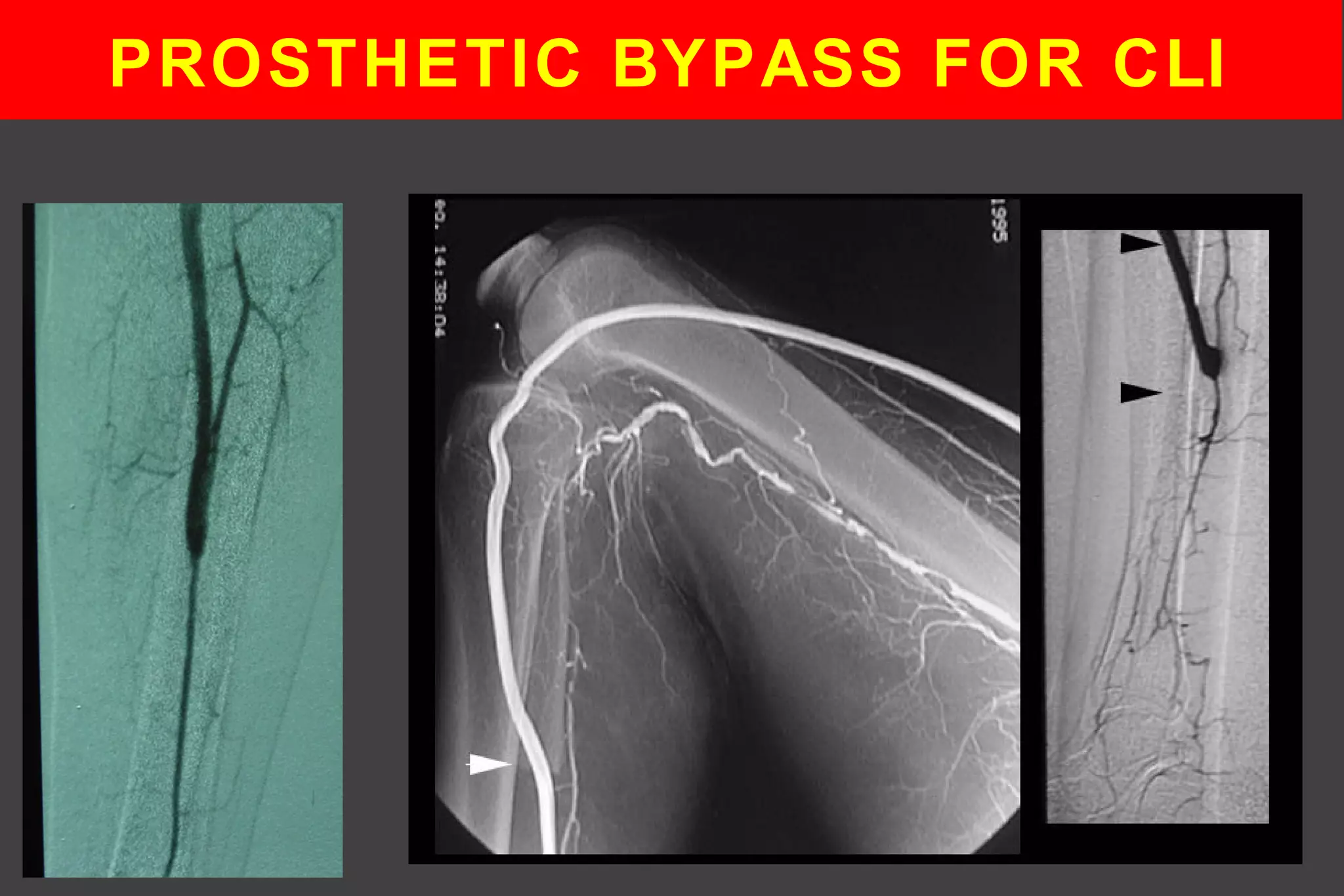
PROSTHETIC BYPASS FOR CLI
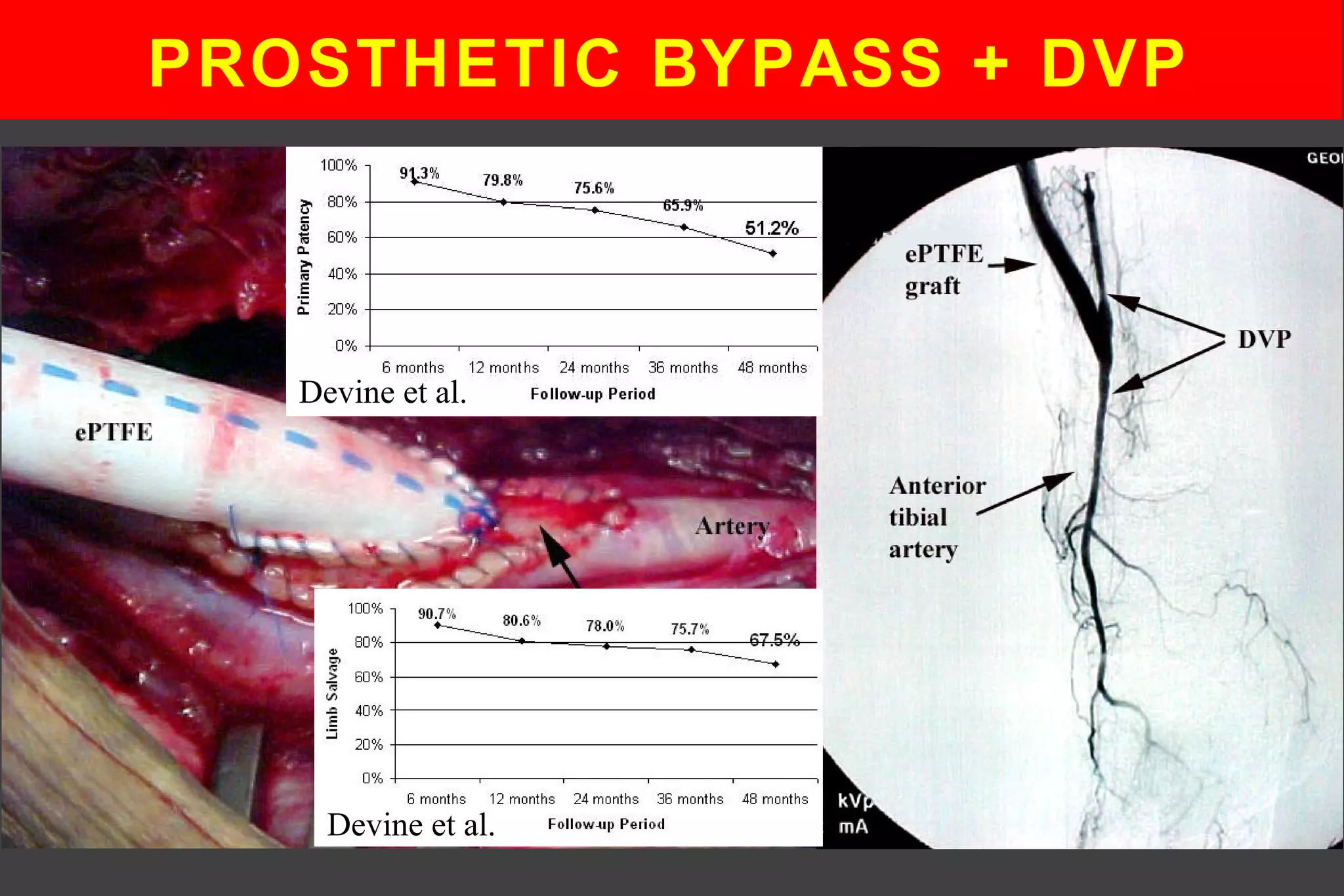
PROSTHETIC BYPASS + DVP
Devine et al.
Devine et al.
EXTREME BYPASS
&
ADJUNCT WOUND THERAPY
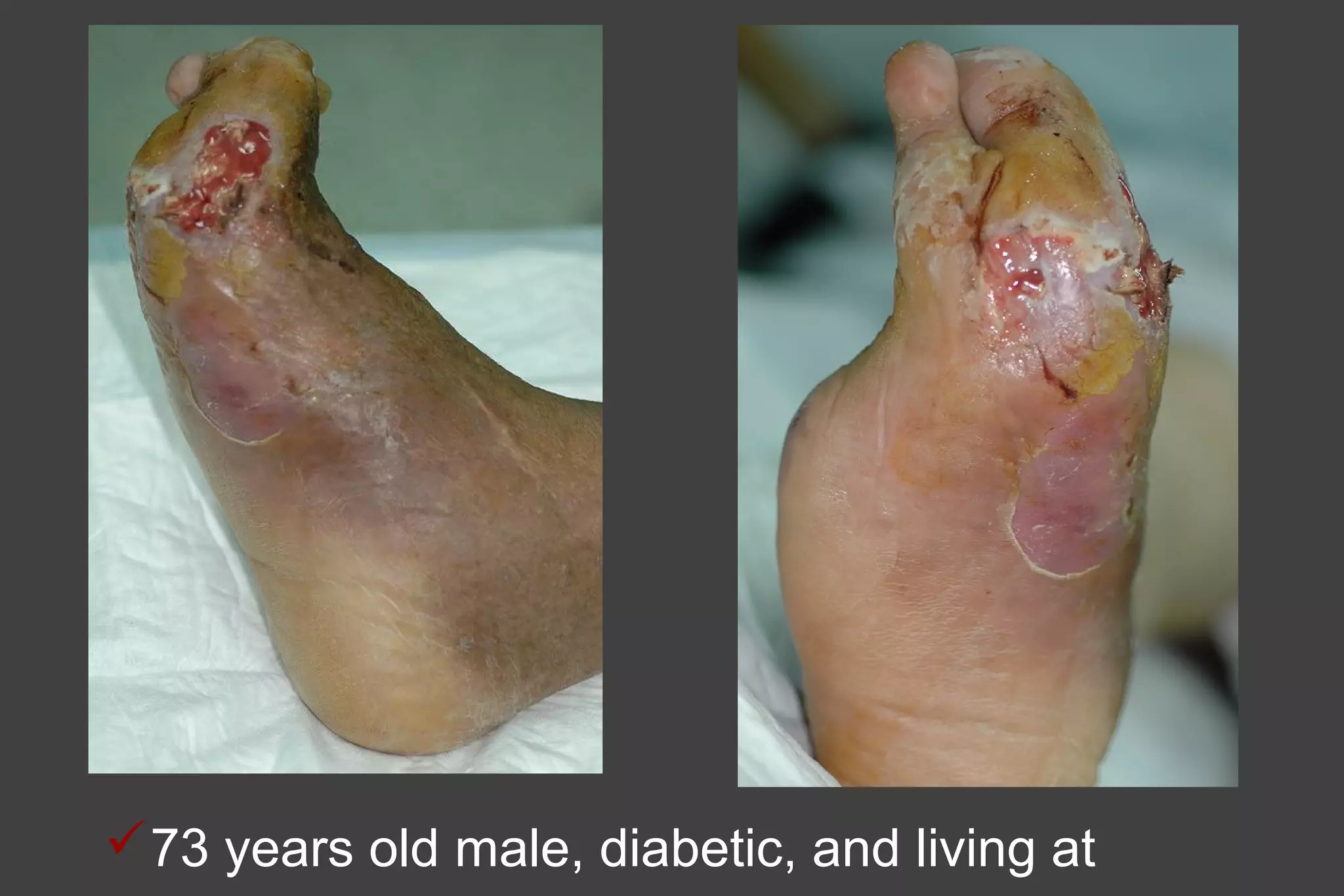
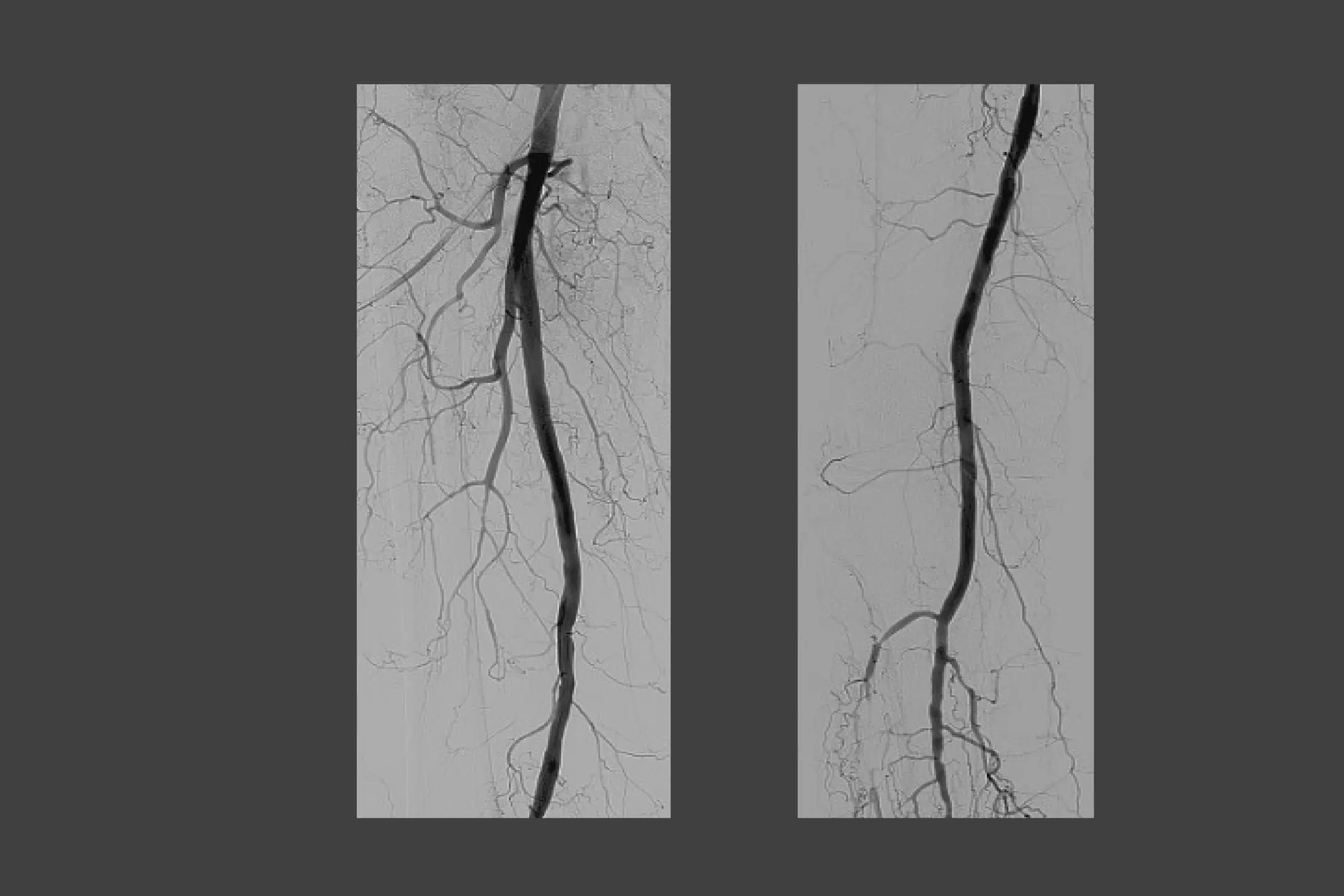
73 years old male, diabetic, and living at
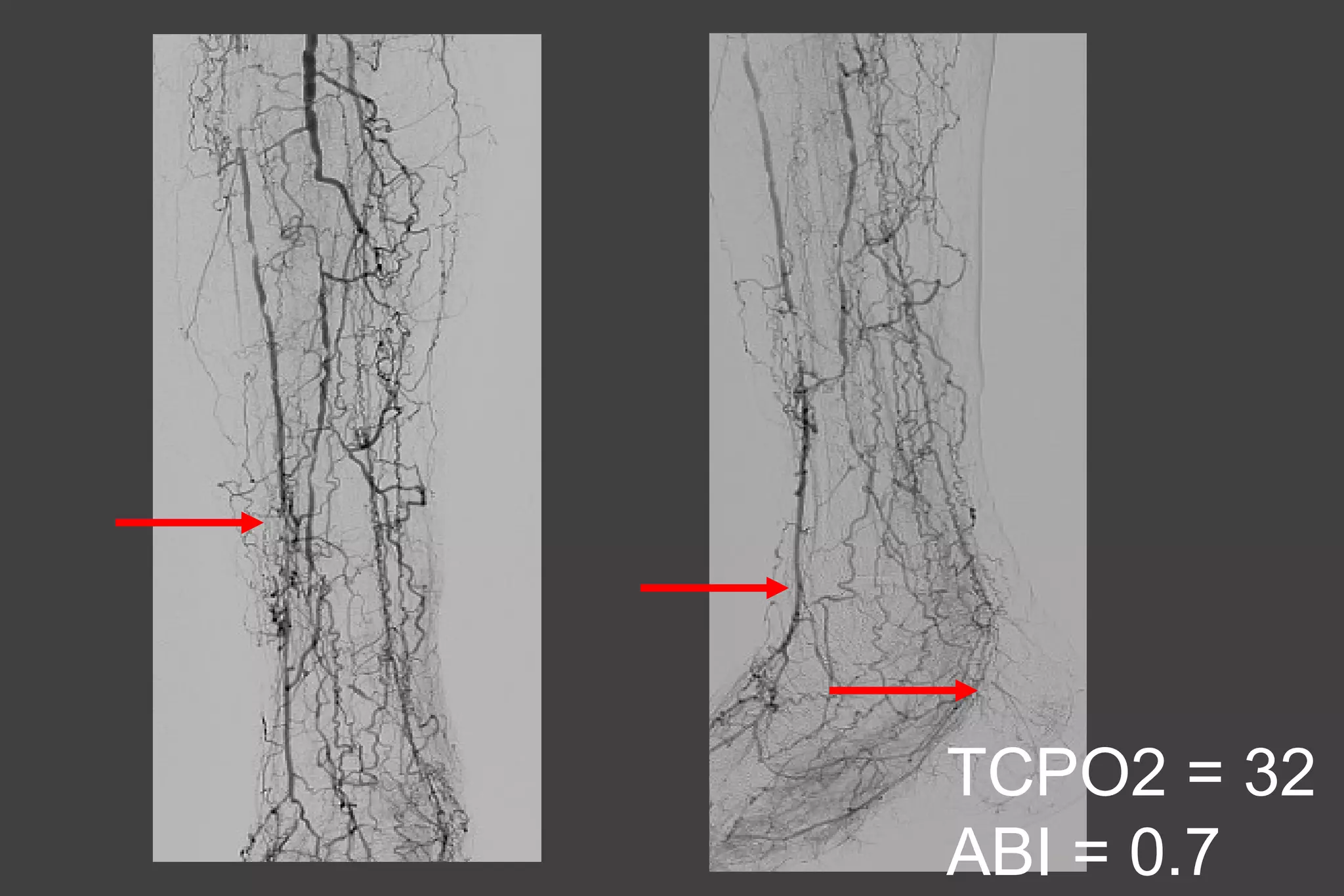
TCPO2 = 32
ABI = 0.7
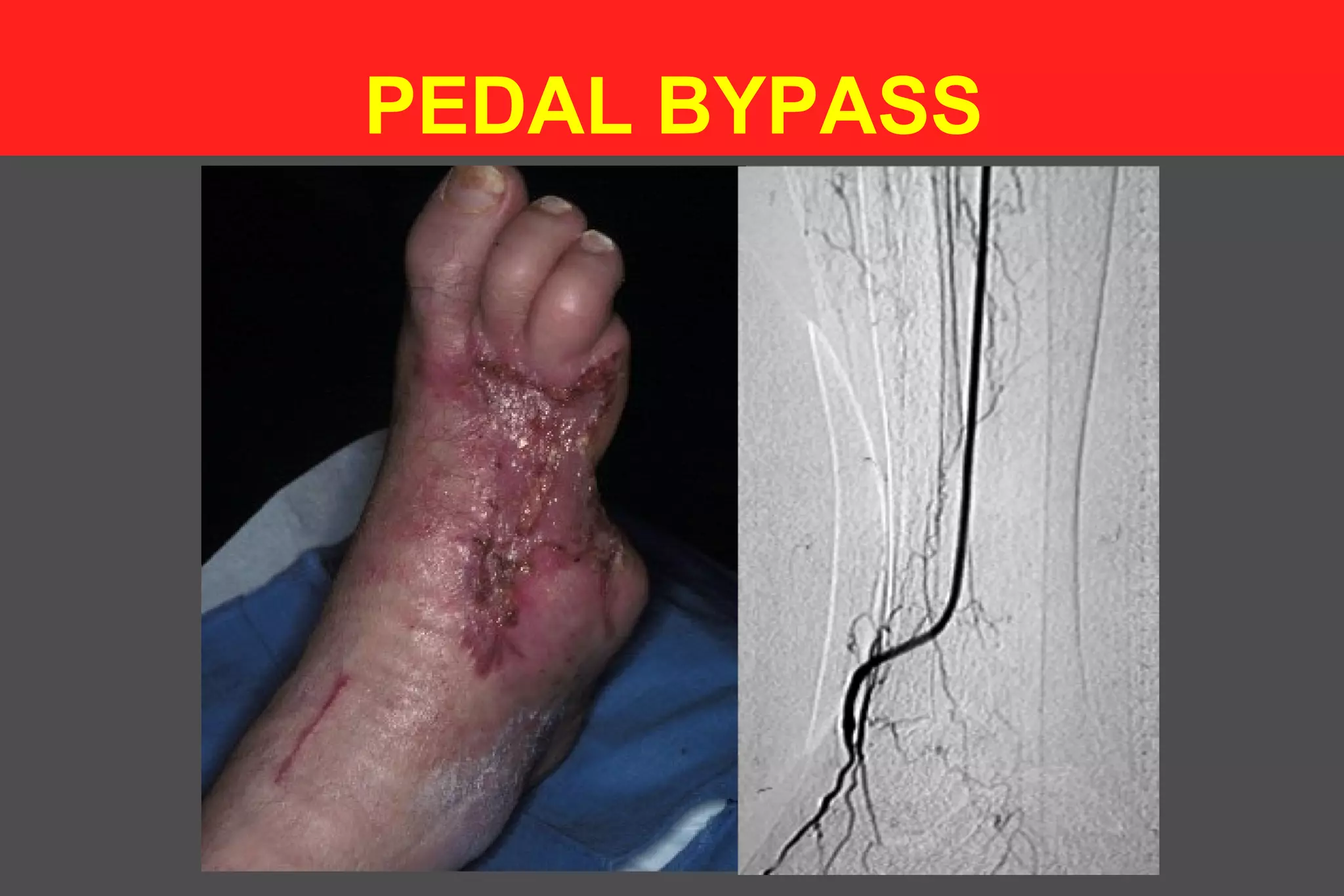
PEDAL BYPASS
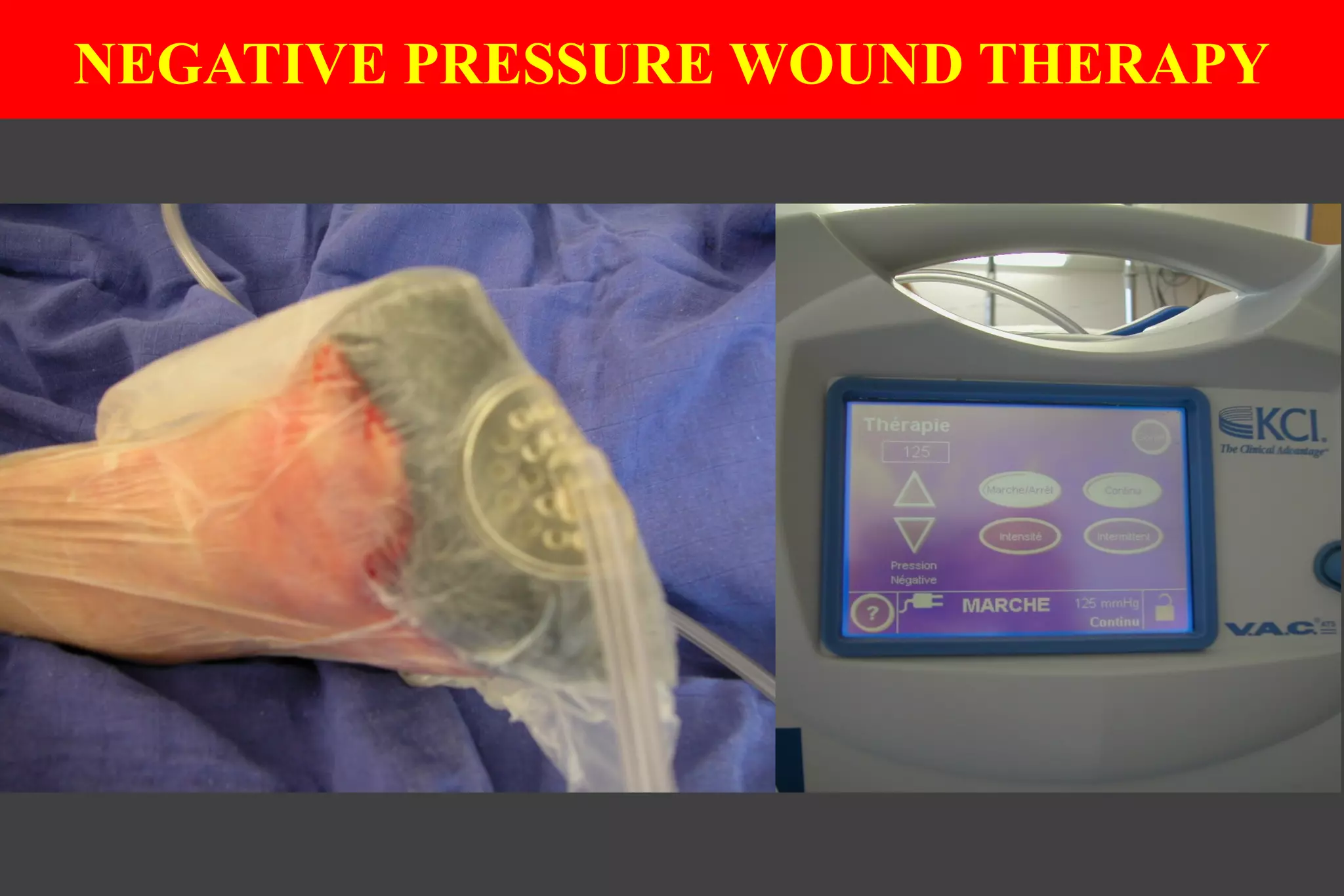
NEGATIVE PRESSURE WOUND THERAPY
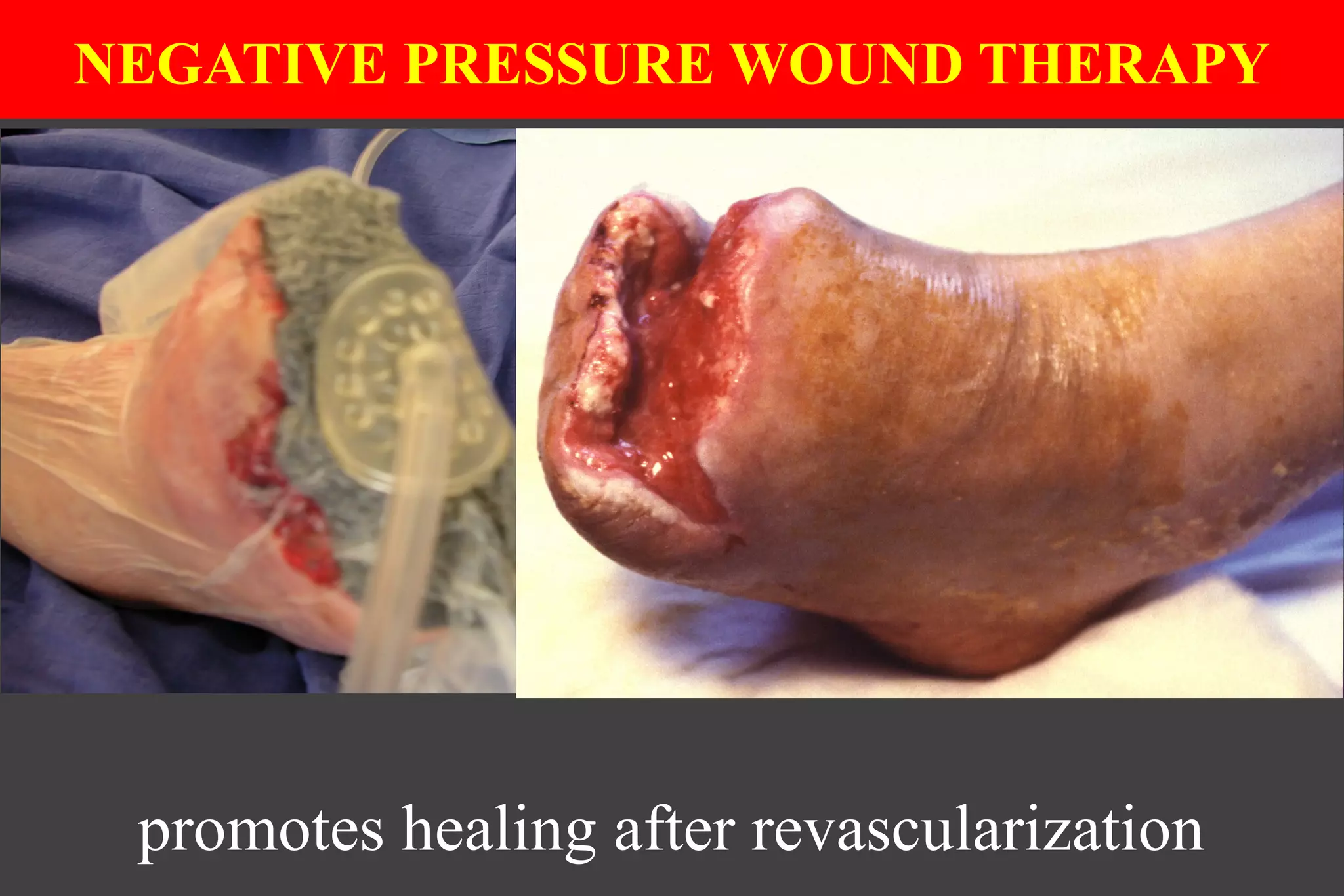
promotes healing after revascularization
NEGATIVE PRESSURE WOUND THERAPY
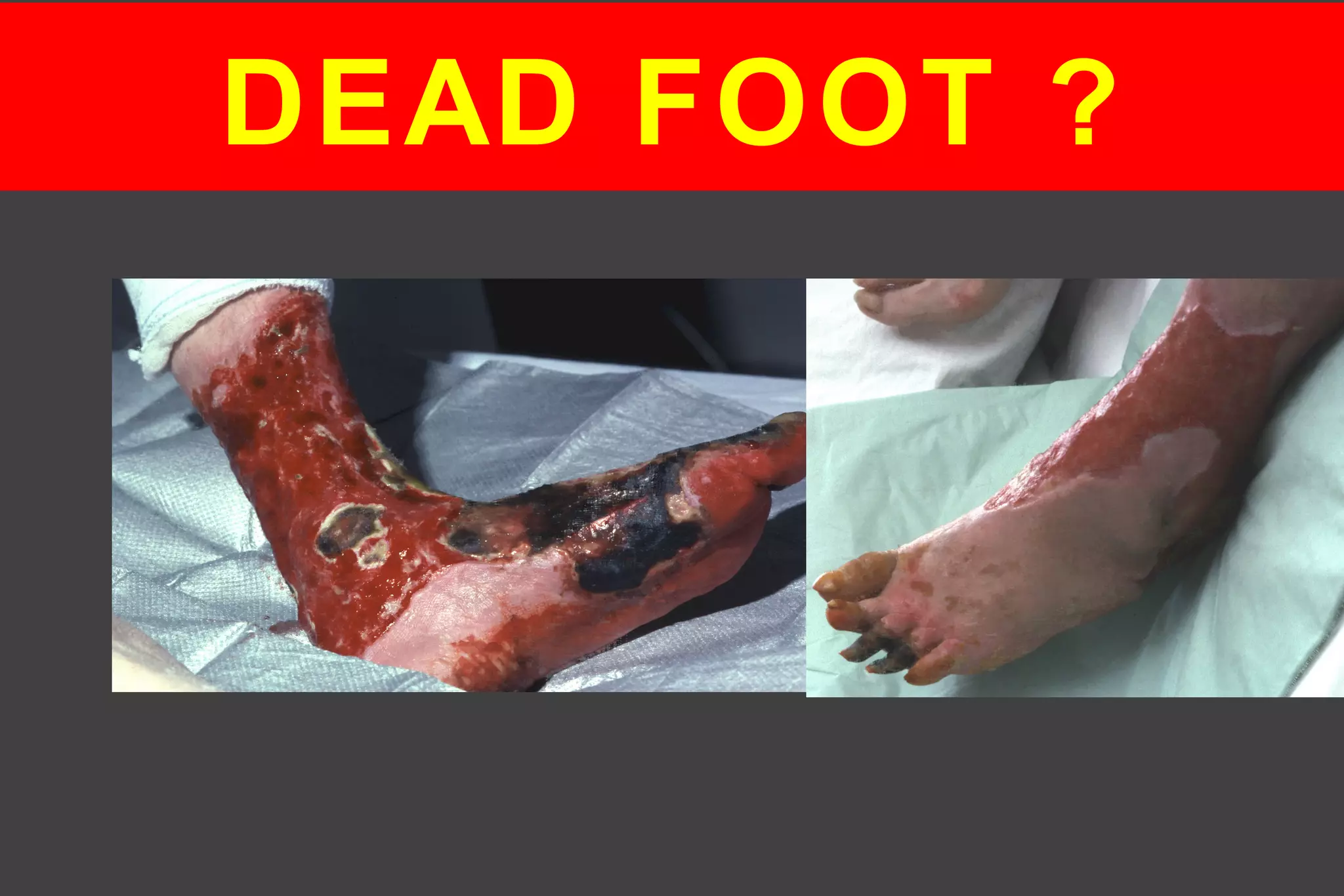
DEAD FOOT ?
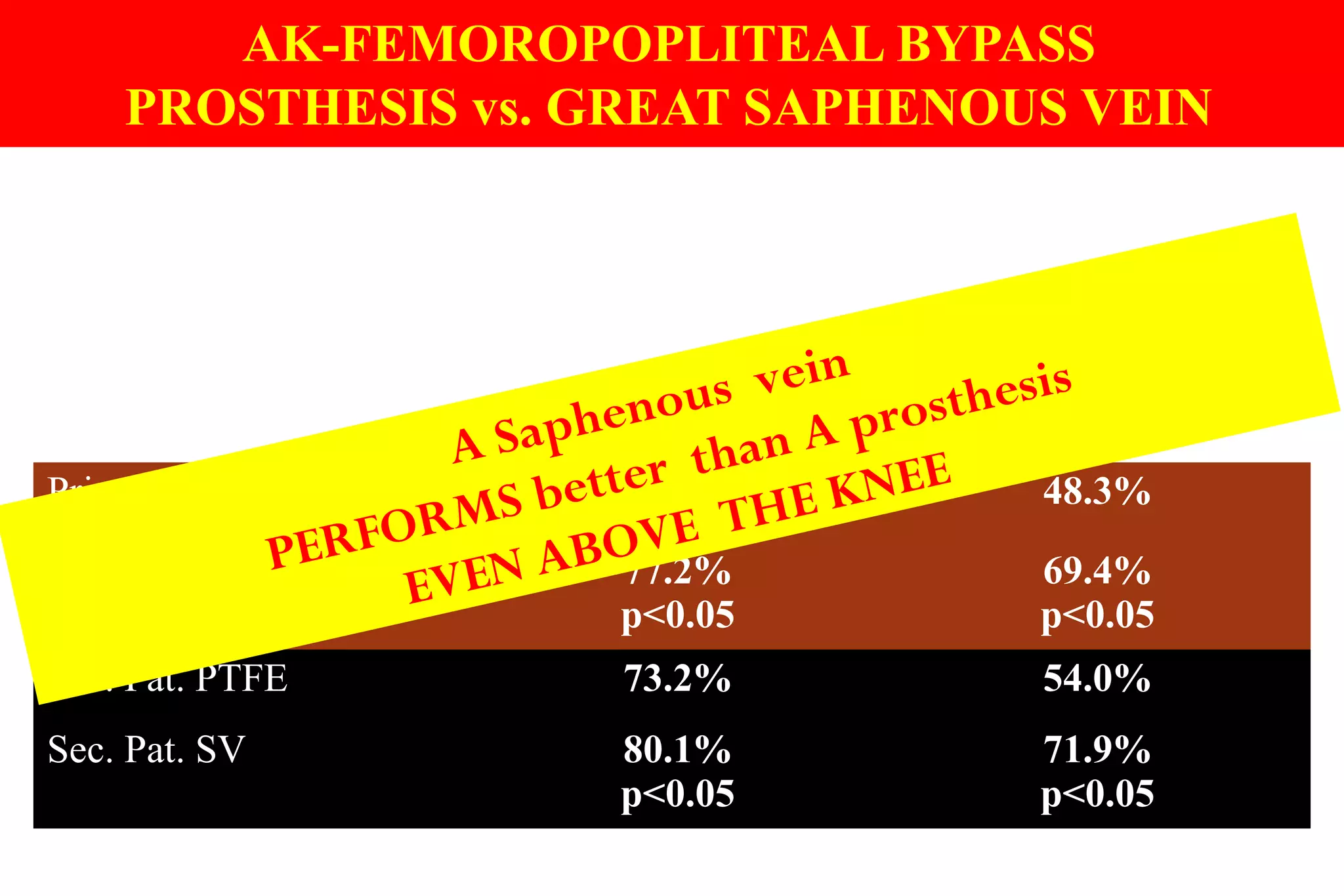
AK-FEMOROPOPLITEAL BYPASS
PROSTHESIS vs. GREAT SAPHENOUS VEIN
STUDIES Pereira
2006 Meta-analysis
Pereira
2006 Meta-analysis
Patients
Follow-up
1713 / 580
5 years
2431 / 703
5 years
Symptoms Claudication Critical Ischemia
Prim. Pat. PTFE 57.4% 48.3%
Prim. Pat. SV 77.2%
p<0.05
69.4%
p<0.05
Sec. Pat. PTFE 73.2% 54.0%
Sec. Pat. SV 80.1%
p<0.05
71.9%
p<0.05
A Saphenous vein
PERFORMS better than A prosthesis
EVEN ABOVE THE KNEE
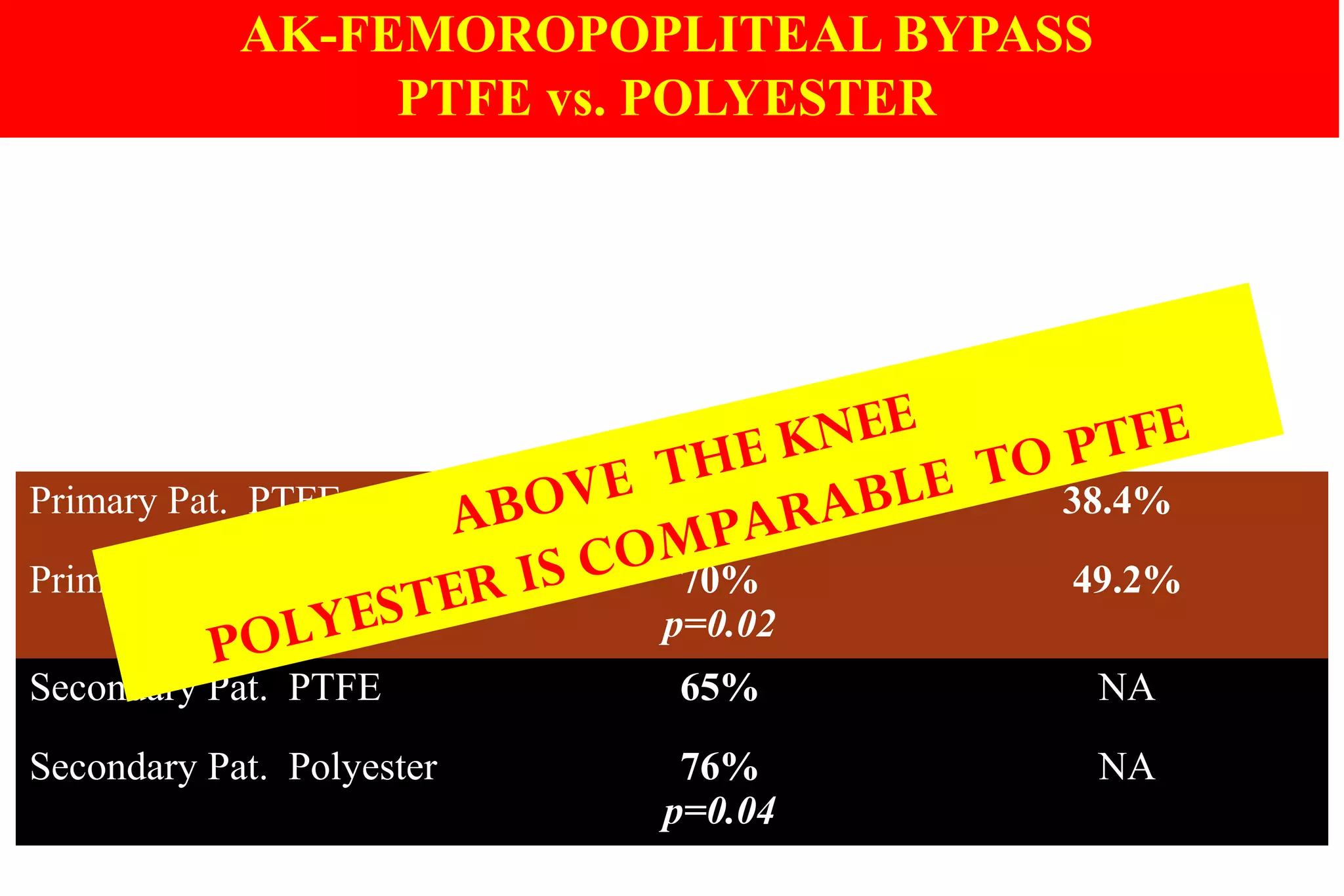
AK-FEMOROPOPLITEAL BYPASS
PTFE vs. POLYESTER
STUDIES Jensen
2007 RCT (2 ans)
Takagi
2010 Meta-analysis (5
ans)
Patients PTFE/Polyester PTFE/Polyester
Symptoms 65% Cl / 35% CLI NA
Primary Pat. PTFE 57% 38.4%
Primary Pat. Polyester 70%
p=0.02
49.2%
Secondary Pat. PTFE 65% NA
Secondary Pat. Polyester 76%
p=0.04
NA
ABOVE THE KNEE
POLYESTER IS COMPARABLE TO PTFE
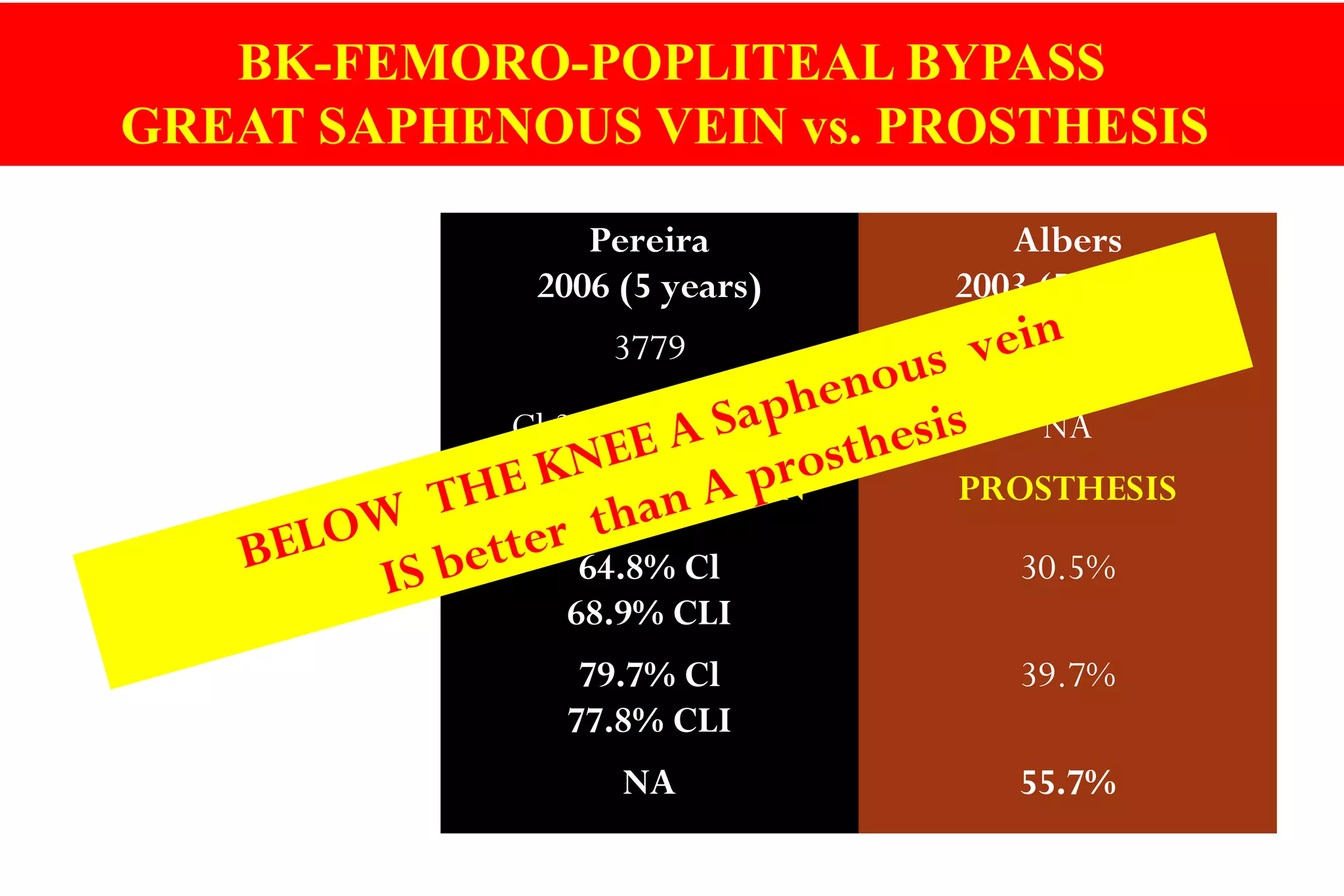
BK-FEMORO-POPLITEAL BYPASS
GREAT SAPHENOUS VEIN vs. PROSTHESIS
STUDIES Pereira
2006 (5 years)
Albers
2003 (5 years)
Patients 3779 43 studies
Symptoms Cl 35% / CLI 65% NA
Graft used SAPHENOUS VEIN PROSTHESIS
Primary Patency 64.8% Cl
68.9% CLI
30.5%
Secondary Patency 79.7% Cl
77.8% CLI
39.7%
Limb Salvage NA 55.7%
BELOW THE KNEE A Saphenous vein
IS better than A prosthesis
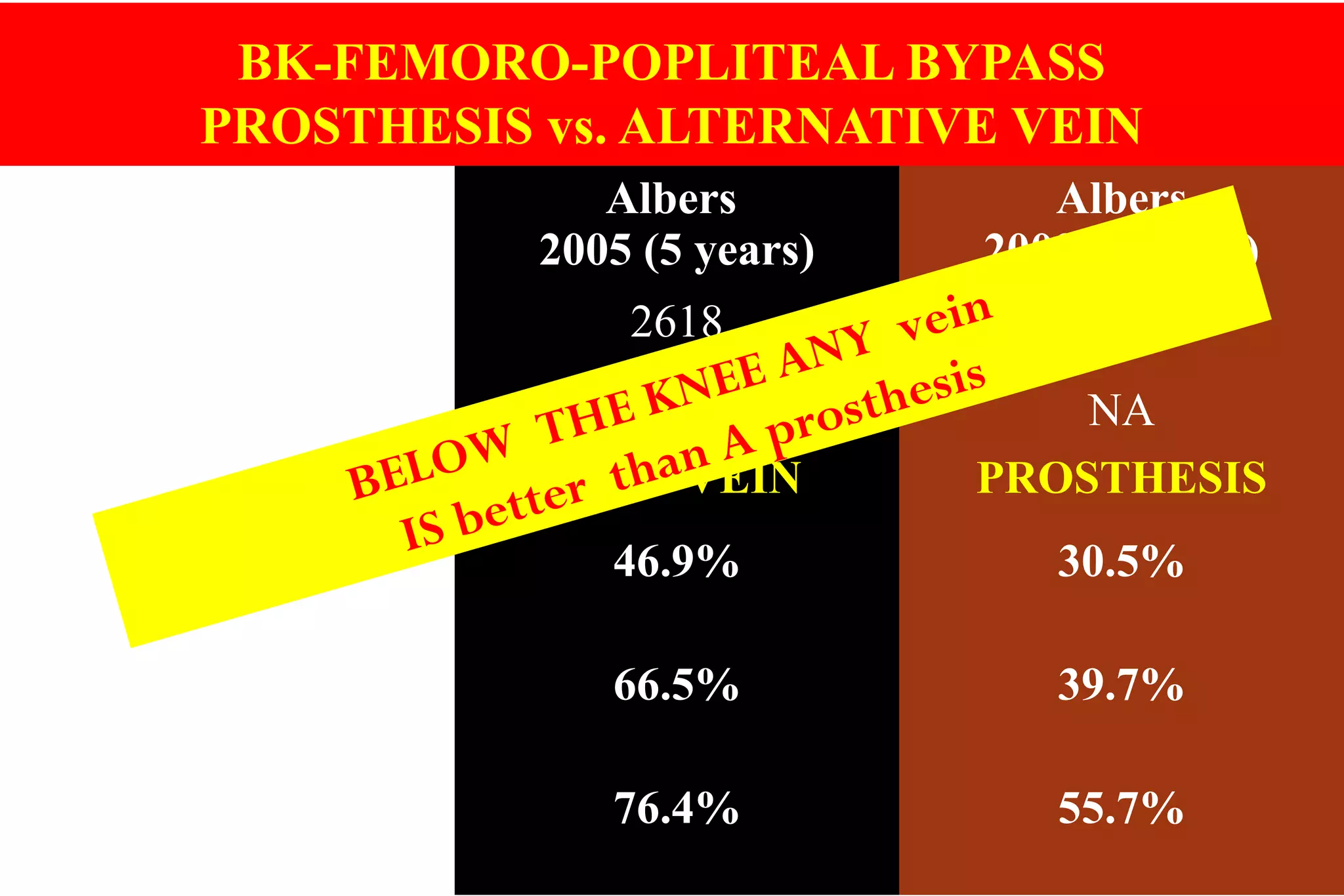
STUDIES Albers
2005 (5 years)
Albers
2003 (5 years)
Patients 2618 43 études
Symptoms Cl 3% /CLI 97% NA
Graft used ARM VEIN PROSTHESIS
Primary Patency 46.9% 30.5%
Secondary Patency 66.5% 39.7%
Limb Salvage 76.4% 55.7%
BELOW THE KNEE ANY vein
IS better than A prosthesis
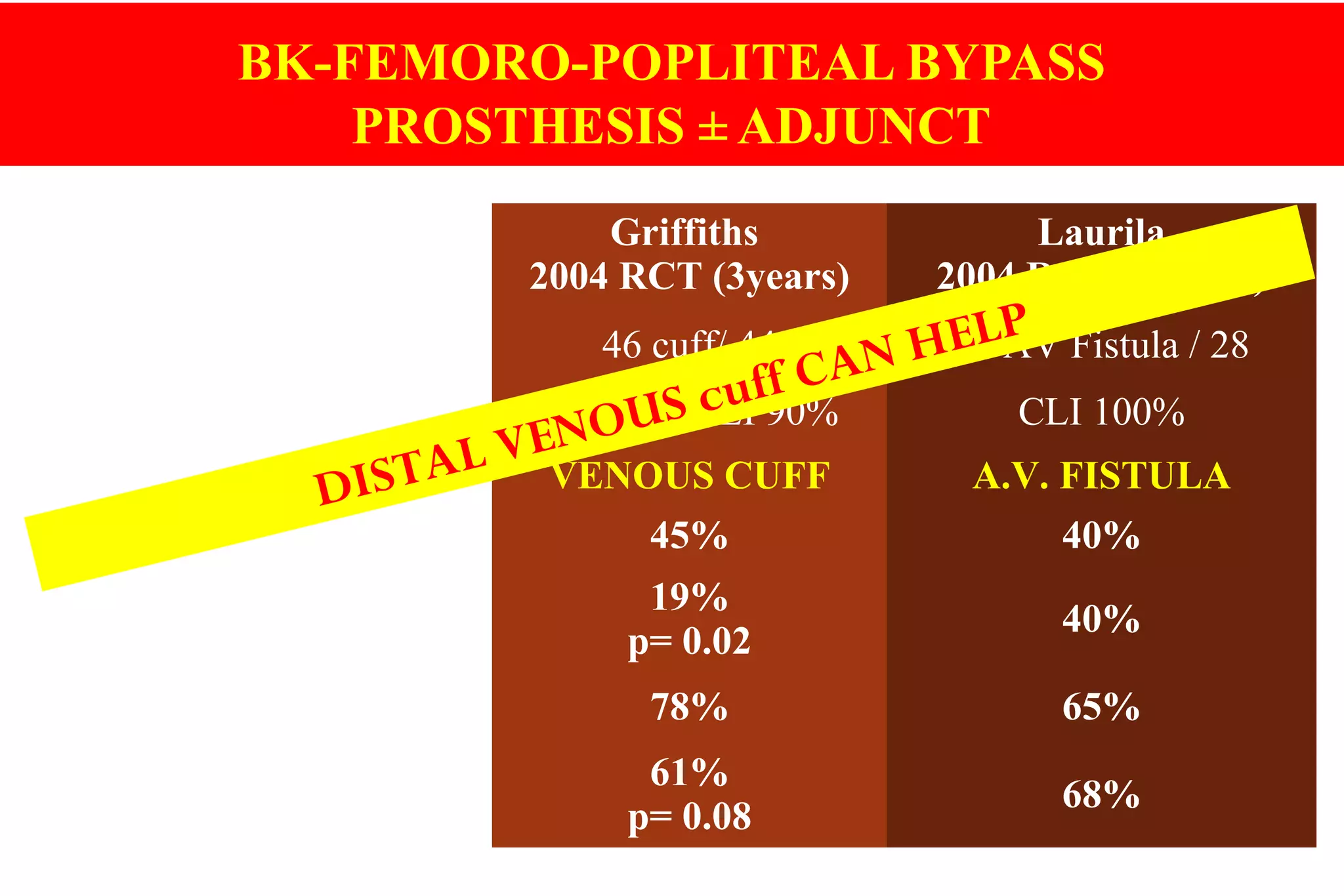
BK-FEMORO-POPLITEAL BYPASS
PROSTHESIS vs. ALTERNATIVE VEIN
STUDIES Griffiths
2004 RCT (3years)
Laurila
2004 RCT (2 years)
Procedures 46 cuff/ 44 31 AV Fistula / 28
Symptoms Cl 10% / CLI 90% CLI 100%
Adjunct VENOUS CUFF A.V. FISTULA
Sec. Pat. with Adjunct 45% 40%
Sec. Pat. PTFE Alone
19%
p= 0.02
40%
Limb Salv. + Adjunct 78% 65%
Limb Salv + PTFE Alone
61%
p= 0.08
68%
DISTAL VENOUS cuff CAN HELP
BK-FEMORO-POPLITEAL BYPASS
PROSTHESIS ± ADJUNCT
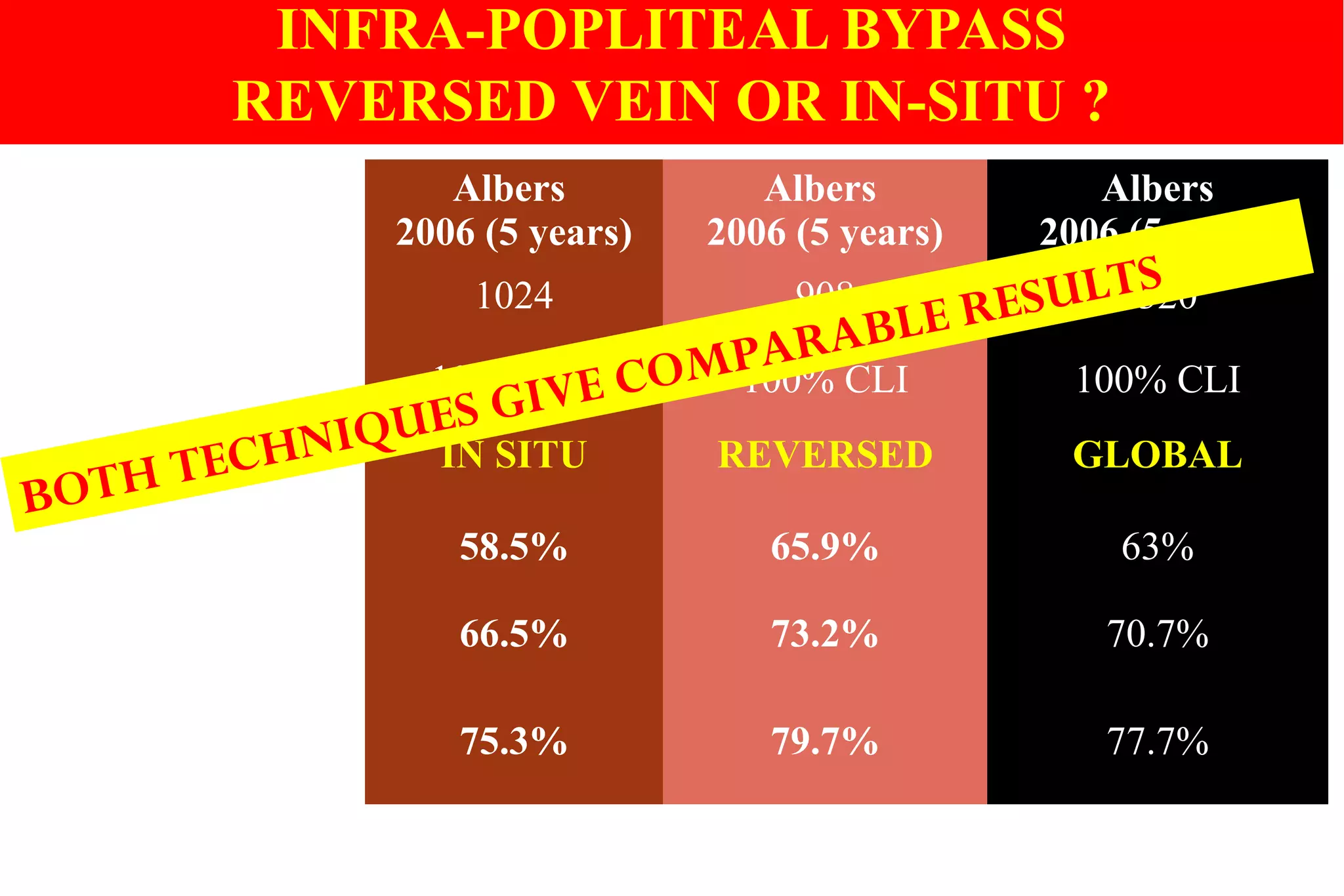
INFRA-POPLITEAL BYPASS
REVERSED VEIN OR IN-SITU ?
STUDIES Albers
2006 (5 years)
Albers
2006 (5 years)
Albers
2006 (5 years)
Patients 1024 908 2320
Symptoms 100% CLI 100% CLI 100% CLI
Technique IN SITU REVERSED GLOBAL
Primary Patency 58.5% 65.9% 63%
Secondary Patency 66.5% 73.2% 70.7%
Limb Salvage 75.3% 79.7% 77.7%
BOTH TECHNIQUES GIVE COMPARABLE RESULTS
STUDIES Albers
2004 M
Albers
2004 M
Albers
2004 M
Albers
2004 M
Albers
2003 M
Patients
Follow-up
687
5 years
218
5 years
157
5 years
1254
5 years
43 studies
5 years
Symptômes CLI CLI CLI CLI CLI
MATERIAL Venous
Allograft
cryopreserved
Arterial
Allograft
cryopreserved
Venous
Allograft
Fresh
Ombilical
Vein
PROSTHESIS
Primary Patency NA NA NA NA 30.5%
Secondary
Patency
19% 21% 24% 30% 39.7%
Limb Salvage 60% 68% 39% 55% 55.7%
An ALLOGRAFT IS NOT BETTER THAN a PROSTHESIS
TIBIAL BYPASS - ALLOGRAFT
ENDOVASCULAR
TECHNIQUES
FOR CLI PATIENTS
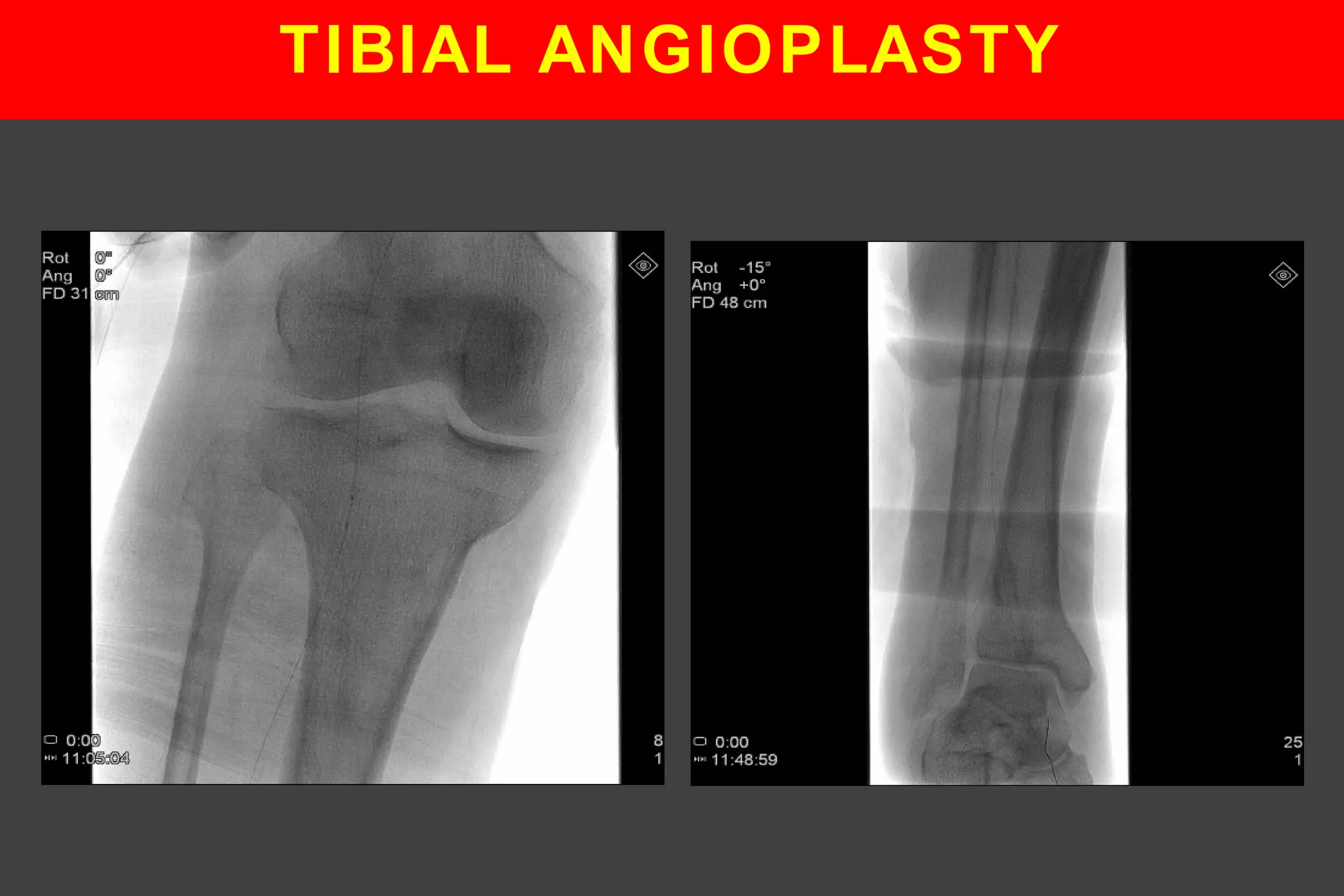
TIBIAL ANGIOPLASTY
TIBIAL ANGIOPLASTY - RESULT
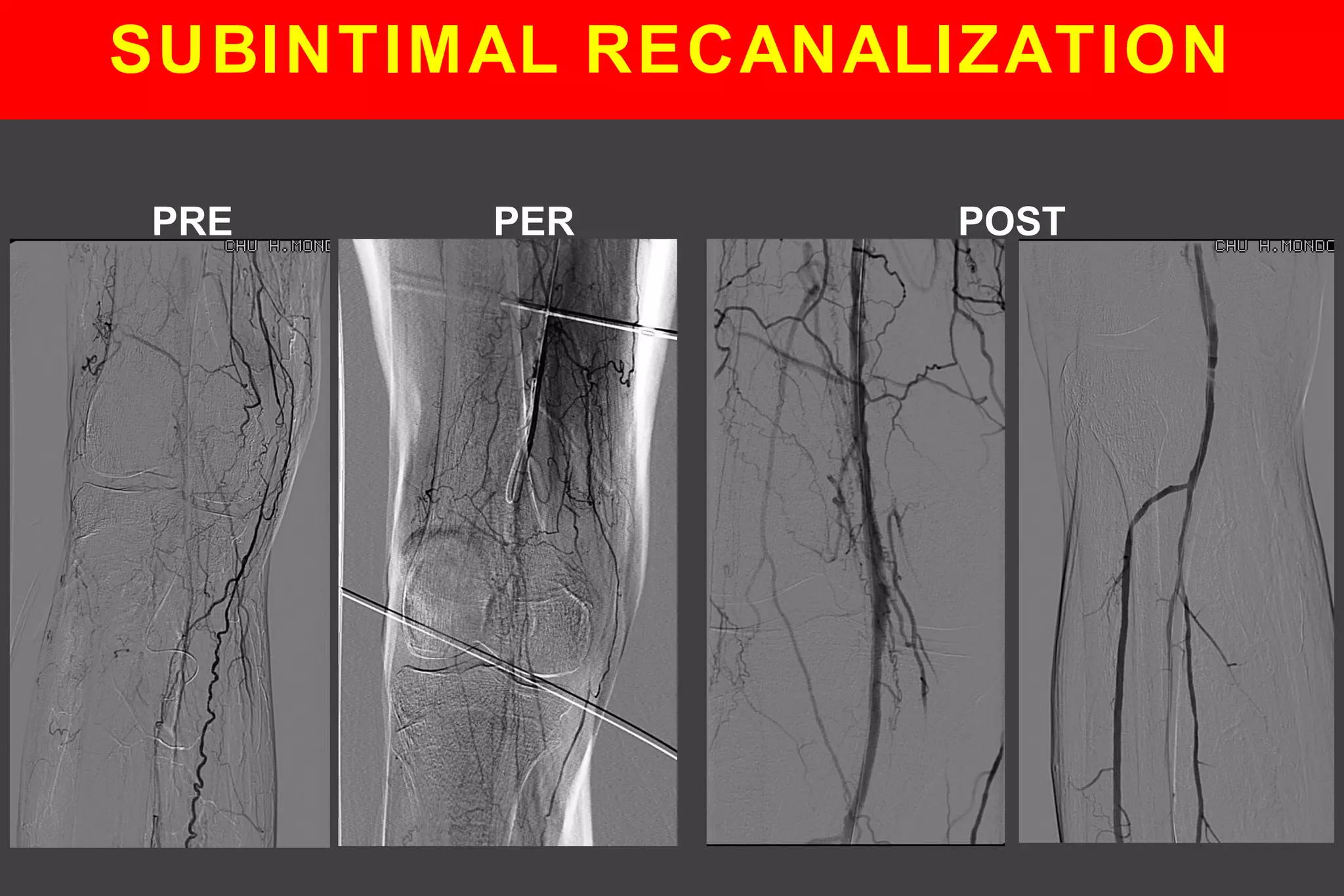
PRE PER POST
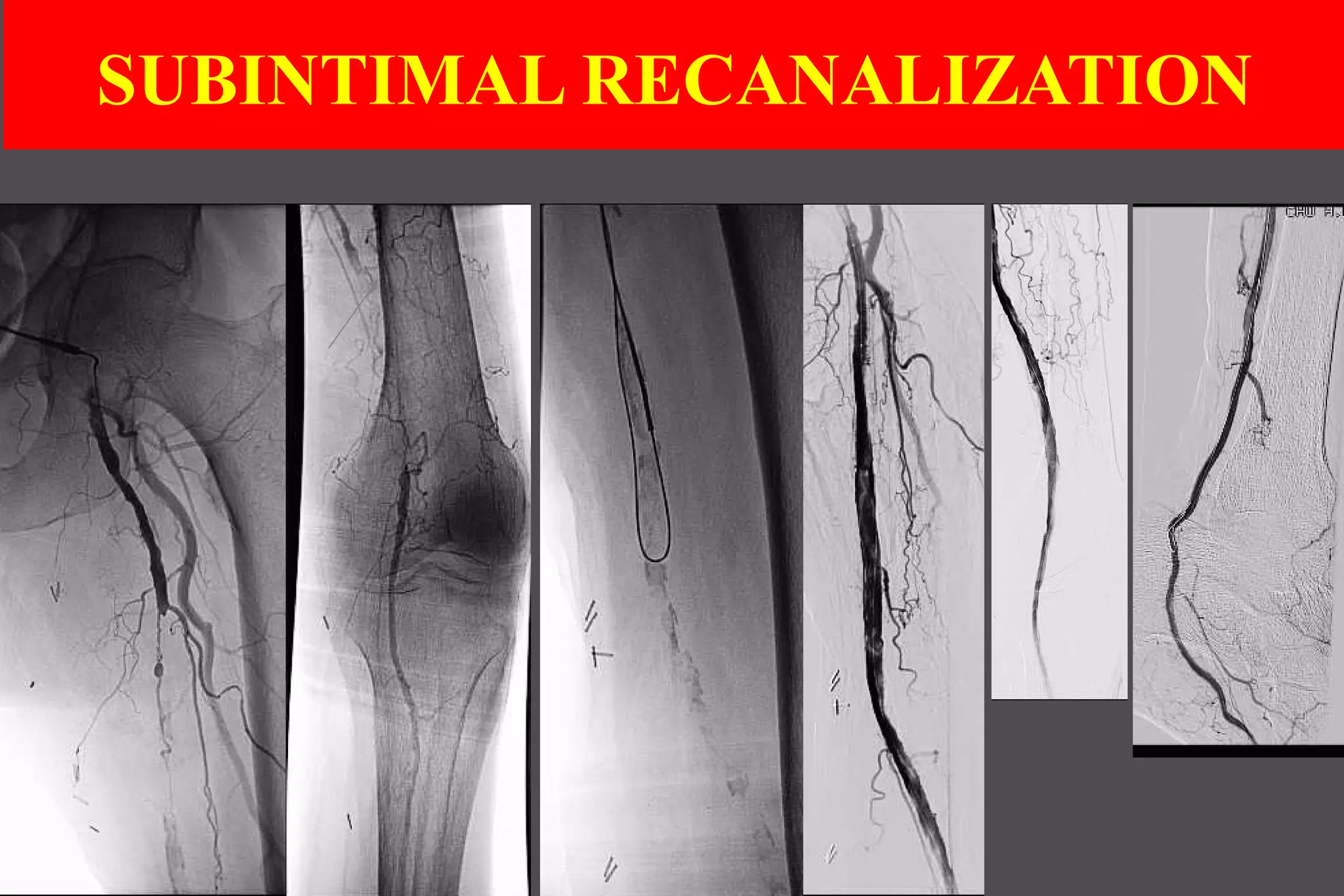
SUBINTIMAL RECANALIZATION
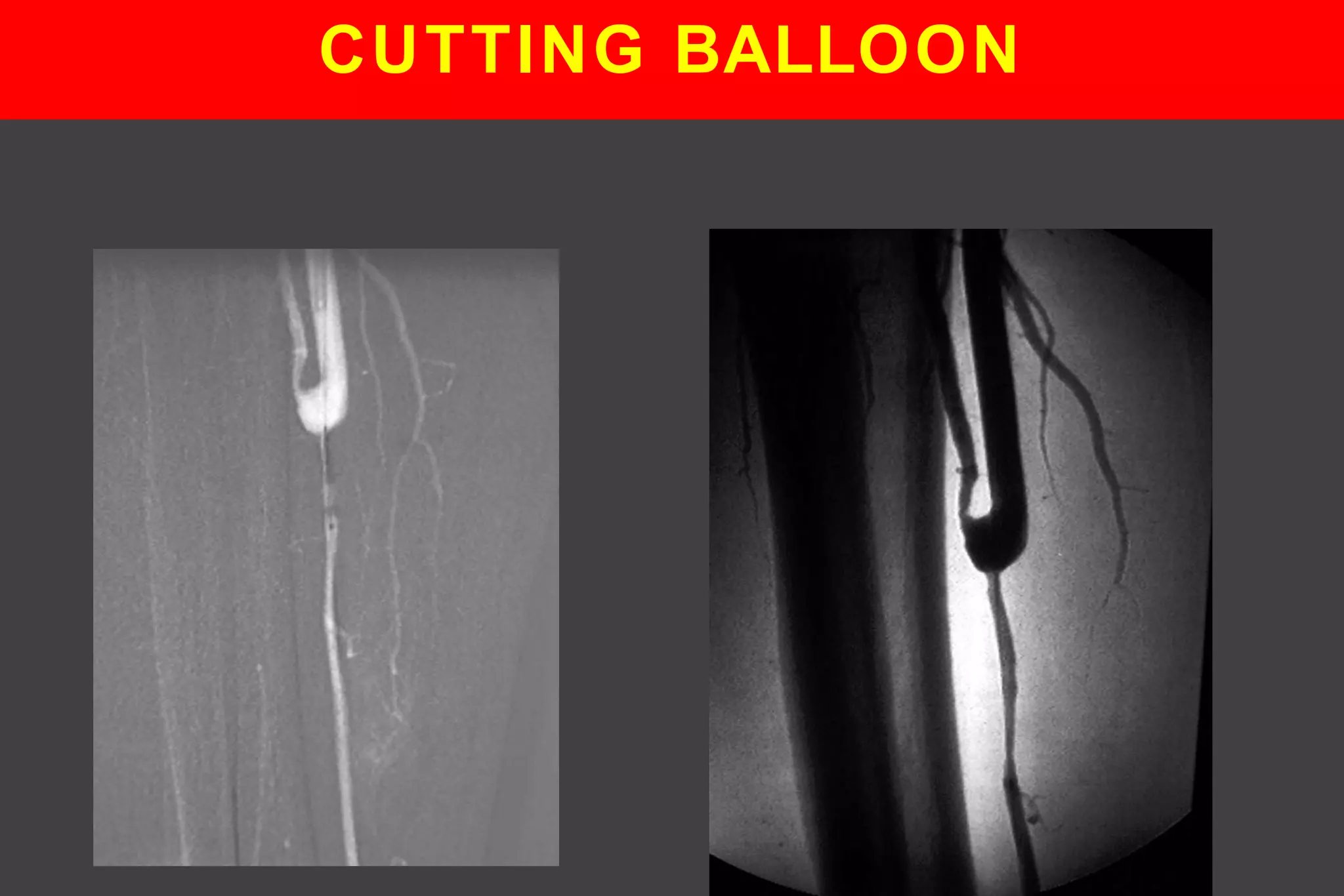
CUTTING BALLOON
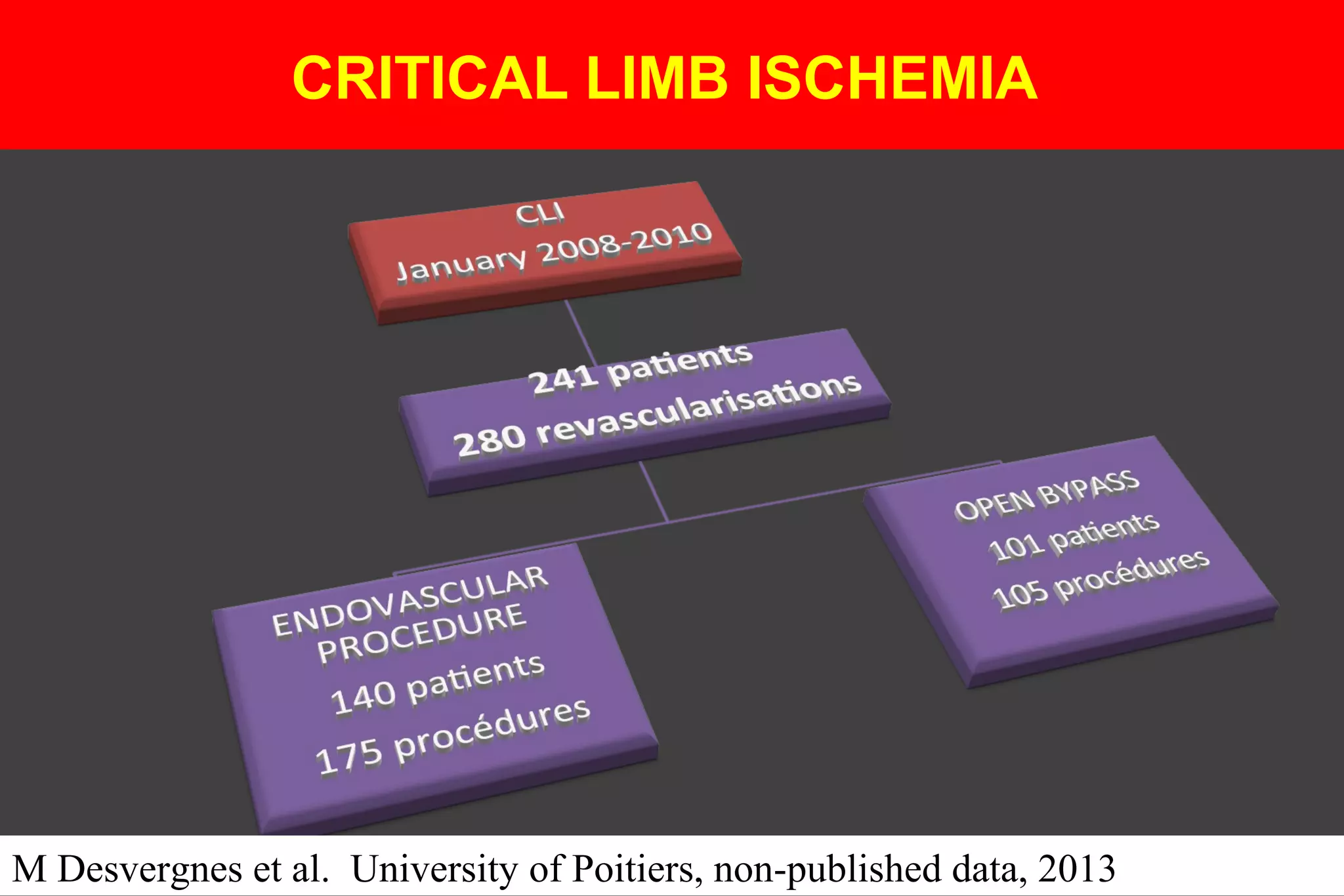
CRITICAL LIMB ISCHEMIA
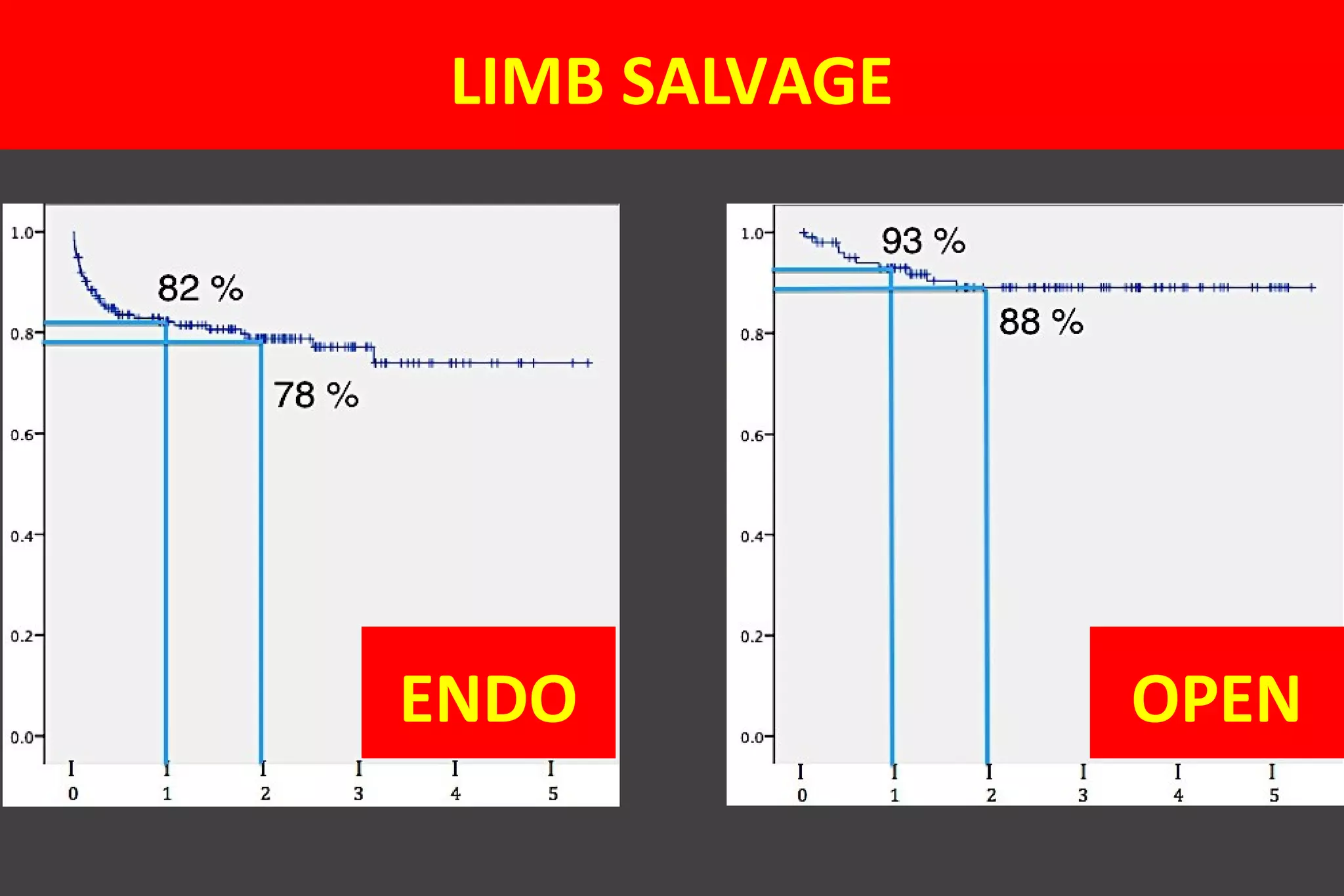
M Desvergnes et al. University of Poitiers, non-published data, 2013
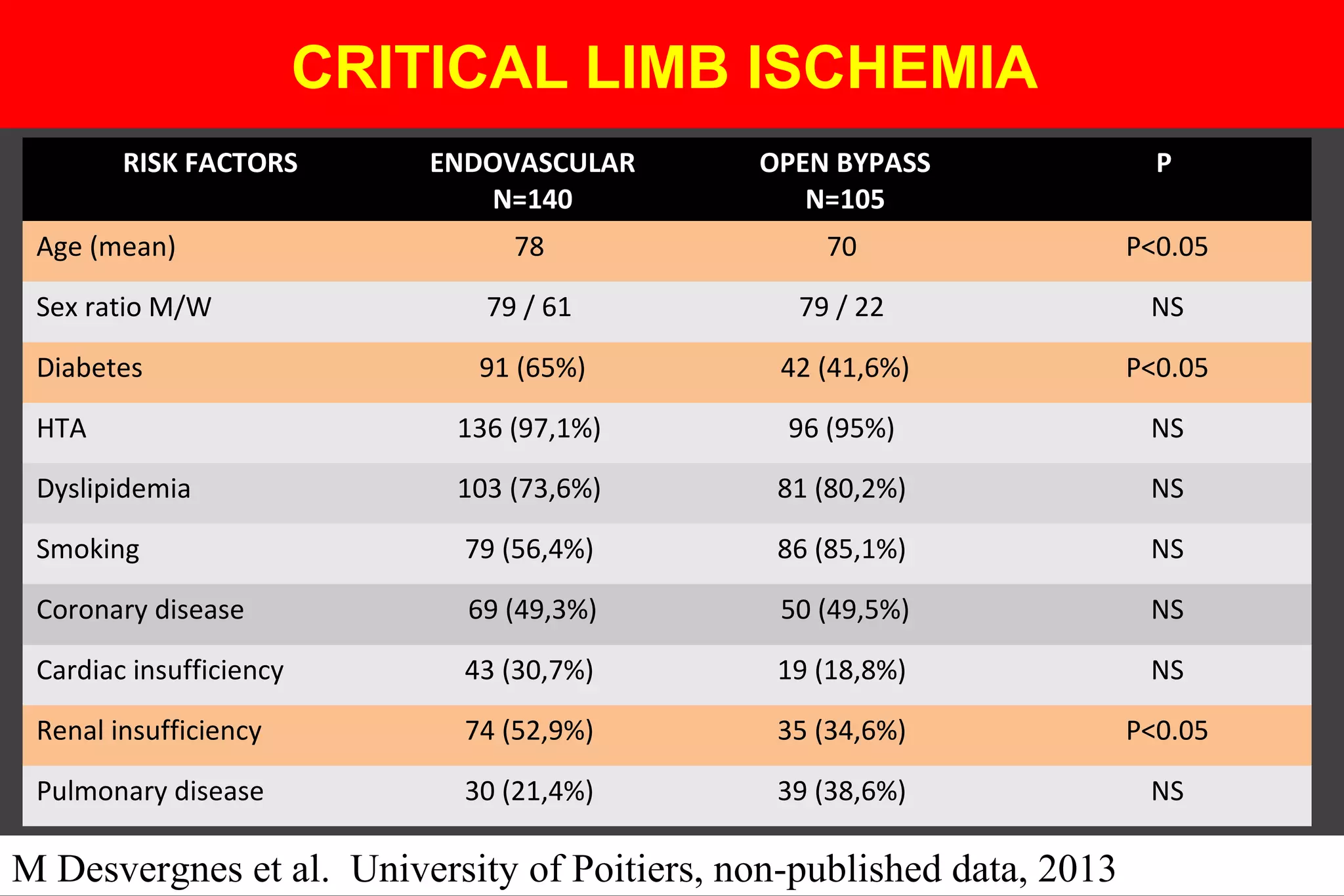
RISK FACTORS ENDOVASCULAR
N=140
OPEN BYPASS
N=105
P
Age (mean) 78 70 P<0.05
Sex ratio M/W 79 / 61 79 / 22 NS
Diabetes 91 (65%) 42 (41,6%) P<0.05
HTA 136 (97,1%) 96 (95%) NS
Dyslipidemia 103 (73,6%) 81 (80,2%) NS
Smoking 79 (56,4%) 86 (85,1%) NS
Coronary disease 69 (49,3%) 50 (49,5%) NS
Cardiac insufficiency 43 (30,7%) 19 (18,8%) NS
Renal insufficiency 74 (52,9%) 35 (34,6%) P<0.05
Pulmonary disease 30 (21,4%) 39 (38,6%) NS
CRITICAL LIMB ISCHEMIA
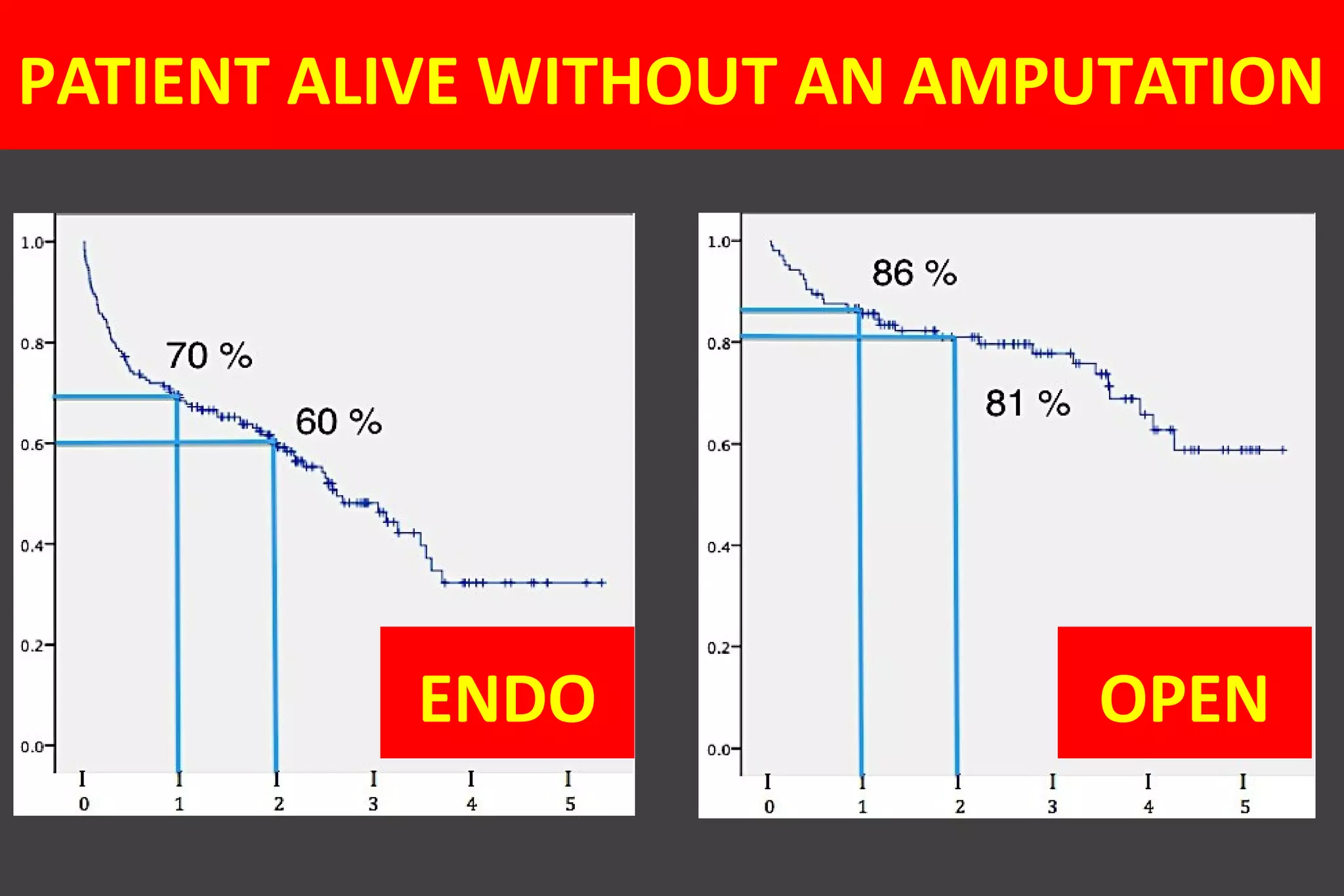
M Desvergnes et al. University of Poitiers, non-published data, 2013
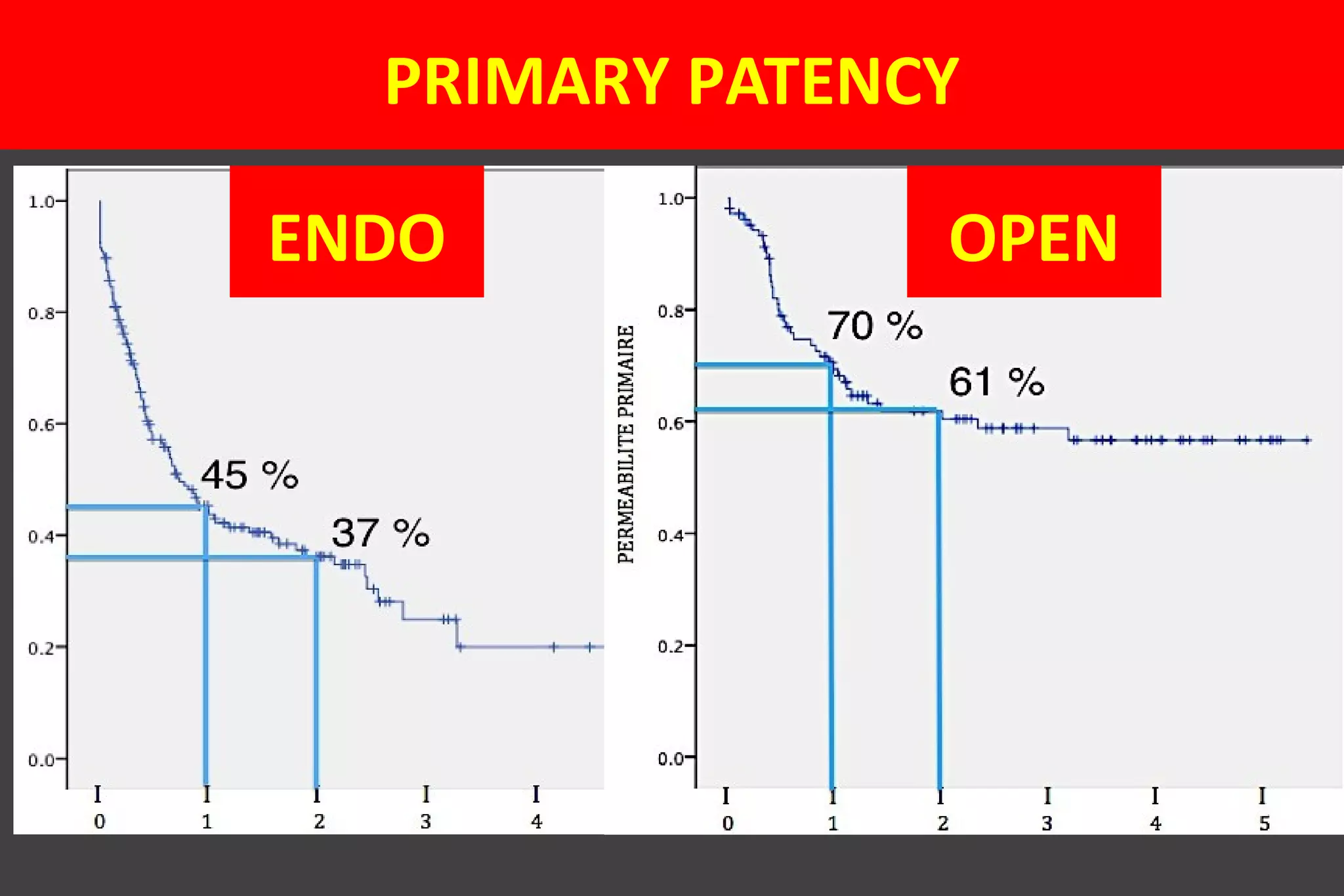
PRIMARY PATENCY
ENDO OPEN
ENDOVASCULAR PROCEDURES
TASC ? N (%)
A 1 (0,6%)
B 61 (34,9%)
C 75 (42,9%)
D 38 (21,7%)
RUN-OFF [LEG] N (%)
0 23 (13,1%)
1 94 (53,7%)
2 52 (29,7%)
3 6 (3,4%)
M Desvergnes et al. University of Poitiers, non-published data, 2013
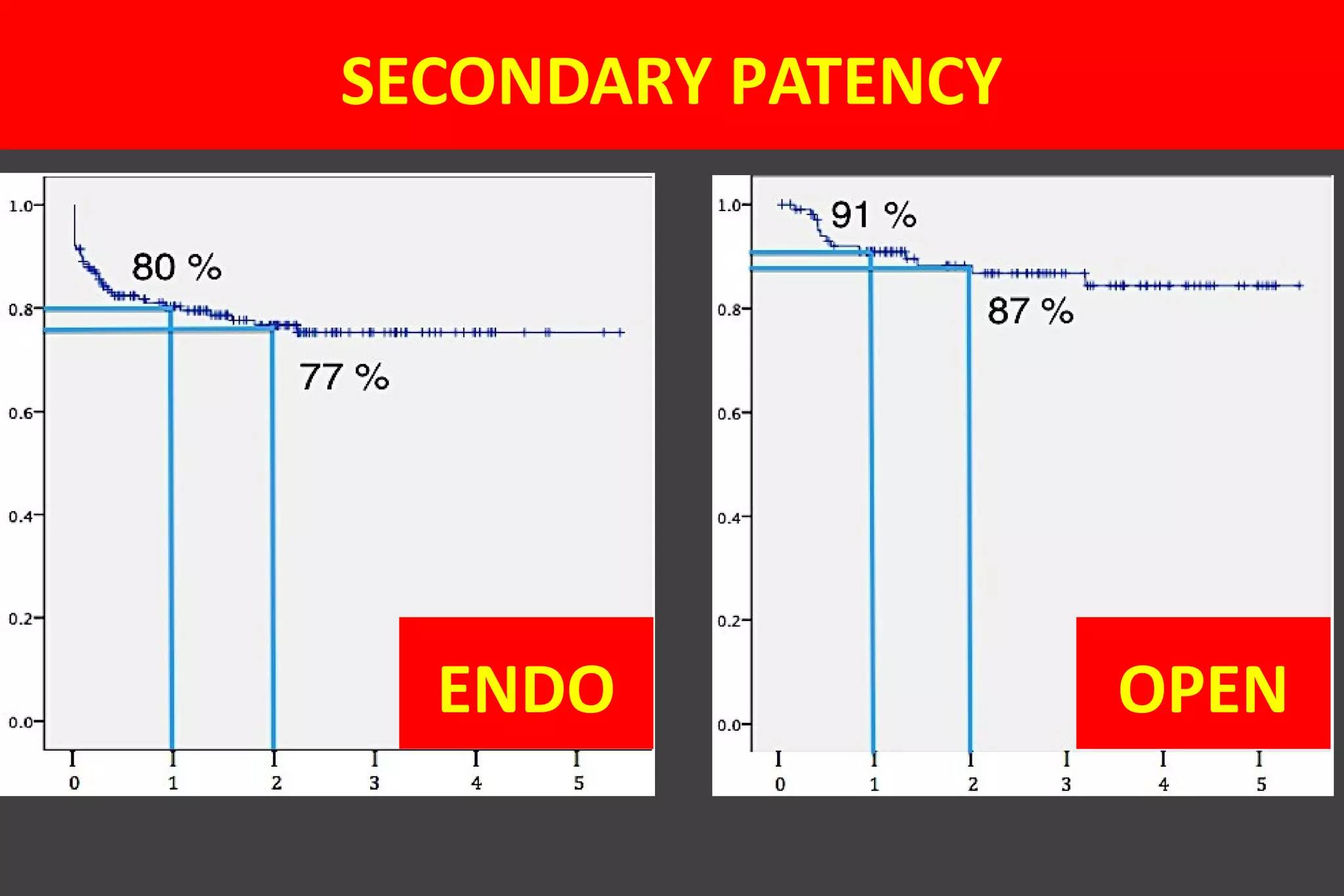
SECONDARY PATENCY
ENDO OPEN
LIMB SALVAGE
ENDO OPEN
PATIENT ALIVE WITHOUT AN AMPUTATION
ENDO OPEN
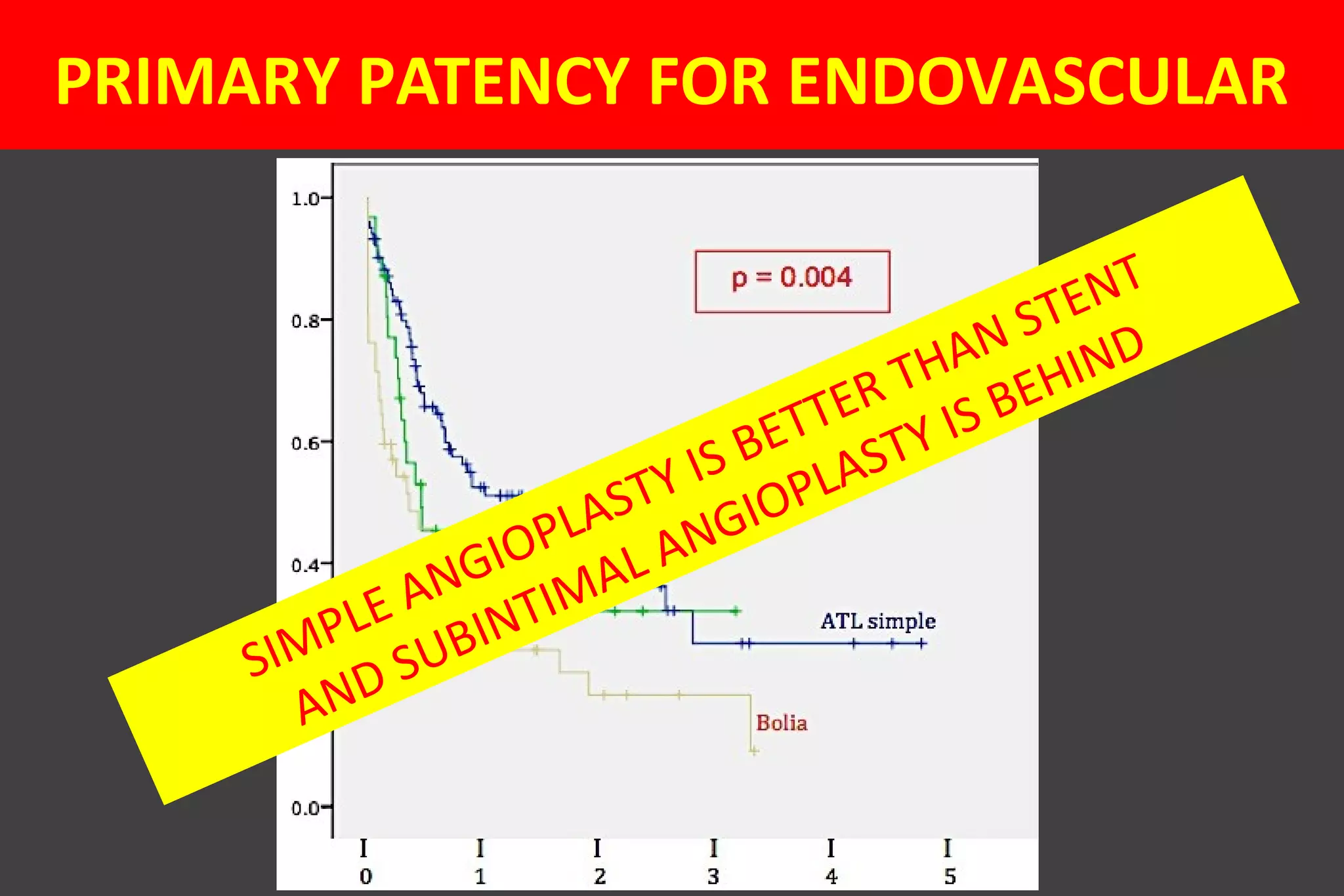
PRIMARY PATENCY FOR ENDOVASCULAR
SIMPLE ANGIOPLASTY IS BETTER THAN STENT
AND SUBINTIMAL ANGIOPLASTY IS BEHIND
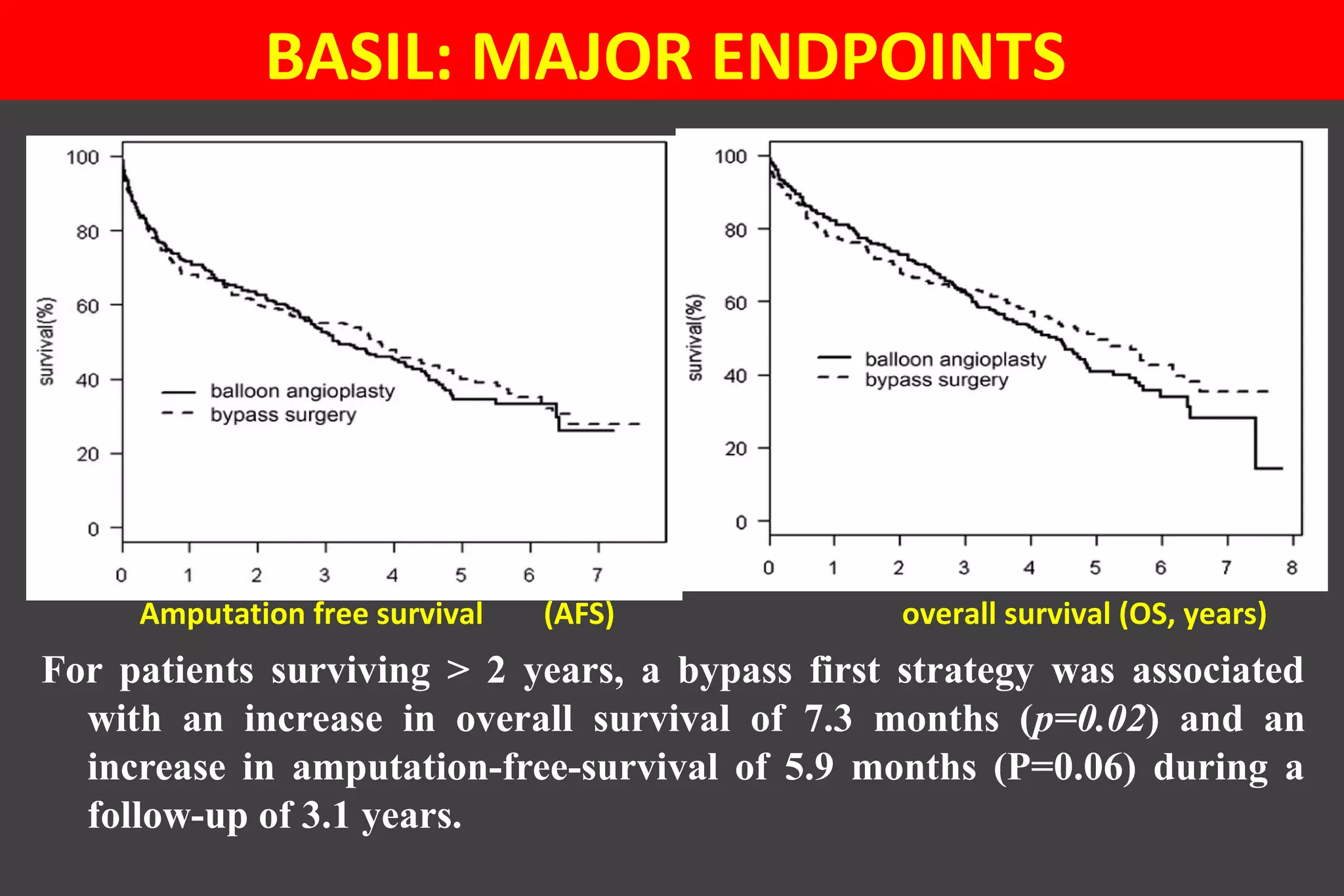
BASIL: MAJOR ENDPOINTS
Amputation free survival (AFS) overall survival (OS, years)
For patients surviving > 2 years, a bypass first strategy was associated
with an increase in overall survival of 7.3 months (p=0.02) and an
increase in amputation-free-survival of 5.9 months (P=0.06) during a
follow-up of 3.1 years.
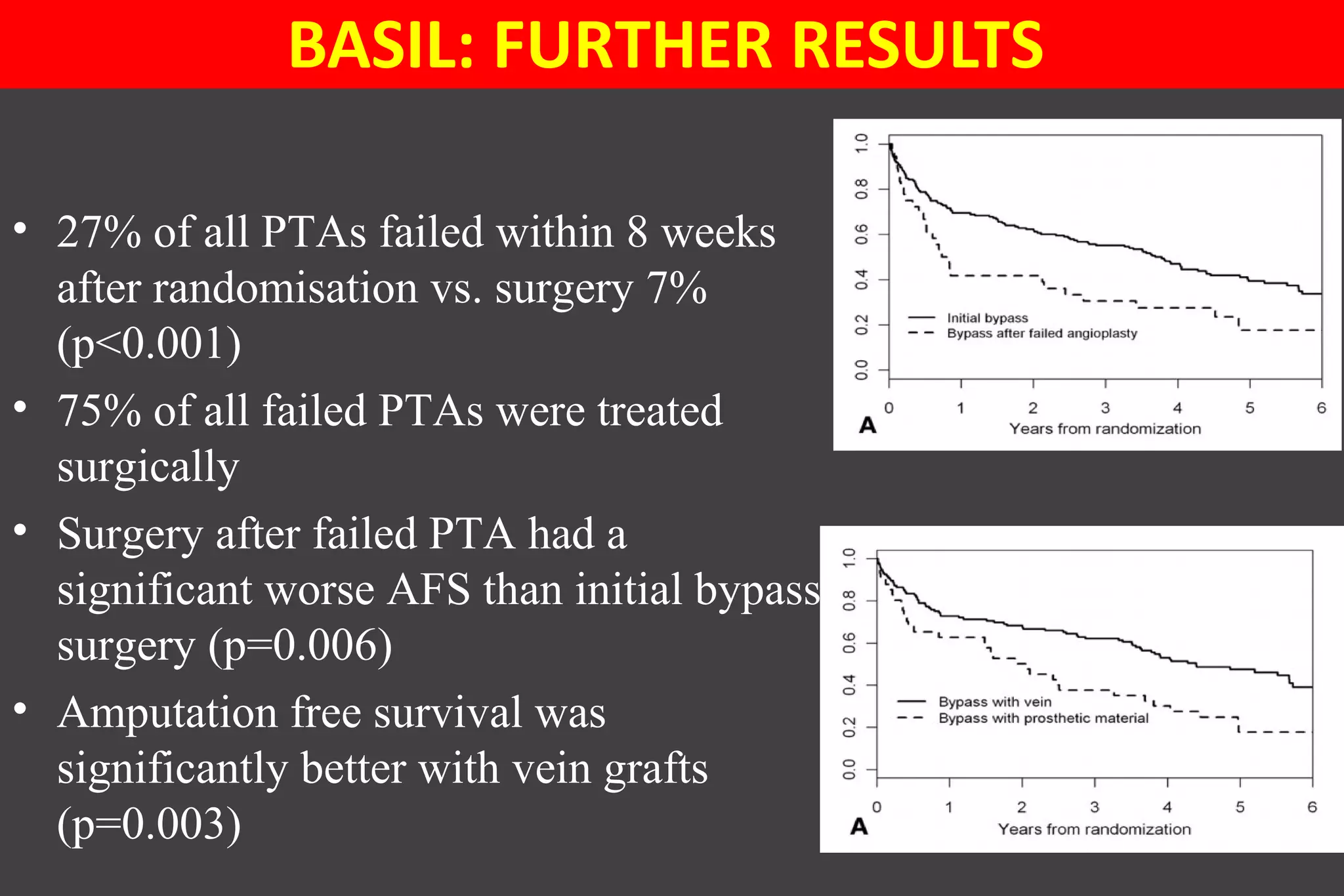
• 27% of all PTAs failed within 8 weeks
after randomisation vs. surgery 7%
(p<0.001)
• 75% of all failed PTAs were treated
surgically
• Surgery after failed PTA had a
significant worse AFS than initial bypass
surgery (p=0.006)
• Amputation free survival was
significantly better with vein grafts
(p=0.003)
BASIL: FURTHER RESULTS
ANGIOSOMES
A NEW CONCEPT FOR CLI ?
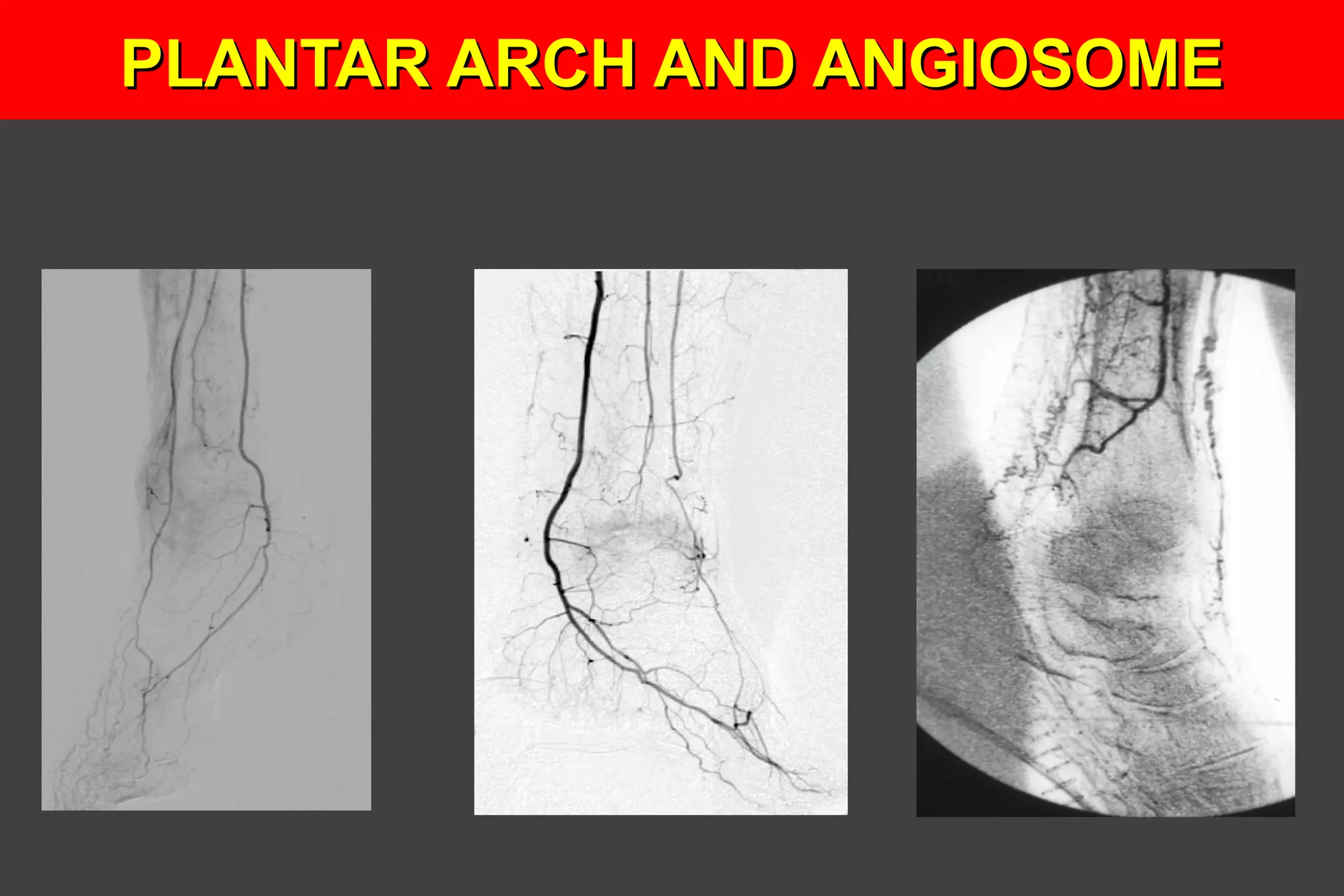
PLANTAR ARCH AND ANGIOSOMEPLANTAR ARCH AND ANGIOSOME
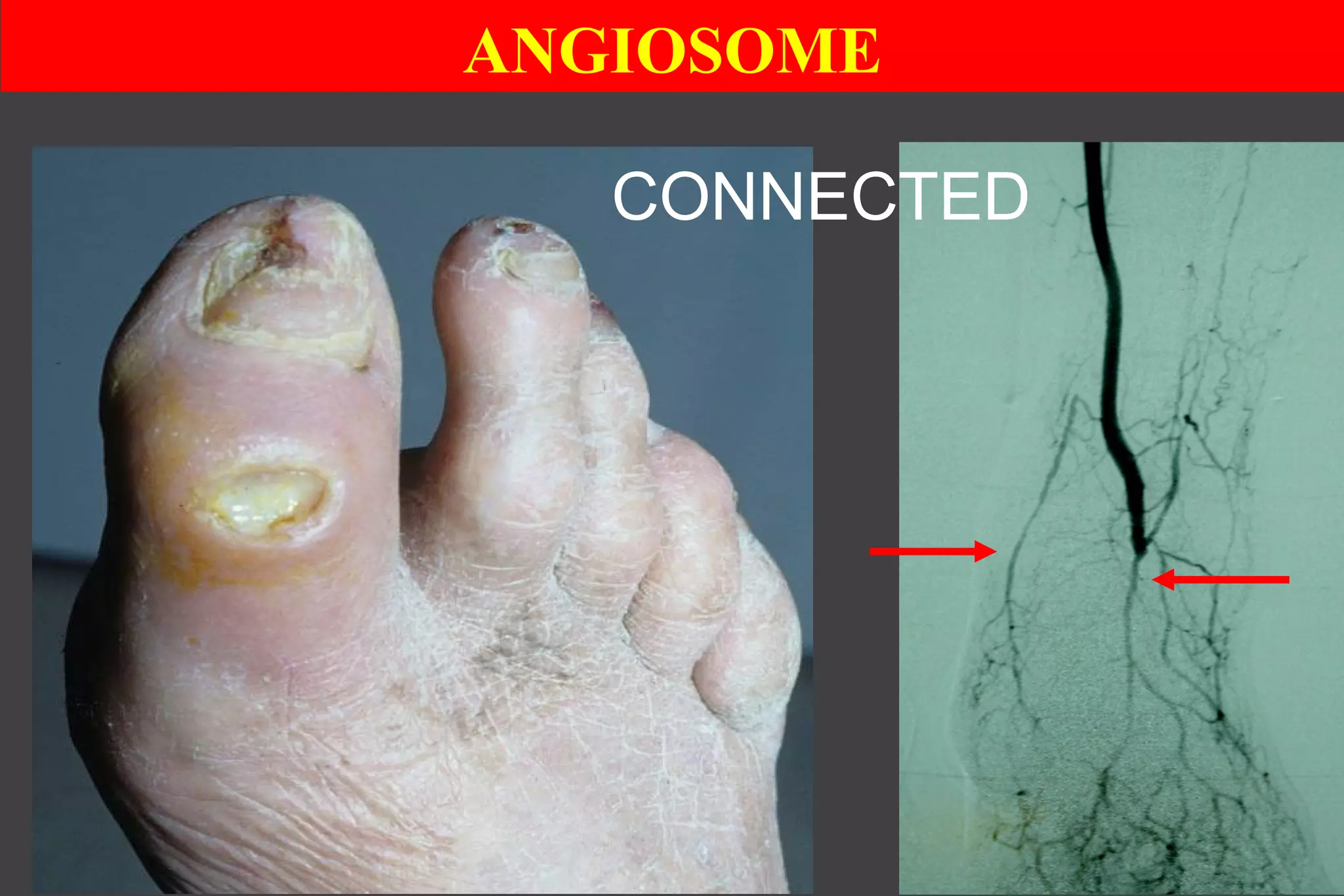
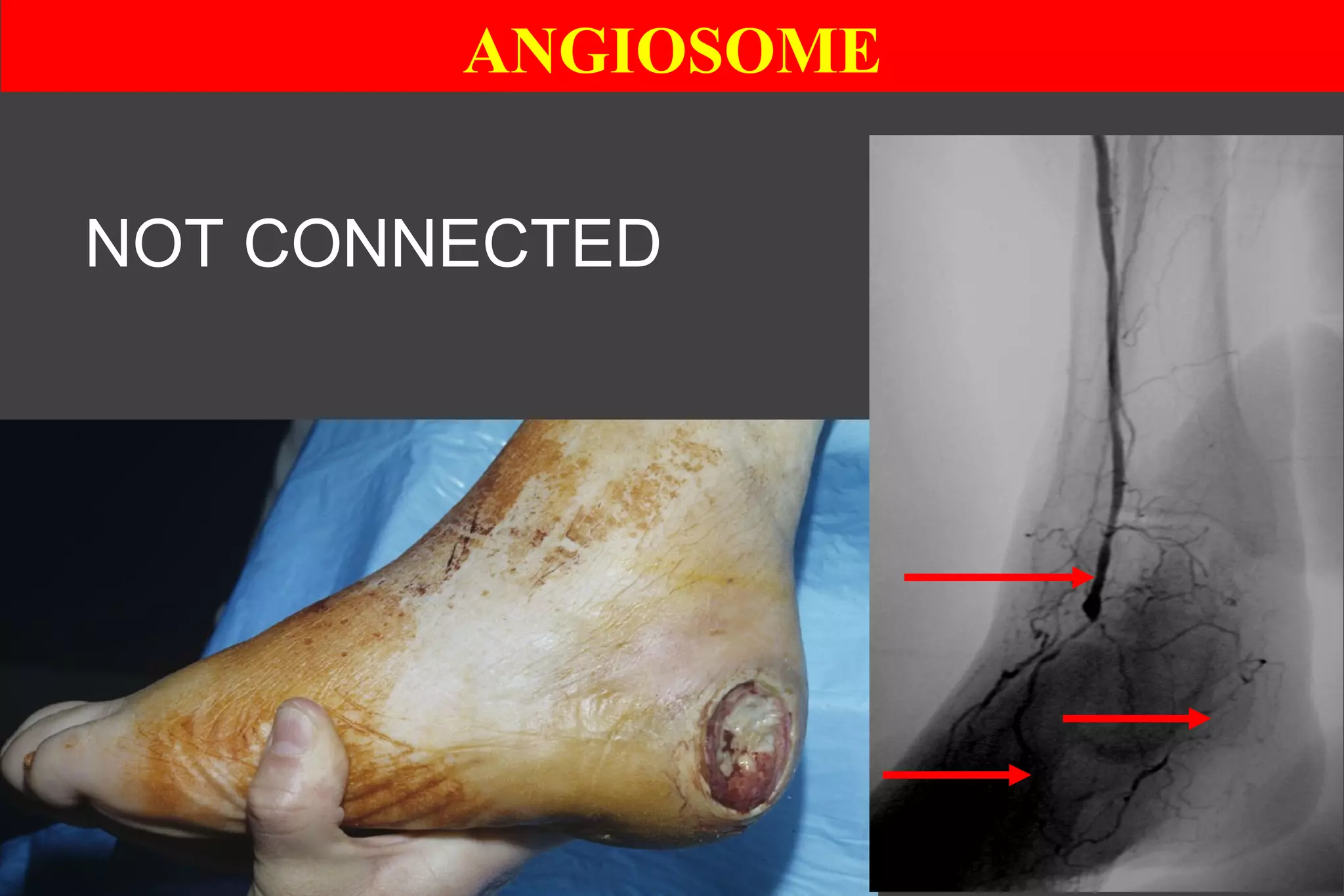
ANGIOSOME
CONNECTED
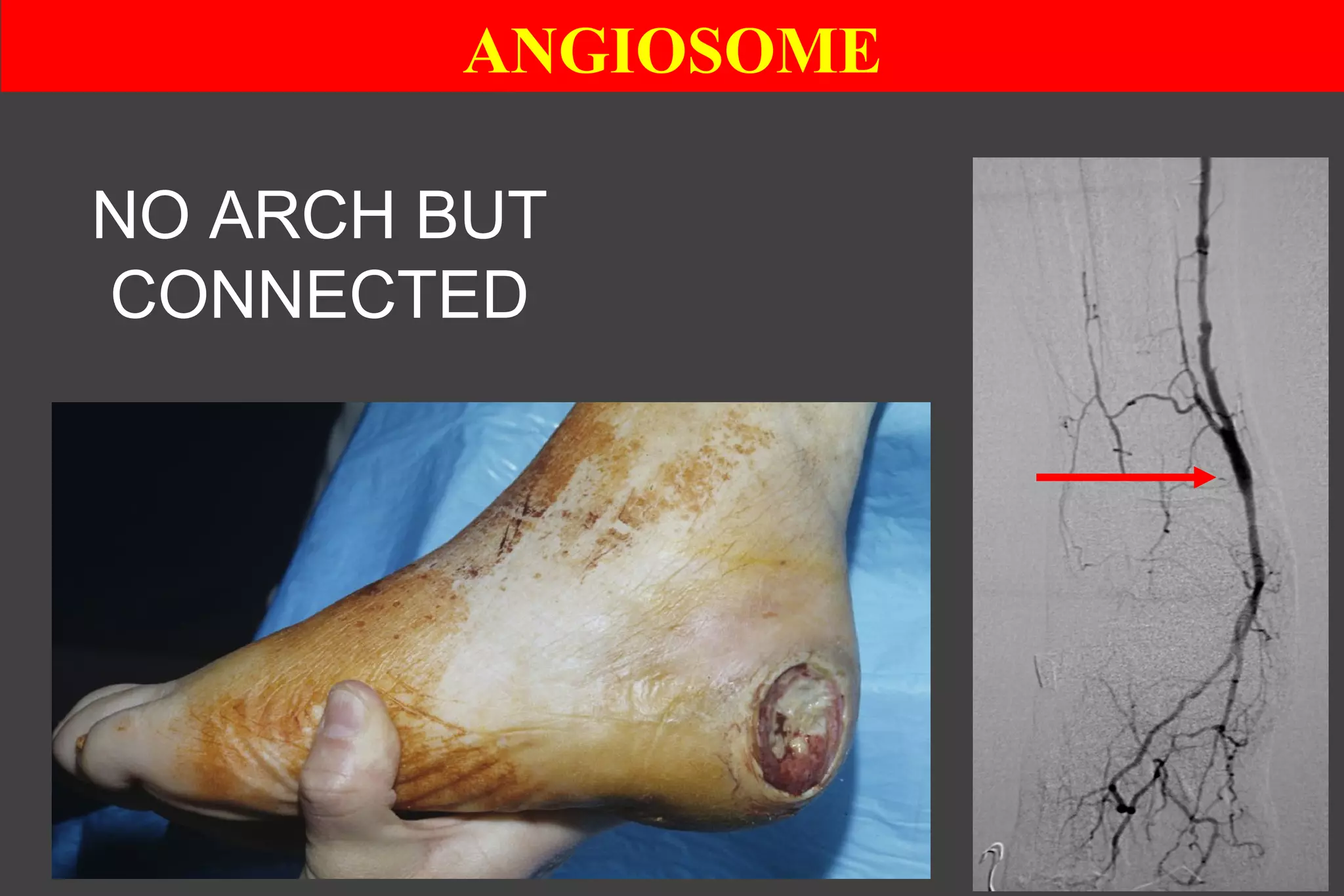
ANGIOSOME
NO ARCH BUT
CONNECTED
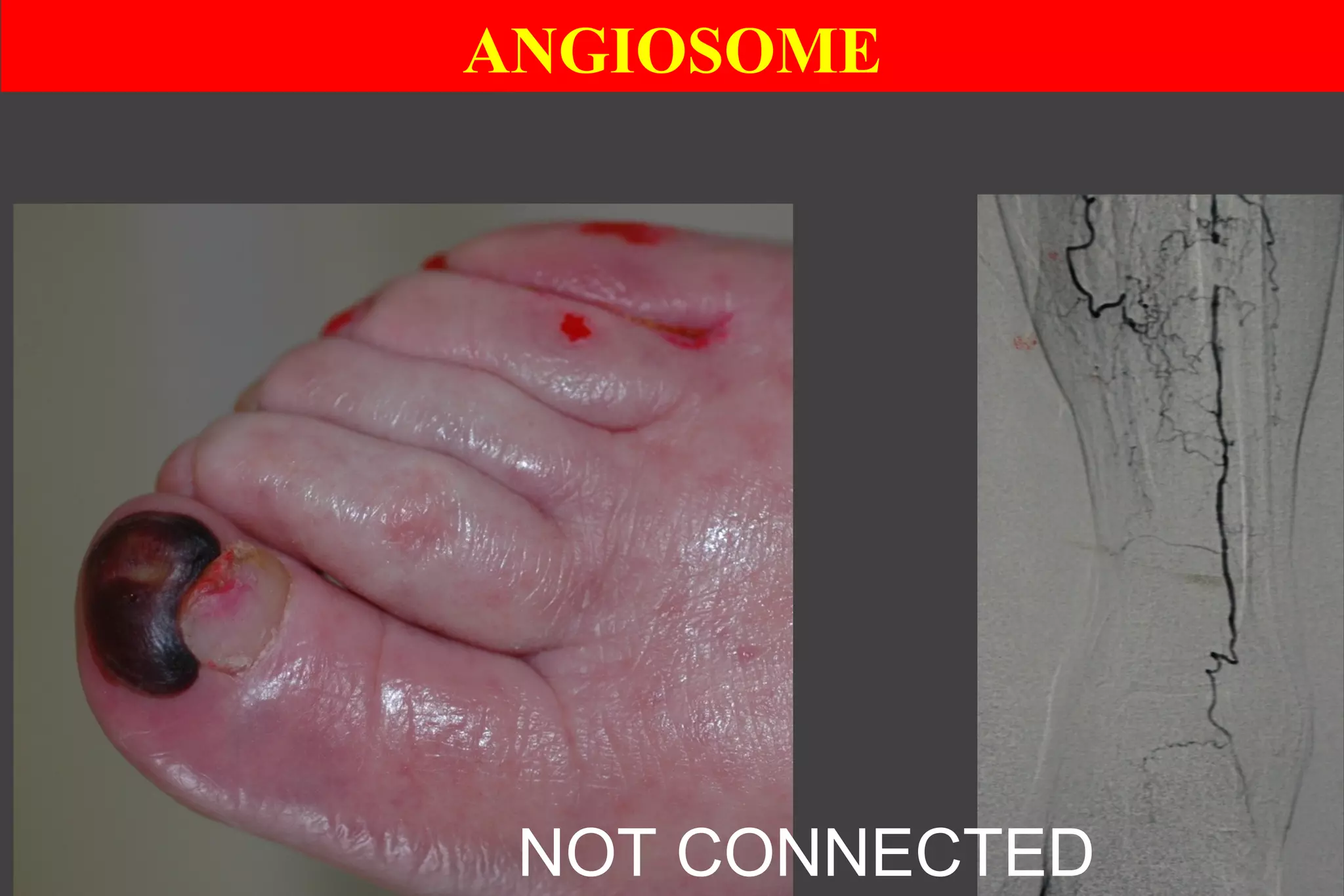
ANGIOSOME
NOT CONNECTED
NOT CONNECTED
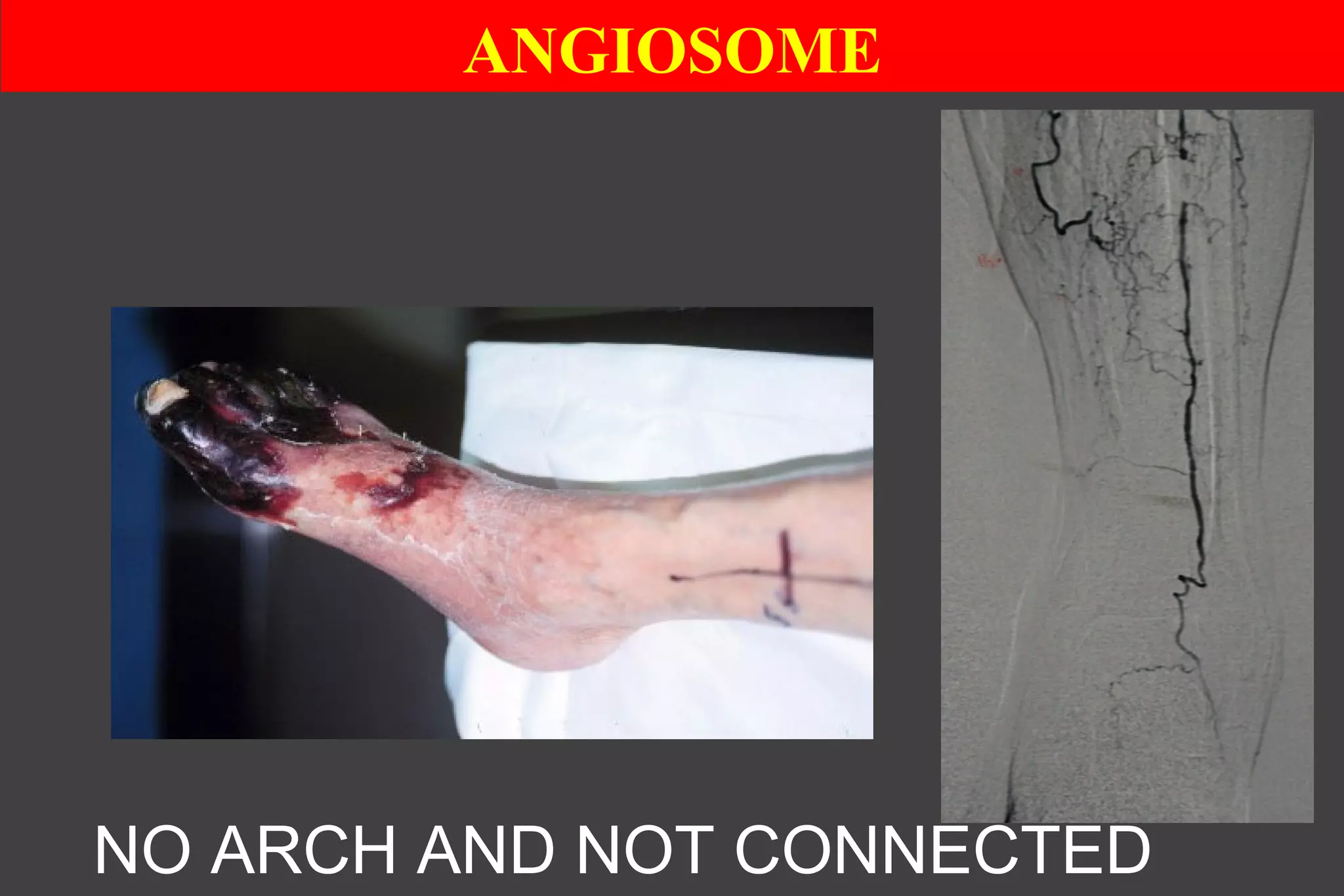
ANGIOSOME
ANGIOSOME
NO ARCH AND NOT CONNECTED
ANGIOSOMES – CLI PATIENTS
CHU POITIERS
175 ENDOVASCULAR
PROCEDURES
ANGIOSOME
DIRECT
(N=134)
ANGIOSOME
INDIRECT
(N=41)
p
MEAN AGE 77 [42-97] 77,4 [43-89] 0,98
SEX RATIO (M/F) 49,2% 68,9% 0,01
DIABETES 61,9% 78,04% 0,05
RENAL FAILURE 56,7% 48,7% 0,37
HTA 97,7% 97,5% 0,94
CORONARY DISEASE 46,2% 82,9% 0,01
SMOKING 55,9% 58,5% 0,77
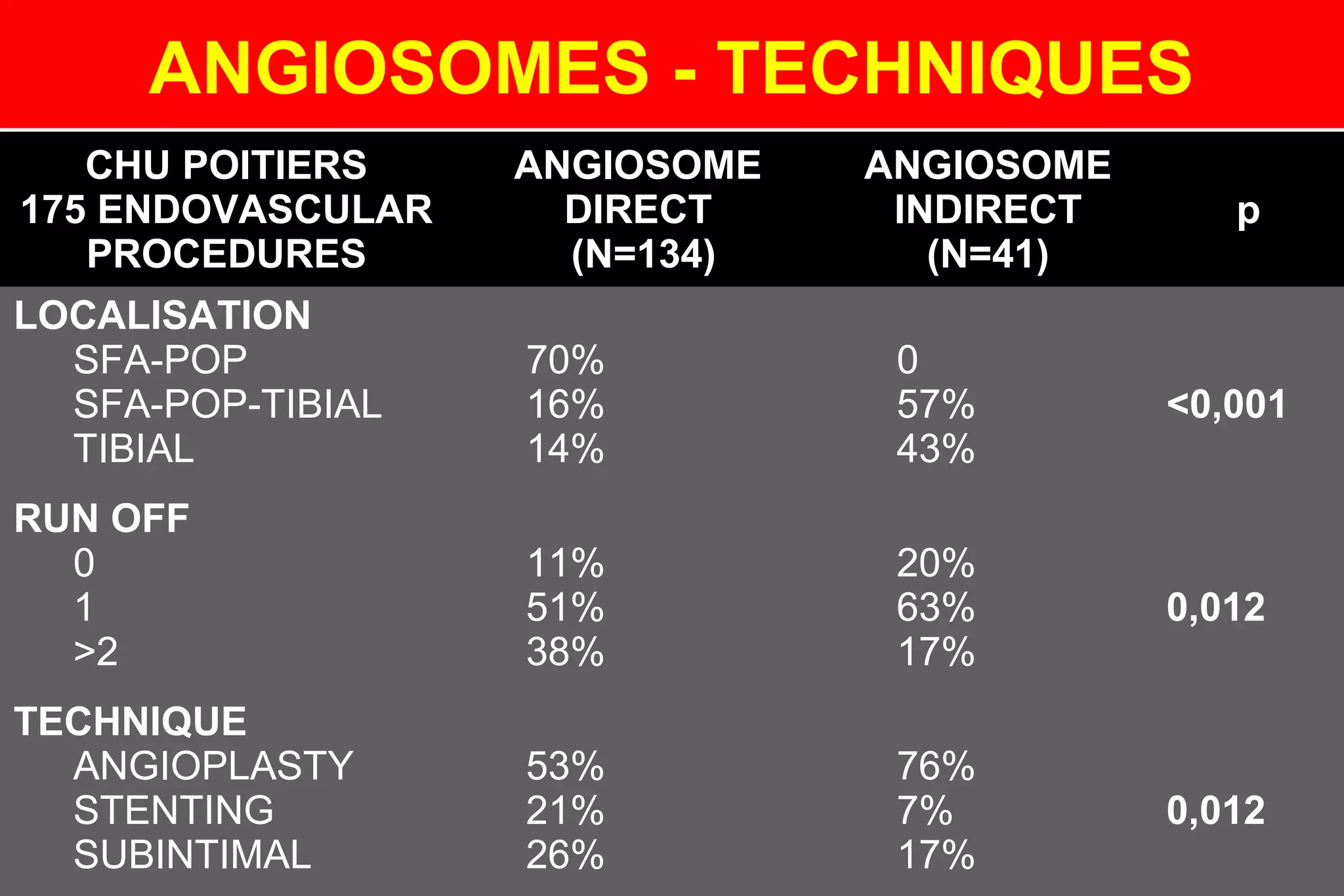
CHU POITIERS
175 ENDOVASCULAR
PROCEDURES
ANGIOSOME
DIRECT
(N=134)
ANGIOSOME
INDIRECT
(N=41)
p
LOCALISATION
SFA-POP
SFA-POP-TIBIAL
TIBIAL
70%
16%
14%
0
57%
43%
<0,001
RUN OFF
0
1
>2
11%
51%
38%
20%
63%
17%
0,012
TECHNIQUE
ANGIOPLASTY
STENTING
SUBINTIMAL
53%
21%
26%
76%
7%
17%
0,012
ANGIOSOMES - TECHNIQUES
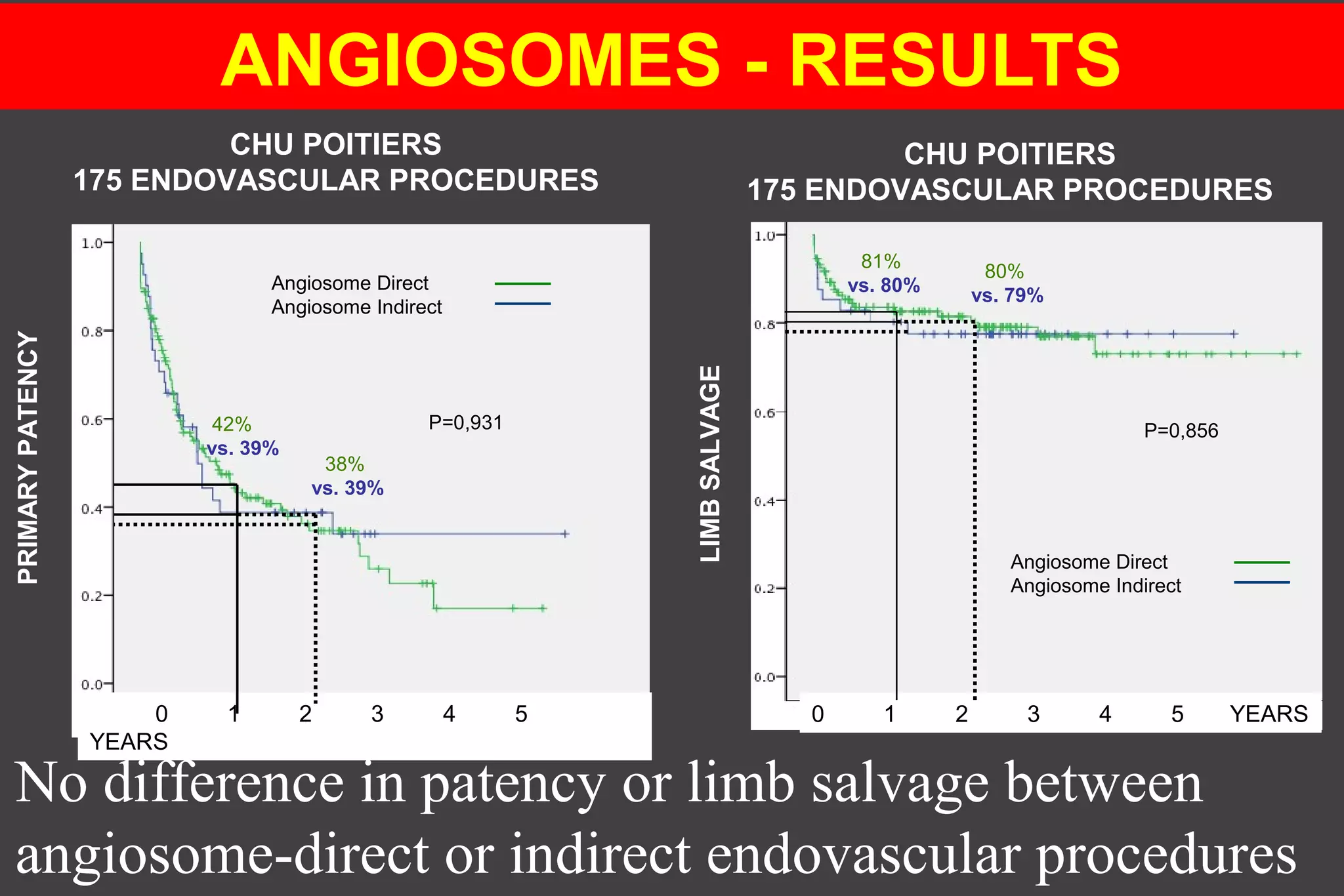
ANGIOSOMES - RESULTS
0 1 2 3 4 5
YEARS
42%
vs. 39%
38%
vs. 39%
PRIMARYPATENCY
P=0,931
Angiosome Direct
Angiosome Indirect
0 1 2 3 4 5 YEARS
81%
vs. 80%
80%
vs. 79%
P=0,856
LIMBSALVAGE
Angiosome Direct
Angiosome Indirect
No difference in patency or limb salvage between
angiosome-direct or indirect endovascular procedures
CHU POITIERS
175 ENDOVASCULAR PROCEDURES
CHU POITIERS
175 ENDOVASCULAR PROCEDURES
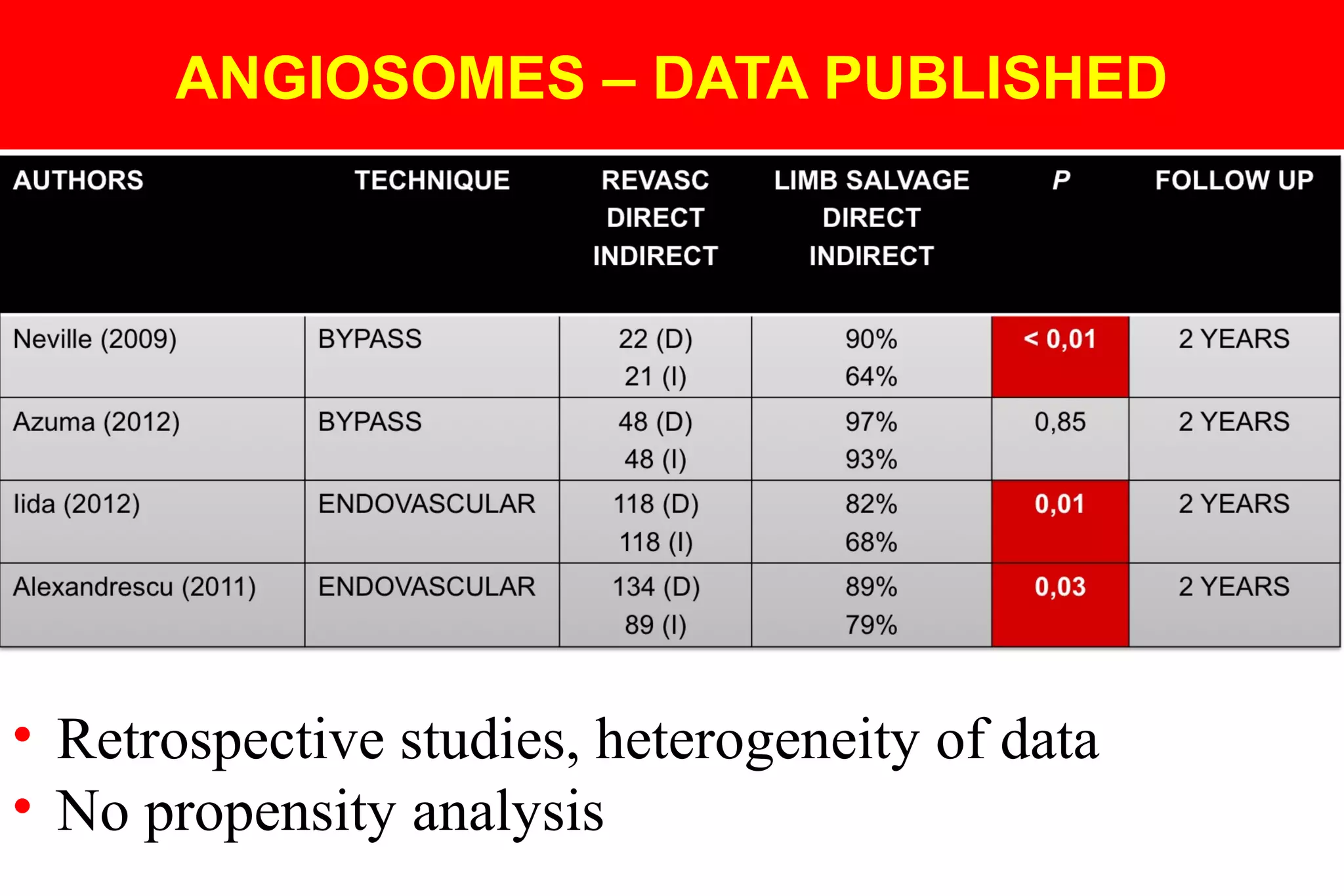
ANGIOSOMES – DATA PUBLISHED
• Retrospective studies, heterogeneity of data
• No propensity analysis
Chronic critical limb ischemia

Chronic critical limb ischemia

  • 1.
    Jean-Baptiste Ricco Vascular service HospitalJean Bernard University of Poitiers, France CHRONIC CRITICAL LIMB ISCHEMIA
  • 2.
    DIFFICULT PATIENTS TOTAKE CARE 82 y.o. man s/p aortic tube graft 12 years ago Rest pain, gangrene of the right toe Chronic heart failure
  • 3.
    THIS MAN ISLIKE AN OLD BRIDGE
  • 4.
    WHY WE SHOULDREVASCULARIZE THESE PATIENTS WITH CLI 5 -YEAR SURVIVAL - After revascularisation 70 % - After a major Amputation 26 % Difference is highly significant: p = 0.014
  • 5.
  • 6.
    TASC 2000 The originalTransAtlantic InterSociety Consensus (TASC) published in 2000 was the first international consensus on the diagnosis and treatment of PAD
  • 7.
     TASC IIprimarily designed to provide guidance for primary care physicians  Easy-to-read document (67 vs. 296 pages)  Not intended for vascular specialists ! TASC II - 2007
  • 8.
     A numberof aspects are not updated  It is not exhaustively referenced  Recommendations are deliberately simplified  Fails to recognize that more can be done with endovascular and open techniques 2007 TASC LITE…
  • 9.
  • 10.
  • 11.
    TASC A TASC B TASCC TASC D Definition for stenosis? > 50 %? Heavy calcified lesion? Absence of tibial vessels? Total poplital artery occlusion? Poplital artery stenosis? ? ? ? ?
  • 12.
    HOW DO YOUCLASSIFY THIS LESION?
  • 13.
    HOW DO YOUCLASSIFY THIS LESION? ?
  • 14.
    Diabetics Patients with CLI GrazianiL et al. EJVES 2007;33:453-60 BELOW THE KNEE LESIONS ? 36%36% 11%11% 27%27% 74% Lesions located in crural arteries
  • 15.
    TASC II Classificationfor femoropopliteal lesions allows wide individual interpretations and therefore, the common use of this classification as a basis of decision making and reporting outcome can be questioned. FEMOROPOPLITEAL LESIONS
  • 16.
  • 17.
    TASC II B[2011]TASC II B [2011] • Not endorsed by the SVS and by the ESVS • Recommendations were not the product of rigorous scientific scrutinity • TASC II B advocates an endovascular first option even in patients with claudication secondary to an isolated tibial artery disease while there is no Grade A/B supporting this conclusion
  • 18.
    TASC II B[2011]TASC II B [2011] TASC II B guidelines adopt a primarily anatomical approach, which pays insufficient attention to the clinical symptoms and risk factors
  • 19.
    EuropeanJournalofVascular&EndovascularSurgeryELSEVIER Journal European Journal of Vascular& Endovascular Surgery Celebrating our Silver Jubilee ... www.ejves.com pp.S1-S90Volume42Supplement2December2011 Volume 42 Supplement 2 December 2011 ISSN 1078-5884 Management of Clinical Practice Guidelines of the European Society for Vascular Surgery Critical Limb Ischaemia and Diabetic Foot
  • 20.
  • 21.
    BYPASS WITH THESAPHENOUS VEIN The best that can happen to a patient with CLI !
  • 22.
  • 23.
  • 24.
    BYPASS WITH FREEVASCULAR FLAP
  • 25.
    • Short autogenousbypass • Perigeniculate collateral arteries PERIGENICULATE ARTERY BYPASS Barral et al. Eur J Vasc Endovasc Surg
  • 26.
  • 27.
    PROSTHETIC BYPASS +DVP Devine et al. Devine et al.
  • 28.
  • 29.
    73 years oldmale, diabetic, and living at
  • 31.
  • 32.
  • 33.
  • 34.
  • 35.
    promotes healing afterrevascularization NEGATIVE PRESSURE WOUND THERAPY
  • 36.
  • 37.
    AK-FEMOROPOPLITEAL BYPASS PROSTHESIS vs.GREAT SAPHENOUS VEIN STUDIES Pereira 2006 Meta-analysis Pereira 2006 Meta-analysis Patients Follow-up 1713 / 580 5 years 2431 / 703 5 years Symptoms Claudication Critical Ischemia Prim. Pat. PTFE 57.4% 48.3% Prim. Pat. SV 77.2% p<0.05 69.4% p<0.05 Sec. Pat. PTFE 73.2% 54.0% Sec. Pat. SV 80.1% p<0.05 71.9% p<0.05 A Saphenous vein PERFORMS better than A prosthesis EVEN ABOVE THE KNEE
  • 38.
    AK-FEMOROPOPLITEAL BYPASS PTFE vs.POLYESTER STUDIES Jensen 2007 RCT (2 ans) Takagi 2010 Meta-analysis (5 ans) Patients PTFE/Polyester PTFE/Polyester Symptoms 65% Cl / 35% CLI NA Primary Pat. PTFE 57% 38.4% Primary Pat. Polyester 70% p=0.02 49.2% Secondary Pat. PTFE 65% NA Secondary Pat. Polyester 76% p=0.04 NA ABOVE THE KNEE POLYESTER IS COMPARABLE TO PTFE
  • 39.
    BK-FEMORO-POPLITEAL BYPASS GREAT SAPHENOUSVEIN vs. PROSTHESIS STUDIES Pereira 2006 (5 years) Albers 2003 (5 years) Patients 3779 43 studies Symptoms Cl 35% / CLI 65% NA Graft used SAPHENOUS VEIN PROSTHESIS Primary Patency 64.8% Cl 68.9% CLI 30.5% Secondary Patency 79.7% Cl 77.8% CLI 39.7% Limb Salvage NA 55.7% BELOW THE KNEE A Saphenous vein IS better than A prosthesis
  • 40.
    STUDIES Albers 2005 (5years) Albers 2003 (5 years) Patients 2618 43 études Symptoms Cl 3% /CLI 97% NA Graft used ARM VEIN PROSTHESIS Primary Patency 46.9% 30.5% Secondary Patency 66.5% 39.7% Limb Salvage 76.4% 55.7% BELOW THE KNEE ANY vein IS better than A prosthesis BK-FEMORO-POPLITEAL BYPASS PROSTHESIS vs. ALTERNATIVE VEIN
  • 41.
    STUDIES Griffiths 2004 RCT(3years) Laurila 2004 RCT (2 years) Procedures 46 cuff/ 44 31 AV Fistula / 28 Symptoms Cl 10% / CLI 90% CLI 100% Adjunct VENOUS CUFF A.V. FISTULA Sec. Pat. with Adjunct 45% 40% Sec. Pat. PTFE Alone 19% p= 0.02 40% Limb Salv. + Adjunct 78% 65% Limb Salv + PTFE Alone 61% p= 0.08 68% DISTAL VENOUS cuff CAN HELP BK-FEMORO-POPLITEAL BYPASS PROSTHESIS ± ADJUNCT
  • 42.
    INFRA-POPLITEAL BYPASS REVERSED VEINOR IN-SITU ? STUDIES Albers 2006 (5 years) Albers 2006 (5 years) Albers 2006 (5 years) Patients 1024 908 2320 Symptoms 100% CLI 100% CLI 100% CLI Technique IN SITU REVERSED GLOBAL Primary Patency 58.5% 65.9% 63% Secondary Patency 66.5% 73.2% 70.7% Limb Salvage 75.3% 79.7% 77.7% BOTH TECHNIQUES GIVE COMPARABLE RESULTS
  • 43.
    STUDIES Albers 2004 M Albers 2004M Albers 2004 M Albers 2004 M Albers 2003 M Patients Follow-up 687 5 years 218 5 years 157 5 years 1254 5 years 43 studies 5 years Symptômes CLI CLI CLI CLI CLI MATERIAL Venous Allograft cryopreserved Arterial Allograft cryopreserved Venous Allograft Fresh Ombilical Vein PROSTHESIS Primary Patency NA NA NA NA 30.5% Secondary Patency 19% 21% 24% 30% 39.7% Limb Salvage 60% 68% 39% 55% 55.7% An ALLOGRAFT IS NOT BETTER THAN a PROSTHESIS TIBIAL BYPASS - ALLOGRAFT
  • 44.
  • 45.
  • 46.
  • 47.
  • 48.
  • 49.
  • 50.
    CRITICAL LIMB ISCHEMIA MDesvergnes et al. University of Poitiers, non-published data, 2013
  • 51.
    RISK FACTORS ENDOVASCULAR N=140 OPENBYPASS N=105 P Age (mean) 78 70 P<0.05 Sex ratio M/W 79 / 61 79 / 22 NS Diabetes 91 (65%) 42 (41,6%) P<0.05 HTA 136 (97,1%) 96 (95%) NS Dyslipidemia 103 (73,6%) 81 (80,2%) NS Smoking 79 (56,4%) 86 (85,1%) NS Coronary disease 69 (49,3%) 50 (49,5%) NS Cardiac insufficiency 43 (30,7%) 19 (18,8%) NS Renal insufficiency 74 (52,9%) 35 (34,6%) P<0.05 Pulmonary disease 30 (21,4%) 39 (38,6%) NS CRITICAL LIMB ISCHEMIA M Desvergnes et al. University of Poitiers, non-published data, 2013
  • 52.
  • 53.
    ENDOVASCULAR PROCEDURES TASC ?N (%) A 1 (0,6%) B 61 (34,9%) C 75 (42,9%) D 38 (21,7%) RUN-OFF [LEG] N (%) 0 23 (13,1%) 1 94 (53,7%) 2 52 (29,7%) 3 6 (3,4%) M Desvergnes et al. University of Poitiers, non-published data, 2013
  • 54.
  • 55.
  • 56.
    PATIENT ALIVE WITHOUTAN AMPUTATION ENDO OPEN
  • 57.
    PRIMARY PATENCY FORENDOVASCULAR SIMPLE ANGIOPLASTY IS BETTER THAN STENT AND SUBINTIMAL ANGIOPLASTY IS BEHIND
  • 58.
    BASIL: MAJOR ENDPOINTS Amputationfree survival (AFS) overall survival (OS, years) For patients surviving > 2 years, a bypass first strategy was associated with an increase in overall survival of 7.3 months (p=0.02) and an increase in amputation-free-survival of 5.9 months (P=0.06) during a follow-up of 3.1 years.
  • 59.
    • 27% ofall PTAs failed within 8 weeks after randomisation vs. surgery 7% (p<0.001) • 75% of all failed PTAs were treated surgically • Surgery after failed PTA had a significant worse AFS than initial bypass surgery (p=0.006) • Amputation free survival was significantly better with vein grafts (p=0.003) BASIL: FURTHER RESULTS
  • 60.
  • 61.
    PLANTAR ARCH ANDANGIOSOMEPLANTAR ARCH AND ANGIOSOME
  • 62.
  • 63.
  • 64.
  • 65.
  • 66.
    ANGIOSOME NO ARCH ANDNOT CONNECTED
  • 67.
    ANGIOSOMES – CLIPATIENTS CHU POITIERS 175 ENDOVASCULAR PROCEDURES ANGIOSOME DIRECT (N=134) ANGIOSOME INDIRECT (N=41) p MEAN AGE 77 [42-97] 77,4 [43-89] 0,98 SEX RATIO (M/F) 49,2% 68,9% 0,01 DIABETES 61,9% 78,04% 0,05 RENAL FAILURE 56,7% 48,7% 0,37 HTA 97,7% 97,5% 0,94 CORONARY DISEASE 46,2% 82,9% 0,01 SMOKING 55,9% 58,5% 0,77
  • 68.
    CHU POITIERS 175 ENDOVASCULAR PROCEDURES ANGIOSOME DIRECT (N=134) ANGIOSOME INDIRECT (N=41) p LOCALISATION SFA-POP SFA-POP-TIBIAL TIBIAL 70% 16% 14% 0 57% 43% <0,001 RUNOFF 0 1 >2 11% 51% 38% 20% 63% 17% 0,012 TECHNIQUE ANGIOPLASTY STENTING SUBINTIMAL 53% 21% 26% 76% 7% 17% 0,012 ANGIOSOMES - TECHNIQUES
  • 69.
    ANGIOSOMES - RESULTS 01 2 3 4 5 YEARS 42% vs. 39% 38% vs. 39% PRIMARYPATENCY P=0,931 Angiosome Direct Angiosome Indirect 0 1 2 3 4 5 YEARS 81% vs. 80% 80% vs. 79% P=0,856 LIMBSALVAGE Angiosome Direct Angiosome Indirect No difference in patency or limb salvage between angiosome-direct or indirect endovascular procedures CHU POITIERS 175 ENDOVASCULAR PROCEDURES CHU POITIERS 175 ENDOVASCULAR PROCEDURES
  • 70.
    ANGIOSOMES – DATAPUBLISHED • Retrospective studies, heterogeneity of data • No propensity analysis

Editor's Notes

  • #7 Thank you Dr Veith, Dr Katzen. After TASC I published in 2000 which was a comprehensive and updated document
  • #8 TASC II published in 2007 has disappointed a number of vascular specialists and did not meet their expectations of a major update. Apparently this was due to a common misconception about the intended purpose of TASC II which was to a significant degree aimed at referring physicians.
  • #9 Read the slide
  • #10 As the TASC consensus aims to recommend the preferable method of revascularization according to an anatomic classification. AND is used in scientific reports to characterize patients population and treated lesions. A major criticism of TASC II was the difficulty to use this anatomical classification particularly for infrainguinal arterial lesions
  • #11 Many details are lacking in this classification,
  • #12 Including the degree of stenosis, presence of heavily calcified lesions, doubt concerning the classification of total occlusion of the popliteal artery and 1-2/3 trifurcation vessels. making the grading of the lesions cumbersome and allowing individual interpretations, which of course, diminishes the applicability of the classification and the value of these guidelines.
  • #13 This a lesion with several potential classifications, TASC B or TASC D.
  • #14 And this lesion is not fitting to any of the TASC II classes.
  • #15 With ignorance of all isolated tibial arteries lesions so frequent in patients with CLI and in diabetic patients.
  • #16 Read the slide
  • #17 We were expecting some improvement when TASC Iib was send to the vascular surgical societies for approval, but despite some efforts this Iib version was misleading
  • #18 Read the text
  • #20 We hope that the TASC III committee will consider some of these issues, pending their decision, we are publishing next month the ESVS clinical guidelines on CLI and diabetic foot that covers some aspects of this problem. Thank you for your attention.
  • #26 TASC should also not ignore extreme bypasses in these difficult situations
  • #33 An endovascular first option is probably not the best option in these patients with CLI and only a distal artery open to the foot but a goos great saphenous vein available
  • #49 And also the value of subintimal recanalization in tailored indications and not as an “endovascular first systematic option” particularly is the life expectancy of the patient is above 2 years
  • #51 241 patients en ischémie critique des membres inférieurs
  • #52 140 patients du groupe endovasculaire
  • #53 Taux de perméabilité des 175 procédures endovasculaires : perméabilité primaire, primaire assistée et secondaire
  • #54 Proportion élevée de lésions TASC C et D (mauvais pronostic en termes de perméabilité primaire) Forte proportion de lit d’aval précaire : Les données de la littérature suggèrent que la présence d’un lit d’aval précaire diminue les taux de perméabilité Nous avons donc analysé la perméabilité primaire des procédures endovasculaires en fonction du nombre d’axes jambiers perméables en les divisant en 2 groupes : Groupe 1 ( 0 ou 1 axe jambier perméable) Groupe 2 (2 ou 3 axes perméables) : pas de différence significative Association lit d’aval précaire et lésions sévères peut expliquer les mauvais résultats.
  • #55 Taux de perméabilité des 175 procédures endovasculaires : perméabilité primaire, primaire assistée et secondaire
  • #56 Taux de perméabilité des 175 procédures endovasculaires : perméabilité primaire, primaire assistée et secondaire
  • #57 Taux de perméabilité des 175 procédures endovasculaires : perméabilité primaire, primaire assistée et secondaire
  • #58 Différence statistiquement significative en termes de perméabilité primaire, primaire assistée et secondaire L’ensemble de ces données ne confirme donc pas l’amélioration attendue de la diffusion des stents nitinol et confirme les mauvais résultats de l’angioplastie sous-intimale en termes de perméabilité.
  • #62 L’un des facteurs déterminant pour la réussite du pontage est la vascularisation du pied à l’angiographie, et donc la présence ou non d’une arche plantaire. Dans notre série, 24% des MI
  • #72 Analyse des principaux résultats du groupe endovasculaire A 1 et 2 ans