B.KANNABIRAN
Senior Sports Physio
Ankle Sprains in Sports
 53% - Basketball
 19% - Soccer
 9.3% - Football
 7.2% - Running
physical therapy guideline for
an chronic ankle complaint.
Impaired ankle function


            Acute            Chronic


                                       POST TRAUMATIC


                                          SYSTEMIC
TRAUMATIC     A TRAUMATIC

                                         INFECTION


                                       OSTEOARTHRITIS
ACUTE ANKLE
             FUNCTIONAL      WITH NEW         SPRAIN
             INSTABILITY      DAMAGE        GUIDELINES
                             WITHOUT
                               NEW
               SUBTALAR      DAMAGE
              INSTABILITY
                                             CHRONIC
                                           ANKLE SPRAIN
                 DISTAL                     GUIDELINES
             TIBIOFIBULAR
   POST      SYNDESMOTIC
TRAUMATIC      RUPTURE
                             WITH SOFT
                               TISSUE
            OSTEOCHONDRAL   IMPINGEMENT
               LESIONS &                      DISCUSS
                            WITHOUT SOFT       WITH
              OSTEOPHYTE       TISSUE        REFERRING
                            IMPINGEMENT      PHYSICISN
                               LOOSE
              SINUS TARSI
                             BODIES/OCD
              SYNDROME
Factors involved
functional instability
 Mechanical instability
 Disturbed Proprioception and balance
 Reduced muscle strength
 Slow muscle reaction times
 Reduced mobility
 Inappropriate complaint-related behaviour
 Inadequate acute ankle sprain rehab
Physical therapy treatment goals


 To achieve optimal functional recovery.


 The highest achievable or desired level of activities.


 To prevent relapses, exacerbations and further
  dysfunction.
Functional Rehabilitation
    Prolonged immobilization of ankle sprains is a
  common treatment error.
    Functional stress stimulates the incorporation of
  stronger replacement collagen.

 The four components of rehabilitation are:

1.   Range-of-motion rehabilitation
2.   Progressive muscle-strengthening exercises
3.   Proprioceptive training
4.   Activity-specific training
Range of Motion

• Range of motion must be
  regained before functional
  activity is initiated.

• Regardless of weight-bearing
  capacity, Achilles tendon
  stretching should be instituted
 within 48 to 72 hours after the
 ankle injury because of the
 tendency of tissues to contract
 following trauma.
INCREASING THE RANGE OF MOTION
Achilles tendon stretch,
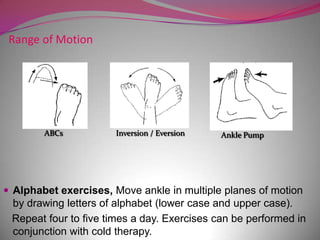
Range of Motion


        ABCs          Inversion / Eversion   Ankle Pump


 Alphabet exercises, Move ankle in multiple planes of motion
 by drawing letters of alphabet (lower case and upper case).
 Repeat four to five times a day. Exercises can be performed in
 conjunction with cold therapy.
PROGRESS ONCE ROM IS REGAINED
 Once range of motion
 is regained, and
 swelling and pain are
 controlled, the patient
 is ready to progress to
 the strengthening
 phase of rehabilitation.
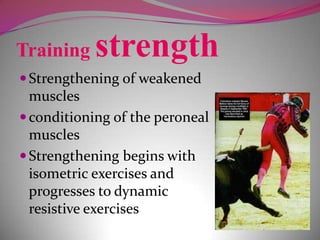
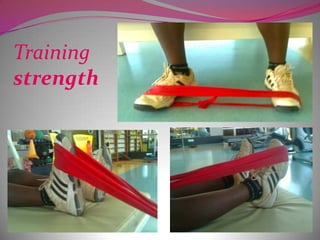
Training   strength
 Strengthening of weakened
  muscles
 conditioning of the peroneal
  muscles
 Strengthening begins with
  isometric exercises and
  progresses to dynamic
  resistive exercises
Muscle Strengthening
 Isometric exercises,
 Plantar flexion,
 Dorsiflexion,
 Inversion,
 Eversion,


 For each exercise, hold 1 second for concentric component and
  perform eccentric component over 4 seconds; do three sets of
  10 repetitions; repeat two times a day.
Muscle Strengthening


 Toe curls and marble pickups, Two sets of 10 repetitions;
 repeat two times a day. Toe curls can be done throughout
 the day, at work or at home.

 Toe raises, heel walks and toe walks,
Heel walk &   Toe walk
Training
strength
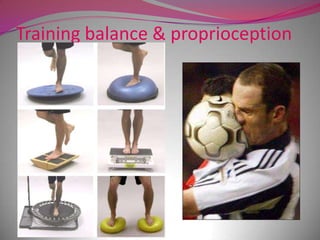
Training balance & proprioception
747
       Stable platform
       747
       Reverse 747
       spokes
Reverse 747

 Stable platform
 747
 Reverse 747
 spokes
spokes

 Stable platform
 747
 Reverse 747
 spokes
Training balance and Proprioception
Training on the Dyna disc
Training on the Bosu ball
Functional activities on
unstable platform
RETURN TO
ACTIVITY-
SPECIFIC
TRAINING
RETURN TO ACTIVITY-SPECIFIC
TRAINING
Complex activity training for
football player with chronic ankle
sprain
Composite drills
composite
  drills
STRUCTURE OF REHABILITATION
  IN SPORTS INJURY
 A stepwise approach
        Increasing the level of difficulty
        Increasing the speed, duration and dynamic quality of practiced
  movements.
      Training of specific skills
       Reset Talus in Mortise
       Peroneal tendon friction massage
       fibular head mobility
Reset the Talus in the Mortise
• Apply traction with dorsiflexion and eversion
• Quick tug to reset the talus in the mortise
Peroneal Tendon Friction Massage

 Direct pressure to tendon in perpendicular direction
 Increases blood flow to the tendon
 Increases activity of fibroblasts
 Decreases fibrosis/adhesions
 Most effective with stretching and functional exercise
Correct posterior fibular head –
Passive Motion

                    •Patient supine, knee flexed

                    •Sit on foot

                    •Stabilize knee with hand

                    •Pull fibular head anterolaterally and
                    then push posteromedially repeatedly
Correct posterior fibular head –
  Muscle Energy
Remember “PIP AID”

For a Posterior fibular
head, Invert and Plantarflex

For an Anterior fibular
head, Invert and Dorsiflex
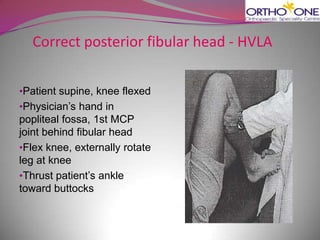
Correct posterior fibular head - HVLA

•Patient supine, knee flexed
•Physician’s hand in
popliteal fossa, 1st MCP
joint behind fibular head
•Flex knee, externally rotate
leg at knee
•Thrust patient’s ankle
toward buttocks
Exercising functions and skills
  • A symmetrical and dynamic gait should be
    strongly encouraged.
  • All relevant daily life activities should be exercised.
Training for Return to Activity
• When walking a specified distance is no longer limited by
  pain, the patient may progress to a regimen of 50 percent
  walking and 50 percent jogging.

• When this can be done without pain, jogging eventually
  progresses to forward, backward and pattern running. Circles
  and figure-eights are commonly employed for pattern running.

• Although these routines are time-consuming, they represent the
  final phase and are essential for the recovery of ankle stability.
AQUA AEROBICS
 VERY USEFUL IN EARLY RETURN TO ACTIVITY
Plyometrics
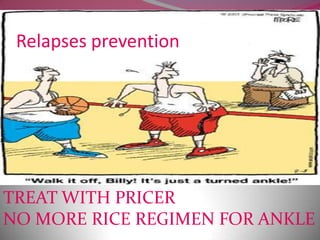
Relapses prevention


TREAT WITH PRICER
NO MORE RICE REGIMEN FOR ANKLE
P.R.I.C.E.R Protocols
  Protect
  Rest limit weight bearing, crutches if necessary, an ankle
   brace helps control swelling and adds stability

  Ice No ice directly on the skin, no ice more than 20 minutes
   at a time to avoid frost bite.


  Compression can be helpful in controlling swelling
   and is usually accomplished with an ACE bandage.


  Elevate above the waist or heart as needed
  Rehab
AOFAS updated Jan 2008
Relapses prevention
 After finishing therapy, to pay attention to sports
  specific as well as prevention training.
 Use new sports shoes
 No taping or braces during training sessions use only
 at high risk sports
Injury Prevention
 Neuromuscular Control is the ability to compensate
 for uneven surfaces or sudden change in surfaces. It is
 retrained by using balance and agility exercises such as
 a BAPS board or standing on one leg with eyes closed
 as well as using a single leg on a mini trampoline.
Take home message
 Treatment of ankle sprain should consist of an exercise
 program that is as varied and intense as possible to
 obtain optimal ankle functioning

 The target performance level should be achieved at the
  end of treatment
 Do evaluate the eversion “red-headed step child”
 Whirl Pool/AquaAerobics If Accessible
 Of course Neuromuscular control
Thank you
for your attention
Questions?
…before hands-on practice
REFERENCES
 Immobilisation and functional treatment for acute
  lateralankle ligament injuries in adults (COCHRANE
  Review)Kerkhoffs GMMJ, Rowe BH, Assendelft
  WJJ, Kelly KD, Struijs PAA, van Dijk CN(2009)
 Clinical practice guidelines for physical therapy in
  patients with chronic ankle sprain RA de Bie PT
  PhDI, MAMB Heemskerk PTII, AF Lenssen PT
  MScIII, SR van Moorsel PTIV, G Rondhuis PTV,DJ
  Stomp PT MScVI, RAHM Swinkels PT MScVII, HJM
  Hendriks PT PhDVIII(ROYAL DUTCH SOCIETY
  GUIDE LINE FOR PHYSIO 2003)

Chronic ankle sprain

  • 1.
  • 2.
    Ankle Sprains inSports  53% - Basketball  19% - Soccer  9.3% - Football  7.2% - Running
  • 3.
    physical therapy guidelinefor an chronic ankle complaint.
  • 4.
    Impaired ankle function Acute Chronic POST TRAUMATIC SYSTEMIC TRAUMATIC A TRAUMATIC INFECTION OSTEOARTHRITIS
  • 5.
    ACUTE ANKLE FUNCTIONAL WITH NEW SPRAIN INSTABILITY DAMAGE GUIDELINES WITHOUT NEW SUBTALAR DAMAGE INSTABILITY CHRONIC ANKLE SPRAIN DISTAL GUIDELINES TIBIOFIBULAR POST SYNDESMOTIC TRAUMATIC RUPTURE WITH SOFT TISSUE OSTEOCHONDRAL IMPINGEMENT LESIONS & DISCUSS WITHOUT SOFT WITH OSTEOPHYTE TISSUE REFERRING IMPINGEMENT PHYSICISN LOOSE SINUS TARSI BODIES/OCD SYNDROME
  • 6.
    Factors involved functional instability Mechanical instability  Disturbed Proprioception and balance  Reduced muscle strength  Slow muscle reaction times  Reduced mobility  Inappropriate complaint-related behaviour  Inadequate acute ankle sprain rehab
  • 7.
    Physical therapy treatmentgoals  To achieve optimal functional recovery.  The highest achievable or desired level of activities.  To prevent relapses, exacerbations and further dysfunction.
  • 8.
    Functional Rehabilitation  Prolonged immobilization of ankle sprains is a common treatment error.  Functional stress stimulates the incorporation of stronger replacement collagen.  The four components of rehabilitation are: 1. Range-of-motion rehabilitation 2. Progressive muscle-strengthening exercises 3. Proprioceptive training 4. Activity-specific training
  • 9.
    Range of Motion •Range of motion must be regained before functional activity is initiated. • Regardless of weight-bearing capacity, Achilles tendon stretching should be instituted within 48 to 72 hours after the ankle injury because of the tendency of tissues to contract following trauma.
  • 10.
    INCREASING THE RANGEOF MOTION Achilles tendon stretch,
  • 11.
    Range of Motion ABCs Inversion / Eversion Ankle Pump  Alphabet exercises, Move ankle in multiple planes of motion by drawing letters of alphabet (lower case and upper case). Repeat four to five times a day. Exercises can be performed in conjunction with cold therapy.
  • 12.
    PROGRESS ONCE ROMIS REGAINED  Once range of motion is regained, and swelling and pain are controlled, the patient is ready to progress to the strengthening phase of rehabilitation.
  • 13.
    Training strength  Strengthening of weakened muscles  conditioning of the peroneal muscles  Strengthening begins with isometric exercises and progresses to dynamic resistive exercises
  • 14.
    Muscle Strengthening  Isometricexercises,  Plantar flexion,  Dorsiflexion,  Inversion,  Eversion,  For each exercise, hold 1 second for concentric component and perform eccentric component over 4 seconds; do three sets of 10 repetitions; repeat two times a day.
  • 15.
    Muscle Strengthening  Toecurls and marble pickups, Two sets of 10 repetitions; repeat two times a day. Toe curls can be done throughout the day, at work or at home.  Toe raises, heel walks and toe walks,
  • 16.
    Heel walk & Toe walk
  • 17.
  • 18.
    Training balance &proprioception
  • 19.
    747  Stable platform  747  Reverse 747  spokes
  • 20.
    Reverse 747  Stableplatform  747  Reverse 747  spokes
  • 21.
    spokes  Stable platform 747  Reverse 747  spokes
  • 22.
    Training balance andProprioception
  • 23.
    Training balance andProprioception
  • 24.
    Training on theDyna disc
  • 25.
    Training on theBosu ball
  • 26.
    Training on theBosu ball
  • 27.
    Training on theBosu ball
  • 28.
  • 29.
  • 30.
  • 31.
    Complex activity trainingfor football player with chronic ankle sprain
  • 32.
  • 33.
  • 34.
    STRUCTURE OF REHABILITATION IN SPORTS INJURY  A stepwise approach Increasing the level of difficulty Increasing the speed, duration and dynamic quality of practiced movements. Training of specific skills Reset Talus in Mortise Peroneal tendon friction massage fibular head mobility
  • 35.
    Reset the Talusin the Mortise • Apply traction with dorsiflexion and eversion • Quick tug to reset the talus in the mortise
  • 36.
    Peroneal Tendon FrictionMassage  Direct pressure to tendon in perpendicular direction  Increases blood flow to the tendon  Increases activity of fibroblasts  Decreases fibrosis/adhesions  Most effective with stretching and functional exercise
  • 37.
    Correct posterior fibularhead – Passive Motion •Patient supine, knee flexed •Sit on foot •Stabilize knee with hand •Pull fibular head anterolaterally and then push posteromedially repeatedly
  • 38.
    Correct posterior fibularhead – Muscle Energy Remember “PIP AID” For a Posterior fibular head, Invert and Plantarflex For an Anterior fibular head, Invert and Dorsiflex
  • 39.
    Correct posterior fibularhead - HVLA •Patient supine, knee flexed •Physician’s hand in popliteal fossa, 1st MCP joint behind fibular head •Flex knee, externally rotate leg at knee •Thrust patient’s ankle toward buttocks
  • 40.
    Exercising functions andskills • A symmetrical and dynamic gait should be strongly encouraged. • All relevant daily life activities should be exercised.
  • 41.
    Training for Returnto Activity • When walking a specified distance is no longer limited by pain, the patient may progress to a regimen of 50 percent walking and 50 percent jogging. • When this can be done without pain, jogging eventually progresses to forward, backward and pattern running. Circles and figure-eights are commonly employed for pattern running. • Although these routines are time-consuming, they represent the final phase and are essential for the recovery of ankle stability.
  • 42.
    AQUA AEROBICS  VERYUSEFUL IN EARLY RETURN TO ACTIVITY
  • 43.
  • 44.
    Relapses prevention TREAT WITHPRICER NO MORE RICE REGIMEN FOR ANKLE
  • 45.
    P.R.I.C.E.R Protocols Protect  Rest limit weight bearing, crutches if necessary, an ankle brace helps control swelling and adds stability  Ice No ice directly on the skin, no ice more than 20 minutes at a time to avoid frost bite.  Compression can be helpful in controlling swelling and is usually accomplished with an ACE bandage.  Elevate above the waist or heart as needed  Rehab AOFAS updated Jan 2008
  • 46.
    Relapses prevention  Afterfinishing therapy, to pay attention to sports specific as well as prevention training.  Use new sports shoes
  • 47.
     No tapingor braces during training sessions use only at high risk sports
  • 48.
    Injury Prevention  NeuromuscularControl is the ability to compensate for uneven surfaces or sudden change in surfaces. It is retrained by using balance and agility exercises such as a BAPS board or standing on one leg with eyes closed as well as using a single leg on a mini trampoline.
  • 49.
    Take home message Treatment of ankle sprain should consist of an exercise program that is as varied and intense as possible to obtain optimal ankle functioning  The target performance level should be achieved at the end of treatment  Do evaluate the eversion “red-headed step child”  Whirl Pool/AquaAerobics If Accessible  Of course Neuromuscular control
  • 50.
  • 51.
  • 52.
    REFERENCES  Immobilisation andfunctional treatment for acute lateralankle ligament injuries in adults (COCHRANE Review)Kerkhoffs GMMJ, Rowe BH, Assendelft WJJ, Kelly KD, Struijs PAA, van Dijk CN(2009)  Clinical practice guidelines for physical therapy in patients with chronic ankle sprain RA de Bie PT PhDI, MAMB Heemskerk PTII, AF Lenssen PT MScIII, SR van Moorsel PTIV, G Rondhuis PTV,DJ Stomp PT MScVI, RAHM Swinkels PT MScVII, HJM Hendriks PT PhDVIII(ROYAL DUTCH SOCIETY GUIDE LINE FOR PHYSIO 2003)