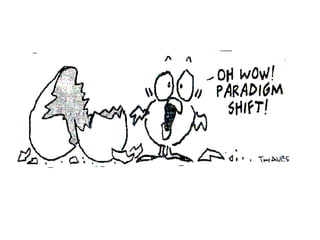






Paradigm shift in Spinal Manual Therapy
Biomechanics to Neurophysiology
Dr.B.KANNABIRAN PhD P.T
PROFESSOR – RVS COLLEGE OF PHYSIOTHERAPY
SPINAL,FASCIAL,CRANIAL,VISCERAL MANIPULATION & DRY NEEDLING PRACTIONER
COIMBATORE
EXISTENCE OF CHANGE PREVAILS IN
ALL THE MAJOR DOMAINS OF
PHYSICAL THERAPY
• EXERCISE THERAPY
• ELECTRO THERAPY
• HYDRO THERAPY
•MANUAL THERAPY
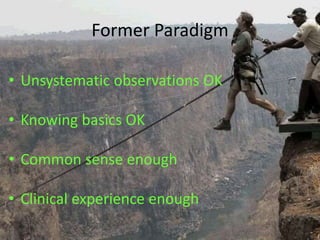
Former Paradigm
• Unsystematic observations OK
• Knowing basics OK
• Common sense enough
• Clinical experience enough
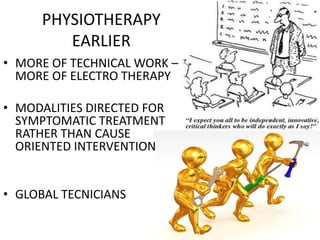
PHYSIOTHERAPY
EARLIER
• MORE OF TECHNICAL WORK –
MORE OF ELECTRO THERAPY
• MODALITIES DIRECTED FOR
SYMPTOMATIC TREATMENT
RATHER THAN CAUSE
ORIENTED INTERVENTION
• GLOBAL TECNICIANS
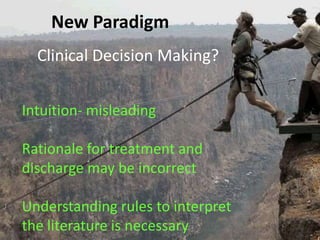
Clinical Decision Making?
Intuition- misleading
Rationale for treatment and
discharge may be incorrect
Understanding rules to interpret
the literature is necessary
New Paradigm
Why Evidence- based
Practice
• 30,000 biomedical journal articles per year with a 7% increase
each year
• There are over 3,200 physiotherapy articles published per year
• To keep up to date, a clinician would need to read
approximately 10 articles per day
• If 2 articles are read per day, after 1 year a clinician would be
approximately 4 years behind
Consequences of Not Keeping
Up-To-Date
• Lag in optimal practice behaviors
• Clinical practice is opinion driven
• Patients may be denied best care
• Patients may selectively know more than clinicians
What qualities define a clinical specialist
Manual Physical Therapist?
• Content knowledge
• Practical knowledge
• Technical skill
• Application of general principles or theory
• Critical analysis
Mildonis et al, JOSPT, 1999
Evidence – based Practice
Imperfect but necessary
Evidence-based Practice
“the integration of best research
evidence with clinical expertise and
patient values”
D.L. Sackett et al, 2000
Clinical Decision
Making?
THINKING THERAPISTS
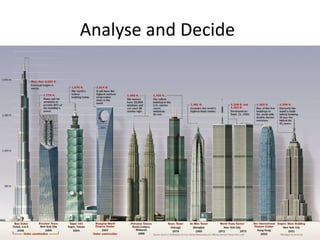
Analyse and Decide
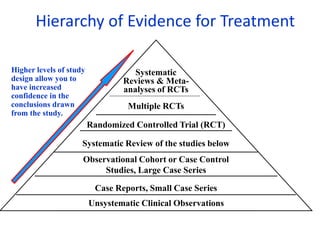
Observational Cohort or Case Control
Studies, Large Case Series
Systematic
Reviews & Meta-
analyses of RCTs
Case Reports, Small Case Series
Systematic Review of the studies below
Randomized Controlled Trial (RCT)
Multiple RCTs
Unsystematic Clinical Observations
Higher levels of study
design allow you to
have increased
confidence in the
conclusions drawn
from the study.
Hierarchy of Evidence for Treatment
A joint can be stable only if there
is equilibrium between the
forces acting on it
STEINDLER, 1955
• “The cause of low
back pain is unknown
in the majority of the
cases”
• NACHEMSON 1984
• “Since the cause is
unknown let us not
waste time with a
diagnosis but
concentrate on
treating the objective
findings”
• PARIS 1984
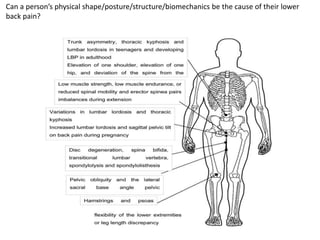
Figure 1
Journal of Bodywork and Movement Therapies 2011 15, 131-138DOI: (10.1016/j.jbmt.2011.01.011)
Can a person’s physical shape/posture/structure/biomechanics be the cause of their lower
back pain?
popular and enduring biomechanical concept is the spinal
“neutral zone”. It claims to be related to stability and LBP
(Panjabi, 1992a and b; Panjabi, 2003; Suni et al., 2006).
This mechanical concept is derived from mathematical
models and cadaver experiments on which an extensive
amount of spinal joint damage had to be inflicted before
the
findings could fit the model (Gracovetsky, 2005). Since its
inception three decades ago, no study exists to show
a correlation between mechanical changes in the neutral
zone changes and LBP (Leone et al., 2007, review).
Facts
• The disparity between pathomechanics and
symptomatology can be observed in other
segmental conditions.
• For example, in an MRI study of patients with
nerve root pain it was found that the degree of
disc displacement, nerve root enhancement or
nerve compression did not correlate with the
magnitude of the patients’ subjective pain or
level of functional disability (Karppinen et al.,
2001; see also Beattie et al., 2000).
Facts
• No association has been found between
congenital abnormalities in the lumbar spine and
pain in that area (spina bifida, transitional lumbar
vertebra, spondylolysis and spondylolisthesis: van
Tulder et al., 1997, syst. review, Luoma et al.,
2004; Brooks et al., 2009).
• Although spina bifida and transitional vertebra
may not be the cause of LBP, they may determine
the pain levels (Taskaynatan et al., 2005, weaker
study).
Facts
• Prospective studies of inflexibility of the lower
extremities and hamstrings and psoas
tightness also fail to predict future episodes of
LBP (Hellsing, 1988c; Nadler, 1998).
Facts
• Surprisingly even whole body changes such as
overweight/ obesity have a low association with
LBP (Leboeuf- Yde, 2000 syst. review).
• Contrary to common beliefs, a recent study has
shown that cumulative or repetitive loading due
to higher body mass (nearly 30 pounds on
average) was not harmful to the discs. The study
founda slight delay in disc desiccation (L1-L4) in
the heavier men when compared with their
lighter twin brothers (Videman et al., 2009).
Facts
• As for foot biomechanics there is strong
evidence that orthotic corrections have no
effect on preventing back pain (Sahar et al.,
2007, syst. review).
The alternative: a process approach
• A clinical alternative to the PSB model is a
Process Approach model.
• In this approach the aim is to identify the
processes underlying the patient’s condition
and provide the
stimulation/signals/management/care that
will support/assist/facilitate change.
Summary
• PSB asymmetries and imperfections are normal
variations not a pathology.
• Neuromuscular and motor control variations are also
normal.
• The body has surplus capacity to tolerate such variation
without loss to normal function or development of
symptomatic conditions.
• Pathomechanics do not determine symptomatology.
• There is no relationship between the pre-existing PSB
factors and back pain.
• Correcting all PSB factors is not clinically attainable and
is unlikely to change the future course of a lower back
condition.
Clinical implications
• Observational or physical assessments of PSB factors
have no value in elucidating the causes for back pain.
• Clinical assessment of PSB factors assessed by manual
and visual means may be unreliable.
• Such assessments are likely to be terminated and can
be safely removed from clinical practice. This excludes
assessment that aim to identify serious pathologies.
• PSB factors are unlikely to change in the long-term by
manual techniques or even exercise, unless rigorously
maintained (exercise).
• A PSB model may introduce an element of therapeutic
failure as the aims and goals of this approach may not
be attainable by manual therapy or even exercise.
References
The fall of the postural-structural-biomechanical model in
manual and physical therapies: Exemplified by lower back
pain
Eyal Lederman, PhD DO
Journal of Bodywork and Movement Therapies
Volume 15, Issue 2, Pages 131-138 (April 2011)
DOI: 10.1016/j.jbmt.2011.01.011
THINKING THERAPISTS

Paradigm shift in spinal manual therapy

  • 1.
    Paradigm shift inSpinal Manual Therapy Biomechanics to Neurophysiology Dr.B.KANNABIRAN PhD P.T PROFESSOR – RVS COLLEGE OF PHYSIOTHERAPY SPINAL,FASCIAL,CRANIAL,VISCERAL MANIPULATION & DRY NEEDLING PRACTIONER COIMBATORE
  • 2.
    EXISTENCE OF CHANGEPREVAILS IN ALL THE MAJOR DOMAINS OF PHYSICAL THERAPY • EXERCISE THERAPY • ELECTRO THERAPY • HYDRO THERAPY •MANUAL THERAPY
  • 3.
    Former Paradigm • Unsystematicobservations OK • Knowing basics OK • Common sense enough • Clinical experience enough
  • 4.
    PHYSIOTHERAPY EARLIER • MORE OFTECHNICAL WORK – MORE OF ELECTRO THERAPY • MODALITIES DIRECTED FOR SYMPTOMATIC TREATMENT RATHER THAN CAUSE ORIENTED INTERVENTION • GLOBAL TECNICIANS
  • 6.
    Clinical Decision Making? Intuition-misleading Rationale for treatment and discharge may be incorrect Understanding rules to interpret the literature is necessary New Paradigm
  • 7.
    Why Evidence- based Practice •30,000 biomedical journal articles per year with a 7% increase each year • There are over 3,200 physiotherapy articles published per year • To keep up to date, a clinician would need to read approximately 10 articles per day • If 2 articles are read per day, after 1 year a clinician would be approximately 4 years behind
  • 8.
    Consequences of NotKeeping Up-To-Date • Lag in optimal practice behaviors • Clinical practice is opinion driven • Patients may be denied best care • Patients may selectively know more than clinicians
  • 9.
    What qualities definea clinical specialist Manual Physical Therapist? • Content knowledge • Practical knowledge • Technical skill • Application of general principles or theory • Critical analysis Mildonis et al, JOSPT, 1999
  • 10.
    Evidence – basedPractice Imperfect but necessary
  • 11.
    Evidence-based Practice “the integrationof best research evidence with clinical expertise and patient values” D.L. Sackett et al, 2000
  • 12.
  • 13.
  • 14.
    Observational Cohort orCase Control Studies, Large Case Series Systematic Reviews & Meta- analyses of RCTs Case Reports, Small Case Series Systematic Review of the studies below Randomized Controlled Trial (RCT) Multiple RCTs Unsystematic Clinical Observations Higher levels of study design allow you to have increased confidence in the conclusions drawn from the study. Hierarchy of Evidence for Treatment
  • 15.
    A joint canbe stable only if there is equilibrium between the forces acting on it STEINDLER, 1955
  • 16.
    • “The causeof low back pain is unknown in the majority of the cases” • NACHEMSON 1984 • “Since the cause is unknown let us not waste time with a diagnosis but concentrate on treating the objective findings” • PARIS 1984
  • 17.
    Figure 1 Journal ofBodywork and Movement Therapies 2011 15, 131-138DOI: (10.1016/j.jbmt.2011.01.011) Can a person’s physical shape/posture/structure/biomechanics be the cause of their lower back pain?
  • 18.
    popular and enduringbiomechanical concept is the spinal “neutral zone”. It claims to be related to stability and LBP (Panjabi, 1992a and b; Panjabi, 2003; Suni et al., 2006). This mechanical concept is derived from mathematical models and cadaver experiments on which an extensive amount of spinal joint damage had to be inflicted before the findings could fit the model (Gracovetsky, 2005). Since its inception three decades ago, no study exists to show a correlation between mechanical changes in the neutral zone changes and LBP (Leone et al., 2007, review).
  • 19.
    Facts • The disparitybetween pathomechanics and symptomatology can be observed in other segmental conditions. • For example, in an MRI study of patients with nerve root pain it was found that the degree of disc displacement, nerve root enhancement or nerve compression did not correlate with the magnitude of the patients’ subjective pain or level of functional disability (Karppinen et al., 2001; see also Beattie et al., 2000).
  • 20.
    Facts • No associationhas been found between congenital abnormalities in the lumbar spine and pain in that area (spina bifida, transitional lumbar vertebra, spondylolysis and spondylolisthesis: van Tulder et al., 1997, syst. review, Luoma et al., 2004; Brooks et al., 2009). • Although spina bifida and transitional vertebra may not be the cause of LBP, they may determine the pain levels (Taskaynatan et al., 2005, weaker study).
  • 21.
    Facts • Prospective studiesof inflexibility of the lower extremities and hamstrings and psoas tightness also fail to predict future episodes of LBP (Hellsing, 1988c; Nadler, 1998).
  • 22.
    Facts • Surprisingly evenwhole body changes such as overweight/ obesity have a low association with LBP (Leboeuf- Yde, 2000 syst. review). • Contrary to common beliefs, a recent study has shown that cumulative or repetitive loading due to higher body mass (nearly 30 pounds on average) was not harmful to the discs. The study founda slight delay in disc desiccation (L1-L4) in the heavier men when compared with their lighter twin brothers (Videman et al., 2009).
  • 23.
    Facts • As forfoot biomechanics there is strong evidence that orthotic corrections have no effect on preventing back pain (Sahar et al., 2007, syst. review).
  • 24.
    The alternative: aprocess approach • A clinical alternative to the PSB model is a Process Approach model. • In this approach the aim is to identify the processes underlying the patient’s condition and provide the stimulation/signals/management/care that will support/assist/facilitate change.
  • 25.
    Summary • PSB asymmetriesand imperfections are normal variations not a pathology. • Neuromuscular and motor control variations are also normal. • The body has surplus capacity to tolerate such variation without loss to normal function or development of symptomatic conditions. • Pathomechanics do not determine symptomatology. • There is no relationship between the pre-existing PSB factors and back pain. • Correcting all PSB factors is not clinically attainable and is unlikely to change the future course of a lower back condition.
  • 26.
    Clinical implications • Observationalor physical assessments of PSB factors have no value in elucidating the causes for back pain. • Clinical assessment of PSB factors assessed by manual and visual means may be unreliable. • Such assessments are likely to be terminated and can be safely removed from clinical practice. This excludes assessment that aim to identify serious pathologies. • PSB factors are unlikely to change in the long-term by manual techniques or even exercise, unless rigorously maintained (exercise). • A PSB model may introduce an element of therapeutic failure as the aims and goals of this approach may not be attainable by manual therapy or even exercise.
  • 28.
    References The fall ofthe postural-structural-biomechanical model in manual and physical therapies: Exemplified by lower back pain Eyal Lederman, PhD DO Journal of Bodywork and Movement Therapies Volume 15, Issue 2, Pages 131-138 (April 2011) DOI: 10.1016/j.jbmt.2011.01.011 THINKING THERAPISTS