


SUSPENSION THERAPY
Dr.Satish K Pimpale PT
MPTh in Neurosciences
Assistant Professor
TMV'S Lokmanya Medical College of Physiotherapy,
Kharghar ,Navi Mumbai
At the end of the session...
 Principle
 Suspension Apparatus
 Types of Suspension
 Effect & Uses
 Techniques for individual joints
Dr.Satish K Pimpale PT
PRINCIPLE
Principle
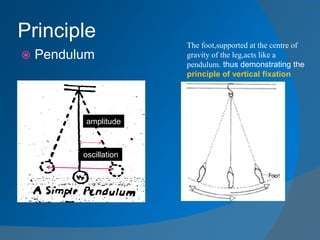
 Pendulum
amplitude
oscillation
The foot,supported at the centre of
gravity of the leg,acts like a
pendulum. thus demonstrating the
principle of vertical fixation
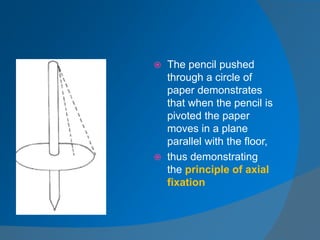
 The pencil pushed
through a circle of
paper demonstrates
that when the pencil is
pivoted the paper
moves in a plane
parallel with the floor,
 thus demonstrating
the principle of axial
fixation
Suspension Apparatus
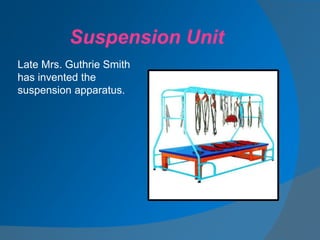
Suspension Unit
Late Mrs. Guthrie Smith
has invented the
suspension apparatus.
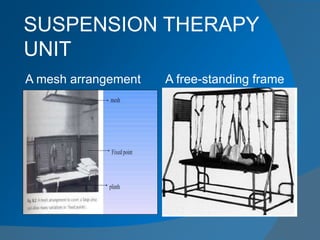
SUSPENSION THERAPY
UNIT
A mesh arrangement A free-standing frame
Fixed point.
Supporting ropes
Slings
Wooden Cleat
Dog clip/ S Hook
Storage trolley
Parts
It is made of stainless steel or
plastic coated steel.
In the top and head end side
presents the 5cm metal mesh
and remaining side kept open.
Fixed Point
Ropes should be of 3-ply hemp
so that they will not slip.
1.5m long
There are following three types of
supporting ropes:
1) Single Rope
2) Double Rope
3) Pulley Rope
Supporting Ropes
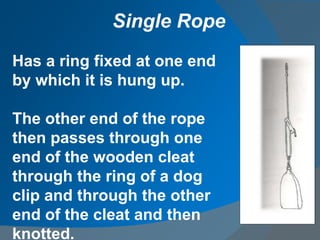
Has a ring fixed at one end
by which it is hung up.
The other end of the rope
then passes through one
end of the wooden cleat
through the ring of a dog
clip and through the other
end of the cleat and then
knotted.
Single Rope
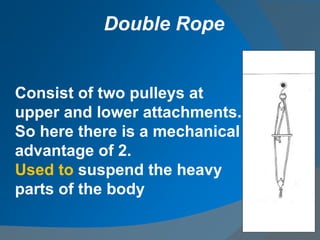
Consist of two pulleys at
upper and lower attachments.
So here there is a mechanical
advantage of 2.
Used to suspend the heavy
parts of the body
Double Rope
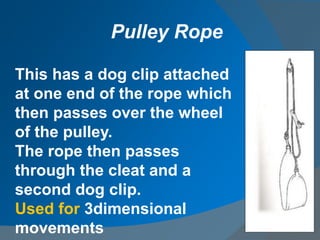
This has a dog clip attached
at one end of the rope which
then passes over the wheel
of the pulley.
The rope then passes
through the cleat and a
second dog clip.
Used for 3dimensional
movements
Pulley Rope
There are following four types of
slings:
Single Sling
Double Sling
Three Ring Sling/3D RING SLING
Head Sling
Slings
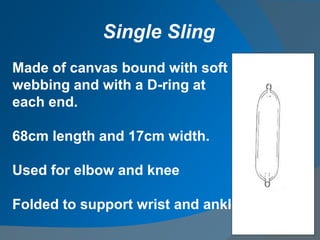
Made of canvas bound with soft
webbing and with a D-ring at
each end.
68cm length and 17cm width.
Used for elbow and knee
Folded to support wrist and ankle.
Single Sling
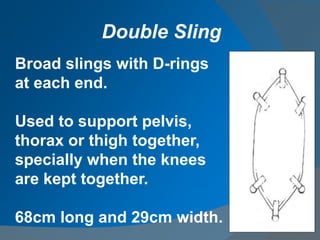
Broad slings with D-rings
at each end.
Used to support pelvis,
thorax or thigh together,
specially when the knees
are kept together.
68cm long and 29cm width.
Double Sling
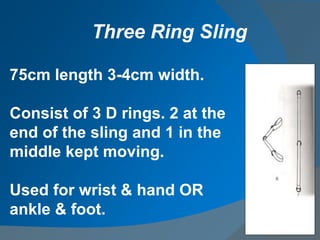
75cm length 3-4cm width.
Consist of 3 D rings. 2 at the
end of the sling and 1 in the
middle kept moving.
Used for wrist & hand OR
ankle & foot.
Three Ring Sling
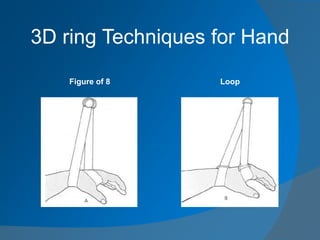
3D ring Techniques for Hand
Figure of 8 Loop
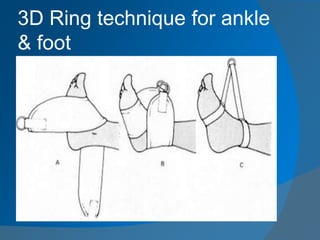
3D Ring technique for ankle
& foot
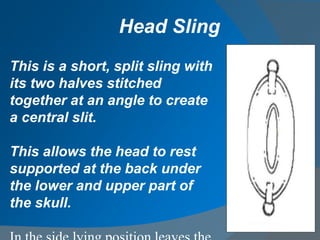
This is a short, split sling with
its two halves stitched
together at an angle to create
a central slit.
This allows the head to rest
supported at the back under
the lower and upper part of
the skull.
Head Sling
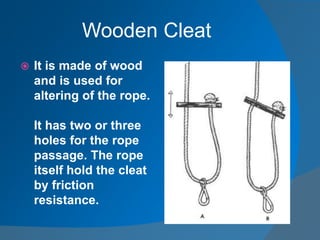
Wooden Cleat
 It is made of wood
and is used for
altering of the rope.
It has two or three
holes for the rope
passage. The rope
itself hold the cleat
by friction
resistance.
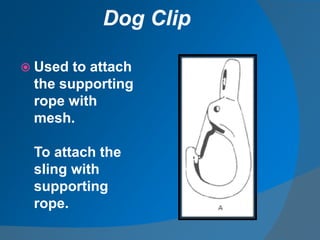
Dog Clip
 Used to attach
the supporting
rope with
mesh.
To attach the
sling with
supporting
rope.
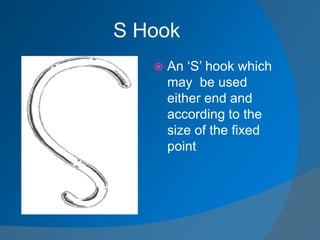
S Hook
 An ‘S’ hook which
may be used
either end and
according to the
size of the fixed
point
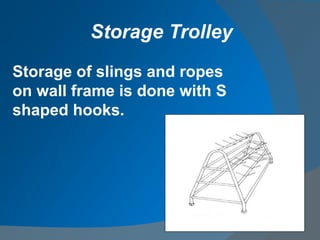
Storage of slings and ropes
on wall frame is done with S
shaped hooks.
Storage Trolley
Types of Suspension
Effect & Uses
These movements are
produced by an external force
during muscular inactivity is
voluntarily reduced as much
as possible to permit
movements.
Passive Movements
when muscle strength or co-
ordination is inadequate to perform
a movement an external force is
applied to compensate for the
deficiency
Assisted Exercises
Treatment or therapeutic
exercise given to patients to
increase ROM,
increase muscle power and
support body parts by using
ropes and slings.
Suspension Therapy
Muscle Strengthening.
Neuro-Muscular Co-
ordination
Aim
There are following three types of
suspension therapy:
Axial Suspension
Pendular Suspension
Vertical Suspension
Types
It is the most common type.
Joint is taken as point of suspension.
Limb is supported by the slings above the
joint.
Limb will move to both sides parallel to
floor.
Axial Suspension
Relaxation.
Maintain muscle property.
Increase blood circulation.
Increase venous and lymphatic
drainage.
Uses
Point of suspension should be shifted
away from the joint axis.
Muscles will be getting resistance while
moving if the axis is shifted opposite to
that movement.
Pendular Suspension
Increase the muscle strength.
Increase the muscle endurance.
Uses
COG of the body part or the body is
taken as point of suspension.
Used to provide support to the body
parts of the patient.
Vertical Suspension
Relaxation.
Prevent pressure sore
Support
Uses
It reduces the burden of
therapist.
Easy to lift the limbs.
Active movement can be
performed easily with
minimum friction.
Advantages
Techniques for individual joints
Shoulder - flexion/extension & abduction/adduction
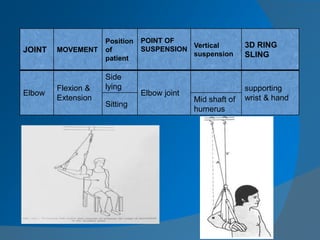
Elbow – flexion/extension
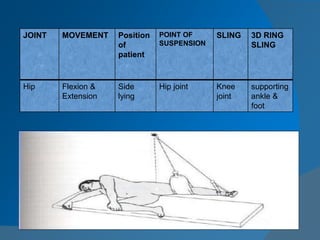
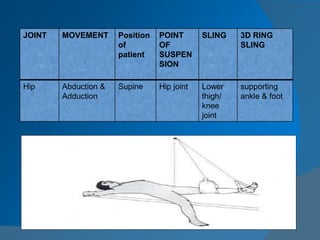
Hip - Shoulder-flexion/extension & abduction/adduction
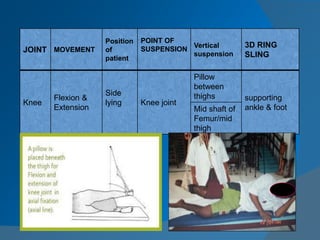
Knee – flexion/extension
Suspension exercises can be
performed on upper limbs and lower
limbs.
Suspension Exercises
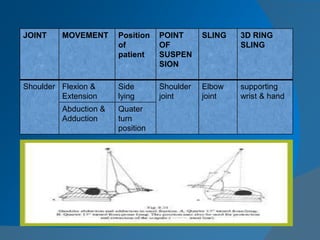
JOINT MOVEMENT Position
of
patient
POINT
OF
SUSPEN
SION
SLING 3D RING
SLING
Shoulder Flexion &
Extension
Side
lying
Shoulder
joint
Elbow
joint
supporting
wrist & hand
Abduction &
Adduction
Quater
turn
position
JOINT MOVEMENT
Position
of
patient
POINT OF
SUSPENSION
Vertical
suspension
3D RING
SLING
Elbow
Flexion &
Extension
Side
lying
Elbow joint
supporting
wrist & hand
Sitting
Mid shaft of
humerus
JOINT MOVEMENT Position
of
patient
POINT OF
SUSPENSION
SLING 3D RING
SLING
Hip Flexion &
Extension
Side
lying
Hip joint Knee
joint
supporting
ankle &
foot
JOINT MOVEMENT Position
of
patient
POINT
OF
SUSPEN
SION
SLING 3D RING
SLING
Hip Abduction &
Adduction
Supine Hip joint Lower
thigh/
knee
joint
supporting
ankle & foot
JOINT MOVEMENT
Position
of
patient
POINT OF
SUSPENSION
Vertical
suspension
3D RING
SLING
Knee
Flexion &
Extension
Side
lying Knee joint
Pillow
between
thighs supporting
ankle & footMid shaft of
Femur/mid
thigh
Summary
 Axial
 Pendular
 Vertical
References
 The Principles of Exercise Therapy-
M.Dena Gardiner
 Practical Exercise Therapy by Margaret
Hollis
Suspension Therapy

Suspension Therapy

  • 1.
    SUSPENSION THERAPY Dr.Satish KPimpale PT MPTh in Neurosciences Assistant Professor TMV'S Lokmanya Medical College of Physiotherapy, Kharghar ,Navi Mumbai
  • 2.
    At the endof the session...  Principle  Suspension Apparatus  Types of Suspension  Effect & Uses  Techniques for individual joints Dr.Satish K Pimpale PT
  • 3.
  • 4.
    Principle  Pendulum amplitude oscillation The foot,supportedat the centre of gravity of the leg,acts like a pendulum. thus demonstrating the principle of vertical fixation
  • 5.
     The pencilpushed through a circle of paper demonstrates that when the pencil is pivoted the paper moves in a plane parallel with the floor,  thus demonstrating the principle of axial fixation
  • 6.
  • 7.
    Suspension Unit Late Mrs.Guthrie Smith has invented the suspension apparatus.
  • 8.
    SUSPENSION THERAPY UNIT A mesharrangement A free-standing frame
  • 9.
    Fixed point. Supporting ropes Slings WoodenCleat Dog clip/ S Hook Storage trolley Parts
  • 10.
    It is madeof stainless steel or plastic coated steel. In the top and head end side presents the 5cm metal mesh and remaining side kept open. Fixed Point
  • 11.
    Ropes should beof 3-ply hemp so that they will not slip. 1.5m long There are following three types of supporting ropes: 1) Single Rope 2) Double Rope 3) Pulley Rope Supporting Ropes
  • 12.
    Has a ringfixed at one end by which it is hung up. The other end of the rope then passes through one end of the wooden cleat through the ring of a dog clip and through the other end of the cleat and then knotted. Single Rope
  • 13.
    Consist of twopulleys at upper and lower attachments. So here there is a mechanical advantage of 2. Used to suspend the heavy parts of the body Double Rope
  • 14.
    This has adog clip attached at one end of the rope which then passes over the wheel of the pulley. The rope then passes through the cleat and a second dog clip. Used for 3dimensional movements Pulley Rope
  • 15.
    There are followingfour types of slings: Single Sling Double Sling Three Ring Sling/3D RING SLING Head Sling Slings
  • 16.
    Made of canvasbound with soft webbing and with a D-ring at each end. 68cm length and 17cm width. Used for elbow and knee Folded to support wrist and ankle. Single Sling
  • 17.
    Broad slings withD-rings at each end. Used to support pelvis, thorax or thigh together, specially when the knees are kept together. 68cm long and 29cm width. Double Sling
  • 18.
    75cm length 3-4cmwidth. Consist of 3 D rings. 2 at the end of the sling and 1 in the middle kept moving. Used for wrist & hand OR ankle & foot. Three Ring Sling
  • 19.
    3D ring Techniquesfor Hand Figure of 8 Loop
  • 20.
    3D Ring techniquefor ankle & foot
  • 21.
    This is ashort, split sling with its two halves stitched together at an angle to create a central slit. This allows the head to rest supported at the back under the lower and upper part of the skull. Head Sling
  • 22.
    Wooden Cleat  Itis made of wood and is used for altering of the rope. It has two or three holes for the rope passage. The rope itself hold the cleat by friction resistance.
  • 23.
    Dog Clip  Usedto attach the supporting rope with mesh. To attach the sling with supporting rope.
  • 24.
    S Hook  An‘S’ hook which may be used either end and according to the size of the fixed point
  • 25.
    Storage of slingsand ropes on wall frame is done with S shaped hooks. Storage Trolley
  • 26.
  • 27.
    These movements are producedby an external force during muscular inactivity is voluntarily reduced as much as possible to permit movements. Passive Movements
  • 28.
    when muscle strengthor co- ordination is inadequate to perform a movement an external force is applied to compensate for the deficiency Assisted Exercises
  • 29.
    Treatment or therapeutic exercisegiven to patients to increase ROM, increase muscle power and support body parts by using ropes and slings. Suspension Therapy
  • 30.
  • 31.
    There are followingthree types of suspension therapy: Axial Suspension Pendular Suspension Vertical Suspension Types
  • 32.
    It is themost common type. Joint is taken as point of suspension. Limb is supported by the slings above the joint. Limb will move to both sides parallel to floor. Axial Suspension
  • 33.
    Relaxation. Maintain muscle property. Increaseblood circulation. Increase venous and lymphatic drainage. Uses
  • 34.
    Point of suspensionshould be shifted away from the joint axis. Muscles will be getting resistance while moving if the axis is shifted opposite to that movement. Pendular Suspension
  • 35.
    Increase the musclestrength. Increase the muscle endurance. Uses
  • 36.
    COG of thebody part or the body is taken as point of suspension. Used to provide support to the body parts of the patient. Vertical Suspension
  • 37.
  • 38.
    It reduces theburden of therapist. Easy to lift the limbs. Active movement can be performed easily with minimum friction. Advantages
  • 39.
    Techniques for individualjoints Shoulder - flexion/extension & abduction/adduction Elbow – flexion/extension Hip - Shoulder-flexion/extension & abduction/adduction Knee – flexion/extension
  • 40.
    Suspension exercises canbe performed on upper limbs and lower limbs. Suspension Exercises
  • 41.
    JOINT MOVEMENT Position of patient POINT OF SUSPEN SION SLING3D RING SLING Shoulder Flexion & Extension Side lying Shoulder joint Elbow joint supporting wrist & hand Abduction & Adduction Quater turn position
  • 42.
    JOINT MOVEMENT Position of patient POINT OF SUSPENSION Vertical suspension 3DRING SLING Elbow Flexion & Extension Side lying Elbow joint supporting wrist & hand Sitting Mid shaft of humerus
  • 43.
    JOINT MOVEMENT Position of patient POINTOF SUSPENSION SLING 3D RING SLING Hip Flexion & Extension Side lying Hip joint Knee joint supporting ankle & foot
  • 44.
    JOINT MOVEMENT Position of patient POINT OF SUSPEN SION SLING3D RING SLING Hip Abduction & Adduction Supine Hip joint Lower thigh/ knee joint supporting ankle & foot
  • 45.
    JOINT MOVEMENT Position of patient POINT OF SUSPENSION Vertical suspension 3DRING SLING Knee Flexion & Extension Side lying Knee joint Pillow between thighs supporting ankle & footMid shaft of Femur/mid thigh
  • 46.
  • 47.
    References  The Principlesof Exercise Therapy- M.Dena Gardiner  Practical Exercise Therapy by Margaret Hollis

Editor's Notes

  • #5 a simple pendulum is a heavy object, suspended by a weightless thread and free to move to & fro..when the pendulum is at rest the thread(rope) is vertical,but if the weight is drwan to one side and then released ,the pendulum will swing to & fro.one complete swing in each directn is called as oscillation,and the extent of swing to any one side from vertical is the amplitude.a force is required to set the pendulum in motion and then the oscillation will continue until it is brought to rest,suddenly,by an opposing force,or progessivy by an opposing force,acceleration is due to gravity.
  • #8 Suspension is the means whereby parts of the body are supported in slings and elevated by the use of variable length ropes fixed to a point above the body. Suspension frees the body from the friction of the material upon which body components may be resting and it permits free movement without resistance when the fixation is suitably arranged relative to the supported part. This is a frame big enough to take a single bed
  • #37 Vertical fixation is used primarily to support, e.g. the abducted upper limb when the elbow is to be moved is supported from above the centre of gravity of the arm and axial fixation is used over the elbow for forearm movement
  • #42 Flexion & ext: The starting position is side lying on pillows and quarter turned to the back. Female patients need two pillows under the head and one under the shoulder to allow the forearm to clear their wider pelvis. The slings and ropes are arranged as described above and again the movement may be limited to the glenohumeral joint and the muscles working over it, or movements of the shoulder girdle may be included.If in addition to the angular movements it is desired to perform rotation of the glenohumeral joint, then only one sling should be used at the level of the elbow and a single pulley rope should be attached to the fixed point above the shoulder. The ends of the sling are attached to each end of the pulley circuit and it will then be possible to perform medial or lateral rotation with two angular movements abduction & adduction:The starting position is lying, quarter turned towards the arm which is to be moved (Fig. 8.21A). This allows the normal anatomical movement to be performed in the plane of the scapula. Alternatively, the starting position is prone lying, quarter turned towards side lying with a pillow under the trunk on the side of the arm which is to be moved (Fig. 8.21B). The advantage of prone lying is that the therapist can see the movements of the scapula as well as those of the arm. Two single ropes are required, one attached to a single sling under the elbow and one to a three-ring sling applied to the wrist and hand. The fixation point is over the shoulder joint. If the movement is to be only of the glenohumeral joint, the therapist must stand on the opposite side with one hand on the point of the shoulder depressing the scapula. In this form of support either abduction and adduction of the glenohumeral joint, or movements of the shoulder girdle, may be mobilized. Glenohumeral rhythm may be re-educated and all the muscles performing shoulder girdle movements may be worked.
  • #43 Because of the carrying angle of the forearm it is easier to perform these movements when the arm is suspended in abduction. The starting position is sitting on a low-backed chair. A single sling and rope supports the arm in vertical fixation, and a three-ring sling and single rope are fixed to a point above the elbow joint (Fig. 8.15). The therapist should stand behind as she may need to give additional support by holding the arm with a grasp inside the sling, which will allow palpation of the flexors and extensors which are covered by the supporting sling. Alternatively, a folded single sling under the palm, attached to a single pulley rope, will allow pronation and supination to occur with extension and flexion of the elbow joint.
  • #44 The starting position is side lying with the underneath leg flexed as far as possible. The fixation point and sling arrangements are as above, with the limb lifted until it is horizontal. If the movement of flexion is to be mobilized the knee and hip must be flexed together to overcome the passive insufficiency of the hamstrings.Equally, when mobilizing extension the knee should be extended to overcome active insufficiency of the hamstrings  
  • #45 The starting position is lying with the opposite leg abducted to its limit, even if the knee has to be bent over the side of the plinth and the foot supported on a footstool. The fixation point is immediately above the hip joint. One sling is put under the lower thigh and one three-ring sling on the foot and ankle; each is attached to a rope hung from the fixation point. The limb is lifted just clear of the plinth. Using this method of support the movements of abduction and adduction may be mobilized or the abductor or adductor muscles may be especially worked with or without manual resistance
  • #46 The starting position is side lying with one or two pillows between the slightly flexed thighs. One three-ring sling is applied to the foot and ankle and one rope attached to a fixation point above the knee joint. By keeping the hip slightly flexed on the trunk the foot can be seen each time the knee is extended and part of the arc of movement is thus observed by the patient. This position may be used to mobilize the knee joint or to work the flexors or extensors of the knee