SPRAINED ANKLE
By Ashley Dockstader
WHAT IS A SPRAINED ANKLE?
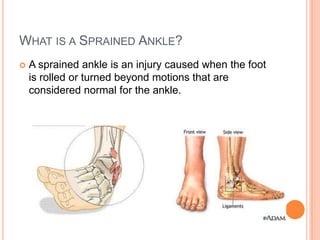
   A sprained ankle is an injury caused when the foot
    is rolled or turned beyond motions that are
    considered normal for the ankle.
CAUSES OF A SPRAINED ANKLE
   Sprained ankles are caused when the ankle is
    turned in or inverted.

   Many sprained ankles are caused from sports
    because it is really easy to sprain your ankle while
    playing a sport.
TYPES OF SPRAINED ANKLES
   There are three types of sprained ankles. A Grade
    1, Grade 2, and Grade 3 sprain.

 Grade 1 sprains are slight stretching and damage
  to the fibers of the ligament.
 Grade 2 sprains are partial tearing of the ligament.
  Laxity, or looseness, of the ankle joint may occur.
 Grade 3 sprains are complete tearing of the
  ligament, gross instability may occur.
TREATMENT OF A SPRAINED ANKLE
   When treating a Grade 1 and Grade 2 sprain just use “R.I.C.E.”
    Rest, ice, compression and elevate.

   Rest your ankle by not walking on it.
   Ice your ankle for 20-30 minutes 3-4 times daily and combine
    with wrapping to decrease pain and dysfunction.
   Compression dressings, or bandages support and immobilize
    the injured ankle.
   Elevate your ankle above the heart for 48 hours.

When treating a Grade 2 sprain use “R.I.C.E.” but allow for more
 time to heal.
TREATMENT OF A SPRAINED ANKLE
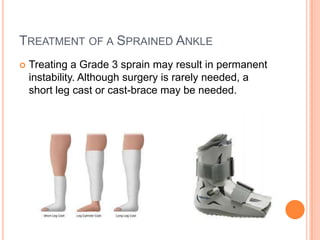
   Treating a Grade 3 sprain may result in permanent
    instability. Although surgery is rarely needed, a
    short leg cast or cast-brace may be needed.
TREATMENT OF A SPRAINED ANKLE
   If your ankle needs to be treated with surgery there
    are 2 common methods that are used.

 Arthroscopy- a surgeon will go in and look to see if
  any loose fragments or pieces of bone or cartilage
  are visible or if part of the ligament is caught in the
  joint.
 Reconstruction- a surgeon will repair the torn
  ligament with stitches or use ligaments from the
  foot to repair the damaged ligament.
REHABILITATION OF A SPRAINED ANKLE
   Rehabilitation is used to help heal the ankle and make
    sure no chronic ankle problems occur, and also to
    decrease pain and swelling.

   Phase 1 is resting and protecting the ankle while
    reducing swelling.
   Phase 2 works on restoring the motion flexibility and
    strength of the ankle.
   Phase 3 includes returning to activity that does not twist
    or turn the ankle, while doing maintenance exercises.

The length of your recovery depends on the severity
  of the sprain and rehabilitation could take weeks to
  months.
PREVENTION OF A SPRAINED ANKLE
   The best way to prevent a sprained ankle is to
    maintain flexibility, good strength, and muscle
    balance.

 Warm up before you exercise.
 Pay attention to walking and running surfaces.

 Wear good shoes.

 Pay attention to your body’s warning signs. Slow
  down when you feel pain or fatigue.
WORKS CITED
 Google images
 http://en.wikipedia.org/wiki/Sprained_ankle

 http://orthoinfo.aaos.org/topic.cfm?topic=a00150

Sprained ankle powerpoint ashley dockstader

  • 1.
  • 2.
    WHAT IS ASPRAINED ANKLE?  A sprained ankle is an injury caused when the foot is rolled or turned beyond motions that are considered normal for the ankle.
  • 4.
    CAUSES OF ASPRAINED ANKLE  Sprained ankles are caused when the ankle is turned in or inverted.  Many sprained ankles are caused from sports because it is really easy to sprain your ankle while playing a sport.
  • 5.
    TYPES OF SPRAINEDANKLES  There are three types of sprained ankles. A Grade 1, Grade 2, and Grade 3 sprain.  Grade 1 sprains are slight stretching and damage to the fibers of the ligament.  Grade 2 sprains are partial tearing of the ligament. Laxity, or looseness, of the ankle joint may occur.  Grade 3 sprains are complete tearing of the ligament, gross instability may occur.
  • 6.
    TREATMENT OF ASPRAINED ANKLE  When treating a Grade 1 and Grade 2 sprain just use “R.I.C.E.” Rest, ice, compression and elevate.  Rest your ankle by not walking on it.  Ice your ankle for 20-30 minutes 3-4 times daily and combine with wrapping to decrease pain and dysfunction.  Compression dressings, or bandages support and immobilize the injured ankle.  Elevate your ankle above the heart for 48 hours. When treating a Grade 2 sprain use “R.I.C.E.” but allow for more time to heal.
  • 7.
    TREATMENT OF ASPRAINED ANKLE  Treating a Grade 3 sprain may result in permanent instability. Although surgery is rarely needed, a short leg cast or cast-brace may be needed.
  • 8.
    TREATMENT OF ASPRAINED ANKLE  If your ankle needs to be treated with surgery there are 2 common methods that are used.  Arthroscopy- a surgeon will go in and look to see if any loose fragments or pieces of bone or cartilage are visible or if part of the ligament is caught in the joint.  Reconstruction- a surgeon will repair the torn ligament with stitches or use ligaments from the foot to repair the damaged ligament.
  • 9.
    REHABILITATION OF ASPRAINED ANKLE  Rehabilitation is used to help heal the ankle and make sure no chronic ankle problems occur, and also to decrease pain and swelling.  Phase 1 is resting and protecting the ankle while reducing swelling.  Phase 2 works on restoring the motion flexibility and strength of the ankle.  Phase 3 includes returning to activity that does not twist or turn the ankle, while doing maintenance exercises. The length of your recovery depends on the severity of the sprain and rehabilitation could take weeks to months.
  • 10.
    PREVENTION OF ASPRAINED ANKLE  The best way to prevent a sprained ankle is to maintain flexibility, good strength, and muscle balance.  Warm up before you exercise.  Pay attention to walking and running surfaces.  Wear good shoes.  Pay attention to your body’s warning signs. Slow down when you feel pain or fatigue.
  • 11.
    WORKS CITED  Googleimages  http://en.wikipedia.org/wiki/Sprained_ankle  http://orthoinfo.aaos.org/topic.cfm?topic=a00150