


Ankle Injuries in gymnasticsBrandi Smith-Young, PTPerfect 10.0 Physical Therapywww.perfect10physicaltherapy.comperfect10pt@gmail.comFellowship trained manual therapistBoard certified orthopedic specialist
IntroductionCompetitive gymnastTwo  time USAG Collegiate National Champions at TWUBachelors in Kinesiology at TWUMasters in Physical Therapy at Tx St
Practicing for 5 yearsFellowship trained in Orthopedic manual physical therapyBoard certified orthopedic specialist in PTOne of 300 therapist in the US with these certifications
My passion:To bring sport specific quality care to gymnastDecrease the number of injuries in gymnastImprove recovery time, decrease time lost in the gym, and improve return to sport statusEnhance performance
Common ComplaintsPain on the outside of the anklePain on the inside back of the anklePain in the midfoot; many times outsidePain in inside of shinPain in outside of shinPain in the Achilles
What plays a role in ankle injuriesAnkle Injury can be caused by and cause:Decreased joint motion (rolling and gliding) Decreased range of motion (flexibility)Decreased strength (hip, knee, ankle)Balance and propriocetion deficits
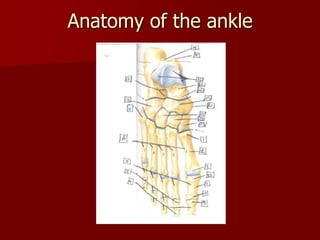
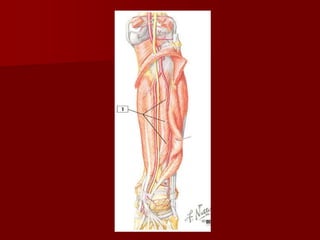
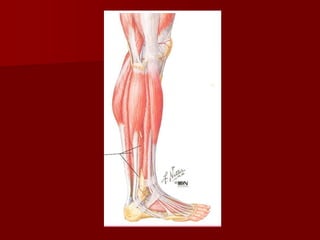
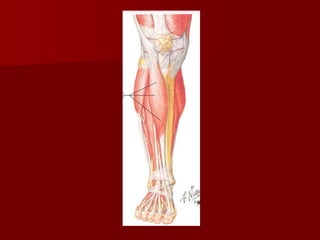
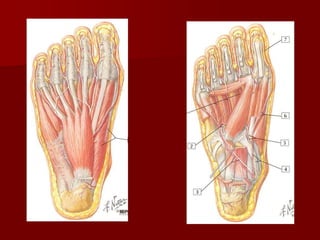
Anatomy of the ankle
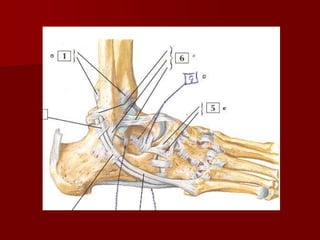
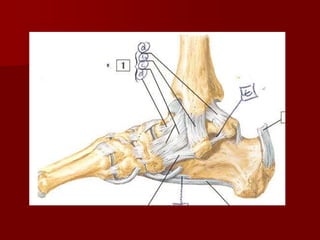
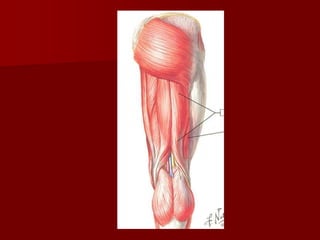
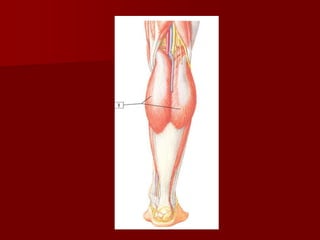
Anatomy cont’dAll these muscle provide stabilization for the ankle and foot.If these muscles are not functioning properly increased stress will eventually lead to injury.
Muscle imbalancesSome muscles are strongWhile opposing muscles are weakSome muscles are stretched outWhile opposing muscles are too tight
Due to the stringent requirements placed on gymnast certain muscles tend to develop stronger than othersCertain muscles get weakOther muscles develop tighterSome develop looser or stretched
Common muscle imbalancesPoor hip, knee, and foot controlWeak hip musclesWeak posterior tibialisPosterior tibialis doing too much and the gastroc not doing enoughWeak Soleus muscle (the other toe pointer)Weak foot intrinsic musclesTight calf muscles
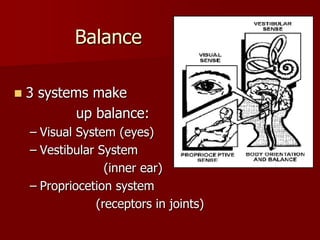
          Balance3 systems make               up balance:Visual System (eyes)Vestibular System                    (inner ear)Propriocetion system                  (receptors in joints)
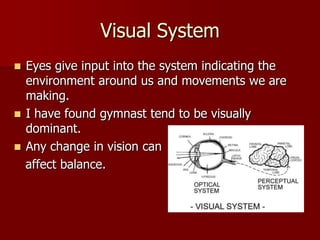
Visual SystemEyes give input into the system indicating the environment around us and movements we are making.I have found gymnast tend to be visually dominant.Any change in vision can   affect balance.
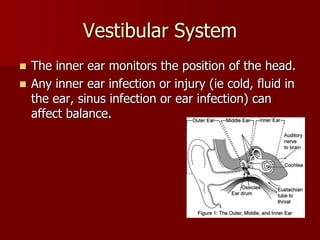
Vestibular SystemThe inner ear monitors the position of the head.Any inner ear infection or injury (ie cold, fluid in the ear, sinus infection or ear infection) can affect balance.
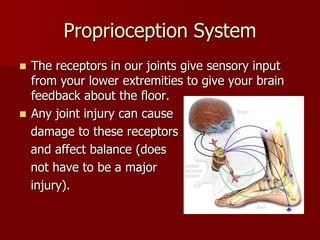
Proprioception SystemThe receptors in our joints give sensory input from your lower extremities to give your brain feedback about the floor.Any joint injury can cause    damage to these receptors   and affect balance (does    not have to be a major   injury).
Demonstration Time
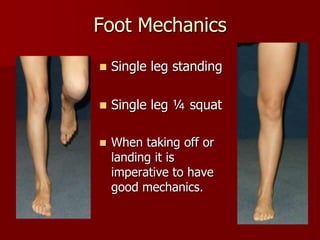
Foot MechanicsSingle leg standingSingle leg ¼ squatWhen taking off or landing it is imperative to have good mechanics.
Improper mechanics lead to repetitive abnormal stressLeads to inefficient performanceLeads to injury
Foot Mechanics & BalanceSingle leg standing (SLS)MechanicsEyes open hard surface Eyes closed(-visual system) (test proprioception and vestibular)Eyes closed on soft surface  (- visual –proprioception) (test vestibular)Eyes closed on soft surface head back(challenge vestibular system)
Eyes open on hard surface
Eyes closed on hard surface
Eyes closed on soft surface
Eyes closed head backon 8 incher
Demonstrate Muscle testing HipAnkleFootFlexibility testingGastrocSoleus
Proper foot mechanics can be achieved byBalancing muscle imbalancesHip, ankle, and foot strength and flexibilityImproving balance or proprioceptionTraining proper take-off and landing mechanics
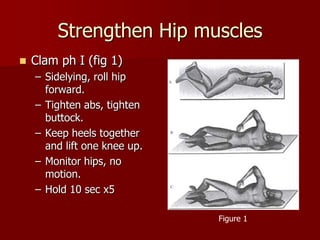
Strengthen Hip musclesClam ph I (fig 1)Sidelying, roll hip forward.Tighten abs, tighten buttock.Keep heels together and lift one knee up.Monitor hips, no motion.Hold 10 sec x5Figure 1
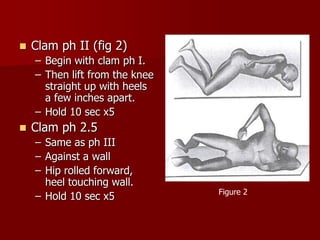
Clam ph II (fig 2)Begin with clam ph I.Then lift from the knee straight up with heels a few inches apart.Hold 10 sec x5Clam ph 2.5Same as ph IIIAgainst a wallHip rolled forward, heel touching wall.Hold 10 sec x5Figure 2
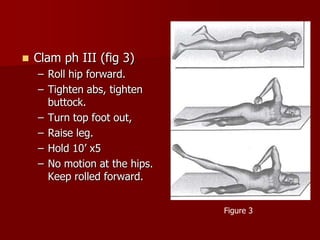
Clam ph III (fig 3)Roll hip forward.Tighten abs, tighten buttock.Turn top foot out,Raise leg.Hold 10’ x5No motion at the hips.  Keep rolled forward.Figure 3
Hip & knee controlSquatting (card pickups near wall)Both legsCreate archHinge from hipsBend straight downKnee over second toe
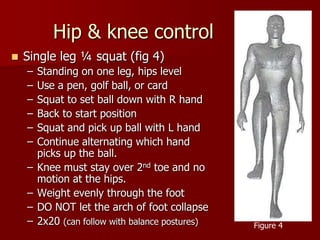
Hip & knee controlSingle leg ¼ squat (fig 4)Standing on one leg, hips levelUse a pen, golf ball, or card Squat to set ball down with R handBack to start positionSquat and pick up ball with L handContinue alternating which hand picks up the ball.Knee must stay over 2nd toe and no motion at the hips.Weight evenly through the footDO NOT let the arch of foot collapse2x20 (can follow with balance postures)Figure 4
These exercises can lead up to landing drills:Make sure the gymnast’s foot is not collapsing when landingMay start with just a jump to a stick.Then jumping from the beam or vault to a stick.
When doing plyos and other conditioning the key is for the gymnast to control their foot on push-off and landing.Do NOT allow the foot to collapse or be loose.
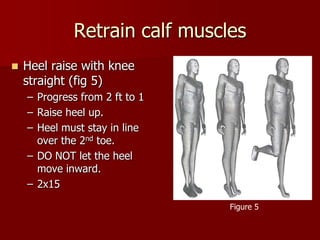
Retrain calf musclesHeel raise with knee straight (fig 5)Progress from 2 ft to 1Raise heel up.Heel must stay in line over the 2nd toe.DO NOT let the heel move inward.2x15Figure 5
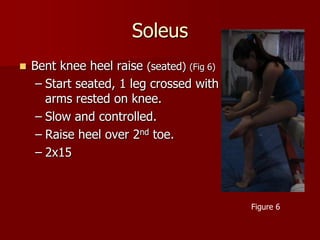
SoleusBent knee heel raise (seated) (Fig 6)Start seated, 1 leg crossed with arms rested on knee.Slow and controlled.Raise heel over 2nd toe.2x15Figure 6
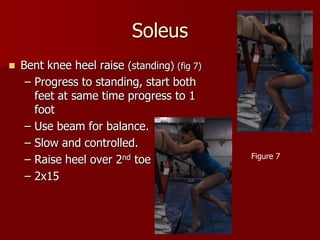
SoleusBent knee heel raise (standing) (fig 7)Progress to standing, start both feet at same time progress to 1 footUse beam for balance.Slow and controlled.Raise heel over 2nd toe2x15Figure 7
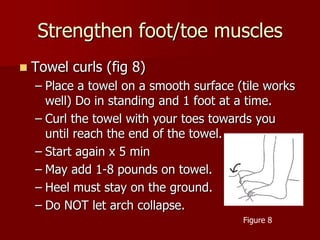
Strengthen foot/toe musclesTowel curls (fig 8)Place a towel on a smooth surface (tile works well) Do in standing and 1 foot at a time.Curl the towel with your toes towards you until reach the end of the towel.Start again x 5 minMay add 1-8 pounds on towel.Heel must stay on the ground.Do NOT let arch collapse.Figure 8
Balance Training progressionSLS eyes openBalance posturesSLS eyes closedBalance posturesSLS on 8 incher eyes openSLS on 8 incher eyes closedSLS on 8 incher head back eyes closedSLS balance postures on beam
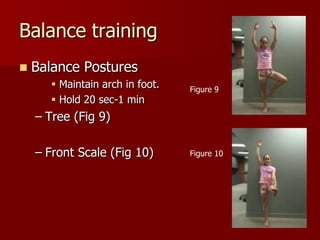
Balance trainingBalance PosturesMaintain arch in foot.Hold 20 sec-1 minTree (Fig 9)Front Scale (Fig 10)Figure 9Figure 10
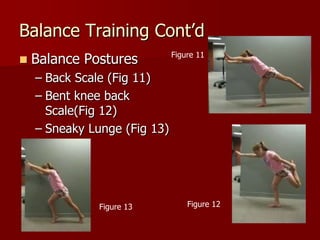
Balance Training Cont’dBalance PosturesBack Scale (Fig 11)Bent knee back Scale(Fig 12)Sneaky Lunge (Fig 13)Figure 11Figure 12Figure 13
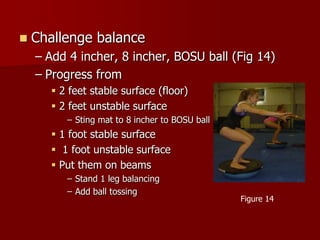
Challenge balanceAdd 4 incher, 8 incher, BOSU ball (Fig 14)Progress from2 feet stable surface (floor)2 feet unstable surface Sting mat to 8 incher to BOSU ball1 foot stable surface 1 foot unstable surfacePut them on beamsStand 1 leg balancingAdd ball tossingFigure 14
Beam ball toss
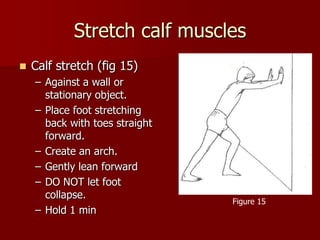
Stretch calf musclesCalf stretch (fig 15)Against a wall or stationary object.Place foot stretching back with toes straight forward.Create an arch.Gently lean forwardDO NOT let foot collapse.Hold 1 minFigure 15
Contact InformationPerfect 10.0 Physical Therapy             & Performance Trainingwww.perfect10physicaltherapy.comperfect10pt@gmail.com512-426-6593Follow  Perfect10PT  on gymanstike, facebook, and twitter
All information from:The Manual Therapy Institutehttp://www.mtitx.com/Shirley Sahrmann.Diagnosis and Treatment of Movement Impairment Syndrome.

Ankle Injuries in Gymnast

  • 1.
    Ankle Injuries ingymnasticsBrandi Smith-Young, PTPerfect 10.0 Physical Therapywww.perfect10physicaltherapy.comperfect10pt@gmail.comFellowship trained manual therapistBoard certified orthopedic specialist
  • 2.
    IntroductionCompetitive gymnastTwo time USAG Collegiate National Champions at TWUBachelors in Kinesiology at TWUMasters in Physical Therapy at Tx St
  • 3.
    Practicing for 5yearsFellowship trained in Orthopedic manual physical therapyBoard certified orthopedic specialist in PTOne of 300 therapist in the US with these certifications
  • 4.
    My passion:To bringsport specific quality care to gymnastDecrease the number of injuries in gymnastImprove recovery time, decrease time lost in the gym, and improve return to sport statusEnhance performance
  • 5.
    Common ComplaintsPain onthe outside of the anklePain on the inside back of the anklePain in the midfoot; many times outsidePain in inside of shinPain in outside of shinPain in the Achilles
  • 6.
    What plays arole in ankle injuriesAnkle Injury can be caused by and cause:Decreased joint motion (rolling and gliding) Decreased range of motion (flexibility)Decreased strength (hip, knee, ankle)Balance and propriocetion deficits
  • 7.
  • 16.
    Anatomy cont’dAll thesemuscle provide stabilization for the ankle and foot.If these muscles are not functioning properly increased stress will eventually lead to injury.
  • 17.
    Muscle imbalancesSome musclesare strongWhile opposing muscles are weakSome muscles are stretched outWhile opposing muscles are too tight
  • 18.
    Due to thestringent requirements placed on gymnast certain muscles tend to develop stronger than othersCertain muscles get weakOther muscles develop tighterSome develop looser or stretched
  • 19.
    Common muscle imbalancesPoorhip, knee, and foot controlWeak hip musclesWeak posterior tibialisPosterior tibialis doing too much and the gastroc not doing enoughWeak Soleus muscle (the other toe pointer)Weak foot intrinsic musclesTight calf muscles
  • 20.
    Balance3 systems make up balance:Visual System (eyes)Vestibular System (inner ear)Propriocetion system (receptors in joints)
  • 21.
    Visual SystemEyes giveinput into the system indicating the environment around us and movements we are making.I have found gymnast tend to be visually dominant.Any change in vision can affect balance.
  • 22.
    Vestibular SystemThe innerear monitors the position of the head.Any inner ear infection or injury (ie cold, fluid in the ear, sinus infection or ear infection) can affect balance.
  • 23.
    Proprioception SystemThe receptorsin our joints give sensory input from your lower extremities to give your brain feedback about the floor.Any joint injury can cause damage to these receptors and affect balance (does not have to be a major injury).
  • 24.
  • 25.
    Foot MechanicsSingle legstandingSingle leg ¼ squatWhen taking off or landing it is imperative to have good mechanics.
  • 26.
    Improper mechanics leadto repetitive abnormal stressLeads to inefficient performanceLeads to injury
  • 29.
    Foot Mechanics &BalanceSingle leg standing (SLS)MechanicsEyes open hard surface Eyes closed(-visual system) (test proprioception and vestibular)Eyes closed on soft surface (- visual –proprioception) (test vestibular)Eyes closed on soft surface head back(challenge vestibular system)
  • 30.
    Eyes open onhard surface
  • 31.
    Eyes closed onhard surface
  • 32.
    Eyes closed onsoft surface
  • 33.
    Eyes closed headbackon 8 incher
  • 34.
    Demonstrate Muscle testingHipAnkleFootFlexibility testingGastrocSoleus
  • 35.
    Proper foot mechanicscan be achieved byBalancing muscle imbalancesHip, ankle, and foot strength and flexibilityImproving balance or proprioceptionTraining proper take-off and landing mechanics
  • 36.
    Strengthen Hip musclesClamph I (fig 1)Sidelying, roll hip forward.Tighten abs, tighten buttock.Keep heels together and lift one knee up.Monitor hips, no motion.Hold 10 sec x5Figure 1
  • 37.
    Clam ph II(fig 2)Begin with clam ph I.Then lift from the knee straight up with heels a few inches apart.Hold 10 sec x5Clam ph 2.5Same as ph IIIAgainst a wallHip rolled forward, heel touching wall.Hold 10 sec x5Figure 2
  • 38.
    Clam ph III(fig 3)Roll hip forward.Tighten abs, tighten buttock.Turn top foot out,Raise leg.Hold 10’ x5No motion at the hips. Keep rolled forward.Figure 3
  • 39.
    Hip & kneecontrolSquatting (card pickups near wall)Both legsCreate archHinge from hipsBend straight downKnee over second toe
  • 40.
    Hip & kneecontrolSingle leg ¼ squat (fig 4)Standing on one leg, hips levelUse a pen, golf ball, or card Squat to set ball down with R handBack to start positionSquat and pick up ball with L handContinue alternating which hand picks up the ball.Knee must stay over 2nd toe and no motion at the hips.Weight evenly through the footDO NOT let the arch of foot collapse2x20 (can follow with balance postures)Figure 4
  • 41.
    These exercises canlead up to landing drills:Make sure the gymnast’s foot is not collapsing when landingMay start with just a jump to a stick.Then jumping from the beam or vault to a stick.
  • 42.
    When doing plyosand other conditioning the key is for the gymnast to control their foot on push-off and landing.Do NOT allow the foot to collapse or be loose.
  • 43.
    Retrain calf musclesHeelraise with knee straight (fig 5)Progress from 2 ft to 1Raise heel up.Heel must stay in line over the 2nd toe.DO NOT let the heel move inward.2x15Figure 5
  • 44.
    SoleusBent knee heelraise (seated) (Fig 6)Start seated, 1 leg crossed with arms rested on knee.Slow and controlled.Raise heel over 2nd toe.2x15Figure 6
  • 45.
    SoleusBent knee heelraise (standing) (fig 7)Progress to standing, start both feet at same time progress to 1 footUse beam for balance.Slow and controlled.Raise heel over 2nd toe2x15Figure 7
  • 46.
    Strengthen foot/toe musclesTowelcurls (fig 8)Place a towel on a smooth surface (tile works well) Do in standing and 1 foot at a time.Curl the towel with your toes towards you until reach the end of the towel.Start again x 5 minMay add 1-8 pounds on towel.Heel must stay on the ground.Do NOT let arch collapse.Figure 8
  • 47.
    Balance Training progressionSLSeyes openBalance posturesSLS eyes closedBalance posturesSLS on 8 incher eyes openSLS on 8 incher eyes closedSLS on 8 incher head back eyes closedSLS balance postures on beam
  • 48.
    Balance trainingBalance PosturesMaintainarch in foot.Hold 20 sec-1 minTree (Fig 9)Front Scale (Fig 10)Figure 9Figure 10
  • 49.
    Balance Training Cont’dBalancePosturesBack Scale (Fig 11)Bent knee back Scale(Fig 12)Sneaky Lunge (Fig 13)Figure 11Figure 12Figure 13
  • 50.
    Challenge balanceAdd 4incher, 8 incher, BOSU ball (Fig 14)Progress from2 feet stable surface (floor)2 feet unstable surface Sting mat to 8 incher to BOSU ball1 foot stable surface 1 foot unstable surfacePut them on beamsStand 1 leg balancingAdd ball tossingFigure 14
  • 51.
  • 52.
    Stretch calf musclesCalfstretch (fig 15)Against a wall or stationary object.Place foot stretching back with toes straight forward.Create an arch.Gently lean forwardDO NOT let foot collapse.Hold 1 minFigure 15
  • 53.
    Contact InformationPerfect 10.0Physical Therapy & Performance Trainingwww.perfect10physicaltherapy.comperfect10pt@gmail.com512-426-6593Follow Perfect10PT on gymanstike, facebook, and twitter
  • 54.
    All information from:TheManual Therapy Institutehttp://www.mtitx.com/Shirley Sahrmann.Diagnosis and Treatment of Movement Impairment Syndrome.