Knee Rehab
Novel Concepts
&
Application
B.KANNABIRAN
Existing
• Home Versus Supervised
Therapy
• Home Exercise Versus
Weight Machines
• Aquatic Therapy
• Open Versus Closed
Chain Exercise
• Progression Based on
Objective Criteria
What's new?
Critical Points EFFECTS OF INJURY ON
PROPRIOCEPTION,
GAIT, AND DURATION OF INJURY
• A decrease in proprioception
and kinesthesia occurs after
anterior cruciate ligament (ACL)
injury. Changes that occur
within the joint affect normal
recruitment and timing patterns
of the surrounding musculature.
Critical Points EFFECTS OF INJURY ON
PROPRIOCEPTION,
GAIT, AND DURATION OF INJURY
• After ACL rupture, patients
walk with greater hamstring
activity, a flexed knee, and
minimal to no quadriceps
electro myographic activity.
• Altered proprioception of
the knee joint may last 1 to
3 yr after injury.
Critical Points EFFECTS OF INJURY ON
PROPRIOCEPTION,
GAIT, AND DURATION OF INJURY
• There is a significant decrease in muscle
activation timing and recruitment order in the
lower extremity in response to anterior tibial
translation in ACL-deficient knees compared
with uninjured controls.
ARTHROGENIC INHIBITION
Critical Points LOWER EXTREMITY
MUSCLE STRENGTH
RECOVERY AFTER SURGERY
• Abnormal gamma loop function in quadriceps
muscles from lack of normal sensory function
(loss native ACL mechanoreceptors) in the
reconstructed ACL.
• Non-optimal activation of muscles during
voluntary contraction in ACL-deficient knees.
Developing a Neuromuscular
Rehabilitation program
• 1. The focus on functional
movement
• 2. The principle of
skill/ability level
rehabilitation
• 3. The code for motor
adaptation
….that ought to
participate in this
particular
movement &
accompany the
stabilization of the
body.
Neuromuscular exercises
– do they exist?
• Peripheral plasticity –
muscle, the acrobat of
adaptation
• Neuromuscular
rehabilitation is not just
about exercising.
It is about providing cognitive
sensory-motor challenges
that will facilitate motor
learning/adaptation.
A functional approach
in KNEE Rehabilitation
• Functional movement is
defined here as the
unique movement array
of an individual.
• Functional rehabilitation of a
person to recover their
movement capacity by using
own movement repertoire
(whenever possible)
A functional approach
in KNEE Rehabilitation
• However, rehabilitatio
n is likely to be less
effective if the
remedial movement
patterns or tasks are
outside the
individual’s
experience
(extra-functional).
A functional approach
in KNEE Rehabilitation
Rehabilitation levels:
skill and
ability level KNEE Rehabilitation
• The center of attention in
this form of movement
recovery is on the overall
skill of performing the
particular
movement, which is
loosely referred to as skill
rehabilitation
The code for neuromuscular
adaptation
“Simplified complexity” in tensional
fields.
Shaded circles represent tension created
by muscle groups
MOTOR COMPLEXITY MODEL
Neuromuscular Rehabilitation in Manual
and Physical Therapies , Eyal Lederman 2010
The motor system as a process. The
inner circle represents processes occurring at
reflexive, sub-awareness level.
The comparator system identifies
movement
irregularities/errors.
Change in proprioceptive acuity
Damage to proprioceptive apparatus peripherally combined with nociception will result in
unrefined motor output.
Experiences that contain the five code
elements are more like to promote
adaptive changes within the
neuromuscular system resulting in
movement and behavioural changes.
The transition from cognitive to
autonomous phase during motor learning.
Throughout the transition some elements
will remain cognitive and autonomous.
ADAPTIVE CODE & PHYSICAL
STIMULATION FOR PROPRIOCEPTION
To treat or not to treat
• Can the motor changes lead to further injury
or progressive damage?
• The primary aim of neuromuscular
rehabilitation is to help individuals to recover
their control movement. It is unknown if
rehabilitation would confer protective
function against progressive tissue damage in
the future.
Optimal functional activity
A functional approach
Merging the adaptive code
with rehabilitation Similarity spheres
Rehabilitation
Similarity spheres
Context and specific injury
rehabilitation
(the amazing clinical shortcut)
Amazing clinical shortcut
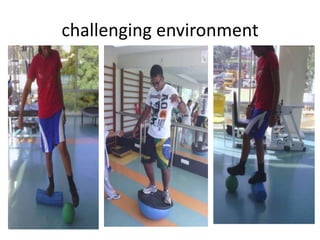
Beyond the session: creating
a challenging environment
for repair and adaptation
challenging environment
Complexity
• Complexity rules! Don’t become lost in the
labyrinth of the neuromuscular system; look
at the whole, not at minute details.
Creativity
• Neuromuscular rehabilitation is a creative process;
it is not protocol-based. Every patient is different
and presents with new challenges. You will forever
have to problem-solve on your feet.
Clinical certainty is uncertainty
• The only clinical certainty is uncertainty – don’t
fight it, learn to work with it. You will never know all
the answers but you will be expected to provide
expert care.
Finally Think movement not muscles.
• There is nothing like one
brain to stimulate another.
• Make it fun, interesting
and continuously
challenging.
Functional approach composite abilities
Functional approach composite
progression
Functional Approach Rehabilitation
(Re–abilitation)
Functional Approach Rehabilitation
(Re–abilitation)
Functional Approach Re-abilitation
Functional approach
Advanced composite workouts
Balance/postural
stability challenge.
Balancing on the
affected
side and drawing
imaginary
numbers from 0-
10 with the
unaffected side.
Demonstration
challenge to balance/postural stability
• Unexpected
challenge to
balance/postural
stability can be
introduced by
multidirectional
perturbations
provided by the
practitioner.
The Future Trends in
Rehabilitation/ RE-ABILITATION
• The Facility
• Influence of Technology
• Recognizing the importance of progressing
rehabilitation objectively and preventing the
detrimental effects of immobilization, but also
protecting the integrity of healing tissue.
Take Home
• One is the restoration of neuromuscular control
almost immediately after surgical procedures to
the knee joint to prevent deafferentation
of the joint.
• The progression of the patient must be
increased gradually, and therefore, it is the
responsibility of the therapist to find a balance
between a detrimentally slow progression and
advanced techniques prematurely that could
have dangerous results.
• Teamwork
• Goals
• Communication
• Motivation
• Compliance
• Reinforcement
• Managing Complications
• Optimizing Results
• Rehabilitation Protocols
• Healing Tissue Should Never Be Overstressed
• Preventing the Detrimental Effects of Immobilization
• Cardiopulmonary Conditioning
• Program Based on Current Research & creativity
Refereces
•Hole CD, Smit GH, Hammond J, et al. Dynamic control and conventional strength ratios of the
quadriceps and hamstrings in subjects with anterior cruciate ligament deficiency. Ergonomics
2000;43(10):1603–1609.
• Patel RR, Hurwitz DE, Bush- Joseph CA, et al. Comparison of clinical and dynamic knee function
in patients with anterior cruciate ligament deficiency. Am J Sports Med 2003;31(1):68–74.
• St Clair Gibson A, Lambert MI, Durandt JJ, et al. Quadriceps and hamstrings peak torque ratio
changes in persons with chronic anterior cruciate ligament deficiency. J Orthop Sports Phys Ther
2000;30(7):418–427.
• Konishi Y, Ikeda K, Nishino A, et al. Relationship between quadriceps femoris muscle volume
and muscle torque after anterior cruciate ligament repair. Scand J Med Sci Sports 2007;
17(6):656–661.
• Berchuck M, Andriacchi TP.Gait adaptations by patientswho have a deficient anteriorcruciate
ligament. J BoneJoint Surg Am1990;72A:871–877.
• Thambyah A, Thiagarajan P,Goh Cho Hong J. Knee jointmoments during stair climbing of
patients with anterior cruciate ligament deficiency. Clin Biomech (Bristol, Avon)2004;19(5):489–
496.
• Robon MJ, Perell KL, Fang M,et al. The relationship betweenankle plantar flexor muscle
moments and knee compressive forces in subjects with andwithout pain. Clin
Biomech(Bristol, Avon) 2000;15(7):522–527.
• Shrader MW, Draganich LF, Pottenger LA, et al. Effects of knee pain relief in osteoarthritis on
gait and stair-stepping. Clin Orthop Relat Res 2004; (421):188–193.
• Mu¨ndermann A, Dyrby CO, Hurwitz DE, et al. Potential
strategies to reduce medial compartment loading in patients with knee osteoarthritis of varying
severity: reduced walking speed. Arthritis Rheum 2004;50(4):1172–1178.

Ultimate knee Rehabilitation

  • 1.
  • 2.
    Existing • Home VersusSupervised Therapy • Home Exercise Versus Weight Machines • Aquatic Therapy • Open Versus Closed Chain Exercise • Progression Based on Objective Criteria What's new?
  • 3.
    Critical Points EFFECTSOF INJURY ON PROPRIOCEPTION, GAIT, AND DURATION OF INJURY • A decrease in proprioception and kinesthesia occurs after anterior cruciate ligament (ACL) injury. Changes that occur within the joint affect normal recruitment and timing patterns of the surrounding musculature.
  • 4.
    Critical Points EFFECTSOF INJURY ON PROPRIOCEPTION, GAIT, AND DURATION OF INJURY • After ACL rupture, patients walk with greater hamstring activity, a flexed knee, and minimal to no quadriceps electro myographic activity. • Altered proprioception of the knee joint may last 1 to 3 yr after injury.
  • 5.
    Critical Points EFFECTSOF INJURY ON PROPRIOCEPTION, GAIT, AND DURATION OF INJURY • There is a significant decrease in muscle activation timing and recruitment order in the lower extremity in response to anterior tibial translation in ACL-deficient knees compared with uninjured controls.
  • 6.
  • 7.
    Critical Points LOWEREXTREMITY MUSCLE STRENGTH RECOVERY AFTER SURGERY • Abnormal gamma loop function in quadriceps muscles from lack of normal sensory function (loss native ACL mechanoreceptors) in the reconstructed ACL. • Non-optimal activation of muscles during voluntary contraction in ACL-deficient knees.
  • 8.
    Developing a Neuromuscular Rehabilitationprogram • 1. The focus on functional movement • 2. The principle of skill/ability level rehabilitation • 3. The code for motor adaptation ….that ought to participate in this particular movement & accompany the stabilization of the body.
  • 9.
    Neuromuscular exercises – dothey exist? • Peripheral plasticity – muscle, the acrobat of adaptation • Neuromuscular rehabilitation is not just about exercising. It is about providing cognitive sensory-motor challenges that will facilitate motor learning/adaptation.
  • 10.
    A functional approach inKNEE Rehabilitation • Functional movement is defined here as the unique movement array of an individual. • Functional rehabilitation of a person to recover their movement capacity by using own movement repertoire (whenever possible)
  • 11.
    A functional approach inKNEE Rehabilitation • However, rehabilitatio n is likely to be less effective if the remedial movement patterns or tasks are outside the individual’s experience (extra-functional).
  • 12.
    A functional approach inKNEE Rehabilitation
  • 13.
    Rehabilitation levels: skill and abilitylevel KNEE Rehabilitation • The center of attention in this form of movement recovery is on the overall skill of performing the particular movement, which is loosely referred to as skill rehabilitation
  • 14.
    The code forneuromuscular adaptation
  • 15.
    “Simplified complexity” intensional fields. Shaded circles represent tension created by muscle groups
  • 16.
  • 17.
    Neuromuscular Rehabilitation inManual and Physical Therapies , Eyal Lederman 2010
  • 18.
    The motor systemas a process. The inner circle represents processes occurring at reflexive, sub-awareness level.
  • 19.
    The comparator systemidentifies movement irregularities/errors.
  • 20.
    Change in proprioceptiveacuity Damage to proprioceptive apparatus peripherally combined with nociception will result in unrefined motor output.
  • 21.
    Experiences that containthe five code elements are more like to promote adaptive changes within the neuromuscular system resulting in movement and behavioural changes.
  • 22.
    The transition fromcognitive to autonomous phase during motor learning. Throughout the transition some elements will remain cognitive and autonomous.
  • 23.
    ADAPTIVE CODE &PHYSICAL STIMULATION FOR PROPRIOCEPTION
  • 24.
    To treat ornot to treat • Can the motor changes lead to further injury or progressive damage? • The primary aim of neuromuscular rehabilitation is to help individuals to recover their control movement. It is unknown if rehabilitation would confer protective function against progressive tissue damage in the future.
  • 25.
  • 26.
  • 27.
  • 28.
    Merging the adaptivecode with rehabilitation Similarity spheres
  • 29.
  • 30.
    Context and specificinjury rehabilitation (the amazing clinical shortcut)
  • 31.
  • 32.
    Beyond the session:creating a challenging environment for repair and adaptation
  • 33.
  • 34.
    Complexity • Complexity rules!Don’t become lost in the labyrinth of the neuromuscular system; look at the whole, not at minute details.
  • 35.
    Creativity • Neuromuscular rehabilitationis a creative process; it is not protocol-based. Every patient is different and presents with new challenges. You will forever have to problem-solve on your feet.
  • 36.
    Clinical certainty isuncertainty • The only clinical certainty is uncertainty – don’t fight it, learn to work with it. You will never know all the answers but you will be expected to provide expert care.
  • 37.
    Finally Think movementnot muscles. • There is nothing like one brain to stimulate another. • Make it fun, interesting and continuously challenging.
  • 38.
  • 39.
  • 40.
  • 41.
  • 42.
  • 43.
  • 44.
    Balance/postural stability challenge. Balancing onthe affected side and drawing imaginary numbers from 0- 10 with the unaffected side. Demonstration
  • 45.
    challenge to balance/posturalstability • Unexpected challenge to balance/postural stability can be introduced by multidirectional perturbations provided by the practitioner.
  • 46.
    The Future Trendsin Rehabilitation/ RE-ABILITATION • The Facility • Influence of Technology • Recognizing the importance of progressing rehabilitation objectively and preventing the detrimental effects of immobilization, but also protecting the integrity of healing tissue.
  • 47.
    Take Home • Oneis the restoration of neuromuscular control almost immediately after surgical procedures to the knee joint to prevent deafferentation of the joint. • The progression of the patient must be increased gradually, and therefore, it is the responsibility of the therapist to find a balance between a detrimentally slow progression and advanced techniques prematurely that could have dangerous results.
  • 48.
    • Teamwork • Goals •Communication • Motivation • Compliance • Reinforcement • Managing Complications • Optimizing Results • Rehabilitation Protocols • Healing Tissue Should Never Be Overstressed • Preventing the Detrimental Effects of Immobilization • Cardiopulmonary Conditioning • Program Based on Current Research & creativity
  • 50.
    Refereces •Hole CD, SmitGH, Hammond J, et al. Dynamic control and conventional strength ratios of the quadriceps and hamstrings in subjects with anterior cruciate ligament deficiency. Ergonomics 2000;43(10):1603–1609. • Patel RR, Hurwitz DE, Bush- Joseph CA, et al. Comparison of clinical and dynamic knee function in patients with anterior cruciate ligament deficiency. Am J Sports Med 2003;31(1):68–74. • St Clair Gibson A, Lambert MI, Durandt JJ, et al. Quadriceps and hamstrings peak torque ratio changes in persons with chronic anterior cruciate ligament deficiency. J Orthop Sports Phys Ther 2000;30(7):418–427. • Konishi Y, Ikeda K, Nishino A, et al. Relationship between quadriceps femoris muscle volume and muscle torque after anterior cruciate ligament repair. Scand J Med Sci Sports 2007; 17(6):656–661. • Berchuck M, Andriacchi TP.Gait adaptations by patientswho have a deficient anteriorcruciate ligament. J BoneJoint Surg Am1990;72A:871–877. • Thambyah A, Thiagarajan P,Goh Cho Hong J. Knee jointmoments during stair climbing of patients with anterior cruciate ligament deficiency. Clin Biomech (Bristol, Avon)2004;19(5):489– 496. • Robon MJ, Perell KL, Fang M,et al. The relationship betweenankle plantar flexor muscle moments and knee compressive forces in subjects with andwithout pain. Clin Biomech(Bristol, Avon) 2000;15(7):522–527. • Shrader MW, Draganich LF, Pottenger LA, et al. Effects of knee pain relief in osteoarthritis on gait and stair-stepping. Clin Orthop Relat Res 2004; (421):188–193. • Mu¨ndermann A, Dyrby CO, Hurwitz DE, et al. Potential strategies to reduce medial compartment loading in patients with knee osteoarthritis of varying severity: reduced walking speed. Arthritis Rheum 2004;50(4):1172–1178.