
Chloroplast
 By
 Dr. Harinatha Reddy Aswartha
Introduction:
 Chloroplasts, the organelles responsible for photosynthesis, are in
many respects similar to mitochondria.
 Both chloroplasts and mitochondria function to generate metabolic
energy.
 Both have evolved by endosymbiosis, both contain their own
genetic systems, and both replicate by division.
The Structure and Function of Chloroplasts:
 Plant chloroplasts are large organelles (5 to 10 Micrometer long).
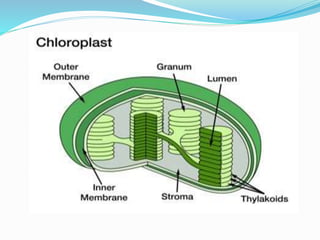
 Chloroplasts, are bounded by a double membrane called the
chloroplast envelope.
 Chloroplasts have a third internal membrane system, called the
thylakoid membrane.
 The thylakoid membrane forms a network of flattened discs
called thylakoids, which are frequently arranged in stacks
called grana.
 Thylakoids exist in the open space of the chloroplast known as
the stroma.
 Three membranes divide chloroplasts into three distinct
internal compartments:
 (1) the intermembrane space between the two membranes of
the chloroplast.
 (2) the stroma, which lies inside the envelope but outside the
thylakoid membrane.
 (3) the thylakoid lumen.
 The outer membrane of the chloroplast envelope, like that of
mitochondria, contains porins and is therefore freely permeable to
small molecules.
 The chloroplast stroma is also equivalent in function to the
mitochondrial matrix:
The Chloroplast Genome:
 The genomes of chloroplasts consist of circular DNA molecules
present in multiple copies per organelle.
 However, chloroplast genomes are larger and more complex than
those of mitochondria, ranging from 120 to 160 kb and containing
approximately 150 genes.
 The chloroplast genome also encodes approximately 30 proteins
that are involved in photosynthesis.
 Ribulose 1,5 bisphosphate carboxylase (Rubisco) is encoded by
chloroplast DNA.
 Starch granules are very common in chloroplasts.
 The chloroplast stroma contains many proteins, though the
most common and important protein is RuBisCO.
 The thylakoid membranes are important protein complexes which
carry out the light reactions of photosynthesis.
 Photosystem II and photosystem I contain light-harvesting
complexes with chlorophyll and carotenoids that absorb light
energy and convert to chemically.
Chlorophylls:
 Chlorophyll a is found in all chloroplasts, as well as their
cyanobacterial ancestors. Chlorophyll a is a blue-green
pigment.
 Chlorophyll b found only in the chloroplasts of plants, green
algae.
 Chlorophyll c is mainly found in secondary endosymbiotic
chloroplasts that originated from a red alga,
Chloroplast

Chloroplast

  • 1.
    Chloroplast  By  Dr.Harinatha Reddy Aswartha
  • 2.
    Introduction:  Chloroplasts, theorganelles responsible for photosynthesis, are in many respects similar to mitochondria.  Both chloroplasts and mitochondria function to generate metabolic energy.  Both have evolved by endosymbiosis, both contain their own genetic systems, and both replicate by division.
  • 3.
    The Structure andFunction of Chloroplasts:  Plant chloroplasts are large organelles (5 to 10 Micrometer long).  Chloroplasts, are bounded by a double membrane called the chloroplast envelope.  Chloroplasts have a third internal membrane system, called the thylakoid membrane.
  • 5.
     The thylakoidmembrane forms a network of flattened discs called thylakoids, which are frequently arranged in stacks called grana.  Thylakoids exist in the open space of the chloroplast known as the stroma.
  • 6.
     Three membranesdivide chloroplasts into three distinct internal compartments:  (1) the intermembrane space between the two membranes of the chloroplast.  (2) the stroma, which lies inside the envelope but outside the thylakoid membrane.  (3) the thylakoid lumen.
  • 7.
     The outermembrane of the chloroplast envelope, like that of mitochondria, contains porins and is therefore freely permeable to small molecules.  The chloroplast stroma is also equivalent in function to the mitochondrial matrix:
  • 8.
    The Chloroplast Genome: The genomes of chloroplasts consist of circular DNA molecules present in multiple copies per organelle.  However, chloroplast genomes are larger and more complex than those of mitochondria, ranging from 120 to 160 kb and containing approximately 150 genes.
  • 9.
     The chloroplastgenome also encodes approximately 30 proteins that are involved in photosynthesis.  Ribulose 1,5 bisphosphate carboxylase (Rubisco) is encoded by chloroplast DNA.
  • 10.
     Starch granulesare very common in chloroplasts.  The chloroplast stroma contains many proteins, though the most common and important protein is RuBisCO.
  • 11.
     The thylakoidmembranes are important protein complexes which carry out the light reactions of photosynthesis.  Photosystem II and photosystem I contain light-harvesting complexes with chlorophyll and carotenoids that absorb light energy and convert to chemically.
  • 12.
    Chlorophylls:  Chlorophyll ais found in all chloroplasts, as well as their cyanobacterial ancestors. Chlorophyll a is a blue-green pigment.  Chlorophyll b found only in the chloroplasts of plants, green algae.  Chlorophyll c is mainly found in secondary endosymbiotic chloroplasts that originated from a red alga,