Chapter 8


     The Unification of China


                                                                                                      1
   Copyright © 2007 The McGraw-Hill Companies Inc. Permission Required for Reproduction or Display.
Chapter 8


     The Unification of China


                                                                                                      1
   Copyright © 2007 The McGraw-Hill Companies Inc. Permission Required for Reproduction or Display.
Confucius

   Kong Fuzi (551-479 BCE)
       Master Philosopher Kong
   Aristocratic roots
   Unwilling to compromise principle
   Decade of unemployment, wandering
   Returned home a failure, died soon thereafter
   Teachings: Analects


                                                                                                               2
            Copyright © 2007 The McGraw-Hill Companies Inc. Permission Required for Reproduction or Display.
Confucian Ideas

   Ethics and politics
       Avoided religion, metaphysics
   Junzi: “superior individuals”
       Role in government service
   Emphasis on Zhou Dynasty texts
       later formed core texts of Chinese education


                                                                                                                3
             Copyright © 2007 The McGraw-Hill Companies Inc. Permission Required for Reproduction or Display.
Confucian Values

   Ren
        Kindness, benevolence
   Li
        Propriety
   Xiao
        Filial piety
   Traits lead to development of junzi
        Ideal leaders


                                                                                                                 4
              Copyright © 2007 The McGraw-Hill Companies Inc. Permission Required for Reproduction or Display.
Mencius (372-289 BCE)

   Principal Confucian scholar
   Optimist, belief in power of ren
   Not influential during lifetime
       Considered prime exponent of Confucian thought since
        10th century


                                                                                                               5
            Copyright © 2007 The McGraw-Hill Companies Inc. Permission Required for Reproduction or Display.
Xunzi (298-238 BCE)

   Career as government administrator
   Belief in fundamental selfishness of humanity
       Compare with Mencius
   Emphasis on li, rigid propriety
   discipline


                                                                                                               6
            Copyright © 2007 The McGraw-Hill Companies Inc. Permission Required for Reproduction or Display.
Daoism

   Critics of Confucianism
       Passivism, rejection of active attempts to change the
        course of events
   Founder: Laozi, 6th c. BCE
   The Daodejing (Classic of Way and of Virtue)
   Zhuangzi (named for author, 369-236 BCE)


                                                                                                                7
             Copyright © 2007 The McGraw-Hill Companies Inc. Permission Required for Reproduction or Display.
The Dao

   “The Way” (of nature, of the cosmos)
       Water: soft and yielding, but capable of eroding rock
       Cavity of pots, wheels: nonexistent, but essential


                                                                                                                8
             Copyright © 2007 The McGraw-Hill Companies Inc. Permission Required for Reproduction or Display.
Doctrine of Wuwei

   Attempt to control universe results in chaos
   Restore order by disengagement
       No advanced education
       No ambition
   Simple living in harmony with nature
   Cultivate self-knowledge


                                                                                                               9
            Copyright © 2007 The McGraw-Hill Companies Inc. Permission Required for Reproduction or Display.
Political Implications of Daoism

   Confucianism as public doctrine
   Daoism as private pursuit
   Ironic combination allowed intellectuals to pursue
    both


                                                                                                             10
          Copyright © 2007 The McGraw-Hill Companies Inc. Permission Required for Reproduction or Display.
Legalism

   Emphasis on development of the state
       Ruthless, end justifies the means
   Role of Law
       Strict punishment for violators
       Principle of collective responsibility
   Shang Yang (390-338 BCE), The Book of the Lord
    Shang
   Han Feizi (280-233 BCE)
       Forced to commit suicide by political enemies


                                                                                                                11
             Copyright © 2007 The McGraw-Hill Companies Inc. Permission Required for Reproduction or Display.
Legalist Doctrine

   Two strengths of the state
       Agriculture
       Military
   Emphasized development of peasant, soldier
    classes
   Distrust of pure intellectual, cultural pursuits
   Historically, often imitated but rarely praised


                                                                                                                12
             Copyright © 2007 The McGraw-Hill Companies Inc. Permission Required for Reproduction or Display.
Unification of China

   Qin dynasty develops, 4th-3rd centuries BCE
   Generous land grants under Shang Yang
       Private farmers decrease power of large landholders
       Increasing centralization of power
   Improved military technology


                                                                                                                13
             Copyright © 2007 The McGraw-Hill Companies Inc. Permission Required for Reproduction or Display.
The First Emperor

   Qin Shihuangdi (r. 221-210 BCE) founds new
    dynasty as “First Emperor”
   Dynasty ends in 207, but sets dramatic precedent
   Basis of rule: centralized bureaucracy
   Massive public works begun
       Precursor to Great Wall


                                                                                                                14
             Copyright © 2007 The McGraw-Hill Companies Inc. Permission Required for Reproduction or Display.
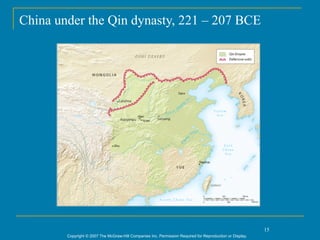
China under the Qin dynasty, 221 – 207 BCE


                                                                                                           15
        Copyright © 2007 The McGraw-Hill Companies Inc. Permission Required for Reproduction or Display.
Resistance to Qin Policies

   Emperor orders execution of all critics
   Orders burning of all ideological works
   Some 460 scholars buried alive
   Others exiled
   Massive cultural losses


                                                                                                             16
          Copyright © 2007 The McGraw-Hill Companies Inc. Permission Required for Reproduction or Display.
Qin Centralization

   Standardized:
       Laws
       Currencies
       Weights and measures
       Script
           Previously: single language written in distinct scripts
   Building of roads, bridges


                                                                                                                  17
               Copyright © 2007 The McGraw-Hill Companies Inc. Permission Required for Reproduction or Display.
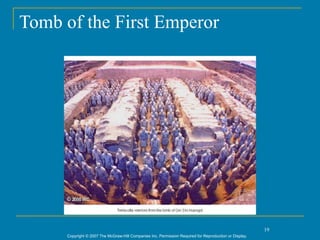
Massive Tomb Projects

   Built by 700,000 workers
   Slaves, concubines, and craftsmen sacrificed and
    buried
   Excavated in 1974, 15,000 terra cotta sculptures
    of soldiers, horses, and weapons unearthed


                                                                                                             18
          Copyright © 2007 The McGraw-Hill Companies Inc. Permission Required for Reproduction or Display.
Tomb of the First Emperor


                                                                                                         19
      Copyright © 2007 The McGraw-Hill Companies Inc. Permission Required for Reproduction or Display.
The Han Dynasty

   Civil disorder brings down Qin dynasty 207 BCE
   Liu Bang forms new dynasty: the Han (206
    BCE-220 CE)
       Former Han (206 BCE-9 CE)
       Interruption 9-23 CE
       Later Han (25-220 CE)


                                                                                                               20
            Copyright © 2007 The McGraw-Hill Companies Inc. Permission Required for Reproduction or Display.
Early Han Policies

   Relaxed Qin tyranny without returning to Zhou
    anarchy
   Created large landholdings
   But maintained control over administrative
    regions
   After failed rebellion, took more central control


                                                                                                             21
          Copyright © 2007 The McGraw-Hill Companies Inc. Permission Required for Reproduction or Display.
Han Centralization

   The Martial Emperor: Han Wudi (141-87 BCE)
   Increased taxes to fund more public works
   But huge demand for government officials,
    decline since Qin persecution


                                                                                                            22
         Copyright © 2007 The McGraw-Hill Companies Inc. Permission Required for Reproduction or Display.
Confucian Educational System

   Han Wudi establishes an Imperial University in
    124 BCE
   Not a lover of scholarship, but demanded
    educated class for bureaucracy
   Adopted Confucianism as official course of study
   3000 students by end of Former Han, 30,000 by
    end of Later Han


                                                                                                             23
          Copyright © 2007 The McGraw-Hill Companies Inc. Permission Required for Reproduction or Display.
Han Imperial Expansion

   Invasions of Vietnam, Korea
   Constant attacks from Xiongnu
       Nomads from Central Asia
       Horsemen
       Brutal: Maodun (210-174 BCE), had soldiers murder
        his wife, father
   Han Wudi briefly dominates Xiongnu


                                                                                                               24
            Copyright © 2007 The McGraw-Hill Companies Inc. Permission Required for Reproduction or Display.
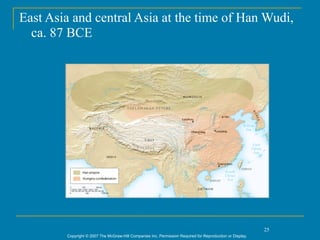
East Asia and central Asia at the time of Han Wudi,
  ca. 87 BCE


                                                                                                           25
        Copyright © 2007 The McGraw-Hill Companies Inc. Permission Required for Reproduction or Display.
Patriarchal Social Order

   Classic of Filial Piety
       Subordination to elder males
   Admonitions for Women
       Female virtues:
           Humility, obedience, subservience, loyalty


                                                                                                                  26
               Copyright © 2007 The McGraw-Hill Companies Inc. Permission Required for Reproduction or Display.
Iron Metallurgy

   Expansion of iron manufacture
       Iron tips on tools abandoned as tools entirely made
        from iron
   Increased food production
   Superior weaponry


                                                                                                                27
             Copyright © 2007 The McGraw-Hill Companies Inc. Permission Required for Reproduction or Display.
Other technological Developments

   Cultivation of silkworms
       Breeding
       Diet control
           Other silk-producing lands relied on wild worms
   Development of paper
       Bamboo, fabric abandoned in favor of wood and
        textile-based paper


                                                                                                                  28
               Copyright © 2007 The McGraw-Hill Companies Inc. Permission Required for Reproduction or Display.
Population Growth in the Han Dynasty

   220 BCE 20 million people
   By 9 CE 60 million people
   General prosperity
   Increased agricultural productivity
   Taxes small part of overall income
   Produce occasionally spoiling in state
    granaries


                                                                                                             29
          Copyright © 2007 The McGraw-Hill Companies Inc. Permission Required for Reproduction or Display.
Economic and Social Difficulties

   Expenses of military expeditions, esp. vs.
    Xiongnu
   Taxes increasing
   Arbitrary property confiscations rise
   Increasing gap between rich and poor
       Slavery, tenant farming increase
       Banditry, rebellion


                                                                                                                30
             Copyright © 2007 The McGraw-Hill Companies Inc. Permission Required for Reproduction or Display.
Reign of Wang Mang (9-23 CE)

   Wang Mang regent for 2-year old Emperor, 6 CE
   Takes power himself 9 CE
   Introduces massive reforms
       The “socialist emperor”
       Land redistribution, but poorly handled
   Social chaos ends in his assassination 23 CE


                                                                                                                31
             Copyright © 2007 The McGraw-Hill Companies Inc. Permission Required for Reproduction or Display.
Later Han Dynasty

   Han Dynasty emperors manage, with difficulty, to
    reassert control
   Yellow Turban uprising challenges land
    distribution problems
   Internal court intrigue
   Weakened Han Dynasty collapses by 220 CE


                                                                                                             32
          Copyright © 2007 The McGraw-Hill Companies Inc. Permission Required for Reproduction or Display.

Ch 8 classical china keynote

  • 1.
    Chapter 8 The Unification of China 1 Copyright © 2007 The McGraw-Hill Companies Inc. Permission Required for Reproduction or Display.
  • 2.
    Chapter 8 The Unification of China 1 Copyright © 2007 The McGraw-Hill Companies Inc. Permission Required for Reproduction or Display.
  • 3.
    Confucius  Kong Fuzi (551-479 BCE)  Master Philosopher Kong  Aristocratic roots  Unwilling to compromise principle  Decade of unemployment, wandering  Returned home a failure, died soon thereafter  Teachings: Analects 2 Copyright © 2007 The McGraw-Hill Companies Inc. Permission Required for Reproduction or Display.
  • 4.
    Confucian Ideas  Ethics and politics  Avoided religion, metaphysics  Junzi: “superior individuals”  Role in government service  Emphasis on Zhou Dynasty texts  later formed core texts of Chinese education 3 Copyright © 2007 The McGraw-Hill Companies Inc. Permission Required for Reproduction or Display.
  • 5.
    Confucian Values  Ren  Kindness, benevolence  Li  Propriety  Xiao  Filial piety  Traits lead to development of junzi  Ideal leaders 4 Copyright © 2007 The McGraw-Hill Companies Inc. Permission Required for Reproduction or Display.
  • 6.
    Mencius (372-289 BCE)  Principal Confucian scholar  Optimist, belief in power of ren  Not influential during lifetime  Considered prime exponent of Confucian thought since 10th century 5 Copyright © 2007 The McGraw-Hill Companies Inc. Permission Required for Reproduction or Display.
  • 7.
    Xunzi (298-238 BCE)  Career as government administrator  Belief in fundamental selfishness of humanity  Compare with Mencius  Emphasis on li, rigid propriety  discipline 6 Copyright © 2007 The McGraw-Hill Companies Inc. Permission Required for Reproduction or Display.
  • 8.
    Daoism  Critics of Confucianism  Passivism, rejection of active attempts to change the course of events  Founder: Laozi, 6th c. BCE  The Daodejing (Classic of Way and of Virtue)  Zhuangzi (named for author, 369-236 BCE) 7 Copyright © 2007 The McGraw-Hill Companies Inc. Permission Required for Reproduction or Display.
  • 9.
    The Dao  “The Way” (of nature, of the cosmos)  Water: soft and yielding, but capable of eroding rock  Cavity of pots, wheels: nonexistent, but essential 8 Copyright © 2007 The McGraw-Hill Companies Inc. Permission Required for Reproduction or Display.
  • 10.
    Doctrine of Wuwei  Attempt to control universe results in chaos  Restore order by disengagement  No advanced education  No ambition  Simple living in harmony with nature  Cultivate self-knowledge 9 Copyright © 2007 The McGraw-Hill Companies Inc. Permission Required for Reproduction or Display.
  • 11.
    Political Implications ofDaoism  Confucianism as public doctrine  Daoism as private pursuit  Ironic combination allowed intellectuals to pursue both 10 Copyright © 2007 The McGraw-Hill Companies Inc. Permission Required for Reproduction or Display.
  • 12.
    Legalism  Emphasis on development of the state  Ruthless, end justifies the means  Role of Law  Strict punishment for violators  Principle of collective responsibility  Shang Yang (390-338 BCE), The Book of the Lord Shang  Han Feizi (280-233 BCE)  Forced to commit suicide by political enemies 11 Copyright © 2007 The McGraw-Hill Companies Inc. Permission Required for Reproduction or Display.
  • 13.
    Legalist Doctrine  Two strengths of the state  Agriculture  Military  Emphasized development of peasant, soldier classes  Distrust of pure intellectual, cultural pursuits  Historically, often imitated but rarely praised 12 Copyright © 2007 The McGraw-Hill Companies Inc. Permission Required for Reproduction or Display.
  • 14.
    Unification of China  Qin dynasty develops, 4th-3rd centuries BCE  Generous land grants under Shang Yang  Private farmers decrease power of large landholders  Increasing centralization of power  Improved military technology 13 Copyright © 2007 The McGraw-Hill Companies Inc. Permission Required for Reproduction or Display.
  • 15.
    The First Emperor  Qin Shihuangdi (r. 221-210 BCE) founds new dynasty as “First Emperor”  Dynasty ends in 207, but sets dramatic precedent  Basis of rule: centralized bureaucracy  Massive public works begun  Precursor to Great Wall 14 Copyright © 2007 The McGraw-Hill Companies Inc. Permission Required for Reproduction or Display.
  • 16.
    China under theQin dynasty, 221 – 207 BCE 15 Copyright © 2007 The McGraw-Hill Companies Inc. Permission Required for Reproduction or Display.
  • 17.
    Resistance to QinPolicies  Emperor orders execution of all critics  Orders burning of all ideological works  Some 460 scholars buried alive  Others exiled  Massive cultural losses 16 Copyright © 2007 The McGraw-Hill Companies Inc. Permission Required for Reproduction or Display.
  • 18.
    Qin Centralization  Standardized:  Laws  Currencies  Weights and measures  Script  Previously: single language written in distinct scripts  Building of roads, bridges 17 Copyright © 2007 The McGraw-Hill Companies Inc. Permission Required for Reproduction or Display.
  • 19.
    Massive Tomb Projects  Built by 700,000 workers  Slaves, concubines, and craftsmen sacrificed and buried  Excavated in 1974, 15,000 terra cotta sculptures of soldiers, horses, and weapons unearthed 18 Copyright © 2007 The McGraw-Hill Companies Inc. Permission Required for Reproduction or Display.
  • 20.
    Tomb of theFirst Emperor 19 Copyright © 2007 The McGraw-Hill Companies Inc. Permission Required for Reproduction or Display.
  • 21.
    The Han Dynasty  Civil disorder brings down Qin dynasty 207 BCE  Liu Bang forms new dynasty: the Han (206 BCE-220 CE)  Former Han (206 BCE-9 CE)  Interruption 9-23 CE  Later Han (25-220 CE) 20 Copyright © 2007 The McGraw-Hill Companies Inc. Permission Required for Reproduction or Display.
  • 22.
    Early Han Policies  Relaxed Qin tyranny without returning to Zhou anarchy  Created large landholdings  But maintained control over administrative regions  After failed rebellion, took more central control 21 Copyright © 2007 The McGraw-Hill Companies Inc. Permission Required for Reproduction or Display.
  • 23.
    Han Centralization  The Martial Emperor: Han Wudi (141-87 BCE)  Increased taxes to fund more public works  But huge demand for government officials, decline since Qin persecution 22 Copyright © 2007 The McGraw-Hill Companies Inc. Permission Required for Reproduction or Display.
  • 24.
    Confucian Educational System  Han Wudi establishes an Imperial University in 124 BCE  Not a lover of scholarship, but demanded educated class for bureaucracy  Adopted Confucianism as official course of study  3000 students by end of Former Han, 30,000 by end of Later Han 23 Copyright © 2007 The McGraw-Hill Companies Inc. Permission Required for Reproduction or Display.
  • 25.
    Han Imperial Expansion  Invasions of Vietnam, Korea  Constant attacks from Xiongnu  Nomads from Central Asia  Horsemen  Brutal: Maodun (210-174 BCE), had soldiers murder his wife, father  Han Wudi briefly dominates Xiongnu 24 Copyright © 2007 The McGraw-Hill Companies Inc. Permission Required for Reproduction or Display.
  • 26.
    East Asia andcentral Asia at the time of Han Wudi, ca. 87 BCE 25 Copyright © 2007 The McGraw-Hill Companies Inc. Permission Required for Reproduction or Display.
  • 27.
    Patriarchal Social Order  Classic of Filial Piety  Subordination to elder males  Admonitions for Women  Female virtues:  Humility, obedience, subservience, loyalty 26 Copyright © 2007 The McGraw-Hill Companies Inc. Permission Required for Reproduction or Display.
  • 28.
    Iron Metallurgy  Expansion of iron manufacture  Iron tips on tools abandoned as tools entirely made from iron  Increased food production  Superior weaponry 27 Copyright © 2007 The McGraw-Hill Companies Inc. Permission Required for Reproduction or Display.
  • 29.
    Other technological Developments  Cultivation of silkworms  Breeding  Diet control  Other silk-producing lands relied on wild worms  Development of paper  Bamboo, fabric abandoned in favor of wood and textile-based paper 28 Copyright © 2007 The McGraw-Hill Companies Inc. Permission Required for Reproduction or Display.
  • 30.
    Population Growth inthe Han Dynasty  220 BCE 20 million people  By 9 CE 60 million people  General prosperity  Increased agricultural productivity  Taxes small part of overall income  Produce occasionally spoiling in state granaries 29 Copyright © 2007 The McGraw-Hill Companies Inc. Permission Required for Reproduction or Display.
  • 31.
    Economic and SocialDifficulties  Expenses of military expeditions, esp. vs. Xiongnu  Taxes increasing  Arbitrary property confiscations rise  Increasing gap between rich and poor  Slavery, tenant farming increase  Banditry, rebellion 30 Copyright © 2007 The McGraw-Hill Companies Inc. Permission Required for Reproduction or Display.
  • 32.
    Reign of WangMang (9-23 CE)  Wang Mang regent for 2-year old Emperor, 6 CE  Takes power himself 9 CE  Introduces massive reforms  The “socialist emperor”  Land redistribution, but poorly handled  Social chaos ends in his assassination 23 CE 31 Copyright © 2007 The McGraw-Hill Companies Inc. Permission Required for Reproduction or Display.
  • 33.
    Later Han Dynasty  Han Dynasty emperors manage, with difficulty, to reassert control  Yellow Turban uprising challenges land distribution problems  Internal court intrigue  Weakened Han Dynasty collapses by 220 CE 32 Copyright © 2007 The McGraw-Hill Companies Inc. Permission Required for Reproduction or Display.