•Mathematics

in
China
emerged
independently by the 11th
century BC.
• The Chinese independently

developed
very
large
and
negative
numbers, decimals, a place
value decimal system,
a
system,
algebra,
geometry,
and trigonometry.
• Knowledge

of
Chinese mathematics before
254 BC is somewhat
fragmentary, and even after
this date the manuscript
traditions are obscure.
• As in other early societies
the
focus

was
on astronomy in order to
perfect
the
agricultural calendar, and
other practical tasks, and not
on
establishing
formal
systems.
• Ancient

Chinese
mathematicians did not develop
an axiomatic approach, but
made advances in algorithm
development and algebra. The
achievement
of
Chinese
algebra reached its zenith in the
13th century, when Zhu
Shijie invented method of four
unknowns.
• Frequently, elements of the

mathematics
of
early
societies
correspond
to
rudimentary results found
later in branches of modern
mathematics
such
as
geometry or number theory.
• The Pythagorean theorem for

example, has been attested to
the time of the Duke of Zhou.
Knowledge
of
Pascal's
triangle has also been shown
to have existed in China
centuries before Pascal, such as
by Shen Kuo.
Early Chinese
Mathematics
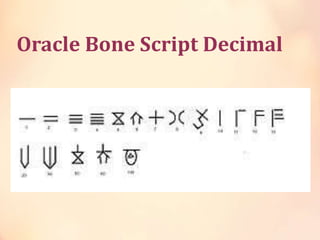
• Simple mathematics on Oracle

bone script date back to
the Shang Dynasty (1600–
1050 BC). One of the oldest
surviving mathematical works
is the Yi Jing, which greatly
influenced written literature
during
the
Zhou
Dynasty (1050–256 BC).
Oracle Bone Script Decimal
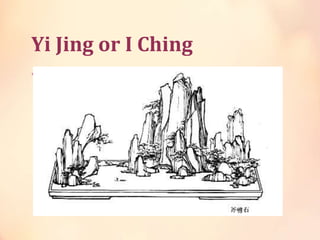
Yi Jing or I Ching
•
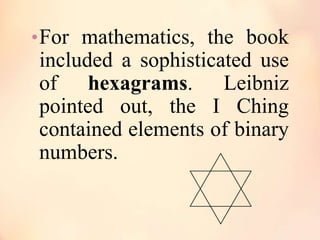
• For mathematics, the book

included a sophisticated use
of hexagrams. Leibniz
pointed out, the I Ching
contained elements of binary
numbers.
• Since the Shang period, the

Chinese had already fully
developed a decimal system.
Since early times, Chinese
understood basic arithmetic
(which dominated far eastern
history), algebra, equations,
and negative numbers with
counting rods.
• Although the Chinese were

more focused on arithmetic and
advanced
algebra
for
astronomical uses, they were
also the first to develop
negative numbers, algebraic
geometry
(only
Chinese
geometry) and the usage of
decimals.
• Math was one of the Liù Yì (

六艺) or Six Arts, students
were required to master
during
the
Zhou
Dynasty (1122–256 BC).
• Learning them all perfectly

was required to be a perfect
gentleman, or in the Chinese
sense,
a
"Renaissance
Man". Six Arts have their
roots in the Confucian
philosophy.
• They

also have geometry
which is the oldest existent
mathematical work in China
which is written in the Mo
Jing.
• It is similar to the definitions
given by the Greeks; Euclid
and Plato.
The
Mathematics
In Different
Dynasties
Qin Mathematics
• Not much is known about Qin

dynasty
mathematics,
or
before, due to the burning of
books and burying of scholars.
• The Qin dynasty created a
standard system of weights.
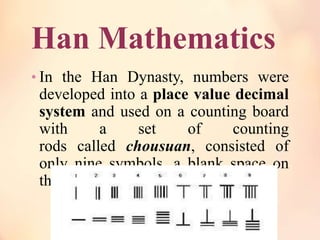
Han Mathematics
• In the Han Dynasty, numbers were

developed into a place value decimal
system and used on a counting board
with
a
set
of
counting
rods called chousuan, consisted of
only nine symbols, a blank space on
the counting board stood for zero.
Suan shu shu
• an ancient Chinese text on
mathematics
approximately
seven thousand characters in
length
• written on 190 bamboo strips
The Nine Chapters
Mathematical Art

on

the

• is a Chinese mathematics book,

its oldest archaeological date
being 179 AD (traditionally dated
1000 BC)
• the author(s) are unknown, they

made a huge contribution in the
eastern world
• It

was one of the most
influential of all Chinese
mathematical books and it is
composed of some 246
problems.
• It also contains the popular
theory, Chou Pei.
Chou Pei
• Chou Pei is oldest existing

Chinese texts containing
formal
mathematical
theories
and
were
produced during the Han
period.
• The

Arithmetic Classic of the
Gnomon and the Circular Paths of
Heaven (Chou Pei Suan Ching)
is dated before the 3rd century B.C
and contains various modern
mathematical principles such as
working with fractions using a
common denominator, and proofs
of many geometrical theories
• The text contains an accurate

process of division for finding
out the square root of
numbers.

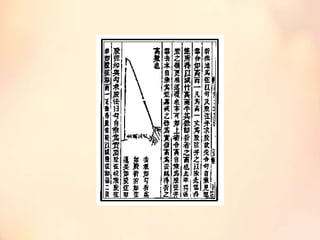
• In fact, the Chou Pei presents

the oldest known proof of the
right-angle triangle theory in
the hsuan-thu diagram.
• This theory, commonly known

as the "Pythagorean theorem"
shows that the sum of the
squares of the legs of a right
triangle is equal to the squares
of the hypotenuse or a2+ b2 =
c2.
• The Chou Pei was not an isolated

academic text shared only by a
few
ancient
Chinese
mathematicians. The principles
in the text were reflected in the
popular approach known as chichu, or "the piling up of squares"
which was a process of using
geometry to solve algebraic
problems.
Sample Problems In
Pythagorean Theorem
or Chou Pei
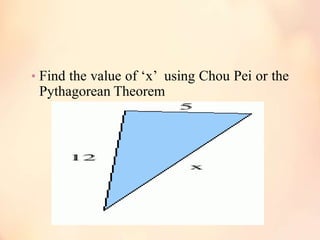
• Find the value of ‘x’ using Chou Pei or the

Pythagorean Theorem
Ancient Chinese Mathematics

Ancient Chinese Mathematics

  • 3.
  • 4.
    • The Chineseindependently developed very large and negative numbers, decimals, a place value decimal system, a system, algebra, geometry, and trigonometry.
  • 5.
    • Knowledge of Chinese mathematicsbefore 254 BC is somewhat fragmentary, and even after this date the manuscript traditions are obscure.
  • 6.
    • As inother early societies the focus was on astronomy in order to perfect the agricultural calendar, and other practical tasks, and not on establishing formal systems.
  • 7.
    • Ancient Chinese mathematicians didnot develop an axiomatic approach, but made advances in algorithm development and algebra. The achievement of Chinese algebra reached its zenith in the 13th century, when Zhu Shijie invented method of four unknowns.
  • 9.
    • Frequently, elementsof the mathematics of early societies correspond to rudimentary results found later in branches of modern mathematics such as geometry or number theory.
  • 10.
    • The Pythagoreantheorem for example, has been attested to the time of the Duke of Zhou. Knowledge of Pascal's triangle has also been shown to have existed in China centuries before Pascal, such as by Shen Kuo.
  • 11.
  • 12.
    • Simple mathematicson Oracle bone script date back to the Shang Dynasty (1600– 1050 BC). One of the oldest surviving mathematical works is the Yi Jing, which greatly influenced written literature during the Zhou Dynasty (1050–256 BC).
  • 13.
  • 14.
    Yi Jing orI Ching •
  • 15.
    • For mathematics,the book included a sophisticated use of hexagrams. Leibniz pointed out, the I Ching contained elements of binary numbers.
  • 16.
    • Since theShang period, the Chinese had already fully developed a decimal system. Since early times, Chinese understood basic arithmetic (which dominated far eastern history), algebra, equations, and negative numbers with counting rods.
  • 17.
    • Although theChinese were more focused on arithmetic and advanced algebra for astronomical uses, they were also the first to develop negative numbers, algebraic geometry (only Chinese geometry) and the usage of decimals.
  • 18.
    • Math wasone of the Liù Yì ( 六艺) or Six Arts, students were required to master during the Zhou Dynasty (1122–256 BC).
  • 19.
    • Learning themall perfectly was required to be a perfect gentleman, or in the Chinese sense, a "Renaissance Man". Six Arts have their roots in the Confucian philosophy.
  • 20.
    • They also havegeometry which is the oldest existent mathematical work in China which is written in the Mo Jing. • It is similar to the definitions given by the Greeks; Euclid and Plato.
  • 21.
  • 22.
    Qin Mathematics • Notmuch is known about Qin dynasty mathematics, or before, due to the burning of books and burying of scholars. • The Qin dynasty created a standard system of weights.
  • 23.
    Han Mathematics • Inthe Han Dynasty, numbers were developed into a place value decimal system and used on a counting board with a set of counting rods called chousuan, consisted of only nine symbols, a blank space on the counting board stood for zero.
  • 24.
    Suan shu shu •an ancient Chinese text on mathematics approximately seven thousand characters in length • written on 190 bamboo strips
  • 25.
    The Nine Chapters MathematicalArt on the • is a Chinese mathematics book, its oldest archaeological date being 179 AD (traditionally dated 1000 BC) • the author(s) are unknown, they made a huge contribution in the eastern world
  • 26.
    • It was oneof the most influential of all Chinese mathematical books and it is composed of some 246 problems. • It also contains the popular theory, Chou Pei.
  • 27.
  • 28.
    • Chou Peiis oldest existing Chinese texts containing formal mathematical theories and were produced during the Han period.
  • 29.
    • The Arithmetic Classicof the Gnomon and the Circular Paths of Heaven (Chou Pei Suan Ching) is dated before the 3rd century B.C and contains various modern mathematical principles such as working with fractions using a common denominator, and proofs of many geometrical theories
  • 30.
    • The textcontains an accurate process of division for finding out the square root of numbers. • In fact, the Chou Pei presents the oldest known proof of the right-angle triangle theory in the hsuan-thu diagram.
  • 31.
    • This theory,commonly known as the "Pythagorean theorem" shows that the sum of the squares of the legs of a right triangle is equal to the squares of the hypotenuse or a2+ b2 = c2.
  • 33.
    • The ChouPei was not an isolated academic text shared only by a few ancient Chinese mathematicians. The principles in the text were reflected in the popular approach known as chichu, or "the piling up of squares" which was a process of using geometry to solve algebraic problems.
  • 34.
    Sample Problems In PythagoreanTheorem or Chou Pei
  • 35.
    • Find thevalue of ‘x’ using Chou Pei or the Pythagorean Theorem