CHILLING
AND
FREEZING
STRESS IN
CROPS
Chilling Injury
• Plant chilling injury refers to an injury that is caused by a temperature
drop to below 15°C but above the freezing point.
• The most common site implicated for chilling injury is the plasma
membrane.
• The consequences of this change may lead to cell leakage or disruption.
• Changes in membrane permeability are often invoked as a cause of the
loss of cell turgor .
Symptoms of Chilling
injury
Many chilling-injury symptoms are common to other stresses such as
drought stress, root rot diseases, phytotoxicity to chemicals, heat stress
and light stress.
•Rapid wilting followed by water soaked patches which develop into
sunken pits that reflect cells tissue collapse.
•Formation of crystalline deposits in root cells, epidermal, mesophyll
and vascular cells of leaves -leading to tonoplast disruption
•Accelerated rate of senescence (natural death), but with otherwise
normal appearance.
•Increased susceptibility to attack by fungi and bacteria not
commonly found on the plant.
•Slowed growth, or limited growth flush
Affects on plants
Chilling injury causes several metabolic of physiological dysfunctions to
the plant including
•disruption of the conversion of starch to sugars (amylotytic activity)
•decreased carbon dioxide exchange
•reduction in net photosynthesis
•the destruction/degradation of chlorophyll
•

Causes of Chilling
injury
The primary cause has been found to be the opening (and locking) of

the leaf stomata when the permeability of the roots to water is low.
• The leaves lose water faster than it can be replaced and they become
dehydrated..
• In some plants, the stomata behave properly at chilling temperatures
and the injury is said to be metabolic.
• A decrease in respiration, photosynthesis and fatty acid synthesis may
all contribute to the chill-starvation of some plants.
Freezing injury
Freezing injury in plants can be from two sources:
o1. Freezing of soil water, and;
o2. Freezing of the fluids within the plant.
•The soil water that is available to plants is found in the porous
regions between soil particles. It freezes at about -2°C, depriving the
plant of its source of water.
•Freezing of water within the plant can cause disruption of structure
and function of cells and tissues.
•Ice usually forms first in the cell walls and intercellular spaces
•Damage occurs when ice crystals grow and puncture into the
cytoplasm
Freezing injury
Two types of freezing occur in plant cells and tissues
•Vitrification : Solidification of the cellular content into  noncrystalline state (amorphous state) .It occurs by rapid freezing of cells
to a  very low temperature.
•Crystallisation / ice formation : Crystallisation of ice occur either
extracellularly or intracellularly
Symptoms of Freezing
injury

• Desiccation or burning of foliage
• Water-soaked areas that progress to necrotic spots on leaves, stems or
fruit and death of sections of the plant or the entire plant.
• Close examination of woody plants several days or weeks after
freezing may reveal a dead or weakened root system or split bark on
stems or branches.
• Obvious symptoms on plant foliage may not be present until after the
plant has been stressed by warm temperatures.
• A hot, bright day could increase transpirational water loss beyond
the ability of injured roots or stem conductive tissue to replace.
• Wilting and/or desiccation, as caused by direct drought stress.
Formation of ice intracellularly may be due to
•By internal nucleation (certain large polysaccharides /proteins serve
as nucleating agents to form ice)
•By penetration of external ice crystals into the cells
•Intracellular ice formation is very lethal which causes immediate
disruption of cells.
•It spreads from cell to cell through plasmodesmata
•Formed in the cell wall adjacent to the intercellular spaces
•Originates spontaneously from centers of nucleation in the
cytoplasm.
Preventions & Protection
Cold hardening

• Cold hardening alters the behavior of the stomata so that they close
under the same conditions; the root permeability is also increased.
• Cold hardening affects the lipid content of cell membranes and has
been found to lower the optimum temperature for photosynthesis and
respiration.
Preventions & Protection
Some methods to avoid chilling and
freezing effects artificially:
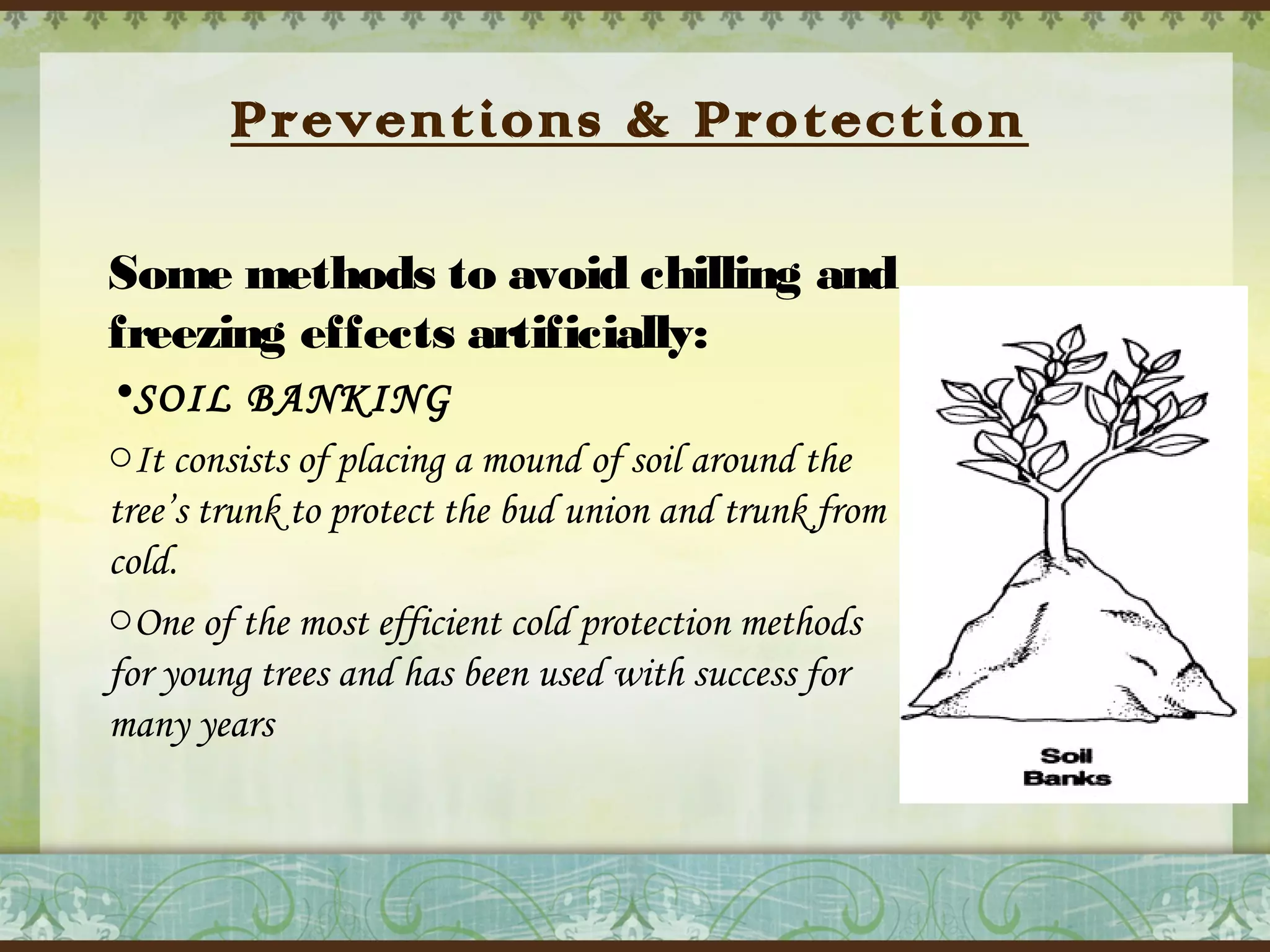
•SOIL BANKING
oIt consists of placing a mound of soil around the
tree’s trunk to protect the bud union and trunk from
cold.
oOne of the most efficient cold protection methods
for young trees and has been used with success for
many years
Preventions & Protection
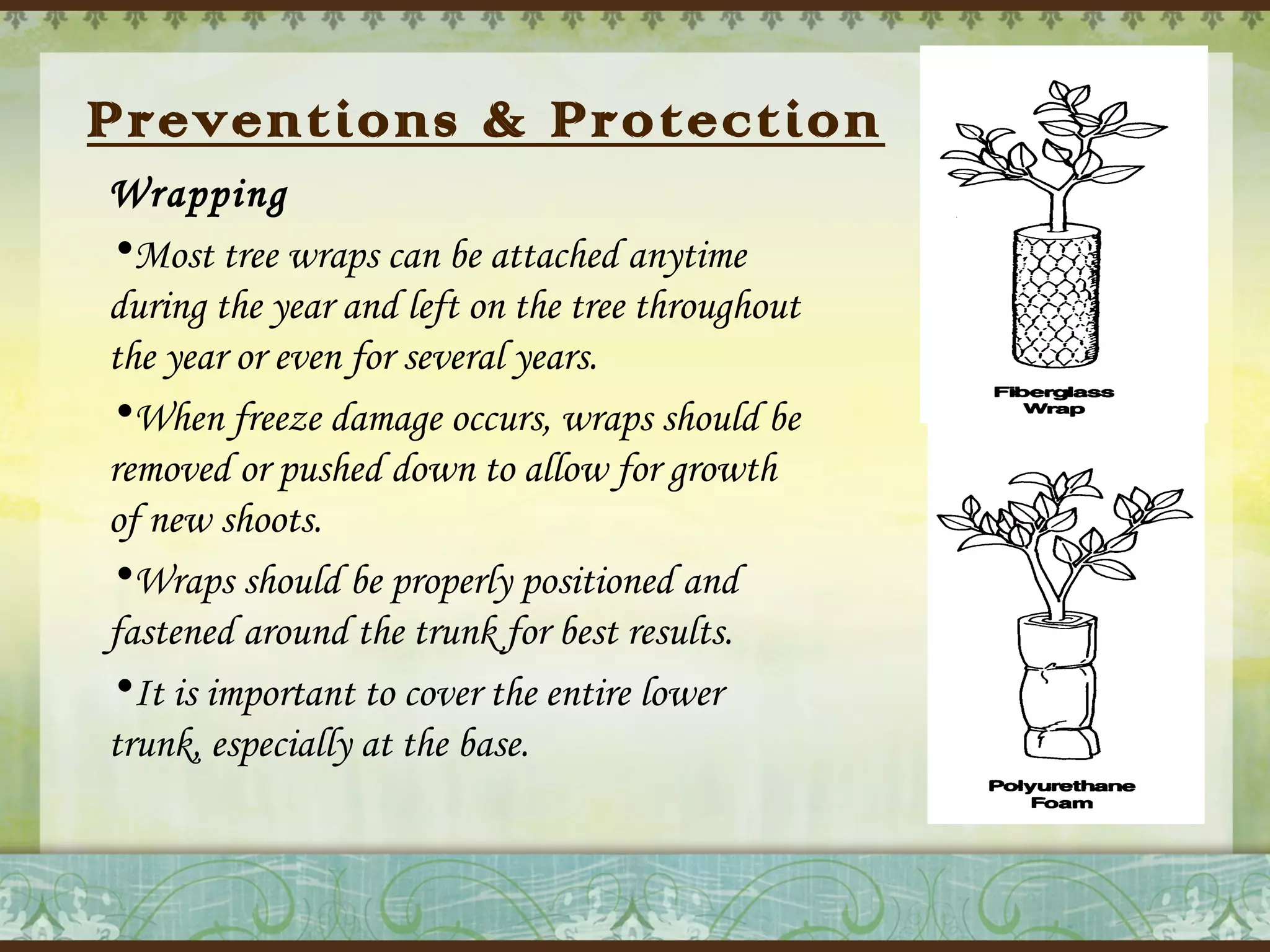
Wrapping
•Most tree wraps can be attached anytime
during the year and left on the tree throughout
the year or even for several years.
•When freeze damage occurs, wraps should be
removed or pushed down to allow for growth
of new shoots.
•Wraps should be properly positioned and
fastened around the trunk for best results.
•It is important to cover the entire lower
trunk, especially at the base.
Preventions & Protection
Sprinkling
•It can be used to moderate temperatures above freezing because of
sensible heat in water and can maintain plant leaf temperature at 1 to
2°C degrees or more.
•Sprinkling should continue until after thawing or the wet bulb
temperature rises above freezing especially if windy, dry conditions
prevail.
•Water applied to aisles of shade structures or greenhouses increases
the moisture content of the air and soil surrounding the plants, thus
slowing the rate of temperature drop.
•The water absorbs heat during the day which is released slowly at
night.
Preventions & Protection
Fogging
•Fog also retards the loss of heat from soil and plant surfaces to the
atmosphere
•Fog can provide up to 4°C (8°F) of protection outdoors during
radiational cooling
•Applying ground water with an average temperature of 21°C (70°F)
to a greenhouse can create a ground fog if the ground surface is several
degrees cooler than the water.
•The applied water adds heat to the plant environment and/or buffers
temperature change by increased humidity.
•Temperatures can be elevated as much as 5°C (9°F) in these unheated
structures
Preventions & Protection
Supplementary Heat supply
Air movement method:
•Wind machines have been used for many years in citrus and
vegetable industries and recently in the ornamental industry as a
means of cold protection
•Air movement also helps distribute and circulate heat added by
orchard heaters or other sources.
Warm water movement:
•Circulation of warm water (43 to 54°C, 110 to 130°F), not hot
water, in enclosed growing and/or storage areas is effective to prevent
cold injuries
THANK YOU

Chilling & freezing stress in crops

  • 1.
  • 2.
    Chilling Injury • Plantchilling injury refers to an injury that is caused by a temperature drop to below 15°C but above the freezing point. • The most common site implicated for chilling injury is the plasma membrane. • The consequences of this change may lead to cell leakage or disruption. • Changes in membrane permeability are often invoked as a cause of the loss of cell turgor .
  • 3.
    Symptoms of Chilling injury Manychilling-injury symptoms are common to other stresses such as drought stress, root rot diseases, phytotoxicity to chemicals, heat stress and light stress. •Rapid wilting followed by water soaked patches which develop into sunken pits that reflect cells tissue collapse. •Formation of crystalline deposits in root cells, epidermal, mesophyll and vascular cells of leaves -leading to tonoplast disruption •Accelerated rate of senescence (natural death), but with otherwise normal appearance. •Increased susceptibility to attack by fungi and bacteria not commonly found on the plant. •Slowed growth, or limited growth flush
  • 4.
    Affects on plants Chillinginjury causes several metabolic of physiological dysfunctions to the plant including •disruption of the conversion of starch to sugars (amylotytic activity) •decreased carbon dioxide exchange •reduction in net photosynthesis •the destruction/degradation of chlorophyll
  • 5.
    • Causes of Chilling injury Theprimary cause has been found to be the opening (and locking) of the leaf stomata when the permeability of the roots to water is low. • The leaves lose water faster than it can be replaced and they become dehydrated.. • In some plants, the stomata behave properly at chilling temperatures and the injury is said to be metabolic. • A decrease in respiration, photosynthesis and fatty acid synthesis may all contribute to the chill-starvation of some plants.
  • 6.
    Freezing injury Freezing injuryin plants can be from two sources: o1. Freezing of soil water, and; o2. Freezing of the fluids within the plant. •The soil water that is available to plants is found in the porous regions between soil particles. It freezes at about -2°C, depriving the plant of its source of water. •Freezing of water within the plant can cause disruption of structure and function of cells and tissues. •Ice usually forms first in the cell walls and intercellular spaces •Damage occurs when ice crystals grow and puncture into the cytoplasm
  • 7.
    Freezing injury Two typesof freezing occur in plant cells and tissues •Vitrification : Solidification of the cellular content into  noncrystalline state (amorphous state) .It occurs by rapid freezing of cells to a  very low temperature. •Crystallisation / ice formation : Crystallisation of ice occur either extracellularly or intracellularly
  • 8.
    Symptoms of Freezing injury •Desiccation or burning of foliage • Water-soaked areas that progress to necrotic spots on leaves, stems or fruit and death of sections of the plant or the entire plant. • Close examination of woody plants several days or weeks after freezing may reveal a dead or weakened root system or split bark on stems or branches. • Obvious symptoms on plant foliage may not be present until after the plant has been stressed by warm temperatures. • A hot, bright day could increase transpirational water loss beyond the ability of injured roots or stem conductive tissue to replace. • Wilting and/or desiccation, as caused by direct drought stress.
  • 9.
    Formation of iceintracellularly may be due to •By internal nucleation (certain large polysaccharides /proteins serve as nucleating agents to form ice) •By penetration of external ice crystals into the cells •Intracellular ice formation is very lethal which causes immediate disruption of cells. •It spreads from cell to cell through plasmodesmata •Formed in the cell wall adjacent to the intercellular spaces •Originates spontaneously from centers of nucleation in the cytoplasm.
  • 10.
    Preventions & Protection Coldhardening • Cold hardening alters the behavior of the stomata so that they close under the same conditions; the root permeability is also increased. • Cold hardening affects the lipid content of cell membranes and has been found to lower the optimum temperature for photosynthesis and respiration.
  • 11.
    Preventions & Protection Somemethods to avoid chilling and freezing effects artificially: •SOIL BANKING oIt consists of placing a mound of soil around the tree’s trunk to protect the bud union and trunk from cold. oOne of the most efficient cold protection methods for young trees and has been used with success for many years
  • 12.
    Preventions & Protection Wrapping •Mosttree wraps can be attached anytime during the year and left on the tree throughout the year or even for several years. •When freeze damage occurs, wraps should be removed or pushed down to allow for growth of new shoots. •Wraps should be properly positioned and fastened around the trunk for best results. •It is important to cover the entire lower trunk, especially at the base.
  • 13.
    Preventions & Protection Sprinkling •Itcan be used to moderate temperatures above freezing because of sensible heat in water and can maintain plant leaf temperature at 1 to 2°C degrees or more. •Sprinkling should continue until after thawing or the wet bulb temperature rises above freezing especially if windy, dry conditions prevail. •Water applied to aisles of shade structures or greenhouses increases the moisture content of the air and soil surrounding the plants, thus slowing the rate of temperature drop. •The water absorbs heat during the day which is released slowly at night.
  • 14.
    Preventions & Protection Fogging •Fogalso retards the loss of heat from soil and plant surfaces to the atmosphere •Fog can provide up to 4°C (8°F) of protection outdoors during radiational cooling •Applying ground water with an average temperature of 21°C (70°F) to a greenhouse can create a ground fog if the ground surface is several degrees cooler than the water. •The applied water adds heat to the plant environment and/or buffers temperature change by increased humidity. •Temperatures can be elevated as much as 5°C (9°F) in these unheated structures
  • 15.
    Preventions & Protection SupplementaryHeat supply Air movement method: •Wind machines have been used for many years in citrus and vegetable industries and recently in the ornamental industry as a means of cold protection •Air movement also helps distribute and circulate heat added by orchard heaters or other sources. Warm water movement: •Circulation of warm water (43 to 54°C, 110 to 130°F), not hot water, in enclosed growing and/or storage areas is effective to prevent cold injuries
  • 16.