Adaptation to cold stress
Utshav Bhandari
R-2022-HRT-03M
 Chilling is exposure to low, non-freezing temperatures
 Freezing (exposure to sub-zero temperatures)
 Exposure to chilling temperatures is not always detrimental,
 For instance, chilling is a key environmental cue in the process of flowering through vernalization, the exposure
to such cold temperatures being necessary to accelerate the transition from vegetative growth to the
reproductive phase (Zografos and Sung, 2012).
 Chilling of imbibed seeds (e.g. stratification) can be necessary to break seed dormancy,
 Chilling is also needed for the induction of bud dormancy in the autumn, for example in species such as pear
and apple, and at the same time also for breaking bud dormancy at the end of winter (Heide and Prestrud,
2005).
Flow diagram showing the
effects of chilling stress
during the reproductive phase
processes (from Thakur et
al., 2010).
 Effect of chilling on the reproductive stage of plant
Effects of chilling and
freezing on cellular processes
and the cellular responses to
chilling that will lead to
chilling tolerance and freezing
tolerance. The effects of cold,
either chilling (A) or freezing
(B), are indicated in boxes.
The responses that are
triggered during an exposure
to chilling and which will
participate in alleviating the
chilling stress (A) or the
freezing stress (B) are
indicated with a line with a
bar (adapted from Ruelland et
al., 2009).
 Effect of chilling on cellular responses and cellular processes
Adaptations to cold stress in plants:
 Membrane Fluidity Adjustment:
 Cold temperatures can cause cell membranes to become rigid, affecting their integrity and function.
 Plants adjust the lipid composition of their cell membranes to maintain fluidity at lower temperatures.
 This involves an increase in unsaturated fatty acids, which helps prevent membrane damage.
 Accumulation of Cryoprotectants:
 Plants accumulate certain compounds known as cryoprotectants, which help protect cells from damage
caused by freezing.
 Common cryoprotectants include sugars (such as sucrose), proline, and other compatible solutes.
 These substances help lower the freezing point of cell sap and prevent ice crystal formation inside cells.
 Antioxidant Defense System:
 Cold stress can lead to an increase in reactive oxygen species (ROS), which can cause cellular damage.
 Plants enhance their antioxidant defense system by producing enzymes such as superoxide dismutase (SOD),
catalase, and peroxidase. These enzymes help scavenge ROS and protect cells from oxidative stress.
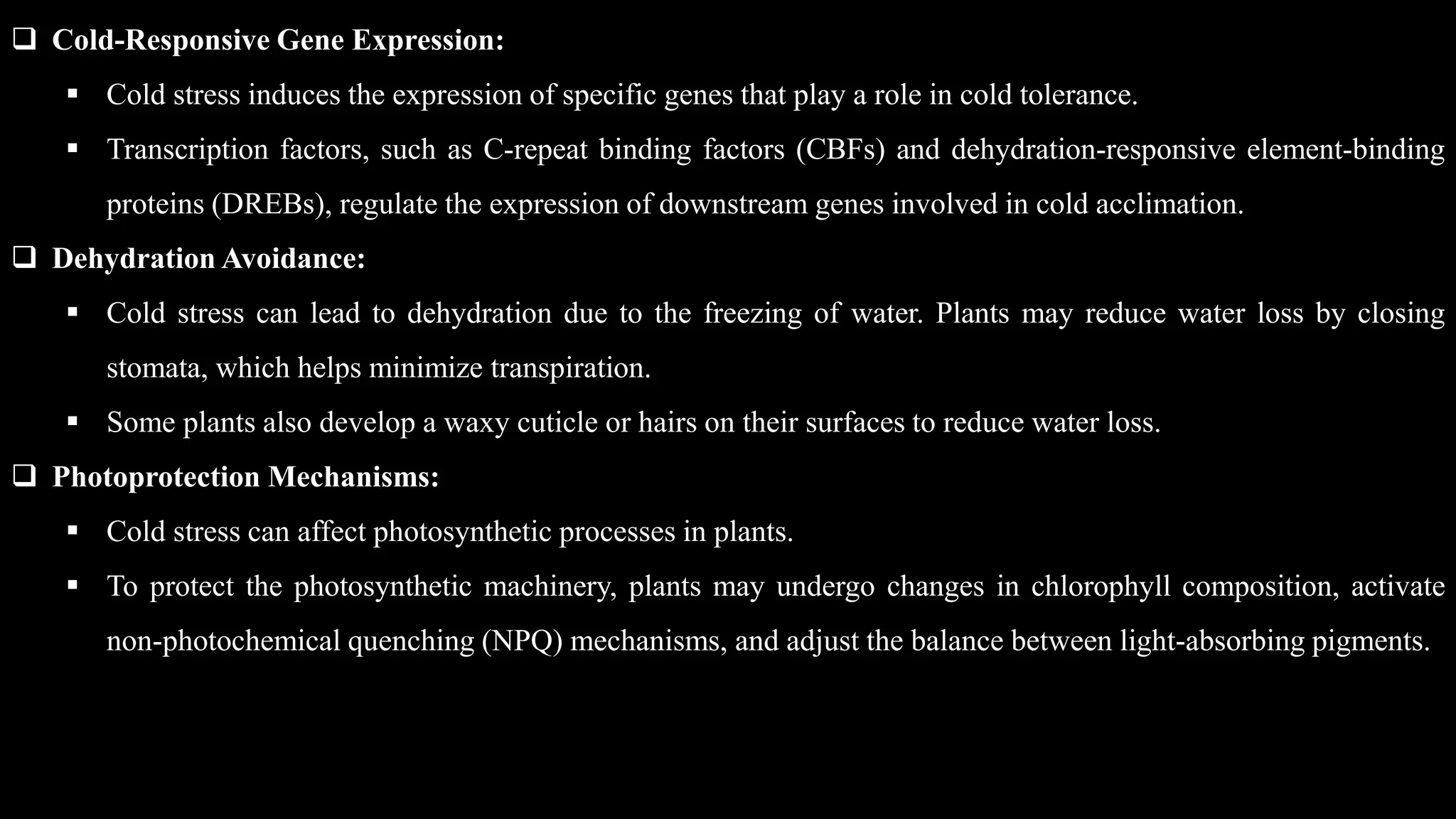
 Cold-Responsive Gene Expression:
 Cold stress induces the expression of specific genes that play a role in cold tolerance.
 Transcription factors, such as C-repeat binding factors (CBFs) and dehydration-responsive element-binding
proteins (DREBs), regulate the expression of downstream genes involved in cold acclimation.
 Dehydration Avoidance:
 Cold stress can lead to dehydration due to the freezing of water. Plants may reduce water loss by closing
stomata, which helps minimize transpiration.
 Some plants also develop a waxy cuticle or hairs on their surfaces to reduce water loss.
 Photoprotection Mechanisms:
 Cold stress can affect photosynthetic processes in plants.
 To protect the photosynthetic machinery, plants may undergo changes in chlorophyll composition, activate
non-photochemical quenching (NPQ) mechanisms, and adjust the balance between light-absorbing pigments.
 Metabolic Adjustments:
 Cold-acclimated plants often undergo metabolic changes to optimize energy usage and resource allocation.
 This may include alterations in the levels of metabolites, enzymes, and other cellular components to support
the plant's survival under cold conditions.
 Root Development and Insulation:
 Plants may invest in root development to explore deeper soil layers where temperatures are more stable.
 Additionally, some plants develop insulating structures such as a layer of dead cells (e.g., aerenchyma)
around their shoot apices to protect them from freezing temperatures.
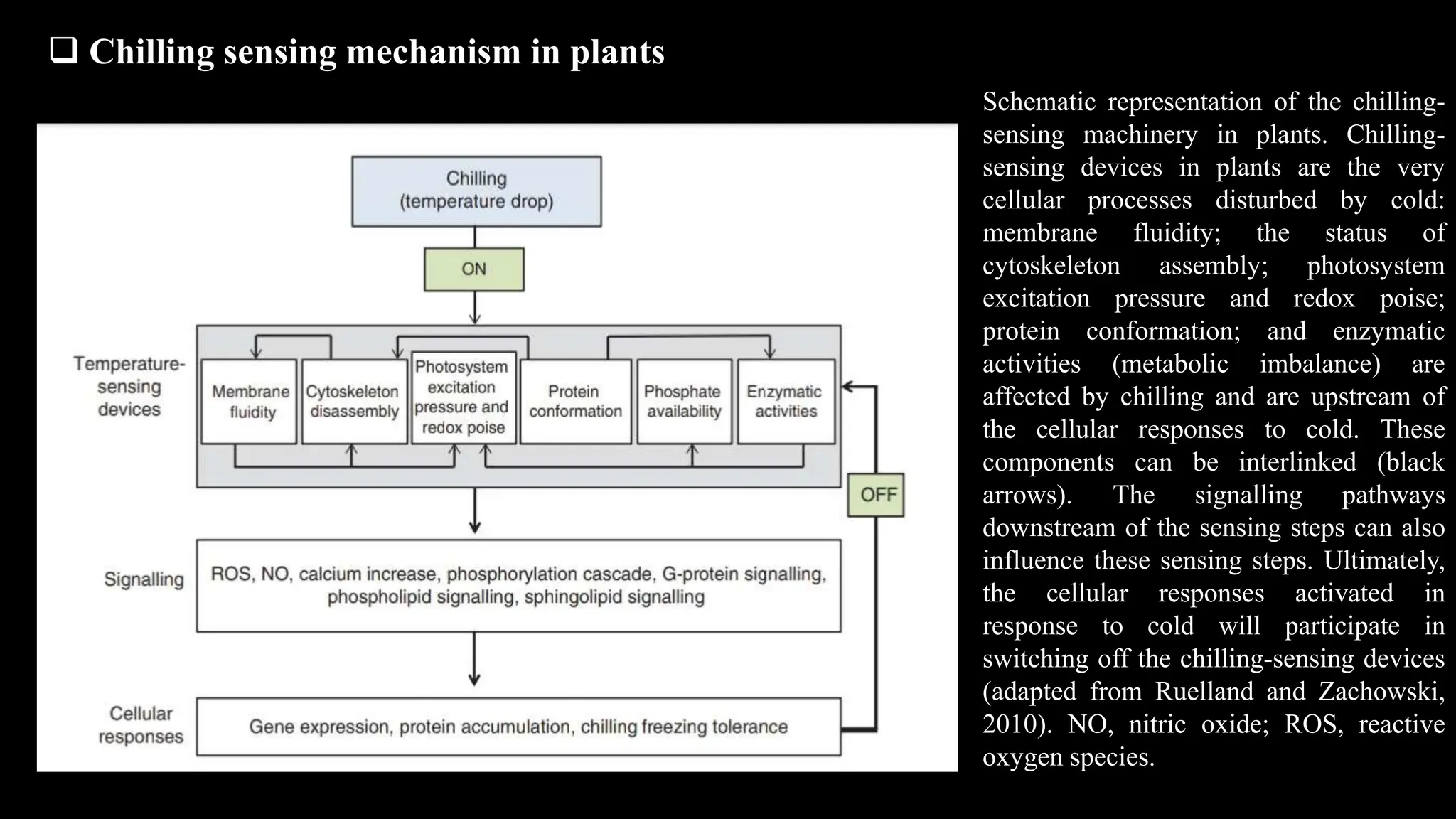
Schematic representation of the chilling-
sensing machinery in plants. Chilling-
sensing devices in plants are the very
cellular processes disturbed by cold:
membrane fluidity; the status of
cytoskeleton assembly; photosystem
excitation pressure and redox poise;
protein conformation; and enzymatic
activities (metabolic imbalance) are
affected by chilling and are upstream of
the cellular responses to cold. These
components can be interlinked (black
arrows). The signalling pathways
downstream of the sensing steps can also
influence these sensing steps. Ultimately,
the cellular responses activated in
response to cold will participate in
switching off the chilling-sensing devices
(adapted from Ruelland and Zachowski,
2010). NO, nitric oxide; ROS, reactive
oxygen species.
 Chilling sensing mechanism in plants
Fig: Schematic way of chilling response in plants
 How plant adapt to chilling?
 Adaptation mechanism
 Cold-shock proteins and RNA-binding proteins
 One of the major problems that living organisms have to deal with when exposed to low temperatures is the
formation and stabilization of RNA secondary structures that may prevent efficient translation and transcription.
 Bacteria have RNA chaperones that destabilize RNA secondary structures, enabling efficient translation at low
temperature.
 Such bacteria chaperones are named cold-shock proteins (CSPs) and are composed of a single nucleic acid
binding domain (of about 70 amino acid residues) called the cold-shock domain (CSD)
 Change in lipid composition
 The changes in the lipid composition of plasma membranes and chloroplast envelopes have also been proposed as
having a role in the acquisition of freezing tolerance by chilling exposure: they may prevent freeze-induced
membrane damage by stabilizing the bilayer lamellar configuration,
 Among these responses are the accumulation of hydrophilic proteins, the accumulation of sugars and compatible
solutes, changes in membrane lipid composition and cell wall composition, the induction of protein-chaperone
and RNA-chaperone synthesis.
 Compatible solutes other than sugars
 In addition to soluble sugars, compatible solutes are a heterogeneous group of molecules comprising amino acids
(Pro, Ala, Gly, Ser) and polyamines.
 Compatible solutes are low molecular weight organic molecules that are produced in response to many stresses
such as desiccation, osmotic stress or low-temperature stress.
 Anthocyanin and flavonoid accumulation
 Anthocyanin accumulation can contribute to the adaptation of photosynthesis to chilling. These pigments
accumulate in leaves and stems in response to low temperature and changes in light Intensity
 Some flavonoids that are accumulated in the cold are able to depress the freezing point of plant cells or tissues
and contribute to the deep supercooling ability of xylem parenchyma cells in katsura trees (Kasuga et al., 2008)
 Anthocyanin accumulation has been reported to protect developing pine needles from photoinhibition during
growth of seedlings at low temperatures, due to light trapping, which decreased chlorophyll excitation by blue
light (Harvaux and Kloppstech, 2001).
 Detoxification of ROS
 At low temperature, the enzymatic systems that normally detoxicate ROS will be less efficient. This will lead to
an increase in ROS production that will need to be detoxified via the induction of ROS defence mechanisms.
 The detoxification of hydrogen peroxide produced in the chloroplasts indeed relies exclusively on the activity of
ascorbate peroxidase bound to thylakoid membranes in the vicinity of photosystem I.
 For instance, the pea cultivar with increased abundance of pectic polymers after chilling exposure was freezing
tolerant while the other was freezing sensitive (Baldwin et al., 2014).
 Metabolic readjustments and the induction of ROS-scavenging systems are also necessary to cope with cold,
 Decrease in lignin content
 Concerning lignification, decrease in lignin content is correlated with increased freezing-tolerance.
 Dehydrins
 Dehydrins may indeed have a role in freezing-tolerance, possibly by preventing the membrane destabilization
that occurs during the osmotic contraction associated with freezing.
 Calcium signalling
 Chilling is not perceived by a single mechanism in plants but at different sensory levels that are the very
biological processes disturbed by the temperature downshift. Once perceived, chilling stress is transduced.
 An increase in cytosolic calcium is the major transducing event that will then regulate the activity of many
signalling components, including phospholipases and protein kinases.
Chilling Resistant
Arabidopsis thaliana Arabidopsis No chilling injury observed unless another stress factor is simultaneously
imposed.Plastids and mitochondria remain intact
Brassica oleracea Cabbage
Spinacia oleracea Spinach
Chilling Sensitive
Cucumis sativum Cucumber Chloroplast swelling, thylakoid dilation, randomly tilted grana stacks,
formation of peripheral reticulum, serpentine-like thylakoids and
accumulation of lipid droplets in the stroma all observed. Chloroplasts
disintegrate with prolonged chilling.
No injury in mitochondria.
Fragaria virginiana Strawberry
Lycopersicon
esculentum
Tomato
Phaseolus vulgaris Common bean
Pisum sativum Pea
 Chilling sensitivity of the horticultural crops
THANK YOU

Adaptation mechanism to cold stress.pptx

  • 1.
    Adaptation to coldstress Utshav Bhandari R-2022-HRT-03M
  • 2.
     Chilling isexposure to low, non-freezing temperatures  Freezing (exposure to sub-zero temperatures)  Exposure to chilling temperatures is not always detrimental,  For instance, chilling is a key environmental cue in the process of flowering through vernalization, the exposure to such cold temperatures being necessary to accelerate the transition from vegetative growth to the reproductive phase (Zografos and Sung, 2012).  Chilling of imbibed seeds (e.g. stratification) can be necessary to break seed dormancy,  Chilling is also needed for the induction of bud dormancy in the autumn, for example in species such as pear and apple, and at the same time also for breaking bud dormancy at the end of winter (Heide and Prestrud, 2005).
  • 3.
    Flow diagram showingthe effects of chilling stress during the reproductive phase processes (from Thakur et al., 2010).  Effect of chilling on the reproductive stage of plant
  • 4.
    Effects of chillingand freezing on cellular processes and the cellular responses to chilling that will lead to chilling tolerance and freezing tolerance. The effects of cold, either chilling (A) or freezing (B), are indicated in boxes. The responses that are triggered during an exposure to chilling and which will participate in alleviating the chilling stress (A) or the freezing stress (B) are indicated with a line with a bar (adapted from Ruelland et al., 2009).  Effect of chilling on cellular responses and cellular processes
  • 5.
    Adaptations to coldstress in plants:  Membrane Fluidity Adjustment:  Cold temperatures can cause cell membranes to become rigid, affecting their integrity and function.  Plants adjust the lipid composition of their cell membranes to maintain fluidity at lower temperatures.  This involves an increase in unsaturated fatty acids, which helps prevent membrane damage.  Accumulation of Cryoprotectants:  Plants accumulate certain compounds known as cryoprotectants, which help protect cells from damage caused by freezing.  Common cryoprotectants include sugars (such as sucrose), proline, and other compatible solutes.  These substances help lower the freezing point of cell sap and prevent ice crystal formation inside cells.  Antioxidant Defense System:  Cold stress can lead to an increase in reactive oxygen species (ROS), which can cause cellular damage.  Plants enhance their antioxidant defense system by producing enzymes such as superoxide dismutase (SOD), catalase, and peroxidase. These enzymes help scavenge ROS and protect cells from oxidative stress.
  • 6.
     Cold-Responsive GeneExpression:  Cold stress induces the expression of specific genes that play a role in cold tolerance.  Transcription factors, such as C-repeat binding factors (CBFs) and dehydration-responsive element-binding proteins (DREBs), regulate the expression of downstream genes involved in cold acclimation.  Dehydration Avoidance:  Cold stress can lead to dehydration due to the freezing of water. Plants may reduce water loss by closing stomata, which helps minimize transpiration.  Some plants also develop a waxy cuticle or hairs on their surfaces to reduce water loss.  Photoprotection Mechanisms:  Cold stress can affect photosynthetic processes in plants.  To protect the photosynthetic machinery, plants may undergo changes in chlorophyll composition, activate non-photochemical quenching (NPQ) mechanisms, and adjust the balance between light-absorbing pigments.
  • 7.
     Metabolic Adjustments: Cold-acclimated plants often undergo metabolic changes to optimize energy usage and resource allocation.  This may include alterations in the levels of metabolites, enzymes, and other cellular components to support the plant's survival under cold conditions.  Root Development and Insulation:  Plants may invest in root development to explore deeper soil layers where temperatures are more stable.  Additionally, some plants develop insulating structures such as a layer of dead cells (e.g., aerenchyma) around their shoot apices to protect them from freezing temperatures.
  • 8.
    Schematic representation ofthe chilling- sensing machinery in plants. Chilling- sensing devices in plants are the very cellular processes disturbed by cold: membrane fluidity; the status of cytoskeleton assembly; photosystem excitation pressure and redox poise; protein conformation; and enzymatic activities (metabolic imbalance) are affected by chilling and are upstream of the cellular responses to cold. These components can be interlinked (black arrows). The signalling pathways downstream of the sensing steps can also influence these sensing steps. Ultimately, the cellular responses activated in response to cold will participate in switching off the chilling-sensing devices (adapted from Ruelland and Zachowski, 2010). NO, nitric oxide; ROS, reactive oxygen species.  Chilling sensing mechanism in plants
  • 9.
    Fig: Schematic wayof chilling response in plants  How plant adapt to chilling?
  • 10.
     Adaptation mechanism Cold-shock proteins and RNA-binding proteins  One of the major problems that living organisms have to deal with when exposed to low temperatures is the formation and stabilization of RNA secondary structures that may prevent efficient translation and transcription.  Bacteria have RNA chaperones that destabilize RNA secondary structures, enabling efficient translation at low temperature.  Such bacteria chaperones are named cold-shock proteins (CSPs) and are composed of a single nucleic acid binding domain (of about 70 amino acid residues) called the cold-shock domain (CSD)  Change in lipid composition  The changes in the lipid composition of plasma membranes and chloroplast envelopes have also been proposed as having a role in the acquisition of freezing tolerance by chilling exposure: they may prevent freeze-induced membrane damage by stabilizing the bilayer lamellar configuration,
  • 11.
     Among theseresponses are the accumulation of hydrophilic proteins, the accumulation of sugars and compatible solutes, changes in membrane lipid composition and cell wall composition, the induction of protein-chaperone and RNA-chaperone synthesis.  Compatible solutes other than sugars  In addition to soluble sugars, compatible solutes are a heterogeneous group of molecules comprising amino acids (Pro, Ala, Gly, Ser) and polyamines.  Compatible solutes are low molecular weight organic molecules that are produced in response to many stresses such as desiccation, osmotic stress or low-temperature stress.  Anthocyanin and flavonoid accumulation  Anthocyanin accumulation can contribute to the adaptation of photosynthesis to chilling. These pigments accumulate in leaves and stems in response to low temperature and changes in light Intensity  Some flavonoids that are accumulated in the cold are able to depress the freezing point of plant cells or tissues and contribute to the deep supercooling ability of xylem parenchyma cells in katsura trees (Kasuga et al., 2008)
  • 12.
     Anthocyanin accumulationhas been reported to protect developing pine needles from photoinhibition during growth of seedlings at low temperatures, due to light trapping, which decreased chlorophyll excitation by blue light (Harvaux and Kloppstech, 2001).  Detoxification of ROS  At low temperature, the enzymatic systems that normally detoxicate ROS will be less efficient. This will lead to an increase in ROS production that will need to be detoxified via the induction of ROS defence mechanisms.  The detoxification of hydrogen peroxide produced in the chloroplasts indeed relies exclusively on the activity of ascorbate peroxidase bound to thylakoid membranes in the vicinity of photosystem I.  For instance, the pea cultivar with increased abundance of pectic polymers after chilling exposure was freezing tolerant while the other was freezing sensitive (Baldwin et al., 2014).  Metabolic readjustments and the induction of ROS-scavenging systems are also necessary to cope with cold,  Decrease in lignin content  Concerning lignification, decrease in lignin content is correlated with increased freezing-tolerance.
  • 13.
     Dehydrins  Dehydrinsmay indeed have a role in freezing-tolerance, possibly by preventing the membrane destabilization that occurs during the osmotic contraction associated with freezing.  Calcium signalling  Chilling is not perceived by a single mechanism in plants but at different sensory levels that are the very biological processes disturbed by the temperature downshift. Once perceived, chilling stress is transduced.  An increase in cytosolic calcium is the major transducing event that will then regulate the activity of many signalling components, including phospholipases and protein kinases.
  • 14.
    Chilling Resistant Arabidopsis thalianaArabidopsis No chilling injury observed unless another stress factor is simultaneously imposed.Plastids and mitochondria remain intact Brassica oleracea Cabbage Spinacia oleracea Spinach Chilling Sensitive Cucumis sativum Cucumber Chloroplast swelling, thylakoid dilation, randomly tilted grana stacks, formation of peripheral reticulum, serpentine-like thylakoids and accumulation of lipid droplets in the stroma all observed. Chloroplasts disintegrate with prolonged chilling. No injury in mitochondria. Fragaria virginiana Strawberry Lycopersicon esculentum Tomato Phaseolus vulgaris Common bean Pisum sativum Pea  Chilling sensitivity of the horticultural crops
  • 15.