Gustavo A. Martínez-Muñiz
                BIOL 3095
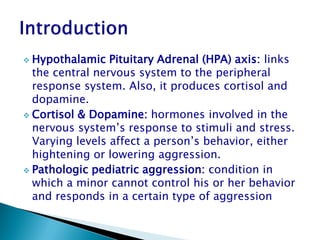
 Hypothalamic   Pituitary Adrenal (HPA) axis: links
  the central nervous system to the peripheral
  response system. Also, it produces cortisol and
  dopamine.
 Cortisol & Dopamine: hormones involved in the
  nervous system’s response to stimuli and stress.
  Varying levels affect a person’s behavior, either
  hightening or lowering aggression.
 Pathologic pediatric aggression: condition in
  which a minor cannot control his or her behavior
  and responds in a certain type of aggression
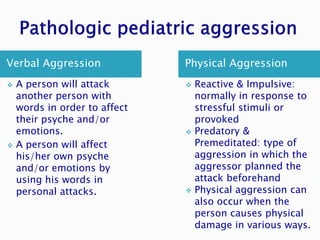
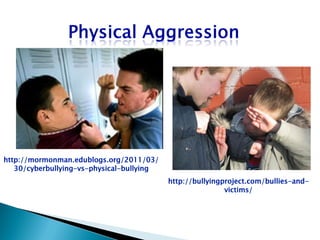
Verbal Aggression              Physical Aggression
   A person will attack          Reactive & Impulsive:
    another person with            normally in response to
    words in order to affect       stressful stimuli or
    their psyche and/or            provoked
    emotions.                     Predatory &
   A person will affect           Premeditated: type of
    his/her own psyche             aggression in which the
    and/or emotions by             aggressor planned the
    using his words in             attack beforehand
    personal attacks.             Physical aggression can
                                   also occur when the
                                   person causes physical
                                   damage in various ways.
 In
   a study made with adolescents, flattered
 diurnal cortisol profile, or low levels of
 cortisol in the system can be weakly
 associated to aggressive behavior. (Van den
 Bergh et al. 2008)
 Whereas  in a study that took place with a
 large group of young children shows that
 proactive (premeditated) aggressive behavior
 can be linked to low levels of cortisol after
 stressful situations. (Lopez-Duran et al.
 2009)
 According    to a recent   Dopamine levels
  review, low cortisol in     in the HPA axis
  the HPA axis is
  associated with             Low    profiles of
  aggressive behavior.              a dopamine
 Pre-pubertal children      metabolite called
  would have low cortisol    homovanillic acid
  levels when exposed to       in children with
                              comorbid ADHD
  stress-inducing               and aggressive
  situations.                      behavior are
 It is also involved in          similar to the
  early development of        profiles of adult
  aggression in young        men convicted of
                                        murder.
  males.                      (Barzman    et al.
 (Barzman   et al. 2010)                 2010)
   “Youth with internalizing behaviors have higher morning
    cortisol levels” – Ruttle et al. (2011)
   In the other hand, youth with external behavior show
    lower levels of morning cortisol.
   Children with lower cortisol profiles are observed to
    have flattened cortisol profiles throughout adolescence.
   This flattened profile of hormones tends to be
    persistent and gives place to more aggressive behaviors
   (Ruttle et al. 2011)
 Children with aggressive behaviors are more
  prone to antisocial behavior and abnormal
  behavior such as: drug and alcohol abuse,
  problems at home, and/or problematic
  friendships.
 A survey in Washington, USA, and Victoria,
  Australia shows that boys are more capable
  of predatory aggression and behavior.
 This would be a factor in behavioral changes
  of the aggressive child or adolescent
 (Hemphill et al. 2010).
 Cortisol and dopamine are two hormones that
  should be closely observed when involving
  aggressive behavior.
 Diagnostics of psychiatric disorders may be
  centered on the measurement of these hormones
  in order to indicate the source of aggression.
 Psychological screenings are also important to
  cross with these hormone measurements in order
  to see social behavior of the potential patient.
 Future works would involve measurement of both
  hormone profiles at the same time in order to
  associate with aggression
 When   growing up, children with low cortisol
  profiles will develop a flattened cortiisol
  profile.
 This gives place to aggressive behavior
  throughout adolescence and possibly
  adulthood.
   Barzman DH, Patel A, Sonnier L, Strawn JR. 2010. Neuroendocrine
    aspects of pediatric aggression: Can hormone measures be
    clinically useful?. Neuropsychiatric Disease and Treatment
    2010:6 691 – 697
   Hemphill SA, Kotevski A, Herrenkohl, Toumbourou JW, Carlin JB,
    Catalano RF, Patton GC. 2010. Pubertal stage and the prevalence
    of violence and social relational aggression. Pediatrics. 2010
    August ; 126(2): e298–e305. doi:10.1542/peds.2009-0574.
   Lopez-Duran NL, Olson SL, Hajal NJ, Felt BT, Vázquez DM. 2009.
    Hypothalamic Pituitary Adrenal Axis Functioning in Reactive and
    Proactive Aggression in Children. J Abnorm Child Psychol (2009)
    37:169–182
        DOI 10.1007/s10802-008-9263-3.
   Van den Bergh BRH, Van Calster B, Pinna Puissant S, Van Huffel S.
    2008. Self-reported symptoms of depressed mood, trait anxiety,
    and aggressive behavior in post-pubertal adolescents:
    Association with diurnal cortisol profiles. Hormones and Behavior
    54 (2008) 258-257
   Ruttle P, Shirtcliff E, Serbin L, Fisher D, Stack D, Schwartzman A.
    Disentangling psychobiological mechanisms underlying
    internalizing and externalizing behaviors in youth: Longitudinal
    and concurrent associations with cortisol. Horm Behav. 2011
    January ; 59(1): 123–132. doi:10.1016/j.yhbeh.2010.10.015.
Cortisol, dopamine, aggression   presentation

Cortisol, dopamine, aggression presentation

  • 1.
  • 2.
     Hypothalamic Pituitary Adrenal (HPA) axis: links the central nervous system to the peripheral response system. Also, it produces cortisol and dopamine.  Cortisol & Dopamine: hormones involved in the nervous system’s response to stimuli and stress. Varying levels affect a person’s behavior, either hightening or lowering aggression.  Pathologic pediatric aggression: condition in which a minor cannot control his or her behavior and responds in a certain type of aggression
  • 3.
    Verbal Aggression Physical Aggression  A person will attack  Reactive & Impulsive: another person with normally in response to words in order to affect stressful stimuli or their psyche and/or provoked emotions.  Predatory &  A person will affect Premeditated: type of his/her own psyche aggression in which the and/or emotions by aggressor planned the using his words in attack beforehand personal attacks.  Physical aggression can also occur when the person causes physical damage in various ways.
  • 6.
     In a study made with adolescents, flattered diurnal cortisol profile, or low levels of cortisol in the system can be weakly associated to aggressive behavior. (Van den Bergh et al. 2008)  Whereas in a study that took place with a large group of young children shows that proactive (premeditated) aggressive behavior can be linked to low levels of cortisol after stressful situations. (Lopez-Duran et al. 2009)
  • 7.
     According to a recent Dopamine levels review, low cortisol in in the HPA axis the HPA axis is associated with Low profiles of aggressive behavior. a dopamine  Pre-pubertal children metabolite called would have low cortisol homovanillic acid levels when exposed to in children with comorbid ADHD stress-inducing and aggressive situations. behavior are  It is also involved in similar to the early development of profiles of adult aggression in young men convicted of murder. males. (Barzman et al.  (Barzman et al. 2010) 2010)
  • 8.
    “Youth with internalizing behaviors have higher morning cortisol levels” – Ruttle et al. (2011)  In the other hand, youth with external behavior show lower levels of morning cortisol.  Children with lower cortisol profiles are observed to have flattened cortisol profiles throughout adolescence.  This flattened profile of hormones tends to be persistent and gives place to more aggressive behaviors  (Ruttle et al. 2011)
  • 9.
     Children withaggressive behaviors are more prone to antisocial behavior and abnormal behavior such as: drug and alcohol abuse, problems at home, and/or problematic friendships.  A survey in Washington, USA, and Victoria, Australia shows that boys are more capable of predatory aggression and behavior.  This would be a factor in behavioral changes of the aggressive child or adolescent (Hemphill et al. 2010).
  • 10.
     Cortisol anddopamine are two hormones that should be closely observed when involving aggressive behavior.  Diagnostics of psychiatric disorders may be centered on the measurement of these hormones in order to indicate the source of aggression.  Psychological screenings are also important to cross with these hormone measurements in order to see social behavior of the potential patient.  Future works would involve measurement of both hormone profiles at the same time in order to associate with aggression
  • 11.
     When growing up, children with low cortisol profiles will develop a flattened cortiisol profile.  This gives place to aggressive behavior throughout adolescence and possibly adulthood.
  • 12.
    Barzman DH, Patel A, Sonnier L, Strawn JR. 2010. Neuroendocrine aspects of pediatric aggression: Can hormone measures be clinically useful?. Neuropsychiatric Disease and Treatment 2010:6 691 – 697  Hemphill SA, Kotevski A, Herrenkohl, Toumbourou JW, Carlin JB, Catalano RF, Patton GC. 2010. Pubertal stage and the prevalence of violence and social relational aggression. Pediatrics. 2010 August ; 126(2): e298–e305. doi:10.1542/peds.2009-0574.  Lopez-Duran NL, Olson SL, Hajal NJ, Felt BT, Vázquez DM. 2009. Hypothalamic Pituitary Adrenal Axis Functioning in Reactive and Proactive Aggression in Children. J Abnorm Child Psychol (2009) 37:169–182 DOI 10.1007/s10802-008-9263-3.  Van den Bergh BRH, Van Calster B, Pinna Puissant S, Van Huffel S. 2008. Self-reported symptoms of depressed mood, trait anxiety, and aggressive behavior in post-pubertal adolescents: Association with diurnal cortisol profiles. Hormones and Behavior 54 (2008) 258-257
  • 13.
    Ruttle P, Shirtcliff E, Serbin L, Fisher D, Stack D, Schwartzman A. Disentangling psychobiological mechanisms underlying internalizing and externalizing behaviors in youth: Longitudinal and concurrent associations with cortisol. Horm Behav. 2011 January ; 59(1): 123–132. doi:10.1016/j.yhbeh.2010.10.015.