SUBMITTED BY:-
NISHU SAINI
Contents
 Definition of Aggression
 Types of Aggression
 Determinants of Aggression
 References
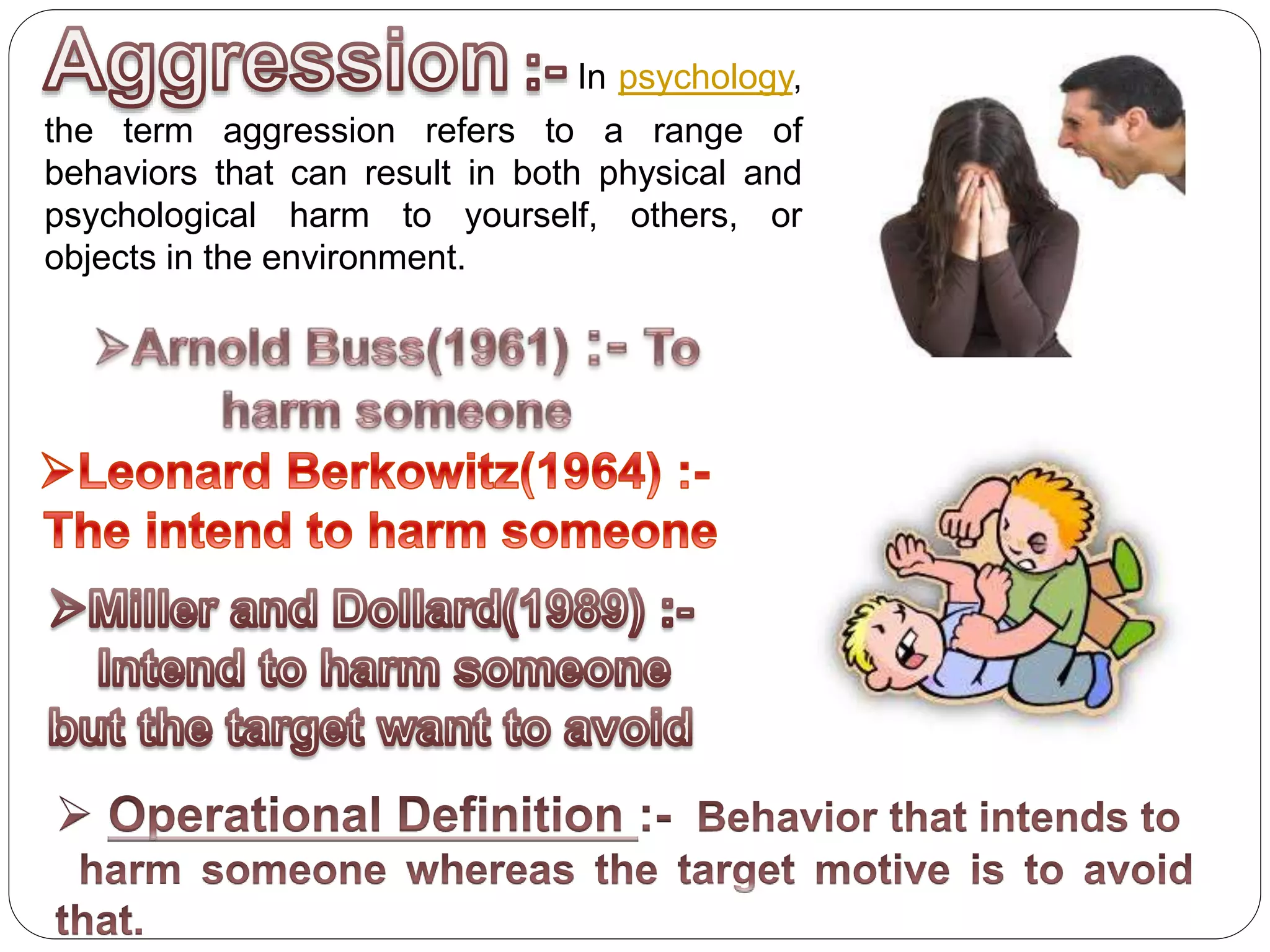
In psychology,
the term aggression refers to a range of
behaviors that can result in both physical and
psychological harm to yourself, others, or
objects in the environment.
Type of aggression
Aggression can take a variety of forms,
including:
 Physical
 Verbal
 Mental
 Emotional
While we often think of aggression as purely
in physical forms such as hitting or pushing,
psychological aggression can also be very
damaging. Intimidating or verbally berating
another person, for example, are examples of
verbal, mental, and emotional aggression.
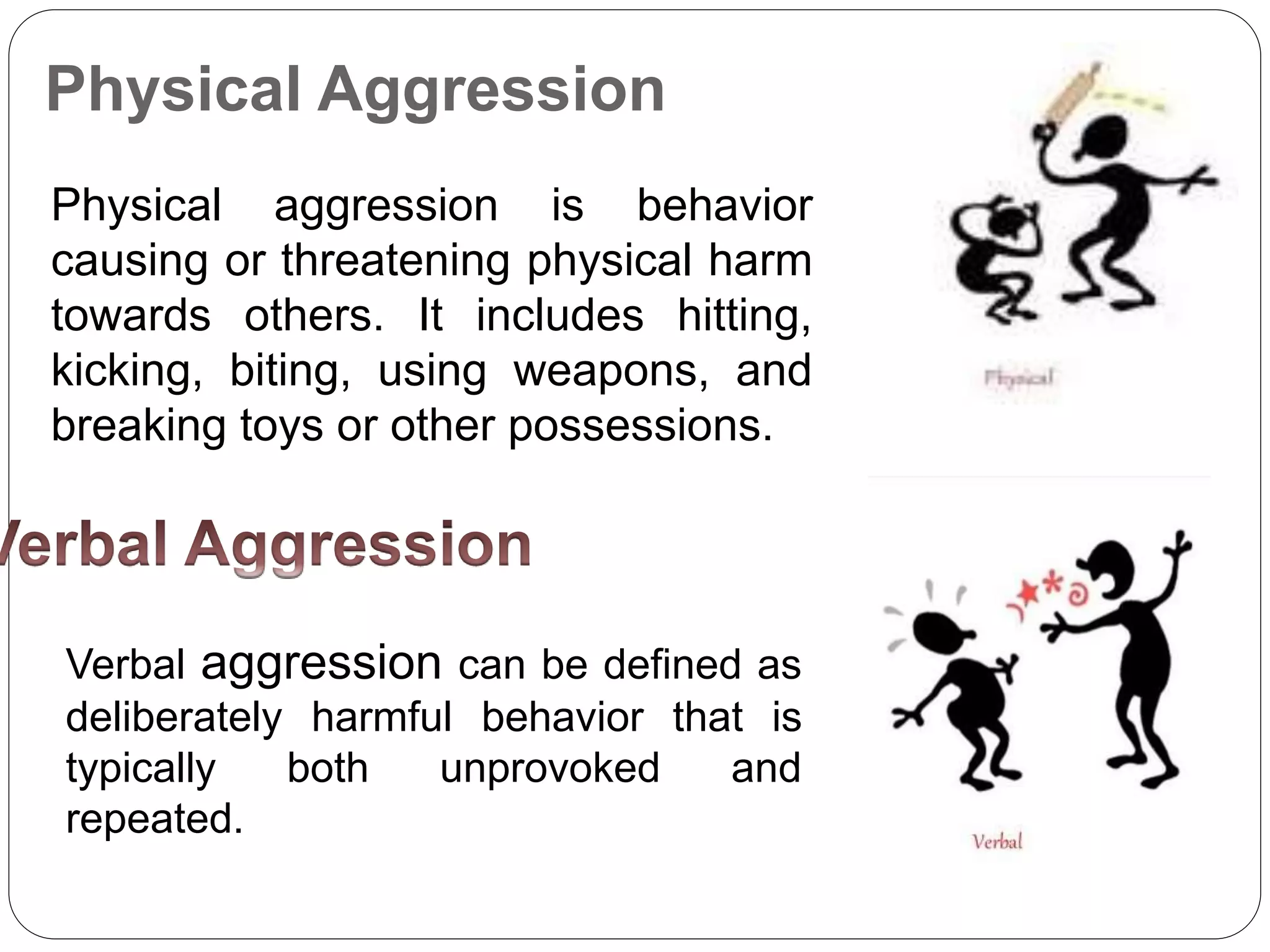
Physical Aggression
Physical aggression is behavior
causing or threatening physical harm
towards others. It includes hitting,
kicking, biting, using weapons, and
breaking toys or other possessions.
Verbal aggression can be defined as
deliberately harmful behavior that is
typically both unprovoked and
repeated.
when the intent of harming
others is just in thought process
Emotional Aggression
Emotional or impulsive
aggression refers to aggression
that occurs with only a small
amount of forethought or intent
and that is determined primarily by
impulsive emotions.
Mental Aggression
Determinants of aggression
There are five type of determinants
of aggression.
 Biological Aggression
 Situational Aggression
 Personal Aggression
 Environment Aggression
 Cultural Aggression
Biological Determinants
Brain Region limbic system
Brain Stem
Amygdala
Hypothalamus
Hormones Testosterone
Estrogen
Chromosomes XYY- 47
Krayotype
v
v
Brain Regions
Brain regions that influence aggression
include the amygdala (area 1) and the
prefrontal cortex (area 2). Individual
differences in one or more of these
regions or in the interconnections among
them can increase the propensity for
impulsive aggression.Harmone
sHormones are also important in
creating aggression. Most important in
this regard is the male sex hormone
testosterone, which is associated with
increased aggression in both animals
and in humans. Although testosterone
levels are much higher in men than in
women, the relationship between
Chromosomes (XYY-47)
47,XYY syndrome is
characterized by an extra
copy of the Y chromosome in
each of a male's cells.
Although many males with
this condition are taller than
average, the chromosomal
change sometimes causes no
unusual physical features.
Most males with 47,XYY
syndrome have normal
production of the male sex
hormone testosterone and
Situational Aggression
Frustration
Attack
Modeling
Deindiviuial
View of Weapons
Exposure to Media violence
Spectators
Lack of Social skill
Disintribition
Desensitization
In psychology, frustration is a common
emotional response to opposition,
related to anger, annoyance and
disappointment, frustration arises from
the perceived resistance to the fulfillment
of an individual's will or goal and is likely
to increase when a will or goal is denied
or blocked.
Attack, sudden onset of intense
apprehension, fear, or terror that
occurs without apparent cause.
Lack of social
skill
A social skill is any competence
facilitating interaction and
communication with others where
social rules and relations are created,
communicated, and changed in verbal
and nonverbal ways. The process of
learning these skills is called
socialization.
In psychology, desensitization is a treatment
or process that diminishes emotional
responsiveness to a negative, aversive or
positive stimulus after repeated exposure to
it. Desensitization also occurs when an
emotional response is repeatedly evoked in
situations in which the action tendency that is
associated with the emotion proves irrelevant
or unnecessary.
Aggression
Age
Gender
Personality
Cognitive Style
Emotional State Anger Arousal Intensity of
frustration
General Arousal Feeling of
Hostility
Sexual Arousal Aggressive
Cues
other form of Arousal
Dispositional
Excitatory
Aggressive behavior during childhood is seen as
a part of the normal developmental process
(Greydanus, Pratt, Greydanus, & Hoffman,
1992). Before children develop verbal skills,
aggressive behavior is manifested physically.
Later on, verbal skills can be used for aggressive
purposes, but also to diffuse aggressive behavior
by communicating needs that could not be
expressed physically (Ferris & Grisso, 1996).
Toddlers display aggressive behavior by crying,
screaming, biting, kicking, throwing, and
breaking objects (Achenbach, 1994; Raine,
Reynolds, Venebles, Mednick, & Farrington,
1998). Anger outbursts typically peak at 18 to 24
months and slowly decrease by age 5. It was
found that the majority of children first reached
the onset of aggressive behavior before age 2&
Davies, 2000; Keenan & Wakschlag, 2000;
Tremblay et , at around 17 months of age (Hay,
Castle, al. 1996).
r
On gender differences in aggressive
behavior are examined. In
proportions of their total aggression
scores, boys and girls are verbally
about equally aggressive, while boys
are more physically and girls more
indirectly aggressive. There are
genetic determinants of both physical
and indirect aggression, suggesting
that both types of aggression give
evolutionary advantages
Personality
Aggressive personalities are
fundamentally at war with anything
that stands in the way of their
unrestrained pursuit of their desires.
Cognitive
Style
Social cognitions about aggression
(self‐evaluation, self‐efficacy,
retaliation approval, aggressive
fantasizing, caring about
consequences), and aggressive
behavior. Results supported the
hypothesis that social cognitions
mediate the relations of exposure to
aggression and anger control to
aggressive behavior.
motional State
The state similar to the state of
aggression is characterized by a
complex of negative emotional and
emotional-modal states
experienced by the subject (a
person) in the act of communication,
Anger Arousal, Sexual Arousal,
Other form of Arousal
The hypothesis that either an angry emotional state or
the expression of aggressive behavior facilitates sexual
arousal has been the subject of considerable speculation
but relatively little research. In a series of studies, Barclay
found that anger increased sexual arousal as measured
by the amount of sexual imagery produced in response to
TAT-like stimuli that depicted males and females in
dominant and submissive roles. In the present research, a
series of experiments was conducted to determine
whether such facilitation can be generalized beyond the
specific procedures used by Barclay. Subjects (151 males
and 136 females) in three experiments were angered by
being negatively evaluated by a confederate identified as
a fellow subject. Some subjects were subsequently given
an opportunity to aggress; additionally, some subjects
were exposed to male- and female-dominant pictorial
stimuli. Results indicated that neither anger instigation nor
the opportunity to engage in aggressive acts influenced
self-reported sexual arousal. There was consistent
evidence, however, that portrayals of dominance
influenced perceptions of the stimulus person's sexuality.
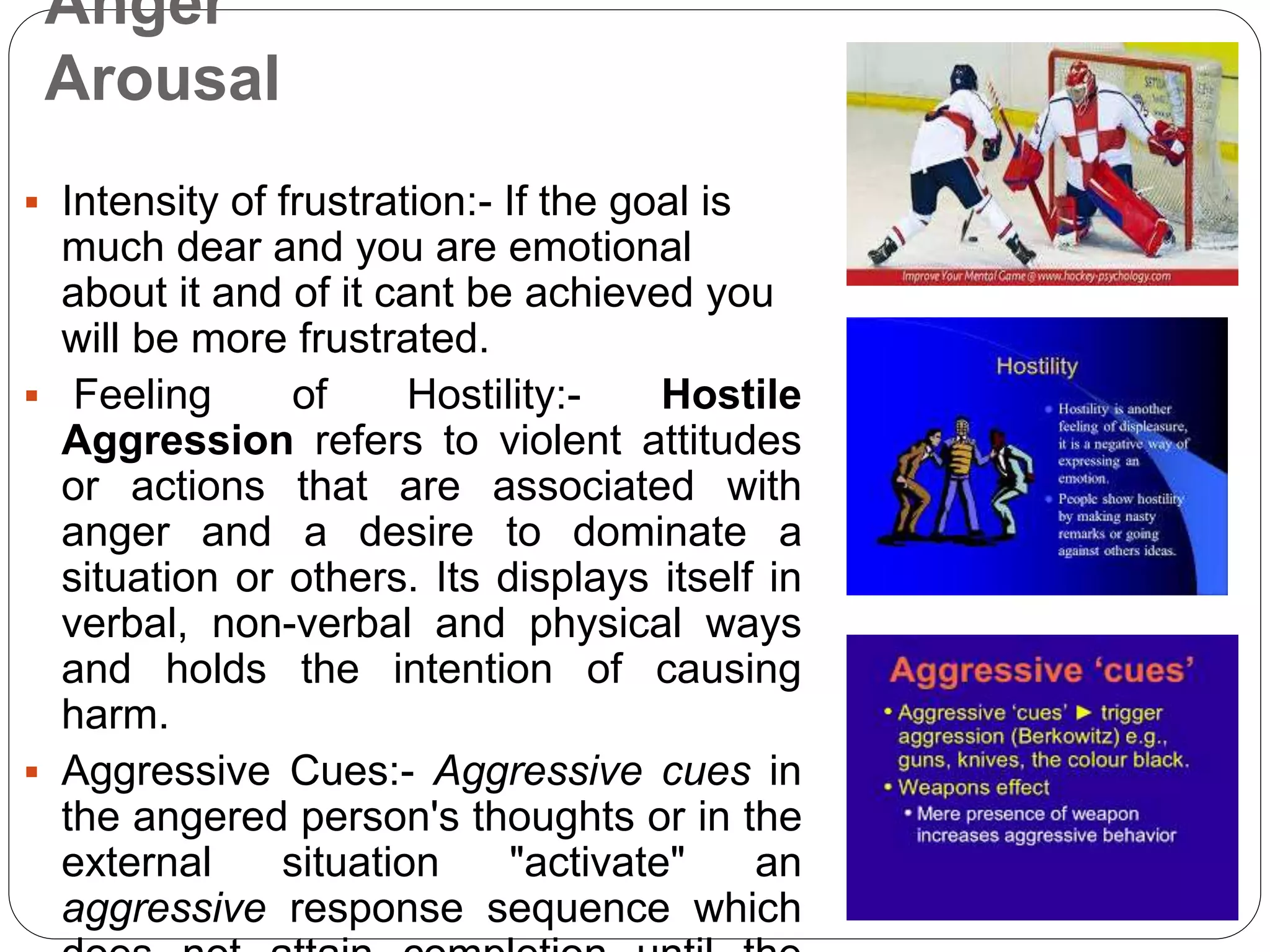
Anger
Arousal
 Intensity of frustration:- If the goal is
much dear and you are emotional
about it and of it cant be achieved you
will be more frustrated.
 Feeling of Hostility:- Hostile
Aggression refers to violent attitudes
or actions that are associated with
anger and a desire to dominate a
situation or others. Its displays itself in
verbal, non-verbal and physical ways
and holds the intention of causing
harm.
 Aggressive Cues:- Aggressive cues in
the angered person's thoughts or in the
external situation "activate" an
aggressive response sequence which
Aggressive
Cues
 Dispositional:-The definition of
dispositional is anything related
to putting affairs in order or a
state of readiness.
 Excitatory:- This suggest that
arousal from one situation can be
transferred to another situation.
 Experiential:-possesses the kind
of experiential knowledge that is
gained only from a long and
eventful life
Environm
ental
Air Pollution
Noise Pollution
Crowding
Heat (>32*)
Noxious odors, fumes, cigarette smoke produce
irritable and aggression. Up to a certain limit,
when the odor becomes foul the aggression
tends to decrease to escape from the unpleasant
environment.
Noise Pollution
Exposure to loud irritating
voice may increase
aggression.
Over crowding may
increase aggression.
Increased temperature
(>32*) facilities
aggression but to a limit
Cultur
al
Culture of Honor
Sexual Jealously
Cultural of Honor
A culture of honor is a culture in
which a person (usually a man)
feels obliged to protect his or her
reputation by answering insults,
affronts, and threats, oftentimes
through the use of violence.
Cultures of honor have been
independently invented many times
across the world.
Sexual jealously
Sexual jealousy is a special form of
jealousy in sexual relationships, based
on suspected or imminent sexual
infidelity.
References
 https://www.google.com/search?ei=SfRHXb2cBpm2rQHPr5i4DA&q=aggr
ession&oq=aggression&gs_l=psy-
ab.3..0i71l8.0.0..78077...0.0..0.0.0.......0......gws-
wiz.JdO73MvWKNc&ved=0ahUKEwj95IH6suvjAhUZWysKHc8XBscQ4d
UDCAo&uact=5
 https://www.google.com/search?ei=mPRHXdjPMdjbrQGW06PgDw&q=ty
pe+of+aggression&oq=type+&gs_l=psy-
ab.3.0.35i39j0i67l2j0l7.190450.207305..209006...13.0..4.957.8570.0j2j6j1
j2j2j5......0....1..gws-
wiz.....10..0i71j0i131i67j0i20i263j0i22i30j0i131.tQfDORC4vnY
 https://www.ncbi.nlm.nih.gov/pubmed/22029493
 https://opentextbc.ca/socialpsychology/chapter/defining-aggression/
 https://psychnews.psychiatryonline.org/doi/10.1176/pn.43.7.0009https://w
ww.verywellmind.com/what-is-aggression-2794818
 https://www.google.com/search?ei=mPRHXdjPMdjbrQGW06PgDw&q=th
eories+of+aggression&oq=aggression&gs_l=psy-
ab.3.7.0i71l8.0.0..6795...0.0..0.0.0.......0......gws-wiz.1OFq-EbYb
 https://study.com/academy/lesson/motivation-theory-of-aggression-in-
THANK
YOU

Aggression Psychology

  • 1.
  • 2.
    Contents  Definition ofAggression  Types of Aggression  Determinants of Aggression  References
  • 3.
    In psychology, the termaggression refers to a range of behaviors that can result in both physical and psychological harm to yourself, others, or objects in the environment.
  • 4.
    Type of aggression Aggressioncan take a variety of forms, including:  Physical  Verbal  Mental  Emotional While we often think of aggression as purely in physical forms such as hitting or pushing, psychological aggression can also be very damaging. Intimidating or verbally berating another person, for example, are examples of verbal, mental, and emotional aggression.
  • 5.
    Physical Aggression Physical aggressionis behavior causing or threatening physical harm towards others. It includes hitting, kicking, biting, using weapons, and breaking toys or other possessions. Verbal aggression can be defined as deliberately harmful behavior that is typically both unprovoked and repeated.
  • 6.
    when the intentof harming others is just in thought process Emotional Aggression Emotional or impulsive aggression refers to aggression that occurs with only a small amount of forethought or intent and that is determined primarily by impulsive emotions. Mental Aggression
  • 7.
    Determinants of aggression Thereare five type of determinants of aggression.  Biological Aggression  Situational Aggression  Personal Aggression  Environment Aggression  Cultural Aggression
  • 8.
    Biological Determinants Brain Regionlimbic system Brain Stem Amygdala Hypothalamus Hormones Testosterone Estrogen Chromosomes XYY- 47 Krayotype v v
  • 9.
    Brain Regions Brain regionsthat influence aggression include the amygdala (area 1) and the prefrontal cortex (area 2). Individual differences in one or more of these regions or in the interconnections among them can increase the propensity for impulsive aggression.Harmone sHormones are also important in creating aggression. Most important in this regard is the male sex hormone testosterone, which is associated with increased aggression in both animals and in humans. Although testosterone levels are much higher in men than in women, the relationship between
  • 10.
    Chromosomes (XYY-47) 47,XYY syndromeis characterized by an extra copy of the Y chromosome in each of a male's cells. Although many males with this condition are taller than average, the chromosomal change sometimes causes no unusual physical features. Most males with 47,XYY syndrome have normal production of the male sex hormone testosterone and
  • 11.
    Situational Aggression Frustration Attack Modeling Deindiviuial View ofWeapons Exposure to Media violence Spectators Lack of Social skill Disintribition Desensitization
  • 12.
    In psychology, frustrationis a common emotional response to opposition, related to anger, annoyance and disappointment, frustration arises from the perceived resistance to the fulfillment of an individual's will or goal and is likely to increase when a will or goal is denied or blocked. Attack, sudden onset of intense apprehension, fear, or terror that occurs without apparent cause.
  • 13.
    Lack of social skill Asocial skill is any competence facilitating interaction and communication with others where social rules and relations are created, communicated, and changed in verbal and nonverbal ways. The process of learning these skills is called socialization. In psychology, desensitization is a treatment or process that diminishes emotional responsiveness to a negative, aversive or positive stimulus after repeated exposure to it. Desensitization also occurs when an emotional response is repeatedly evoked in situations in which the action tendency that is associated with the emotion proves irrelevant or unnecessary.
  • 14.
    Aggression Age Gender Personality Cognitive Style Emotional StateAnger Arousal Intensity of frustration General Arousal Feeling of Hostility Sexual Arousal Aggressive Cues other form of Arousal Dispositional Excitatory
  • 15.
    Aggressive behavior duringchildhood is seen as a part of the normal developmental process (Greydanus, Pratt, Greydanus, & Hoffman, 1992). Before children develop verbal skills, aggressive behavior is manifested physically. Later on, verbal skills can be used for aggressive purposes, but also to diffuse aggressive behavior by communicating needs that could not be expressed physically (Ferris & Grisso, 1996). Toddlers display aggressive behavior by crying, screaming, biting, kicking, throwing, and breaking objects (Achenbach, 1994; Raine, Reynolds, Venebles, Mednick, & Farrington, 1998). Anger outbursts typically peak at 18 to 24 months and slowly decrease by age 5. It was found that the majority of children first reached the onset of aggressive behavior before age 2& Davies, 2000; Keenan & Wakschlag, 2000; Tremblay et , at around 17 months of age (Hay, Castle, al. 1996).
  • 16.
    r On gender differencesin aggressive behavior are examined. In proportions of their total aggression scores, boys and girls are verbally about equally aggressive, while boys are more physically and girls more indirectly aggressive. There are genetic determinants of both physical and indirect aggression, suggesting that both types of aggression give evolutionary advantages Personality Aggressive personalities are fundamentally at war with anything that stands in the way of their unrestrained pursuit of their desires.
  • 17.
    Cognitive Style Social cognitions aboutaggression (self‐evaluation, self‐efficacy, retaliation approval, aggressive fantasizing, caring about consequences), and aggressive behavior. Results supported the hypothesis that social cognitions mediate the relations of exposure to aggression and anger control to aggressive behavior. motional State The state similar to the state of aggression is characterized by a complex of negative emotional and emotional-modal states experienced by the subject (a person) in the act of communication,
  • 18.
    Anger Arousal, SexualArousal, Other form of Arousal The hypothesis that either an angry emotional state or the expression of aggressive behavior facilitates sexual arousal has been the subject of considerable speculation but relatively little research. In a series of studies, Barclay found that anger increased sexual arousal as measured by the amount of sexual imagery produced in response to TAT-like stimuli that depicted males and females in dominant and submissive roles. In the present research, a series of experiments was conducted to determine whether such facilitation can be generalized beyond the specific procedures used by Barclay. Subjects (151 males and 136 females) in three experiments were angered by being negatively evaluated by a confederate identified as a fellow subject. Some subjects were subsequently given an opportunity to aggress; additionally, some subjects were exposed to male- and female-dominant pictorial stimuli. Results indicated that neither anger instigation nor the opportunity to engage in aggressive acts influenced self-reported sexual arousal. There was consistent evidence, however, that portrayals of dominance influenced perceptions of the stimulus person's sexuality.
  • 19.
    Anger Arousal  Intensity offrustration:- If the goal is much dear and you are emotional about it and of it cant be achieved you will be more frustrated.  Feeling of Hostility:- Hostile Aggression refers to violent attitudes or actions that are associated with anger and a desire to dominate a situation or others. Its displays itself in verbal, non-verbal and physical ways and holds the intention of causing harm.  Aggressive Cues:- Aggressive cues in the angered person's thoughts or in the external situation "activate" an aggressive response sequence which
  • 20.
    Aggressive Cues  Dispositional:-The definitionof dispositional is anything related to putting affairs in order or a state of readiness.  Excitatory:- This suggest that arousal from one situation can be transferred to another situation.  Experiential:-possesses the kind of experiential knowledge that is gained only from a long and eventful life
  • 21.
    Environm ental Air Pollution Noise Pollution Crowding Heat(>32*) Noxious odors, fumes, cigarette smoke produce irritable and aggression. Up to a certain limit, when the odor becomes foul the aggression tends to decrease to escape from the unpleasant environment.
  • 22.
    Noise Pollution Exposure toloud irritating voice may increase aggression. Over crowding may increase aggression. Increased temperature (>32*) facilities aggression but to a limit
  • 23.
    Cultur al Culture of Honor SexualJealously Cultural of Honor A culture of honor is a culture in which a person (usually a man) feels obliged to protect his or her reputation by answering insults, affronts, and threats, oftentimes through the use of violence. Cultures of honor have been independently invented many times across the world.
  • 24.
    Sexual jealously Sexual jealousyis a special form of jealousy in sexual relationships, based on suspected or imminent sexual infidelity.
  • 25.
    References  https://www.google.com/search?ei=SfRHXb2cBpm2rQHPr5i4DA&q=aggr ession&oq=aggression&gs_l=psy- ab.3..0i71l8.0.0..78077...0.0..0.0.0.......0......gws- wiz.JdO73MvWKNc&ved=0ahUKEwj95IH6suvjAhUZWysKHc8XBscQ4d UDCAo&uact=5  https://www.google.com/search?ei=mPRHXdjPMdjbrQGW06PgDw&q=ty pe+of+aggression&oq=type+&gs_l=psy- ab.3.0.35i39j0i67l2j0l7.190450.207305..209006...13.0..4.957.8570.0j2j6j1 j2j2j5......0....1..gws- wiz.....10..0i71j0i131i67j0i20i263j0i22i30j0i131.tQfDORC4vnY https://www.ncbi.nlm.nih.gov/pubmed/22029493  https://opentextbc.ca/socialpsychology/chapter/defining-aggression/  https://psychnews.psychiatryonline.org/doi/10.1176/pn.43.7.0009https://w ww.verywellmind.com/what-is-aggression-2794818  https://www.google.com/search?ei=mPRHXdjPMdjbrQGW06PgDw&q=th eories+of+aggression&oq=aggression&gs_l=psy- ab.3.7.0i71l8.0.0..6795...0.0..0.0.0.......0......gws-wiz.1OFq-EbYb  https://study.com/academy/lesson/motivation-theory-of-aggression-in-
  • 26.