This document provides guidance on APA 7 citation style. It discusses in-text citations, reference lists, and basic rules for different citation scenarios. In-text citations can appear parenthetically or narratively and include the author's last name and year. The reference list is on a separate page in alphabetical order by author's last name. It includes the full details of cited works to allow readers to find sources. Proper citation format varies depending on the number of authors and whether the author is known.
What is APA7?
American Psychological Association or APA Style is
a citation and reference format commonly used in
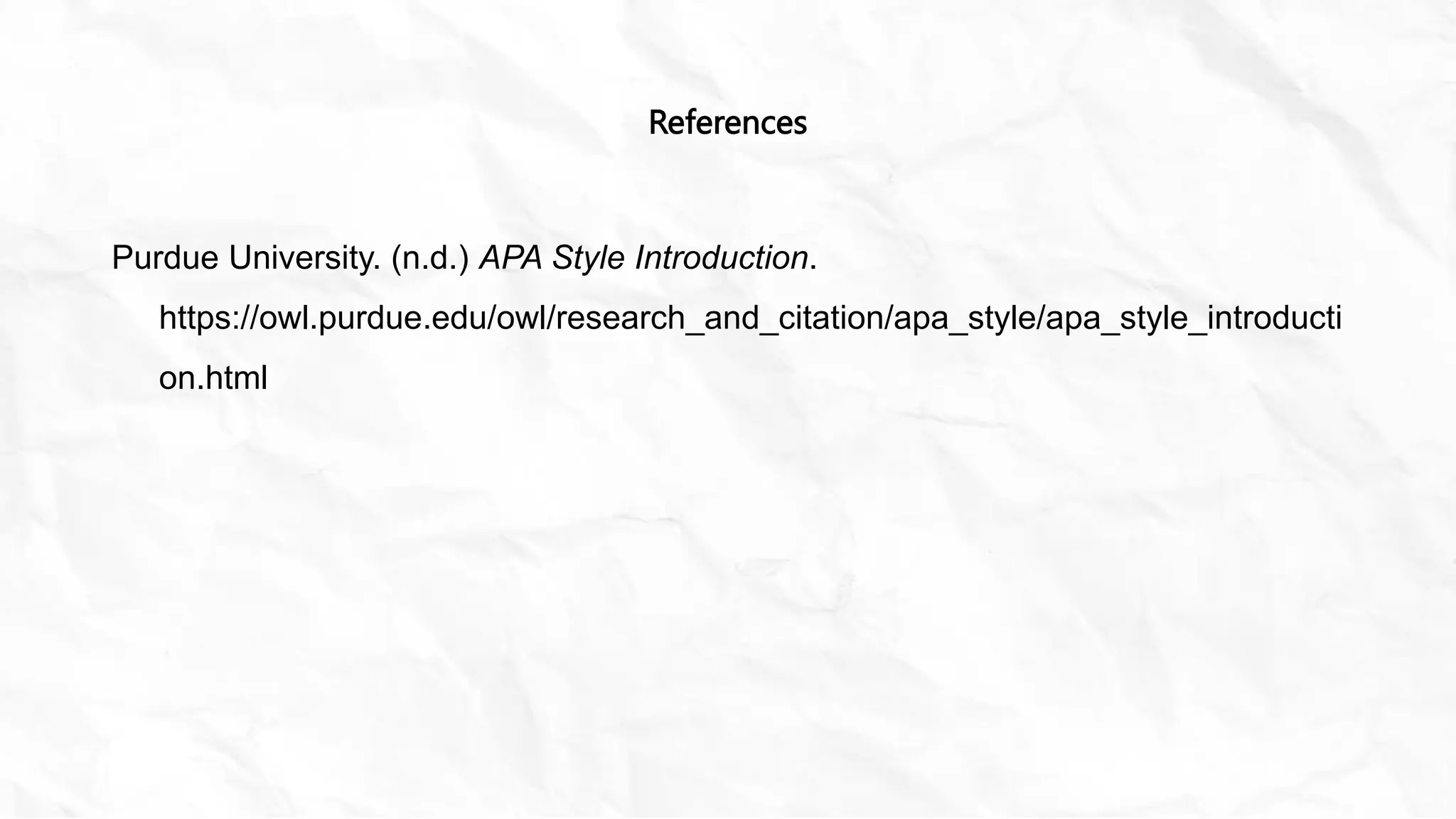
the Social Sciences (Purdue University, n.d.).
The 7th edition of the APA Publication Manual,
released in October 2019, contains updated
guidelines on citing and referencing others' works.
4.
In-text Citation andReference List
o In-text citations are short citations found in the body of
the paper. These can appear in two ways: parenthetically
and narratively.
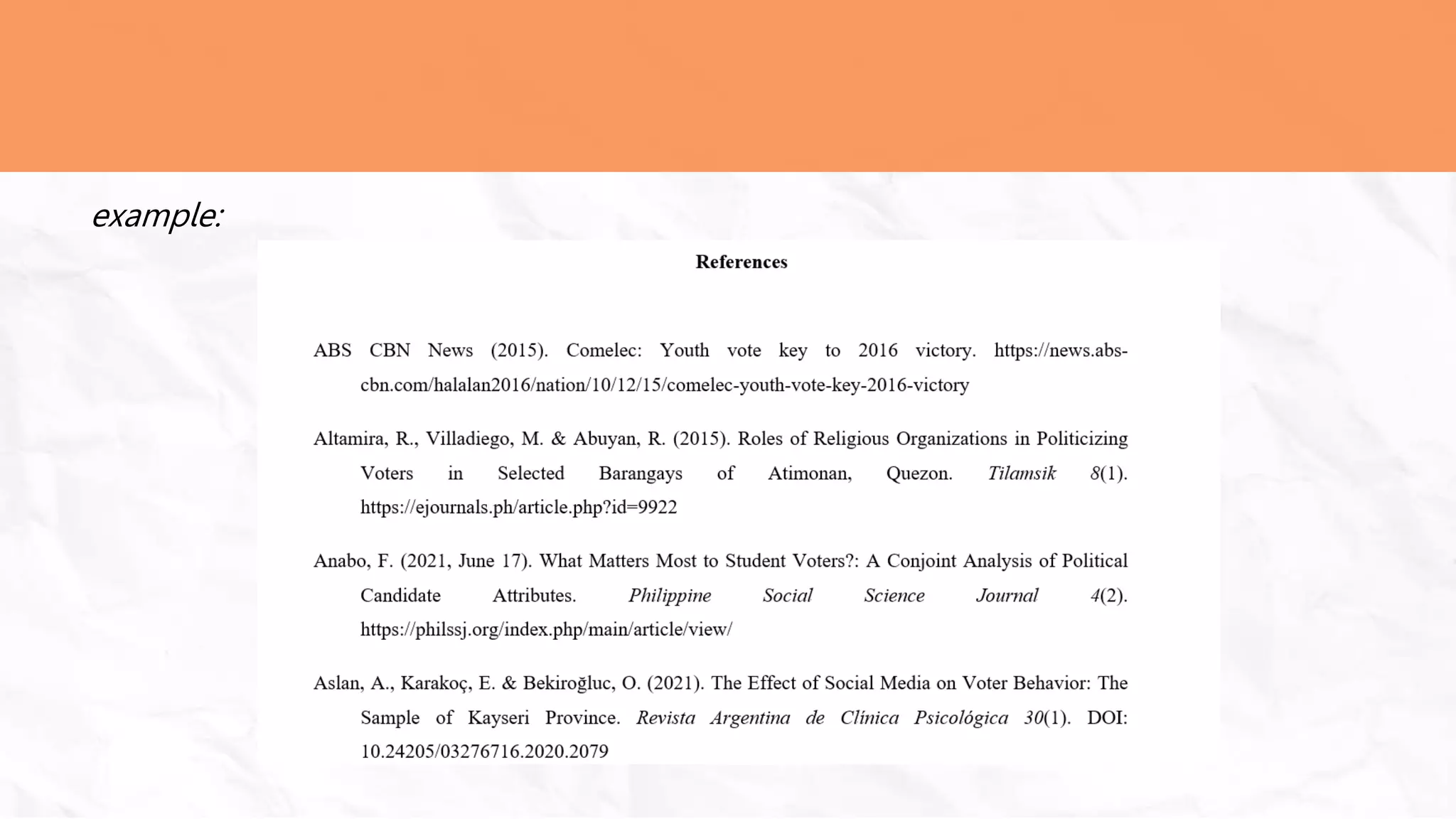
o The Reference List contains the full details of the works
cited in the paper and is found at the end of the
manuscript. It allows the readers to find and read the cited
works themselves.
5.
Basic In-text Citation
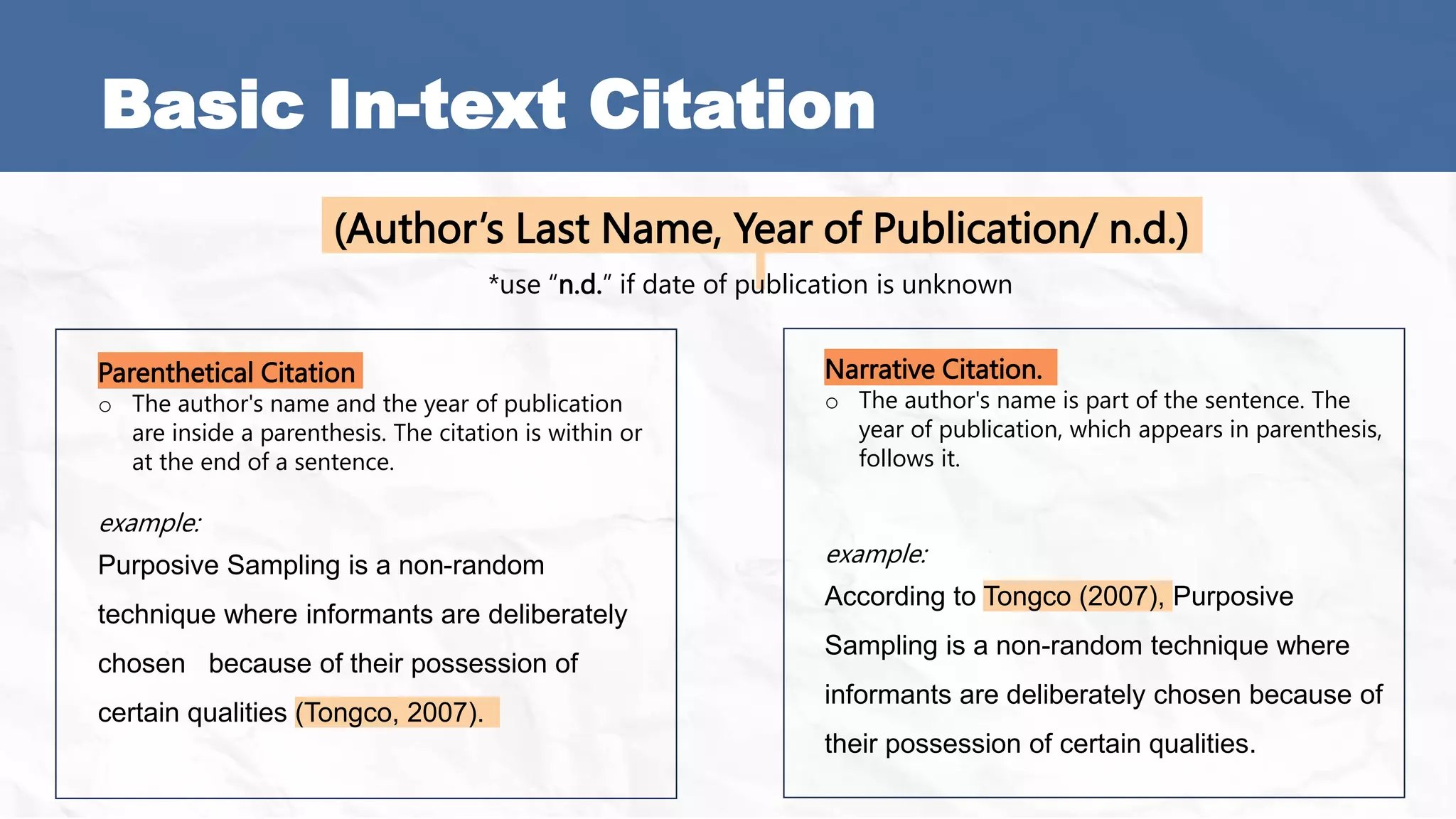
(Author’sLast Name, Year of Publication/ n.d.)
Parenthetical Citation
o The author's name and the year of publication
are inside a parenthesis. The citation is within or
at the end of a sentence.
example:
Purposive Sampling is a non-random
technique where informants are deliberately
chosen because of their possession of
certain qualities (Tongco, 2007).
Narrative Citation.
o The author's name is part of the sentence. The
year of publication, which appears in parenthesis,
follows it.
example:
According to Tongco (2007), Purposive
Sampling is a non-random technique where
informants are deliberately chosen because of
their possession of certain qualities.
*use “n.d.” if date of publication is unknown
6.
In-text Citation forShort Quotations
When directly quoting a work, the page number where the quotation came from must be added. Use “p.”
for a single page and “pp.” for multiple pages.
(Author’s Last Name, Year of Publication/ n.d., page)
Qualitative research is useful for “obtaining
culturally specific information about the values,
views, behaviors, and social circumstances of
particular populations” (Mack et al., 2005, p. 1).
According to Mack et al. (2005), Qualitative
research is useful for “obtaining culturally
specific information about the values,
views, behaviors, and social circumstances
of particular populations” (p. 1).
7.
In-text Citation forLong Quotations
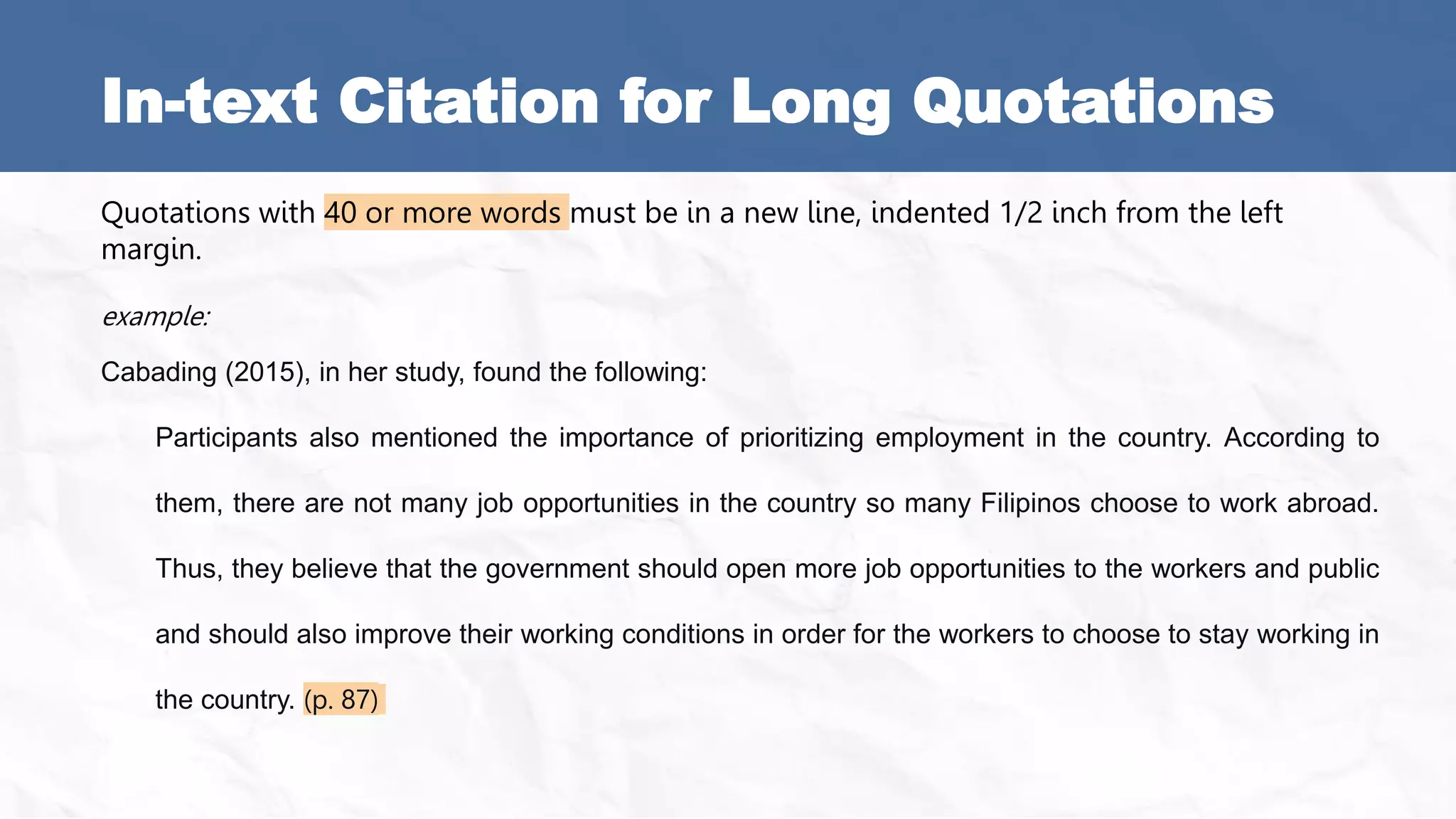
Quotations with 40 or more words must be in a new line, indented 1/2 inch from the left
margin.
example:
Cabading (2015), in her study, found the following:
Participants also mentioned the importance of prioritizing employment in the country. According to
them, there are not many job opportunities in the country so many Filipinos choose to work abroad.
Thus, they believe that the government should open more job opportunities to the workers and public
and should also improve their working conditions in order for the workers to choose to stay working in
the country. (p. 87)
8.
Basic Rules inFormatting a Reference List
o The Reference List is to be put on a new page separate from the manuscript. This page
will be titled "References" in bold, centered at the top.
o It must be alphabetically arranged based on the last name of the first author of each
work.
o The authors' names must follow the format:
Last name, Initials of First and Middle Name. (date of publication).
Cabading, A. (2015).
o Hanging indention is to be applied in all lines after the first line of each entry.
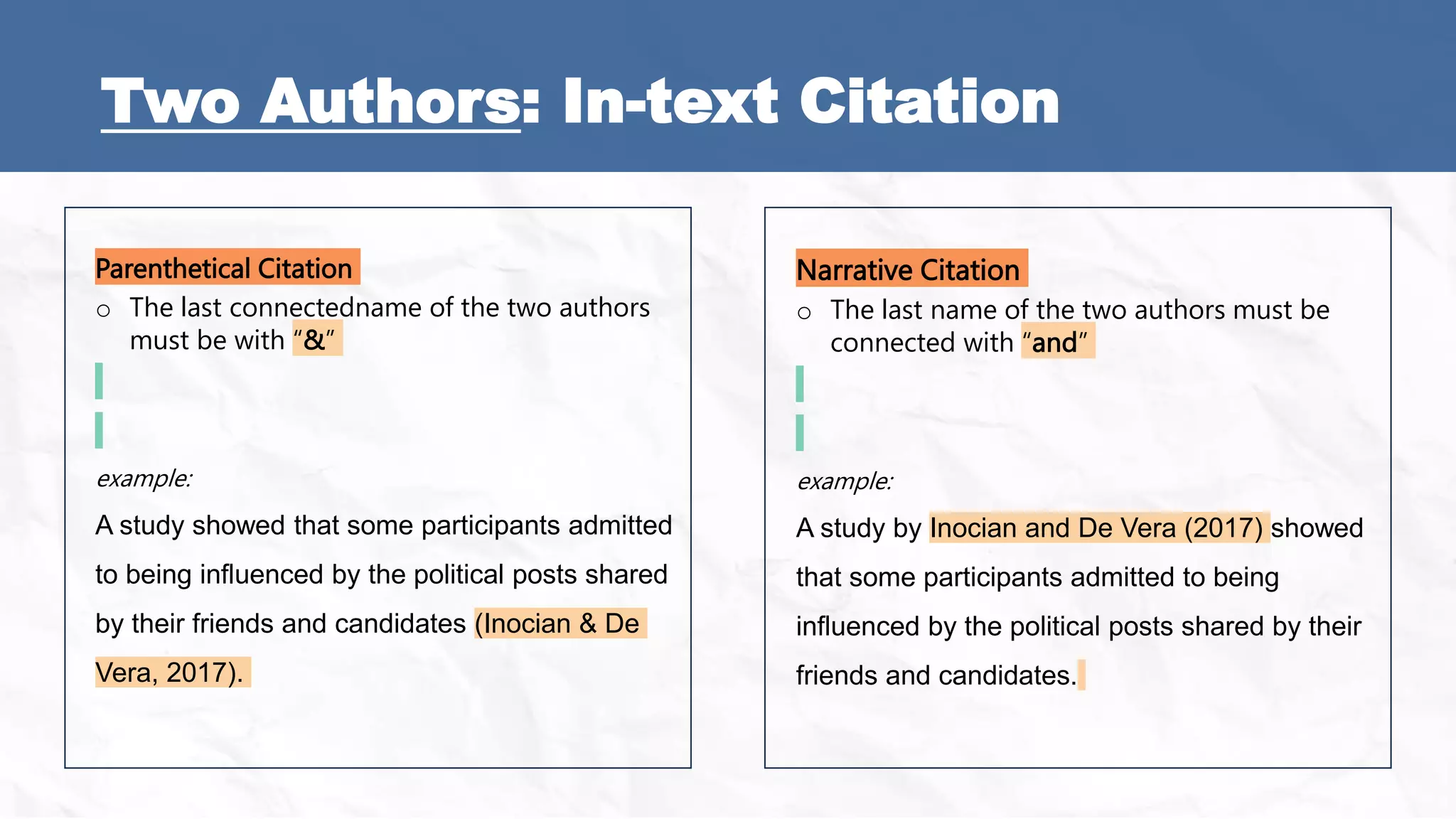
Two Authors: In-textCitation
Narrative Citation
o The last name of the two authors must be
connected with “and”
example:
A study by Inocian and De Vera (2017) showed
that some participants admitted to being
influenced by the political posts shared by their
friends and candidates.
Parenthetical Citation
o The last connectedname of the two authors
must be with “&”
example:
A study showed that some participants admitted
to being influenced by the political posts shared
by their friends and candidates (Inocian & De
Vera, 2017).
12.
Two Authors: ReferenceList
The names of the two authors must be connected using an ampersand “&”
example:
Inocian, R. & De Vera, D. (2017). Influence of Facebook to Voters’ Political Practices.
Asia Pacific Journal of Education 4(1). Retrieved August 14, 2023, from
https://www.researchgate.net/publication/314151928_Influence_of_Facebook_to_Vot
ers'_ Political_Practices
13.
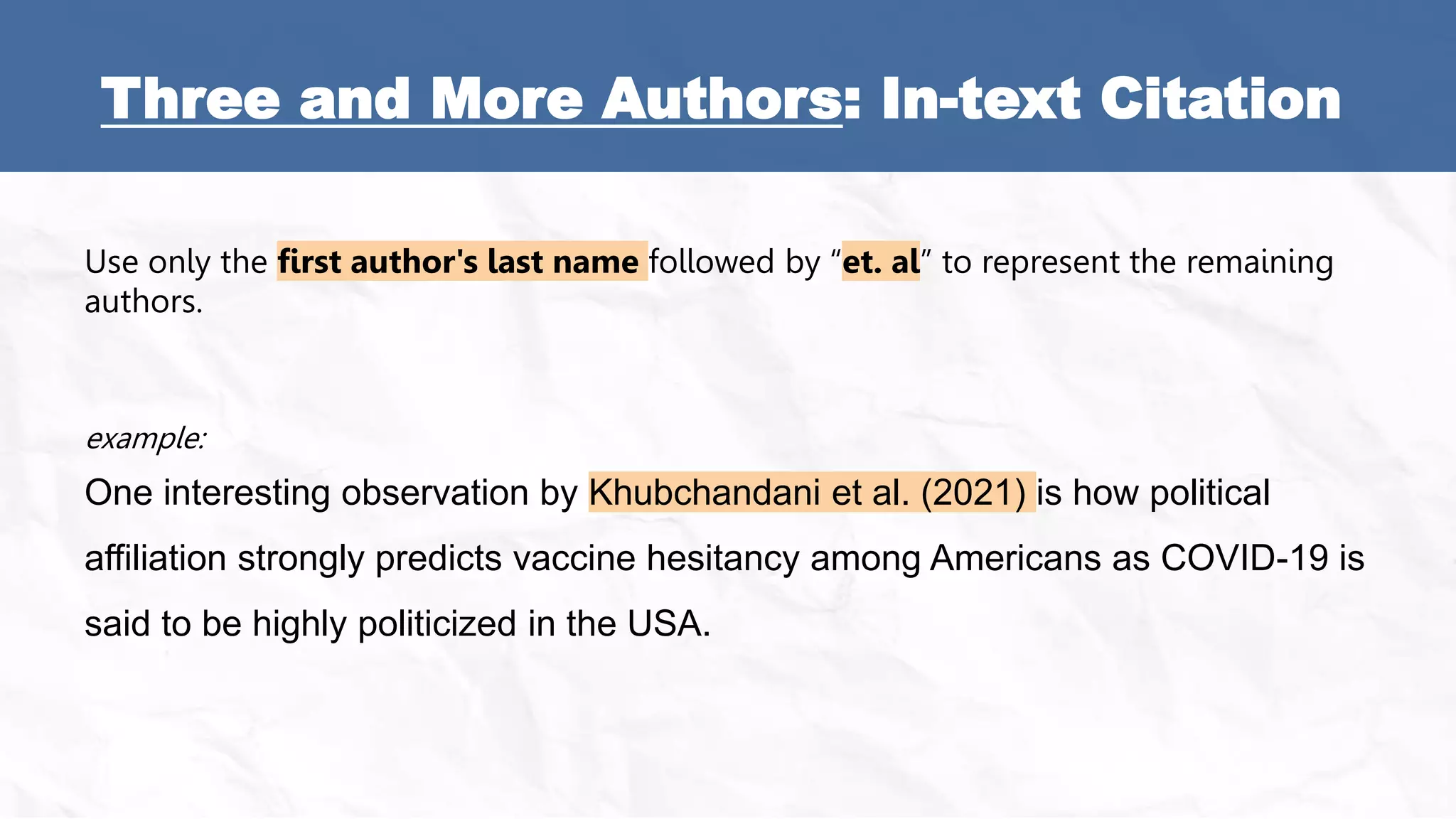
Three and MoreAuthors: In-text Citation
Use only the first author's last name followed by “et. al” to represent the remaining
authors.
example:
One interesting observation by Khubchandani et al. (2021) is how political
affiliation strongly predicts vaccine hesitancy among Americans as COVID-19 is
said to be highly politicized in the USA.
14.
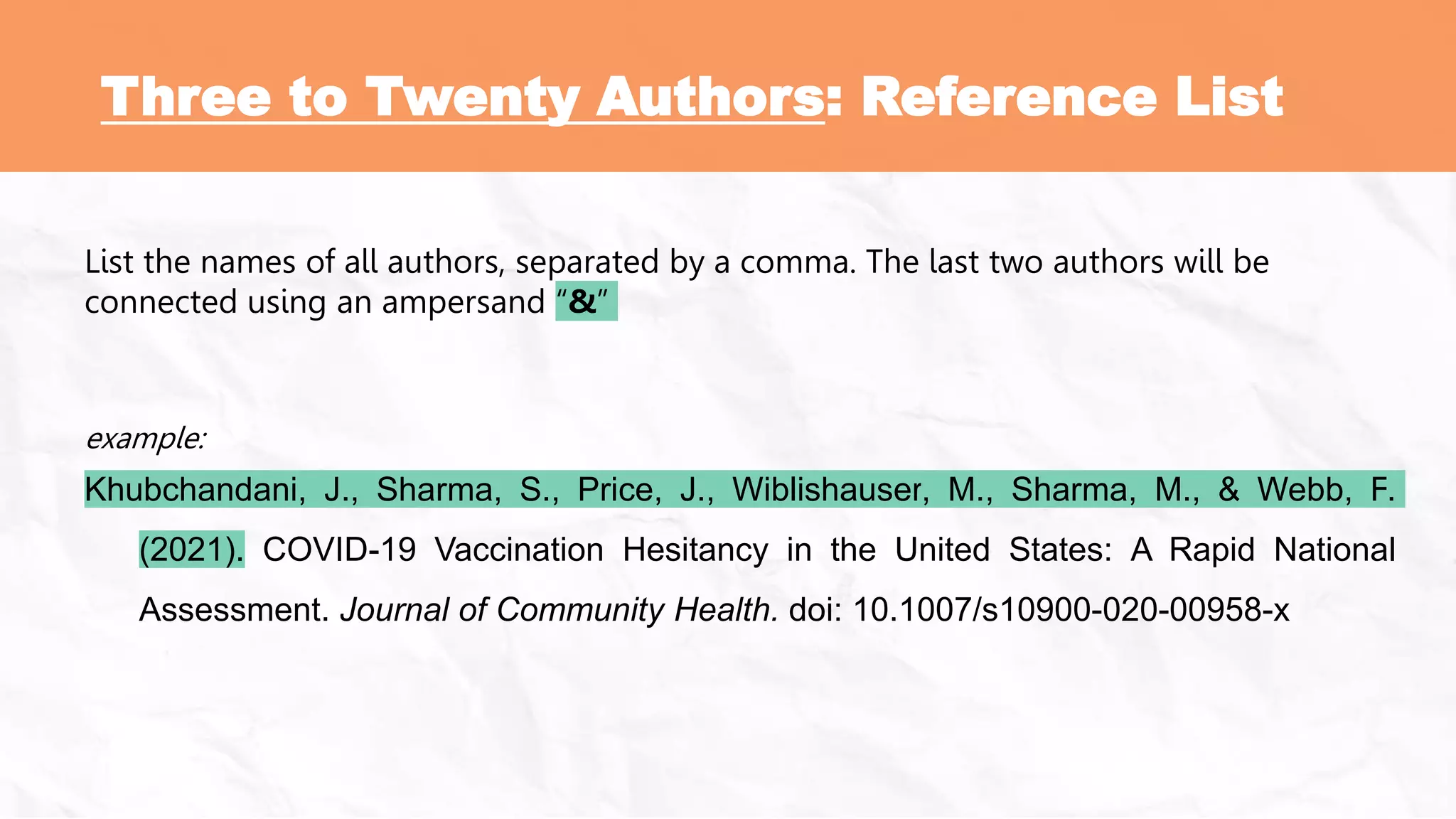
Three to TwentyAuthors: Reference List
List the names of all authors, separated by a comma. The last two authors will be
connected using an ampersand “&”
example:
Khubchandani, J., Sharma, S., Price, J., Wiblishauser, M., Sharma, M., & Webb, F.
(2021). COVID-19 Vaccination Hesitancy in the United States: A Rapid National
Assessment. Journal of Community Health. doi: 10.1007/s10900-020-00958-x
15.
More than 20Authors: Reference List
List the names of all authors, separated by a comma. An ellipsis “…” shall be placed
between the 19th and 20th author.
example:
Pegion, K., Kirtman, B. P., Becker, E., Collins, D. C., LaJoie, E., Burgman, R., Bell, R., DelSole,
R., Min, D., Zhu, Y., Li, W., Sinsky, E., Guan, H., Gottschalck, J., Metzger, E. J., Barton, N. P.,
Achuthavarier, D., Marshak, J., Koster, R., . . . Kim, H. (2019). The subseasonal experiment
(SubX): A multimodel subseasonal prediction experiment. Bulletin of the American
Meteorological Society, 100(10), 2043-2061. https://doi.org/10.1175/BAMS-D-18-0270.1
16.
Group Author: In-textCitation
o Refers to works published by organizations, government agencies, and corporations, among
others.
o Also includes reference works such as dictionaries and thesaurus which usually do not have a
credited author.
o Use the organization’s name as the author.
example:
According to the Institute for Political and Electoral Reform (2003), there are 4
phases of the electoral process.
17.
Group Author: ReferenceList
example:
Institute for Political and Electoral Reform. (2003). A voter's choice: Myself: A
psychological study on voting behavior of the Filipino electorate. Retrieved
July 10, 2022, from https://www.ombudsman.gov.ph/UNDP4/a-voters-choice-
myself-a-psychological-study on-voting-behavior-of-the-filipino-
electorate/index.html
18.
Unknown Author: In-textCitation
If there is no author's name in the source material, cite the title instead. For long titles,
the first few words of the title shall be used.
example:
Election campaign refers to “the means by which candidates and political parties
prepare and present their ideas and positions on issues to the voters in the
period preceding election day” (“Section 3: Key Election Process Categories,”
n.d.).
19.
Unknown Author: ReferenceList
example:
Section 3: Key Election Process Categories. (n.d.). Open Data Election
Initiatives. https://openelectiondata.net/en/guide/key-categories/election-
campaigns/
20.
Indirect Sources: In-textCitation
If you are using a source cited by another author, use the format:
(Original author last name, Year of original work, as cited in Author last name of work
quote found, Year)
example:
In terms of political party affiliation, religion is also deemed significant as white
Born Again or Evangelical Christians mostly support Republican candidates
(Green, 2007, as cited in Bradberry, 2016).
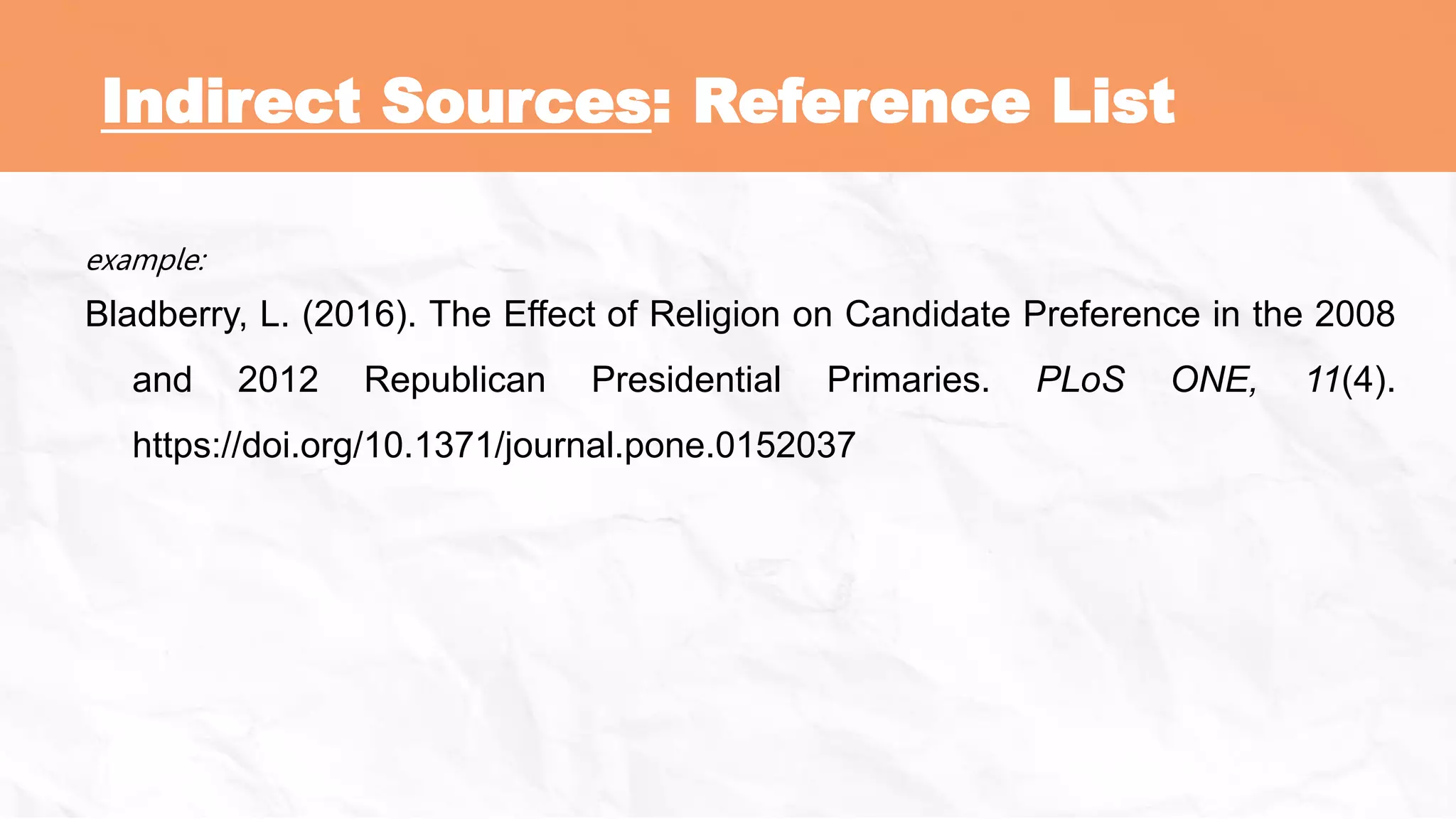
21.
Indirect Sources: ReferenceList
example:
Bladberry, L. (2016). The Effect of Religion on Candidate Preference in the 2008
and 2012 Republican Presidential Primaries. PLoS ONE, 11(4).
https://doi.org/10.1371/journal.pone.0152037