Citation and References:
Documenting Your Sources
____________________
Module 4
Literature review serves as a guide in
choosing a topic and planning your research,
providing a solid background on the topic that
you are going to investigate, which will be the
cornerstone of your study.
When you just lift statements from a
published journal and write them in verbatim,
without even mentioning the authors’ names
and claiming them as your own work, it is
called plagiarism. Therefore, you have to be
knowledgeable about citing and referencing.
The Diwa Senior High School Series: Practical Research 2 (Second Edition)
• It is the process of acknowledging the sources of
information that you have used in your
manuscript.
• It is often placed directly in your written text to
indicate the source of your information.
• The most common format used in citing
information is by indicating the last name of the
author, followed by the year that the work is
published, enclosed in a parenthesis (e.g.,
Castillo, 2013)
Citation
• It demonstrates the thorough literature search and
readings that you have done to create your research.
• Referencing is the process of organizing the written
works cited in your text, which is usually in a form of
a list found at the end of a document.
• In academic research work, only those that are cited
in the manuscript are listed in the reference.
However in other written works, such as a textbook,
all materials consulted, cited or not, are listed; hence
textbooks have a bibliography.
References
• It contains the complete listings of resources
conferred with in relation to the study being
conducted.
• The list consists of the complete details of the
works cited and all the other materials that
you have read, which you think might be
helpful to your readers.
Bibliography
1. To be able to identify and relocate the sources used
in the study for verification purposes.
2. To present a proof that the topic under study is well-
accounted in the research works in its respective
field of study.
3. To rightfully acknowledge the authors of the
research materials mentioned in the study.
4. In a nutshell, when you copy any written work in
verbatim without indicating your source and claim it
as your own, you are plagiarizing.
Reasons for Citations
1. As a direct quote (authors’ last names, date, and
page number after the quoted text)
Ways of Citing a Source Material
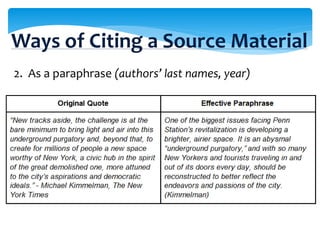
2. As a paraphrase (authors’ last names, year)
Ways of Citing a Source Material
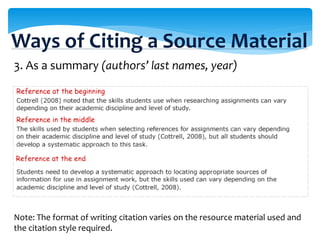
3. As a summary (authors’ last names, year)
Note: The format of writing citation varies on the resource material used and
the citation style required.
Ways of Citing a Source Material
1. To prove that the study is based on academic works.
2. To locate the sources of the cited texts in the study.
3. To share additional knowledge and information
about the topic under study.
4. To confirm the basis of the study’s hypothesis.
5. To show respect and appreciation to the author of
the study and to avoid plagiarism.
Reasons for Referencing
1. In-Text Citation
When you use a directly quoted, paraphrased, and
summarized content of a manuscript in your literature
review, you have to insert the source of the information
enclosed in a parenthesis within or after the information
that you have included.
a. Direct quotation: author surname(s), title of the
material, date of publication, page number.
b. Paraphrased text: author surname(S), date of
publication
c. Summarized text/content
Note: The format of writing citation varies on the resource material used and the
citation style required.
Ways of Referencing Source
Materials
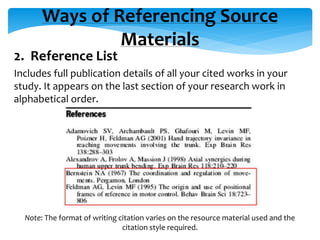
2. Reference List
Includes full publication details of all your cited works in your
study. It appears on the last section of your research work in
alphabetical order.
Note: The format of writing citation varies on the resource material used and the
citation style required.
Ways of Referencing Source
Materials
Different fields of disciplines suggest different
styles of citing sources to write the texts appropriately
as required. The style that you are going to use will
depend on the advice of your teacher in research and
the required style in your school.
The citation style used must also correspond to
the referencing style found in the references list.
However, the widely used style across all fields is the
APA style (sixth edition).
The APA 6th style requires the references to be
indented as illustrated in the examples.
Different Styles of Citation and
References
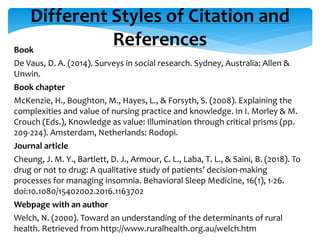
Book
De Vaus, D. A. (2014). Surveys in social research. Sydney, Australia: Allen &
Unwin.
Book chapter
McKenzie, H., Boughton, M., Hayes, L., & Forsyth, S. (2008). Explaining the
complexities and value of nursing practice and knowledge. In I. Morley & M.
Crouch (Eds.), Knowledge as value: Illumination through critical prisms (pp.
209-224). Amsterdam, Netherlands: Rodopi.
Journal article
Cheung, J. M. Y., Bartlett, D. J., Armour, C. L., Laba, T. L., & Saini, B. (2018). To
drug or not to drug: A qualitative study of patients’ decision-making
processes for managing insomnia. Behavioral Sleep Medicine, 16(1), 1-26.
doi:10.1080/15402002.2016.1163702
Webpage with an author
Welch, N. (2000). Toward an understanding of the determinants of rural
health. Retrieved from http://www.ruralhealth.org.au/welch.htm
Different Styles of Citation and
References
Different Styles of Citation and
References
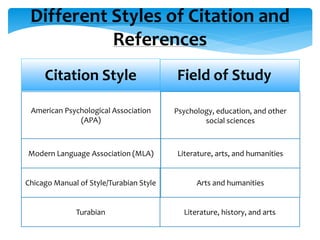
Citation Style Field of Study
American Psychological Association
(APA)
Psychology, education, and other
social sciences
Modern Language Association (MLA) Literature, arts, and humanities
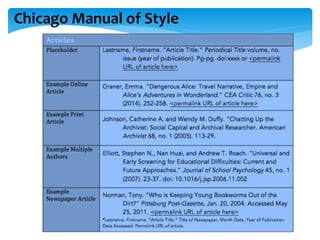
Chicago Manual of Style/Turabian Style Arts and humanities
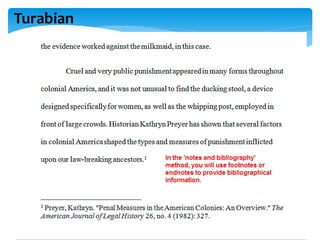
Turabian Literature, history, and arts
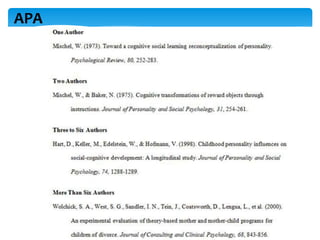
APA
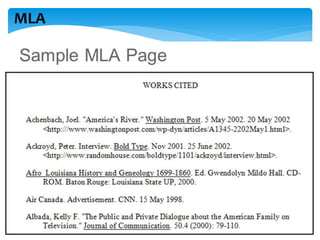
MLA
Chicago Manual of Style
Turabian
Thank You For Listening!
~ Group 2 ~
The Diwa Senior High School Series: Practical Research 2 (Second Edition)

Citation and References

  • 1.
    Citation and References: DocumentingYour Sources ____________________ Module 4
  • 2.
    Literature review servesas a guide in choosing a topic and planning your research, providing a solid background on the topic that you are going to investigate, which will be the cornerstone of your study. When you just lift statements from a published journal and write them in verbatim, without even mentioning the authors’ names and claiming them as your own work, it is called plagiarism. Therefore, you have to be knowledgeable about citing and referencing. The Diwa Senior High School Series: Practical Research 2 (Second Edition)
  • 3.
    • It isthe process of acknowledging the sources of information that you have used in your manuscript. • It is often placed directly in your written text to indicate the source of your information. • The most common format used in citing information is by indicating the last name of the author, followed by the year that the work is published, enclosed in a parenthesis (e.g., Castillo, 2013) Citation
  • 4.
    • It demonstratesthe thorough literature search and readings that you have done to create your research. • Referencing is the process of organizing the written works cited in your text, which is usually in a form of a list found at the end of a document. • In academic research work, only those that are cited in the manuscript are listed in the reference. However in other written works, such as a textbook, all materials consulted, cited or not, are listed; hence textbooks have a bibliography. References
  • 5.
    • It containsthe complete listings of resources conferred with in relation to the study being conducted. • The list consists of the complete details of the works cited and all the other materials that you have read, which you think might be helpful to your readers. Bibliography
  • 6.
    1. To beable to identify and relocate the sources used in the study for verification purposes. 2. To present a proof that the topic under study is well- accounted in the research works in its respective field of study. 3. To rightfully acknowledge the authors of the research materials mentioned in the study. 4. In a nutshell, when you copy any written work in verbatim without indicating your source and claim it as your own, you are plagiarizing. Reasons for Citations
  • 7.
    1. As adirect quote (authors’ last names, date, and page number after the quoted text) Ways of Citing a Source Material
  • 8.
    2. As aparaphrase (authors’ last names, year) Ways of Citing a Source Material
  • 9.
    3. As asummary (authors’ last names, year) Note: The format of writing citation varies on the resource material used and the citation style required. Ways of Citing a Source Material
  • 10.
    1. To provethat the study is based on academic works. 2. To locate the sources of the cited texts in the study. 3. To share additional knowledge and information about the topic under study. 4. To confirm the basis of the study’s hypothesis. 5. To show respect and appreciation to the author of the study and to avoid plagiarism. Reasons for Referencing
  • 11.
    1. In-Text Citation Whenyou use a directly quoted, paraphrased, and summarized content of a manuscript in your literature review, you have to insert the source of the information enclosed in a parenthesis within or after the information that you have included. a. Direct quotation: author surname(s), title of the material, date of publication, page number. b. Paraphrased text: author surname(S), date of publication c. Summarized text/content Note: The format of writing citation varies on the resource material used and the citation style required. Ways of Referencing Source Materials
  • 12.
    2. Reference List Includesfull publication details of all your cited works in your study. It appears on the last section of your research work in alphabetical order. Note: The format of writing citation varies on the resource material used and the citation style required. Ways of Referencing Source Materials
  • 13.
    Different fields ofdisciplines suggest different styles of citing sources to write the texts appropriately as required. The style that you are going to use will depend on the advice of your teacher in research and the required style in your school. The citation style used must also correspond to the referencing style found in the references list. However, the widely used style across all fields is the APA style (sixth edition). The APA 6th style requires the references to be indented as illustrated in the examples. Different Styles of Citation and References
  • 14.
    Book De Vaus, D.A. (2014). Surveys in social research. Sydney, Australia: Allen & Unwin. Book chapter McKenzie, H., Boughton, M., Hayes, L., & Forsyth, S. (2008). Explaining the complexities and value of nursing practice and knowledge. In I. Morley & M. Crouch (Eds.), Knowledge as value: Illumination through critical prisms (pp. 209-224). Amsterdam, Netherlands: Rodopi. Journal article Cheung, J. M. Y., Bartlett, D. J., Armour, C. L., Laba, T. L., & Saini, B. (2018). To drug or not to drug: A qualitative study of patients’ decision-making processes for managing insomnia. Behavioral Sleep Medicine, 16(1), 1-26. doi:10.1080/15402002.2016.1163702 Webpage with an author Welch, N. (2000). Toward an understanding of the determinants of rural health. Retrieved from http://www.ruralhealth.org.au/welch.htm Different Styles of Citation and References
  • 15.
    Different Styles ofCitation and References Citation Style Field of Study American Psychological Association (APA) Psychology, education, and other social sciences Modern Language Association (MLA) Literature, arts, and humanities Chicago Manual of Style/Turabian Style Arts and humanities Turabian Literature, history, and arts
  • 16.
  • 17.
  • 18.
  • 19.
  • 20.
    Thank You ForListening! ~ Group 2 ~ The Diwa Senior High School Series: Practical Research 2 (Second Edition)