Chest x rays
Dr Virbhan
TECHNICAL ASPECT
PROJECTION
ORIENTATION
ROTATION
PENETRATION
DEGREE OF INSPIRATION
Reading of chest X-rays in CHD
Is there cardiomegaly?
Cardiothoracic ratio >60% in neonates
> 55% in infants
> 50% in older children/adult
Is the situs normal?
The situs as defined by-
Stomach bubble
Liver shadow
Bronchial morphology of more horizontal and
short right bronchus
Situs inversus totalis and dextrocardia- rarely
has heart disease
Mesocardia -commonly has c TGA
Left-sided heart in situs inversus- has complex
heart disease.
Apex -dome of diaphragm is lower on the side
of apex.
Is there a particular chamber enlargement ?
RA enlargement-
Vertical height compared to height from aortic
arch to SVC-RA junction
lateral 3 spaces criteria
The RV type- upturned apex e.g TOF
LV type of apex -tricuspid atresia
Is the cardiac silhouette normal?
L-posed aorta
Enlarged thymus
What is the pulmonary blood flow—
increased, decreased or normal?
Increased pulmonary blood flow - more than 5
end-on vessels in the lungs, or more than 3 in
one lung.
The end-on vessels should be more than twice
the size of an accompanying bronchus.
More than 6 vessels could be traced in the
periphery in increased flow states.
Decreased flow - when the vessels are thin and
small.
Less than 3 vessels are seen in the periphery
Pulmonary conus and main arteries are not
prominent.
Is there PAH? How severe?
In adults NORMAL descending branch of right
pulmonary artery-
9–14 mm in females.
10–15 mm in males.
 In children, the artery size larger than the trachea
indicates enlargement.
 Peripheral pruning—that is sudden taper of PA
branches as it travels to periphery indicates PAH.
 Pruning is seen in functional as well as organic PAH.
Is there PVH ? How severe?
PVH is present when the PAWP >12 mm Hg.
Equalization
Cephalization
Perihilar haze
Interstitial edema indicate progressively
increasing PVH.
o Kerley lines generally indicate chronic severe
PVH
Is there aortic arch abnormality?
The aortic arch is identified by the impression on
trachea.
A right aortic arch is commonly associated with
VSD.
A right arch and increased blood flow is typically
seen in truncus arteriosus.
An inconspicuous aortic arch could mean double
arch.
Coarctation with arch hypoplasia.
Is there pulmonary parenchymal lesion—
Infection
Infarction
Aspiration
Hemorrhage
Collapse
Is there asymmetry of findings, e.g.
Decreased vasculature on one side?
This could indicate ipsilateral pulmonary artery
stenosis.
Pulmonary embolism.
Anomalous pulmonary venous drainage
Lung disease.
Is there rib notching? Signs of previous
surgery like rib regeneration?
Are there serial changes?
The changes of pulmonary plethora diminish
but in Eisenmenger’s syndrome
Spot diagnosis-
Boot-shaped heart- TOF,
Egg on side appearance of TGA without VSD
Figure-of-8 for supracardiac TAPVC
Waterfall sign of a truncus arteriosus
Typical straight right border for tricuspid atresia
Aorta forming the left border in corrected
transposition of great vessels.
COMMON ERRORS
Following are the common errors seen in day-
to-day clinical practice:
Spurious cardiomegaly due to expiratory film.
Wrong assessment of lung vasculature due to
over- and underpenetration (underpenetration
increases lung vasculature and vice versa)
Rotation of film leading to wrong
interpretation of cardiac silhouette or hilum.
Missing a spinal deformity causing
cardiomegaly, or altered silhouette.
Over-relying on patterns without taking into
account the sensitivity and specificity of a
finding- e.g RA dilatation, type of apex (RV or
LV), egg-on-side pattern for TGA.
Misunderstanding PVH for pulmonary plethora
can lead to misclassification of the disease.
Wrong reading of hilar shadows is frequent cause
of errors.
Many a times, dilated PAs have been interpreted
as lymph nodes and patients prescribed
antitubercular treatment.
Not paying enough attention to lungs e.g
infiltration, or military shadows missed or over-
read.
Misinterpretation of normal but infrequent
seen structures such as the azygous lobe,
diaphragmatic humps, atypical thymus
shadow, etc.
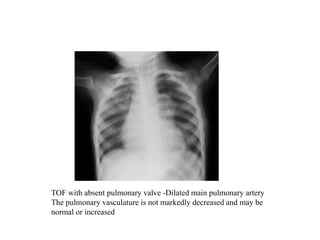
TOF with absent pulmonary valve -Dilated main pulmonary artery
The pulmonary vasculature is not markedly decreased and may be
normal or increased
TOF - markedly decreased lung vasculature
and pulmonary bay and right aortic arch
TOF and endocarditis. Note the infiltration in the lungs due
to septic emboli from the right-sided vegetations. The boot-
shaped heart and decreased pulmonary blood flow is seen
Tricuspid atresia with decreased pulmonary blood flow.
LV type of apex. note the left SVC.
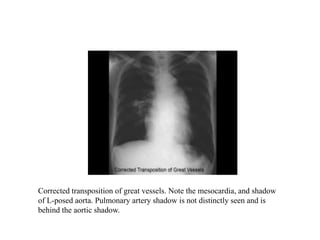
Corrected transposition of great vessels. Note the mesocardia, and shadow
of L-posed aorta. Pulmonary artery shadow is not distinctly seen and is
behind the aortic shadow.
Note the figure-of-8 shadow and increased pulmonary blood flow from
supracardiac TAPVC that is not obstructed (A thymic shadow can sometime
mimic this, but then the pulmonary blood flow will be normal)
Typical sail-like thymic shadow in a normal infant
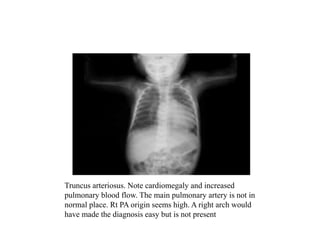
Truncus arteriosus. Note cardiomegaly and increased
pulmonary blood flow. The main pulmonary artery is not in
normal place. Rt PA origin seems high. A right arch would
have made the diagnosis easy but is not present
Two examples of transposition with intect septum. Note the variation in TGA
X-rays.
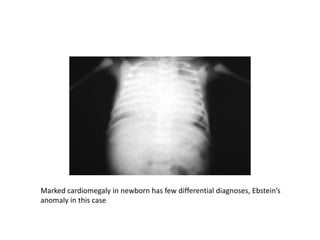
Marked cardiomegaly in newborn has few differential diagnoses, Ebstein’s
anomaly in this case
Regression of pulmonary artery (PA) pressure and its importance
in neonate.
Diffuse cardiomegaly and overpenetrated
film. No comments possible regarding lung
vasculature
Hyperinflated lung in double aortic arch
TOF and cardiomegaly due to severe anemia. Cardiomegaly does not
occur in all lesions of “TOF physiology” unless complicated by other
things
Typical ground-glass appearance in a neonate from obstructed infracardiac
TAPVC. The angiogram shows the descending vertical vein going below the
diaphragm
Increased vasculature in VSD
PAH, peripheral pruning, dilated right
descending PA, and prominent main
PA.
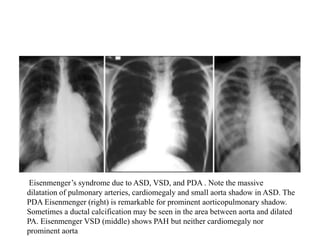
Eisenmenger’s syndrome due to ASD, VSD, and PDA . Note the massive
dilatation of pulmonary arteries, cardiomegaly and small aorta shadow in ASD. The
PDA Eisenmenger (right) is remarkable for prominent aorticopulmonary shadow.
Sometimes a ductal calcification may be seen in the area between aorta and dilated
PA. Eisenmenger VSD (middle) shows PAH but neither cardiomegaly nor
prominent aorta
Prosthetic Cardiac Valves
THANKYOU

Chest x rays vir

  • 1.
  • 2.
  • 3.
    Reading of chestX-rays in CHD Is there cardiomegaly? Cardiothoracic ratio >60% in neonates > 55% in infants > 50% in older children/adult
  • 4.
    Is the situsnormal? The situs as defined by- Stomach bubble Liver shadow Bronchial morphology of more horizontal and short right bronchus
  • 5.
    Situs inversus totalisand dextrocardia- rarely has heart disease Mesocardia -commonly has c TGA Left-sided heart in situs inversus- has complex heart disease. Apex -dome of diaphragm is lower on the side of apex.
  • 6.
    Is there aparticular chamber enlargement ? RA enlargement- Vertical height compared to height from aortic arch to SVC-RA junction lateral 3 spaces criteria The RV type- upturned apex e.g TOF LV type of apex -tricuspid atresia
  • 8.
    Is the cardiacsilhouette normal? L-posed aorta Enlarged thymus
  • 9.
    What is thepulmonary blood flow— increased, decreased or normal? Increased pulmonary blood flow - more than 5 end-on vessels in the lungs, or more than 3 in one lung. The end-on vessels should be more than twice the size of an accompanying bronchus. More than 6 vessels could be traced in the periphery in increased flow states.
  • 10.
    Decreased flow -when the vessels are thin and small. Less than 3 vessels are seen in the periphery Pulmonary conus and main arteries are not prominent.
  • 11.
    Is there PAH?How severe? In adults NORMAL descending branch of right pulmonary artery- 9–14 mm in females. 10–15 mm in males.  In children, the artery size larger than the trachea indicates enlargement.  Peripheral pruning—that is sudden taper of PA branches as it travels to periphery indicates PAH.  Pruning is seen in functional as well as organic PAH.
  • 12.
    Is there PVH? How severe? PVH is present when the PAWP >12 mm Hg. Equalization Cephalization Perihilar haze Interstitial edema indicate progressively increasing PVH. o Kerley lines generally indicate chronic severe PVH
  • 13.
    Is there aorticarch abnormality? The aortic arch is identified by the impression on trachea. A right aortic arch is commonly associated with VSD. A right arch and increased blood flow is typically seen in truncus arteriosus. An inconspicuous aortic arch could mean double arch. Coarctation with arch hypoplasia.
  • 14.
    Is there pulmonaryparenchymal lesion— Infection Infarction Aspiration Hemorrhage Collapse
  • 15.
    Is there asymmetryof findings, e.g. Decreased vasculature on one side? This could indicate ipsilateral pulmonary artery stenosis. Pulmonary embolism. Anomalous pulmonary venous drainage Lung disease. Is there rib notching? Signs of previous surgery like rib regeneration?
  • 16.
    Are there serialchanges? The changes of pulmonary plethora diminish but in Eisenmenger’s syndrome
  • 17.
    Spot diagnosis- Boot-shaped heart-TOF, Egg on side appearance of TGA without VSD Figure-of-8 for supracardiac TAPVC Waterfall sign of a truncus arteriosus Typical straight right border for tricuspid atresia Aorta forming the left border in corrected transposition of great vessels.
  • 18.
    COMMON ERRORS Following arethe common errors seen in day- to-day clinical practice: Spurious cardiomegaly due to expiratory film. Wrong assessment of lung vasculature due to over- and underpenetration (underpenetration increases lung vasculature and vice versa) Rotation of film leading to wrong interpretation of cardiac silhouette or hilum.
  • 19.
    Missing a spinaldeformity causing cardiomegaly, or altered silhouette. Over-relying on patterns without taking into account the sensitivity and specificity of a finding- e.g RA dilatation, type of apex (RV or LV), egg-on-side pattern for TGA.
  • 20.
    Misunderstanding PVH forpulmonary plethora can lead to misclassification of the disease. Wrong reading of hilar shadows is frequent cause of errors. Many a times, dilated PAs have been interpreted as lymph nodes and patients prescribed antitubercular treatment. Not paying enough attention to lungs e.g infiltration, or military shadows missed or over- read.
  • 21.
    Misinterpretation of normalbut infrequent seen structures such as the azygous lobe, diaphragmatic humps, atypical thymus shadow, etc.
  • 22.
    TOF with absentpulmonary valve -Dilated main pulmonary artery The pulmonary vasculature is not markedly decreased and may be normal or increased
  • 23.
    TOF - markedlydecreased lung vasculature and pulmonary bay and right aortic arch
  • 24.
    TOF and endocarditis.Note the infiltration in the lungs due to septic emboli from the right-sided vegetations. The boot- shaped heart and decreased pulmonary blood flow is seen
  • 25.
    Tricuspid atresia withdecreased pulmonary blood flow. LV type of apex. note the left SVC.
  • 26.
    Corrected transposition ofgreat vessels. Note the mesocardia, and shadow of L-posed aorta. Pulmonary artery shadow is not distinctly seen and is behind the aortic shadow.
  • 27.
    Note the figure-of-8shadow and increased pulmonary blood flow from supracardiac TAPVC that is not obstructed (A thymic shadow can sometime mimic this, but then the pulmonary blood flow will be normal)
  • 28.
    Typical sail-like thymicshadow in a normal infant
  • 29.
    Truncus arteriosus. Notecardiomegaly and increased pulmonary blood flow. The main pulmonary artery is not in normal place. Rt PA origin seems high. A right arch would have made the diagnosis easy but is not present
  • 30.
    Two examples oftransposition with intect septum. Note the variation in TGA X-rays.
  • 31.
    Marked cardiomegaly innewborn has few differential diagnoses, Ebstein’s anomaly in this case
  • 32.
    Regression of pulmonaryartery (PA) pressure and its importance in neonate.
  • 33.
    Diffuse cardiomegaly andoverpenetrated film. No comments possible regarding lung vasculature Hyperinflated lung in double aortic arch
  • 34.
    TOF and cardiomegalydue to severe anemia. Cardiomegaly does not occur in all lesions of “TOF physiology” unless complicated by other things
  • 35.
    Typical ground-glass appearancein a neonate from obstructed infracardiac TAPVC. The angiogram shows the descending vertical vein going below the diaphragm
  • 36.
    Increased vasculature inVSD PAH, peripheral pruning, dilated right descending PA, and prominent main PA.
  • 37.
    Eisenmenger’s syndrome dueto ASD, VSD, and PDA . Note the massive dilatation of pulmonary arteries, cardiomegaly and small aorta shadow in ASD. The PDA Eisenmenger (right) is remarkable for prominent aorticopulmonary shadow. Sometimes a ductal calcification may be seen in the area between aorta and dilated PA. Eisenmenger VSD (middle) shows PAH but neither cardiomegaly nor prominent aorta
  • 38.
  • 44.

Editor's Notes

  • #8  Right atrial enlargement is diagnosed when A > B (the horizontal lines are drawn at the top of aortic arch) at superior vena cava-right atrium (SVC-RA) junction, and lower limit of heart at right border
  • #23 The right pulmonary artery (RPA) is also commonly dilated, but not seen here.
  • #39 Localizing cardiac prosthetic valves can be difficult. There are a number of strategies that can be employed to aid in characterizing the type of prosthetic valve. The best strategy involves assessing the location of the valve and then determining the orientation and direction of flow. Additional aids which serve as adjunts are the statistical nature of valve replacement and including patient history. The location of the cardiac valves is best determined on the lateral radiograph. A line is drawn on the lateral radiograph from the carina to the cardiac apex. The pulmonic and aortic valves generally sit above this line and the tricuspid and mitral valves sit below this line. Keep in mind that sometimes the aortic root can be inferiorly displaced which will shift the aortic valve below this line.
  • #40 A second technique to further localize prosthetic valves involves drawing a second line which is perpendicular to the patient's upright position which bisects the cardiac silouette. The aortic valve projects in the upper quadrant, the mitral valve in the lower quadrant and the tricuspid valve in the anterior quadrant. The pulmonary valve projects in the superior portion of the posterior quadrant which is illustrated in the below images:
  • #41 An alternative method, which is less reproducible, involves the frontal radiograph. On the frontal chest radiograph (either the AP or PA view) cardiac valvular prostheses can be localized by drawing a longitudinal line through the mid sternal body. Use this line to bisect the sternum in the sagittal plane and then draw a perpendicular line dividing the heart horizontally. The aortic valve should overlie the intersection of these two lines. The mitral valve will lie in the lower left quadrant (the patient’s left). The tricuspid valve would lie in the lower right corner (the patient's right) and the pulmonic valve will lie in the upper left corner (the patient's left). A word of warning pertains to the above strategies. Patients with cardiac valves often have chamber enlargement and cardiac rotation which can displace the positions of the valves as well as create difficulty when drawing lines through the cardiac silhouette. These rules are meant as a guideline to better localize cardiac valves although they do not always work.
  • #44 One additional pearl in determining the location of cardiac valves includes localizing the direction of flow. Some bioprosthetic valves have components that determine the direction of flow which helps localize the valve prosthesis. If the direction of flow is from inferior to superior and then an aortic valve is likely. If the direction of flow is from superior to inferior in the left chest then the valve is likely a mitral valve.