Presented by 
Ruokuomenuo Rio
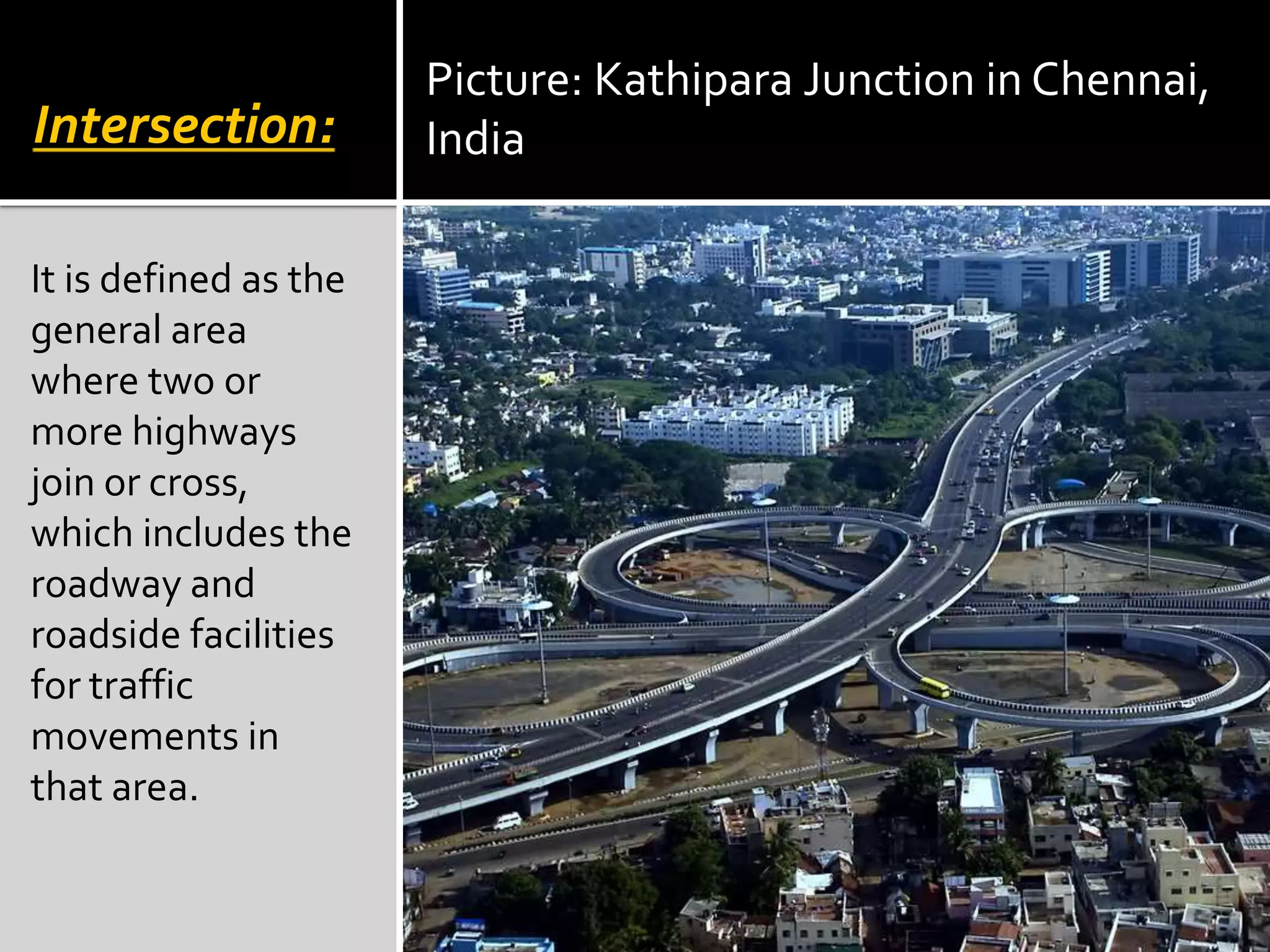
Intersection: 
It is defined as the 
general area 
where two or 
more highways 
join or cross, 
which includes the 
roadway and 
roadside facilities 
for traffic 
movements in 
that area. 
Picture: Kathipara Junction in Chennai, 
India
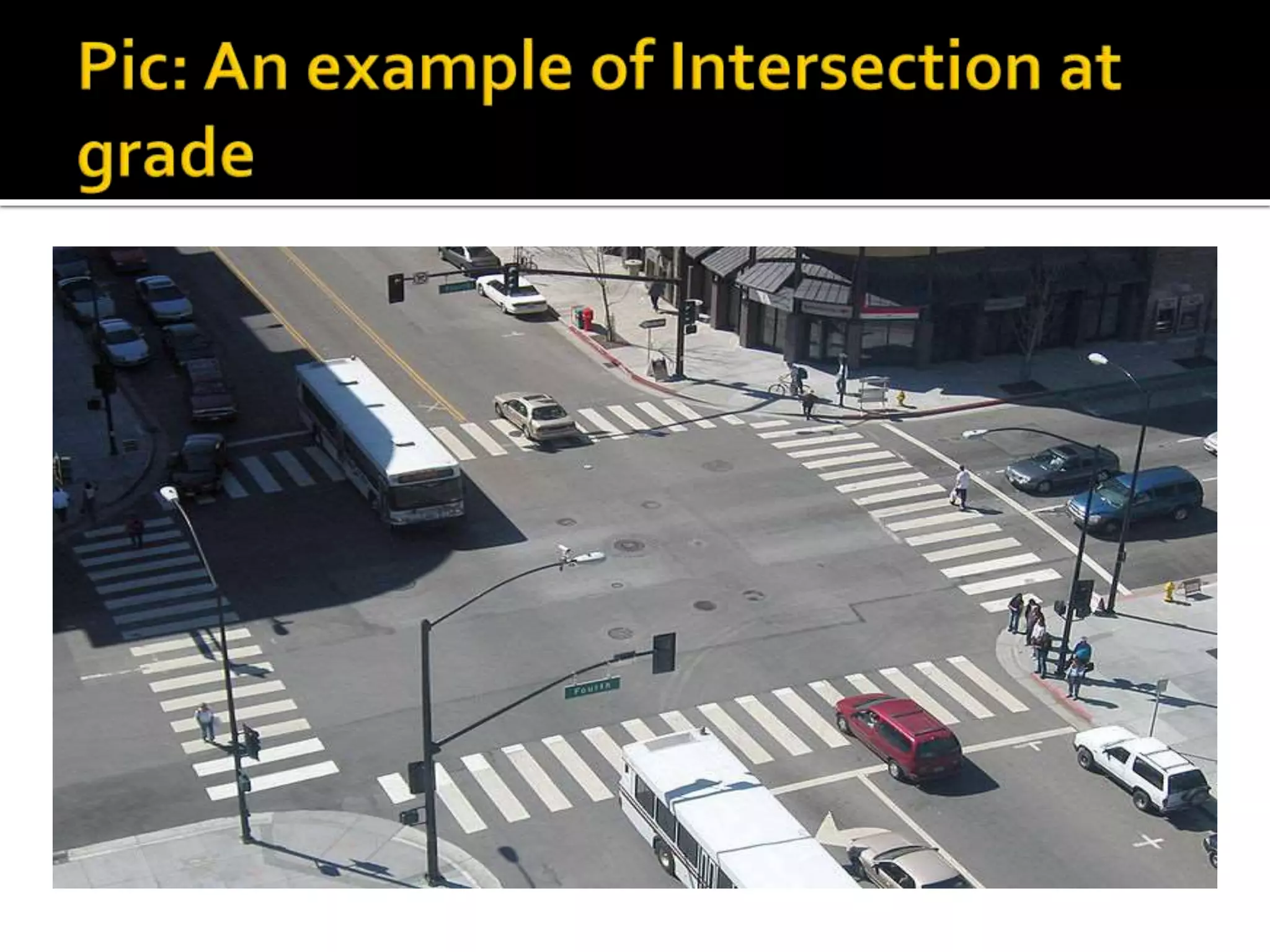
1. At-grade intersection 
2. Grade separated intersection 
 An intersection where all roadways join or 
cross at the same level. The traffic 
manoeuvres like merging, diverging and 
crossing are involved in the intersection at 
grade. It is further classified as 
i. Un-channelized 
ii. Channelized 
iii. Rotary intersection 
iv. Signalized intersection
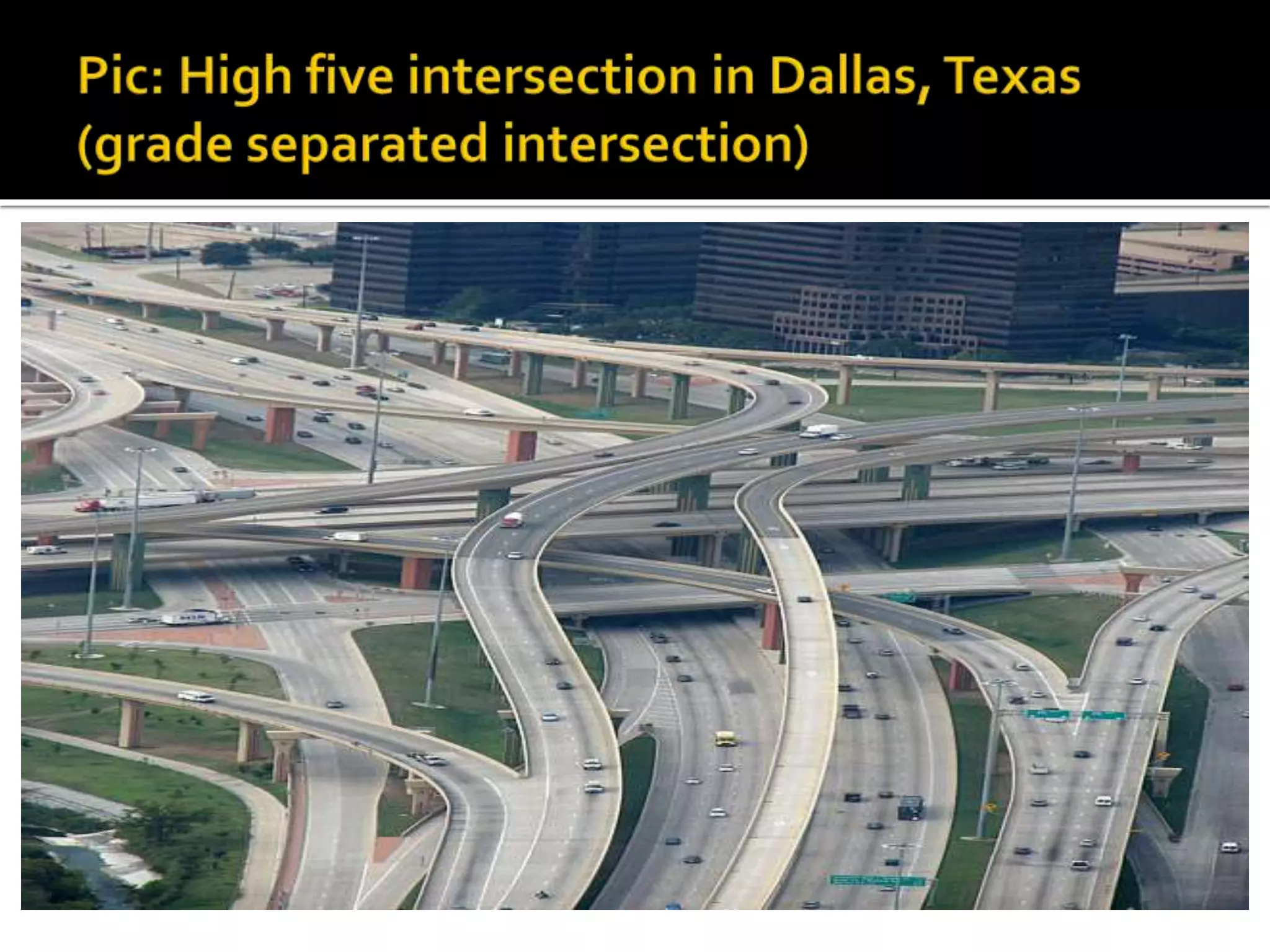
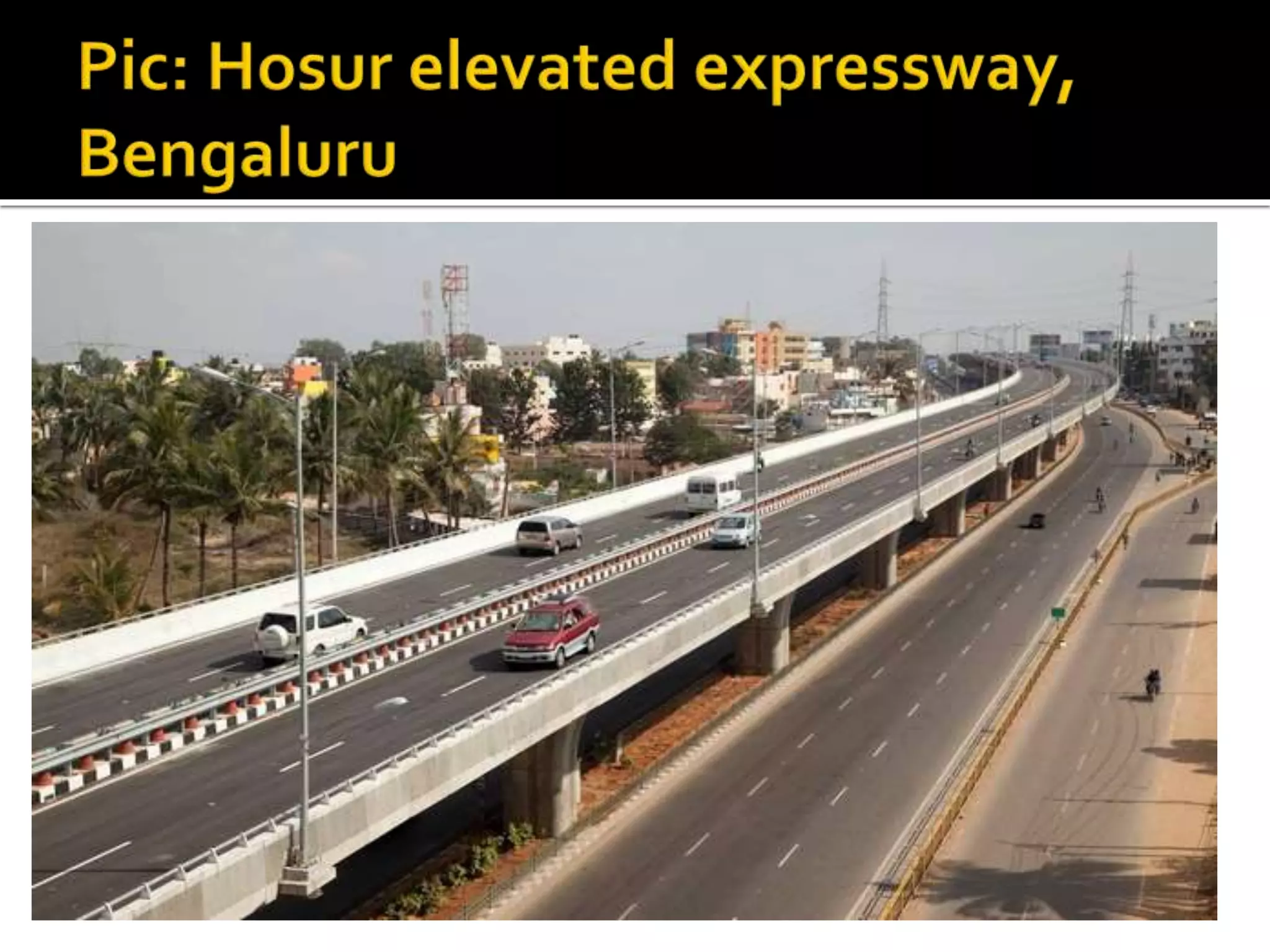
 An intersection layout which permits crossing 
manoeuvres at different levels is known as grade 
separated intersections. It is further classified as 
i. Underpass 
ii. Overpass 
iii. Trumpet Interchange 
iv. Diamond Interchange 
v. Cloverleaf Interchange 
vi. Partial Cloverleaf Interchange 
vii. Directional Interchange 
viii. Bridged Rotary
 Rotary intersections or roundabouts are 
special form of at-grade intersections laid out 
for the movement of traffic in one direction 
around a central traffic island before they can 
weave out of traffic flow into their respective 
direction. 
 In India and other countries where ‘‘keep to 
the left’’ regulation is followed, the vehicles 
entering the rotary are gently forced to move 
in a clock-wise direction in orderly fashion.
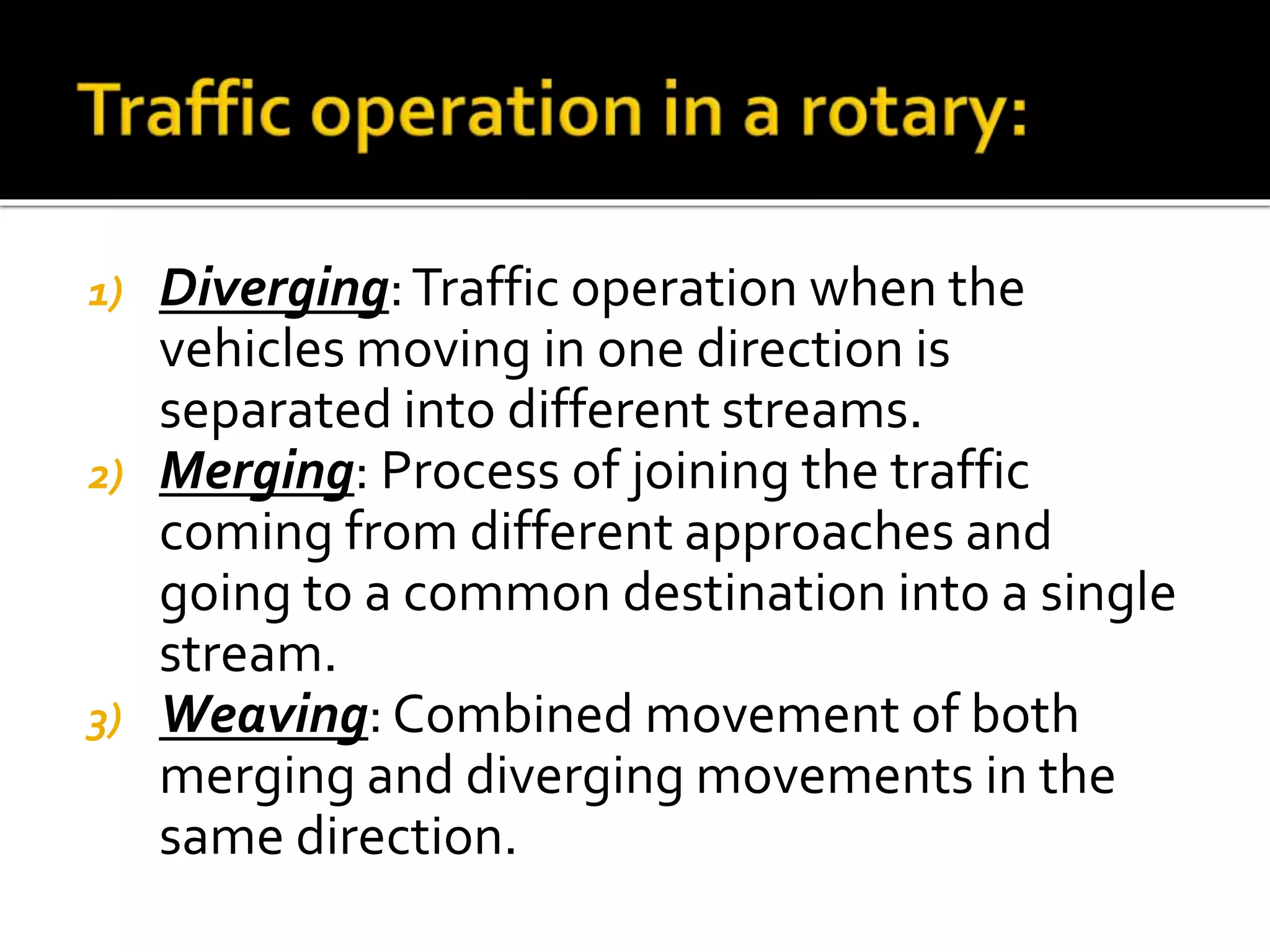
1) Diverging: Traffic operation when the 
vehicles moving in one direction is 
separated into different streams. 
2) Merging: Process of joining the traffic 
coming from different approaches and 
going to a common destination into a single 
stream. 
3) Weaving: Combined movement of both 
merging and diverging movements in the 
same direction.
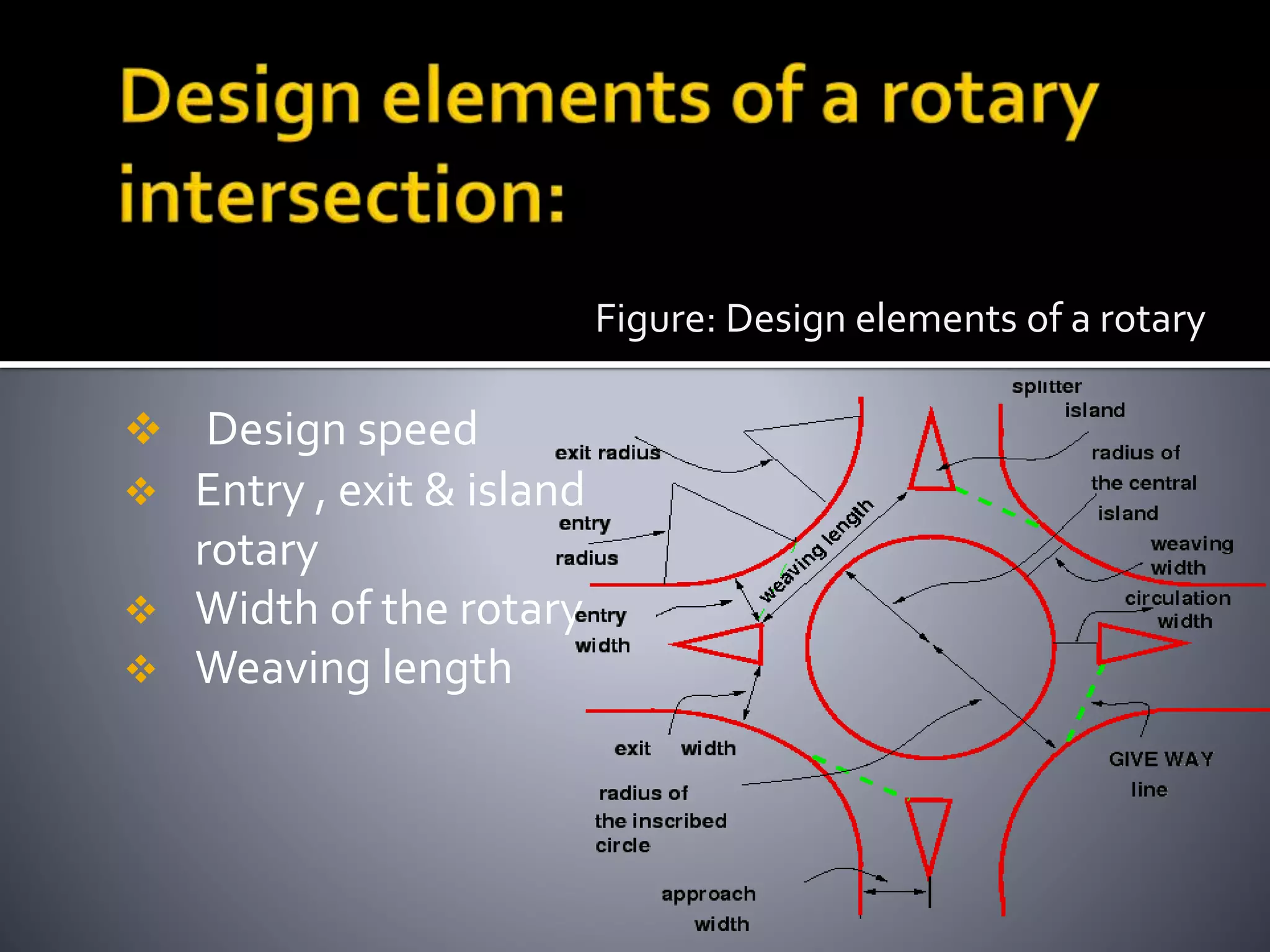
 Design speed 
 Entry , exit & island 
rotary 
 Width of the rotary 
 Weaving length 
Figure: Design elements of a rotary
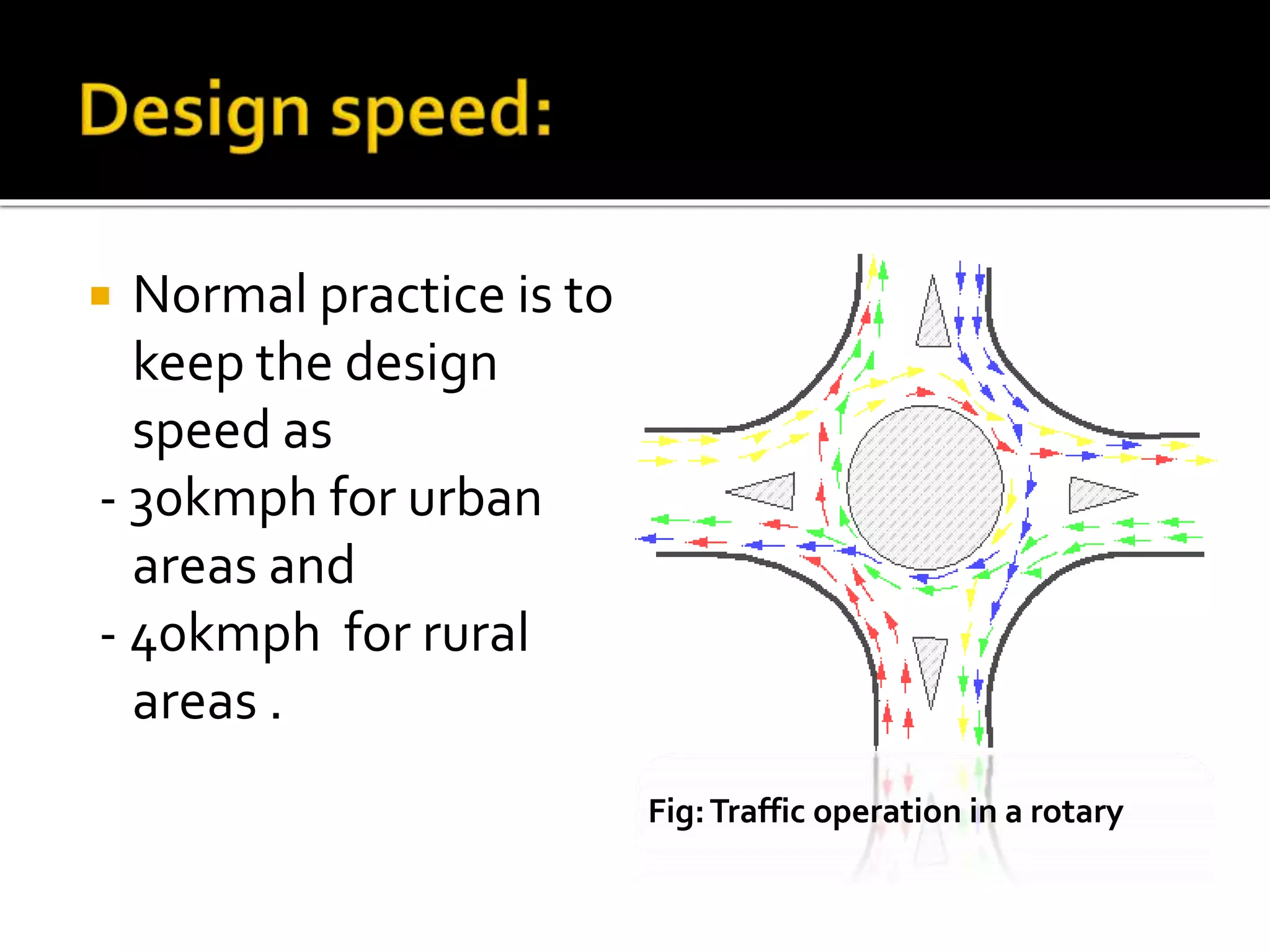
 Normal practice is to 
keep the design 
speed as 
- 30kmph for urban 
areas and 
- 40kmph for rural 
areas . 
Fig: Traffic operation in a rotary
Entry Radius: 
 For rural design, entry radius of about 20-25m 
 For urban design, entry radius of about 15- 
20m is suitable. 
Exit Radius: 
 Exit radius should be higher than radius of 
rotary island. 
 General practice is to keep exit radius as 1.5 
to 2 times the entry radius.
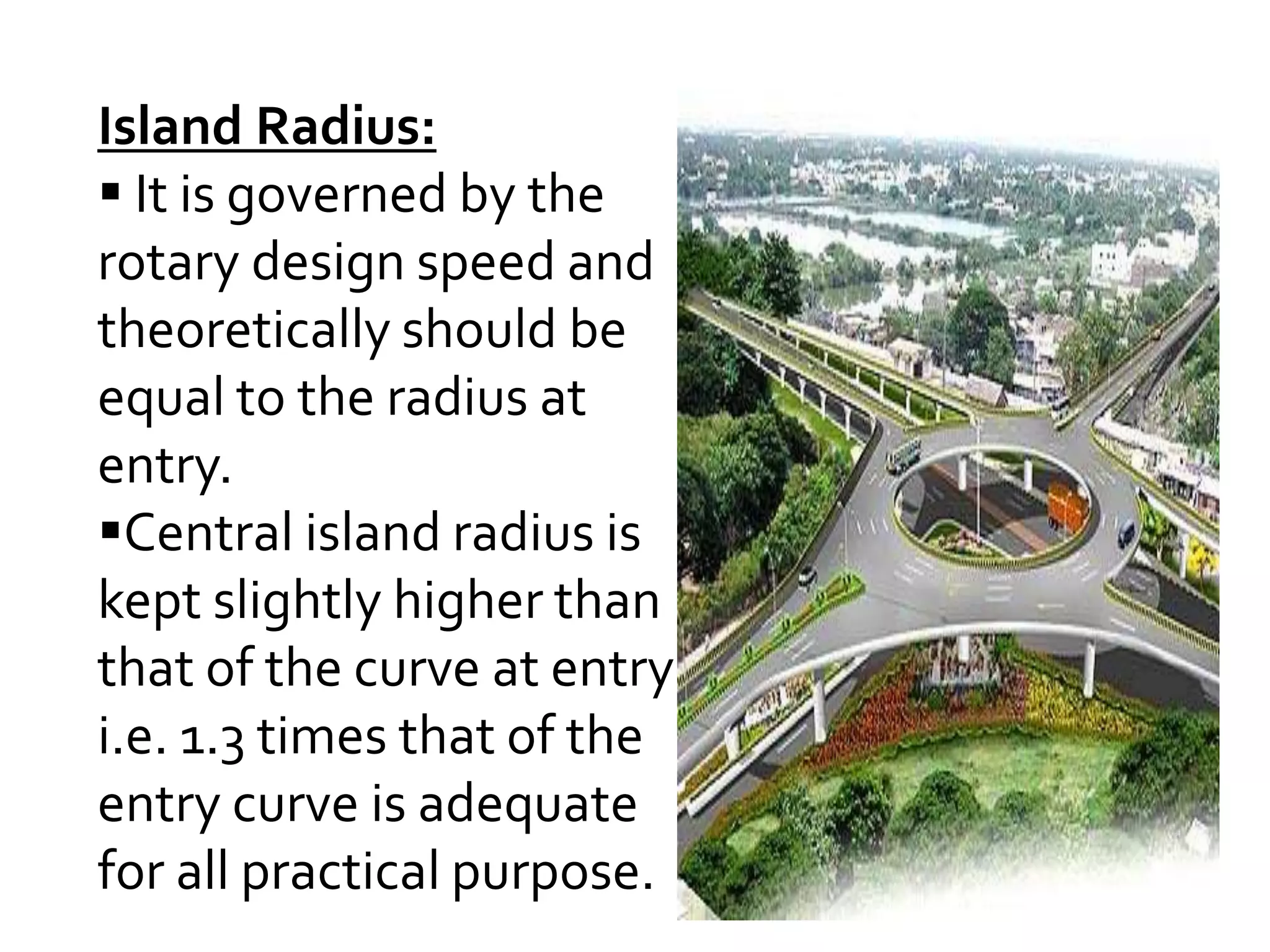
Island Radius: 
 It is governed by the 
rotary design speed and 
theoretically should be 
equal to the radius at 
entry. 
Central island radius is 
kept slightly higher than 
that of the curve at entry 
i.e. 1.3 times that of the 
entry curve is adequate 
for all practical purpose.
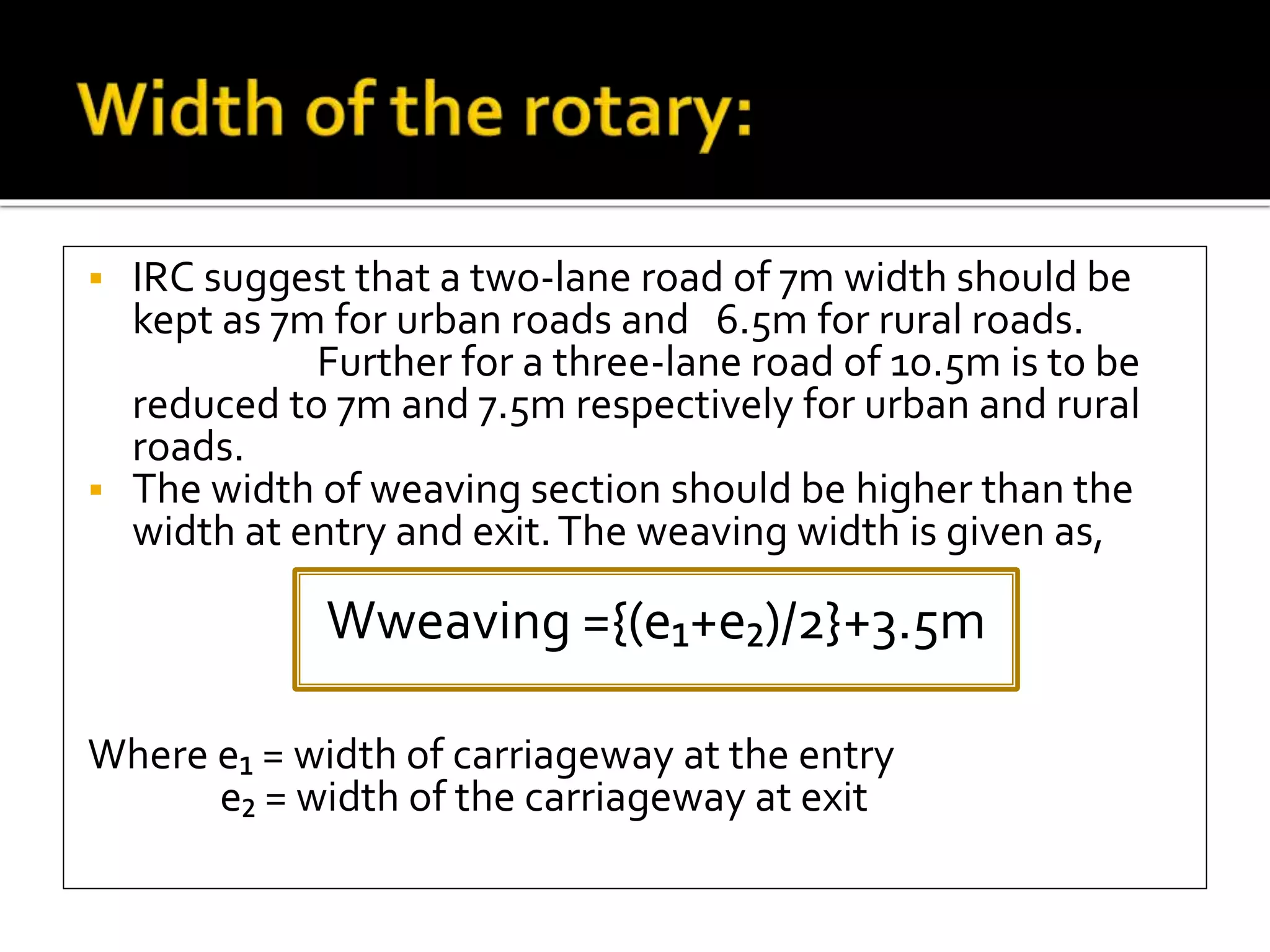
 IRC suggest that a two-lane road of 7m width should be 
kept as 7m for urban roads and 6.5m for rural roads. 
Further for a three-lane road of 10.5m is to be 
reduced to 7m and 7.5m respectively for urban and rural 
roads. 
 The width of weaving section should be higher than the 
width at entry and exit. The weaving width is given as, 
Wweaving ={(e₁+e₂)/2}+3.5m 
Where e₁ = width of carriageway at the entry 
e₂ = width of the carriageway at exit
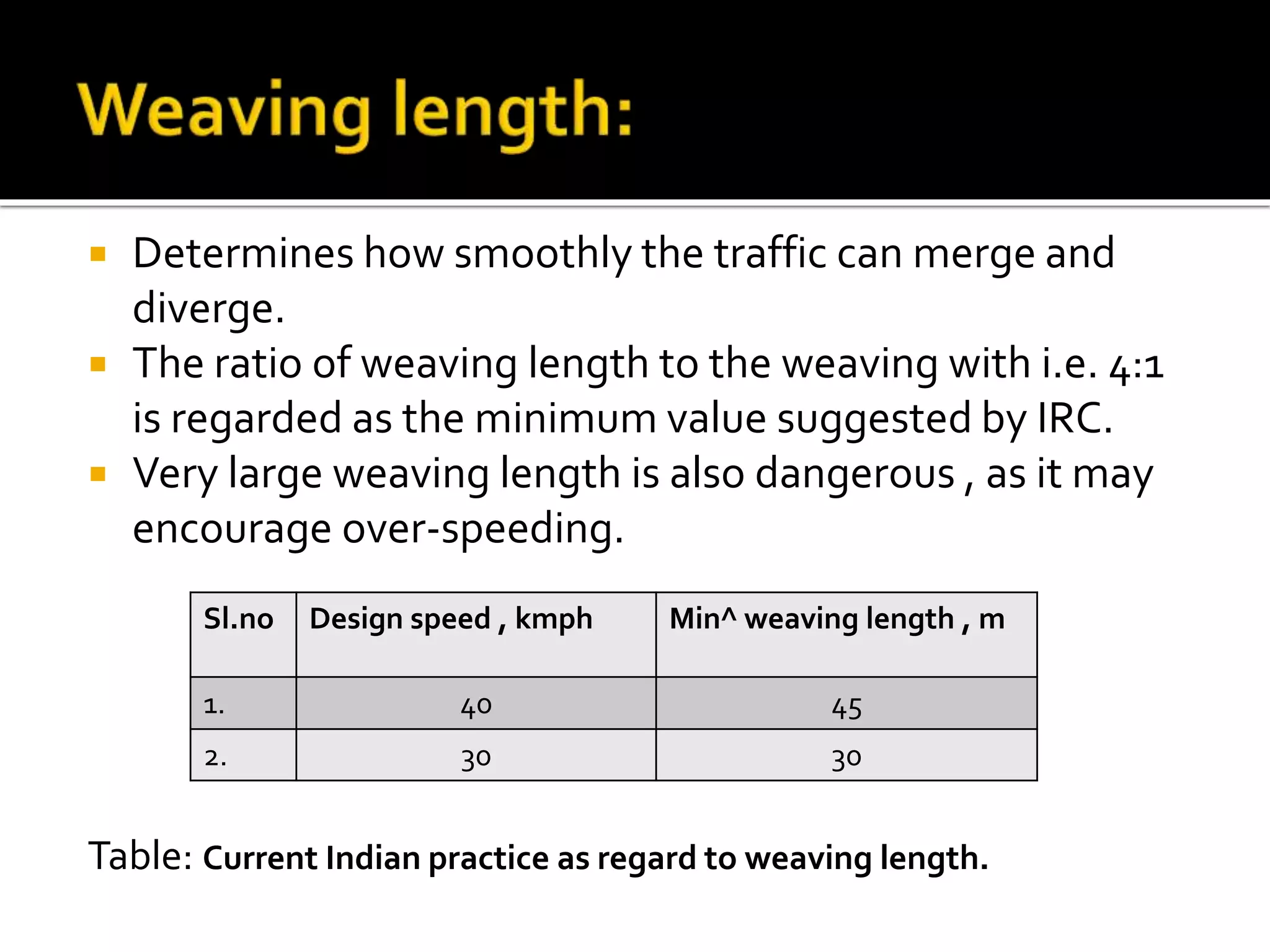
 Determines how smoothly the traffic can merge and 
diverge. 
 The ratio of weaving length to the weaving with i.e. 4:1 
is regarded as the minimum value suggested by IRC. 
 Very large weaving length is also dangerous , as it may 
encourage over-speeding. 
Sl.no Design speed , kmph Min^ weaving length , m 
1. 40 45 
2. 30 30 
Table: Current Indian practice as regard to weaving length.
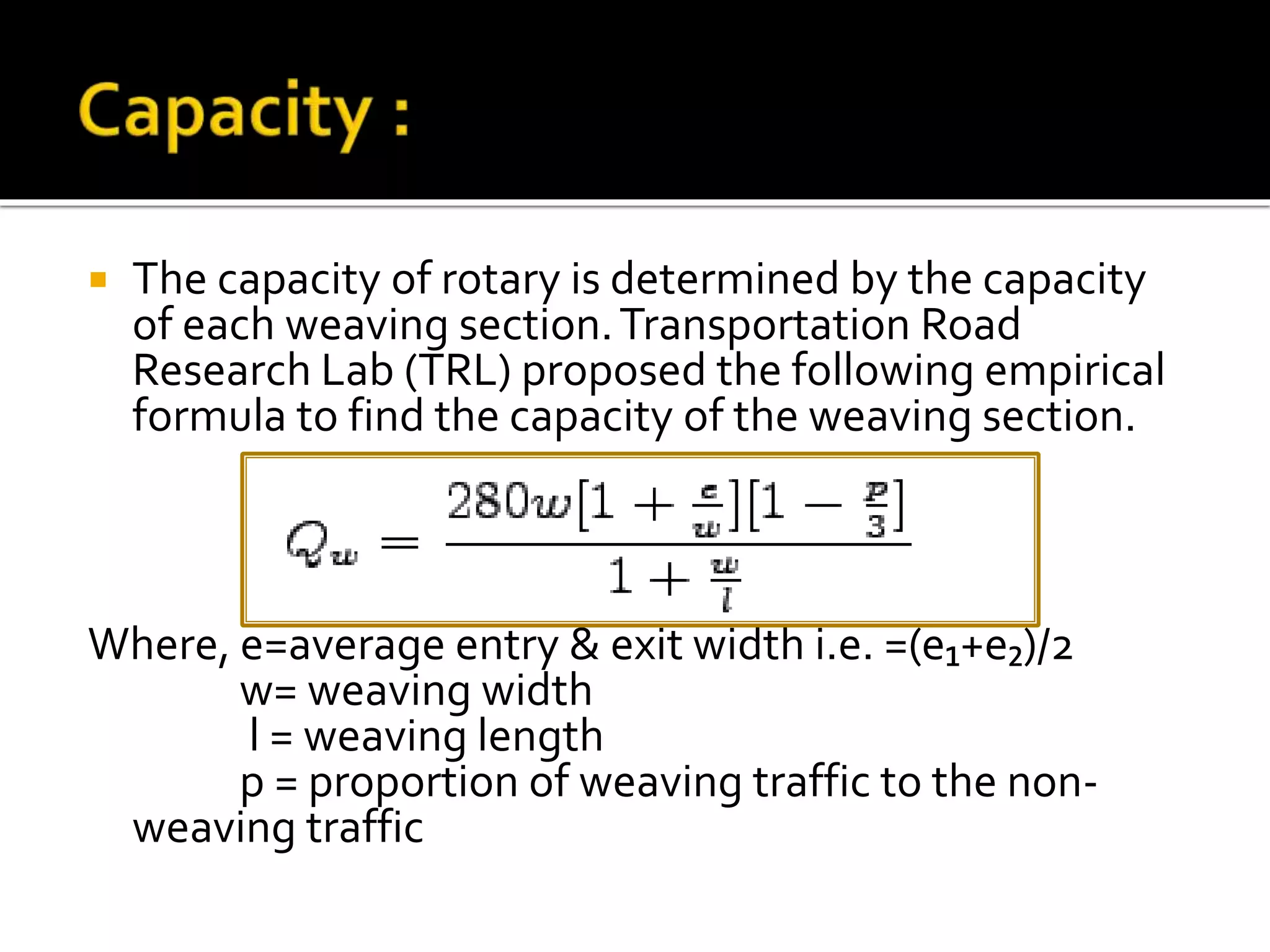
 The capacity of rotary is determined by the capacity 
of each weaving section. Transportation Road 
Research Lab (TRL) proposed the following empirical 
formula to find the capacity of the weaving section. 
Where, e=average entry & exit width i.e. =(e₁+e₂)/2 
w= weaving width 
l = weaving length 
p = proportion of weaving traffic to the non-weaving 
traffic
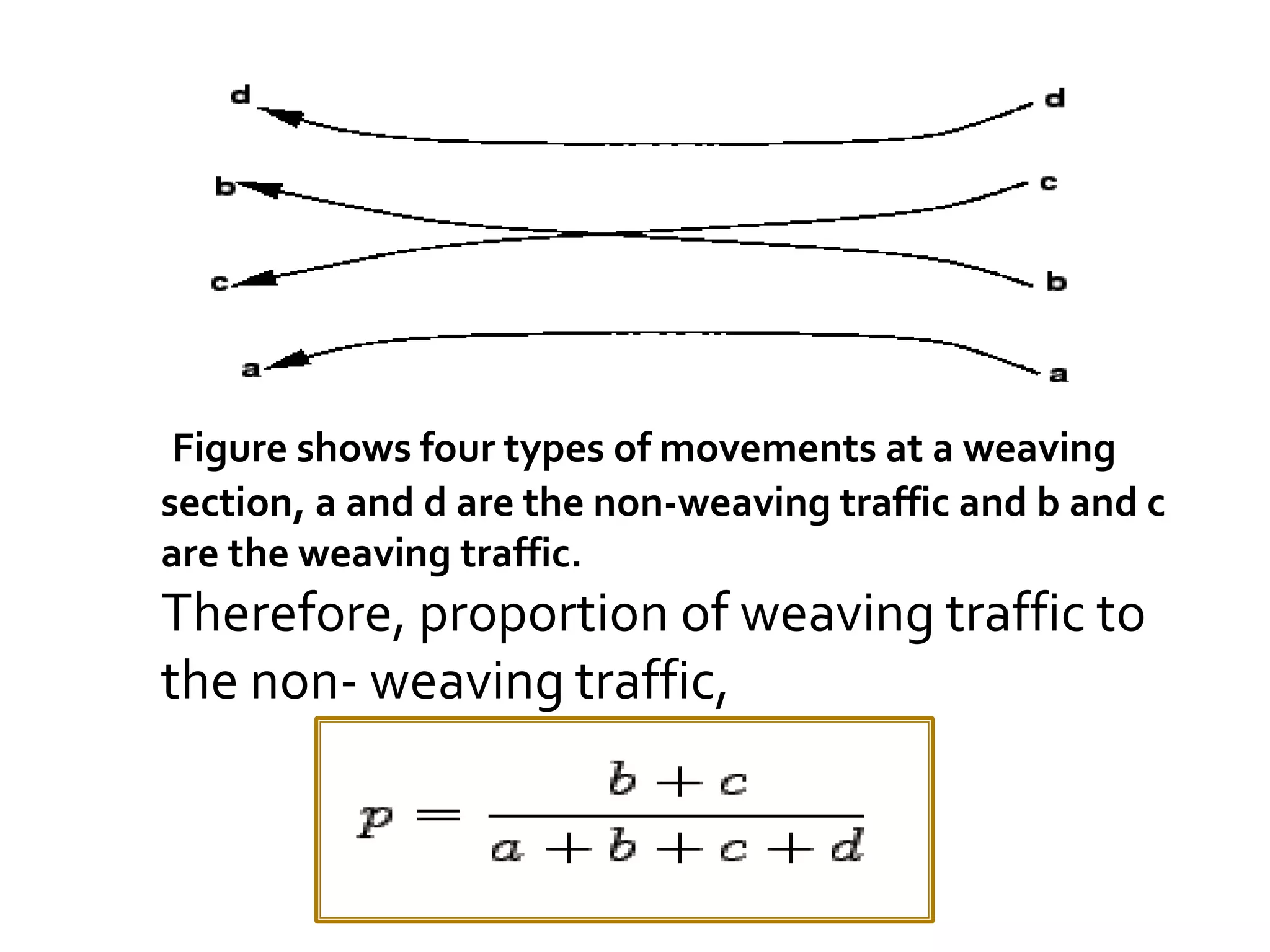
Figure shows four types of movements at a weaving 
section, a and d are the non-weaving traffic and b and c 
are the weaving traffic. 
Therefore, proportion of weaving traffic to 
the non- weaving traffic,
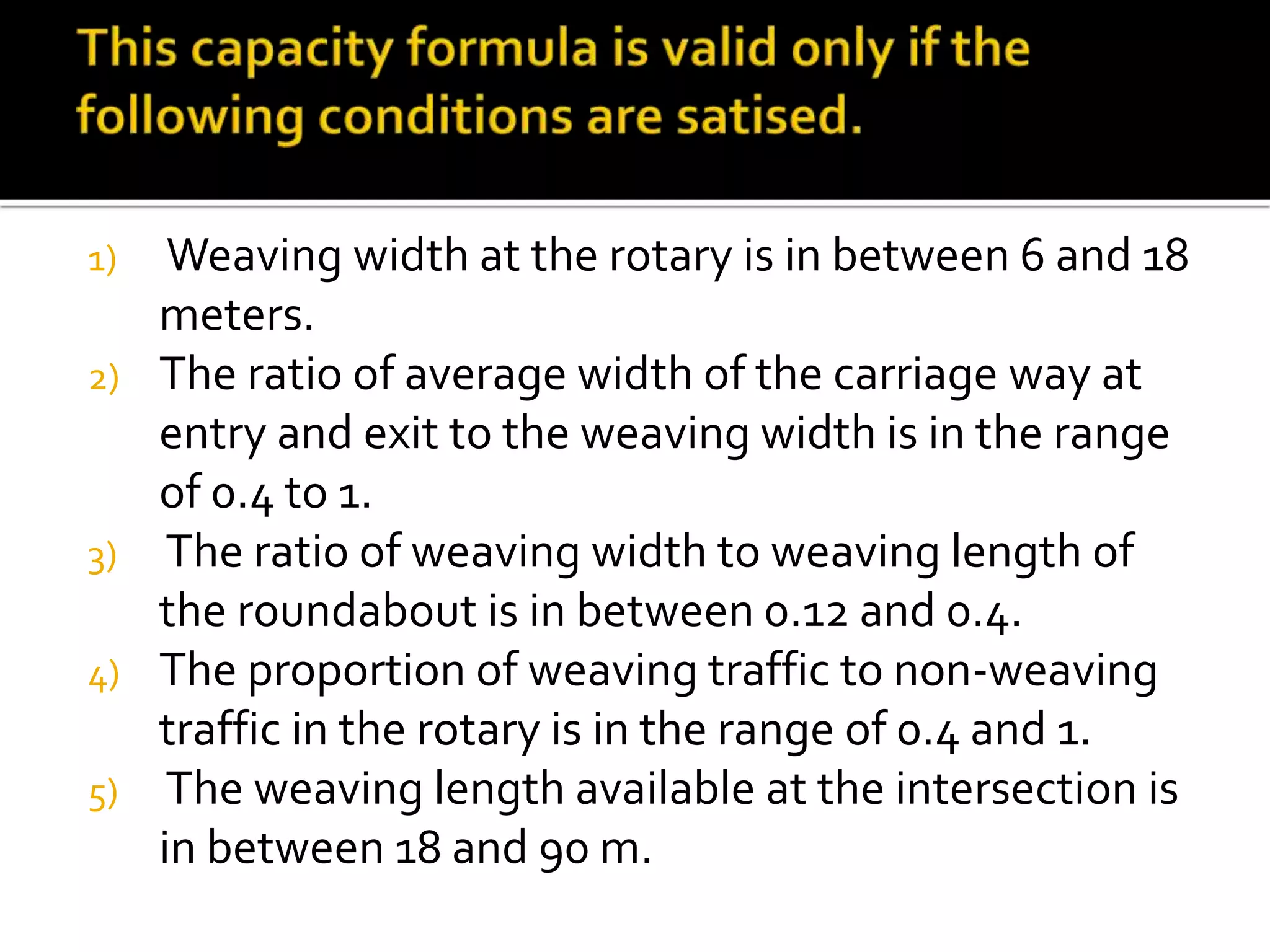
1) Weaving width at the rotary is in between 6 and 18 
meters. 
2) The ratio of average width of the carriage way at 
entry and exit to the weaving width is in the range 
of 0.4 to 1. 
3) The ratio of weaving width to weaving length of 
the roundabout is in between 0.12 and 0.4. 
4) The proportion of weaving traffic to non-weaving 
traffic in the rotary is in the range of 0.4 and 1. 
5) The weaving length available at the intersection is 
in between 18 and 90 m.
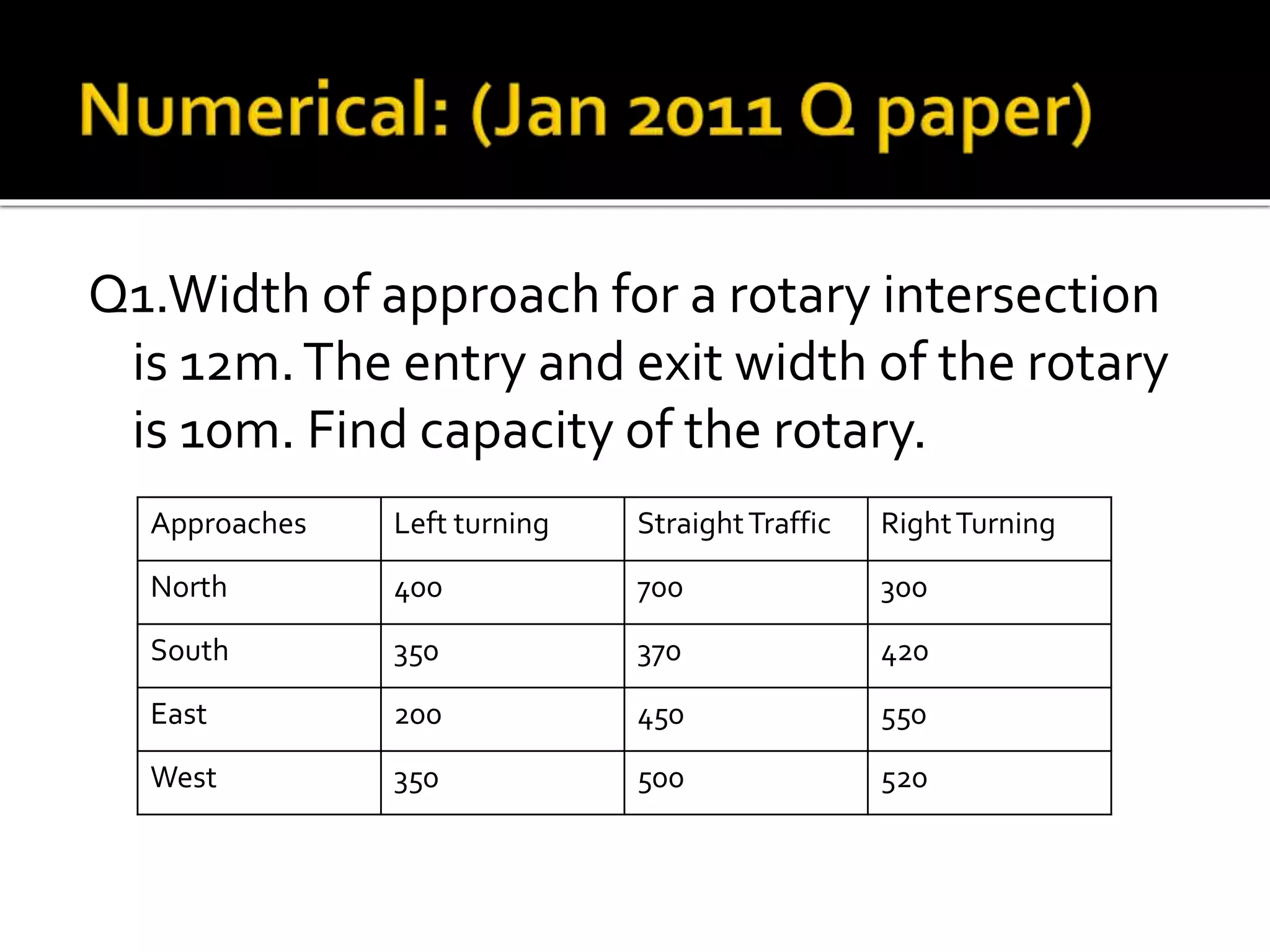
Q1.Width of approach for a rotary intersection 
is 12m. The entry and exit width of the rotary 
is 10m. Find capacity of the rotary. 
Approaches Left turning StraightTraffic Right Turning 
North 400 700 300 
South 350 370 420 
East 200 450 550 
West 350 500 520
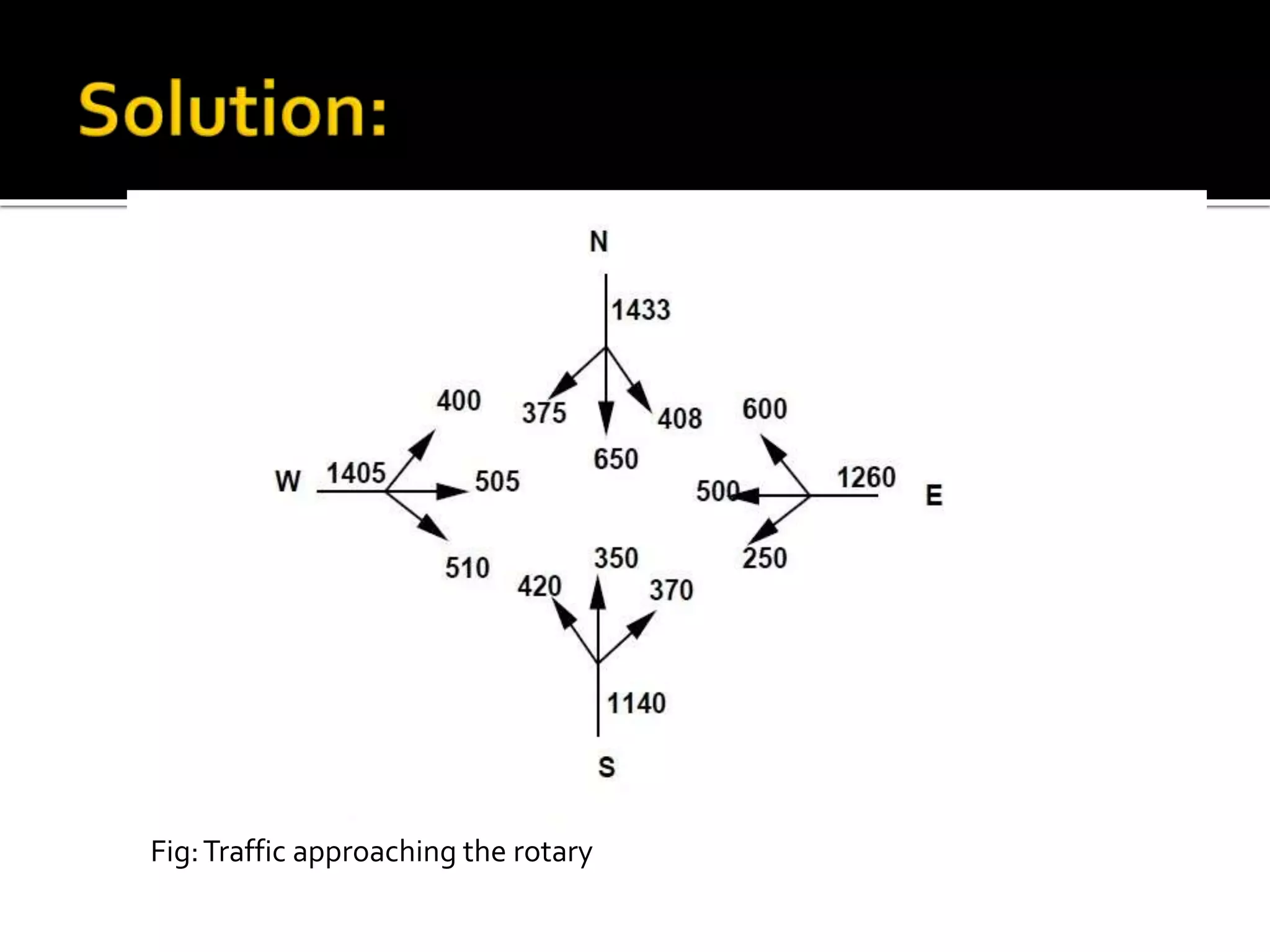
Fig: Traffic approaching the rotary
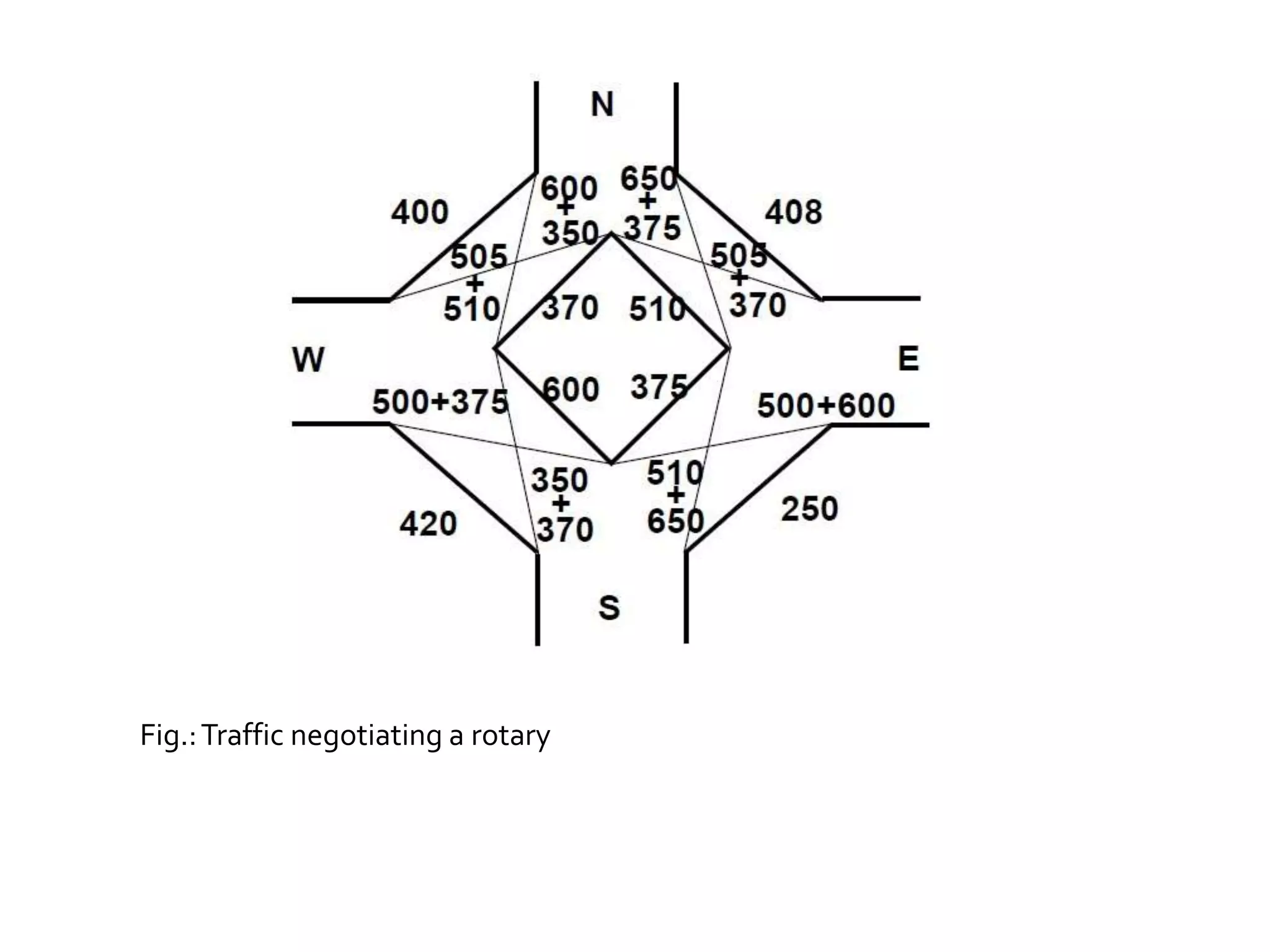
Fig.: Traffic negotiating a rotary
 Weaving width is calculated as, 
w = [(e₁+e₂)/2] + 3:5 = 13.5 m 
 Weaving length is calculated as 
l = 4*w = 54 m 
 The proportion of weaving traffic to the non-weaving 
traffic in all the four approaches is found out first. 
 Let the proportion of weaving traffic to the non-weaving 
traffic in West-North direction be denoted as 
pWN, in North-East direction as pNE, in the East-South 
direction as pES, and finally in the South-West 
direction as pSW.
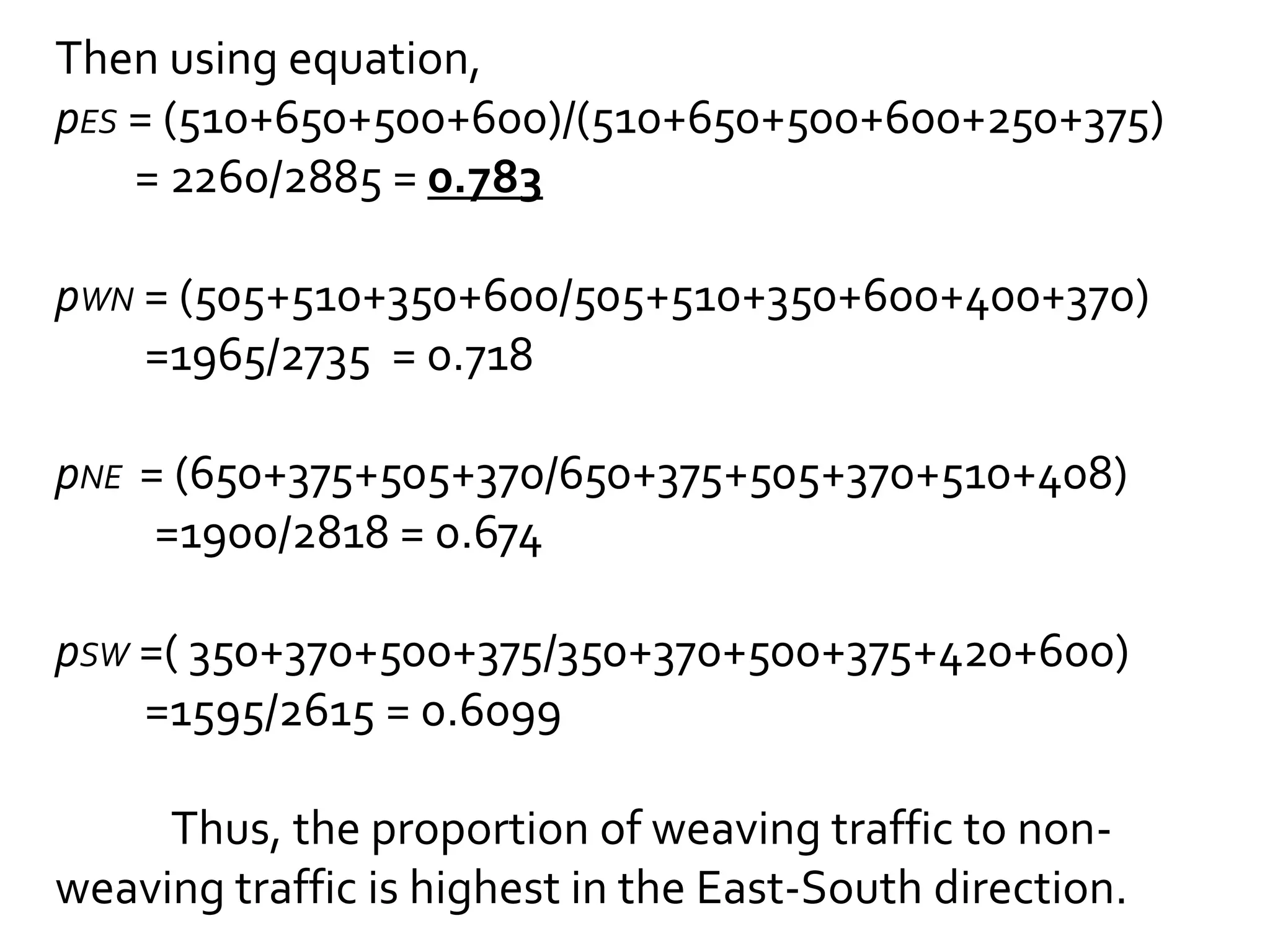
Then using equation, 
pES = (510+650+500+600)/(510+650+500+600+250+375) 
= 2260/2885 = 0.783 
pWN = (505+510+350+600/505+510+350+600+400+370) 
=1965/2735 = 0.718 
pNE = (650+375+505+370/650+375+505+370+510+408) 
=1900/2818 = 0.674 
pSW =( 350+370+500+375/350+370+500+375+420+600) 
=1595/2615 = 0.6099 
Thus, the proportion of weaving traffic to non-weaving 
traffic is highest in the East-South direction.
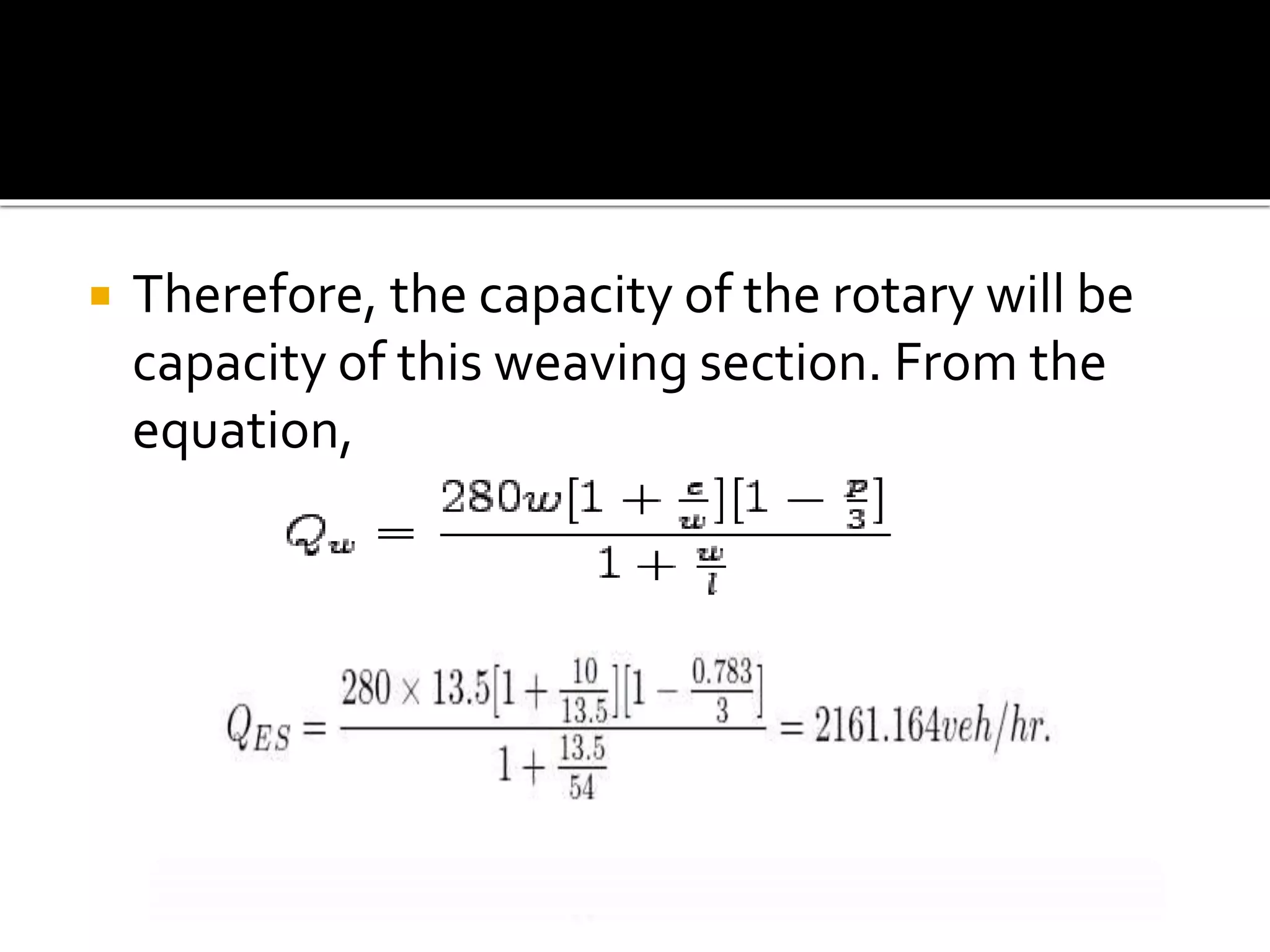
 Therefore, the capacity of the rotary will be 
capacity of this weaving section. From the 
equation,
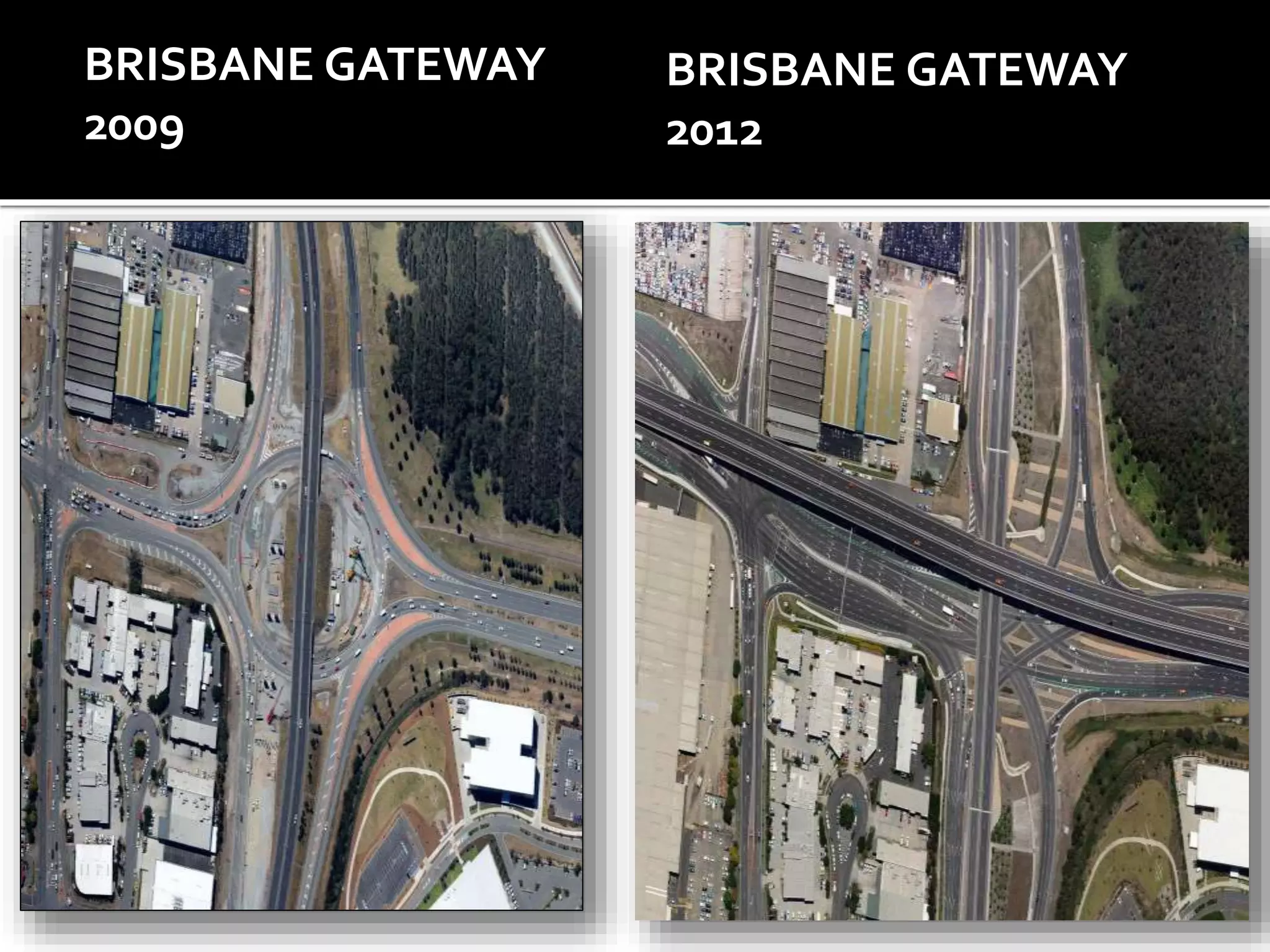
BRISBANE GATEWAY 
2009 
BRISBANE GATEWAY 
2012
 Traffic rotaries reduce the complexity of crossing 
traffic by forcing them into weaving operations. 
 The shape and size of the rotary are determined 
by the traffic volume and share of turning 
movements. 
 Capacity assessment of a rotary is done by 
analyzing the section having the greatest 
proportion of weaving traffic. 
 The analysis is done by using the formula given 
by TRL.
 http://textofvideo.nptel.iitm.ac.in/105105107/lec 
6.pdf 
 http://www.skyscrapercity.com/showthread.php 
?t=1489703&page=2 
 http://www.civil.iitb.ac.in/tvm/1111_nptel/566_R 
otary/plain/plain.html 
 L. R. Kadiyali, ‘Traffic Engineering and 
Transportation Planning’, Khanna Publishers, 8th 
Edition:2013, New Delhi. 
 S.K.Khanna, C.E.J.Justo, A.Veeraragavan, 
‘Highway Engineering’ revised 10th edition 2014, 
NemChand & Bros, Roorkee
Capacity at intersection

Capacity at intersection

  • 1.
  • 2.
    Intersection: It isdefined as the general area where two or more highways join or cross, which includes the roadway and roadside facilities for traffic movements in that area. Picture: Kathipara Junction in Chennai, India
  • 3.
    1. At-grade intersection 2. Grade separated intersection  An intersection where all roadways join or cross at the same level. The traffic manoeuvres like merging, diverging and crossing are involved in the intersection at grade. It is further classified as i. Un-channelized ii. Channelized iii. Rotary intersection iv. Signalized intersection
  • 5.
     An intersectionlayout which permits crossing manoeuvres at different levels is known as grade separated intersections. It is further classified as i. Underpass ii. Overpass iii. Trumpet Interchange iv. Diamond Interchange v. Cloverleaf Interchange vi. Partial Cloverleaf Interchange vii. Directional Interchange viii. Bridged Rotary
  • 8.
     Rotary intersectionsor roundabouts are special form of at-grade intersections laid out for the movement of traffic in one direction around a central traffic island before they can weave out of traffic flow into their respective direction.  In India and other countries where ‘‘keep to the left’’ regulation is followed, the vehicles entering the rotary are gently forced to move in a clock-wise direction in orderly fashion.
  • 11.
    1) Diverging: Trafficoperation when the vehicles moving in one direction is separated into different streams. 2) Merging: Process of joining the traffic coming from different approaches and going to a common destination into a single stream. 3) Weaving: Combined movement of both merging and diverging movements in the same direction.
  • 12.
     Design speed  Entry , exit & island rotary  Width of the rotary  Weaving length Figure: Design elements of a rotary
  • 13.
     Normal practiceis to keep the design speed as - 30kmph for urban areas and - 40kmph for rural areas . Fig: Traffic operation in a rotary
  • 14.
    Entry Radius: For rural design, entry radius of about 20-25m  For urban design, entry radius of about 15- 20m is suitable. Exit Radius:  Exit radius should be higher than radius of rotary island.  General practice is to keep exit radius as 1.5 to 2 times the entry radius.
  • 15.
    Island Radius: It is governed by the rotary design speed and theoretically should be equal to the radius at entry. Central island radius is kept slightly higher than that of the curve at entry i.e. 1.3 times that of the entry curve is adequate for all practical purpose.
  • 16.
     IRC suggestthat a two-lane road of 7m width should be kept as 7m for urban roads and 6.5m for rural roads. Further for a three-lane road of 10.5m is to be reduced to 7m and 7.5m respectively for urban and rural roads.  The width of weaving section should be higher than the width at entry and exit. The weaving width is given as, Wweaving ={(e₁+e₂)/2}+3.5m Where e₁ = width of carriageway at the entry e₂ = width of the carriageway at exit
  • 17.
     Determines howsmoothly the traffic can merge and diverge.  The ratio of weaving length to the weaving with i.e. 4:1 is regarded as the minimum value suggested by IRC.  Very large weaving length is also dangerous , as it may encourage over-speeding. Sl.no Design speed , kmph Min^ weaving length , m 1. 40 45 2. 30 30 Table: Current Indian practice as regard to weaving length.
  • 18.
     The capacityof rotary is determined by the capacity of each weaving section. Transportation Road Research Lab (TRL) proposed the following empirical formula to find the capacity of the weaving section. Where, e=average entry & exit width i.e. =(e₁+e₂)/2 w= weaving width l = weaving length p = proportion of weaving traffic to the non-weaving traffic
  • 19.
    Figure shows fourtypes of movements at a weaving section, a and d are the non-weaving traffic and b and c are the weaving traffic. Therefore, proportion of weaving traffic to the non- weaving traffic,
  • 20.
    1) Weaving widthat the rotary is in between 6 and 18 meters. 2) The ratio of average width of the carriage way at entry and exit to the weaving width is in the range of 0.4 to 1. 3) The ratio of weaving width to weaving length of the roundabout is in between 0.12 and 0.4. 4) The proportion of weaving traffic to non-weaving traffic in the rotary is in the range of 0.4 and 1. 5) The weaving length available at the intersection is in between 18 and 90 m.
  • 21.
    Q1.Width of approachfor a rotary intersection is 12m. The entry and exit width of the rotary is 10m. Find capacity of the rotary. Approaches Left turning StraightTraffic Right Turning North 400 700 300 South 350 370 420 East 200 450 550 West 350 500 520
  • 22.
  • 23.
  • 24.
     Weaving widthis calculated as, w = [(e₁+e₂)/2] + 3:5 = 13.5 m  Weaving length is calculated as l = 4*w = 54 m  The proportion of weaving traffic to the non-weaving traffic in all the four approaches is found out first.  Let the proportion of weaving traffic to the non-weaving traffic in West-North direction be denoted as pWN, in North-East direction as pNE, in the East-South direction as pES, and finally in the South-West direction as pSW.
  • 25.
    Then using equation, pES = (510+650+500+600)/(510+650+500+600+250+375) = 2260/2885 = 0.783 pWN = (505+510+350+600/505+510+350+600+400+370) =1965/2735 = 0.718 pNE = (650+375+505+370/650+375+505+370+510+408) =1900/2818 = 0.674 pSW =( 350+370+500+375/350+370+500+375+420+600) =1595/2615 = 0.6099 Thus, the proportion of weaving traffic to non-weaving traffic is highest in the East-South direction.
  • 26.
     Therefore, thecapacity of the rotary will be capacity of this weaving section. From the equation,
  • 27.
    BRISBANE GATEWAY 2009 BRISBANE GATEWAY 2012
  • 28.
     Traffic rotariesreduce the complexity of crossing traffic by forcing them into weaving operations.  The shape and size of the rotary are determined by the traffic volume and share of turning movements.  Capacity assessment of a rotary is done by analyzing the section having the greatest proportion of weaving traffic.  The analysis is done by using the formula given by TRL.
  • 29.
     http://textofvideo.nptel.iitm.ac.in/105105107/lec 6.pdf  http://www.skyscrapercity.com/showthread.php ?t=1489703&page=2  http://www.civil.iitb.ac.in/tvm/1111_nptel/566_R otary/plain/plain.html  L. R. Kadiyali, ‘Traffic Engineering and Transportation Planning’, Khanna Publishers, 8th Edition:2013, New Delhi.  S.K.Khanna, C.E.J.Justo, A.Veeraragavan, ‘Highway Engineering’ revised 10th edition 2014, NemChand & Bros, Roorkee