HL Chemistry AssiaChelaghma
To determine an equilibrium Constant
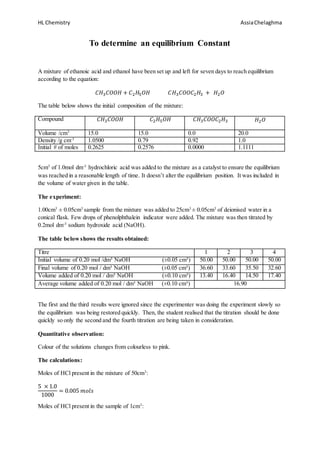
A mixture of ethanoic acid and ethanol have been set up and left for seven days to reach equilibrium
according to the equation:
𝐶𝐻3 𝐶𝑂𝑂𝐻 + 𝐶2 𝐻5 𝑂𝐻 𝐶𝐻3 𝐶𝑂𝑂𝐶2 𝐻3 + 𝐻2 𝑂
The table below shows the initial composition of the mixture:
Compound 𝐶𝐻3 𝐶𝑂𝑂𝐻 𝐶2 𝐻5 𝑂𝐻 𝐶𝐻3 𝐶𝑂𝑂𝐶2 𝐻3 𝐻2 𝑂
Volume /cm3
15.0 15.0 0.0 20.0
Density /g cm-3
1.0500 0.79 0.92 1.0
Initial # of moles 0.2625 0.2576 0.0000 1.1111
5cm3
of 1.0mol dm-3
hydrochloric acid was added to the mixture as a catalyst to ensure the equilibrium
was reached in a reasonable length of time. It doesn’t alter the equilibrium position. It was included in
the volume of water given in the table.
The experiment:
1.00cm3
± 0.05cm3
sample from the mixture was added to 25cm3
± 0.05cm3
of deionised water in a
conical flask. Few drops of phenolphthalein indicator were added. The mixture was then titrated by
0.2mol dm-3
sodium hydroxide acid (NaOH).
The table belowshows the results obtained:
Titre 1 2 3 4
Initial volume of 0.20 mol /dm³ NaOH (±0.05 cm³) 50.00 50.00 50.00 50.00
Final volume of 0.20 mol / dm³ NaOH (±0.05 cm³) 36.60 33.60 35.50 32.60
Volume added of 0.20 mol / dm³ NaOH (±0.10 cm³) 13.40 16.40 14.50 17.40
Average volume added of 0.20 mol / dm³ NaOH (±0.10 cm³) 16.90
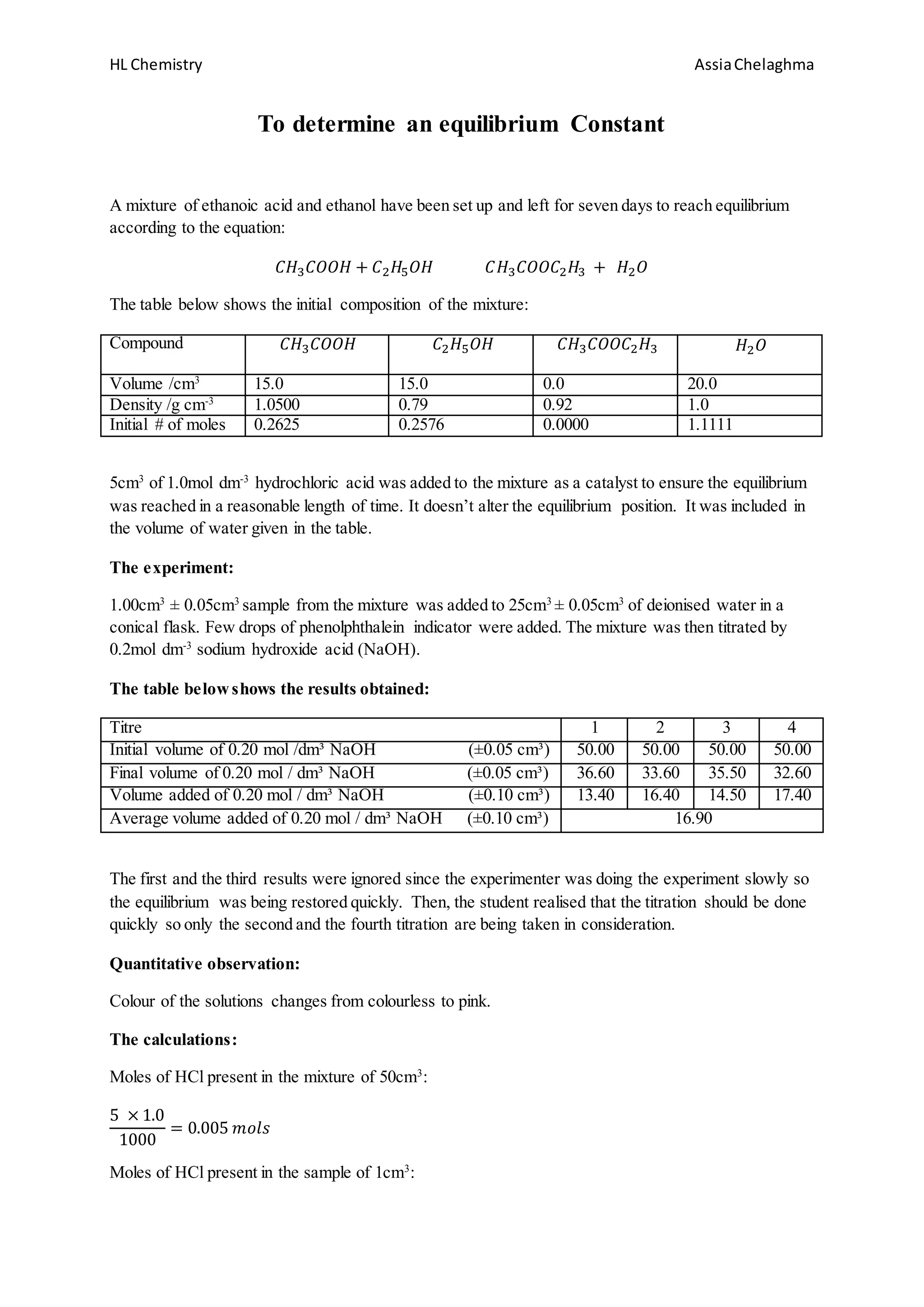
The first and the third results were ignored since the experimenter was doing the experiment slowly so
the equilibrium was being restored quickly. Then, the student realised that the titration should be done
quickly so only the second and the fourth titration are being taken in consideration.
Quantitative observation:
Colour of the solutions changes from colourless to pink.
The calculations:
Moles of HCl present in the mixture of 50cm3
:
5 × 1.0
1000
= 0.005 𝑚𝑜𝑙𝑠
Moles of HCl present in the sample of 1cm3
:
HL Chemistry AssiaChelaghma
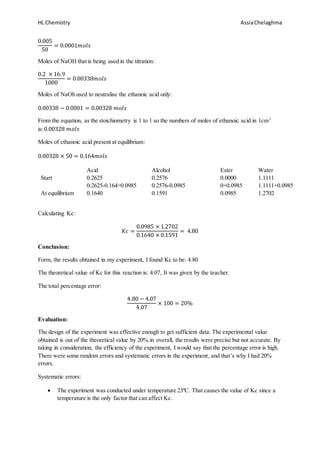
0.005
50
= 0.0001𝑚𝑜𝑙𝑠
Moles of NaOH that is being used in the titration:
0.2 × 16.9
1000
= 0.00338𝑚𝑜𝑙𝑠
Moles of NaOh used to neutralise the ethanoic acid only:
0.00338 − 0.0001 = 0.00328 𝑚𝑜𝑙𝑠
From the equation, as the stoichiometry is 1 to 1 so the numbers of moles of ethanoic acid in 1cm3
is:0.00328 𝑚𝑜𝑙𝑠
Moles of ethanoic acid present at equilibrium:
0.00328 × 50 = 0.164𝑚𝑜𝑙𝑠
Acid Alcohol Ester Water
Start 0.2625 0.2576 0.0000 1.1111
0.2625-0.164=0.0985 0.2576-0.0985 0+0.0985 1.1111+0.0985
At equilibrium 0.1640 0.1591 0.0985 1.2702
Calculating Kc:
𝐾𝑐 =
0.0985 × 1.2702
0.1640 × 0.1591
= 4.80
Conclusion:
Form, the results obtained in my experiment, I found Kc to be: 4.80
The theoretical value of Kc for this reaction is: 4.07, It was given by the teacher.
The total percentage error:
4.80 − 4.07
4.07
× 100 = 20%
Evaluation:
The design of the experiment was effective enough to get sufficient data. The experimental value
obtained is out of the theoretical value by 20%.in overall, the results were precise but not accurate. By
taking in consideration, the efficiency of the experiment, I would say that the percentage error is high.
There were some random errors and systematic errors in the experiment, and that’s why I had 20%
errors.
Systematic errors:
 The experiment was conducted under temperature 23ºC. That causes the value of Kc since a
temperature is the only factor that can affect Kc.
HL Chemistry AssiaChelaghma
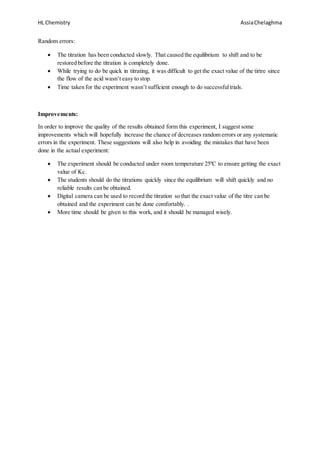
Random errors:
 The titration has been conducted slowly. That caused the equilibrium to shift and to be
restored before the titration is completely done.
 While trying to do be quick in titrating, it was difficult to get the exact value of the tirtre since
the flow of the acid wasn’t easy to stop.
 Time taken for the experiment wasn’t sufficient enough to do successfultrials.
Improvements:
In order to improve the quality of the results obtained form this experiment, I suggest some
improvements which will hopefully increase the chance of decreases random errors or any systematic
errors in the experiment. These suggestions will also help in avoiding the mistakes that have been
done in the actual experiment:
 The experiment should be conducted under room temperature 25ºC to ensure getting the exact
value of Kc.
 The students should do the titrations quickly since the equilibrium will shift quickly and no
reliable results can be obtained.
 Digital camera can be used to record the titration so that the exact value of the titre can be
obtained and the experiment can be done comfortably. .
 More time should be given to this work, and it should be managed wisely.

IB IA Chemistry HL Lab

  • 1.
    HL Chemistry AssiaChelaghma Todetermine an equilibrium Constant A mixture of ethanoic acid and ethanol have been set up and left for seven days to reach equilibrium according to the equation: 𝐶𝐻3 𝐶𝑂𝑂𝐻 + 𝐶2 𝐻5 𝑂𝐻 𝐶𝐻3 𝐶𝑂𝑂𝐶2 𝐻3 + 𝐻2 𝑂 The table below shows the initial composition of the mixture: Compound 𝐶𝐻3 𝐶𝑂𝑂𝐻 𝐶2 𝐻5 𝑂𝐻 𝐶𝐻3 𝐶𝑂𝑂𝐶2 𝐻3 𝐻2 𝑂 Volume /cm3 15.0 15.0 0.0 20.0 Density /g cm-3 1.0500 0.79 0.92 1.0 Initial # of moles 0.2625 0.2576 0.0000 1.1111 5cm3 of 1.0mol dm-3 hydrochloric acid was added to the mixture as a catalyst to ensure the equilibrium was reached in a reasonable length of time. It doesn’t alter the equilibrium position. It was included in the volume of water given in the table. The experiment: 1.00cm3 ± 0.05cm3 sample from the mixture was added to 25cm3 ± 0.05cm3 of deionised water in a conical flask. Few drops of phenolphthalein indicator were added. The mixture was then titrated by 0.2mol dm-3 sodium hydroxide acid (NaOH). The table belowshows the results obtained: Titre 1 2 3 4 Initial volume of 0.20 mol /dm³ NaOH (±0.05 cm³) 50.00 50.00 50.00 50.00 Final volume of 0.20 mol / dm³ NaOH (±0.05 cm³) 36.60 33.60 35.50 32.60 Volume added of 0.20 mol / dm³ NaOH (±0.10 cm³) 13.40 16.40 14.50 17.40 Average volume added of 0.20 mol / dm³ NaOH (±0.10 cm³) 16.90 The first and the third results were ignored since the experimenter was doing the experiment slowly so the equilibrium was being restored quickly. Then, the student realised that the titration should be done quickly so only the second and the fourth titration are being taken in consideration. Quantitative observation: Colour of the solutions changes from colourless to pink. The calculations: Moles of HCl present in the mixture of 50cm3 : 5 × 1.0 1000 = 0.005 𝑚𝑜𝑙𝑠 Moles of HCl present in the sample of 1cm3 :
  • 2.
    HL Chemistry AssiaChelaghma 0.005 50 =0.0001𝑚𝑜𝑙𝑠 Moles of NaOH that is being used in the titration: 0.2 × 16.9 1000 = 0.00338𝑚𝑜𝑙𝑠 Moles of NaOh used to neutralise the ethanoic acid only: 0.00338 − 0.0001 = 0.00328 𝑚𝑜𝑙𝑠 From the equation, as the stoichiometry is 1 to 1 so the numbers of moles of ethanoic acid in 1cm3 is:0.00328 𝑚𝑜𝑙𝑠 Moles of ethanoic acid present at equilibrium: 0.00328 × 50 = 0.164𝑚𝑜𝑙𝑠 Acid Alcohol Ester Water Start 0.2625 0.2576 0.0000 1.1111 0.2625-0.164=0.0985 0.2576-0.0985 0+0.0985 1.1111+0.0985 At equilibrium 0.1640 0.1591 0.0985 1.2702 Calculating Kc: 𝐾𝑐 = 0.0985 × 1.2702 0.1640 × 0.1591 = 4.80 Conclusion: Form, the results obtained in my experiment, I found Kc to be: 4.80 The theoretical value of Kc for this reaction is: 4.07, It was given by the teacher. The total percentage error: 4.80 − 4.07 4.07 × 100 = 20% Evaluation: The design of the experiment was effective enough to get sufficient data. The experimental value obtained is out of the theoretical value by 20%.in overall, the results were precise but not accurate. By taking in consideration, the efficiency of the experiment, I would say that the percentage error is high. There were some random errors and systematic errors in the experiment, and that’s why I had 20% errors. Systematic errors:  The experiment was conducted under temperature 23ºC. That causes the value of Kc since a temperature is the only factor that can affect Kc.
  • 3.
    HL Chemistry AssiaChelaghma Randomerrors:  The titration has been conducted slowly. That caused the equilibrium to shift and to be restored before the titration is completely done.  While trying to do be quick in titrating, it was difficult to get the exact value of the tirtre since the flow of the acid wasn’t easy to stop.  Time taken for the experiment wasn’t sufficient enough to do successfultrials. Improvements: In order to improve the quality of the results obtained form this experiment, I suggest some improvements which will hopefully increase the chance of decreases random errors or any systematic errors in the experiment. These suggestions will also help in avoiding the mistakes that have been done in the actual experiment:  The experiment should be conducted under room temperature 25ºC to ensure getting the exact value of Kc.  The students should do the titrations quickly since the equilibrium will shift quickly and no reliable results can be obtained.  Digital camera can be used to record the titration so that the exact value of the titre can be obtained and the experiment can be done comfortably. .  More time should be given to this work, and it should be managed wisely.