This work is licensed under a Creative Commons Attribution-Noncommercial-Share Alike 2.0 UK: England & Wales License   Lab 6: Saliva Practical Beer-Lambert Law University of Lincoln presentation
This session…. Overview of the practical… Statistical analysis…. Take a look at an example control chart… This work is licensed under a Creative Commons Attribution-Noncommercial-Share Alike 2.0 UK: England & Wales License
The Practical Determine the thiocyanate (SCN - ) in a sample of your saliva using a colourimetric method of analysis Calibration curve to determine the [SCN - ] of the unknowns This was ALL completed in the practical class Some of your absorbance values may have been higher than the absorbance values of your top standards… is this a problem???? This work is licensed under a Creative Commons Attribution-Noncommercial-Share Alike 2.0 UK: England & Wales License
This work is licensed under a Creative Commons Attribution-Noncommercial-Share Alike 2.0 UK: England & Wales License   Types of data QUALITATIVE Non numerical i.e what is present? QUANTITATIVE Numerical: i.e. How much is present?
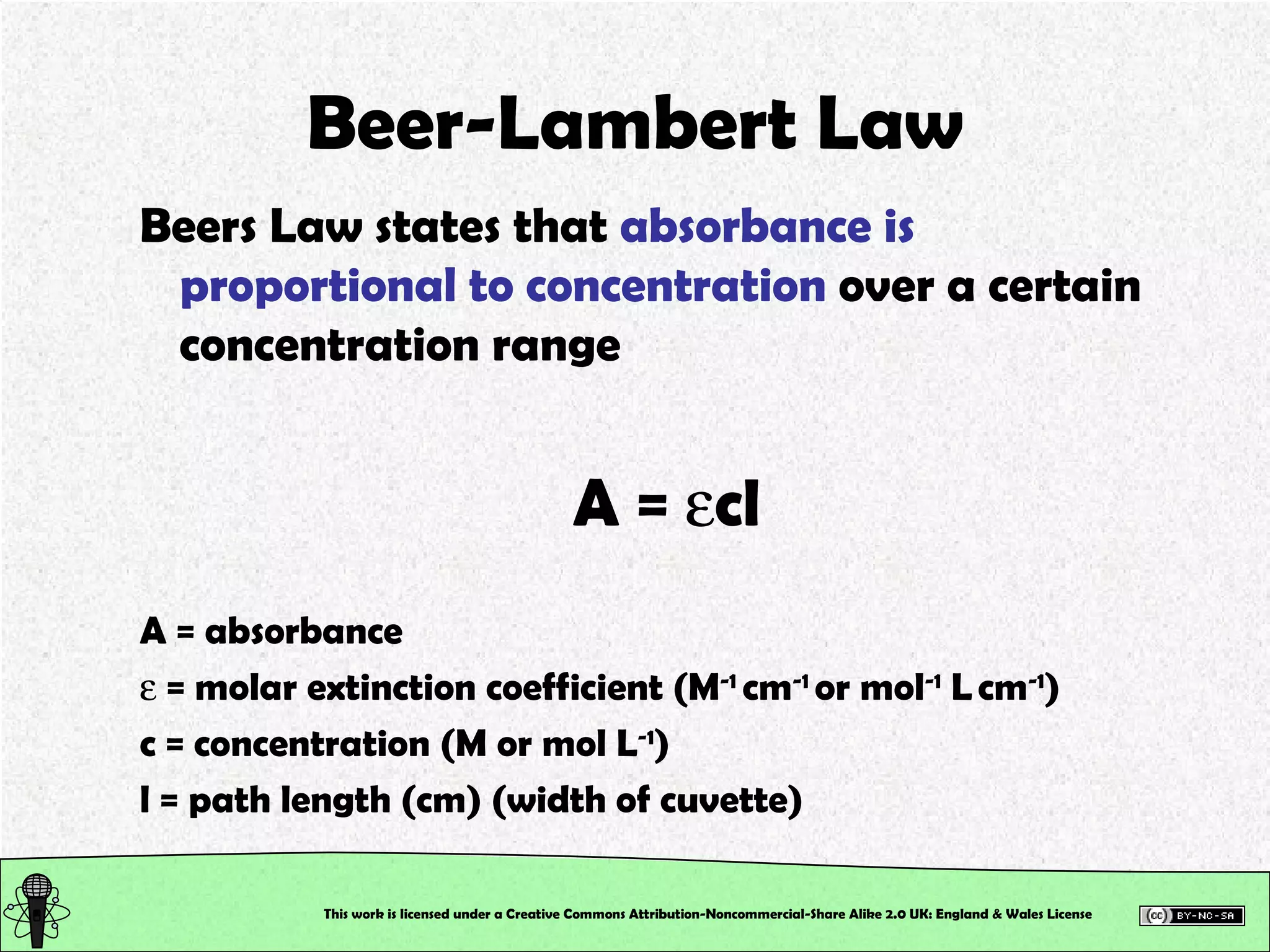
Beer-Lambert Law Beers Law states that  absorbance is proportional to concentration  over a certain concentration range A =   cl A = absorbance    = molar extinction coefficient (M -1  cm -1  or mol -1  L   cm -1 ) c = concentration (M or mol L -1 ) l = path length (cm) (width of cuvette) This work is licensed under a Creative Commons Attribution-Noncommercial-Share Alike 2.0 UK: England & Wales License
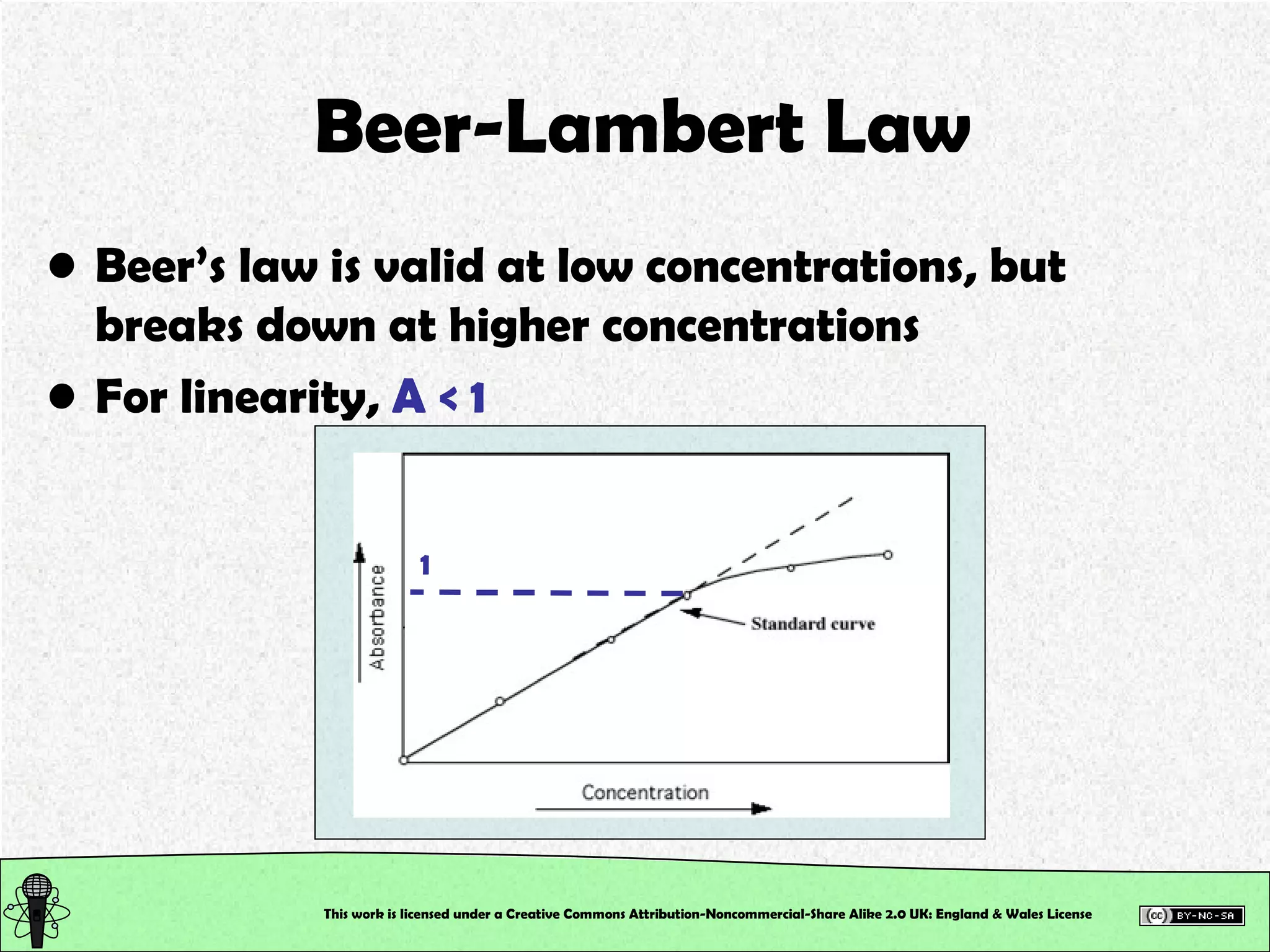
Beer-Lambert Law Beer’s law is valid at low concentrations, but breaks down at higher concentrations For linearity,  A < 1 This work is licensed under a Creative Commons Attribution-Noncommercial-Share Alike 2.0 UK: England & Wales License   1
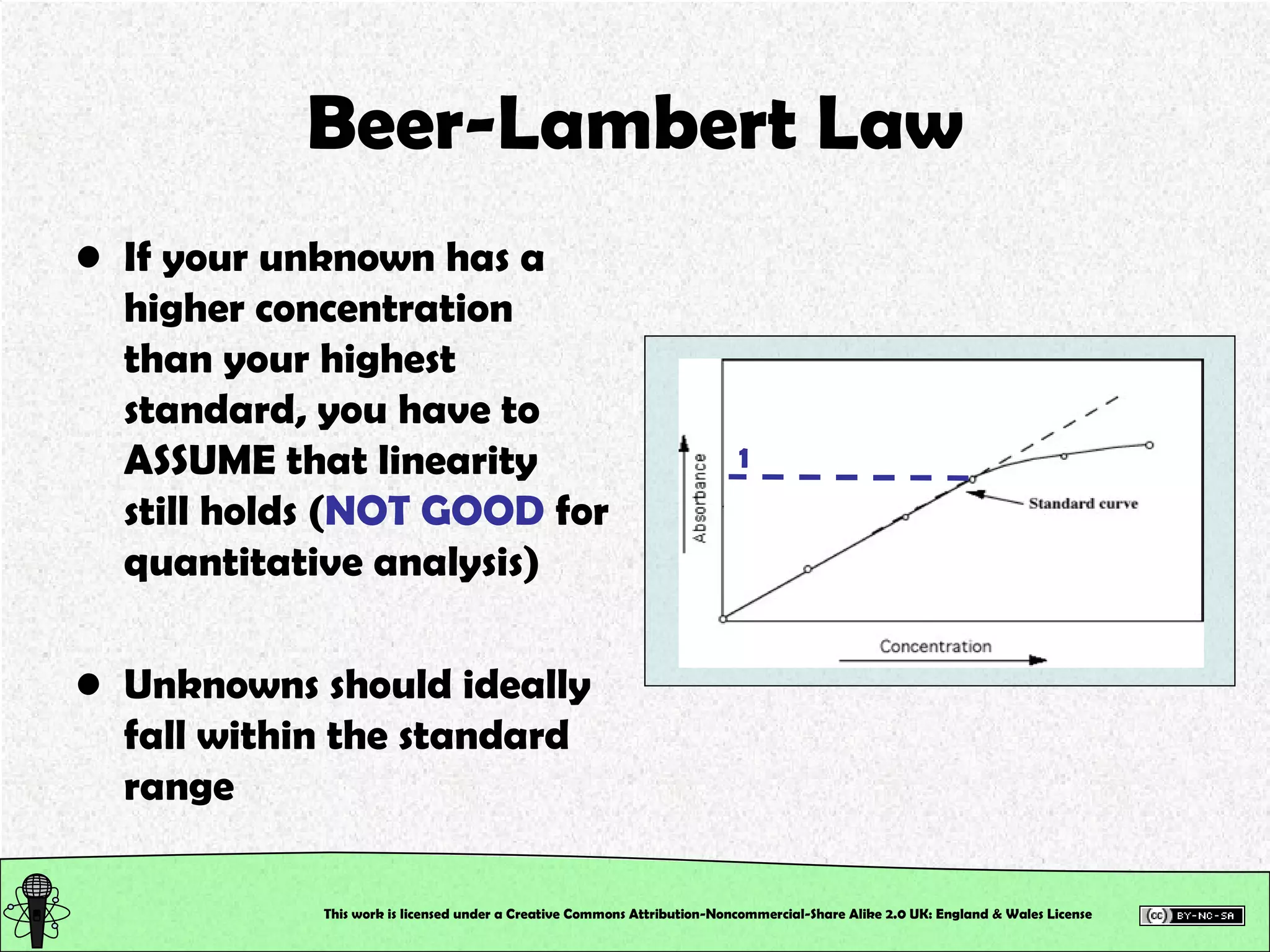
Beer-Lambert Law If your unknown has a higher concentration than your highest standard, you have to ASSUME that linearity still holds ( NOT GOOD  for quantitative analysis) Unknowns should ideally fall within the standard range This work is licensed under a Creative Commons Attribution-Noncommercial-Share Alike 2.0 UK: England & Wales License   1
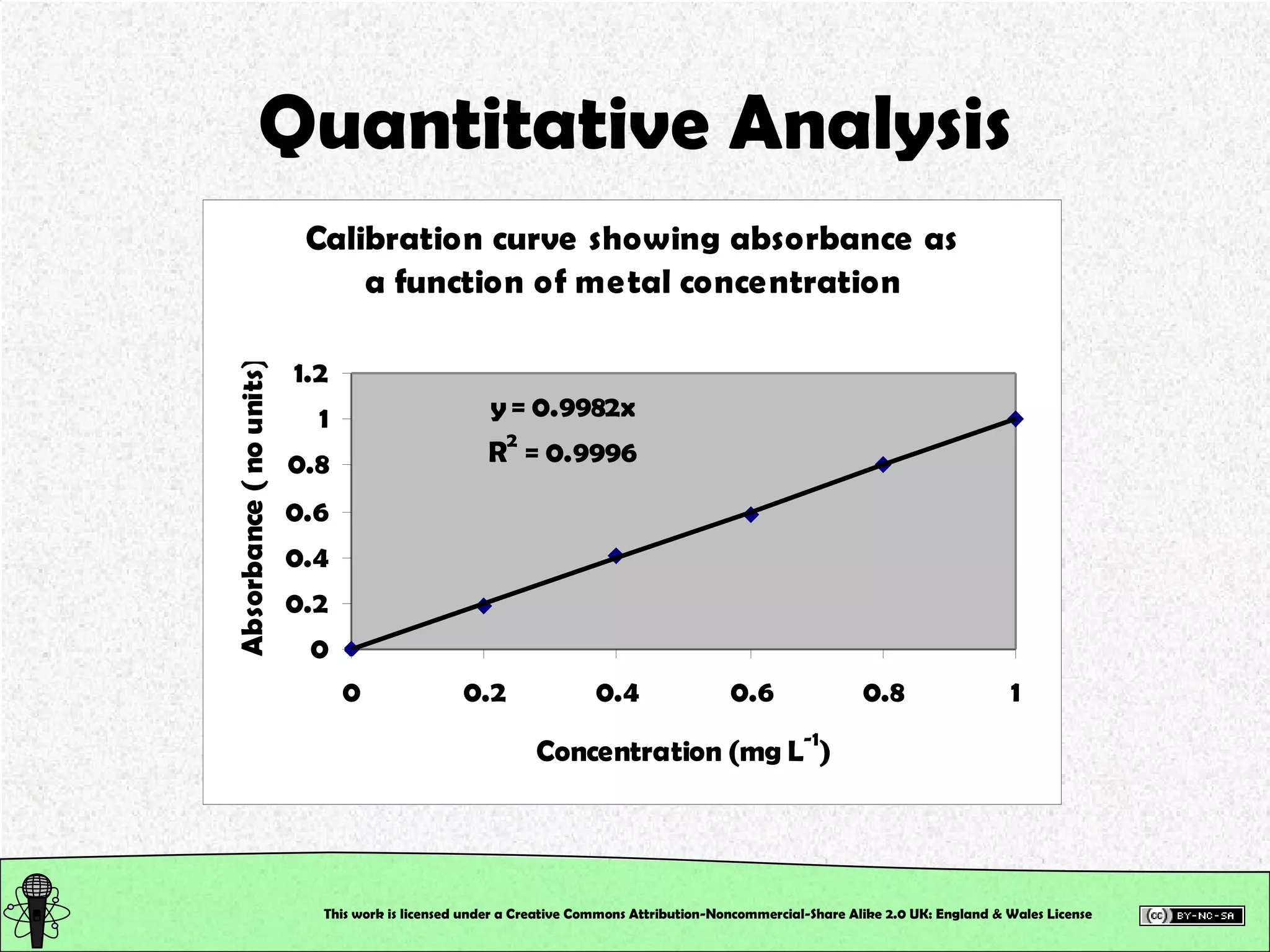
Quantitative Analysis A < 1 If A > 1: Dilute the sample Use a narrower cuvette  (cuvettes are usually 1 mm, 1 cm or 10 cm)  Plot the data (A v C) to produce a calibration ‘curve’ Obtain equation of straight line (y=mx) from line of ‘best fit’ Use equation to calculate the concentration of the unknown(s) This work is licensed under a Creative Commons Attribution-Noncommercial-Share Alike 2.0 UK: England & Wales License
Quantitative Analysis This work is licensed under a Creative Commons Attribution-Noncommercial-Share Alike 2.0 UK: England & Wales License
Statistical Analysis This work is licensed under a Creative Commons Attribution-Noncommercial-Share Alike 2.0 UK: England & Wales License
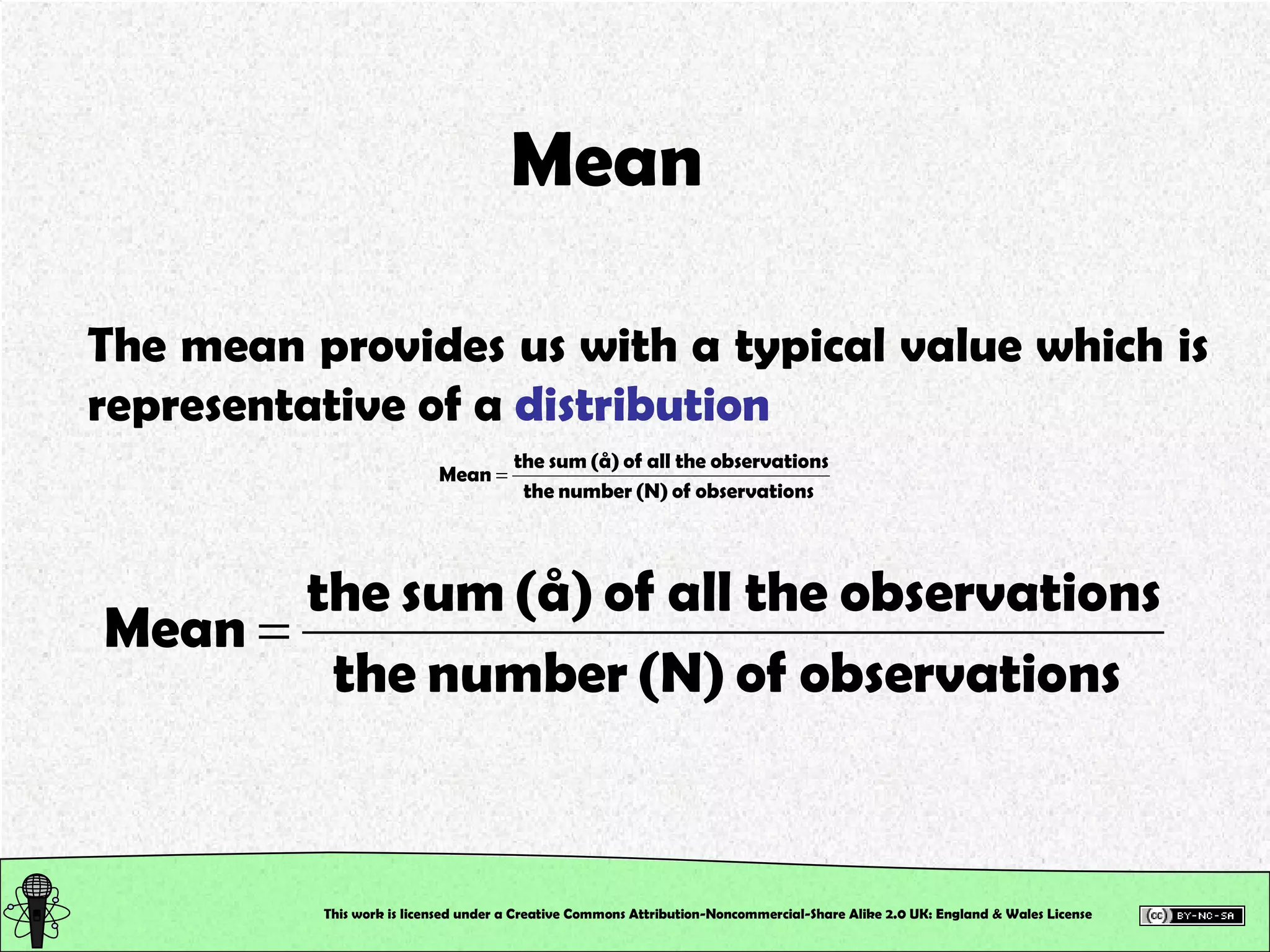
This work is licensed under a Creative Commons Attribution-Noncommercial-Share Alike 2.0 UK: England & Wales License   Mean  The mean provides us with a typical value which is  representative of a  distribution
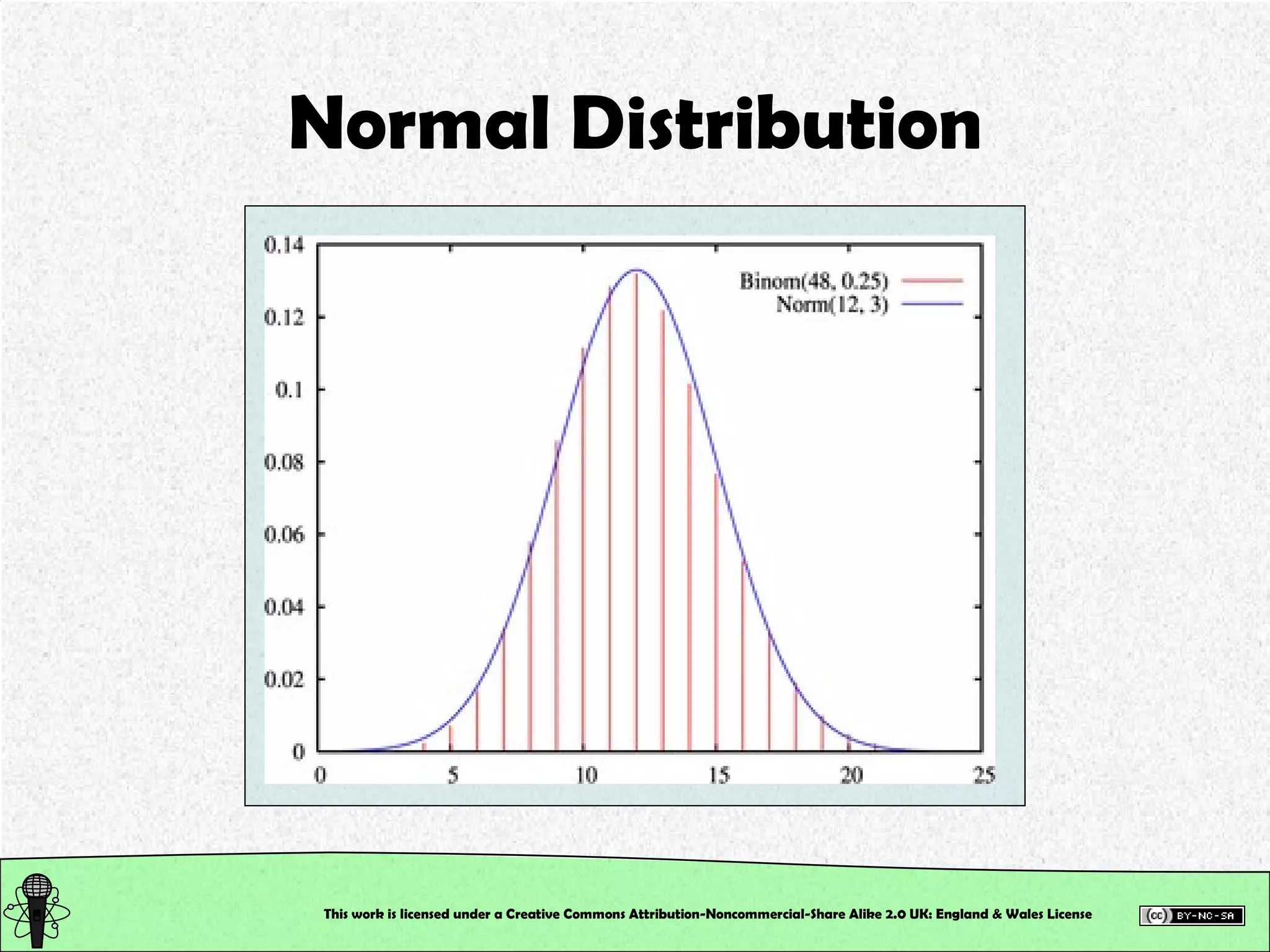
Normal Distribution This work is licensed under a Creative Commons Attribution-Noncommercial-Share Alike 2.0 UK: England & Wales License
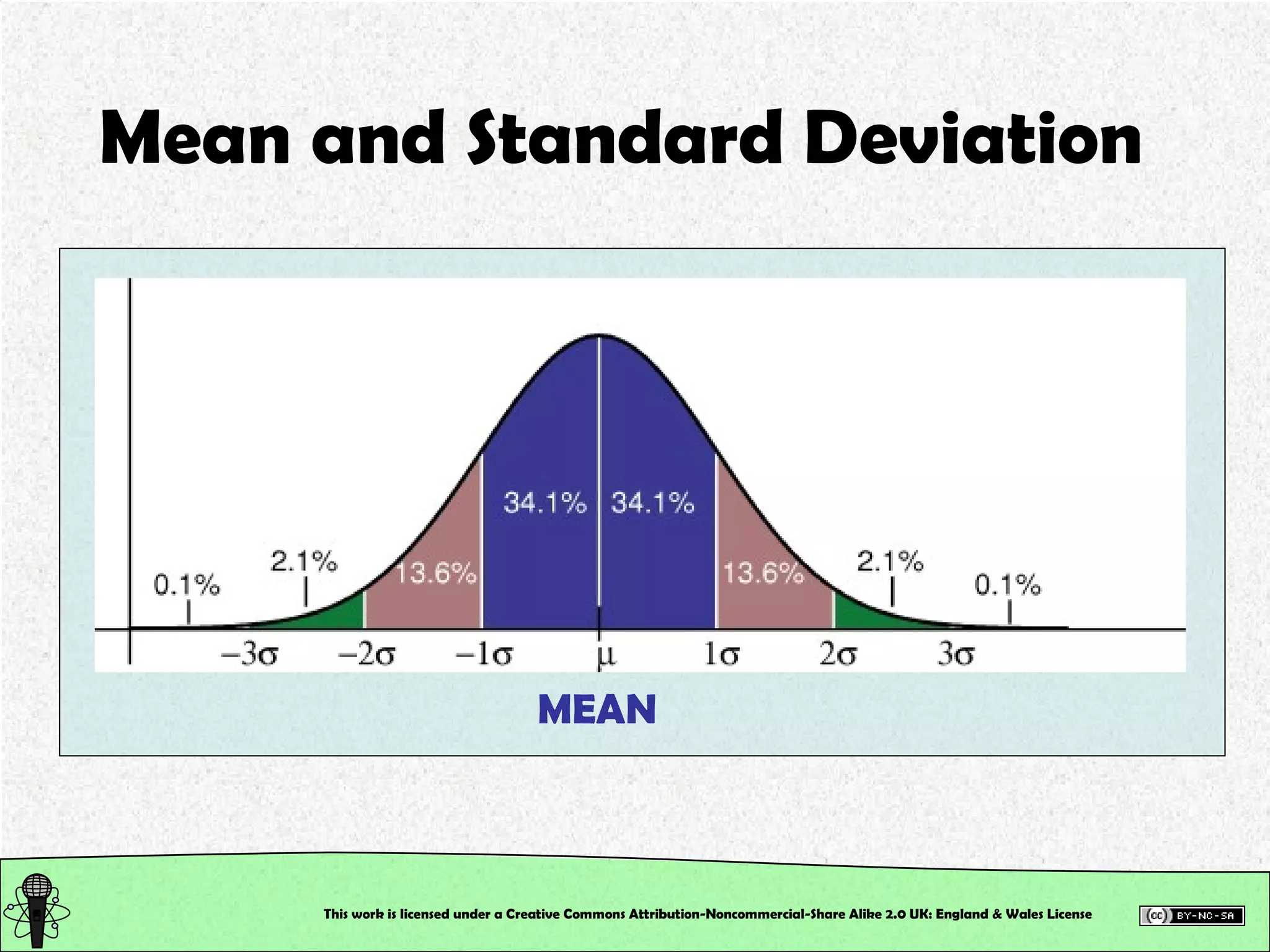
Mean and Standard Deviation This work is licensed under a Creative Commons Attribution-Noncommercial-Share Alike 2.0 UK: England & Wales License   MEAN
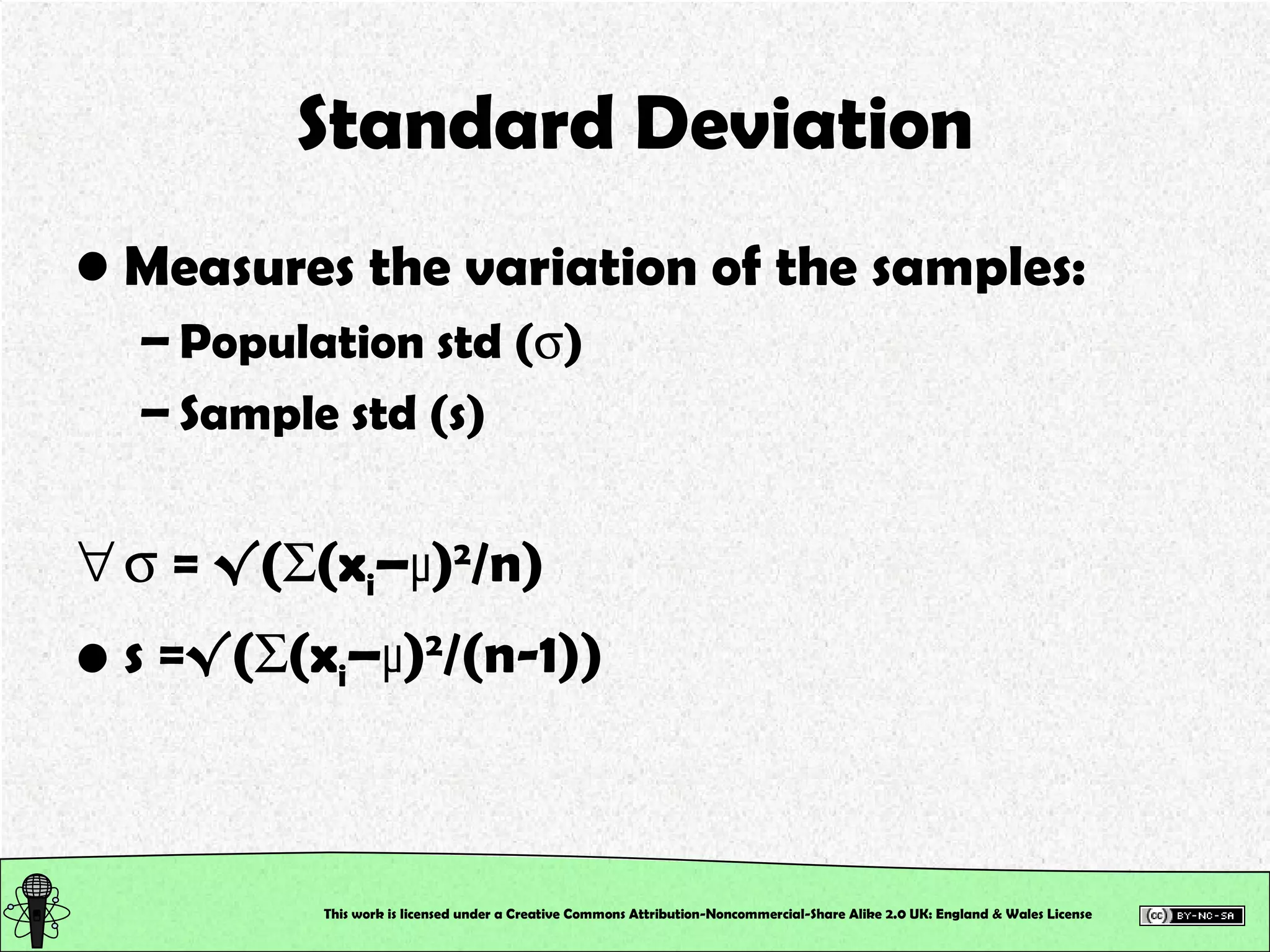
Standard Deviation Measures the variation of the samples: Population std (  ) Sample std (s)    = √(  (x i – µ ) 2 /n) s =√(  (x i – µ ) 2 /(n-1)) This work is licensed under a Creative Commons Attribution-Noncommercial-Share Alike 2.0 UK: England & Wales License
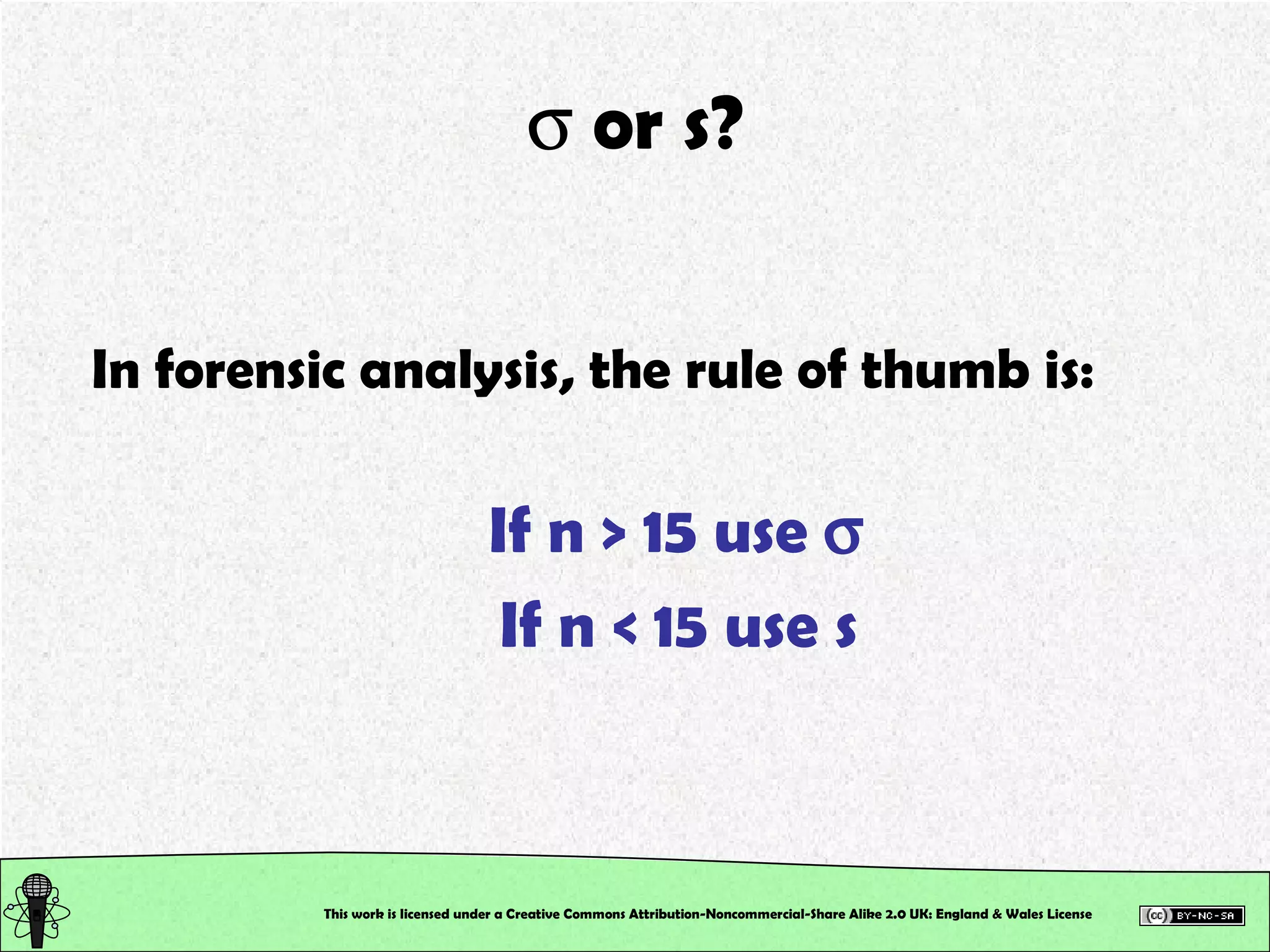
   or s? In forensic analysis, the rule of thumb is: If n > 15 use   If n < 15 use s This work is licensed under a Creative Commons Attribution-Noncommercial-Share Alike 2.0 UK: England & Wales License
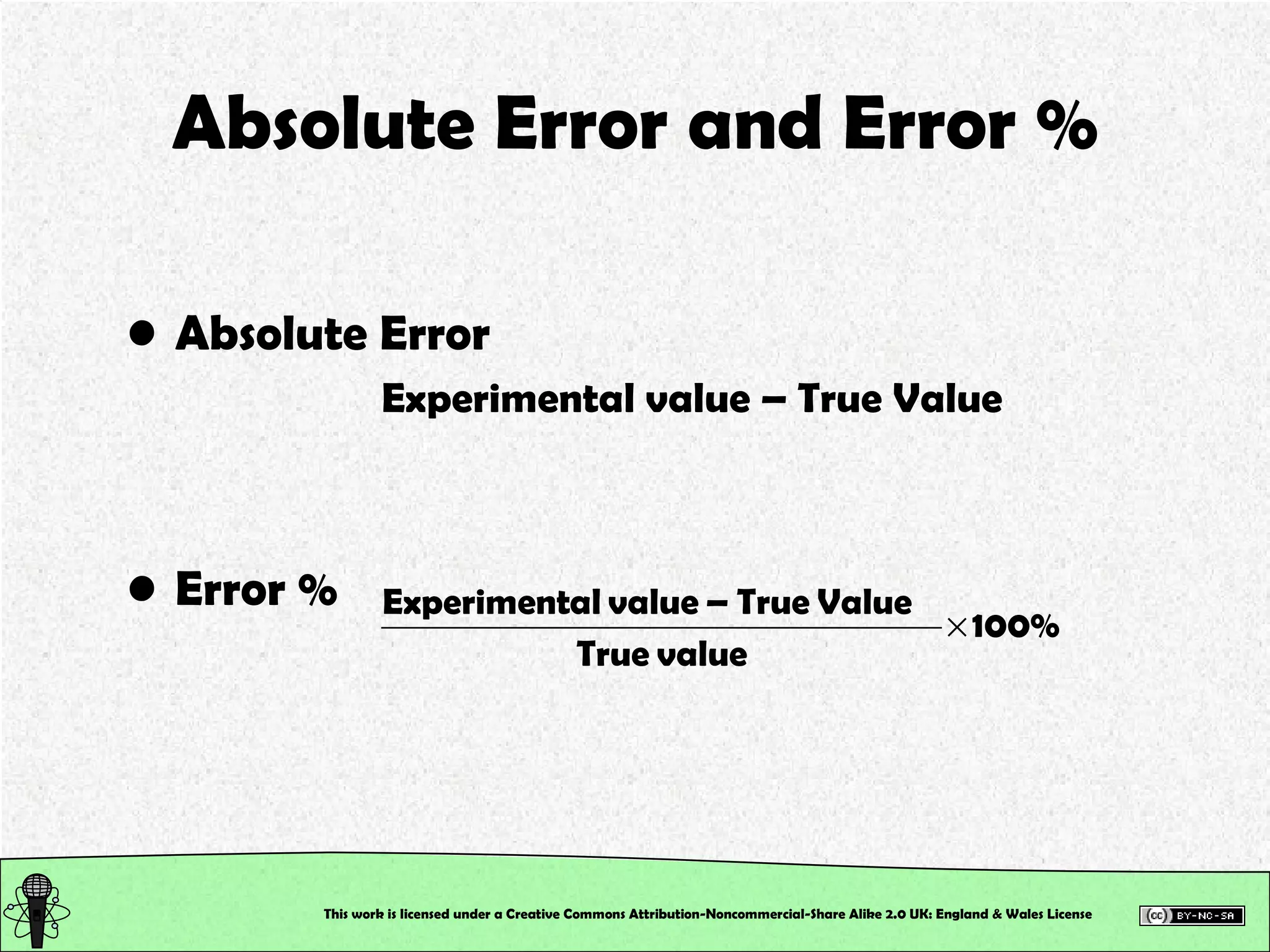
Absolute Error and Error % Absolute Error Experimental value – True Value Error % This work is licensed under a Creative Commons Attribution-Noncommercial-Share Alike 2.0 UK: England & Wales License
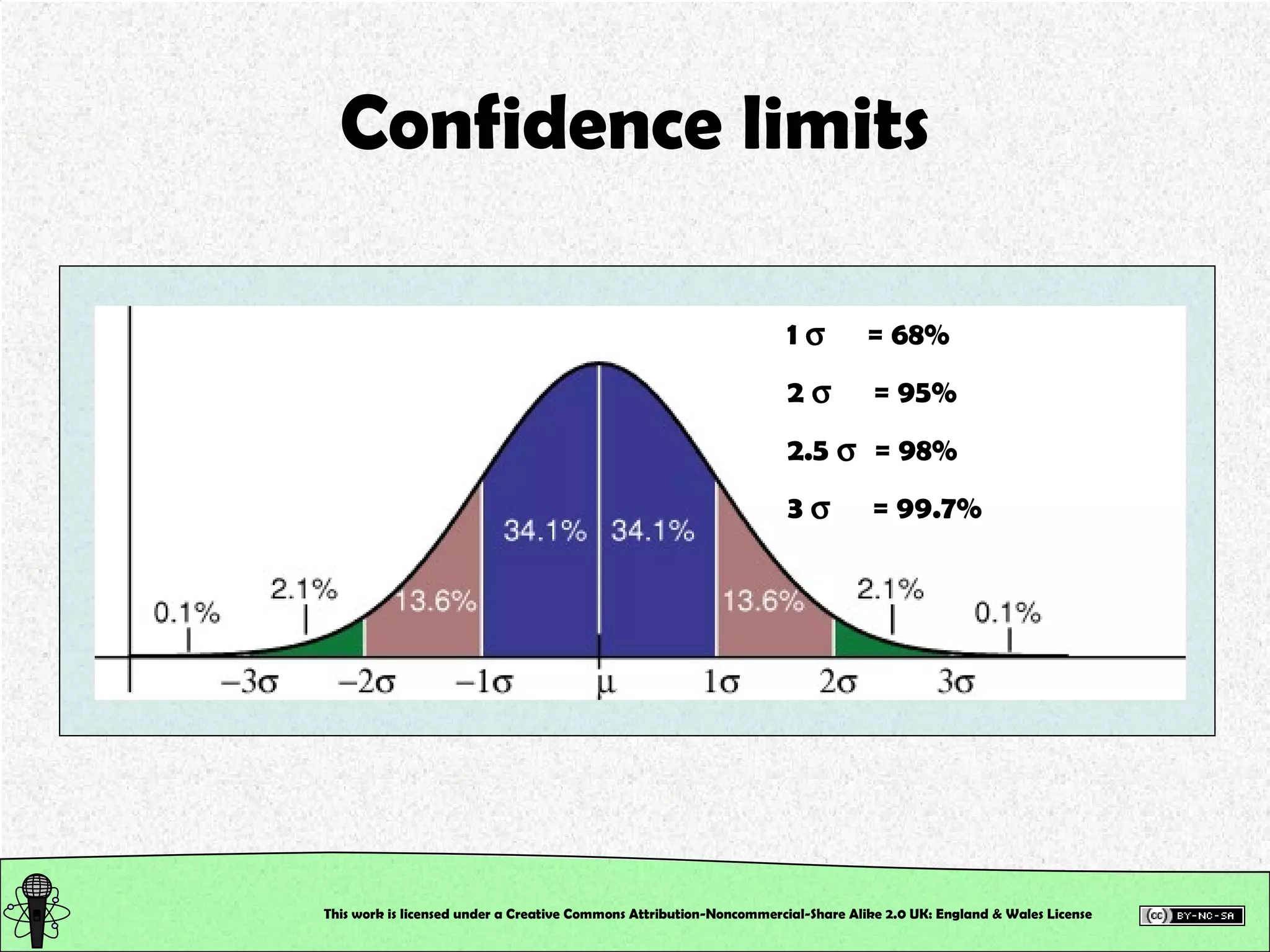
Confidence limits This work is licensed under a Creative Commons Attribution-Noncommercial-Share Alike 2.0 UK: England & Wales License   1     = 68% 2     = 95% 2.5     = 98% 3     = 99.7%
Control Data Work out the mean and standard deviation of the control data Use only 1 value per group Which std is it?    or s? This will tell us how  precise  your work is in the lab This work is licensed under a Creative Commons Attribution-Noncommercial-Share Alike 2.0 UK: England & Wales License
Control Data Calculate the Absolute Error and the Error % True value of [SCN – ] in the control = 2.0 x 10 –3  M This will tell us how  accurately  you work, and hence how good your calibration is!!! This work is licensed under a Creative Commons Attribution-Noncommercial-Share Alike 2.0 UK: England & Wales License
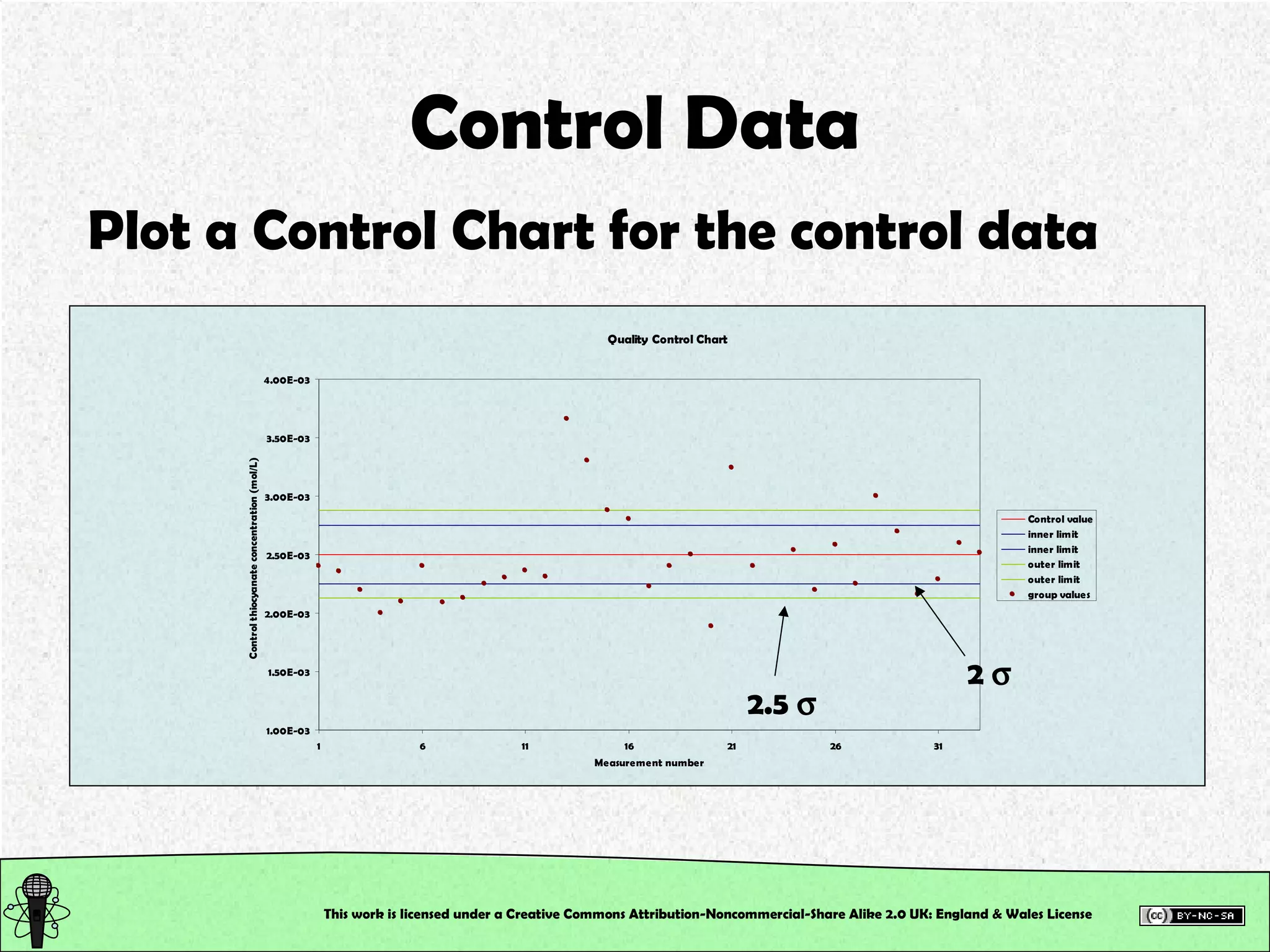
Control Data Plot a Control Chart for the control data This work is licensed under a Creative Commons Attribution-Noncommercial-Share Alike 2.0 UK: England & Wales License   2.5   2  
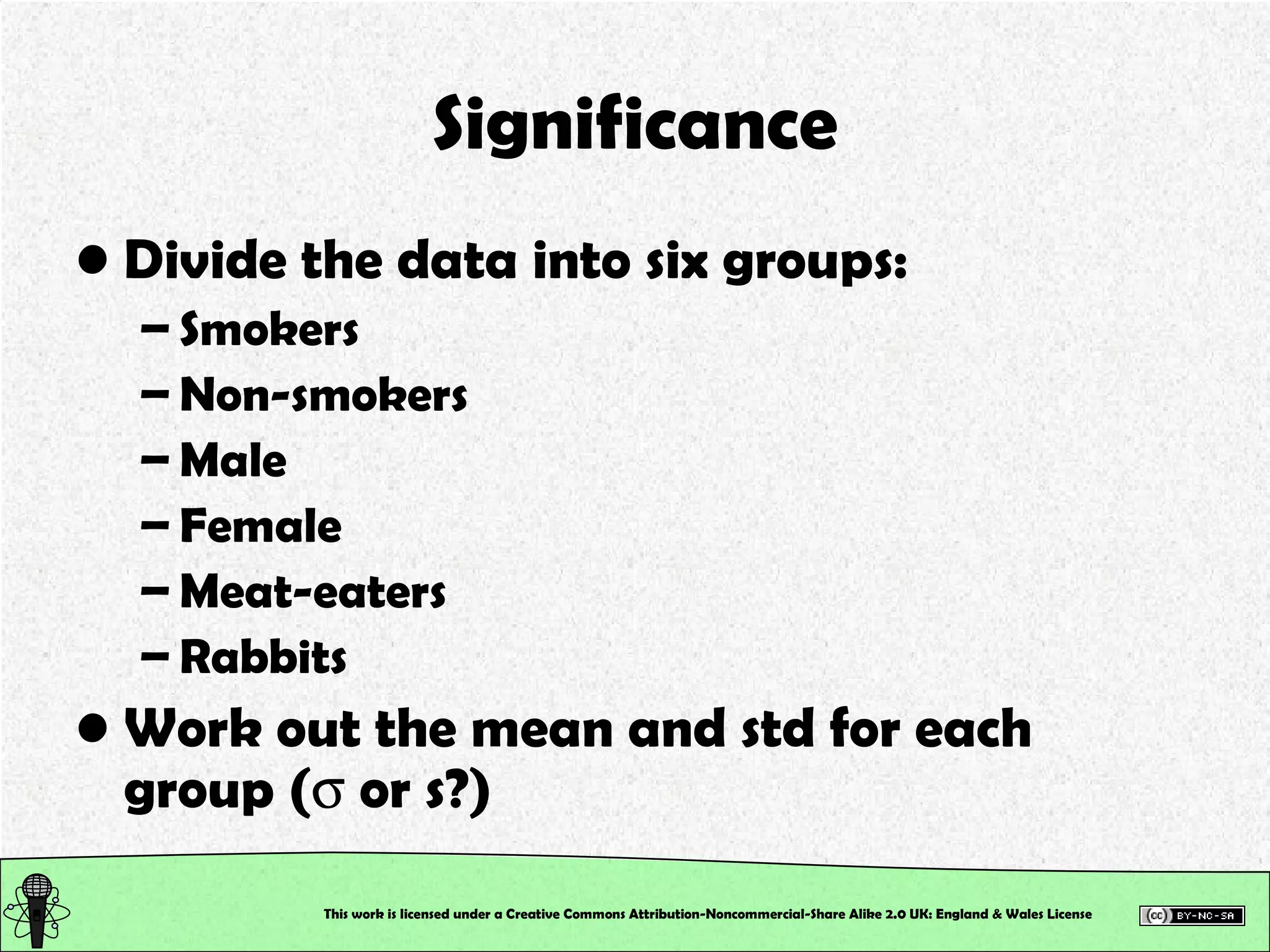
Significance Divide the data into six groups: Smokers Non-smokers Male Female Meat-eaters Rabbits Work out the mean and std for each group (   or s?) This work is licensed under a Creative Commons Attribution-Noncommercial-Share Alike 2.0 UK: England & Wales License
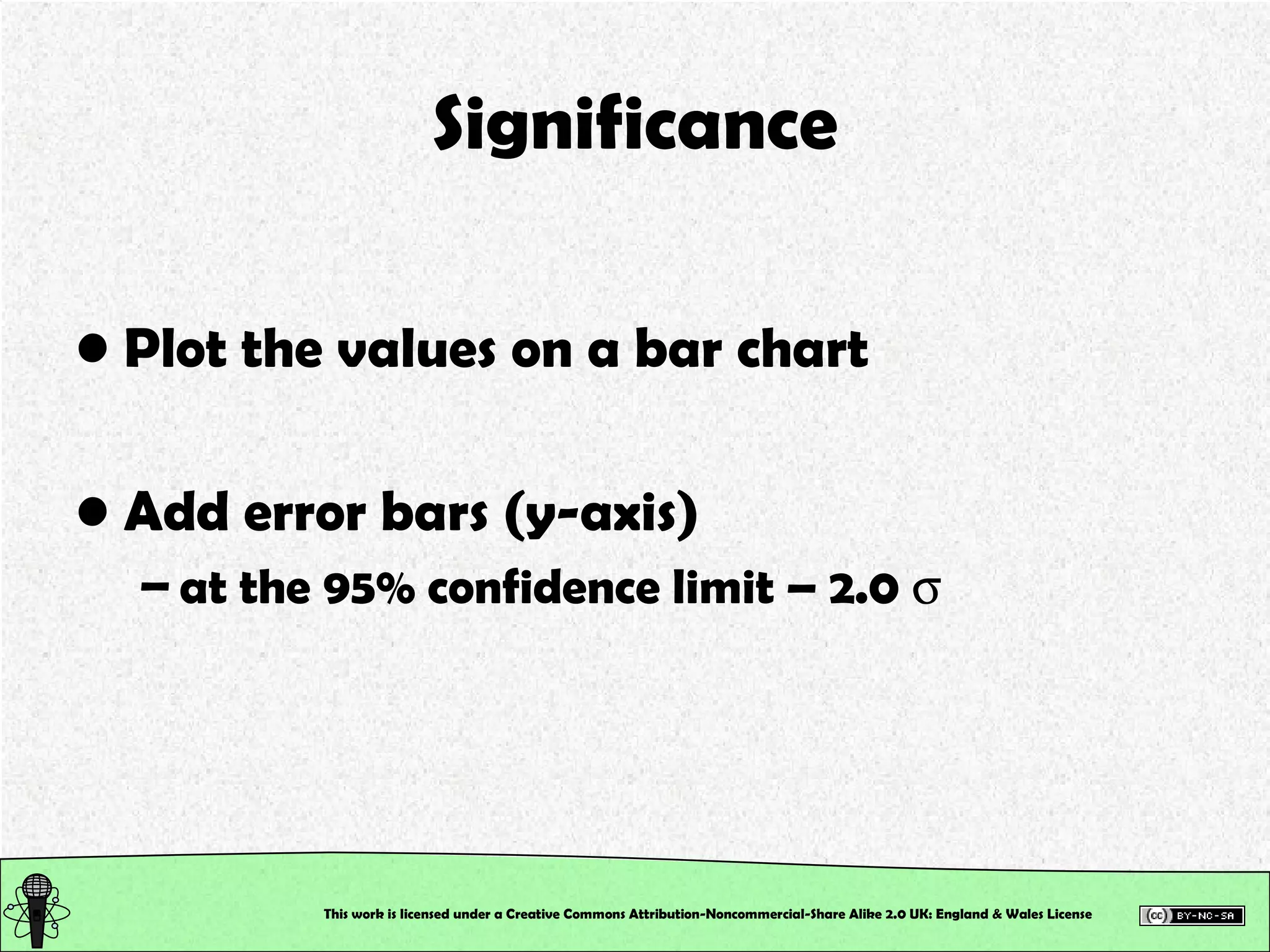
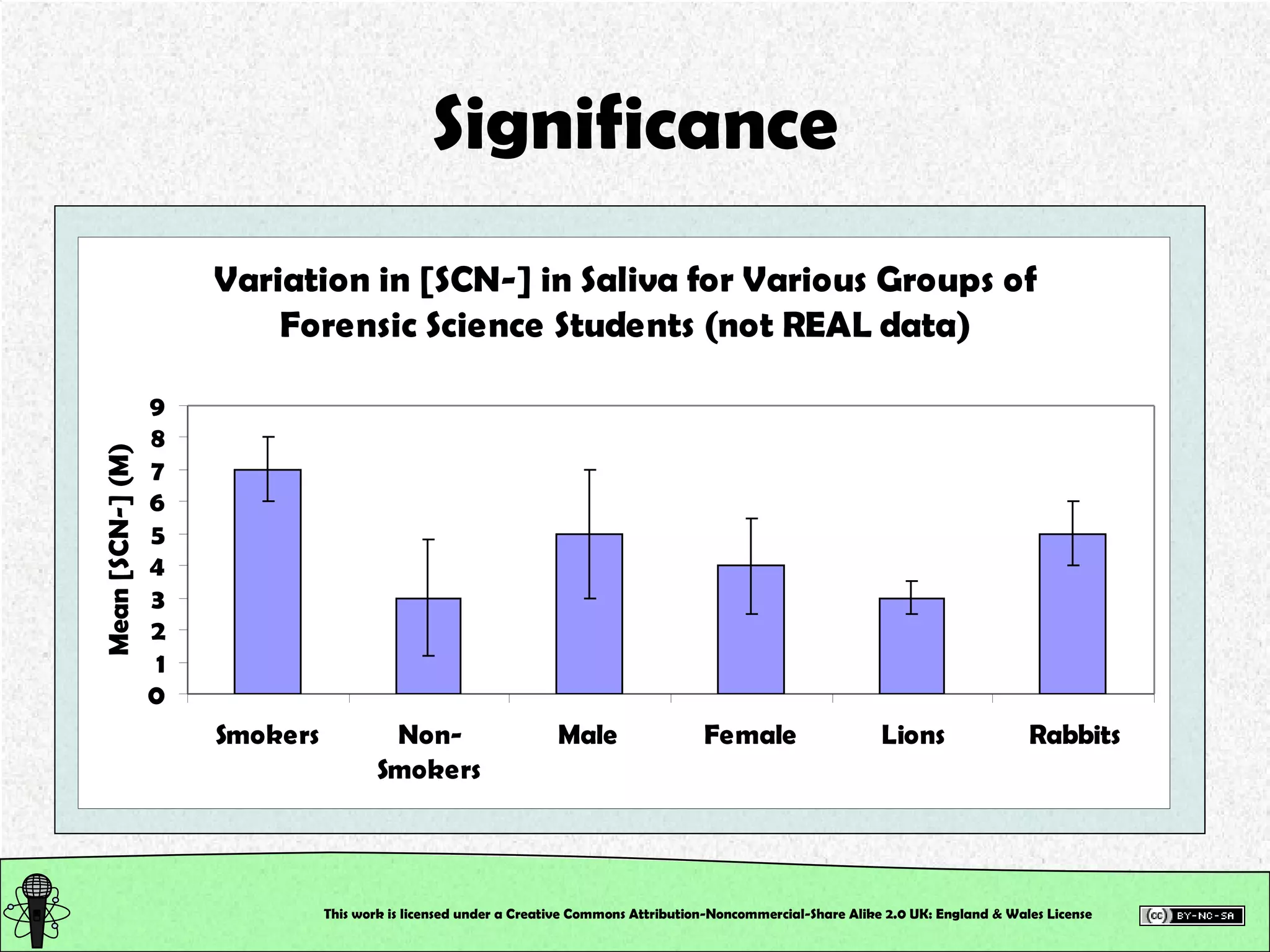
Significance Plot the values on a bar chart Add error bars (y-axis)  at the 95% confidence limit – 2.0   This work is licensed under a Creative Commons Attribution-Noncommercial-Share Alike 2.0 UK: England & Wales License
Significance This work is licensed under a Creative Commons Attribution-Noncommercial-Share Alike 2.0 UK: England & Wales License
Identifying Significance In the most simplistic terms: If there is no overlap of error bars between two groups, you can be fairly sure the difference in means is significant  This work is licensed under a Creative Commons Attribution-Noncommercial-Share Alike 2.0 UK: England & Wales License
This work is licensed under a Creative Commons Attribution-Noncommercial-Share Alike 2.0 UK: England & Wales License   Acknowledgements JISC HEA Centre for Educational Research and Development School of natural and applied sciences School of Journalism SirenFM http://tango.freedesktop.org

Chemical and Physical Properties: Practical Session

  • 1.
    This work islicensed under a Creative Commons Attribution-Noncommercial-Share Alike 2.0 UK: England & Wales License Lab 6: Saliva Practical Beer-Lambert Law University of Lincoln presentation
  • 2.
    This session…. Overviewof the practical… Statistical analysis…. Take a look at an example control chart… This work is licensed under a Creative Commons Attribution-Noncommercial-Share Alike 2.0 UK: England & Wales License
  • 3.
    The Practical Determinethe thiocyanate (SCN - ) in a sample of your saliva using a colourimetric method of analysis Calibration curve to determine the [SCN - ] of the unknowns This was ALL completed in the practical class Some of your absorbance values may have been higher than the absorbance values of your top standards… is this a problem???? This work is licensed under a Creative Commons Attribution-Noncommercial-Share Alike 2.0 UK: England & Wales License
  • 4.
    This work islicensed under a Creative Commons Attribution-Noncommercial-Share Alike 2.0 UK: England & Wales License Types of data QUALITATIVE Non numerical i.e what is present? QUANTITATIVE Numerical: i.e. How much is present?
  • 5.
    Beer-Lambert Law BeersLaw states that absorbance is proportional to concentration over a certain concentration range A =  cl A = absorbance  = molar extinction coefficient (M -1 cm -1 or mol -1 L cm -1 ) c = concentration (M or mol L -1 ) l = path length (cm) (width of cuvette) This work is licensed under a Creative Commons Attribution-Noncommercial-Share Alike 2.0 UK: England & Wales License
  • 6.
    Beer-Lambert Law Beer’slaw is valid at low concentrations, but breaks down at higher concentrations For linearity, A < 1 This work is licensed under a Creative Commons Attribution-Noncommercial-Share Alike 2.0 UK: England & Wales License 1
  • 7.
    Beer-Lambert Law Ifyour unknown has a higher concentration than your highest standard, you have to ASSUME that linearity still holds ( NOT GOOD for quantitative analysis) Unknowns should ideally fall within the standard range This work is licensed under a Creative Commons Attribution-Noncommercial-Share Alike 2.0 UK: England & Wales License 1
  • 8.
    Quantitative Analysis A< 1 If A > 1: Dilute the sample Use a narrower cuvette (cuvettes are usually 1 mm, 1 cm or 10 cm) Plot the data (A v C) to produce a calibration ‘curve’ Obtain equation of straight line (y=mx) from line of ‘best fit’ Use equation to calculate the concentration of the unknown(s) This work is licensed under a Creative Commons Attribution-Noncommercial-Share Alike 2.0 UK: England & Wales License
  • 9.
    Quantitative Analysis Thiswork is licensed under a Creative Commons Attribution-Noncommercial-Share Alike 2.0 UK: England & Wales License
  • 10.
    Statistical Analysis Thiswork is licensed under a Creative Commons Attribution-Noncommercial-Share Alike 2.0 UK: England & Wales License
  • 11.
    This work islicensed under a Creative Commons Attribution-Noncommercial-Share Alike 2.0 UK: England & Wales License Mean The mean provides us with a typical value which is representative of a distribution
  • 12.
    Normal Distribution Thiswork is licensed under a Creative Commons Attribution-Noncommercial-Share Alike 2.0 UK: England & Wales License
  • 13.
    Mean and StandardDeviation This work is licensed under a Creative Commons Attribution-Noncommercial-Share Alike 2.0 UK: England & Wales License MEAN
  • 14.
    Standard Deviation Measuresthe variation of the samples: Population std (  ) Sample std (s)  = √(  (x i – µ ) 2 /n) s =√(  (x i – µ ) 2 /(n-1)) This work is licensed under a Creative Commons Attribution-Noncommercial-Share Alike 2.0 UK: England & Wales License
  • 15.
    or s? In forensic analysis, the rule of thumb is: If n > 15 use  If n < 15 use s This work is licensed under a Creative Commons Attribution-Noncommercial-Share Alike 2.0 UK: England & Wales License
  • 16.
    Absolute Error andError % Absolute Error Experimental value – True Value Error % This work is licensed under a Creative Commons Attribution-Noncommercial-Share Alike 2.0 UK: England & Wales License
  • 17.
    Confidence limits Thiswork is licensed under a Creative Commons Attribution-Noncommercial-Share Alike 2.0 UK: England & Wales License 1  = 68% 2  = 95% 2.5  = 98% 3  = 99.7%
  • 18.
    Control Data Workout the mean and standard deviation of the control data Use only 1 value per group Which std is it?  or s? This will tell us how precise your work is in the lab This work is licensed under a Creative Commons Attribution-Noncommercial-Share Alike 2.0 UK: England & Wales License
  • 19.
    Control Data Calculatethe Absolute Error and the Error % True value of [SCN – ] in the control = 2.0 x 10 –3 M This will tell us how accurately you work, and hence how good your calibration is!!! This work is licensed under a Creative Commons Attribution-Noncommercial-Share Alike 2.0 UK: England & Wales License
  • 20.
    Control Data Plota Control Chart for the control data This work is licensed under a Creative Commons Attribution-Noncommercial-Share Alike 2.0 UK: England & Wales License 2.5  2 
  • 21.
    Significance Divide thedata into six groups: Smokers Non-smokers Male Female Meat-eaters Rabbits Work out the mean and std for each group (  or s?) This work is licensed under a Creative Commons Attribution-Noncommercial-Share Alike 2.0 UK: England & Wales License
  • 22.
    Significance Plot thevalues on a bar chart Add error bars (y-axis) at the 95% confidence limit – 2.0  This work is licensed under a Creative Commons Attribution-Noncommercial-Share Alike 2.0 UK: England & Wales License
  • 23.
    Significance This workis licensed under a Creative Commons Attribution-Noncommercial-Share Alike 2.0 UK: England & Wales License
  • 24.
    Identifying Significance Inthe most simplistic terms: If there is no overlap of error bars between two groups, you can be fairly sure the difference in means is significant This work is licensed under a Creative Commons Attribution-Noncommercial-Share Alike 2.0 UK: England & Wales License
  • 25.
    This work islicensed under a Creative Commons Attribution-Noncommercial-Share Alike 2.0 UK: England & Wales License Acknowledgements JISC HEA Centre for Educational Research and Development School of natural and applied sciences School of Journalism SirenFM http://tango.freedesktop.org