Ionic Compounds and
        Metals
      Chemistry Unit 6
Main Ideas
Ions are formed when atoms gain or lose valence
electrons to achieve a stable octet electron
configuration.
Oppositely charged ion attract each other, forming
electrically neutral ionic compounds.
In written names and formulas for ionic
compounds, the cation appears first, followed by
the anion.
Metals form crystal lattices and can be modeled as
cations surrounded by a “sea’” of freely
moving valence electrons.
Ion Formation
Ions are formed when atoms gain or lose
  valence electrons to achieve a stable octet
  electron configuration.
Goals and Objectives:
  Define a chemical bond.
  Describe the formation of positive and
  negative ions.
  Relate ion formation to electron
  configuration.
Valence Electrons and
   Chemical Bonds
Chemical Bond – is a force that holds two
atoms together.
  They can form between the positive nucleus
  of one atom and the negative valence
  electrons of another atom or between two
  oppositely charged ions.
Valence Electrons and
   Chemical Bonds
Atom’s try to form the octet – the stable
arrangement of eight valence electrons in the
outer energy level – by gaining or losing
valence electrons.
The transfer of valence electrons between
two atoms is based on the ionization energy
and electron affinity of the two atoms.
  Noble gases- high ionization energy + low
  electron affinity = little chemical reactivity.
Positive Ion Formation
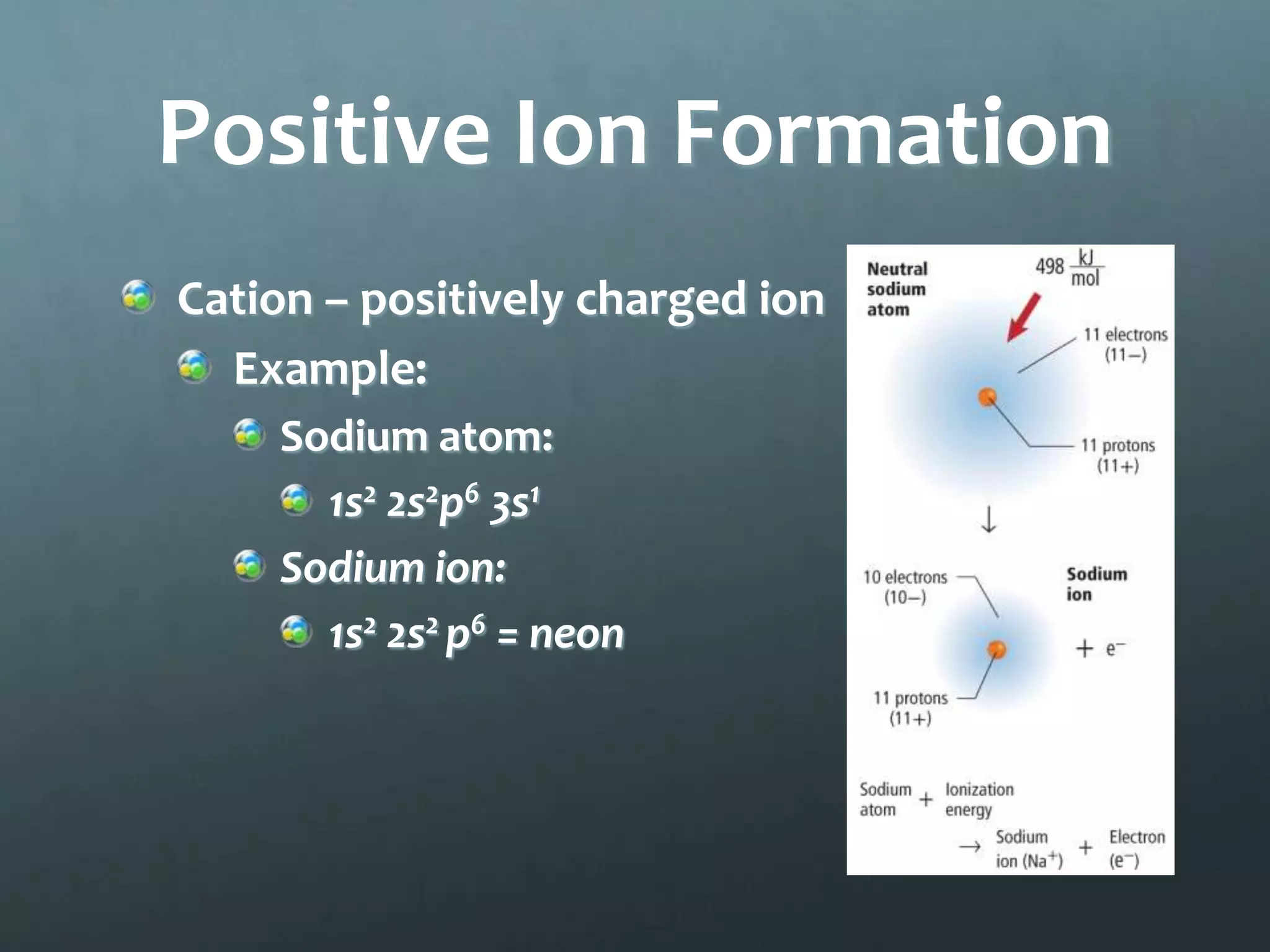
Cation – positively charged ion
  Example:
    Sodium atom:
      1s2 2s2p6 3s1
    Sodium ion:
      1s2 2s2 p6 = neon
Positive Ion Formation
Metal atoms are reactive because they lose
valence electrons easily.
   Group 1: commonly form +1 ions
   Group 2: commonly form +2 ions
   Group 13: sometimes +3 ions
Positive Ion Formation
Transition metal ions have an outer shell of s2
   They will lose their s electrons and
   occasionally a d electron.
   Typically form +2 or +3 ions but can form
   greater than +3 ions
Positive Ion Formation
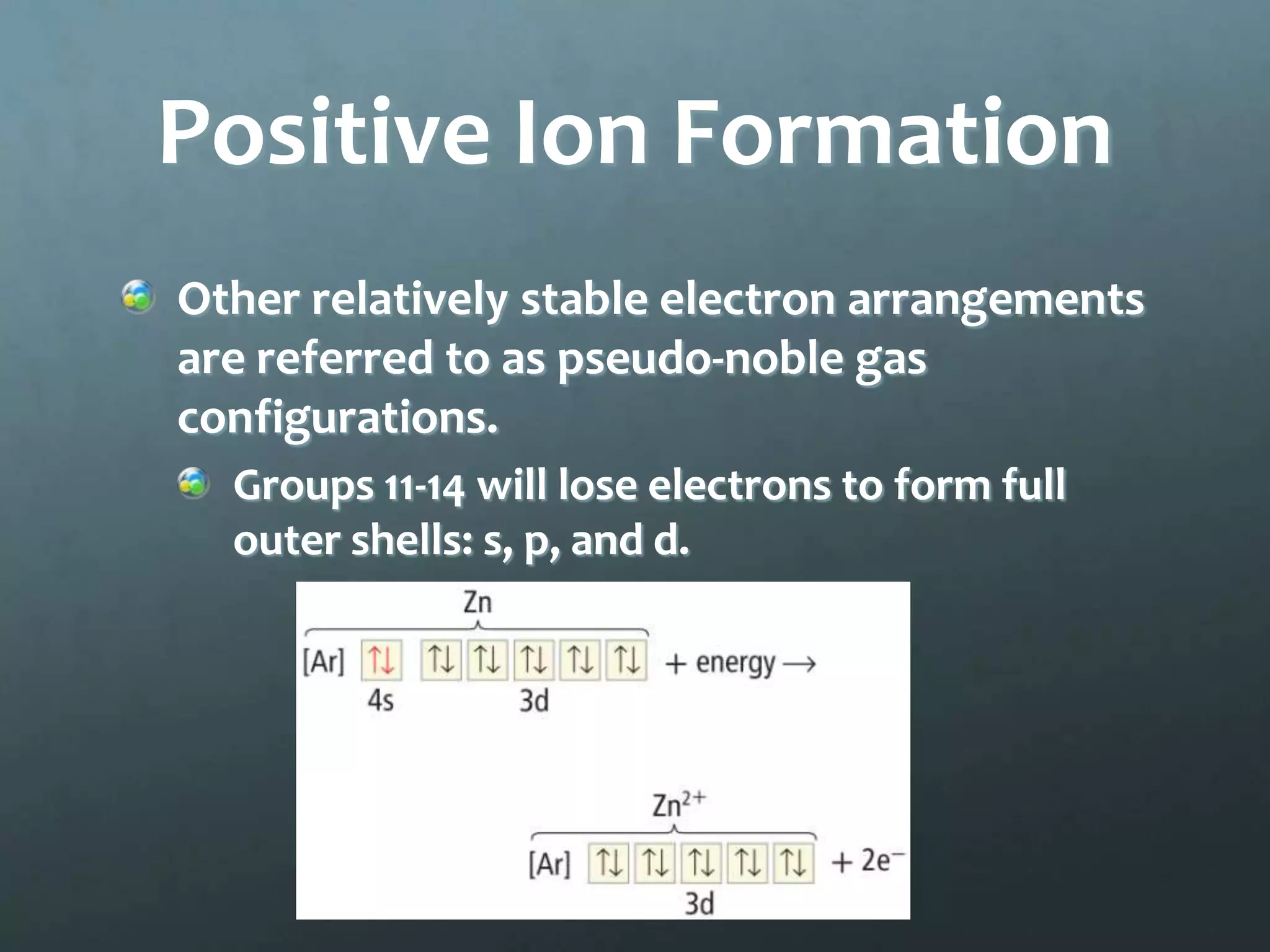
Other relatively stable electron arrangements
are referred to as pseudo-noble gas
configurations.
  Groups 11-14 will lose electrons to form full
  outer shells: s, p, and d.
Negative Ion Formation
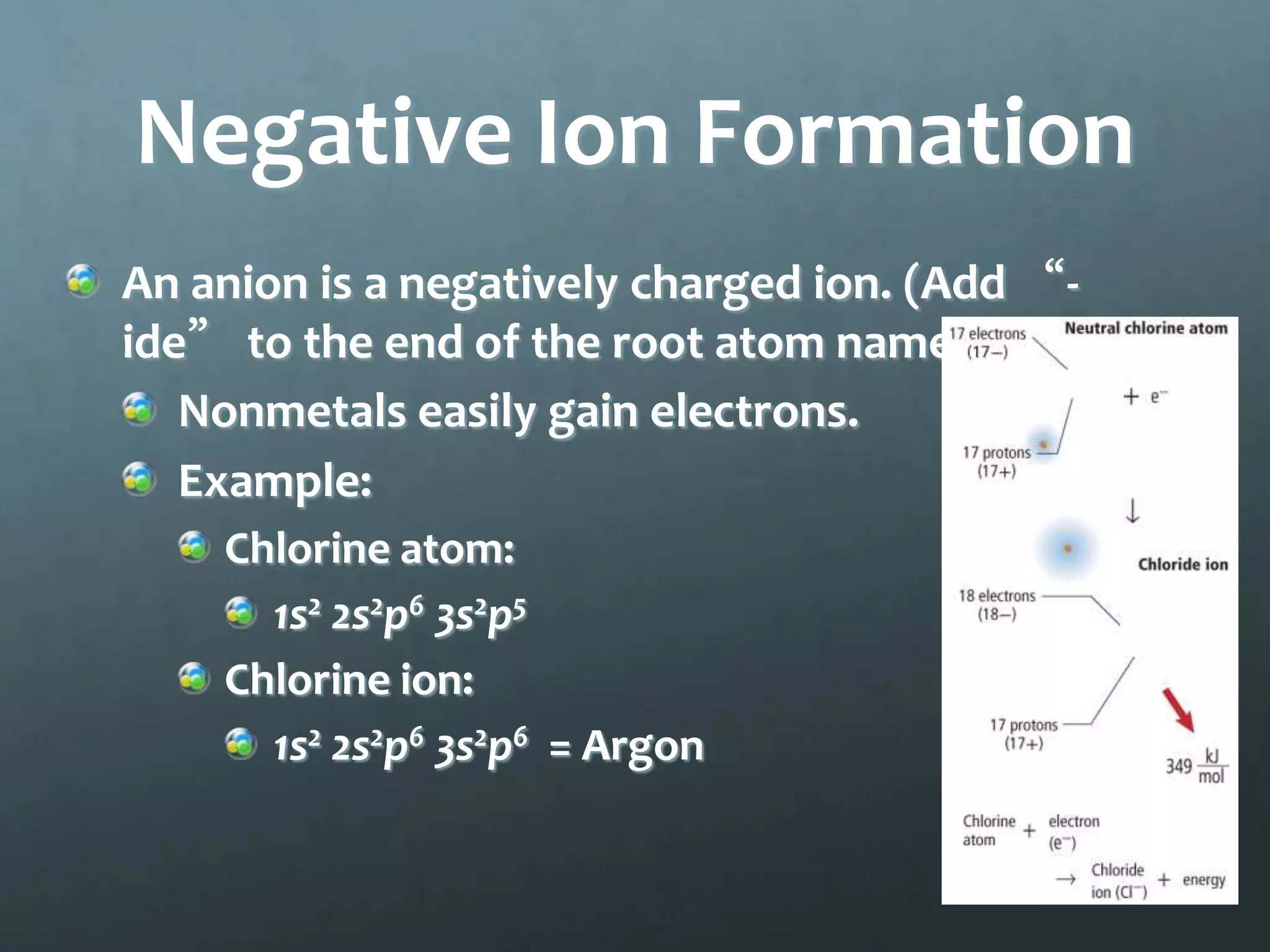
An anion is a negatively charged ion. (Add “-
ide” to the end of the root atom name.)
   Nonmetals easily gain electrons.
   Example:
    Chlorine atom:
      1s2 2s2p6 3s2p5
    Chlorine ion:
      1s2 2s2p6 3s2p6 = Argon
Negative Ion Formation
Nonmetal ions gain the number of electrons
required to fill an octet.
Some nonmetals can gain or lose electrons to
complete an octet.
  Phosphorus can gain 3 or lose 5
  Group 15 usually gains 3 electrons
  Group 16 usually gains 2 electrons
  Group 17 usually gains 1 electron
Practice Problems
CALM 6:1
Ionic Bonds and Ionic
     Compounds
Ionic Bonds and Ionic
           Compounds
Oppositely charged ions attract each other, forming
electrically neutral ionic compounds.
Goals and Objectives:
 Describe the formation of ionic bonds and the structure
of ionic compounds.
  Generalize about the strength of ionic bonds based on
the physical properties of ionic compounds.
  Categorize ionic bond formation as exothermic or
endothermic.
Ionic Bond
Ionic Bond is the electrostatic force that
holds oppositely charged particles together.
Ionic Compound is a compound that contains
an ionic bond.
   Ionic bonds between metals and oxygen
   are called oxides.
   Most other ionic compounds are
   considered salts.
Binary Ionic Compound
Binary Ionic compound is an ionic compound
that contains two different elements.
  One metallic cation and a nonmetallic anion.
  Examples: NaCl, MgO, KBr, LiF
Ionic Bond Formation
Electrons gained and lost in each element
must be equal. (conservation of electrons)
   Calcium and Fluorine

  Aluminum and Oxygen

  Sodium and Chlorine
Properties of Ionic
        Compounds
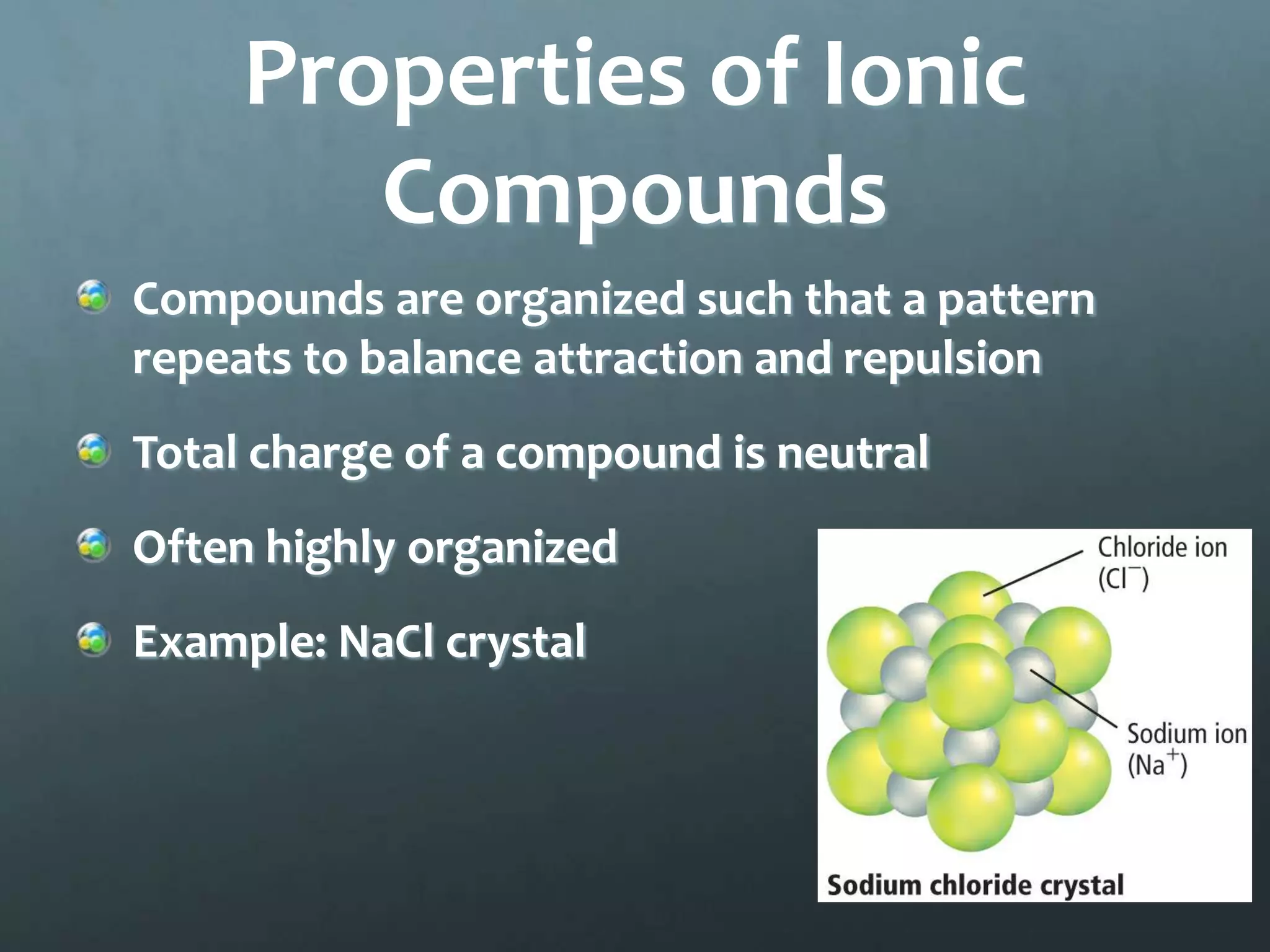
Compounds are organized such that a pattern
repeats to balance attraction and repulsion
Total charge of a compound is neutral
Often highly organized
Example: NaCl crystal
Crystal Lattice
A crystal lattice is a three dimensional
geometric arrangement of particles.
   Each negative ion is surrounded by a
   positive ion which results in strong
   attractions between ions.
   Size and shape are dependent on relative
   numbers of ions.
Crystal Lattice
Physical Properties:
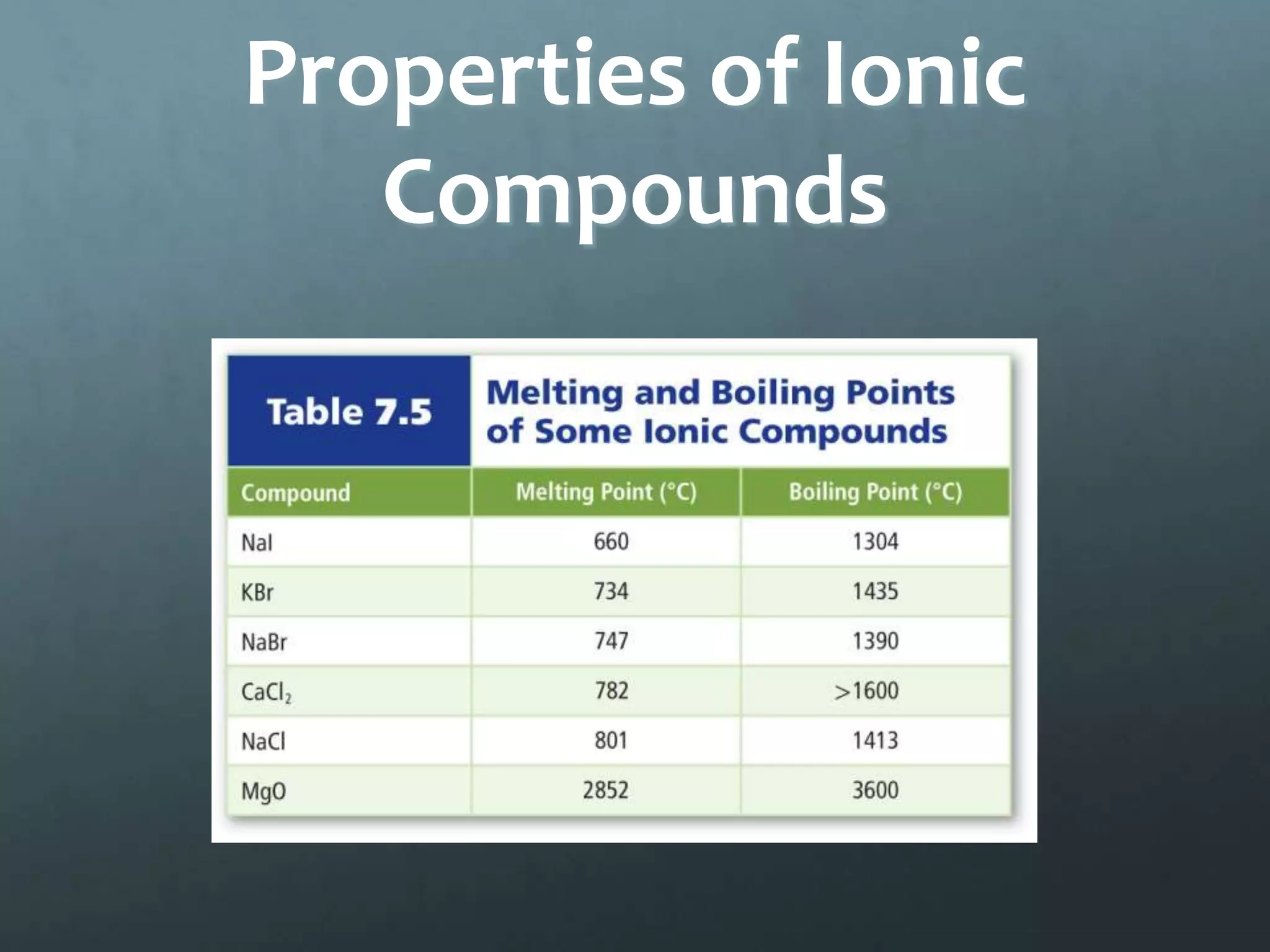
  Characteristics of bond strength – ionic
  bonds are relatively strong and take a large
  amount of energy to break.
    Melting point – high
    Boiling point – high
    Hardness of material is high: rigid and
    brittle solids.
Properties of Ionic
   Compounds
Crystal Lattice
Characteristics of the compound:
  Conducts electricity, conditionally
    Ions in solid state ionic compounds are locked
    in place and they do not have free electrons
    in order to conduct electricity.
    Ionic compounds that are melted or dissolved
    in aqueous solutions have ions that are free
    to move and therefore do conduct electricity
       Electrolyte – an ionic compound that
       conducts electricity in an aqueous solution.
Energy and the Ionic
          Bond
Formation of ionic compounds forms a
more stable system and therefore reduces
the energy required to sustain it.
  Since the creating of bonds lowers
  energy, energy is released in the process. The
  creation of bonds is said to be Exothermic.
    Exothermic – energy is released during a
    chemical reaction.
Energy and the Ionic
          Bond
Breaking of ionic compounds reduces the
stability of a system and therefore increases
the energy required to sustain it .
  Since the creating of bonds lowers energy, the
  breaking of bonds increases energy and
  therefore it is required for the process.
    Endothermic – energy is absorbed during a
    chemical reaction.
Lattice Energy
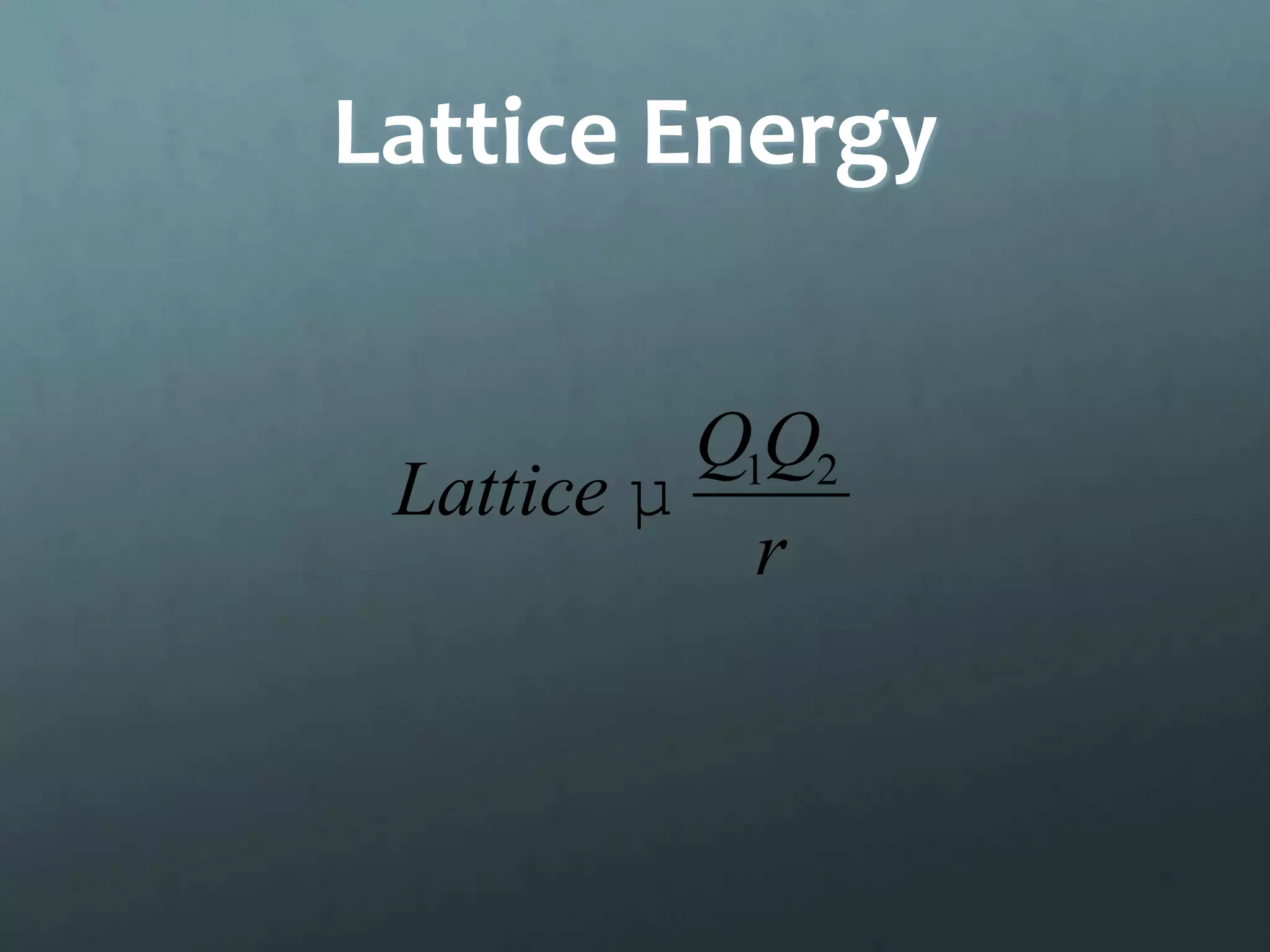
Lattice energy is the energy required to separate 1
mole of the ions of an ionic compound.
  higher the lattice energy the stronger the bond
  strength.
  Directly related to the size of the ions bonded.
     smaller ions form compounds more closely
     because attraction increases with decreased
     distance.
  Also affected by charge of ions
    Higher ion charge typically has higher lattice
    energy.
Lattice Energy


           Q1Q2
 Lattice µ
             r
Practice Problems
CALM 6:2
Names and Formulas
for Ionic Compounds
Names and Formulas
   for Ionic Compounds
In written names and formulas for ionic compounds, the
cation appears first, followed by the anion.
Goals and Objectives:
 Relate a formula unit of an ionic compound to its
composition.
 Write formulas for ionic compounds and oxyanions.
 Apply naming conventions to ionic compounds and
oxyanions.
Formulas for Ionic
      Compounds
A standardized system for naming compounds
was developed for much the same reason as the
SI unit system. This serves as a universal naming
system for communication among the science
community.
Formula Unit
A formula unit is the chemical formula for an ionic
compound and represents the simplest ratio of
ions.
   MgCl2 not Mg4Cl8
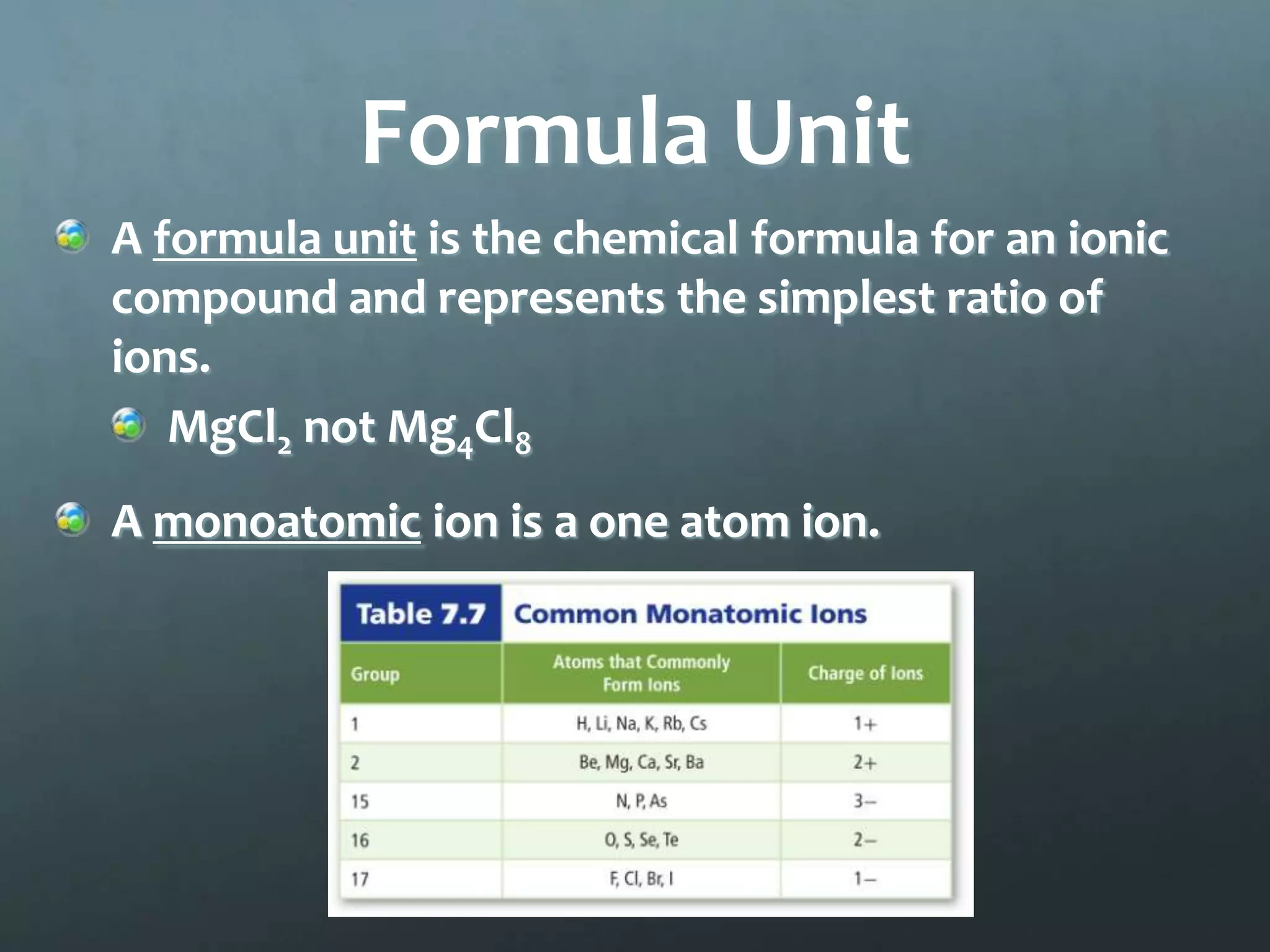
A monoatomic ion is a one atom ion.
Oxidation number
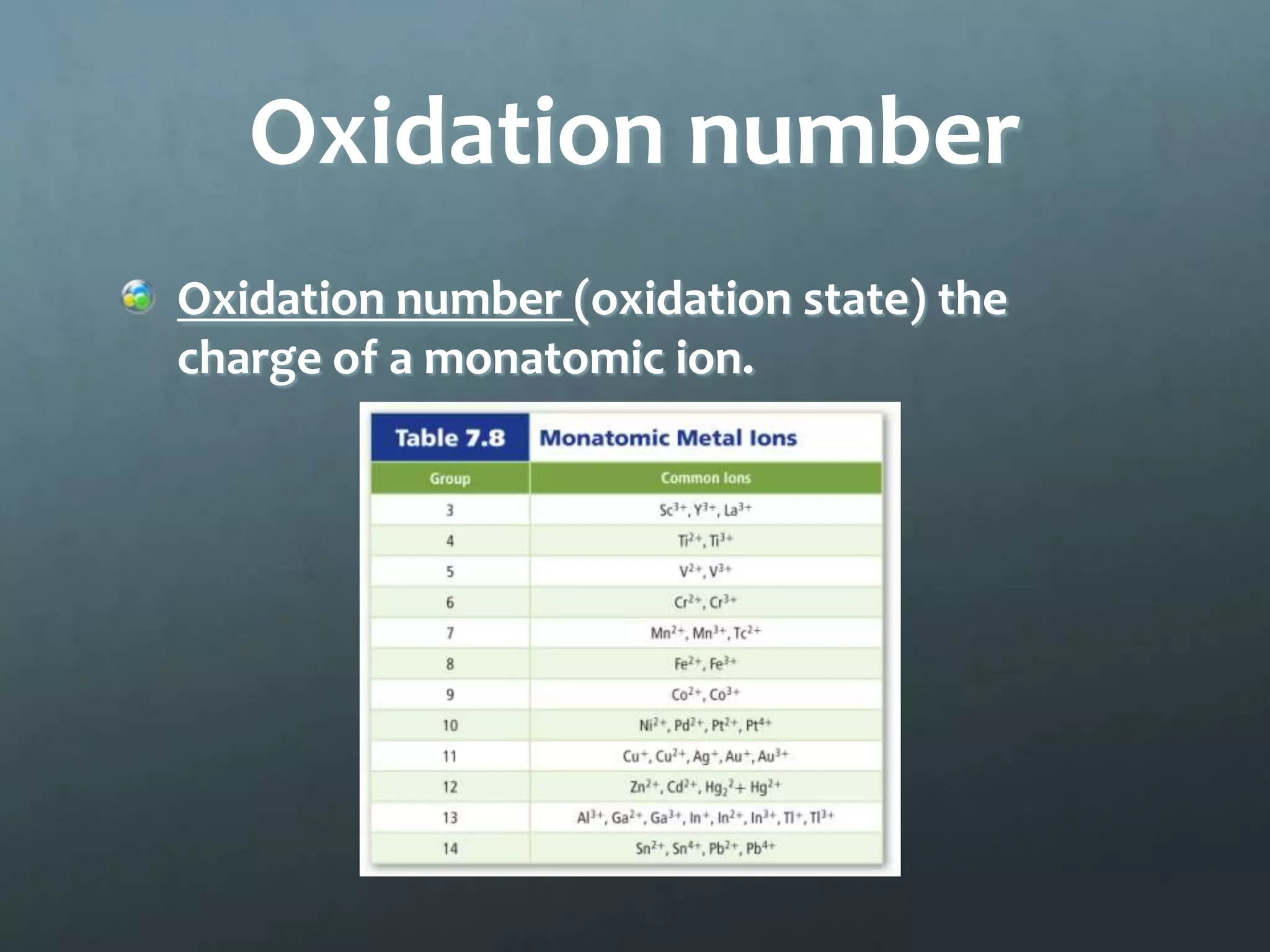
Oxidation number (oxidation state) the
charge of a monatomic ion.
Formulas for Ionic
      Compounds
The symbol for the cation is written first with
the anion second.
Subscripts represent the number of atoms of
each element in a compound.
The total charge must equal zero in an ionic
compound.
Polyatomic Ions
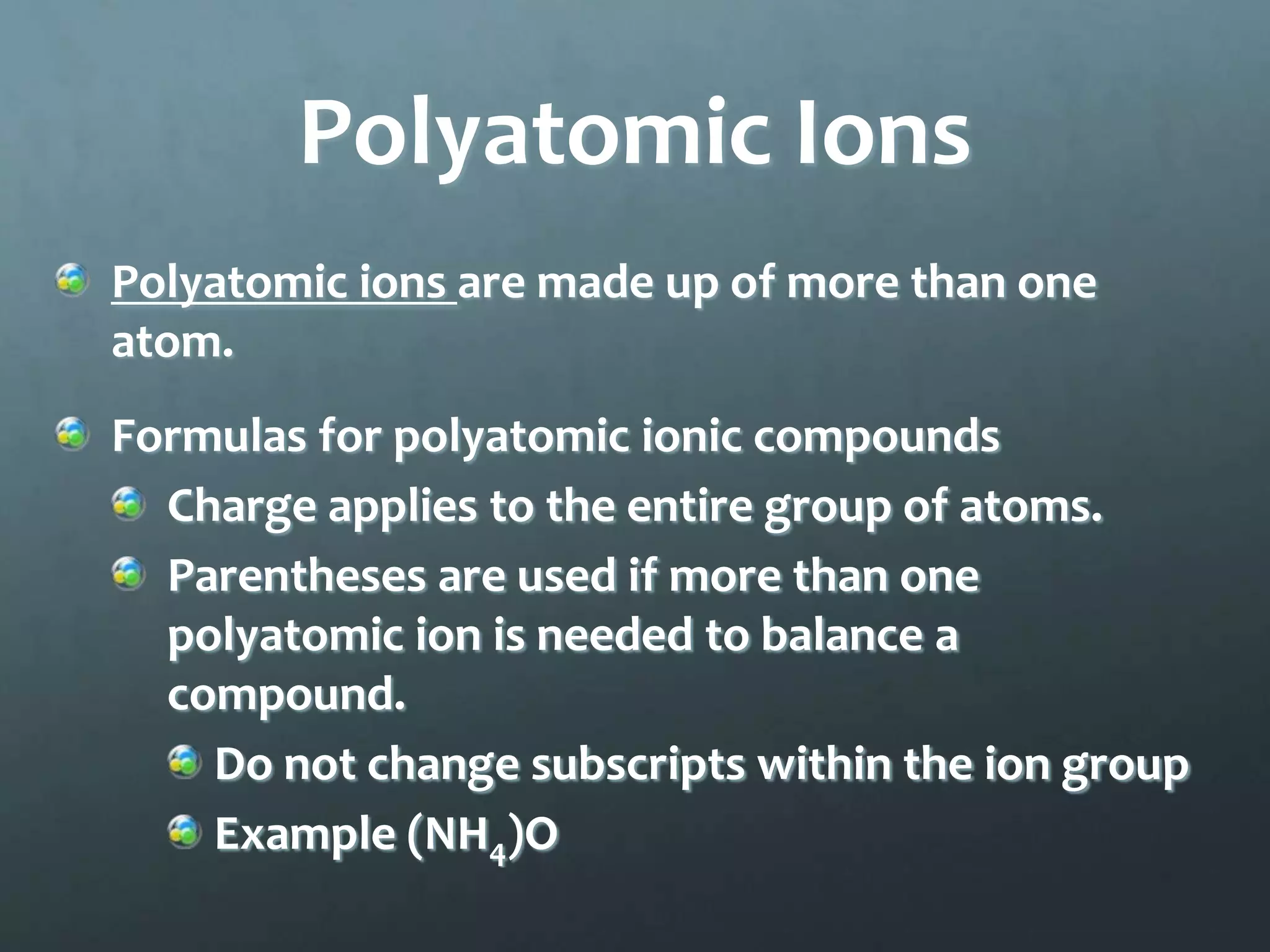
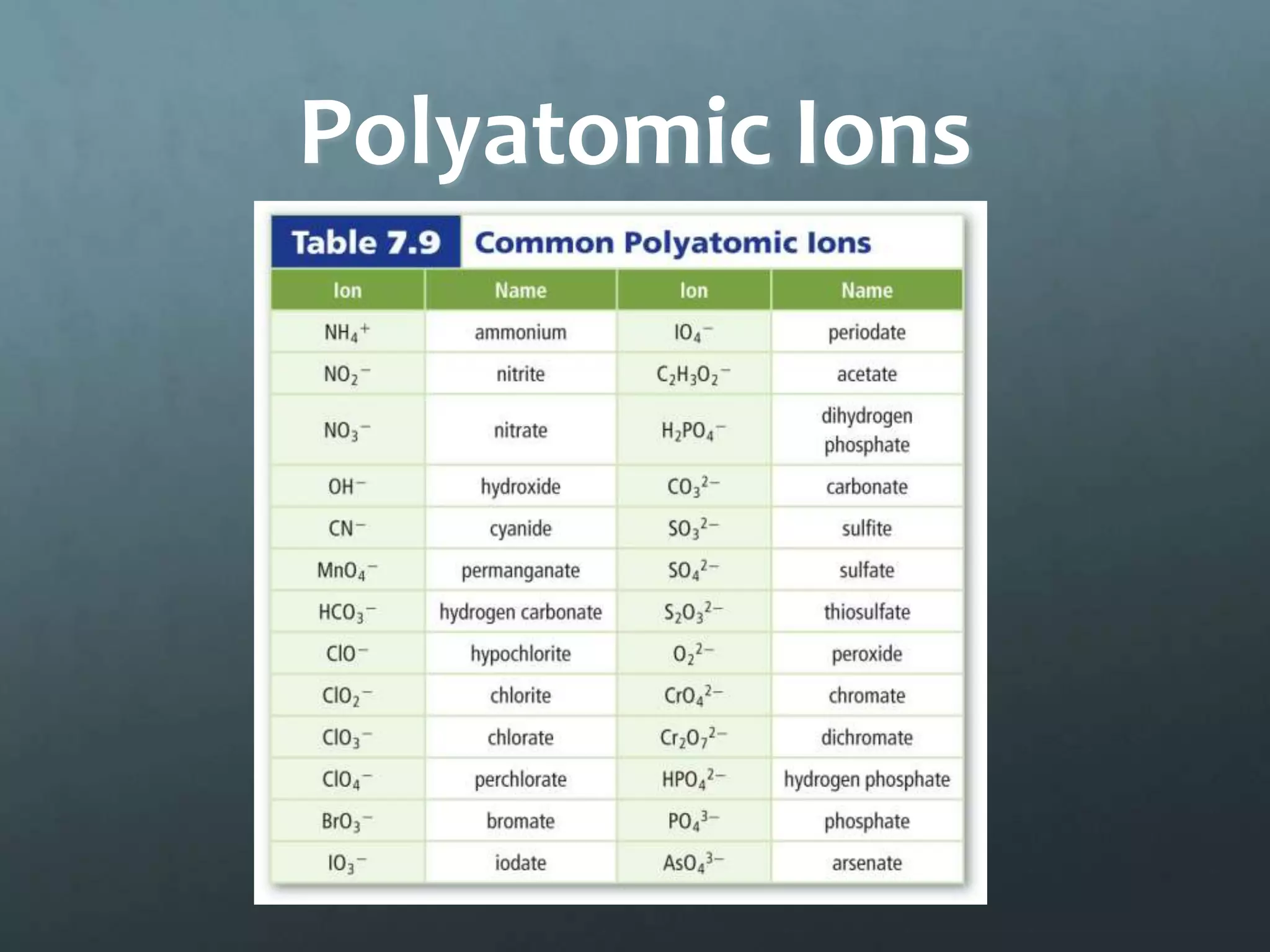
Polyatomic ions are made up of more than one
atom.
Formulas for polyatomic ionic compounds
  Charge applies to the entire group of atoms.
  Parentheses are used if more than one
  polyatomic ion is needed to balance a
  compound.
    Do not change subscripts within the ion group
    Example (NH4)O
Polyatomic Ions
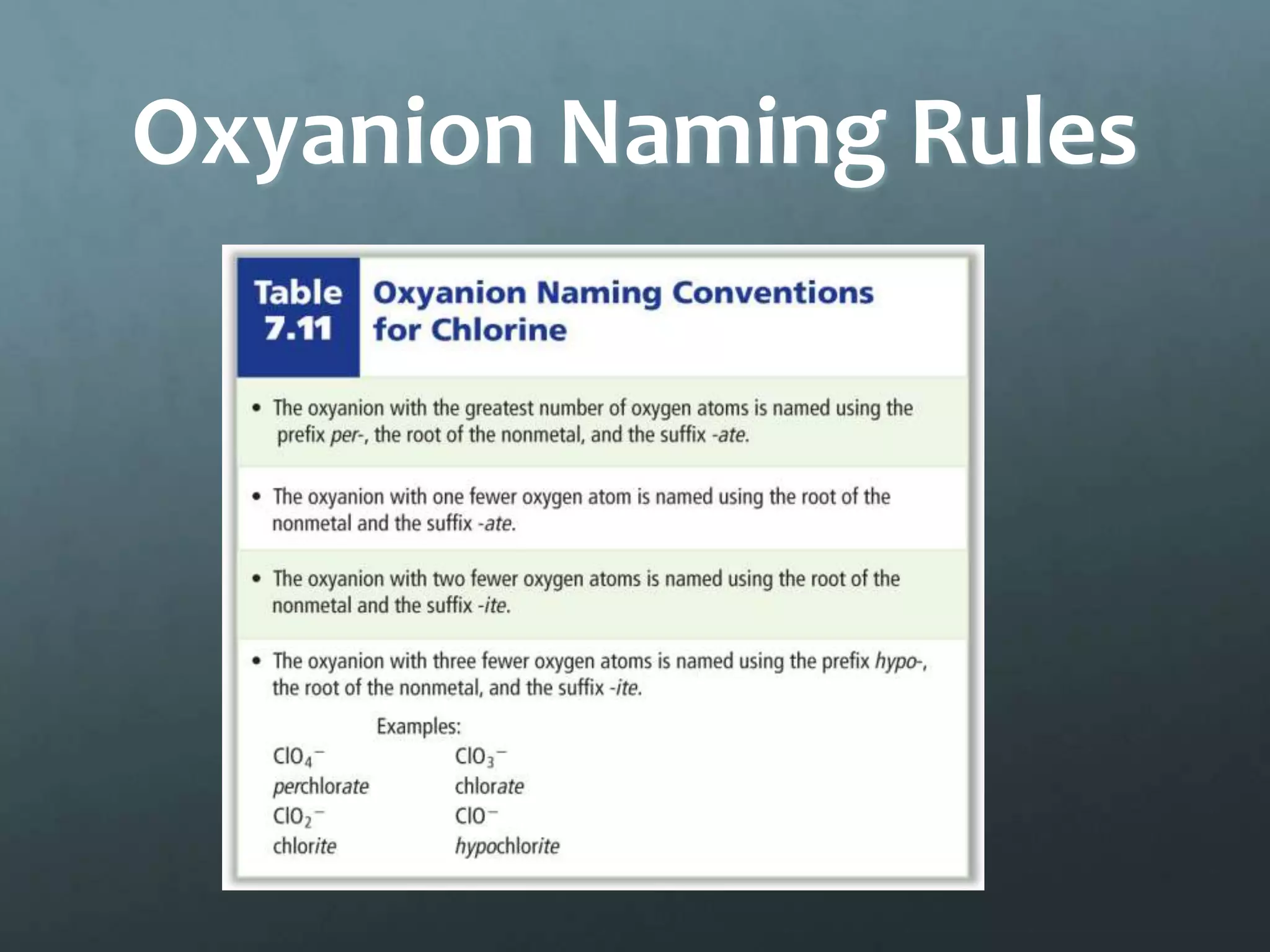
Oxyanion
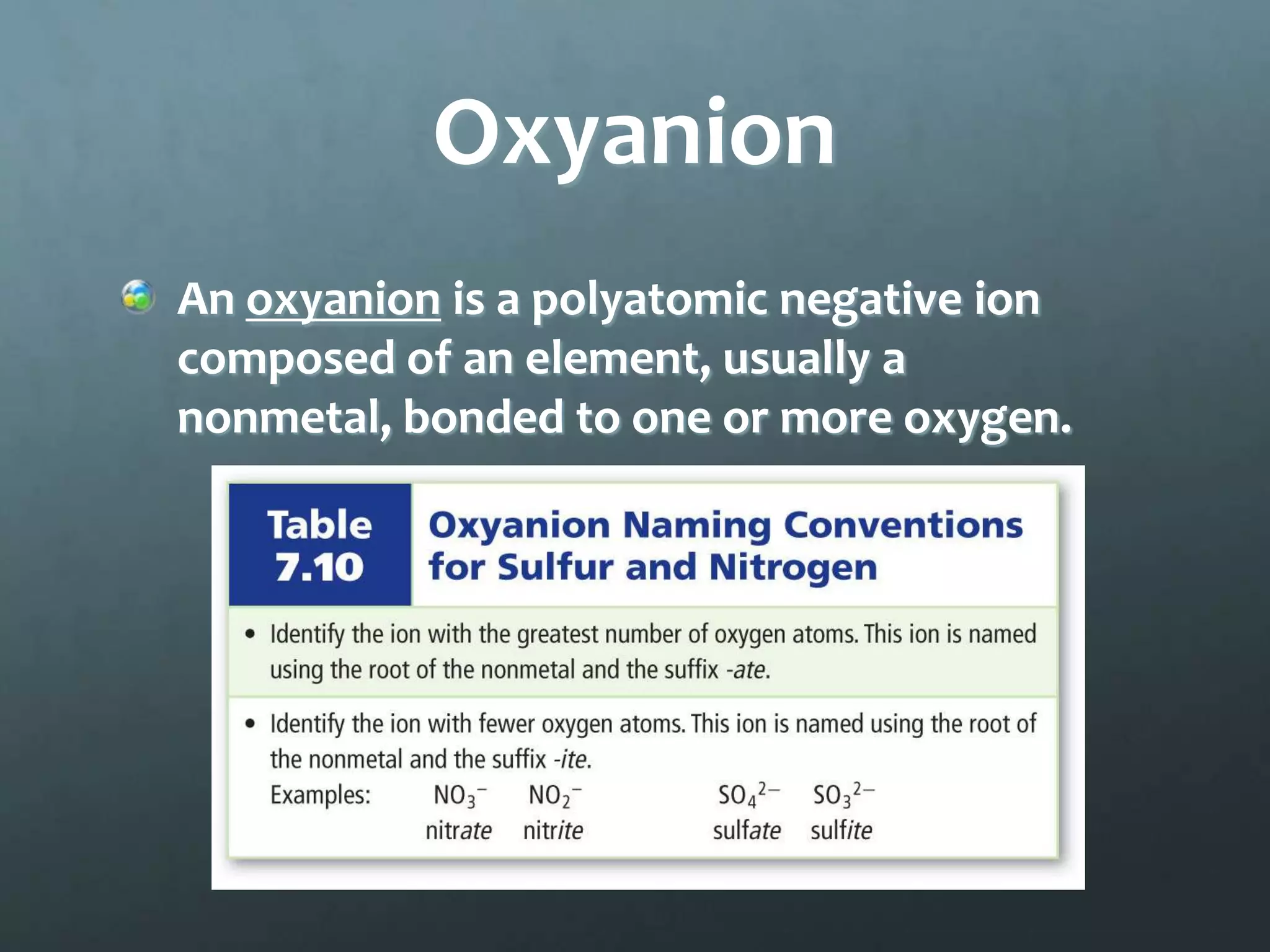
An oxyanion is a polyatomic negative ion
composed of an element, usually a
nonmetal, bonded to one or more oxygen.
Oxyanion Naming Rules
Names for Ions and
     Ionic Compounds
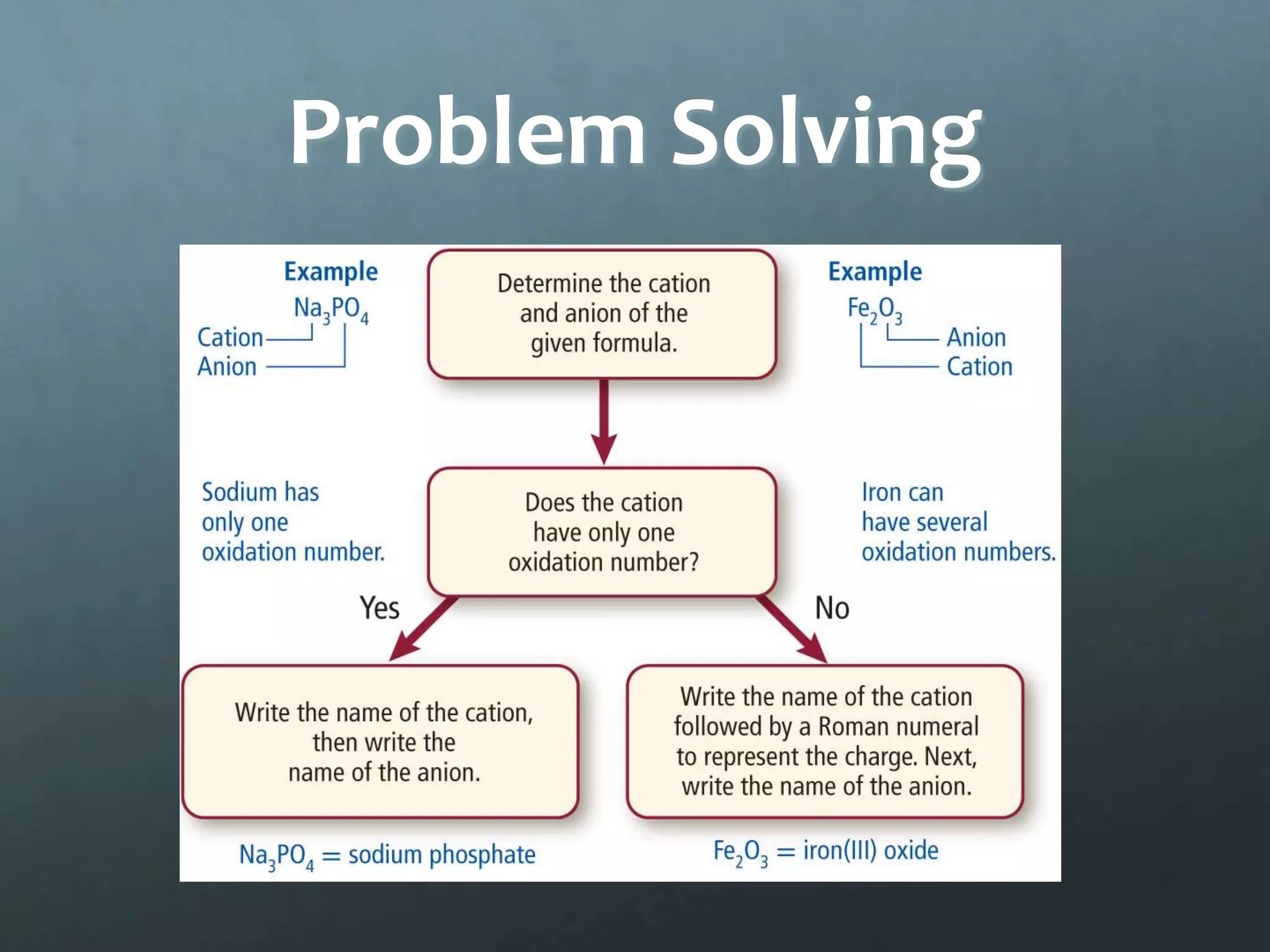
1. Name the cation followed by the anion.
2. For monatomic cations, use the element
   name.
3. For monatomic anions, use the root of the
   element with the suffix –ide.
Names for Ions and
         Ionic Compounds
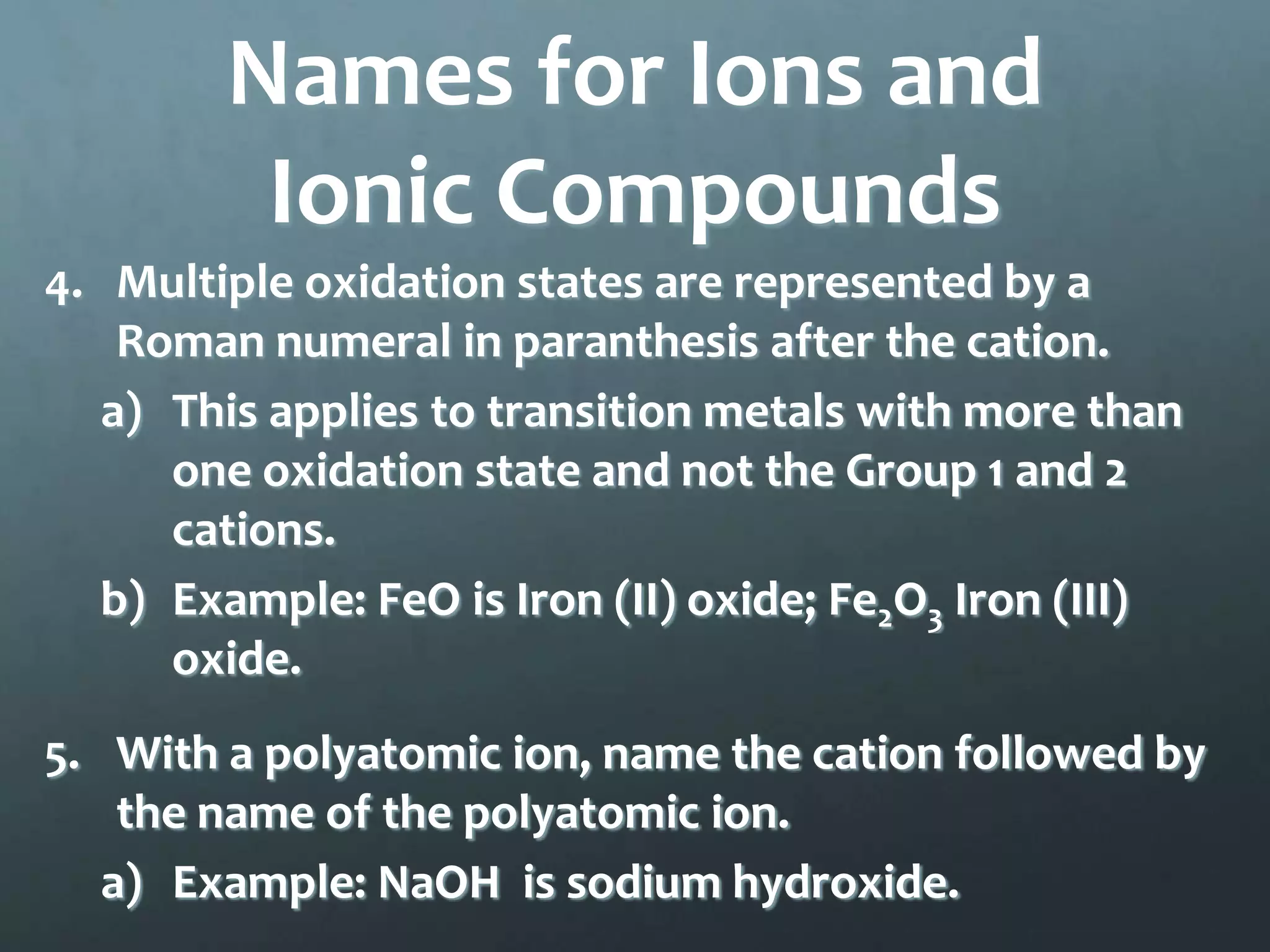
4. Multiple oxidation states are represented by a
    Roman numeral in paranthesis after the cation.
   a) This applies to transition metals with more than
      one oxidation state and not the Group 1 and 2
      cations.
   b) Example: FeO is Iron (II) oxide; Fe2O3 Iron (III)
      oxide.
5. With a polyatomic ion, name the cation followed by
    the name of the polyatomic ion.
   a) Example: NaOH is sodium hydroxide.
Problem Solving
Practice Problems
CALM 6:3
Metallic Bonds and the
 Properties of Metals
Metallic Bonds and the
  Properties of Metals
Metals form crystal lattices and can be modeled as
cations surrounded by a “sea” of freely moving valence
electrons.
Goals and Objectives:
 Describe a metallic bond.
 Relate the electron sea model to the physical
properties of metals.
  Define alloys, and categorize them into two basic
types.
Metals
Metals are not ionic but share several properties
with ionic compounds.
Metals also form lattices in the solid
state, where 8 to 12 other atoms closely
surround each metal atom.
  Within the crowded lattice, the outer energy
  levels of metal atoms overlap.
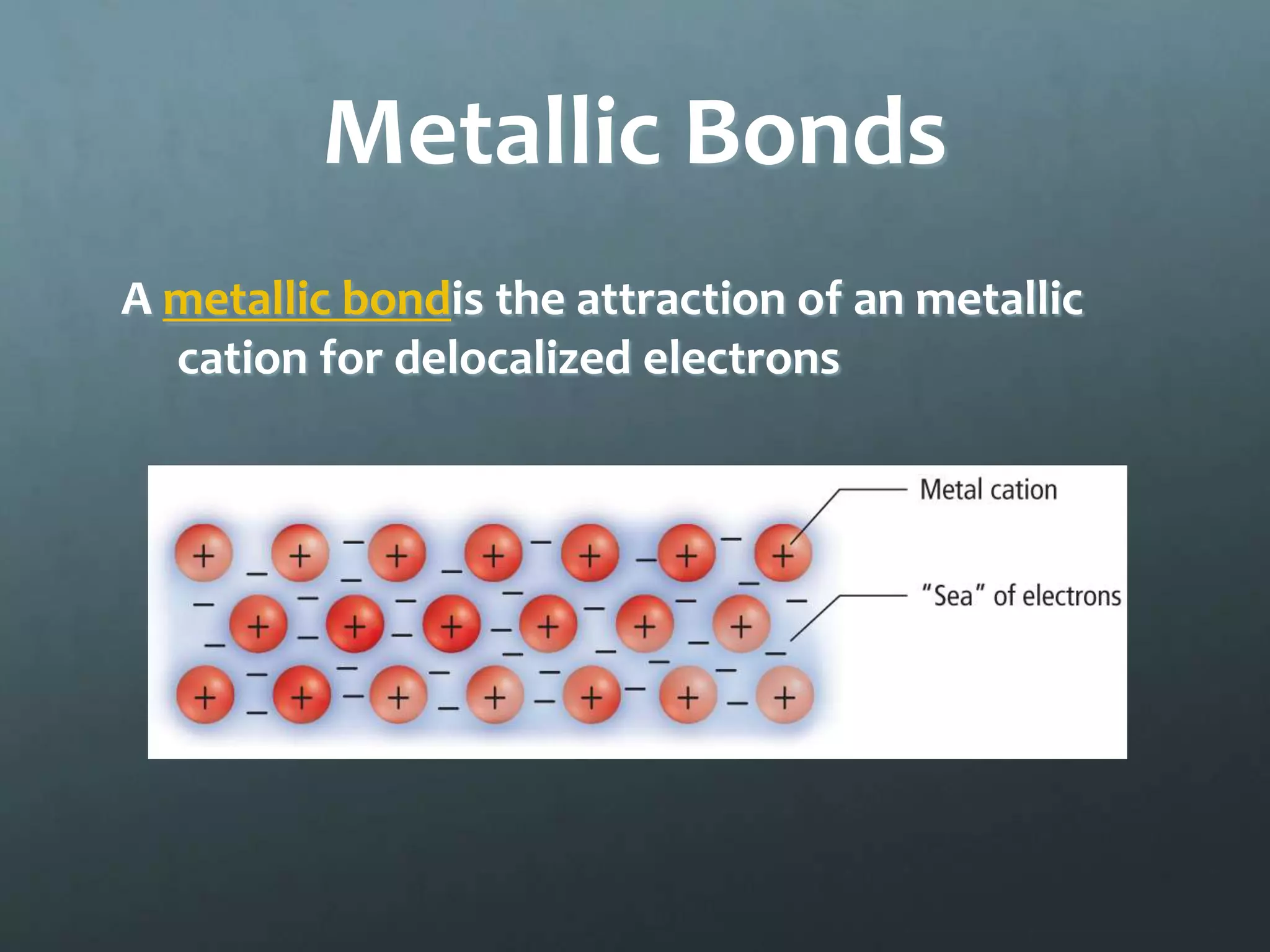
Electron Sea Model
The electron sea model proposes that all metal
  atoms in a metallic solid contribute their
  valence electrons to form a "sea" of electron.
  The electrons are free to move around and
  are referred to as delocalized
  electrons, forming a metallic cation.
Metallic Bonds
A metallic bondis the attraction of an metallic
  cation for delocalized electrons
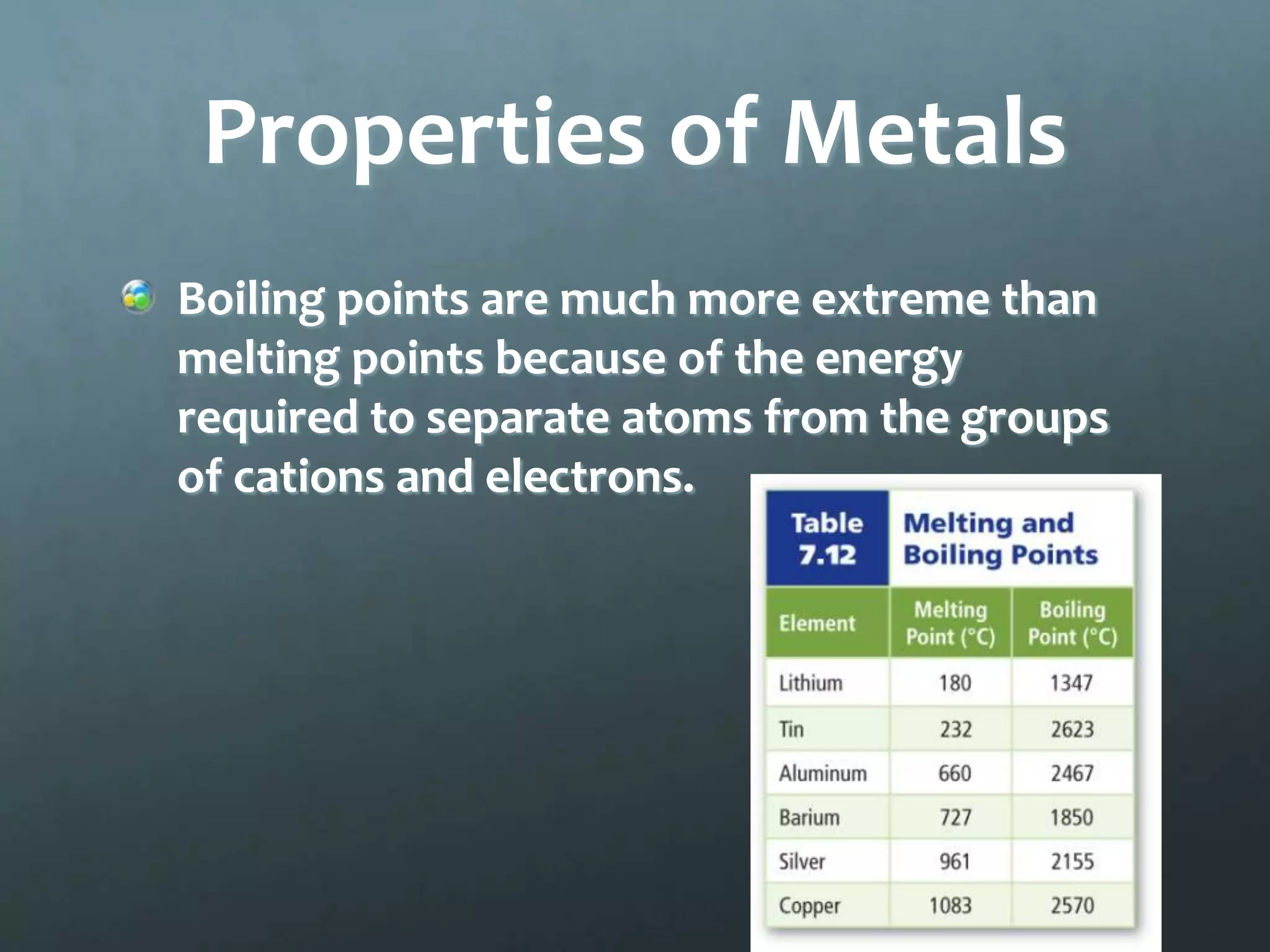
Properties of Metals
Boiling points are much more extreme than
melting points because of the energy
required to separate atoms from the groups
of cations and electrons.
Properties of Metals
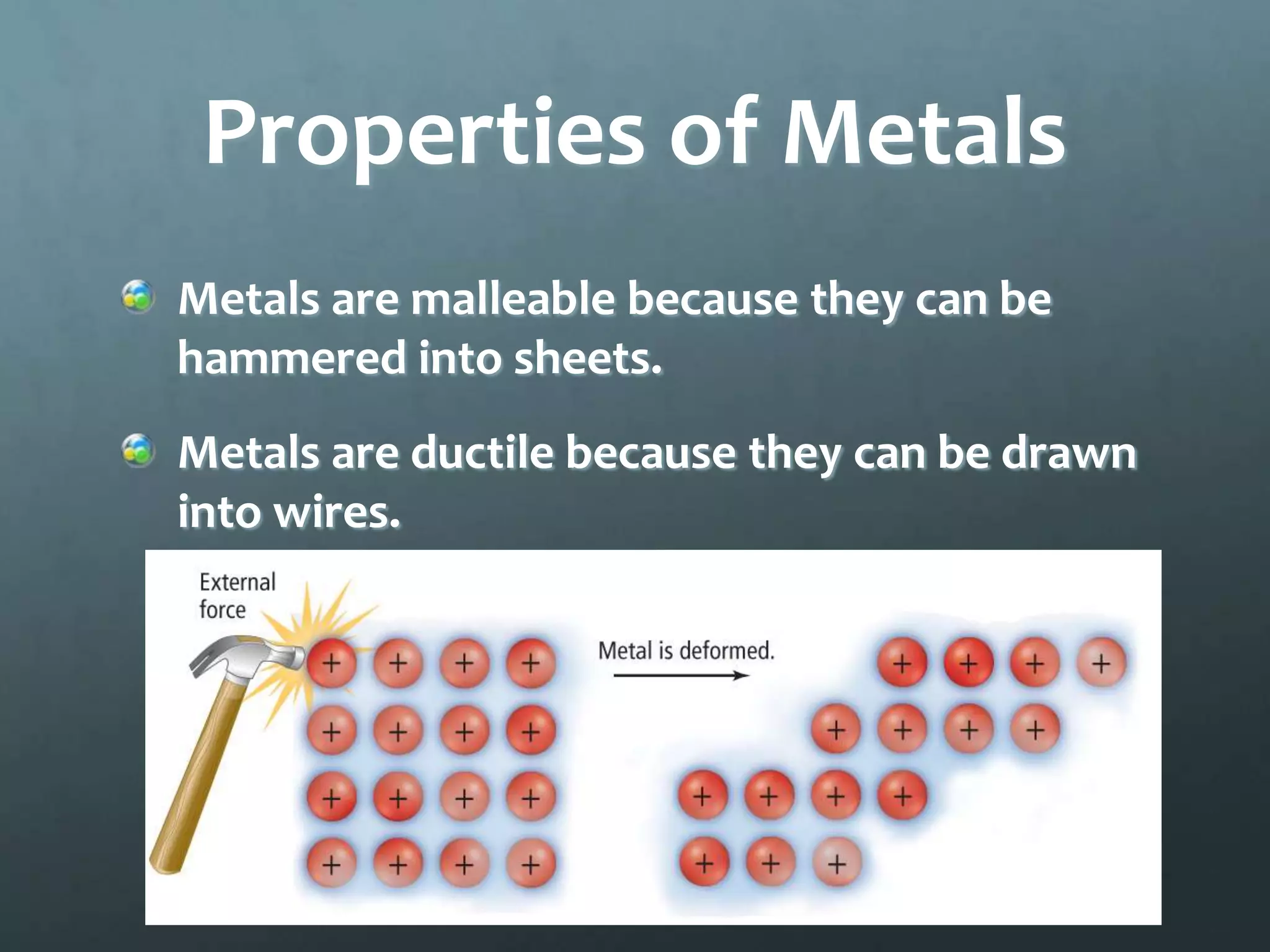
Metals are malleable because they can be
hammered into sheets.
Metals are ductile because they can be drawn
into wires.
Properties of Metals
Mobile electrons around cations make metals
good conductors of electricity and heat.
As the number of delocalized electrons
increases, so does hardness and strength.
Metal Alloys
An alloy is a mixture of elements that has
  metallic properties.
  The properties of alloys differ from the
  elements they contain.
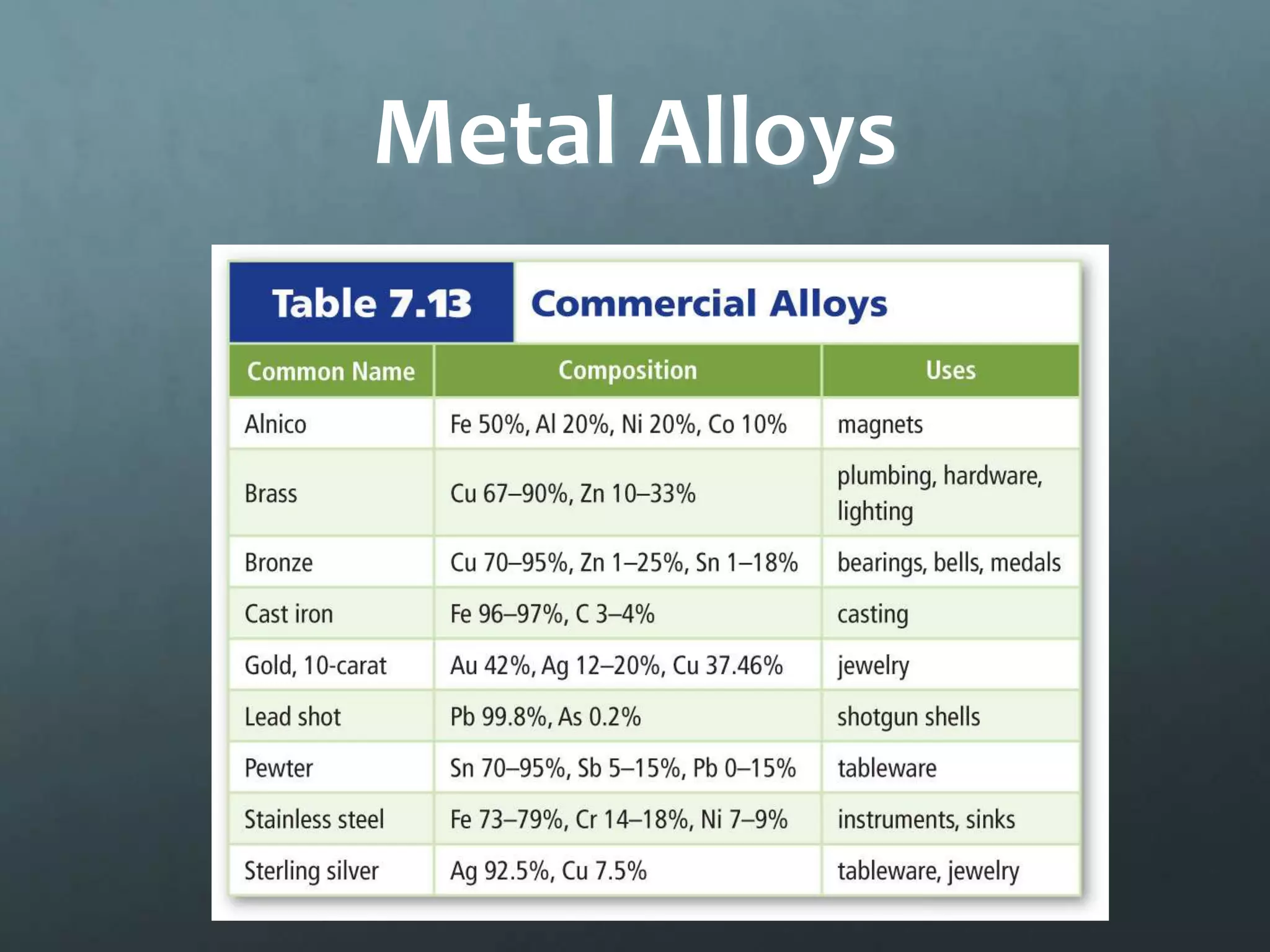
Metal Alloys
Metal Alloys
Substitutional alloys are formed when some
atoms in the original metallic solid are
replaced by other metals of similar atomic
structure.
Interstitial alloys are formed when small
holes in a metallic crystal are filled with
smaller atoms.
Practice Problems
CALM 6:4
Accumulating Content
How does the electron configuration of a neutral
element compare to that of its ion configuration?
Accumulating Content
How does energy and stability relate to ion
formation and bond formation?
Accumulating Content
What are some physical and chemical properties of
metals that are caused by the way they ionize or
bond?
Study Guide
  Key Concepts
Key Concepts
A chemical bond is the force that holds two atoms
together.
Some atoms form ions to gain stability. This stable
configuration involves a complete outer energy
level, usually consisting of eight valence
electrons.
Ions are formed by the loss or gain of valence
electrons.
Key Concepts
The number of protons remains unchanged during
ion formation.
Ionic compounds contain ionic bonds formed by
the attraction of oppositely charged ions.
Ions in an ionic compound are arranged in a
repeating pattern known as a crystal lattice
Key Concepts
Ionic compound properties are related to
ionic bond strength.
Ionic compounds are electrolytes; they
conduct an electric current in the liquid phase
and in aqueous solution.
Lattice energy is the energy needed to
remove 1 mol of ions from its crystal lattice.
Key Concepts
A formula unit gives the ratio of cations to
anions in the ionic compound.
A monatomic ion is formed from one atom.
The charge of a monatomic ion is its
oxidation number.
Roman numerals indicate the oxidation
number of cations having multiple possible
oxidation states.
Key Concepts
Polyatomic ions consist of more than one
atom and act as a single unit.
To indicate more than one polyatomic ion in a
chemical formula, place parentheses around
the polyatomic ion and use a subscript.
A metallic bond forms when metal cations
attract freely moving, delocalized valence
electrons.
Key Concepts
In the electron sea model, electrons move
through the metallic crystal and are not held
by any particular atom.
The electron sea model explains the physical
properties of metallic solids.
Metal alloys are formed when a metal is
mixed with one or more other elements.
Questions
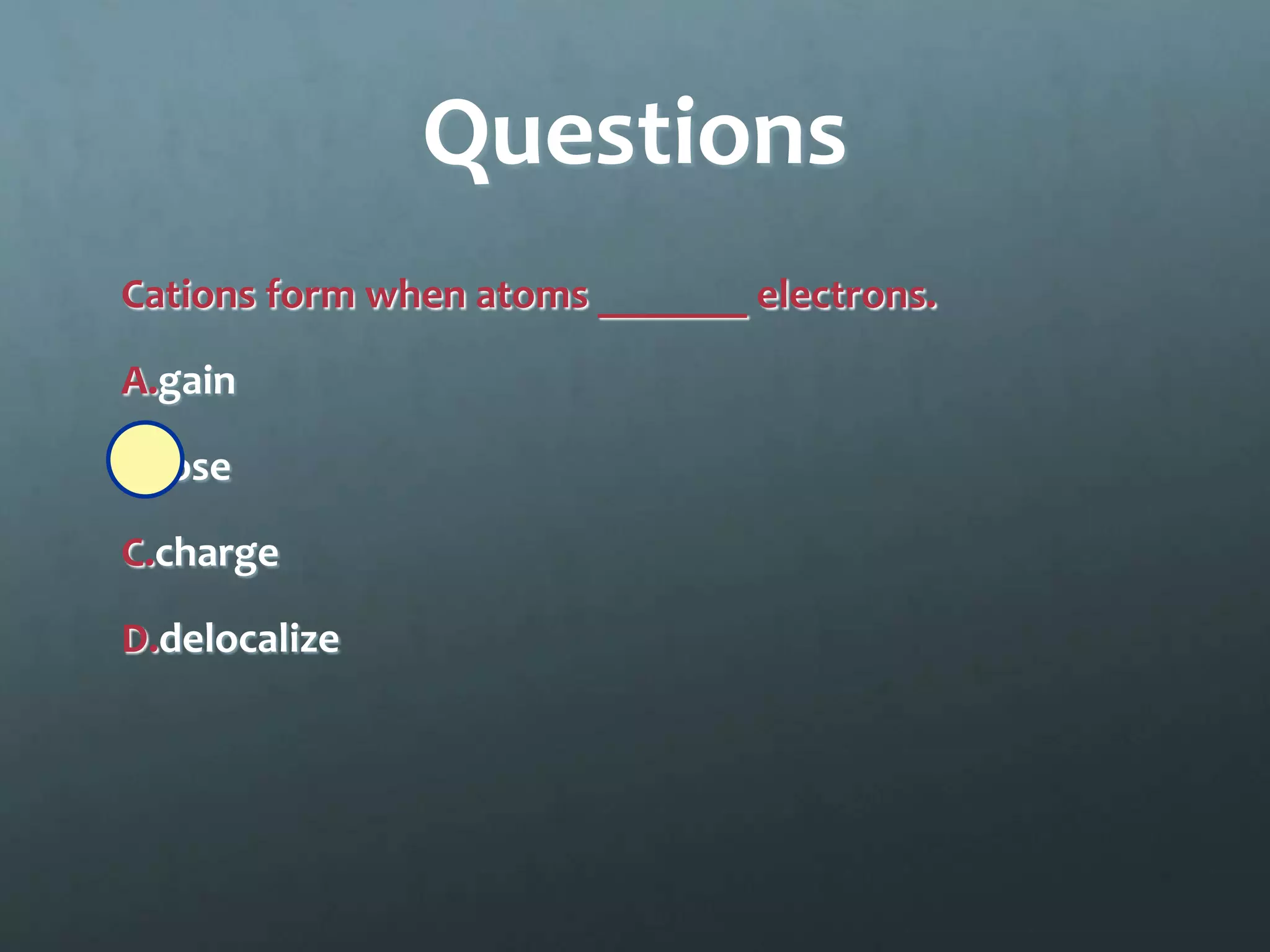
Cations form when atoms _______ electrons.

A.gain

B.lose

C.charge

D.delocalize
Questions
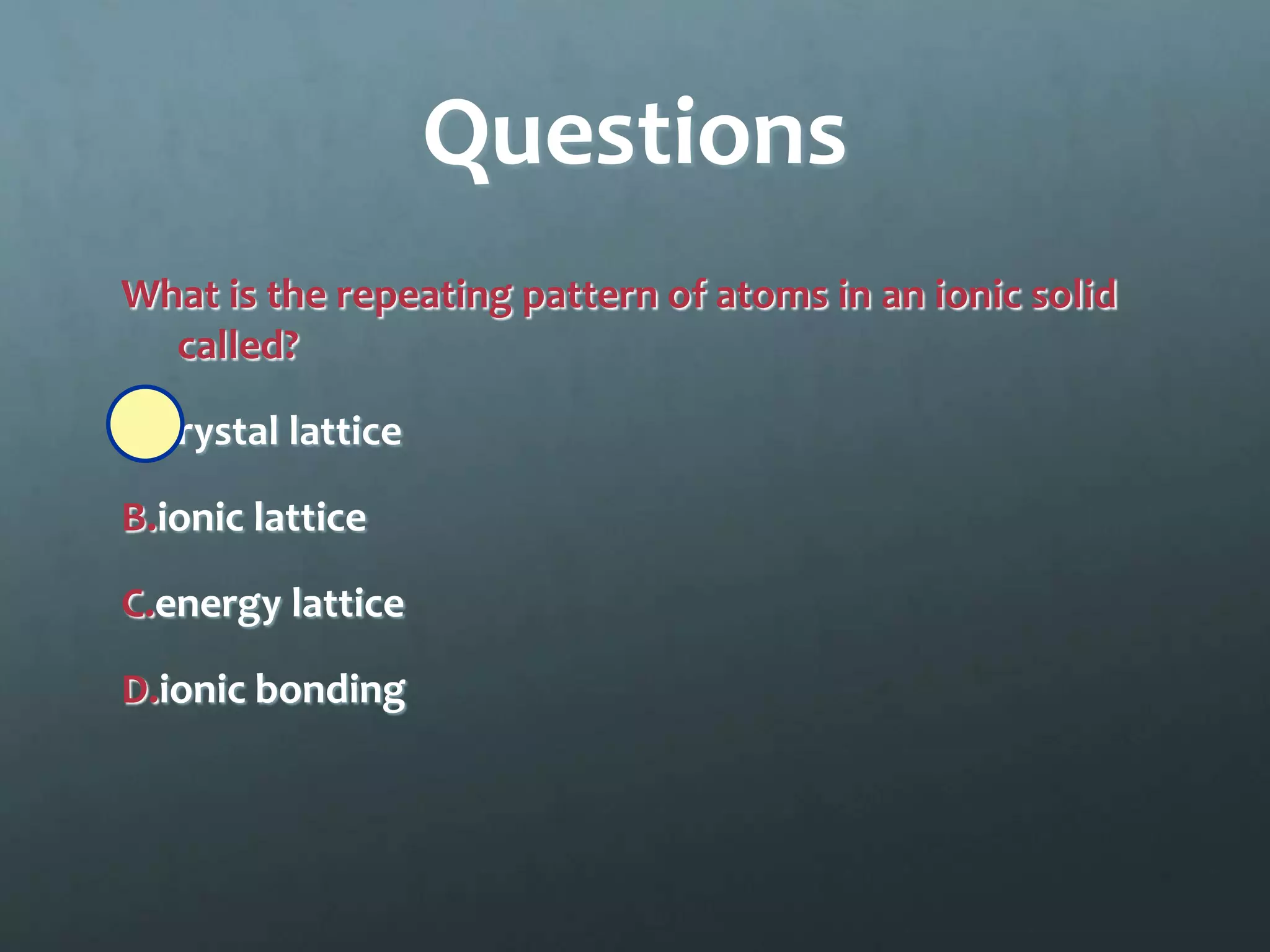
What is the repeating pattern of atoms in an ionic solid
  called?

A.crystal lattice

B.ionic lattice

C.energy lattice

D.ionic bonding
Questions
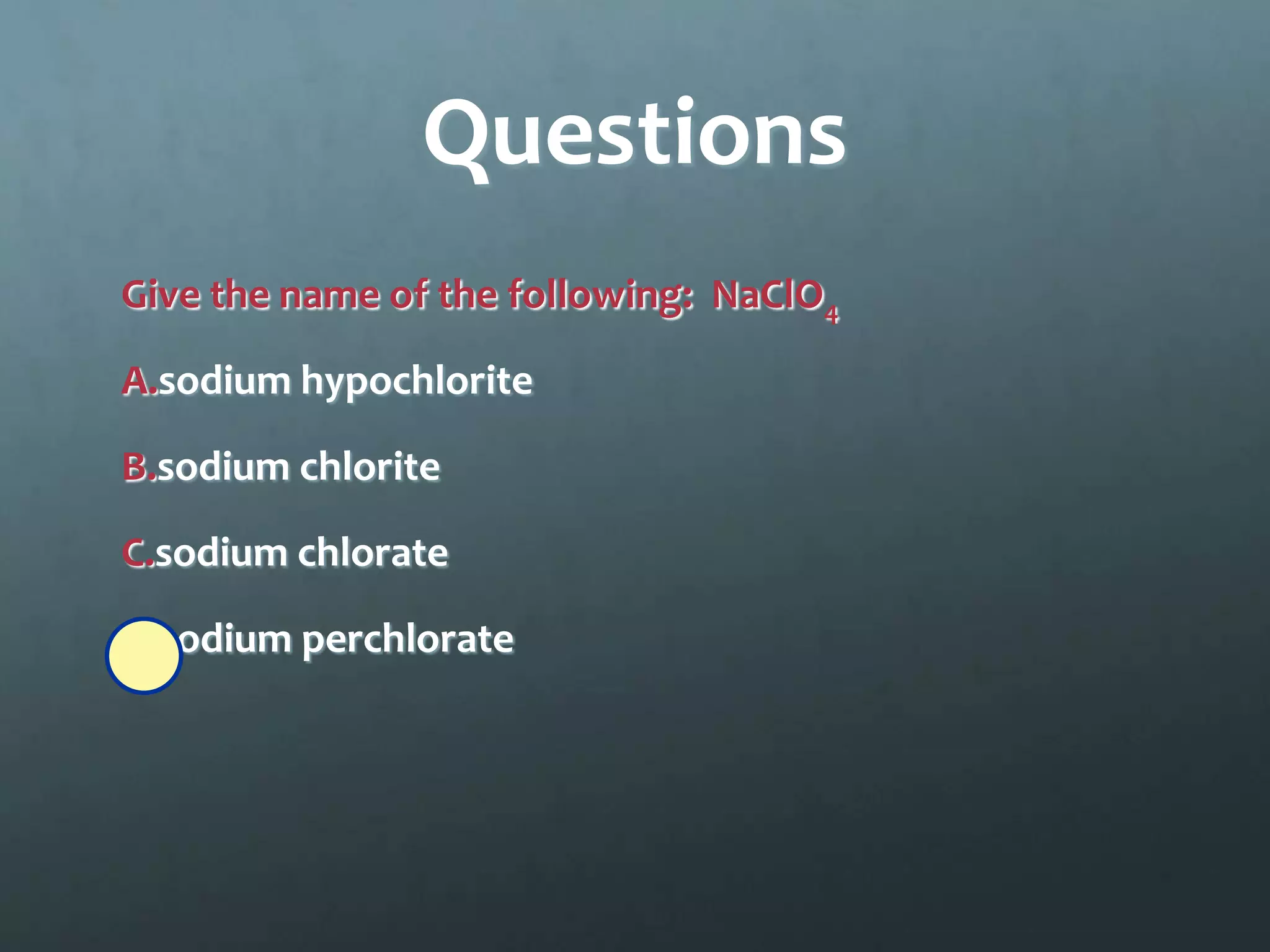
Give the name of the following: NaClO4

A.sodium hypochlorite

B.sodium chlorite

C.sodium chlorate

D.sodium perchlorate
Questions
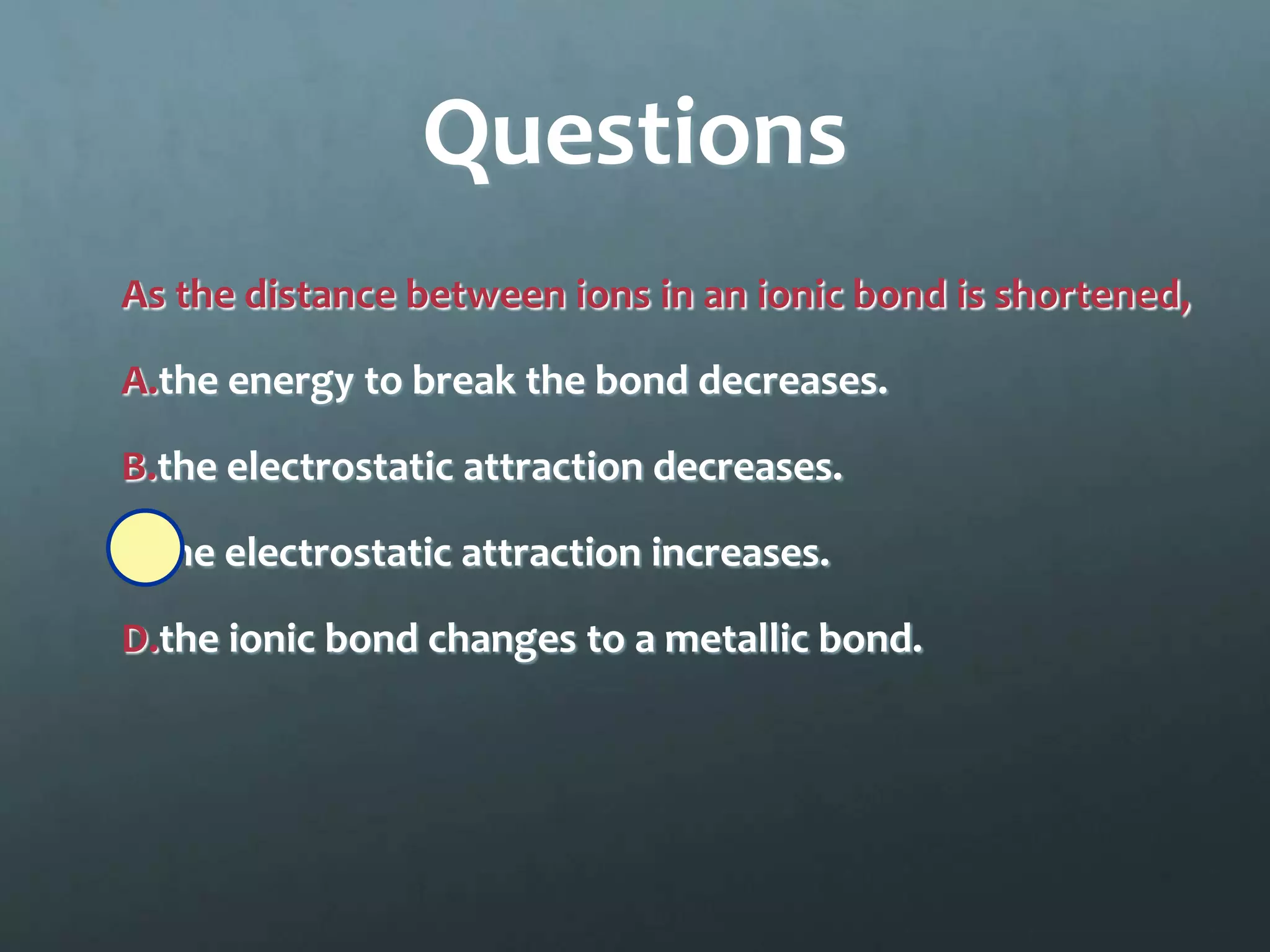
As the distance between ions in an ionic bond is shortened,

A.the energy to break the bond decreases.

B.the electrostatic attraction decreases.

C.the electrostatic attraction increases.

D.the ionic bond changes to a metallic bond.
Questions
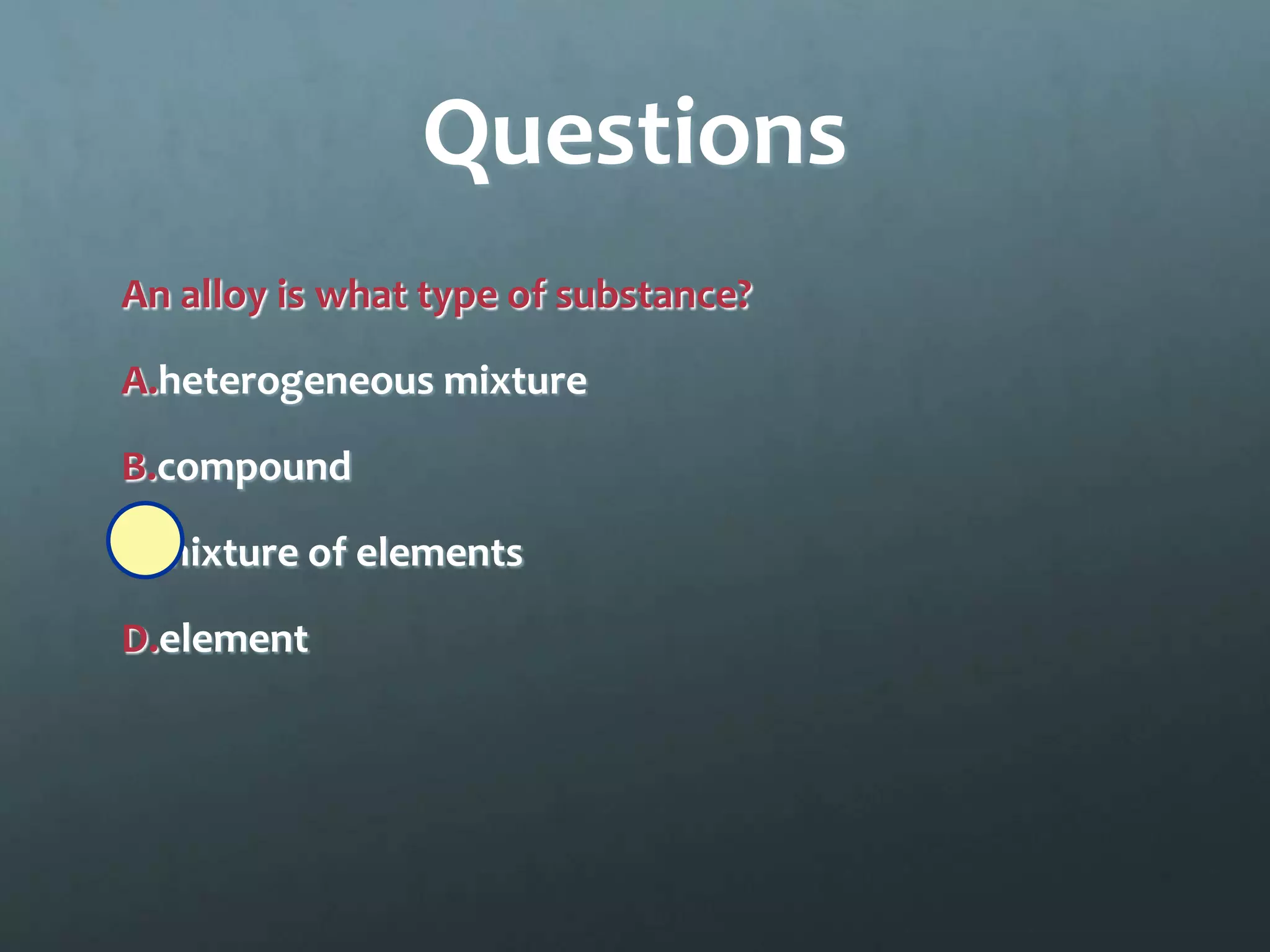
An alloy is what type of substance?

A.heterogeneous mixture

B.compound

C.mixture of elements

D.element
Questions
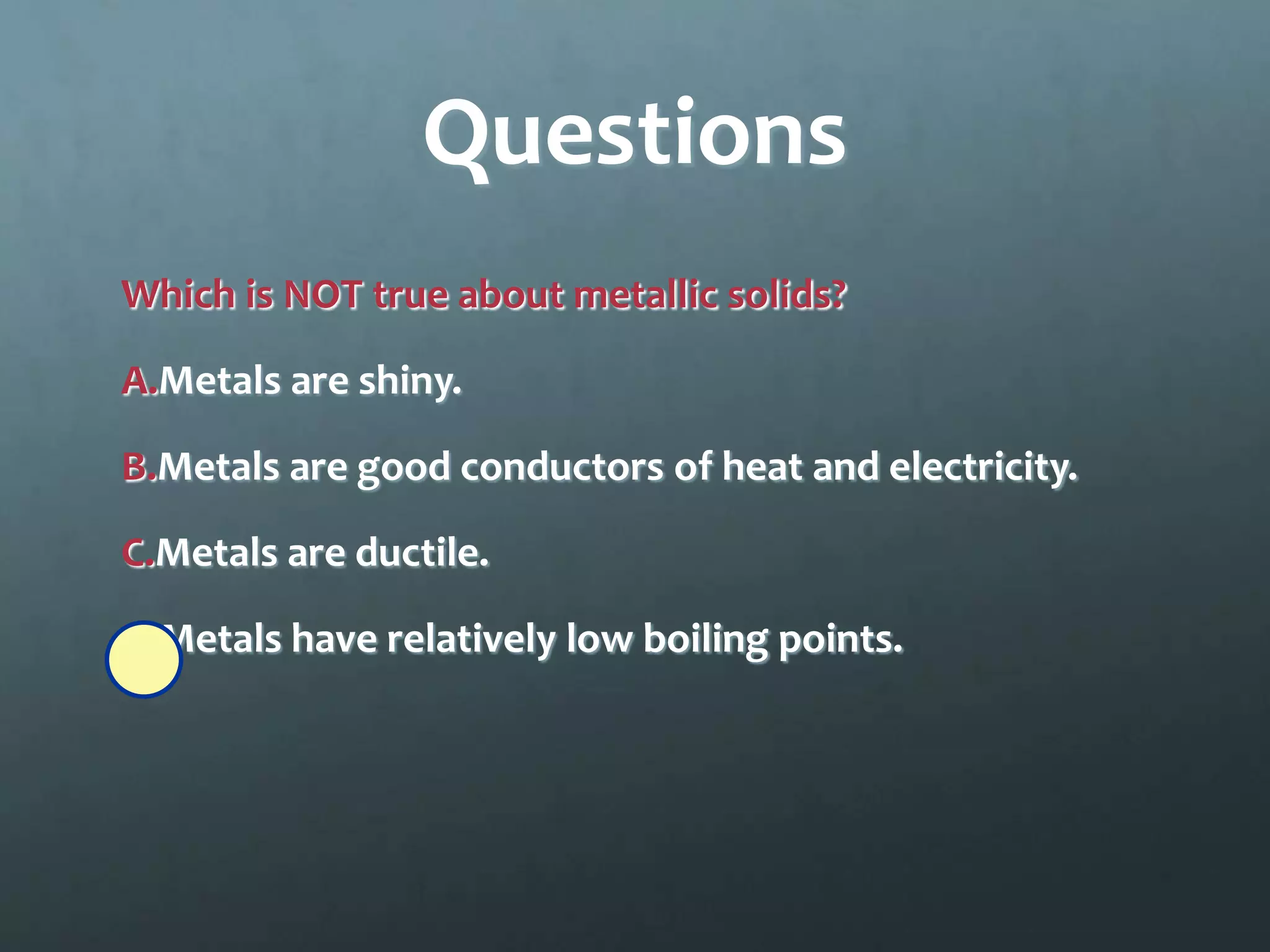
Which is NOT true about metallic solids?

A.Metals are shiny.

B.Metals are good conductors of heat and electricity.

C.Metals are ductile.

D.Metals have relatively low boiling points.
Questions
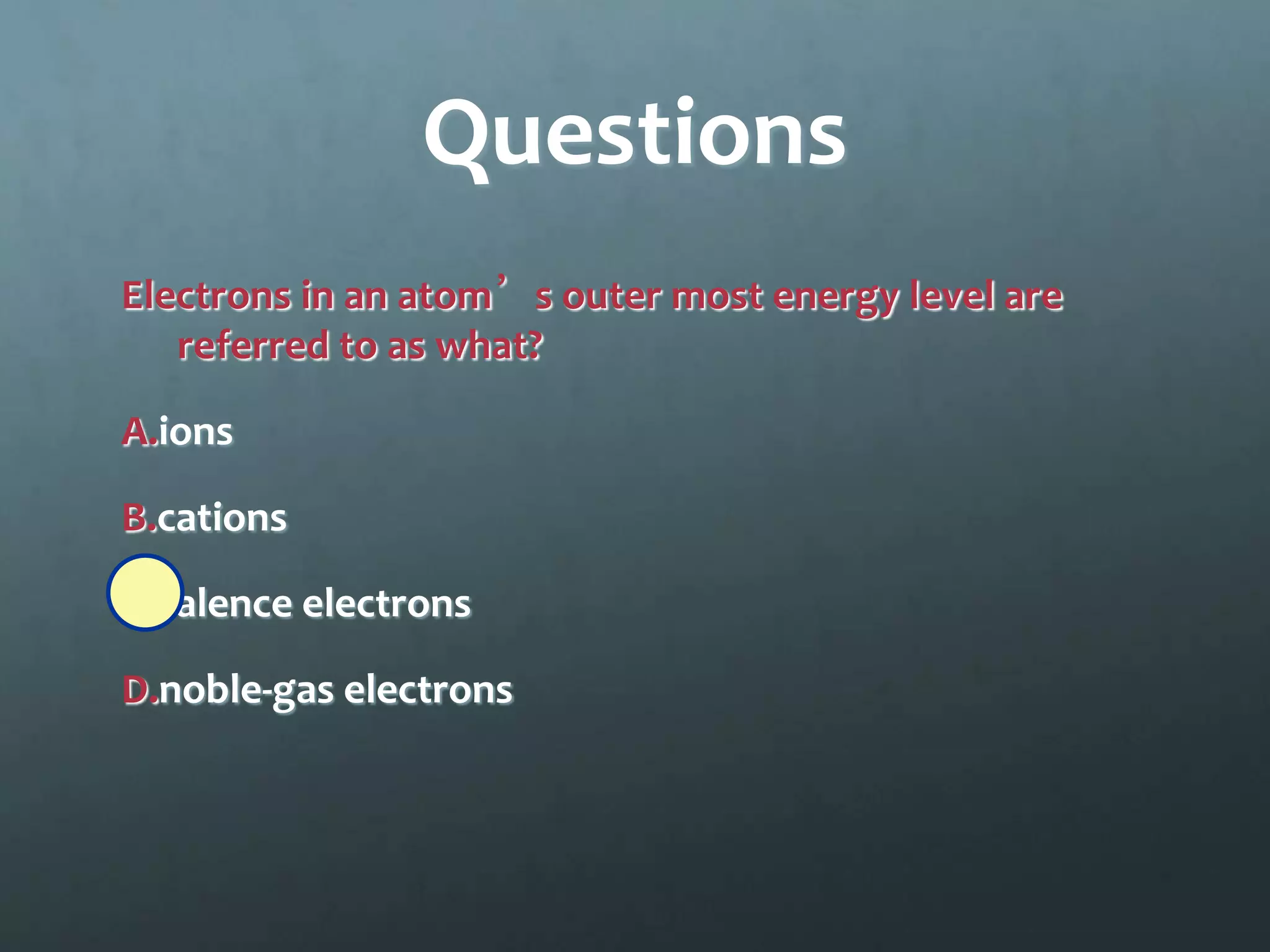
Electrons in an atom’s outer most energy level are
   referred to as what?

A.ions

B.cations

C.valence electrons

D.noble-gas electrons
Questions
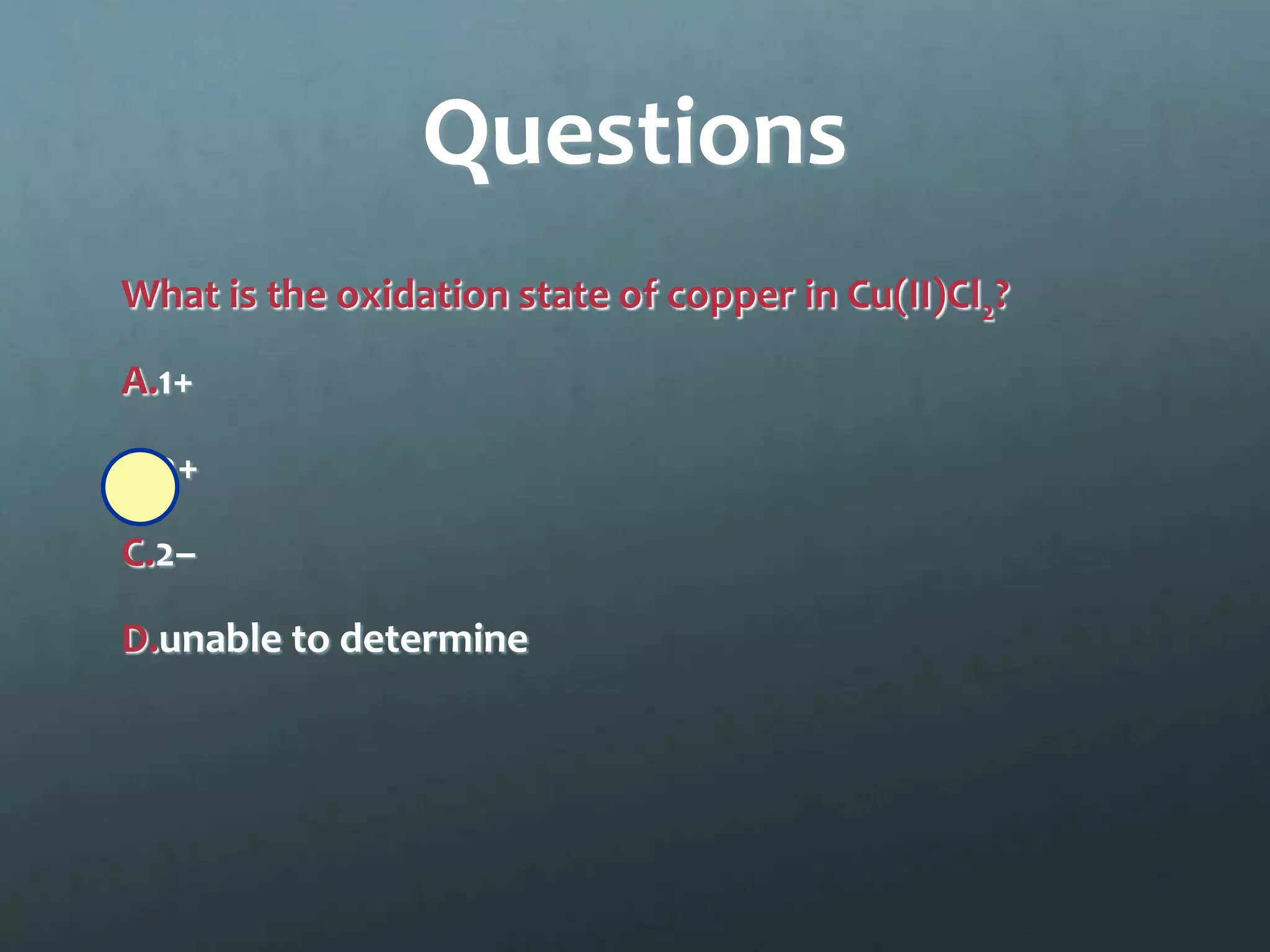
What is the oxidation state of copper in Cu(II)Cl2?

A.1+

B.2+

C.2–

D.unable to determine
Questions
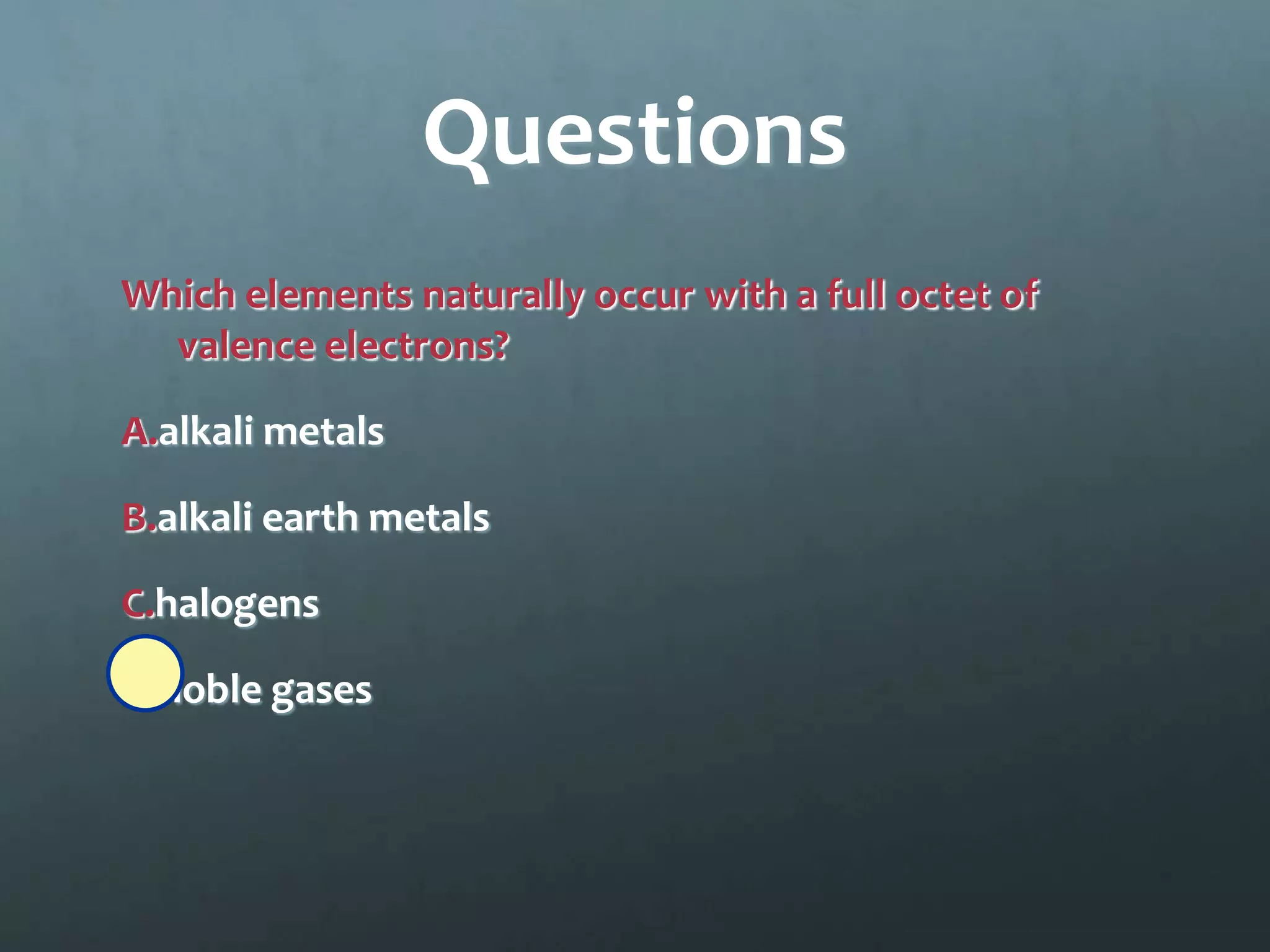
Which elements naturally occur with a full octet of
  valence electrons?

A.alkali metals

B.alkali earth metals

C.halogens

D.noble gases
Questions
How many electrons are in a full octet?

A.10

B.8

C.6

D.4
The End

Chem unit 6 presentation

  • 1.
    Ionic Compounds and Metals Chemistry Unit 6
  • 2.
    Main Ideas Ions areformed when atoms gain or lose valence electrons to achieve a stable octet electron configuration. Oppositely charged ion attract each other, forming electrically neutral ionic compounds. In written names and formulas for ionic compounds, the cation appears first, followed by the anion. Metals form crystal lattices and can be modeled as cations surrounded by a “sea’” of freely moving valence electrons.
  • 3.
    Ion Formation Ions areformed when atoms gain or lose valence electrons to achieve a stable octet electron configuration. Goals and Objectives: Define a chemical bond. Describe the formation of positive and negative ions. Relate ion formation to electron configuration.
  • 4.
    Valence Electrons and Chemical Bonds Chemical Bond – is a force that holds two atoms together. They can form between the positive nucleus of one atom and the negative valence electrons of another atom or between two oppositely charged ions.
  • 5.
    Valence Electrons and Chemical Bonds Atom’s try to form the octet – the stable arrangement of eight valence electrons in the outer energy level – by gaining or losing valence electrons. The transfer of valence electrons between two atoms is based on the ionization energy and electron affinity of the two atoms. Noble gases- high ionization energy + low electron affinity = little chemical reactivity.
  • 6.
    Positive Ion Formation Cation– positively charged ion Example: Sodium atom: 1s2 2s2p6 3s1 Sodium ion: 1s2 2s2 p6 = neon
  • 7.
    Positive Ion Formation Metalatoms are reactive because they lose valence electrons easily. Group 1: commonly form +1 ions Group 2: commonly form +2 ions Group 13: sometimes +3 ions
  • 8.
    Positive Ion Formation Transitionmetal ions have an outer shell of s2 They will lose their s electrons and occasionally a d electron. Typically form +2 or +3 ions but can form greater than +3 ions
  • 9.
    Positive Ion Formation Otherrelatively stable electron arrangements are referred to as pseudo-noble gas configurations. Groups 11-14 will lose electrons to form full outer shells: s, p, and d.
  • 10.
    Negative Ion Formation Ananion is a negatively charged ion. (Add “- ide” to the end of the root atom name.) Nonmetals easily gain electrons. Example: Chlorine atom: 1s2 2s2p6 3s2p5 Chlorine ion: 1s2 2s2p6 3s2p6 = Argon
  • 11.
    Negative Ion Formation Nonmetalions gain the number of electrons required to fill an octet. Some nonmetals can gain or lose electrons to complete an octet. Phosphorus can gain 3 or lose 5 Group 15 usually gains 3 electrons Group 16 usually gains 2 electrons Group 17 usually gains 1 electron
  • 12.
  • 13.
    Ionic Bonds andIonic Compounds
  • 14.
    Ionic Bonds andIonic Compounds Oppositely charged ions attract each other, forming electrically neutral ionic compounds. Goals and Objectives: Describe the formation of ionic bonds and the structure of ionic compounds. Generalize about the strength of ionic bonds based on the physical properties of ionic compounds. Categorize ionic bond formation as exothermic or endothermic.
  • 15.
    Ionic Bond Ionic Bondis the electrostatic force that holds oppositely charged particles together. Ionic Compound is a compound that contains an ionic bond. Ionic bonds between metals and oxygen are called oxides. Most other ionic compounds are considered salts.
  • 16.
    Binary Ionic Compound BinaryIonic compound is an ionic compound that contains two different elements. One metallic cation and a nonmetallic anion. Examples: NaCl, MgO, KBr, LiF
  • 17.
    Ionic Bond Formation Electronsgained and lost in each element must be equal. (conservation of electrons) Calcium and Fluorine Aluminum and Oxygen Sodium and Chlorine
  • 18.
    Properties of Ionic Compounds Compounds are organized such that a pattern repeats to balance attraction and repulsion Total charge of a compound is neutral Often highly organized Example: NaCl crystal
  • 19.
    Crystal Lattice A crystallattice is a three dimensional geometric arrangement of particles. Each negative ion is surrounded by a positive ion which results in strong attractions between ions. Size and shape are dependent on relative numbers of ions.
  • 20.
    Crystal Lattice Physical Properties: Characteristics of bond strength – ionic bonds are relatively strong and take a large amount of energy to break. Melting point – high Boiling point – high Hardness of material is high: rigid and brittle solids.
  • 21.
  • 22.
    Crystal Lattice Characteristics ofthe compound: Conducts electricity, conditionally Ions in solid state ionic compounds are locked in place and they do not have free electrons in order to conduct electricity. Ionic compounds that are melted or dissolved in aqueous solutions have ions that are free to move and therefore do conduct electricity Electrolyte – an ionic compound that conducts electricity in an aqueous solution.
  • 23.
    Energy and theIonic Bond Formation of ionic compounds forms a more stable system and therefore reduces the energy required to sustain it. Since the creating of bonds lowers energy, energy is released in the process. The creation of bonds is said to be Exothermic. Exothermic – energy is released during a chemical reaction.
  • 24.
    Energy and theIonic Bond Breaking of ionic compounds reduces the stability of a system and therefore increases the energy required to sustain it . Since the creating of bonds lowers energy, the breaking of bonds increases energy and therefore it is required for the process. Endothermic – energy is absorbed during a chemical reaction.
  • 25.
    Lattice Energy Lattice energyis the energy required to separate 1 mole of the ions of an ionic compound. higher the lattice energy the stronger the bond strength. Directly related to the size of the ions bonded. smaller ions form compounds more closely because attraction increases with decreased distance. Also affected by charge of ions Higher ion charge typically has higher lattice energy.
  • 26.
    Lattice Energy Q1Q2 Lattice µ r
  • 27.
  • 28.
    Names and Formulas forIonic Compounds
  • 29.
    Names and Formulas for Ionic Compounds In written names and formulas for ionic compounds, the cation appears first, followed by the anion. Goals and Objectives: Relate a formula unit of an ionic compound to its composition. Write formulas for ionic compounds and oxyanions. Apply naming conventions to ionic compounds and oxyanions.
  • 30.
    Formulas for Ionic Compounds A standardized system for naming compounds was developed for much the same reason as the SI unit system. This serves as a universal naming system for communication among the science community.
  • 31.
    Formula Unit A formulaunit is the chemical formula for an ionic compound and represents the simplest ratio of ions. MgCl2 not Mg4Cl8 A monoatomic ion is a one atom ion.
  • 32.
    Oxidation number Oxidation number(oxidation state) the charge of a monatomic ion.
  • 33.
    Formulas for Ionic Compounds The symbol for the cation is written first with the anion second. Subscripts represent the number of atoms of each element in a compound. The total charge must equal zero in an ionic compound.
  • 34.
    Polyatomic Ions Polyatomic ionsare made up of more than one atom. Formulas for polyatomic ionic compounds Charge applies to the entire group of atoms. Parentheses are used if more than one polyatomic ion is needed to balance a compound. Do not change subscripts within the ion group Example (NH4)O
  • 35.
  • 36.
    Oxyanion An oxyanion isa polyatomic negative ion composed of an element, usually a nonmetal, bonded to one or more oxygen.
  • 37.
  • 38.
    Names for Ionsand Ionic Compounds 1. Name the cation followed by the anion. 2. For monatomic cations, use the element name. 3. For monatomic anions, use the root of the element with the suffix –ide.
  • 39.
    Names for Ionsand Ionic Compounds 4. Multiple oxidation states are represented by a Roman numeral in paranthesis after the cation. a) This applies to transition metals with more than one oxidation state and not the Group 1 and 2 cations. b) Example: FeO is Iron (II) oxide; Fe2O3 Iron (III) oxide. 5. With a polyatomic ion, name the cation followed by the name of the polyatomic ion. a) Example: NaOH is sodium hydroxide.
  • 40.
  • 41.
  • 42.
    Metallic Bonds andthe Properties of Metals
  • 43.
    Metallic Bonds andthe Properties of Metals Metals form crystal lattices and can be modeled as cations surrounded by a “sea” of freely moving valence electrons. Goals and Objectives: Describe a metallic bond. Relate the electron sea model to the physical properties of metals. Define alloys, and categorize them into two basic types.
  • 44.
    Metals Metals are notionic but share several properties with ionic compounds. Metals also form lattices in the solid state, where 8 to 12 other atoms closely surround each metal atom. Within the crowded lattice, the outer energy levels of metal atoms overlap.
  • 45.
    Electron Sea Model Theelectron sea model proposes that all metal atoms in a metallic solid contribute their valence electrons to form a "sea" of electron. The electrons are free to move around and are referred to as delocalized electrons, forming a metallic cation.
  • 46.
    Metallic Bonds A metallicbondis the attraction of an metallic cation for delocalized electrons
  • 47.
    Properties of Metals Boilingpoints are much more extreme than melting points because of the energy required to separate atoms from the groups of cations and electrons.
  • 48.
    Properties of Metals Metalsare malleable because they can be hammered into sheets. Metals are ductile because they can be drawn into wires.
  • 49.
    Properties of Metals Mobileelectrons around cations make metals good conductors of electricity and heat. As the number of delocalized electrons increases, so does hardness and strength.
  • 50.
    Metal Alloys An alloyis a mixture of elements that has metallic properties. The properties of alloys differ from the elements they contain.
  • 51.
  • 52.
    Metal Alloys Substitutional alloysare formed when some atoms in the original metallic solid are replaced by other metals of similar atomic structure. Interstitial alloys are formed when small holes in a metallic crystal are filled with smaller atoms.
  • 53.
  • 54.
    Accumulating Content How doesthe electron configuration of a neutral element compare to that of its ion configuration?
  • 55.
    Accumulating Content How doesenergy and stability relate to ion formation and bond formation?
  • 56.
    Accumulating Content What aresome physical and chemical properties of metals that are caused by the way they ionize or bond?
  • 57.
    Study Guide Key Concepts
  • 58.
    Key Concepts A chemicalbond is the force that holds two atoms together. Some atoms form ions to gain stability. This stable configuration involves a complete outer energy level, usually consisting of eight valence electrons. Ions are formed by the loss or gain of valence electrons.
  • 59.
    Key Concepts The numberof protons remains unchanged during ion formation. Ionic compounds contain ionic bonds formed by the attraction of oppositely charged ions. Ions in an ionic compound are arranged in a repeating pattern known as a crystal lattice
  • 60.
    Key Concepts Ionic compoundproperties are related to ionic bond strength. Ionic compounds are electrolytes; they conduct an electric current in the liquid phase and in aqueous solution. Lattice energy is the energy needed to remove 1 mol of ions from its crystal lattice.
  • 61.
    Key Concepts A formulaunit gives the ratio of cations to anions in the ionic compound. A monatomic ion is formed from one atom. The charge of a monatomic ion is its oxidation number. Roman numerals indicate the oxidation number of cations having multiple possible oxidation states.
  • 62.
    Key Concepts Polyatomic ionsconsist of more than one atom and act as a single unit. To indicate more than one polyatomic ion in a chemical formula, place parentheses around the polyatomic ion and use a subscript. A metallic bond forms when metal cations attract freely moving, delocalized valence electrons.
  • 63.
    Key Concepts In theelectron sea model, electrons move through the metallic crystal and are not held by any particular atom. The electron sea model explains the physical properties of metallic solids. Metal alloys are formed when a metal is mixed with one or more other elements.
  • 64.
    Questions Cations form whenatoms _______ electrons. A.gain B.lose C.charge D.delocalize
  • 65.
    Questions What is therepeating pattern of atoms in an ionic solid called? A.crystal lattice B.ionic lattice C.energy lattice D.ionic bonding
  • 66.
    Questions Give the nameof the following: NaClO4 A.sodium hypochlorite B.sodium chlorite C.sodium chlorate D.sodium perchlorate
  • 67.
    Questions As the distancebetween ions in an ionic bond is shortened, A.the energy to break the bond decreases. B.the electrostatic attraction decreases. C.the electrostatic attraction increases. D.the ionic bond changes to a metallic bond.
  • 68.
    Questions An alloy iswhat type of substance? A.heterogeneous mixture B.compound C.mixture of elements D.element
  • 69.
    Questions Which is NOTtrue about metallic solids? A.Metals are shiny. B.Metals are good conductors of heat and electricity. C.Metals are ductile. D.Metals have relatively low boiling points.
  • 70.
    Questions Electrons in anatom’s outer most energy level are referred to as what? A.ions B.cations C.valence electrons D.noble-gas electrons
  • 71.
    Questions What is theoxidation state of copper in Cu(II)Cl2? A.1+ B.2+ C.2– D.unable to determine
  • 72.
    Questions Which elements naturallyoccur with a full octet of valence electrons? A.alkali metals B.alkali earth metals C.halogens D.noble gases
  • 73.
    Questions How many electronsare in a full octet? A.10 B.8 C.6 D.4
  • 74.