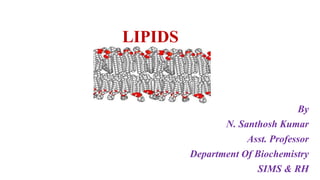
LIPIDS
By
N. Santhosh Kumar
Asst. Professor
Department Of Biochemistry
SIMS & RH
Def:
Lipids are organic substances that are insoluble in
water but soluble in organic solvents (chloroform, alcohol
, ether, benzene etc).
CLASSIFICATION
 BLOOR classification:
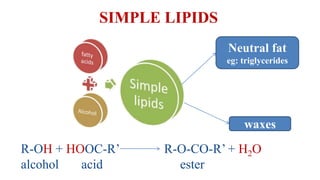
SIMPLE LIPIDS
Neutral fat
eg: triglycerides
waxes
R-OH + HOOC-R’ R-O-CO-R’ + H2O
alcohol acid ester
Fat & oils (triglycerides)
 Physically oil is a liquid while fat is a solid at room
temperature.
e.g: vegetable oils – Sun flower oil
Ground nut oil
Mustard oil
Corn oil etc.
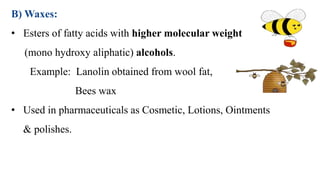
B) Waxes:
• Esters of fatty acids with higher molecular weight
(mono hydroxy aliphatic) alcohols.
Example: Lanolin obtained from wool fat,
Bees wax
• Used in pharmaceuticals as Cosmetic, Lotions, Ointments
& polishes.
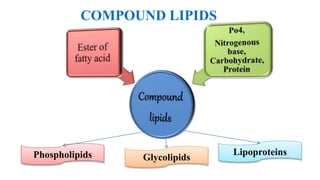
COMPOUND LIPIDS
Phospholipids Glycolipids
Lipoproteins
PHOSPHOLIPIDS
• Esters of fatty acids containing phosphate group,
nitrogenous bases and other substitution groups.
G
L
Y
C
E
R
O
L
FATTY ACID
FATTY ACID
Phosphate Nitrogenous Base
G
L
Y
C
E
R
O
P
H
O
S
P
H
O
L
I
P
I
D
S
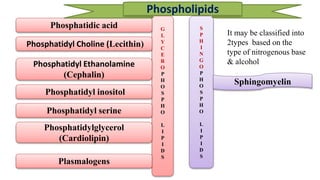
Phosphatidic acid
Phosphatidyl Choline (Lecithin)
Phosphatidyl Ethanolamine
(Cephalin)
Phosphatidyl inositol
Phosphatidyl serine
Plasmalogens
Phosphatidylglycerol
(Cardiolipin)
S
P
H
I
N
G
O
P
H
O
S
P
H
O
L
I
P
I
D
S
Sphingomyelin
Phospholipids
It may be classified into
2types based on the
type of nitrogenous base
& alcohol
GLYCOLIPIDS
• Lipids containing carbohydrates are referred as glycolipids
• Contain an alcohol [sphingosine (sphingol)] and nitrogenous
base, without phosphorous group.
Eg: Cerebrosides,Globosides & Gangliosides
LIPOPROTEINS
 Combination of lipids with a protein as prosthetic group
eg: serum lipoproteins :
III. DERIVED LIPIDS:
 Lipids obtained upon hydrolysis of the simple and complex
lipids.
Fatty acids
Alcohols: - Glycerol, Steroids
- Cholesterol & Vitamins A & D esters.
a) Fatty acid:
b) Alcohol:
• It is simple with hydroxyl (OH) group as functional group.
Simple straight chain alcohol - glycerol
Complex cyclic alcohols - cholesterol.
What is fatty acid
Examples for Essential FAs
Functions of Arachidonic acid
Silent features of Prostaglands
Functions of Prostaglands
Functions of Prostacyclins
Functions of thromboxanes
mono carboxylic acids containing a long hydro carbon
side chain.
- Poly unsaturated fatty acid
What is PUFA
- Linoleic, Linolenic, Arachidonic acid
- Precursor for Eicosanoids
vasodilators , Inhibits gastric secretions, Relax,
contract bronchial & tracheal musculatures
Leukotrienes (LTs) - Increases vascular permeability & immunological reactions
SIMPLE LIPIDS
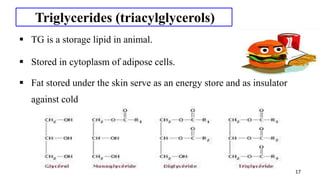
Triglycerides (triacylglycerols)
 TG is a storage lipid in animal.
 Stored in cytoplasm of adipose cells.
 Fat stored under the skin serve as an energy store and as insulator
against cold
 the skin serve as an energy store and as insulator against cold
17
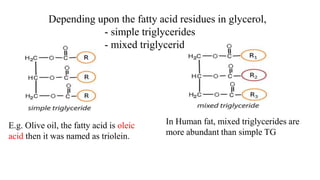
Depending upon the fatty acid residues in glycerol,
- simple triglycerides
- mixed triglycerides
E.g. Olive oil, the fatty acid is oleic
acid then it was named as triolein.
In Human fat, mixed triglycerides are
more abundant than simple TG
Properties of Triglycerides
Hydrolysis:
During digestion of fat in the GI tract .
20
Saponification:
 The hydrolysis of triacylglycerols by alkali to produce glycerol &
alkali salts of the FAs .
Triacylglycerol + 3 KOH Glycerol + 3 R- COOK (soaps)
• Soaps are good cleaning agents, germicides & detoxicants
Hydrogenation:
 It is chemical process
 to add more hydrogen to natural unsaturated fats to decrease the
number of double bonds, finally it converts to saturated fats.
 Used to convert liquid fats of plant origin to solid cooking fats –
hardening.
eg: Vanaspati (dalda) – obtained from vegetable oils
Rancidity
 The unpleasant smell and taste, developed by natural fats upon
prolonged storing.
 Caused by light, exposed to O2 & bacteria
 Due to hydrolysis or oxidation of fat
• When a fat is exposed to air, its unsaturated components are
converted into hydroperoxides.
• which break down into volatile aldehydes, esters, alcohols, and
hydrocarbons, leads to disagreeable odor.
Unsaturated fats are more susceptible to oxidative rancidity than
saturated fatty acids.
Lipid Peroxidation:
- Lipids undergo oxidation to produce peroxides & free radicals,
which can damage the tissues.
- The free radicals to cause inflammatory diseases, ageing,
atherosclerosis & cancer.
Antioxidants:
The substances which can prevent the occurrence of oxidative rancidity.
- Naturally occurring antioxidants
- Vitamin E (tocopherol)
- Beta-carotene (provit-A)
- Vit-C
- Food additives such as – Propyl gallate
- Butylated hydroxy anisole (BHA)
- Butylated hydroxy toluene ( BHT)
CHARACTERISATIO
N
OF
FATS & OILS
Adulteration of fats and oils is increasing day by day.
Several tests are employed in the laboratory to check the purity of fats
& oils.
• Iodine number
• Saponofication number
• Reichert-Meissl (RM) number
• Acid number
IODINE NUMBER
• The no of grams of iodine absorbed by 100g of fat.
• Iodine number directly proportional to the content of USFA.
• It is used to assess the degree of USFA of fat or oils
• It check the purity & nutritive value of fats & oils
Butter 25- 28
human fat 65- 70
Ground nut oil 85- 100
SAPONIFICATION NUMBER
• Number of mgs of KOH required to saponify one gram of fat or oil.
• It measure the average mol wt & chain length of the FAs present
• Saponification number is inversely proportional to Fat or Oil
Human fat 195-200
Butter 210-240
Coconut oil 250-260
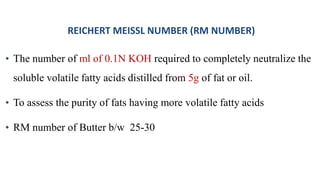
REICHERT MEISSL NUMBER (RM NUMBER)
• The number of ml of 0.1N KOH required to completely neutralize the
soluble volatile fatty acids distilled from 5g of fat or oil.
• To assess the purity of fats having more volatile fatty acids
• RM number of Butter b/w 25-30
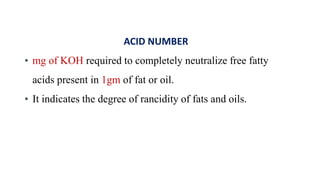
ACID NUMBER
• mg of KOH required to completely neutralize free fatty
acids present in 1gm of fat or oil.
• It indicates the degree of rancidity of fats and oils.
Next PPT
CL-03 Compound lipid- Phospholipids
Don’t compare yourself
with anyone in this world……
If you do so,
you are insulting yourself.
- Bill Gates
Thank your

CL- 02: Lipid classification & Simple lipids

  • 1.
    LIPIDS By N. Santhosh Kumar Asst.Professor Department Of Biochemistry SIMS & RH
  • 2.
    Def: Lipids are organicsubstances that are insoluble in water but soluble in organic solvents (chloroform, alcohol , ether, benzene etc).
  • 3.
  • 4.
  • 5.
    SIMPLE LIPIDS Neutral fat eg:triglycerides waxes R-OH + HOOC-R’ R-O-CO-R’ + H2O alcohol acid ester
  • 6.
    Fat & oils(triglycerides)  Physically oil is a liquid while fat is a solid at room temperature. e.g: vegetable oils – Sun flower oil Ground nut oil Mustard oil Corn oil etc.
  • 7.
    B) Waxes: • Estersof fatty acids with higher molecular weight (mono hydroxy aliphatic) alcohols. Example: Lanolin obtained from wool fat, Bees wax • Used in pharmaceuticals as Cosmetic, Lotions, Ointments & polishes.
  • 8.
  • 9.
    PHOSPHOLIPIDS • Esters offatty acids containing phosphate group, nitrogenous bases and other substitution groups. G L Y C E R O L FATTY ACID FATTY ACID Phosphate Nitrogenous Base
  • 10.
    G L Y C E R O P H O S P H O L I P I D S Phosphatidic acid Phosphatidyl Choline(Lecithin) Phosphatidyl Ethanolamine (Cephalin) Phosphatidyl inositol Phosphatidyl serine Plasmalogens Phosphatidylglycerol (Cardiolipin) S P H I N G O P H O S P H O L I P I D S Sphingomyelin Phospholipids It may be classified into 2types based on the type of nitrogenous base & alcohol
  • 11.
    GLYCOLIPIDS • Lipids containingcarbohydrates are referred as glycolipids • Contain an alcohol [sphingosine (sphingol)] and nitrogenous base, without phosphorous group. Eg: Cerebrosides,Globosides & Gangliosides
  • 12.
    LIPOPROTEINS  Combination oflipids with a protein as prosthetic group eg: serum lipoproteins :
  • 13.
    III. DERIVED LIPIDS: Lipids obtained upon hydrolysis of the simple and complex lipids. Fatty acids Alcohols: - Glycerol, Steroids - Cholesterol & Vitamins A & D esters.
  • 14.
    a) Fatty acid: b)Alcohol: • It is simple with hydroxyl (OH) group as functional group. Simple straight chain alcohol - glycerol Complex cyclic alcohols - cholesterol.
  • 15.
    What is fattyacid Examples for Essential FAs Functions of Arachidonic acid Silent features of Prostaglands Functions of Prostaglands Functions of Prostacyclins Functions of thromboxanes mono carboxylic acids containing a long hydro carbon side chain. - Poly unsaturated fatty acid What is PUFA - Linoleic, Linolenic, Arachidonic acid - Precursor for Eicosanoids vasodilators , Inhibits gastric secretions, Relax, contract bronchial & tracheal musculatures Leukotrienes (LTs) - Increases vascular permeability & immunological reactions
  • 16.
  • 17.
    Triglycerides (triacylglycerols)  TGis a storage lipid in animal.  Stored in cytoplasm of adipose cells.  Fat stored under the skin serve as an energy store and as insulator against cold  the skin serve as an energy store and as insulator against cold 17
  • 18.
    Depending upon thefatty acid residues in glycerol, - simple triglycerides - mixed triglycerides E.g. Olive oil, the fatty acid is oleic acid then it was named as triolein. In Human fat, mixed triglycerides are more abundant than simple TG
  • 19.
    Properties of Triglycerides Hydrolysis: Duringdigestion of fat in the GI tract . 20
  • 20.
    Saponification:  The hydrolysisof triacylglycerols by alkali to produce glycerol & alkali salts of the FAs . Triacylglycerol + 3 KOH Glycerol + 3 R- COOK (soaps) • Soaps are good cleaning agents, germicides & detoxicants
  • 21.
    Hydrogenation:  It ischemical process  to add more hydrogen to natural unsaturated fats to decrease the number of double bonds, finally it converts to saturated fats.  Used to convert liquid fats of plant origin to solid cooking fats – hardening. eg: Vanaspati (dalda) – obtained from vegetable oils
  • 22.
    Rancidity  The unpleasantsmell and taste, developed by natural fats upon prolonged storing.  Caused by light, exposed to O2 & bacteria  Due to hydrolysis or oxidation of fat • When a fat is exposed to air, its unsaturated components are converted into hydroperoxides. • which break down into volatile aldehydes, esters, alcohols, and hydrocarbons, leads to disagreeable odor.
  • 23.
    Unsaturated fats aremore susceptible to oxidative rancidity than saturated fatty acids. Lipid Peroxidation: - Lipids undergo oxidation to produce peroxides & free radicals, which can damage the tissues. - The free radicals to cause inflammatory diseases, ageing, atherosclerosis & cancer.
  • 24.
    Antioxidants: The substances whichcan prevent the occurrence of oxidative rancidity. - Naturally occurring antioxidants - Vitamin E (tocopherol) - Beta-carotene (provit-A) - Vit-C - Food additives such as – Propyl gallate - Butylated hydroxy anisole (BHA) - Butylated hydroxy toluene ( BHT)
  • 25.
  • 26.
    Adulteration of fatsand oils is increasing day by day. Several tests are employed in the laboratory to check the purity of fats & oils. • Iodine number • Saponofication number • Reichert-Meissl (RM) number • Acid number
  • 27.
    IODINE NUMBER • Theno of grams of iodine absorbed by 100g of fat. • Iodine number directly proportional to the content of USFA. • It is used to assess the degree of USFA of fat or oils • It check the purity & nutritive value of fats & oils Butter 25- 28 human fat 65- 70 Ground nut oil 85- 100
  • 28.
    SAPONIFICATION NUMBER • Numberof mgs of KOH required to saponify one gram of fat or oil. • It measure the average mol wt & chain length of the FAs present • Saponification number is inversely proportional to Fat or Oil Human fat 195-200 Butter 210-240 Coconut oil 250-260
  • 29.
    REICHERT MEISSL NUMBER(RM NUMBER) • The number of ml of 0.1N KOH required to completely neutralize the soluble volatile fatty acids distilled from 5g of fat or oil. • To assess the purity of fats having more volatile fatty acids • RM number of Butter b/w 25-30
  • 30.
    ACID NUMBER • mgof KOH required to completely neutralize free fatty acids present in 1gm of fat or oil. • It indicates the degree of rancidity of fats and oils.
  • 31.
    Next PPT CL-03 Compoundlipid- Phospholipids
  • 32.
    Don’t compare yourself withanyone in this world…… If you do so, you are insulting yourself. - Bill Gates Thank your