MONOPOLY
MEMBERS
Rucheer Goregaonkar 23
Sanket Gawali 37
Paresh Prabhulkar 19
Prajakta Mandhare 16
Manish Tiwari 51
Atul Palve 34
INTRODUCTION
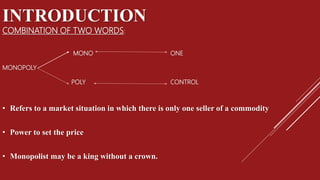
COMBINATION OF TWO WORDS:
MONO ONE
MONOPOLY
POLY CONTROL
• Refers to a market situation in which there is only one seller of a commodity
• Power to set the price
• Monopolist may be a king without a crown.
“ONE
MAN
RULE”
DEFINATION
Monopoly is a market situation in which there is a single seller. There are no close substitutes of
the commodity it produces, there are barriers to entry”. -Koutsoyiannis
Features of Monopoly
Single seller
No close substitute
Unique product
Price maker
Entry barrier
Eg. In Saudi Arabia the government has sole control over the oil industry
By branding, Copyrights, patents there can be no creation Perfect substitutes
EXISTENCE OF MONOPOLY
 True monopoly generally exists in government controlled markets
 E.g. Indian Railways
 Monopoly in private business is rare
 Private firms who have considerable market shares may enjoy
monopoly
 E.g. Microsoft, Intel, Google,
TYPES OF MONOPOLY
 PRIVATE MONOPOLY: -
The monopoly firm owned and operate by private
individuals is called the private monopoly. Their main
motive is to make profit.
 PUBLIC MONOPOLY: -
The monopoly firm owned and operated by public or state
government is called public monopoly Their main motive is to
provide welfare to the public.
 ABSOLUTE MONOPOLY: -
It is a type of monopoly, where a single seller controls the
entire supply of market without facing competition. It is
also known as pure monopoly.
 Discriminative monopoly:
When a monopoly firm changes different prices for the same goods
or services to different consumers it is known as discriminative
monopoly.
 Legal monopoly:
When a firms enjoys rights like trade mark, copy right, patent right, etc.
then it is known as legal monopoly. Such monopoly rights are approved by
the government.
 Natural monopoly:
When a firms enjoys monopoly right due to natural factors like location
reputation earned etc, it is called as natural monopoly.
 Technological monopoly:
When a firm enjoys monopoly power due to technical superiority
over other products in the market, then it is called as technological
monopoly.
ADVANTAGES AND DISADVANTAGES
Advantages
 Monopoly avoids duplication and hence
avoids wastage of resources
 A monopoly enjoys economies of scale of
product or services in market
 Sources of revenue for the government as
government gets revenue from of taxation
 Earning of huge profit led monopoly to
invest in R&D and provide us new product
Disadvantages
 Poor level of services
 Consumers may be charged high price for
low quality of goods
 Lack of competition may lead to low
quality and out dated goods and services
 Loss in R&D may force them to revert the
profit from consumer
APPLICATION OF MONOPOLY
 Example Indian railway
 Monopoly in its segment
 Government , is the only seller
 No close substitute for railway in market
 Barriers to entry in market(capital, requirement, technology)

Monopoly market

  • 1.
  • 2.
    MEMBERS Rucheer Goregaonkar 23 SanketGawali 37 Paresh Prabhulkar 19 Prajakta Mandhare 16 Manish Tiwari 51 Atul Palve 34
  • 3.
    INTRODUCTION COMBINATION OF TWOWORDS: MONO ONE MONOPOLY POLY CONTROL • Refers to a market situation in which there is only one seller of a commodity • Power to set the price • Monopolist may be a king without a crown.
  • 4.
  • 5.
    DEFINATION Monopoly is amarket situation in which there is a single seller. There are no close substitutes of the commodity it produces, there are barriers to entry”. -Koutsoyiannis Features of Monopoly Single seller No close substitute Unique product Price maker Entry barrier Eg. In Saudi Arabia the government has sole control over the oil industry By branding, Copyrights, patents there can be no creation Perfect substitutes
  • 6.
    EXISTENCE OF MONOPOLY True monopoly generally exists in government controlled markets  E.g. Indian Railways  Monopoly in private business is rare  Private firms who have considerable market shares may enjoy monopoly  E.g. Microsoft, Intel, Google,
  • 7.
    TYPES OF MONOPOLY PRIVATE MONOPOLY: - The monopoly firm owned and operate by private individuals is called the private monopoly. Their main motive is to make profit.  PUBLIC MONOPOLY: - The monopoly firm owned and operated by public or state government is called public monopoly Their main motive is to provide welfare to the public.  ABSOLUTE MONOPOLY: - It is a type of monopoly, where a single seller controls the entire supply of market without facing competition. It is also known as pure monopoly.
  • 8.
     Discriminative monopoly: Whena monopoly firm changes different prices for the same goods or services to different consumers it is known as discriminative monopoly.  Legal monopoly: When a firms enjoys rights like trade mark, copy right, patent right, etc. then it is known as legal monopoly. Such monopoly rights are approved by the government.  Natural monopoly: When a firms enjoys monopoly right due to natural factors like location reputation earned etc, it is called as natural monopoly.  Technological monopoly: When a firm enjoys monopoly power due to technical superiority over other products in the market, then it is called as technological monopoly.
  • 9.
    ADVANTAGES AND DISADVANTAGES Advantages Monopoly avoids duplication and hence avoids wastage of resources  A monopoly enjoys economies of scale of product or services in market  Sources of revenue for the government as government gets revenue from of taxation  Earning of huge profit led monopoly to invest in R&D and provide us new product Disadvantages  Poor level of services  Consumers may be charged high price for low quality of goods  Lack of competition may lead to low quality and out dated goods and services  Loss in R&D may force them to revert the profit from consumer
  • 10.
    APPLICATION OF MONOPOLY Example Indian railway  Monopoly in its segment  Government , is the only seller  No close substitute for railway in market  Barriers to entry in market(capital, requirement, technology)