Copyright©2004 South-Western
1515Monopoly
Copyright © 2004 South-Western
• While a competitive firm is a price taker, a
monopoly firm is a price maker.
Copyright © 2004 South-Western
• A firm is considered a monopoly if . . .
• it is the sole seller of its product.
• its product does not have close substitutes.
Copyright © 2004 South-Western
WHY MONOPOLIES ARISE
• The fundamental cause of monopoly is barriers
to entry.
Copyright © 2004 South-Western
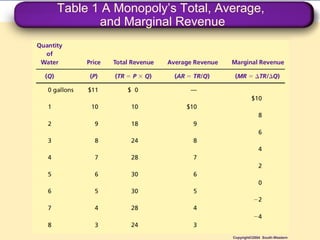
WHY MONOPOLIES ARISE
• Barriers to entry have three sources:
• Ownership of a key resource.
• The government gives a single firm the exclusive
right to produce some good.
• Costs of production make a single producer more
efficient than a large number of producers.
Copyright © 2004 South-Western
Monopoly Resources
• Although exclusive ownership of a key
resource is a potential source of monopoly, in
practice monopolies rarely arise for this reason.
Copyright © 2004 South-Western
Government-Created Monopolies
• Governments may restrict entry by giving a
single firm the exclusive right to sell a
particular good in certain markets.
Copyright © 2004 South-Western
Government-Created Monopolies
• Patent and copyright laws are two important
examples of how government creates a
monopoly to serve the public interest.
Copyright © 2004 South-Western
Natural Monopolies
• An industry is a natural monopoly when a
single firm can supply a good or service to an
entire market at a smaller cost than could two
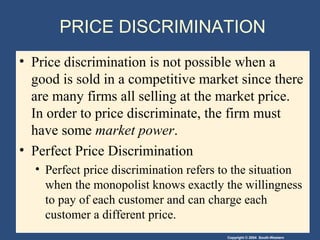
or more firms.
Copyright © 2004 South-Western
Natural Monopolies
• A natural monopoly arises when there are
economies of scale over the relevant range of
output.
Figure 1 Economies of Scale as a Cause of Monopoly
Copyright © 2004 South-Western
Quantity of Output
Average
total
cost
0
Cost
Copyright © 2004 South-Western
HOW MONOPOLIES MAKE PRODUCTION
AND PRICING DECISIONS
• Monopoly versus Competition
• Monopoly
• Is the sole producer
• Faces a downward-sloping demand curve
• Is a price maker
• Reduces price to increase sales
• Competitive Firm
• Is one of many producers
• Faces a horizontal demand curve
• Is a price taker
• Sells as much or as little at same price
Figure 2 Demand Curves for Competitive and Monopoly
Firms
Copyright © 2004 South-Western
Quantity of Output
Demand
(a) A Competitive Firm’s Demand Curve (b) A Monopolist’s Demand Curve
0
Price
Quantity of Output0
Price
Demand
Copyright © 2004 South-Western
A Monopoly’s Revenue
• Total Revenue
P × Q = TR
• Average Revenue
TR/Q = AR = P
• Marginal Revenue
∆TR/∆Q = MR
Table 1 A Monopoly’s Total, Average,
and Marginal Revenue
Copyright©2004 South-Western
Copyright © 2004 South-Western
A Monopoly’s Revenue
• A Monopoly’s Marginal Revenue
• A monopolist’s marginal revenue is always less
than the price of its good.
• The demand curve is downward sloping.
• When a monopoly drops the price to sell one more unit,
the revenue received from previously sold units also
decreases.
Copyright © 2004 South-Western
A Monopoly’s Revenue
• A Monopoly’s Marginal Revenue
• When a monopoly increases the amount it sells, it
has two effects on total revenue (P × Q).
• The output effect—more output is sold, so Q is higher.
• The price effect—price falls, so P is lower.
Figure 3 Demand and Marginal-Revenue Curves for a
Monopoly
Copyright © 2004 South-Western
Quantity of Water
Price
$11
10
9
8
7
6
5
4
3
2
1
0
–1
–2
–3
–4
Demand
(average
revenue)
Marginal
revenue
1 2 3 4 5 6 7 8
Copyright © 2004 South-Western
Profit Maximization
• A monopoly maximizes profit by producing the
quantity at which marginal revenue equals
marginal cost.
• It then uses the demand curve to find the price
that will induce consumers to buy that quantity.
Figure 4 Profit Maximization for a Monopoly
Copyright © 2004 South-Western
QuantityQ Q0
Costs and
Revenue
Demand
Average total cost
Marginal revenue
Marginal
cost
Monopoly
price
QMAX
B
1. The intersection of the
marginal-revenue curve
and the marginal-cost
curve determines the
profit-maximizing
quantity . . .
A
2. . . . and then the demand
curve shows the price
consistent with this quantity.
Copyright © 2004 South-Western
Profit Maximization
• Comparing Monopoly and Competition
• For a competitive firm, price equals marginal cost.
P = MR = MC
• For a monopoly firm, price exceeds marginal cost.
P > MR = MC
Copyright © 2004 South-Western
A Monopoly’s Profit
• Profit equals total revenue minus total costs.
• Profit = TR - TC
• Profit = (TR/Q - TC/Q) × Q
• Profit = (P - ATC) × Q
Figure 5 The Monopolist’s Profit
Copyright © 2004 South-Western
Monopoly
profit
Average
total
cost
Quantity
Monopoly
price
QMAX0
Costs and
Revenue
Demand
Marginal cost
Marginal revenue
Average total cost
B
C
E
D
Copyright © 2004 South-Western
A Monopolist’s Profit
• The monopolist will receive economic profits
as long as price is greater than average total
cost.
Figure 6 The Market for Drugs
Copyright © 2004 South-Western
Quantity0
Costs and
Revenue
DemandMarginal
revenue
Price
during
patent life
Monopoly
quantity
Price after
patent
expires
Marginal
cost
Competitive
quantity
Copyright © 2004 South-Western
THE WELFARE COST OF
MONOPOLY
• In contrast to a competitive firm, the monopoly
charges a price above the marginal cost.
• From the standpoint of consumers, this high
price makes monopoly undesirable.
• However, from the standpoint of the owners of
the firm, the high price makes monopoly very
desirable.
Figure 7 The Efficient Level of Output
Copyright © 2004 South-Western
Quantity0
Price
Demand
(value to buyers)
Marginal cost
Value to buyers
is greater than
cost to seller.
Value to buyers
is less than
cost to seller.
Cost
to
monopolist
Cost
to
monopolist
Value
to
buyers
Value
to
buyers
Efficient
quantity
Copyright © 2004 South-Western
The Deadweight Loss
• Because a monopoly sets its price above
marginal cost, it places a wedge between the
consumer’s willingness to pay and the
producer’s cost.
• This wedge causes the quantity sold to fall short of
the social optimum.
Figure 8 The Inefficiency of Monopoly
Copyright © 2004 South-Western
Quantity0
Price
Deadweight
loss
Demand
Marginal
revenue
Marginal cost
Efficient
quantity
Monopoly
price
Monopoly
quantity
Copyright © 2004 South-Western
The Deadweight Loss
• The Inefficiency of Monopoly
• The monopolist produces less than the socially
efficient quantity of output.
Copyright © 2004 South-Western
The Deadweight Loss
• The deadweight loss caused by a monopoly is
similar to the deadweight loss caused by a tax.
• The difference between the two cases is that the
government gets the revenue from a tax,
whereas a private firm gets the monopoly
profit.
Copyright © 2004 South-Western
PUBLIC POLICY TOWARD
MONOPOLIES
• Government responds to the problem of
monopoly in one of four ways.
• Making monopolized industries more competitive.
• Regulating the behavior of monopolies.
• Turning some private monopolies into public
enterprises.
• Doing nothing at all.
Copyright © 2004 South-Western
Increasing Competition with Antitrust Laws
• Antitrust laws are a collection of statutes aimed
at curbing monopoly power.
• Antitrust laws give government various ways to
promote competition.
• They allow government to prevent mergers.
• They allow government to break up companies.
• They prevent companies from performing activities
that make markets less competitive.
Copyright © 2004 South-Western
Increasing Competition with Antitrust Laws
• Two Important Antitrust Laws
• Sherman Antitrust Act (1890)
• Reduced the market power of the large and powerful
“trusts” of that time period.
• Clayton Act (1914)
• Strengthened the government’s powers and authorized
private lawsuits.
Copyright © 2004 South-Western
Regulation
• Government may regulate the prices that the
monopoly charges.
• The allocation of resources will be efficient if price
is set to equal marginal cost.
Figure 9 Marginal-Cost Pricing for a Natural Monopoly
Copyright © 2004 South-Western
Loss
Quantity0
Price
Demand
Average total cost
Regulated
price Marginal cost
Average total
cost
Copyright © 2004 South-Western
Regulation
• In practice, regulators will allow monopolists to
keep some of the benefits from lower costs in
the form of higher profit, a practice that
requires some departure from marginal-cost
pricing.
Copyright © 2004 South-Western
Public Ownership
• Rather than regulating a natural monopoly that
is run by a private firm, the government can run
the monopoly itself (e.g. in the United States,
the government runs the Postal Service).
Copyright © 2004 South-Western
Doing Nothing
• Government can do nothing at all if the market
failure is deemed small compared to the
imperfections of public policies.
Copyright © 2004 South-Western
PRICE DISCRIMINATION
• Price discrimination is the business practice of
selling the same good at different prices to
different customers, even though the costs for
producing for the two customers are the same.
Copyright © 2004 South-Western
PRICE DISCRIMINATION
• Price discrimination is not possible when a
good is sold in a competitive market since there
are many firms all selling at the market price.
In order to price discriminate, the firm must
have some market power.
• Perfect Price Discrimination
• Perfect price discrimination refers to the situation
when the monopolist knows exactly the willingness
to pay of each customer and can charge each
customer a different price.
Copyright © 2004 South-Western
PRICE DISCRIMINATION
• Two important effects of price discrimination:
• It can increase the monopolist’s profits.
• It can reduce deadweight loss.
Figure 10 Welfare with and without Price Discrimination
Copyright © 2004 South-Western
Profit
(a) Monopolist with Single Price
Price
0 Quantity
Deadweight
loss
DemandMarginal
revenue
Consumer
surplus
Quantity sold
Monopoly
price
Marginal cost
Figure 10 Welfare with and without Price Discrimination
Copyright © 2004 South-Western
Profit
(b) Monopolist with Perfect Price Discrimination
Price
0 Quantity
Demand
Marginal cost
Quantity sold
Copyright © 2004 South-Western
PRICE DISCRIMINATION
• Examples of Price Discrimination
• Movie tickets
• Airline prices
• Discount coupons
• Financial aid
• Quantity discounts
Copyright © 2004 South-Western
CONCLUSION: THE
PREVALENCE OF MONOPOLY
• How prevalent are the problems of monopolies?
• Monopolies are common.
• Most firms have some control over their prices
because of differentiated products.
• Firms with substantial monopoly power are rare.
• Few goods are truly unique.
Copyright © 2004 South-Western
Summary
• A monopoly is a firm that is the sole seller in its
market.
• It faces a downward-sloping demand curve for
its product.
• A monopoly’s marginal revenue is always
below the price of its good.
Copyright © 2004 South-Western
Summary
• Like a competitive firm, a monopoly maximizes
profit by producing the quantity at which
marginal cost and marginal revenue are equal.
• Unlike a competitive firm, its price exceeds its
marginal revenue, so its price exceeds marginal
cost.
Copyright © 2004 South-Western
Summary
• A monopolist’s profit-maximizing level of
output is below the level that maximizes the
sum of consumer and producer surplus.
• A monopoly causes deadweight losses similar
to the deadweight losses caused by taxes.
Copyright © 2004 South-Western
Summary
• Policymakers can respond to the inefficiencies
of monopoly behavior with antitrust laws,
regulation of prices, or by turning the
monopoly into a government-run enterprise.
• If the market failure is deemed small,
policymakers may decide to do nothing at all.
Copyright © 2004 South-Western
Summary
• Monopolists can raise their profits by charging
different prices to different buyers based on
their willingness to pay.
• Price discrimination can raise economic welfare
and lessen deadweight losses.

Monopoly

  • 1.
  • 2.
    Copyright © 2004South-Western • While a competitive firm is a price taker, a monopoly firm is a price maker.
  • 3.
    Copyright © 2004South-Western • A firm is considered a monopoly if . . . • it is the sole seller of its product. • its product does not have close substitutes.
  • 4.
    Copyright © 2004South-Western WHY MONOPOLIES ARISE • The fundamental cause of monopoly is barriers to entry.
  • 5.
    Copyright © 2004South-Western WHY MONOPOLIES ARISE • Barriers to entry have three sources: • Ownership of a key resource. • The government gives a single firm the exclusive right to produce some good. • Costs of production make a single producer more efficient than a large number of producers.
  • 6.
    Copyright © 2004South-Western Monopoly Resources • Although exclusive ownership of a key resource is a potential source of monopoly, in practice monopolies rarely arise for this reason.
  • 7.
    Copyright © 2004South-Western Government-Created Monopolies • Governments may restrict entry by giving a single firm the exclusive right to sell a particular good in certain markets.
  • 8.
    Copyright © 2004South-Western Government-Created Monopolies • Patent and copyright laws are two important examples of how government creates a monopoly to serve the public interest.
  • 9.
    Copyright © 2004South-Western Natural Monopolies • An industry is a natural monopoly when a single firm can supply a good or service to an entire market at a smaller cost than could two or more firms.
  • 10.
    Copyright © 2004South-Western Natural Monopolies • A natural monopoly arises when there are economies of scale over the relevant range of output.
  • 11.
    Figure 1 Economiesof Scale as a Cause of Monopoly Copyright © 2004 South-Western Quantity of Output Average total cost 0 Cost
  • 12.
    Copyright © 2004South-Western HOW MONOPOLIES MAKE PRODUCTION AND PRICING DECISIONS • Monopoly versus Competition • Monopoly • Is the sole producer • Faces a downward-sloping demand curve • Is a price maker • Reduces price to increase sales • Competitive Firm • Is one of many producers • Faces a horizontal demand curve • Is a price taker • Sells as much or as little at same price
  • 13.
    Figure 2 DemandCurves for Competitive and Monopoly Firms Copyright © 2004 South-Western Quantity of Output Demand (a) A Competitive Firm’s Demand Curve (b) A Monopolist’s Demand Curve 0 Price Quantity of Output0 Price Demand
  • 14.
    Copyright © 2004South-Western A Monopoly’s Revenue • Total Revenue P × Q = TR • Average Revenue TR/Q = AR = P • Marginal Revenue ∆TR/∆Q = MR
  • 15.
    Table 1 AMonopoly’s Total, Average, and Marginal Revenue Copyright©2004 South-Western
  • 16.
    Copyright © 2004South-Western A Monopoly’s Revenue • A Monopoly’s Marginal Revenue • A monopolist’s marginal revenue is always less than the price of its good. • The demand curve is downward sloping. • When a monopoly drops the price to sell one more unit, the revenue received from previously sold units also decreases.
  • 17.
    Copyright © 2004South-Western A Monopoly’s Revenue • A Monopoly’s Marginal Revenue • When a monopoly increases the amount it sells, it has two effects on total revenue (P × Q). • The output effect—more output is sold, so Q is higher. • The price effect—price falls, so P is lower.
  • 18.
    Figure 3 Demandand Marginal-Revenue Curves for a Monopoly Copyright © 2004 South-Western Quantity of Water Price $11 10 9 8 7 6 5 4 3 2 1 0 –1 –2 –3 –4 Demand (average revenue) Marginal revenue 1 2 3 4 5 6 7 8
  • 19.
    Copyright © 2004South-Western Profit Maximization • A monopoly maximizes profit by producing the quantity at which marginal revenue equals marginal cost. • It then uses the demand curve to find the price that will induce consumers to buy that quantity.
  • 20.
    Figure 4 ProfitMaximization for a Monopoly Copyright © 2004 South-Western QuantityQ Q0 Costs and Revenue Demand Average total cost Marginal revenue Marginal cost Monopoly price QMAX B 1. The intersection of the marginal-revenue curve and the marginal-cost curve determines the profit-maximizing quantity . . . A 2. . . . and then the demand curve shows the price consistent with this quantity.
  • 21.
    Copyright © 2004South-Western Profit Maximization • Comparing Monopoly and Competition • For a competitive firm, price equals marginal cost. P = MR = MC • For a monopoly firm, price exceeds marginal cost. P > MR = MC
  • 22.
    Copyright © 2004South-Western A Monopoly’s Profit • Profit equals total revenue minus total costs. • Profit = TR - TC • Profit = (TR/Q - TC/Q) × Q • Profit = (P - ATC) × Q
  • 23.
    Figure 5 TheMonopolist’s Profit Copyright © 2004 South-Western Monopoly profit Average total cost Quantity Monopoly price QMAX0 Costs and Revenue Demand Marginal cost Marginal revenue Average total cost B C E D
  • 24.
    Copyright © 2004South-Western A Monopolist’s Profit • The monopolist will receive economic profits as long as price is greater than average total cost.
  • 25.
    Figure 6 TheMarket for Drugs Copyright © 2004 South-Western Quantity0 Costs and Revenue DemandMarginal revenue Price during patent life Monopoly quantity Price after patent expires Marginal cost Competitive quantity
  • 26.
    Copyright © 2004South-Western THE WELFARE COST OF MONOPOLY • In contrast to a competitive firm, the monopoly charges a price above the marginal cost. • From the standpoint of consumers, this high price makes monopoly undesirable. • However, from the standpoint of the owners of the firm, the high price makes monopoly very desirable.
  • 27.
    Figure 7 TheEfficient Level of Output Copyright © 2004 South-Western Quantity0 Price Demand (value to buyers) Marginal cost Value to buyers is greater than cost to seller. Value to buyers is less than cost to seller. Cost to monopolist Cost to monopolist Value to buyers Value to buyers Efficient quantity
  • 28.
    Copyright © 2004South-Western The Deadweight Loss • Because a monopoly sets its price above marginal cost, it places a wedge between the consumer’s willingness to pay and the producer’s cost. • This wedge causes the quantity sold to fall short of the social optimum.
  • 29.
    Figure 8 TheInefficiency of Monopoly Copyright © 2004 South-Western Quantity0 Price Deadweight loss Demand Marginal revenue Marginal cost Efficient quantity Monopoly price Monopoly quantity
  • 30.
    Copyright © 2004South-Western The Deadweight Loss • The Inefficiency of Monopoly • The monopolist produces less than the socially efficient quantity of output.
  • 31.
    Copyright © 2004South-Western The Deadweight Loss • The deadweight loss caused by a monopoly is similar to the deadweight loss caused by a tax. • The difference between the two cases is that the government gets the revenue from a tax, whereas a private firm gets the monopoly profit.
  • 32.
    Copyright © 2004South-Western PUBLIC POLICY TOWARD MONOPOLIES • Government responds to the problem of monopoly in one of four ways. • Making monopolized industries more competitive. • Regulating the behavior of monopolies. • Turning some private monopolies into public enterprises. • Doing nothing at all.
  • 33.
    Copyright © 2004South-Western Increasing Competition with Antitrust Laws • Antitrust laws are a collection of statutes aimed at curbing monopoly power. • Antitrust laws give government various ways to promote competition. • They allow government to prevent mergers. • They allow government to break up companies. • They prevent companies from performing activities that make markets less competitive.
  • 34.
    Copyright © 2004South-Western Increasing Competition with Antitrust Laws • Two Important Antitrust Laws • Sherman Antitrust Act (1890) • Reduced the market power of the large and powerful “trusts” of that time period. • Clayton Act (1914) • Strengthened the government’s powers and authorized private lawsuits.
  • 35.
    Copyright © 2004South-Western Regulation • Government may regulate the prices that the monopoly charges. • The allocation of resources will be efficient if price is set to equal marginal cost.
  • 36.
    Figure 9 Marginal-CostPricing for a Natural Monopoly Copyright © 2004 South-Western Loss Quantity0 Price Demand Average total cost Regulated price Marginal cost Average total cost
  • 37.
    Copyright © 2004South-Western Regulation • In practice, regulators will allow monopolists to keep some of the benefits from lower costs in the form of higher profit, a practice that requires some departure from marginal-cost pricing.
  • 38.
    Copyright © 2004South-Western Public Ownership • Rather than regulating a natural monopoly that is run by a private firm, the government can run the monopoly itself (e.g. in the United States, the government runs the Postal Service).
  • 39.
    Copyright © 2004South-Western Doing Nothing • Government can do nothing at all if the market failure is deemed small compared to the imperfections of public policies.
  • 40.
    Copyright © 2004South-Western PRICE DISCRIMINATION • Price discrimination is the business practice of selling the same good at different prices to different customers, even though the costs for producing for the two customers are the same.
  • 41.
    Copyright © 2004South-Western PRICE DISCRIMINATION • Price discrimination is not possible when a good is sold in a competitive market since there are many firms all selling at the market price. In order to price discriminate, the firm must have some market power. • Perfect Price Discrimination • Perfect price discrimination refers to the situation when the monopolist knows exactly the willingness to pay of each customer and can charge each customer a different price.
  • 42.
    Copyright © 2004South-Western PRICE DISCRIMINATION • Two important effects of price discrimination: • It can increase the monopolist’s profits. • It can reduce deadweight loss.
  • 43.
    Figure 10 Welfarewith and without Price Discrimination Copyright © 2004 South-Western Profit (a) Monopolist with Single Price Price 0 Quantity Deadweight loss DemandMarginal revenue Consumer surplus Quantity sold Monopoly price Marginal cost
  • 44.
    Figure 10 Welfarewith and without Price Discrimination Copyright © 2004 South-Western Profit (b) Monopolist with Perfect Price Discrimination Price 0 Quantity Demand Marginal cost Quantity sold
  • 45.
    Copyright © 2004South-Western PRICE DISCRIMINATION • Examples of Price Discrimination • Movie tickets • Airline prices • Discount coupons • Financial aid • Quantity discounts
  • 46.
    Copyright © 2004South-Western CONCLUSION: THE PREVALENCE OF MONOPOLY • How prevalent are the problems of monopolies? • Monopolies are common. • Most firms have some control over their prices because of differentiated products. • Firms with substantial monopoly power are rare. • Few goods are truly unique.
  • 47.
    Copyright © 2004South-Western Summary • A monopoly is a firm that is the sole seller in its market. • It faces a downward-sloping demand curve for its product. • A monopoly’s marginal revenue is always below the price of its good.
  • 48.
    Copyright © 2004South-Western Summary • Like a competitive firm, a monopoly maximizes profit by producing the quantity at which marginal cost and marginal revenue are equal. • Unlike a competitive firm, its price exceeds its marginal revenue, so its price exceeds marginal cost.
  • 49.
    Copyright © 2004South-Western Summary • A monopolist’s profit-maximizing level of output is below the level that maximizes the sum of consumer and producer surplus. • A monopoly causes deadweight losses similar to the deadweight losses caused by taxes.
  • 50.
    Copyright © 2004South-Western Summary • Policymakers can respond to the inefficiencies of monopoly behavior with antitrust laws, regulation of prices, or by turning the monopoly into a government-run enterprise. • If the market failure is deemed small, policymakers may decide to do nothing at all.
  • 51.
    Copyright © 2004South-Western Summary • Monopolists can raise their profits by charging different prices to different buyers based on their willingness to pay. • Price discrimination can raise economic welfare and lessen deadweight losses.