MonopolyChapter 11-1 The market structure of Monopoly
What is a Monopoly?A monopoly is a market structure in which there is a single supplier of a product.The monopoly firm (monopolist):May be small or large.Must be the ONLY supplier of the product.Sells a product for which there are NO close substitutes. Monopolies are fairly common: U.S. Postal Service, local utility companies, local cable providers, etc.
IntroductionMonopoly is a market structure in which a single firm makes up the entire market.Monopolies exist because of barriers to entry into a market that prevent competition.
The Creation of MonopoliesMonopolies often arise as a result of barriers to entry.Barrier to entry: anything that impedes the ability of firms to begin a new business in an industry in which existing firms are earning positive economic profits. There are three general classes of barriers to entry:Natural barriers, the most common being economies of scaleActions by firms to keep other firms outGovernment (legal) barriers
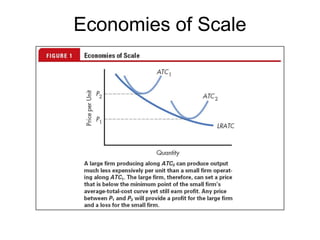
Economies of ScaleIn some industries, the larger the scale of production, the lower the costs of production.Entrants are not usually able to enter the market assured of or capable of a very large volume of production and sales.This gives incumbent firms a significant advantage.Examples are electric power companies and other similar utility providers.
Economies of Scale
Actions by FirmsEntry is barred when one firm owns an essential resource.Examples are inventions, discoveries, recipes, and specific materials.Microsoft owns Windows, and has been challenged by the U.S. Dept. of Justice as a monopolist.
GovernmentGovernments often provide barriers, creating monopolies.As incentives to innovation, governments often grant patents, providing firms with legal monopolies on their products or the use of their inventions or discoveries for a period of 17 years.
Not in your book but another way to  look at barriersLegal barriers, such as patents, prevent others from entering the market.Sociologicalbarriers–entry is prevented by custom or tradition.Natural barriers– the firm has a unique ability to produce what other firms can’t duplicate.Technological barriers – the size of the market can support only one firm.Types of MonopoliesNatural monopoly: A monopoly that arises from economies of scale. The economies of scale arise from natural supply and demand conditions, and not from government actions.Local monopoly: a monopoly that exists in a limited geographic area.Regulated monopoly: a monopoly firm whose behavior is overseen by a government entity.Monopoly power: market power, the power to set prices.Monopolization: an attempt by a firm to dominate a market or become a monopoly.
Regulated MonopoliesThe Florida Public Service Commission exercises regulatory authority over utilities in the state of Florida in one or more of three key areas: rate regulation; competitive market oversight; and monitoring of safety, reliability, and service.
Monopoly market structure

Monopoly market structure

  • 1.
    MonopolyChapter 11-1 Themarket structure of Monopoly
  • 2.
    What is aMonopoly?A monopoly is a market structure in which there is a single supplier of a product.The monopoly firm (monopolist):May be small or large.Must be the ONLY supplier of the product.Sells a product for which there are NO close substitutes. Monopolies are fairly common: U.S. Postal Service, local utility companies, local cable providers, etc.
  • 3.
    IntroductionMonopoly is amarket structure in which a single firm makes up the entire market.Monopolies exist because of barriers to entry into a market that prevent competition.
  • 4.
    The Creation ofMonopoliesMonopolies often arise as a result of barriers to entry.Barrier to entry: anything that impedes the ability of firms to begin a new business in an industry in which existing firms are earning positive economic profits. There are three general classes of barriers to entry:Natural barriers, the most common being economies of scaleActions by firms to keep other firms outGovernment (legal) barriers
  • 5.
    Economies of ScaleInsome industries, the larger the scale of production, the lower the costs of production.Entrants are not usually able to enter the market assured of or capable of a very large volume of production and sales.This gives incumbent firms a significant advantage.Examples are electric power companies and other similar utility providers.
  • 6.
  • 7.
    Actions by FirmsEntryis barred when one firm owns an essential resource.Examples are inventions, discoveries, recipes, and specific materials.Microsoft owns Windows, and has been challenged by the U.S. Dept. of Justice as a monopolist.
  • 8.
    GovernmentGovernments often providebarriers, creating monopolies.As incentives to innovation, governments often grant patents, providing firms with legal monopolies on their products or the use of their inventions or discoveries for a period of 17 years.
  • 9.
    Not in yourbook but another way to look at barriersLegal barriers, such as patents, prevent others from entering the market.Sociologicalbarriers–entry is prevented by custom or tradition.Natural barriers– the firm has a unique ability to produce what other firms can’t duplicate.Technological barriers – the size of the market can support only one firm.Types of MonopoliesNatural monopoly: A monopoly that arises from economies of scale. The economies of scale arise from natural supply and demand conditions, and not from government actions.Local monopoly: a monopoly that exists in a limited geographic area.Regulated monopoly: a monopoly firm whose behavior is overseen by a government entity.Monopoly power: market power, the power to set prices.Monopolization: an attempt by a firm to dominate a market or become a monopoly.
  • 10.
    Regulated MonopoliesThe FloridaPublic Service Commission exercises regulatory authority over utilities in the state of Florida in one or more of three key areas: rate regulation; competitive market oversight; and monitoring of safety, reliability, and service.