Group Activity

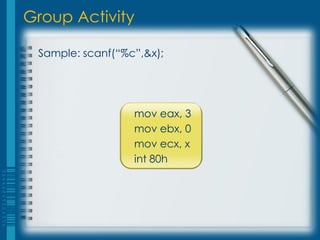
 Sample: scanf(“%c”,&x);


                  mov eax, 3
                  mov ebx, 0
                  mov ecx, x
                  int 80h
Group Activity

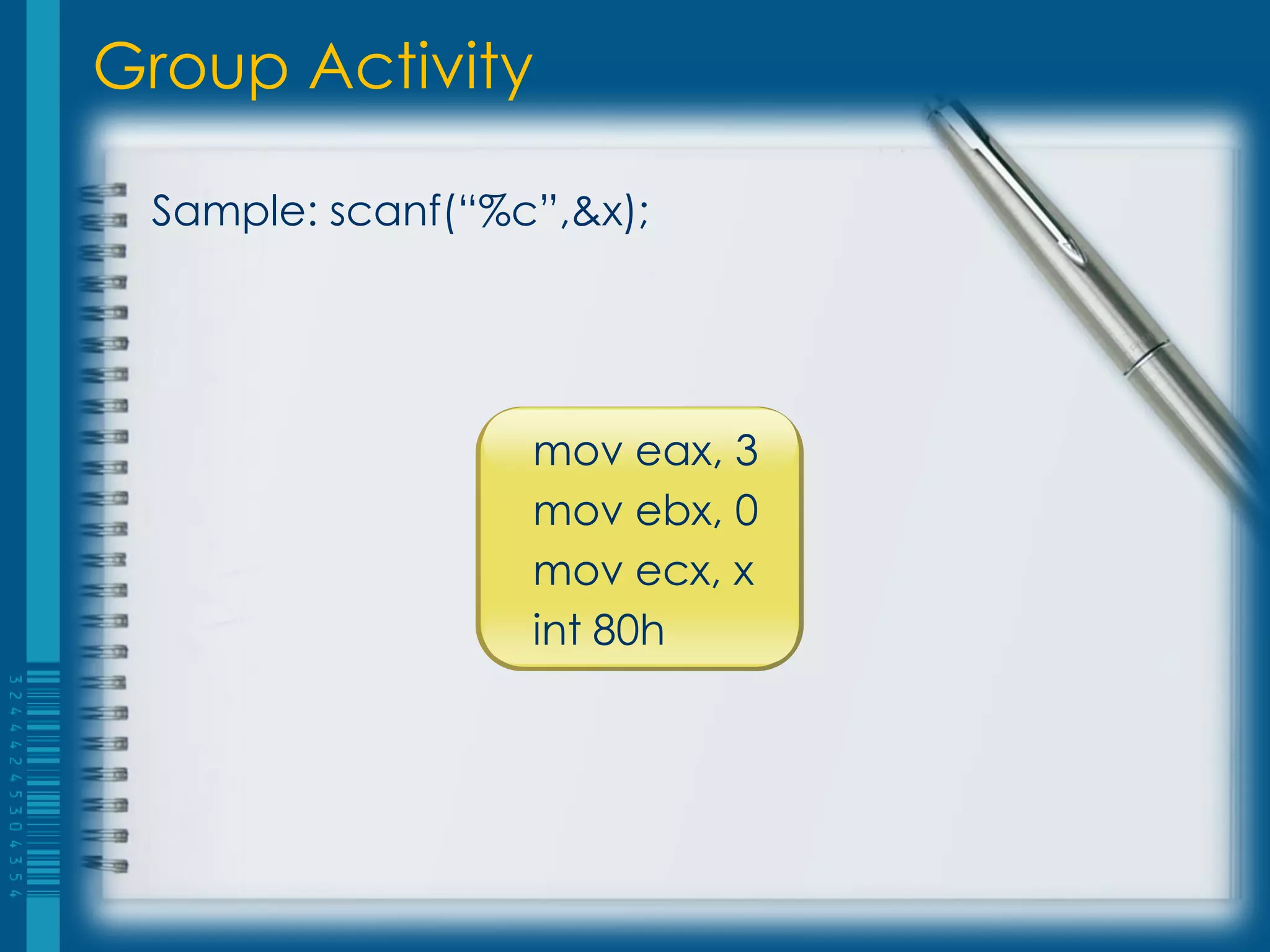
 1. printf(“%c”,x);

 2. sum = x + y;

 3. prod = x * y;

    (assume x and y are byte-size variables)
Group Activity

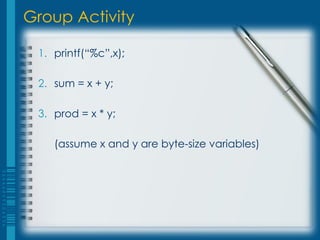
 1. printf(“%c”,x);


                  mov eax, 4
                  mov ebx, 1
                  mov ecx, x
                  mov edx, 1
                  int 80h
Group Activity

 2. sum = x + y;


                   mov bl, [x]
                   add bl, [y]
                   mov [sum], bl
Group Activity

 3. prod = x * y;


                    mov al, [x]
                    mul byte[y]
                    mov [prod], ax
Structured Assembly Language
Programming Techniques
Control Transfer Instructions
Objectives

 At the end of the discussion, the students
   should be able to:
  Implement selection statements in
   assembly
  Describe how unconditional jumps and
   conditional statements work
Control Transfer Instructions

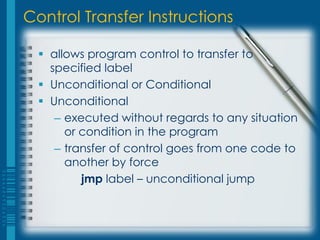
   allows program control to transfer to
    specified label
   Unconditional or Conditional
   Unconditional
     – executed without regards to any situation
       or condition in the program
     – transfer of control goes from one code to
       another by force
          jmp label – unconditional jump
Control Transfer Instructions


   mov al, 5       next:
   add [num1],al
                   mov eax, 4
   jmp next
                   mov ebx, 1
                   mov ecx, num2
   mov eax, 4      mov edx, 1
   mov ebx, 1      int 80h
   mov ecx, num1
   mov edx, 1
   int 80h
       (1)                 (2)
Control Transfer Instructions

   Conditional
    – a jump carried out on the basis of a
      truth value
    – the information on which such
      decisions are based is contained in
      the flags registers
Boolean Expressions

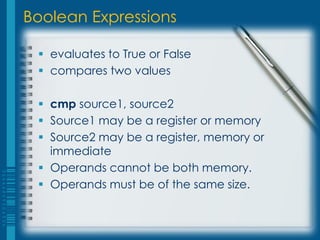
  evaluates to True or False
  compares two values

  cmp source1, source2
  Source1 may be a register or memory
  Source2 may be a register, memory or
   immediate
  Operands cannot be both memory.
  Operands must be of the same size.
Conditional Jumps

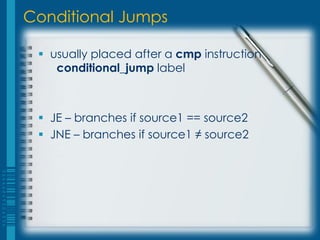
  usually placed after a cmp instruction
    conditional_jump label


  JE – branches if source1 == source2
  JNE – branches if source1 ≠ source2
Conditional Jumps

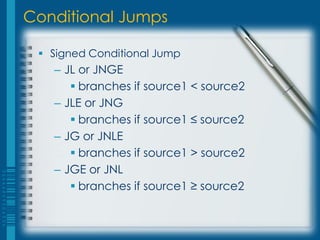
  Signed Conditional Jump
   – JL or JNGE
       branches if source1 < source2
   – JLE or JNG
       branches if source1 ≤ source2
   – JG or JNLE
       branches if source1 > source2
   – JGE or JNL
       branches if source1 ≥ source2
Conditional Jumps

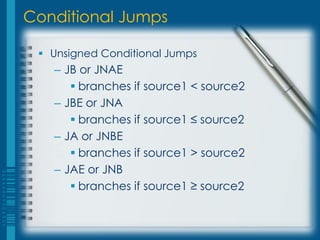
  Unsigned Conditional Jumps
   – JB or JNAE
       branches if source1 < source2
   – JBE or JNA
       branches if source1 ≤ source2
   – JA or JNBE
       branches if source1 > source2
   – JAE or JNB
       branches if source1 ≥ source2
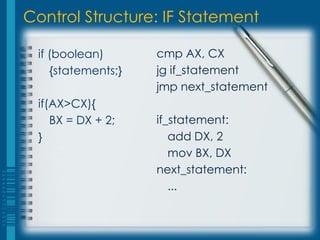
Control Structure: IF Statement

 if (boolean)       cmp AX, CX
    {statements;}   jg if_statement
                    jmp next_statement
 if(AX>CX){
    BX = DX + 2;    if_statement:
 }                     add DX, 2
                       mov BX, DX
                    next_statement:
                       ...

Chapter2a

  • 1.
    Group Activity Sample:scanf(“%c”,&x); mov eax, 3 mov ebx, 0 mov ecx, x int 80h
  • 2.
    Group Activity 1.printf(“%c”,x); 2. sum = x + y; 3. prod = x * y; (assume x and y are byte-size variables)
  • 3.
    Group Activity 1.printf(“%c”,x); mov eax, 4 mov ebx, 1 mov ecx, x mov edx, 1 int 80h
  • 4.
    Group Activity 2.sum = x + y; mov bl, [x] add bl, [y] mov [sum], bl
  • 5.
    Group Activity 3.prod = x * y; mov al, [x] mul byte[y] mov [prod], ax
  • 6.
    Structured Assembly Language ProgrammingTechniques Control Transfer Instructions
  • 7.
    Objectives At theend of the discussion, the students should be able to:  Implement selection statements in assembly  Describe how unconditional jumps and conditional statements work
  • 8.
    Control Transfer Instructions  allows program control to transfer to specified label  Unconditional or Conditional  Unconditional – executed without regards to any situation or condition in the program – transfer of control goes from one code to another by force jmp label – unconditional jump
  • 9.
    Control Transfer Instructions mov al, 5 next: add [num1],al mov eax, 4 jmp next mov ebx, 1 mov ecx, num2 mov eax, 4 mov edx, 1 mov ebx, 1 int 80h mov ecx, num1 mov edx, 1 int 80h (1) (2)
  • 10.
    Control Transfer Instructions  Conditional – a jump carried out on the basis of a truth value – the information on which such decisions are based is contained in the flags registers
  • 11.
    Boolean Expressions evaluates to True or False  compares two values  cmp source1, source2  Source1 may be a register or memory  Source2 may be a register, memory or immediate  Operands cannot be both memory.  Operands must be of the same size.
  • 12.
    Conditional Jumps usually placed after a cmp instruction conditional_jump label  JE – branches if source1 == source2  JNE – branches if source1 ≠ source2
  • 13.
    Conditional Jumps Signed Conditional Jump – JL or JNGE  branches if source1 < source2 – JLE or JNG  branches if source1 ≤ source2 – JG or JNLE  branches if source1 > source2 – JGE or JNL  branches if source1 ≥ source2
  • 14.
    Conditional Jumps Unsigned Conditional Jumps – JB or JNAE  branches if source1 < source2 – JBE or JNA  branches if source1 ≤ source2 – JA or JNBE  branches if source1 > source2 – JAE or JNB  branches if source1 ≥ source2
  • 15.
    Control Structure: IFStatement if (boolean) cmp AX, CX {statements;} jg if_statement jmp next_statement if(AX>CX){ BX = DX + 2; if_statement: } add DX, 2 mov BX, DX next_statement: ...