Computer Science 100
Web Programming


Web Programming in a Nutshell
Outline
●   The Web
●   Short History and Highlights
    –   Beginnings @ CERN
    –   The Browser Wars
    –   The W3C
    –   Web 1.0, Web 2.0 and Web 3.0
●   “Components” of Web Programming
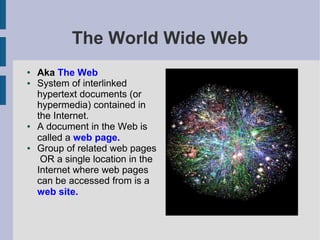
The World Wide Web
●   Aka The Web
●   System of interlinked
    hypertext documents (or
    hypermedia) contained in
    the Internet.
●   A document in the Web is
    called a web page.
●   Group of related web pages
     OR a single location in the
    Internet where web pages
    can be accessed from is a
    web site.
The World Wide Web: Web
                 Pages
●   A Web page may contain:
    –   Text
    –   Images
    –   Embedded objects: videos, audio, binaries (i.e.
        Java applets, Flash)
    –   Tables
    –   Hyperlinks
●   By default a web page is a page written
    using Hypertext Markup Language (HTML)
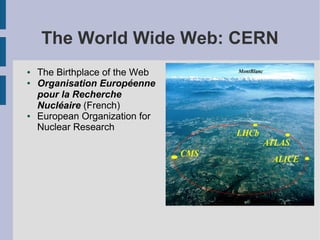
The World Wide Web: CERN
●   The Birthplace of the Web
●   Organisation Européenne
    pour la Recherche
    Nucléaire (French)
●   European Organization for
    Nuclear Research
The World Wide Web
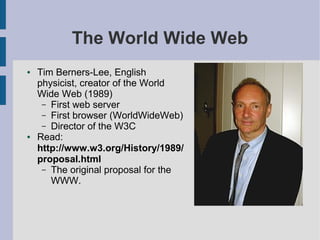
●   Tim Berners-Lee, English
    physicist, creator of the World
    Wide Web (1989)
     – First web server
     – First browser (WorldWideWeb)
     – Director of the W3C
●   Read:
    http://www.w3.org/History/1989/
    proposal.html
     – The original proposal for the
       WWW.
WWW Timeline
●   1989 The World Wide Web begins at CERN.
●   1990 Web server and web browser created.
●   Aug 6, 1991 Marked as the day the Web became a publicly
    available service.
●   1993 NCSA releases Mosaic a multiplatform web browser
    precursor to Netscape Navigator. Other browsers also
    released.
     – June 1993 – Stylesheets proposed for HTML
     – October 1993 CERN announces WWW would be free.
●   1994 Netscape Navigator, Opera browsers released.
●   1995 Internet Explorer released
     – Javascript integrated.
     – The First Browser War starts!
The Browser Wars
●   Metaphorical war, fight for
    market dominance of the
    popular web browsers.
●   The war in short:
     – 1st Browser War: IE
       wins over Netscape*
     – 2nd Browser War:
       Netscape releases
       source code (Firefox)
     – 2008-Present : Google
       etc., joins the fray.
The Browser Wars
●   Competition is always good.
●   Better browsers.
     – Web browsers are the web programmer's application
       user interface platforms.
●
    Negative side effects of the 1st Browser War
     – Each contender came out with their own “HTML tags”
       leading to the non-standardization of HTML.
The W3C
●   The World Wide Web Consortium
●   Founded October, 1994
●   Headed by Tim Berners-Lee
●   Develop standards for the Web
●   http://www.w3.org/
Other Highlights: The DotCom
      Bubble: Boom and Burst
●   From 1995 to 2001
●   Marked by the increase in Internet users (thanks to the
    web).
●   Increase in “Internet startups” (refered to as dot coms)
    offering services through the Internet (Web).
●   Triggered a mild economic repression in 2000.
Other Highlights: Web 1.0, 2.0
               and 3.0
●
    Web 2.0:
     – This “versioning” of the web is unofficial.
     – Associated with web applications which facilitate interactive
       information sharing, interoperability, user-centered design and
       collaboration.
     – Popularized in 2004 by Tim O'Reilly
     – Coined in 1999 by Darcy DiNucci in an article.
     – Allows users to run “software applications” via the web
       browser.
●   Web 1.0
     – Had to be coined because of the above.
●
    Web 3.0 Semantic Web
     – Advanced application of the WWW.
Your Assignment:
●   What are WEB APPLICATIONS?
    –   List down web applications that you use/have
        used/will use and their types. (at least 5)
    –   What do you need to create a web application?
    –   How is a web application different from a
        desktop application?

        Email your answers to
        uplbcmscexercises@gmail.com on or before
        Tuesday, November 22, 2011, 12:00 am. Use
        “CMSC 100 Web App Assign” as the subject of
        your email.

Cmsc 100 (web programming in a nutshell)

  • 1.
    Computer Science 100 WebProgramming Web Programming in a Nutshell
  • 2.
    Outline ● The Web ● Short History and Highlights – Beginnings @ CERN – The Browser Wars – The W3C – Web 1.0, Web 2.0 and Web 3.0 ● “Components” of Web Programming
  • 3.
    The World WideWeb ● Aka The Web ● System of interlinked hypertext documents (or hypermedia) contained in the Internet. ● A document in the Web is called a web page. ● Group of related web pages OR a single location in the Internet where web pages can be accessed from is a web site.
  • 4.
    The World WideWeb: Web Pages ● A Web page may contain: – Text – Images – Embedded objects: videos, audio, binaries (i.e. Java applets, Flash) – Tables – Hyperlinks ● By default a web page is a page written using Hypertext Markup Language (HTML)
  • 5.
    The World WideWeb: CERN ● The Birthplace of the Web ● Organisation Européenne pour la Recherche Nucléaire (French) ● European Organization for Nuclear Research
  • 6.
    The World WideWeb ● Tim Berners-Lee, English physicist, creator of the World Wide Web (1989) – First web server – First browser (WorldWideWeb) – Director of the W3C ● Read: http://www.w3.org/History/1989/ proposal.html – The original proposal for the WWW.
  • 7.
    WWW Timeline ● 1989 The World Wide Web begins at CERN. ● 1990 Web server and web browser created. ● Aug 6, 1991 Marked as the day the Web became a publicly available service. ● 1993 NCSA releases Mosaic a multiplatform web browser precursor to Netscape Navigator. Other browsers also released. – June 1993 – Stylesheets proposed for HTML – October 1993 CERN announces WWW would be free. ● 1994 Netscape Navigator, Opera browsers released. ● 1995 Internet Explorer released – Javascript integrated. – The First Browser War starts!
  • 8.
    The Browser Wars ● Metaphorical war, fight for market dominance of the popular web browsers. ● The war in short: – 1st Browser War: IE wins over Netscape* – 2nd Browser War: Netscape releases source code (Firefox) – 2008-Present : Google etc., joins the fray.
  • 9.
    The Browser Wars ● Competition is always good. ● Better browsers. – Web browsers are the web programmer's application user interface platforms. ● Negative side effects of the 1st Browser War – Each contender came out with their own “HTML tags” leading to the non-standardization of HTML.
  • 10.
    The W3C ● The World Wide Web Consortium ● Founded October, 1994 ● Headed by Tim Berners-Lee ● Develop standards for the Web ● http://www.w3.org/
  • 11.
    Other Highlights: TheDotCom Bubble: Boom and Burst ● From 1995 to 2001 ● Marked by the increase in Internet users (thanks to the web). ● Increase in “Internet startups” (refered to as dot coms) offering services through the Internet (Web). ● Triggered a mild economic repression in 2000.
  • 12.
    Other Highlights: Web1.0, 2.0 and 3.0 ● Web 2.0: – This “versioning” of the web is unofficial. – Associated with web applications which facilitate interactive information sharing, interoperability, user-centered design and collaboration. – Popularized in 2004 by Tim O'Reilly – Coined in 1999 by Darcy DiNucci in an article. – Allows users to run “software applications” via the web browser. ● Web 1.0 – Had to be coined because of the above. ● Web 3.0 Semantic Web – Advanced application of the WWW.
  • 13.
    Your Assignment: ● What are WEB APPLICATIONS? – List down web applications that you use/have used/will use and their types. (at least 5) – What do you need to create a web application? – How is a web application different from a desktop application? Email your answers to uplbcmscexercises@gmail.com on or before Tuesday, November 22, 2011, 12:00 am. Use “CMSC 100 Web App Assign” as the subject of your email.