Normative Theories of Ethics
Chapter 2
SUMMARY OF THE CHAPTER
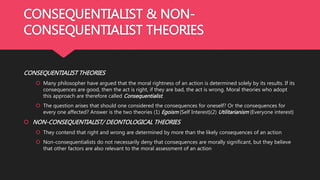
CONSEQUENTIALIST & NON-
CONSEQUENTIALIST THEORIES
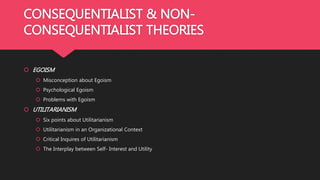
 EGOISM
 Misconception about Egoism
 Psychological Egoism
 Problems with Egoism
 UTILITARIANISM
 Six points about Utilitarianism
 Utilitarianism in an Organizational Context
 Critical Inquires of Utilitarianism
 The Interplay between Self- Interest and Utility
CONSEQUENTIALIST & NON-
CONSEQUENTIALIST THEORIES
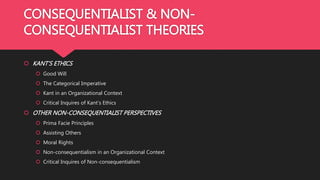
 KANT’S ETHICS
 Good Will
 The Categorical Imperative
 Kant in an Organizational Context
 Critical Inquires of Kant’s Ethics
 OTHER NON-CONSEQUENTIALIST PERSPECTIVES
 Prima Facie Principles
 Assisting Others
 Moral Rights
 Non-consequentialism in an Organizational Context
 Critical Inquires of Non-consequentialism
CONSEQUENTIALIST & NON-
CONSEQUENTIALIST THEORIES
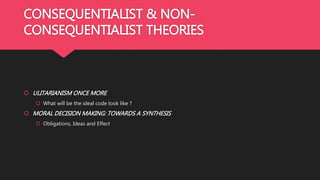
 ULITARIANISM ONCE MORE
 What will be the ideal code look like ?
 MORAL DECISION MAKING: TOWARDS A SYNTHESIS
 Obligations, Ideas and Effect
CONSEQUENTIALIST & NON-
CONSEQUENTIALIST THEORIES
 Many philosopher have argued that the moral rightness of an action is determined solely by its results. If its
consequences are good, then the act is right, if they are bad, the act is wrong. Moral theories who adopt
this approach are therefore called Consequentialist.
 The question arises that should one considered the consequences for oneself? Or the consequences for
every one affected? Answer is the two theories (1) Egoism {Self Interest}(2) Utilitarianism {Everyone interest}
 NON-CONSEQUENTIALIST/ DEONTOLOGICAL THEORIES
 They contend that right and wrong are determined by more than the likely consequences of an action
 Non-consequentialists do not necessarily deny that consequences are morally significant, but they believe
that other factors are also relevant to the moral assessment of an action
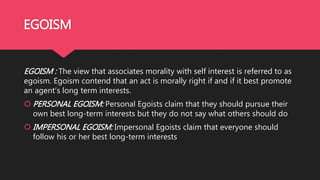
EGOISM
EGOISM : The view that associates morality with self interest is referred to as
egoism. Egoism contend that an act is morally right if and if it best promote
an agent’s long term interests.
 PERSONAL EGOISM: Personal Egoists claim that they should pursue their
own best long-term interests but they do not say what others should do
 IMPERSONAL EGOISM: Impersonal Egoists claim that everyone should
follow his or her best long-term interests
EGOISM
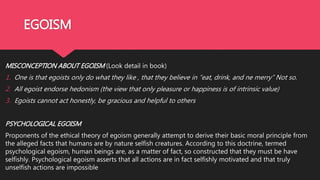
MISCONCEPTION ABOUT EGOISM (Look detail in book)
1. One is that egoists only do what they like , that they believe in “eat, drink, and ne merry” Not so.
2. All egoist endorse hedonism (the view that only pleasure or happiness is of intrinsic value)
3. Egoists cannot act honestly, be gracious and helpful to others
PSYCHOLOGICAL EGOISM
Proponents of the ethical theory of egoism generally attempt to derive their basic moral principle from
the alleged facts that humans are by nature selfish creatures. According to this doctrine, termed
psychological egoism, human beings are, as a matter of fact, so constructed that they must be have
selfishly. Psychological egoism asserts that all actions are in fact selfishly motivated and that truly
unselfish actions are impossible
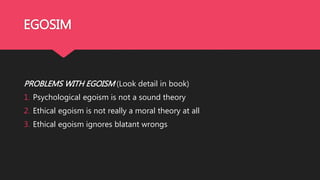
EGOSIM
PROBLEMS WITH EGOISM (Look detail in book)
1. Psychological egoism is not a sound theory
2. Ethical egoism is not really a moral theory at all
3. Ethical egoism ignores blatant wrongs
UTILITARIANISM
UTILITARIANISM is the moral doctrine that we should always act to produce the
greatest possible balance of good over bad for everyone affected by our
action.
CRITICAL INQUIRES OF UTILITARIANISM
1. Is utilitarianism really workable?
2. Are some actions wrong, even if they produce good?
3. Is utilitarianism unjust?
UTILITARIANISM
The Interplay Between Self – Interest and Utility
 Both self-interest and utility play important roles in organizational decisions,
and the views of many businesspeople blend these 2 theories. To the extent
that each business pursues its own interests and each businessperson tries
to maximize personal success, business practice can be called egoistic. But
business practice is also utilitarian in that pursuing self-interest is thought to
maximize the total good, and playing by the established rules of the
competitive game is seen as advancing the good of society as a whole
KANT’S ETHICS
 German philosopher Immanuel Kant sought moral principles that do not rest
on contingencies and that define actions as inherently right or wrong apart
from any particular circumstances. He believed that moral rules can, in
principle, be known as a result of reason alone and are not based on
observation.
 “The basis of obligation must not be sought in human nature, nor in the
circumstance of the world.” – Kant
 Moral reasoning is not based on factual knowledge and that reason by itself can reveal the
basic principle of morality.
KANT’S ETHICS
GOOD WILL
 According to Kant, nothing is good in itself except a good will. This does not mean that intelligence,
courage, self-control, health, happiness, and other things are not good and desirable. But Kant believed
that their goodness depends on the will that makes use of them.
 By will Kant meant the uniquely human capacity to act from principle.
THE CATAGORICAL IMPERATIVE
The categorical imperative is the central philosophical concept in the deontological moral philosophy of
Immanuel Kant. Introduced in Kant's 1785 Grounding for the Metaphysics of Morals, it may be defined as a
way of evaluating motivations for action.
 Kant believed that reason alone can yield a moral law. We need not rely on empirical evidence relating to
consequences and to similar situations.
 Kant’s categorical imperative says that we should act in such a way that we can will the maxim of our action
to become a universal law.
KANT’S ETHICS
KANT IN AN ORGANIZATIONAL CONTEXT
 The categorical imperative gives us firm rules to follow in moral decision making, rules that do not
depend on circumstances or results and that do not permit individual exceptions.
 One of the principal objections to egoism and utilitarianism is that they permit us to treat humans
as means to ends. Kant’s principles clearly forbid this.
 Kant stresses the importance of motivation and of acting on principle. According to Kant, it is not
enough just to do the right thing; an action has moral worth only if it is done from a sense of duty –
that is, from a desire to do the right thing for its own sake
KANT’S ETHICS
CRITICAL INQUIRES OF KANT’S ETHICS (Look detail in book)
 What has moral worth?
 Is the categorical imperative an adequate test of right?
 What does it mean to treat people as means?
PRIMA FACIA PRINCIPLES
 Philosophers like W.D. Ross believe that most, or even all, of our moral obligations are prima facie ones. A
prima facie obligation is simply an obligation that can be over-ridden by a more important obligation.
 Ross thought that the various prima facie obligations could be divided into seven basic types.
PRIMA FACIA OBLIGATIONS
Duties of Fidelity(Loyalty) Duties of Reparation(Compensation, Repayment)
Duties of Gratitude(Thanks, Appreciation) Duties of Justice(equity, fair play)
Duties of Beneficence(charity, mercy) Duties Not to Injure Others (Not to harm)
Duties of Self-Improvement(improve one’s knowledge, character or status)
ASSISTING OTHER
 Most non-utilitarian philosophers believe that we have some obligation to
promote the general welfare, but they typically view this obligation as less
stringent than, for example, the obligation not to injure people. They see us as
having a much stronger obligation to refrain from violating people’s rights
than to promote their happiness or well-being.
 Many moral philosophers draw a related distinction between actions that we
are morally required to take and charitable or supererogatory acts – that is,
actions that would be good to take but not immoral not to take.
MORAL RIGHTS
 A right is an entitlement to act or have others act in a certain way. The
connection between rights and duties is that, generally speaking, if you
have a right to do something, then someone else has a correlative duty to
act in a certain way.
 Moral rights are noneconomic rights that are considered to be the
inalienable rights of the creators of works.
NON CONSEQUENTIALISM IN AN
ORGANISATIONAL CONTEXT
 NC stresses that moral decision making involves the weighing of different
moral factors and considerations
 NC acknowledges that the organization has its own legitimate goals to
pursue.
 NC stresses the importance of moral rights
CRITICAL INQUIRES OF NON
CONSEQUESTIALISM
 How well justified are these non consequentialist principles and moral
rights?
 Can non consequentialists satisfactorily handle conflicting rights and
principles?
MORAL DECISION MAKING: TOWARD A
SYNTHESIS
 Theoretical controversies permeate the subject of ethics, and philosophers have
proposed rival ways of understanding right and wrong. These philosophical
differences of perspective, emphasis, and theory are significant and can have
profound practical consequences
 In any moral discussion, make sure participants agree about the relevant facts
 Once there is general agreement on factual matters, try to spell out the moral
principles to which different people are, at least implicitly, appealing

Chapter # 2

  • 1.
    Normative Theories ofEthics Chapter 2
  • 2.
  • 3.
    CONSEQUENTIALIST & NON- CONSEQUENTIALISTTHEORIES  EGOISM  Misconception about Egoism  Psychological Egoism  Problems with Egoism  UTILITARIANISM  Six points about Utilitarianism  Utilitarianism in an Organizational Context  Critical Inquires of Utilitarianism  The Interplay between Self- Interest and Utility
  • 4.
    CONSEQUENTIALIST & NON- CONSEQUENTIALISTTHEORIES  KANT’S ETHICS  Good Will  The Categorical Imperative  Kant in an Organizational Context  Critical Inquires of Kant’s Ethics  OTHER NON-CONSEQUENTIALIST PERSPECTIVES  Prima Facie Principles  Assisting Others  Moral Rights  Non-consequentialism in an Organizational Context  Critical Inquires of Non-consequentialism
  • 5.
    CONSEQUENTIALIST & NON- CONSEQUENTIALISTTHEORIES  ULITARIANISM ONCE MORE  What will be the ideal code look like ?  MORAL DECISION MAKING: TOWARDS A SYNTHESIS  Obligations, Ideas and Effect
  • 6.
    CONSEQUENTIALIST & NON- CONSEQUENTIALISTTHEORIES CONSEQUENTIALIST THEORIES  Many philosopher have argued that the moral rightness of an action is determined solely by its results. If its consequences are good, then the act is right, if they are bad, the act is wrong. Moral theories who adopt this approach are therefore called Consequentialist.  The question arises that should one considered the consequences for oneself? Or the consequences for every one affected? Answer is the two theories (1) Egoism {Self Interest}(2) Utilitarianism {Everyone interest}  NON-CONSEQUENTIALIST/ DEONTOLOGICAL THEORIES  They contend that right and wrong are determined by more than the likely consequences of an action  Non-consequentialists do not necessarily deny that consequences are morally significant, but they believe that other factors are also relevant to the moral assessment of an action
  • 7.
    EGOISM EGOISM : Theview that associates morality with self interest is referred to as egoism. Egoism contend that an act is morally right if and if it best promote an agent’s long term interests.  PERSONAL EGOISM: Personal Egoists claim that they should pursue their own best long-term interests but they do not say what others should do  IMPERSONAL EGOISM: Impersonal Egoists claim that everyone should follow his or her best long-term interests
  • 8.
    EGOISM MISCONCEPTION ABOUT EGOISM(Look detail in book) 1. One is that egoists only do what they like , that they believe in “eat, drink, and ne merry” Not so. 2. All egoist endorse hedonism (the view that only pleasure or happiness is of intrinsic value) 3. Egoists cannot act honestly, be gracious and helpful to others PSYCHOLOGICAL EGOISM Proponents of the ethical theory of egoism generally attempt to derive their basic moral principle from the alleged facts that humans are by nature selfish creatures. According to this doctrine, termed psychological egoism, human beings are, as a matter of fact, so constructed that they must be have selfishly. Psychological egoism asserts that all actions are in fact selfishly motivated and that truly unselfish actions are impossible
  • 9.
    EGOSIM PROBLEMS WITH EGOISM(Look detail in book) 1. Psychological egoism is not a sound theory 2. Ethical egoism is not really a moral theory at all 3. Ethical egoism ignores blatant wrongs
  • 10.
    UTILITARIANISM UTILITARIANISM is themoral doctrine that we should always act to produce the greatest possible balance of good over bad for everyone affected by our action. CRITICAL INQUIRES OF UTILITARIANISM 1. Is utilitarianism really workable? 2. Are some actions wrong, even if they produce good? 3. Is utilitarianism unjust?
  • 11.
    UTILITARIANISM The Interplay BetweenSelf – Interest and Utility  Both self-interest and utility play important roles in organizational decisions, and the views of many businesspeople blend these 2 theories. To the extent that each business pursues its own interests and each businessperson tries to maximize personal success, business practice can be called egoistic. But business practice is also utilitarian in that pursuing self-interest is thought to maximize the total good, and playing by the established rules of the competitive game is seen as advancing the good of society as a whole
  • 12.
    KANT’S ETHICS  Germanphilosopher Immanuel Kant sought moral principles that do not rest on contingencies and that define actions as inherently right or wrong apart from any particular circumstances. He believed that moral rules can, in principle, be known as a result of reason alone and are not based on observation.  “The basis of obligation must not be sought in human nature, nor in the circumstance of the world.” – Kant  Moral reasoning is not based on factual knowledge and that reason by itself can reveal the basic principle of morality.
  • 13.
    KANT’S ETHICS GOOD WILL According to Kant, nothing is good in itself except a good will. This does not mean that intelligence, courage, self-control, health, happiness, and other things are not good and desirable. But Kant believed that their goodness depends on the will that makes use of them.  By will Kant meant the uniquely human capacity to act from principle. THE CATAGORICAL IMPERATIVE The categorical imperative is the central philosophical concept in the deontological moral philosophy of Immanuel Kant. Introduced in Kant's 1785 Grounding for the Metaphysics of Morals, it may be defined as a way of evaluating motivations for action.  Kant believed that reason alone can yield a moral law. We need not rely on empirical evidence relating to consequences and to similar situations.  Kant’s categorical imperative says that we should act in such a way that we can will the maxim of our action to become a universal law.
  • 14.
    KANT’S ETHICS KANT INAN ORGANIZATIONAL CONTEXT  The categorical imperative gives us firm rules to follow in moral decision making, rules that do not depend on circumstances or results and that do not permit individual exceptions.  One of the principal objections to egoism and utilitarianism is that they permit us to treat humans as means to ends. Kant’s principles clearly forbid this.  Kant stresses the importance of motivation and of acting on principle. According to Kant, it is not enough just to do the right thing; an action has moral worth only if it is done from a sense of duty – that is, from a desire to do the right thing for its own sake
  • 15.
    KANT’S ETHICS CRITICAL INQUIRESOF KANT’S ETHICS (Look detail in book)  What has moral worth?  Is the categorical imperative an adequate test of right?  What does it mean to treat people as means?
  • 16.
    PRIMA FACIA PRINCIPLES Philosophers like W.D. Ross believe that most, or even all, of our moral obligations are prima facie ones. A prima facie obligation is simply an obligation that can be over-ridden by a more important obligation.  Ross thought that the various prima facie obligations could be divided into seven basic types. PRIMA FACIA OBLIGATIONS Duties of Fidelity(Loyalty) Duties of Reparation(Compensation, Repayment) Duties of Gratitude(Thanks, Appreciation) Duties of Justice(equity, fair play) Duties of Beneficence(charity, mercy) Duties Not to Injure Others (Not to harm) Duties of Self-Improvement(improve one’s knowledge, character or status)
  • 17.
    ASSISTING OTHER  Mostnon-utilitarian philosophers believe that we have some obligation to promote the general welfare, but they typically view this obligation as less stringent than, for example, the obligation not to injure people. They see us as having a much stronger obligation to refrain from violating people’s rights than to promote their happiness or well-being.  Many moral philosophers draw a related distinction between actions that we are morally required to take and charitable or supererogatory acts – that is, actions that would be good to take but not immoral not to take.
  • 18.
    MORAL RIGHTS  Aright is an entitlement to act or have others act in a certain way. The connection between rights and duties is that, generally speaking, if you have a right to do something, then someone else has a correlative duty to act in a certain way.  Moral rights are noneconomic rights that are considered to be the inalienable rights of the creators of works.
  • 19.
    NON CONSEQUENTIALISM INAN ORGANISATIONAL CONTEXT  NC stresses that moral decision making involves the weighing of different moral factors and considerations  NC acknowledges that the organization has its own legitimate goals to pursue.  NC stresses the importance of moral rights
  • 20.
    CRITICAL INQUIRES OFNON CONSEQUESTIALISM  How well justified are these non consequentialist principles and moral rights?  Can non consequentialists satisfactorily handle conflicting rights and principles?
  • 21.
    MORAL DECISION MAKING:TOWARD A SYNTHESIS  Theoretical controversies permeate the subject of ethics, and philosophers have proposed rival ways of understanding right and wrong. These philosophical differences of perspective, emphasis, and theory are significant and can have profound practical consequences  In any moral discussion, make sure participants agree about the relevant facts  Once there is general agreement on factual matters, try to spell out the moral principles to which different people are, at least implicitly, appealing

Editor's Notes

  • #4 Consequence: نتیجہ
  • #8 “Agent” can be refer to a single person or to a particular group or organisation
  • #9 Hedonism is a school of thought that argues that pleasure is the primary or most important intrinsic good. A hedonist strives to maximize net pleasure (pleasure minus pain). Proponents: who advocates the theory Intrinsic: Naturally
  • #14 Empirical evidence, also known as sense experience, is a collective term for the knowledge or source of knowledge acquired by means of the senses, particularly by observation and experimentation
  • #17 PRIMA FACIA: Prima facie. Latin for "at first sight." Prima facie may be used as an adjective meaning "sufficient to establish a fact or raise a presumption unless disproved or rebutted;" e.g., prima facie evidence OBLIGATIONS: an act or course of action to which a person is morally or legally bound; a duty or commitment PRIMA FACIA OBLIGATIONS: A prima facie duty is a duty that is binding (obligatory) other things equal, that is, unless it is overridden or trumped by another duty or duties. Another way of putting it is that where there is a prima facie duty to do something, there is at least a fairly strong presumption in favor of doing it.